By Daniel Brouse
Economist & Climatologist
Membrane Domain USA
August 10, 2026
I’m not certain what the future holds. I don’t think anyone can be.
But I’m also not convinced that the future of fossil fuels can be projected simply by looking at today’s production levels and assuming they will continue indefinitely.
There is a very real possibility that economics, energy security, technological substitution, and even economic disruption could phase out fossil fuels much faster than most people expect.
In fact, some of the data already point in that direction.
The Energy Transition Is Already Moving
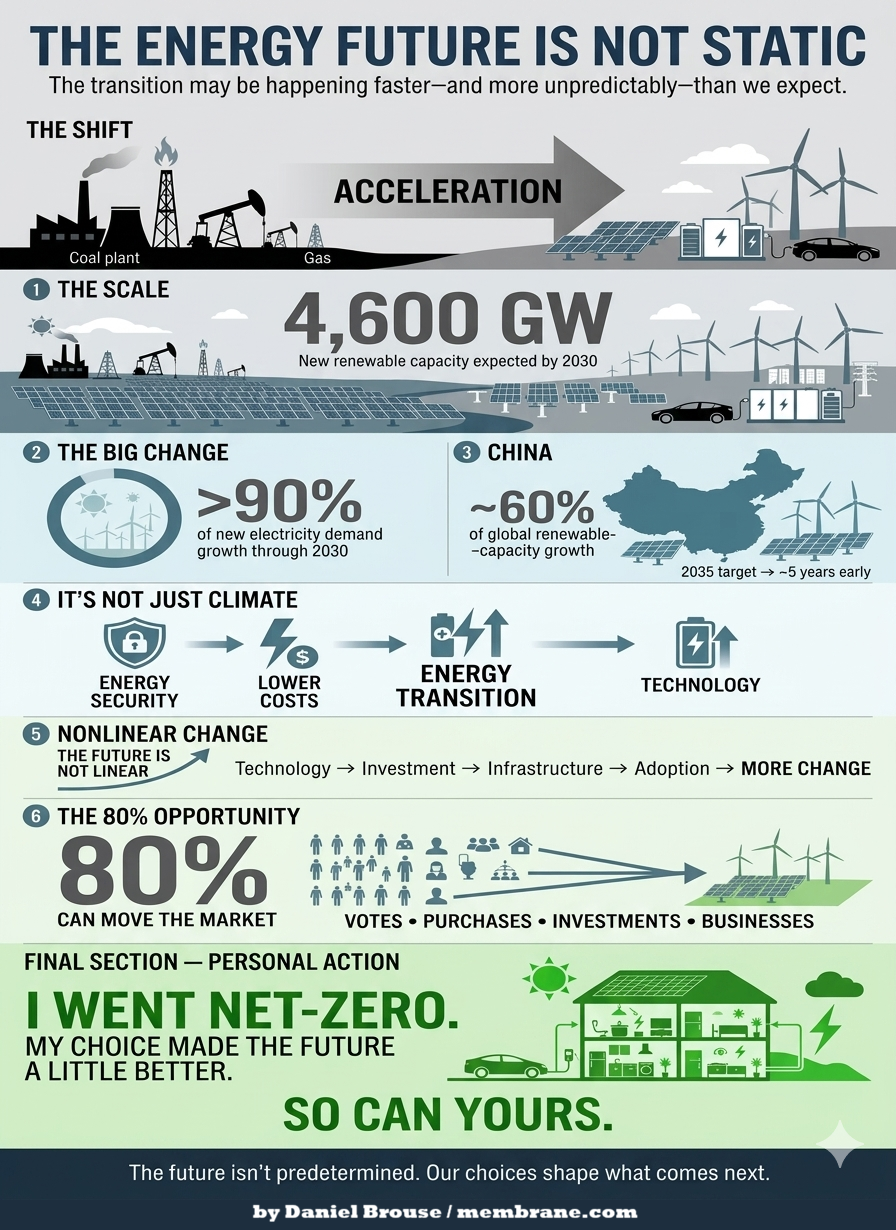
The International Energy Agency estimates that global renewable capacity will increase by roughly 4,600 GW between 2025 and 2030—an extraordinary expansion roughly equivalent to the combined current power capacity of China, the European Union, and Japan.
Solar PV is expected to account for almost 80% of that expansion.
Even more significant is what this means for the growth of electricity demand. Renewables are expected to provide more than 90% of the increase in global electricity generation through 2030.
This is not simply a distant prediction about some hypothetical future energy system. It represents an enormous investment already underway.
And the transition is happening particularly rapidly in China.
China is now responsible for nearly 60% of global renewable-capacity growth. In 2025 alone, it added roughly 314 GW of solar capacity and is on track to reach its 2035 wind-and-solar target approximately five years early.
Whatever one’s views on climate policy, these numbers are difficult to dismiss.
The global energy system is changing.
And it is changing rapidly.
This Isn’t Just About Climate Policy
There is another factor that deserves considerably more attention: energy security.
The transition away from fossil fuels is not being driven exclusively by environmental concerns. Increasingly, it is also becoming an economic and strategic imperative.
The disruption of oil and gas flows through critical transportation routes such as the Strait of Hormuz demonstrates the vulnerability inherent in an energy system dependent upon globally traded fossil fuels.
For Europe and Asia in particular, domestic renewable generation, energy storage, electrification, and efficiency increasingly represent something more than climate policy.
They are energy-security assets.
A solar panel or wind turbine doesn’t need to be transported through a geopolitical chokepoint every time it generates electricity. Once installed, domestic renewable resources can reduce exposure to international fuel-price shocks, supply disruptions, and geopolitical conflicts.
That changes the economic calculation.
And it is one reason I believe the energy transition may prove considerably more nonlinear than many conventional forecasts assume.
The Future May Be Nonlinear
I agree that we shouldn’t pretend we know exactly what the future holds.
My point is almost the opposite.
The future may be much more nonlinear than either of us can confidently predict.
Technologies don’t necessarily replace one another gradually. Once a technology becomes sufficiently cheap, reliable, scalable, and convenient, adoption can accelerate rapidly.
The same thing can happen with infrastructure.
Battery storage becomes cheaper. Electric vehicles become more capable. Solar becomes less expensive. Transmission improves. Heat pumps become more efficient. Businesses discover that electrification can reduce operating costs. Consumers begin choosing technologies that save them money.
Each development can reinforce the others.
And once enough pieces of the system change, the economics of the entire energy system can change with them.
This is why simply extrapolating today’s fossil-fuel production into the future can be misleading.
Could “Drill, Baby, Drill” Backfire?
There is an irony here.
Policies intended to expand U.S. fossil-fuel production could potentially accelerate the transition they are intended to slow if they contribute to greater volatility, geopolitical exposure, or investment in alternatives.
Consider what could happen during a serious economic downturn.
A major recession could cause substantial demand destruction. Businesses would consume less energy. Consumers would drive less and purchase fewer goods. Industrial production would decline.
Fossil-fuel consumption could fall sharply.
That would potentially undermine the very industry that policies designed around expanding fossil-fuel production are intended to strengthen.
There is no guarantee this will happen. But that’s precisely the point.
The future contains feedback loops.
Economic conditions affect energy demand. Energy prices affect technology adoption. Technology affects investment. Investment affects infrastructure. Infrastructure affects energy prices and security. Geopolitical events affect all of them.
The result is a system capable of changing much faster than a simple linear projection would suggest.
This Isn’t an All-or-Nothing Choice
I’m not trying to create another online debate.
I’m simply pointing out that the data show a transition already underway—and its speed is anything but static.
And perhaps the most important point is that this isn’t an all-or-nothing proposition.
Every increment of transition matters.
Every electric vehicle displaces some gasoline consumption. Every solar panel replaces some electricity that otherwise might have come from fossil fuels. Every efficiency improvement reduces energy demand. Every battery installation makes intermittent renewable energy more useful. Every business that electrifies reduces some exposure to fossil-fuel prices.
The more we transition, the more reasonable—and manageable—the future becomes.
We don’t need to transform the entire energy system overnight.
We need to keep moving.
Technology Is Changing More Than Energy
There is another reason I remain optimistic.
Ironically, AI and rapidly advancing technology are accelerating climate science at a pace that may eventually rival the acceleration of climate change itself.
Research that once took years can increasingly be explored in hours.
Large datasets can be analyzed in ways that weren’t previously practical. Relationships between variables can be identified more quickly. Models can be tested, refined, and compared at extraordinary speed.
I’ve been able to identify hundreds of interacting feedbacks and relationships that weren’t even being seriously considered just a few years ago.
That doesn’t mean every hypothesis will be correct.
It means our ability to investigate complex systems is expanding extraordinarily quickly.
And that gives me reason for optimism.
Humans have an extraordinary capacity to adapt, innovate, and solve difficult problems—especially when we are sufficiently motivated to do so.
The future is not predetermined.
What we do now can still make an enormous difference in what comes next.
The 80% Question
A final thought concerns something that initially struck me as particularly concerning.
Roughly 20% of Americans appear to be actively fighting the energy transition.
At first, I found that almost dumbfounding. I expected the number to be closer to less than 2%.
But there is another way to look at it.
That still leaves roughly 80% of the population.
And if that 80% chooses to act—through voting, investment, purchasing decisions, business decisions, and simply choosing where to spend their dollars—the market can move remarkably quickly.
We don’t necessarily have to fight the remaining 20%.
We can vote with our dollars.
Markets respond to demand.
If enough consumers and businesses choose alternatives, capital will follow. Manufacturers will respond. Infrastructure will change. Companies will adapt.
And eventually, the fossil-fuel industry will have to adapt as well—or gradually lose market share.
That is the power of an energy transition driven not only by government policy, but by millions of individual economic decisions.
My Choice. Your Choice. Our Future.
I went net-zero years ago.
If I can do it, anybody can.
I don’t claim that my individual decision changed the world.
But my choice made the future a little better than it otherwise would have been.
And so can yours.
The future of energy isn’t predetermined by today’s production numbers, today’s political battles, or today’s assumptions.
It will be shaped by billions of decisions made by consumers, businesses, investors, engineers, scientists, and governments.
Some of those decisions will be political.
Many will be economic.
Some will be technological.
And countless others will be personal.
That’s why I don’t think the question is whether we can predict exactly what the energy system will look like in 10, 20, or 30 years.
We can’t.
The more important question is:
What direction are we moving—and how much can our choices influence where we ultimately arrive?
The transition is already underway.
Its speed is accelerating.
And the future is still ours to shape.