bookmark_borderSupreme Court Upholds Pollution

The Supreme Court over-ruled one of the Obama administration’s environmental protections — an Environmental Protection Agency regulation that limits emissions of mercury and other pollution from coal-fired power plants.

Writing for the majority, in the 5-to-4 decision, Justice Antonin Scalia wrote: “It is not rational, never mind ‘appropriate,’ to impose billions of dollars in economic costs in return for a few dollars in health or environmental benefits. Statutory context supports this reading.”

In dissent, Justice Elena Kagan wrote: “The agency acted well within its authority in declining to consider costs at the opening bell of the regulatory process given that it would do so in every round thereafter — and given that the emissions limits finally issued would depend crucially on those accountings.”

“The E.P.A. will have to do more homework on costs,” said Sean Donahue, representing environmental groups. “But I’m very confident that the final rule will be up and running and finally approved without a great deal of trouble. This is a disappointment. It’s a bump in the road, but I don’t think by any means it’s the end of this program.”

bookmark_borderCatastrophic Impacts of Climate Change

A study by University College London (UCL) concludes we heave severely underestimated the health impacts of global warming. “The frequency and intensity of extreme weather events will dramatically increase.”

“In essence, whether we respond to “the biggest global health threat of the 21st century” is no longer a technical or economic question — it is political. An effective international agreement will be one that supports stronger efforts everywhere and at every level,” the report says.

The Business Insider reports, “The direct health impacts will come from heat waves, floods, droughts and storms, but the indirect impacts, such as changes in infectious disease patterns, pollution, malnutrition, mass migrations, and conflicts will be just as impactful.”

“Our analysis clearly shows that by tackling climate change, we can also benefit health, and tackling climate change in fact represents one of the greatest opportunities to benefit human health for generations to come,” Commission co-Chair Professor Anthony Costello, Director of the UCL Institute for Global Health told UCL News.

“The difficulty, essentially, is ourselves: the tendency of humans to ignore or discount unpleasant facts or difficult choices, the nature of companies and countries to defend their own rather than collective interests and the narrow, short term horizons of most human institutions, which feed into the difficulties of global negotiations,” the report concludes.

bookmark_borderThe Sixth Mass Extinction Is Here

Researchers from several universities have released a study that concludes the Earth has entered into its sixth mass extinction. Rob Jordan author of the Stanford Woods Institute for the Environment states, “There is no longer any doubt: We are entering a mass extinction that threatens humanity’s existence.”

The onset of the extinction is due to human activity. Paul Ehrlich, the Bing Professor of Population Studies in biology and a senior fellow at the Stanford Woods Institute for the Environment, calls for “fast action to conserve threatened species, populations and habitat, but warn that the window of opportunity is rapidly closing.”

“The study shows without any significant doubt that we are now entering the sixth great mass extinction event,” Ehrlich said. “There are examples of species all over the world that are essentially the walking dead. We are sawing off the limb that we are sitting on.”

The study shows that “even with extremely conservative estimates, species are disappearing up to about 100 times faster than the normal rate between mass extinctions.”

“If it is allowed to continue, life would take many millions of years to recover, and our species itself would likely disappear early on,” said lead author Gerardo Ceballos of the Universidad Autónoma de México.

“We are now entering the sixth great mass extinction event,” one of the authors of the paper told the BBC.

Gerardo Ceballos, lead author of the research, added: “If it is allowed to continue, life would take many millions of years to recover and our species itself would likely disappear early on”.

The main causes of the mass extinction are:


  • Land clearing for farming, logging and settlement
  • Introduction of invasive species
  • Carbon emissions that drive climate change and ocean acidification
  • Toxins that alter and poison ecosystems


Extinction Chart
Extinction Chart

bookmark_borderGeneral Fusion

by Daniel Brouse

Nuclear fusion may be the only energy source that can save humankind from climate change. General Fusion is a British Columbia company that is working on an unlimited supply of green energy.  “Fusion powers the sun, and harnessing fusion here on earth would transform the world’s energy supply.  Fusion fuel is abundant and fusion is clean, resulting in no pollution or greenhouse gas emissions. Fusion is also safe: the process cannot runaway and produces no long-lived radioactive waste.”

General Fusion’s Magnetized Target Fusion system uses a sphere, filled with molten lead-lithium that is pumped to form a vortex.  On each pulse, magnetically-confined plasma is injected into the vortex. Around the sphere, an array of pistons impact and drive a pressure wave into the center of the sphere, compressing the plasma to fusion conditions.

Lockheed Martin is also working on developing a fusion reactor.

bookmark_borderIs Opposition To GMO Crops Irrational?

By Daniel Brouse

There is evidence of genetically modified crops for over 8,000 years. There is no evidence of harm from eating GM foods. The Bible compares the grafting of an olive branch to a human being grafted to God. Romans 11:17 — “But some of these branches from Abraham’s tree — some of the people of Israel — have been broken off. And you Gentiles, who were branches from a wild olive tree, have been grafted in. So now you also receive the blessing God has promised Abraham and his children, sharing in the rich nourishment from the root of God’s special olive tree.”

The BBC program “The Inquiry” asks:

“Ask a scientist, and they will almost certainly tell you genetically modified food is safe to eat. Yet an awful lot of consumers disagree. Is their fear of GM food irrational? Earlier this year the Pew Foundation released a US poll which suggested 88% of scientists think GM food is generally safe to eat, while only 37% of the public agree. It is the issue on which American scientists and the general public are most divided, more so than climate change or vaccines. If the scientific consensus says it is safe, should we embrace a technology that could help solve hunger and feed the world? Or is GM food a lightning rod for justified concerns about the impact of global agribusiness and industrial food production?”

Listen to the report.

The BBC report mentions flood-tolerant rice. The Ronald Laboratories of UC Davis state:

“Each year millions of small farmers in the poorest areas of the world lose their entire crops to flooding. Although 24% of the global rice crop is grown in paddies, most rice varieties will die if fully submerged for more than three days. In India and Bangladesh alone, submergence destroys 4 million tons of rice each year, enough to feed 30 million people.

About 50 years ago, breeders discovered an unusual and ancient variety of rice that could withstand 2 weeks of complete submergence. Using conventional approaches, breeders tried to introduce this submergence tolerance trait into rice varieties favored by farmers in India and Bangladesh. However, because the breeding was imprecise, the resulting varieties were rejected by farmers. In the 1990s, rice breeder David Mackill (University of California, Davis) and graduate student Kenong Xu (University of California, Davis) demonstrated that tolerance to complete submergence mapped to the Submergence tolerance 1 (Sub1) Quantitative trait locus (QTL)

In 1996, Ronald began a project with Mackill and Xu, funded by the USDA, to isolate the genes at the Sub1 locus. Over a period of 10 years, Dr. Xu carried out fine mapping and physical isolation of the Sub1 gene in the Mackill and Ronald laboratories at the University of California, Davis (Xu. et. al., 2000). While working as a postdoctoral fellow in Ronald’s laboratory, Xu identified and sequenced the Sub1 QTL genomic region, revealed that it carried three ethylene response transcription factors (ERF) and demonstrated that one of the ERFs, designated Sub1A, was up-regulated rapidly in response to submergence. Xu and Ronald further demonstrated that overexpression of Sub1A conferred robust tolerance to submergence in genetically engineered plants ( Xu. et. al., 2006). This work revealed an important mechanism with which plants control tolerance to environmental stress and set the stage for in-depth molecular-genetic analyses of Sub1A-mediated processes”

Also see: GMO Rice Wins Humanitarian Award

bookmark_borderCarbon Dioxide Breaks 800,000 Year Record

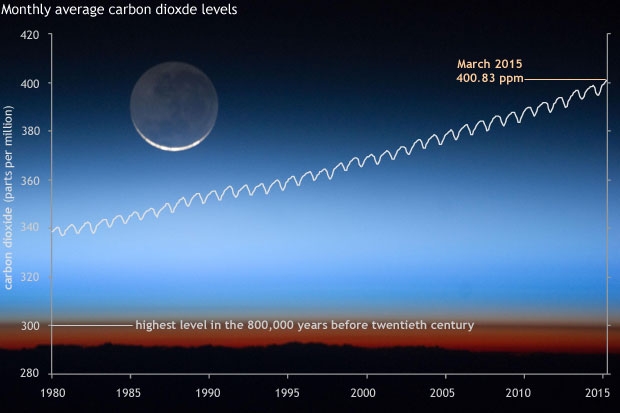
NOAA — For 800,000 years before the twentieth century, carbon dioxide levels in Earth’s atmosphere never exceeded 300 parts per million. Then the Industrial Revolution began, and modern human civilization started burning through millions of years of fossilized carbon in the geological blink of an eye.

NOAA scientists reported that in March 2015 the monthly average global carbon dioxide level went above 400 parts per million for the first time. The graph below puts this value into historical context, showing modern observations since 1980. The seasonal cycle of plant growth and decay in the Northern Hemisphere causes the dips and peaks in the line.

The graph is overlaid on an astronaut photograph of the Earth’s atmospheric limb—the narrow halo of air that appears as a layered cake when viewed from the side and far away. Heat from the sun-warmed surface of the Earth must travel that distance and pass back out to space for Earth’s surface temperature to remain in balance.

But within those layers of atmosphere, carbon dioxide molecules absorb heat, just like the bricks in your chimney absorb heat from a fire. The more carbon dioxide, the more heating, and the longer it takes the atmosphere to cool off. Every night, the solar heating stops, and everything begins to cool off, but every day the Sun comes up and restarts the heating. Because the day’s heat takes longer on average to pass through all those layers than it did when there was less carbon dioxide, Earth’s average temperature has gone up. The more carbon dioxide (and other greenhouse gases) we add, the more it will continue to go up.

In addition to the cascade of climate impacts from this global warming—rising sea level, more extreme rain events, insect pest population explosions, increasing coral bleaching—the extra carbon dioxide is also changing the pH of the ocean. Carbon dioxide is mildly acidic when it dissolves in water (think of your favorite carbonated beverage). The ocean’s rising acidity has harmed oysters and other marine creatures by weakening their shells.

When commenting on the milestone, NOAA scientists pointed out that carbon dioxide is a long-lived greenhouse gas, so stopping the further increase in emissions will not immediately return the Earth’s temperature to it’s pre-industrial state. Once we stop adding more than the Earth’s natural systems can remove in any given year, we will still have to wait thousands of years for the Earth to completely remove the excess amount we have already emitted.

Image by NOAA Climate.gov, based on monthly global carbon dioxide data from Mauna Loa Observatory, provided by NOAA ESRL. Astronaut photograph courtesy NASA Earth Observatory.

Record CO2 Level
Record CO2 Level

bookmark_border12.5 Million Dead Trees in California

CALIFORNIA — In a survey conducted by the U.S. Forest Service, they found the severe drought in California has caused the death of over 12 million trees.

California is in its third year of drought. In 2014, a large increase in tree mortality was observed, especially in the Central Coast and Southern Sierra Ranges. Ground observations noted a continued increase in mortality after the 2014 surveys were flown in July. Early season aerial surveys were conducted in the spring of 2015 in response to the continuing drought and the resulting tree mortality. Another early survey over portions of Southern California was flown the week of April 6th.
• More than 4.1 million acres were surveyed; covering western portions of Stanislaus, Sierra and Sequoia National Forests and Yosemite and Sequoia – Kings Canyon National Parks. The Tehachapi Range and nearby private lands were also surveyed.
• In general mortality was quite severe in many pine species especially in ponderosa and pinyon at lower elevations and more southern areas.
• Along thefoothills mortality was often widespread and severe especially in ponderosa but also gray pine and likely blue and live oak. It unknown if the oaks that were mapped were truly dead or had died back/defoliated due to the drought.
• On the Stanislaus, mortality was scattered in northern areas, but pockets of severe ponderosa and other pine mortality were seen in the  southern low areas. Mortality roughly doubled since July 2014 in the areas of the Stanislaus that were resurveyed this spring.
• At higher elevations conifer mortality was scattered. The survey was too early to detect full extent of mortality levels and anemic levels of snow were common.
• On the Sierra and Sequoia NF pine mortality, mostly from western pine beetle, was common and severe almost everywhere at lower elevations. Estimated number of trees killed on these two Forests together exceeded 5 million. Only about 300,000 trees were estimated killed last year in the same area.
• Southeastern portions of the Sequoia NF and Wilderness areas further east were also flown and widespread, at times, intense pinyon mortality was observed.
• On the Tehachapi Range and on private lands along the foothills of the Sierras, extensive areas of pine mortality were common. Large areas of oak mortality was also suspect.
Dead Pine Trees in California

bookmark_borderGMO Rice Wins Humanitarian Award

by Daniel Brouse

WASHINGTON, DC — Although social media is full of unsubstantiated claims about GMO’s, the truth is: there is no evidence that GMO’s are harmful. In fact, quite the contrary. For instance, there are specific breeds of tomatoes, potatoes and carrots being grown for their additional health benefits.

Such a beneficial crop, Golden Rice, has just won a humanitarian award. Not only is Golden Rice more nutritious, it is also less harmful to the environment. There are numerous health benefits including β-Carotene providing vitamin A to children. The environment would also see a positive impact in many parts of the world from Golden Rice. Because the rice is more nutritious, less of it needs to be consumed. In addition, a healthy population is much less taxing on the natural resources.

The United States Patent and Trademark Office stated, “Despite current interventions, vitamin A deficiency is the leading killer of children globally (2-3 million annually) and also the leading cause of childhood blindness (500,000 cases annually). Most cases arise in Asia where the staple food eaten by 3.5 billion people daily, white rice, lacks vitamin A sources typically found in meat and leafy vegetables. These deaths and blindness are preventable.

Golden Rice was genetically enhanced to provide a source of vitamin A for people subsisting mainly on rice. Professors Potrykus and Beyer invented the technology after a decade of research, and have worked with Dr. Dubock since 2000 to donate it to the resource poor in developing countries. Patenting the technology allowed the inventors to partner with Syngenta on commercial projects in return for support of their humanitarian objectives to make Golden Rice available free of charge to those in need. Local Golden Rice varieties are currently being developed by public sector institutions in Bangladesh, China, India, Indonesia, Philippines, and Vietnam, with a target cost no more than white rice.”

In a statement, Golden Rice said, “The White House Office of Science and Technology Policy and the U.S. Patent and Trademark Office (USPTO) have announced the winners of the 2015 recipients of the Patents for Humanity Award, among them the Golden Rice Project.

Patents for Humanity is a USPTO program that recognizes patent owners and licensees working to improve global health and living standards for underserved populations. The program advances the President’s global development agenda by recognizing private sector leaders who bring life-saving technologies to those in need, while showing how patents are an integral part of tackling the world’s challenges.

The award has been bestowed upon the Golden Rice Project, in particular to Prof Ingo Potrykus, Prof Peter Beyer, and Dr Adrian Dubock. Dr Dubock will attend the official award ceremony on 20 April 2015, accompanied by the Golden Rice Humanitarian.”

Unfortunately, many of the countries most in need of Golden Rice have laws against importing rice; however, the Pacific Trade Partnership could help save millions of kids… annually.

bookmark_borderDesalination

by Daniel Brouse

San Diego County — As drinking water becomes scarcer, desalination will become a rising trend. California is experiencing an extended drought. San Diego County is building a $1 billion desalination plant.

Fresh drinking water will become a larger battle ground as it becomes shorter in supply. Global warming is causing contamination in large fresh water supplies. For example:
Flooding causes sewage treatment plants and other toxic spills to be dispersed.
Droughts cause an obvious shortage of water.
Rising sea water causes salinization. Salt destroys the soil and the drinking water.

San Diego has already seen the need for drinking water. “It was not an easy decision to build this plant,” said Mark Weston, chairman of the agency that supplies water to San Diego County. “But it is turning out to be a spectacular choice. What we thought was on the expensive side 10 years ago is now affordable.”

Since much of the world’s fresh water problems are becoming more severe due to global warming, it is ironic that the plant will use huge amounts of electricity adding to the problem. There is also concern over what the plant will do to sea life. What happens to plants and animals in the 50 million gallons of water a day? “Fish and other marine organisms are killed on the intake screens (impingement); organisms small enough to pass through, such as plankton, fish eggs, and larvae, are killed during processing of the salt water.” [Heather Cooley, Newsha Ajami, Matthew Heberger, The Pacific Institute December 11, 2013]

“Our position is that seawater desalination should be the option of last resort,” said Sean Bothwell, an attorney with the California Coastkeeper Alliance, an environmental coalition that has battled California’s turn toward the technology. “We need to fully use all the sustainable supplies that we have available to us first.”

As the sea level rises, more fresh water sources will become brackish at the same time as extreme weather events will cause extraordinary droughts. It’s a fresh water double whammy.

Reference: The New York Times 2015/04/12

UPDATE:

Claude “Bud” Lewis Carlsbad Desalination Plant – Wikipedia

https://en.wikipedia.org/wiki/Claude_%22Bud%22_Lewis_Carlsbad_Desalination_Plant

The Claude “Bud” Lewis Carlsbad Desalination Plant is a desalination plant that opened on December 14, 2015 in Carlsbad, California, adjacent to the north end of the Encina Power Station. The San Diego County Water Authority (SDCWA), the recipient of the fresh …. “$1-billion desalination plant, hailed as model for state, opens in Carlsbad”.

bookmark_borderPermafrost

For a longtime researches at The Membrane Domain have been conducting R&D on the exponential properties of climate change.

The melting of the permafrost has become a good example of the problem. A recent article in Nature Climate Change reports:

Decomposition of organic carbon from thawing permafrost soils and the resulting release of carbon to the atmosphere are considered to represent a potentially critical global-scale feedback on climate change. The accompanying heat production from microbial metabolism of organic material has been recognized as a potential positive-feedback mechanism that would enhance permafrost thawing and the release of carbon. This internal heat production is poorly understood, however, and the strength of this effect remains unclear3. Here, we have quantified the variability of heat production in contrasting organic permafrost soils across Greenland and tested the hypothesis that these soils produce enough heat to reach a tipping point after which internal heat production can accelerate the decomposition processes. Results show that the impact of climate changes on natural organic soils can be accelerated by microbial heat production with crucial implications for the amounts of carbon being decomposed. The same is shown to be true for organic middens5 with the risk of losing unique evidence of early human presence in the Arctic.