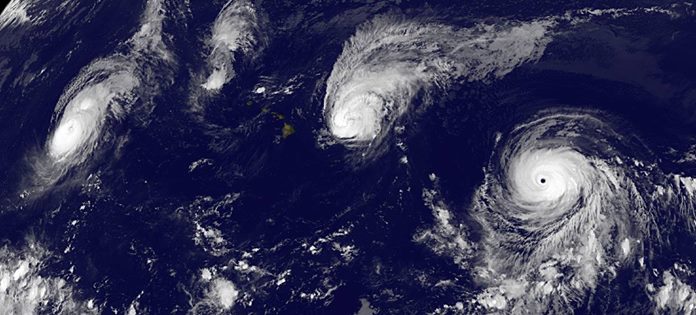
NOAA reports: Three major hurricanes continue over the Pacific Ocean this morning.
Hurricane Ignacio is centered about 320 miles east of Hilo, Hawaii, with maximum sustained winds of 115 mph – a Category 3 hurricane on the Saffir-Simpson Hurricane Wind Scale. There are no coastal watches or warnings in effect, but interests in the Hawaiian Islands should continue to closely monitor the progress of Ignacio.
Hurricane Jimena is centered about 1430 miles east of Hilo, with maximum sustained winds of 150 mph – a strong Category 4 hurricane on the Saffir-Simpson Hurricane Wind Scale. There are no coastal watches or warnings in effect.
Hurricane Kilo is centered about 530 miles south of Midway Island, with maximum sustained winds of 135 mph – a Category 4 hurricane on the Saffir-Simpson Hurricane Wind Scale. There are no coastal watches or warnings in effect.
ENGLAND — The BBC reports: Researchers at Queen Mary University of London said the patients who had listened to music had been less anxious after their surgery and had needed less pain relief.
The Department of Health said doctors should consider the findings. The scientists want hospitals to suggest in NHS information leaflets that patients bring music devices and playlists into hospital with them.
The team reviewed 70 trials, involving about 7,000 patients around the time of surgery, comparing a wide variety of mostly “soothing” music with:
* undisturbed bed rest
* headphones with no music
* white noise
* routine care
The lead author, Dr Catherine Meads, said Pink Floyd’s Dark Side of the Moon album had helped soothe her pain three hours after hip surgery in April.
Music was a safe, cheap and non-invasive option that should “be available to everyone having surgery”, she said.
“Currently music is not used routinely during surgery to help patients in their post-operative recovery.
“The lack of uptake is often down to the scepticism of professionals as to whether it genuinely works, and of course issues of budget and the integration into daily practice.”
Dr Meads added “it was quite a surprise” music had worked under general anaesthetic.
In another study, Prof. Levitin said, “We’ve found compelling evidence that musical interventions can play a health care role in settings ranging from operating rooms to family clinics. But even more importantly, we were able to document the neurochemical mechanisms by which music has an effect in four domains: management of mood, stress, immunity and as an aid to social bonding.”
Playing a musical instrument, singing and dancing provide even greater health benefits.
There are a growing number of scientist that have concluded climate change is severe. Recently, Jim Hansen, a professor at Columbia University’s Earth Institute, wrote:
“One conclusion we share in the latter paper is that ice sheet models that guided IPCC (Intergovernmental Panel on Climate Change) sea level projections and upcoming United Nations meetings in Paris are far too sluggish compared with the magnitude and speed of sea level changes in the paleoclimate record. An implication is that continued high emissions likely would result in multi-meter sea level rise this century and lock in continued ice sheet disintegration such that building cities or rebuilding cities on coast lines would become foolish.
The bottom line message we as scientists should deliver to the public and to policymakers is that we have a global crisis, an emergency that calls for global cooperation to reduce emissions as rapidly as practical. We conclude and reaffirm in our present paper that the crisis calls for an across-the-board rising carbon fee and international technical cooperation in carbon-free technologies. This urgent science must become part of a global conversation about our changing climate and what all citizens can do to make the world livable for future generations.”
“There is no dark side of the moon really. Matter of fact it’s all dark.”
— Pink Floyd
NASA has taken a picture of the far side of the moon:
The far side of the moon, illuminated by the sun, is seen as it crosses between our ‘EPIC’ camera on the Deep Space Climate Observatory (DSCOVR) satellite, and the Earth – one million miles away.
NASA — NASA’s Kepler mission has confirmed the first near-Earth-size planet in the “habitable zone” around a sun-like star. This discovery and the introduction of 11 other new small habitable zone candidate planets mark another milestone in the journey to finding another “Earth.”
The newly discovered Kepler-452b is the smallest planet to date discovered orbiting in the habitable zone — the area around a star where liquid water could pool on the surface of an orbiting planet — of a G2-type star, like our sun. The confirmation of Kepler-452b brings the total number of confirmed planets to 1,030.
“On the 20th anniversary year of the discovery that proved other suns host planets, the Kepler exoplanet explorer has discovered a planet and star which most closely resemble the Earth and our Sun,” said John Grunsfeld, associate administrator of NASA’s Science Mission Directorate at the agency’s headquarters in Washington. “This exciting result brings us one step closer to finding an Earth 2.0.”
Kepler-452b is 60 percent larger in diameter than Earth and is considered a super-Earth-size planet. While its mass and composition are not yet determined, previous research suggests that planets the size of Kepler-452b have a good chance of being rocky.
While Kepler-452b is larger than Earth, its 385-day orbit is only 5 percent longer. The planet is 5 percent farther from its parent star Kepler-452 than Earth is from the Sun. Kepler-452 is 6 billion years old, 1.5 billion years older than our sun, has the same temperature, and is 20 percent brighter and has a diameter 10 percent larger.
“We can think of Kepler-452b as an older, bigger cousin to Earth, providing an opportunity to understand and reflect upon Earth’s evolving environment,” said Jon Jenkins, Kepler data analysis lead at NASA’s Ames Research Center in Moffett Field, California, who led the team that discovered Kepler-452b. “It’s awe-inspiring to consider that this planet has spent 6 billion years in the habitable zone of its star; longer than Earth. That’s substantial opportunity for life to arise, should all the necessary ingredients and conditions for life exist on this planet.”
To help confirm the finding and better determine the properties of the Kepler-452 system, the team conducted ground-based observations at the University of Texas at Austin’s McDonald Observatory, the Fred Lawrence Whipple Observatory on Mt. Hopkins, Arizona, and the W. M. Keck Observatory atop Mauna Kea in Hawaii. These measurements were key for the researchers to confirm the planetary nature of Kepler-452b, to refine the size and brightness of its host star and to better pin down the size of the planet and its orbit.
The Kepler-452 system is located 1,400 light-years away in the constellation Cygnus. The research paper reporting this finding has been accepted for publication in The Astronomical Journal.
In addition to confirming Kepler-452b, the Kepler team has increased the number of new exoplanet candidates by 521 from their analysis of observations conducted from May 2009 to May 2013, raising the number of planet candidates detected by the Kepler mission to 4,696. Candidates require follow-up observations and analysis to verify they are actual planets.
Twelve of the new planet candidates have diameters between one to two times that of Earth, and orbit in their star’s habitable zone. Of these, nine orbit stars that are similar to our sun in size and temperature.
“We’ve been able to fully automate our process of identifying planet candidates, which means we can finally assess every transit signal in the entire Kepler dataset quickly and uniformly,” said Jeff Coughlin, Kepler scientist at the SETI Institute in Mountain View, California, who led the analysis of a new candidate catalog. “This gives astronomers a statistically sound population of planet candidates to accurately determine the number of small, possibly rocky planets like Earth in our Milky Way galaxy.”
These findings, presented in the seventh Kepler Candidate Catalog, will be submitted for publication in the Astrophysical Journal. These findings are derived from data publicly available on the NASA Exoplanet Archive.
Scientists now are producing the last catalog based on the original Kepler mission’s four-year data set. The final analysis will be conducted using sophisticated software that is increasingly sensitive to the tiny telltale signatures of Earth-size planets.
Ames manages the Kepler and K2 missions for NASA’s Science Mission Directorate. NASA’s Jet Propulsion Laboratory in Pasadena, California, managed Kepler mission development. Ball Aerospace & Technologies Corporation operates the flight system with support from the Laboratory for Atmospheric and Space Physics at the University of Colorado in Boulder.
Kepler 452b Compared to Earth
For more information about the Kepler mission, visit:
http://www.nasa.gov/kepler
A related feature story about other potentially habitable planets is online at: http://www.nasa.gov/jpl/finding-another-earth
A new study, written by James Hansen (NASA’s former lead climate scientist) and 16 co-authors, concludes that glaciers in Greenland and Antarctica will melt 10 times faster than previous estimates. The result could be a sea level rise of at least 10 feet in the next 50 years. Hanson said the new findings would be “substantially more persuasive than anything previously published.”
“We conclude that continued high emissions will make multi-meter sea level rise practically unavoidable and likely to occur this century. Social disruption and economic consequences of such large sea level rise could be devastating. It is not difficult to imagine that conflicts arising from forced migrations and economic collapse might make the planet ungovernable, threatening the fabric of civilization.”
It’s been many years since NASA has taken a picture of Earth. Now, they released the Blue Marble image captured by the National Oceanic and Atmospheric Administration (NOAA)’s #DSCOVR spacecraft.
This is the first photo of the entire Earth taken in 43 years:
NASA’s New Horizons spacecraft returned images of Pluto from over three billion miles away. After a decade-long journey through our solar system, New Horizons made its closest approach to Pluto, about 7,750 miles above the surface.
“My dad would be thrilled with New Horizons,” said Clyde Tombaugh’s daughter Annette Tombaugh, of Las Cruces, New Mexico. “To actually see the planet that he had discovered, and find out more about it — to get to see the moons of Pluto– he would have been astounded. I’m sure it would have meant so much to him if he were still alive today.”
WASHINGTON –The U.S. Environmental Protection Agency (EPA) today released one of the most comprehensive analyses to date on the economic, health and environmental benefits to the United States of global climate action. The peer-reviewed report, “Climate Change in the United States: Benefits of Global Action,” examines how future impacts and damages of climate change across a number of sectors in the United States can be avoided or reduced with global action. The report compares two future scenarios: a future with significant global action on climate change, where global warming has been limited to 2 degrees Celsius (3.6 degrees Fahrenheit), and a future with no action on climate change (where global temperatures rise 9 degrees Fahrenheit). The report then quantifies the differences in health, infrastructure and ecosystem impacts under the two scenarios, producing estimates of the costs of inaction and the benefits of reducing global GHG emissions.
“Will the United States benefit from climate action? Absolutely. This report shows us how costly inaction will be to Americans’ health, our environment and our society. But more importantly, it helps us understand the magnitude of benefits to a number of sectors of the U.S. with global climate action,” said EPA Administrator Gina McCarthy. “We can save tens of thousands of American lives, and hundreds of billions of dollars, annually in the United States by the end of this century, but the sooner we act, the better off America and future generations of Americans will be.”
The report examines how the impacts and damages of climate change across a number of sectors in the United States can be avoided with global action. The findings include:
• Global action on climate change reduces the frequency of extreme weather events and associated impacts. For example, by 2100 global action on climate change is projected to avoid an estimated 12,000 deaths annually associated with extreme temperatures in 49 U.S. cities, compared to a future with no reductions in greenhouse gas emissions. This is more than a 90 percent reduction from what we would expect with no action.
• Global action now leads to greater benefits over time. The decisions we make today will have long-term effects, and future generations will either benefit from, or be burdened by, our current actions. Compared to a future with unchecked climate change, climate action is projected to avoid approximately 13,000 deaths in 2050 and 57,000 deaths annually in 2100 from poor air quality. Delaying action on emissions reductions will likely reduce these and other benefits.
• Global action on climate change avoids costly damages in the United States. For nearly all of the 20 sectors studied, global action on climate change significantly reduces the economic damages of climate change. For example, without climate action, we estimated up to $10 billion in increased road maintenance costs each year by the end of the century. With action, we can avoid up to $7 billion of these damages.
• Climate change impacts are not equally distributed. Some regions of the United States are more vulnerable than others and will bear greater impacts. For example, without action on climate change, California is projected to face increasing risk of drought, the Rocky Mountain region will see significant increases in wildfires, and the mid-Atlantic and Southeast are projected to experience infrastructure damage from extreme temperatures, heavy rainfall, sea level rise, and storm surge.
• Adaptation can reduce damages and costs. For some sectors, adaptation can substantially reduce the impacts of climate change. For example, in a future without greenhouse gas reductions, estimated damages from sea-level rise and storm surge to coastal property in the lower 48 states are $5.0 trillion dollars through 2100. With adaptation along the coast, the estimated damages and adaptation costs are reduced to $810 billion.
The report is a product of the Climate Change Impacts and Risks Analysis (CIRA) project, led by EPA in collaboration with the Massachusetts Institute of Technology, the Pacific Northwest National Lab, the National Renewable Energy Laboratory, and other partners. The CIRA project is one of the first efforts to quantify the benefits of global action on climate change across a large number of U.S. sectors using a common analytic framework and consistent underlying data inputs. The project spans 20 U.S. sectors related to health, infrastructure, electricity, water resources, agriculture and forestry, and ecosystems.