bookmark_borderThawing Permafrost

In an article by Harvard, entitled “No Laughing Matter”, the impact of thawing permafrost is examined:

About a quarter of the Northern Hemisphere is covered in permafrost. Now, it turns out these permanently frozen beds of soil, rock, and sediment are actually not so permanent: They’re thawing at an increasing rate.

Human-induced climate change is warming these lands, melting the ice and loosening the soil, and that can cause severe damage. Forests are falling; roads are collapsing; and, in an ironic twist, the warmer soil is releasing even more greenhouse gases, which could further exacerbate the effects of climate change.

Shortly after scientists first noticed signs of thaw in the early 1970s, they rushed to monitor emissions of the two most influential greenhouse gases — carbon dioxide and methane. But until recently, the threat of the third-most-prevalent gas, nitrous oxide (N2O) — known in dentistry as laughing gas — has largely been ignored.
More About Feedback Loops

bookmark_borderPermafrost

For a longtime researches at The Membrane Domain have been conducting R&D on the exponential properties of climate change.

The melting of the permafrost has become a good example of the problem. A recent article in Nature Climate Change reports:

Decomposition of organic carbon from thawing permafrost soils and the resulting release of carbon to the atmosphere are considered to represent a potentially critical global-scale feedback on climate change. The accompanying heat production from microbial metabolism of organic material has been recognized as a potential positive-feedback mechanism that would enhance permafrost thawing and the release of carbon. This internal heat production is poorly understood, however, and the strength of this effect remains unclear3. Here, we have quantified the variability of heat production in contrasting organic permafrost soils across Greenland and tested the hypothesis that these soils produce enough heat to reach a tipping point after which internal heat production can accelerate the decomposition processes. Results show that the impact of climate changes on natural organic soils can be accelerated by microbial heat production with crucial implications for the amounts of carbon being decomposed. The same is shown to be true for organic middens5 with the risk of losing unique evidence of early human presence in the Arctic.

bookmark_borderNews from the Ice Wars

The Membrane Domain has been conducting Human Induced Climate Change Experiments since 1999. One of the first scientist to hypothesize that global warming was exponential (as opposed to the linear models) requested fellow scientists to conduct studies.

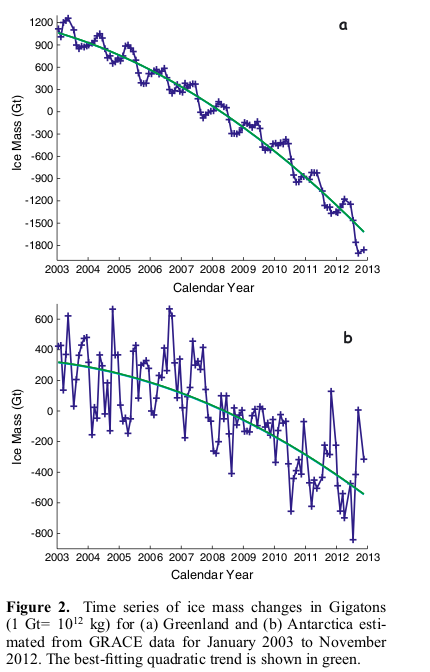
One Membrane Domain scientists began a study on the decline of the ice mass. The analysis is on-going; however, recent data leads to the conclusion that the process is exponential:

The two largest ice sheets on earth, Greenland and Antarctica, are losing mass faster and faster. The figure below is from Velicogna and Wahr, “Time-variable gravity observations of ice sheet mass balance: Precision and limitations of the GRACE satellite data” GEOPHYSICAL RESEARCH LETTERS, VOL. 40, 3055-3063, doi:10.1002/grl.50527, 2013

Mass loss for Greenland and  Antarctica from 2003-2013

For reference, 360 GTonne of mass loss results in 1 mm sea level rise. Greenland lost more than that in 2012 alone.

Causes of Mass Loss

I. Marine terminated glaciers flow to the ocean and calve off icebergs. The figure below is from Rignot and Mouginot,”Ice flow in Greenland for the International Polar Year 2008-2009,” GEOPHYSICAL RESEARCH LETTERS, VOL. 39, L11501, doi:10.1029/2012GL051634, 2012

Read More on the Decline of the Ice Mass