bookmark_borderClimate Change Is Happening Faster

Researchers are reporting in the journal Science that climate change is happening faster than what was forecast. What we thought would take 20,000 is going to happen in 100 years if we don’t take serious action.

Past and future global transformation of terrestrial ecosystems under climate change

by Connor Nolan1, Jonathan T. Overpeck2,1, Judy R. M. Allen3, Patricia M. Anderson4, Julio L. Betancourt5, Heather A. Binney

Future predictions from paleoecology

Terrestrial ecosystems will be transformed by current anthropogenic change, but the extent of this change remains a challenge to predict. Nolan et al. looked at documented vegetational and climatic changes at almost 600 sites worldwide since the last glacial maximum 21,000 years ago. From this, they determined vegetation responses to temperature changes of 4° to 7°C. They went on to estimate the extent of ecosystem changes under current similar (albeit more rapid) scenarios of warming. Without substantial mitigation efforts, terrestrial ecosystems are at risk of major transformation in composition and structure.

Science, this issue p. 920
bookmark_borderNews from the Ice Wars

The Membrane Domain has been conducting Human Induced Climate Change Experiments since 1999. One of the first scientist to hypothesize that global warming was exponential (as opposed to the linear models) requested fellow scientists to conduct studies.

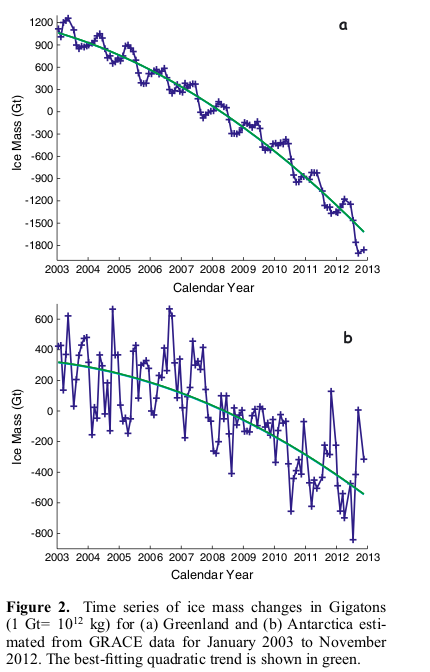
One Membrane Domain scientists began a study on the decline of the ice mass. The analysis is on-going; however, recent data leads to the conclusion that the process is exponential:

The two largest ice sheets on earth, Greenland and Antarctica, are losing mass faster and faster. The figure below is from Velicogna and Wahr, “Time-variable gravity observations of ice sheet mass balance: Precision and limitations of the GRACE satellite data” GEOPHYSICAL RESEARCH LETTERS, VOL. 40, 3055-3063, doi:10.1002/grl.50527, 2013

Mass loss for Greenland and  Antarctica from 2003-2013

For reference, 360 GTonne of mass loss results in 1 mm sea level rise. Greenland lost more than that in 2012 alone.

Causes of Mass Loss

I. Marine terminated glaciers flow to the ocean and calve off icebergs. The figure below is from Rignot and Mouginot,”Ice flow in Greenland for the International Polar Year 2008-2009,” GEOPHYSICAL RESEARCH LETTERS, VOL. 39, L11501, doi:10.1029/2012GL051634, 2012

Read More on the Decline of the Ice Mass