bookmark_borderRussia Attempts to Hack Electric Grid

by Membrane Domain Cybersecurity

Malware associated with a Russian hacking operation, Grizzly Steppe, was found on a Burlington Electric computer. It appears as though Russia was trying to access the power grid; however, the infected computer was not connected to the network.

“Vermonters and all Americans should be both alarmed and outraged that one of the world’s leading thugs, Vladimir Putin, has been attempting to hack our electric grid, which we rely upon to support our quality-of-life, economy, health, and safety,” Vermont Governor Shumlin said in a statement. “This episode should highlight the urgent need for our federal government to vigorously pursue and put an end to this sort of Russian meddling.”

Senator Patrick J. Leahy said, “This is beyond hackers having electronic joy rides — this is now about trying to access utilities to potentially manipulate the grid and shut it down in the middle of winter,” Leahy said in a statement. “That is a direct threat to Vermont and we do not take it lightly.”

Representative Peter Welch said, “It’s systemic, relentless, predatory.They will hack everywhere, even Vermont, in pursuit of opportunities to disrupt our country. We must remain vigilant, which is why I support President Obama’s sanctions against Russia and its attacks on our country and what it stands for.”

According to the Department of Homeland Security:

GRIZZLY STEPPE: Russian Malicious Cyber Activity

Russia’s civilian and military intelligence services engaged in aggressive and sophisticated cyber-enabled operations targeting the U.S. government and its citizens. The U.S. Government refers to this activity as GRIZZLY STEPPE. These cyber operations included spearphishing campaigns targeting government organizations, critical infrastructure entities, think tanks, universities, political organizations, and corporations, and theft of information from these organizations. This stolen information was later publicly released by third parties.

In operations targeting other countries, including U.S. allies and partners, Russian intelligence services (RIS) have undertaken damaging or disruptive cyber-attacks, including on critical infrastructure—in some cases masquerading as third parties or hiding behind false online personas designed to cause the victim to misattribute the source of the attack.

How Do Russian Intelligence Services Operate in Cyberspace?

RIS often uses spearphishing to gain access to targeted systems (see Figure 1 below). In one 2015–16 operation (detailed in our Joint Analysis Report (JAR)), Russian cyber actors conducted a spearphishing campaign to establish presence and persistence on a target network, obtain higher-level privileges, and steal (or “exfiltrate”) information.

These actors tricked recipients into changing their passwords through a fake website that was designed by the Russians cyber actors to appear legitimate. The actors then used those credentials—the username and password—to access the network as if they were legitimate users. They installed other malicious files, moved freely throughout the target network, gathered data and information, and exfiltrated it from the target network. Russian cyber actors continue to conduct spearphishing campaigns, including one launched as recently as November 2016, just days after the U.S. election.

What is the U.S. Government Doing?

The Department of Homeland Security (DHS) and Federal Bureau of Investigation (FBI) released a Joint Analysis Report (JAR), which provides details of the tools and infrastructure used by Russian intelligence services (RIS) to compromise and exploit networks and infrastructure associated with the recent U.S. election, as well as a range of U.S. government, political, and private sector entities. The JAR also arms network defenders with the tools they need to identify, detect, and disrupt Russia’s global campaign of malicious cyber activity. We urge users and administrators to use this information to better protect your networks.

What Is Spearphishing?

Spearphishing is the use of forged emails, texts, and other messages to manipulate users into opening malware or malicious software or clicking on malicious links.

Spearphishing attacks can lead to credential theft (e.g., passwords) or may act as an entry point for threat actors into an organization to steal or manipulate data and disrupt operations.

For more information, see the US CERT Tip on Avoiding Social Engineering and Phishing Attacks.

Screenshot of email that states: Incoming eFax: Elections Outcome could be revised [Facts of Elections Fraud]. Sent by Taylor Fax <securefaxsolutions@gmail.com> on Wednesday, November 9, 2016 at 10:39 To undisclosed-recipients. Attachment: election-headlines-FTE2016.docm (1.1 MB). Preview. eFax Solution. You have received a secure message from eFax Solution Corp. Please open the attachment election-headlines-FTE2016 in this email and enter PIN CODE: 3209. SUBJECT: ELECTIONS OUTCOME CUOLD BE REVISED [FACTS OF ELECTIONS FRAUD]. Please note: if you have trouble opening the message, please try the following 1. In your web browser, delete the temporary internet files and cookies. 2. Close the web browser. 3. Open the election-headlines-FTE2016 file in your secure email. End of screenshot.

Figure 1: Sample of Russian Post-Election Spearphishing

Lifecycle of Successful Spearphishing Operation. Starts on the left in Adversary Space, Russian Intelligence Services. Grizzly Steppe 1.) Leverages Operational Infrastructure (Neutral Space, in the middle) 2.) Crafts email with malicious link 3. ) Sent to Recipient (in Victim Space, on the right) 4.) Clicks on link and enters credentials into Website that looks legitimate (in Neutral Space), 5.) Gathers credentials in operational infrastructure, 6.) Uses credentials to Access Targeted System (in Victim Space) 7.) Install malicious files and 8.) Move through targeted systems and 9.) Gather Data of interested which is 10.) Exfiltrated to Operational Infrastructure (in Neutral Space).

Figure 2: Lifecycle of Successful Spearphishing Operation

What Information is in the JAR?

The JAR includes information on computers, servers, and other devices around the world that RIS uses to conduct command-and-control activity between compromised devices, send spearphishing emails, and steal credentials. The JAR identifies these devices by each one’s Internet Protocol (IP) address, which is a set of numbers that serves as an “address” for each computer and is used to transmit data between computers. Because RIS is using other people’s networks without their owners’ knowledge to hide their malicious activity, the computers at these IP addresses typically also host legitimate websites or other Internet services. In some cases, the cybersecurity community was aware of this infrastructure. In other cases, this information has been newly declassified by the U.S. government. The map in Figure 3 shows the 60 countries in which newly declassified IP addresses are located. The JAR also includes information on how RIS typically conducts their activities. This information can help network defenders understand how this adversary operates and can help identify new activity or disrupt ongoing intrusions by RIS.
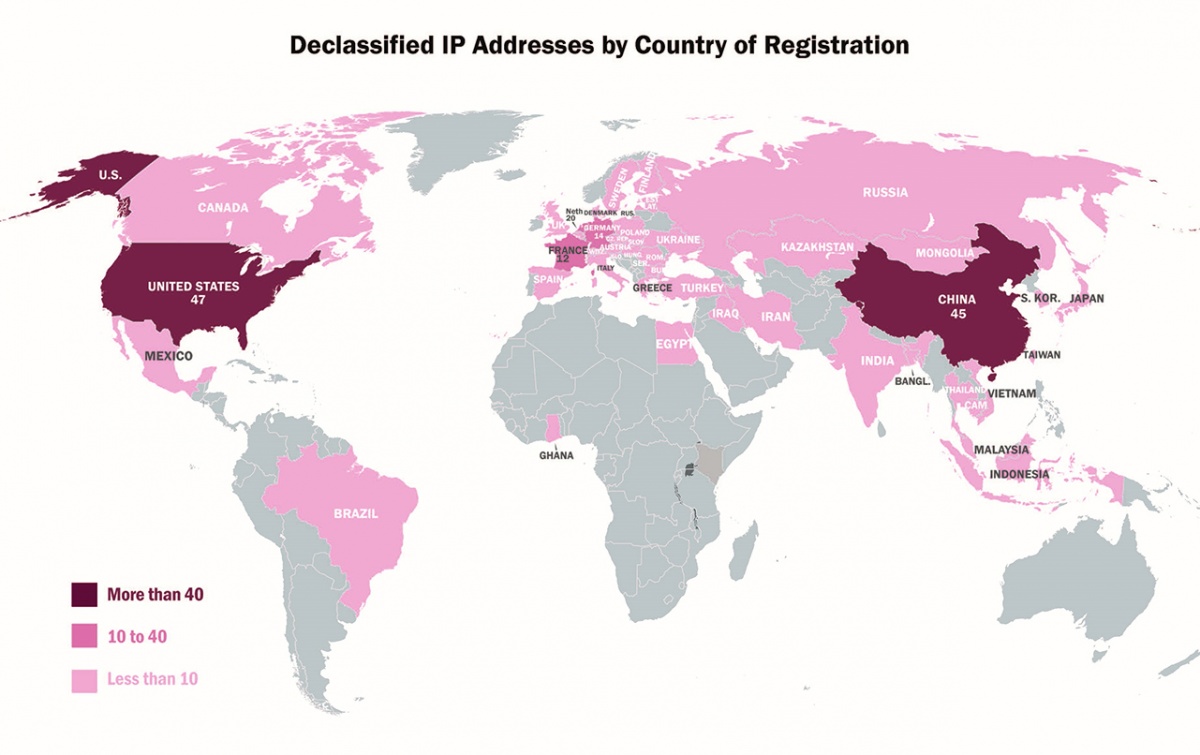
Declassified IP Addresses by Country of Registration. United States: 47. Canada, Mexico, India, Iraq, Egypt, Turkey, Greece, Russia, Kazakhstan, Mongolia, Thailand, Cambodia, Malaysia, Indonesia, Vitenam, South Korea, Japan, Taiwan, Ukraine, Sweden, Finaldn, Poland, Slove, UK, Spaine, Italy, Austria, Poland, and Ghana: Less than 10. France: 12. Germany: 14. Netherlands: 20. China: 45.

Figure 3: Declassified Worldwide Infrastructure Co-Opted by Russian Intelligence Services

How You Can Protect Yourself and Your Networks

A commitment to good cybersecurity and best practices is critical to protecting networks and systems. Here are some questions you may want to ask of your organization to help prevent and mitigate against attacks.

  • Backups: Do we backup all critical information? Are the backups stored offline? Have we tested our ability to revert to backups during an incident?
  • Risk Analysis: Have we conducted a cybersecurity risk analysis of the organization?
  • Staff Training: Have we trained staff on cybersecurity best practices?
  • Vulnerability Scanning and Patching: Have we implemented regular scans of our networks and systems? Do we appropriately patch known system vulnerabilities?
  • Application Whitelisting: Do we allow only approved programs to run on our networks?
  • Incident Response: Do we have an incident response plan? Have we practiced it?
  • Business Continuity: Are we able to sustain business operations without access to certain systems? For how long?
  • Penetration Testing: Have we attempted to hack into our own systems to test the security of our systems and our ability to defend against attacks?

What to Do If You See Signs of Malicious Cyber Activity

If you find signs of malicious cyber activity, we encourage you report it to DHS’s National Cybersecurity and Communications Integration Center (NCCICCustomerService@hq.dhs.gov or 888-282-0870) or the FBI through your local field office or the FBI’s Cyber Division (cywatch@ic.fbi.gov or 855-292-3937).

bookmark_borderRussia And Cybersecurity

by Membrane Domain Cybersecurity

Cozy Bear and Fancy Bear are two hacking organizations from Russia. Cozy Bear (classified as advanced persistent threat APT29) are believed to be associated with Russian intelligence. Fancy Bear (also known as APT28, Pawn Storm, Sofacy Group, Sednit and STRONTIUM) is a cyber espionage group believed to be sponsored by the Russian government.

According to the Christian Science Monitor: “Traditionally, Cozy Bear targets potential victims with phishing attacks – email messages that appear to be from a legitimate, trusted friend or associate. Those messages may contain malicious software that scans a machine for antivirus software, then plants malware on the target machine that make it possible for attackers to monitor keystrokes, communications, documents and other sensitive material on target computers. Fancy Bear is known for stealing targets’ usernames and passwords by setting up dummy websites that appear real enough to convince users to input their email and password information.”

In September of 2015, Special Agent Adrian Hawkins of the Federal Bureau of Investigation called the Democratic National Committee to inform them of a security breech. The FBI referred to Cozy and Fancy Bears as “The Dukes”. Since that time 17 U.S. intelligence agencies have implicated Russia in the hack of the DNC.

It is believed that Putin used the information to undermine the Democrats in the election process. It is also believed that the Russian hackers breached the Republicans. The stolen Republican data will be used to blackmail the new President.

“No one should really be surprised they’d go after the DNC,” said Jason Healey, a senior research scholar at Columbia University. “It’s not really that different from going after the political and military information we suspect the US is also going after.”

bookmark_borderYahoo Hacked

by Membrane Domain Cybersecurity

In September, Yahoo disclosed that 500 million user accounts had been hacked. In December 2016, Yahoo announced that an additional one billion accounts had been hacked.

“What’s most troubling is that this occurred so long ago, in August 2013, and no one saw any indication of a breach occurring until law enforcement came forward,” said Jay Kaplan, the chief executive of Synack, a security company. “Yahoo has a long way to go to catch up to these threats.”

In what could be the biggest hack ever, the Yahoo user accounts included passwords, phone numbers, birth dates, and security questions.

Verizon is in the process of buying-out Yahoo. Verizon is also known for its lackadaisical cybersecurity and has had breeches of their customer data, as well.

bookmark_borderNorth Pole In Danger

In a study published by Geert Jan van Oldenborgh, Marc Macias-Fauria, Andrew King, Peter Uhe, Sjoukje Philip, Sarah Kew, David Karoly, Friederike Otto, Myles Allen, and Heidi Cullen, the scientists found the unusually high temperatures around the North Pole in November–December 2016 were influenced by anthropogenic climate change:

The climate of the North Pole in winter is extreme, with 24 hours of darkness and very cold temperatures that vary from year to year and decade to decade. This year, the North Pole and the surrounding Arctic region are seeing record-high temperatures in November and December and record-low ice extent). Fall usually ushers in the season of sea ice growth, but November saw a brief retreat that was virtually unprecedented in nearly 40 years of satellite records, according to the National Snow and Ice Data Center. That dip helped November set a record low for sea ice area since 1850 (Walsh et al, 2016). By December, the area around the North Pole is typically 95 percent covered by sea ice. However, this year it is only about 80 percent.

Mid-November saw an early winter “heat wave” with the temperature on November 11 reaching -7 ºC (19 ºF) – that is 15 ºC (27 ºF) above normal for the time of year. The monthly mean November temperature was 13 ºC (23 ºF) above normal on the pole. Temperatures in this region declined slightly after that but remained well above normal. The forecast for the next few days is again more than 15 ºC (27 ºF) above normal at the North Pole itself and 10 ºC (18 ºF) averaged over 80–90 ºC N.

To quantify how rare the event was, we computed the November-December averaged temperature around the North Pole (80–90 ºN) in the ERA-interim reanalysis augmented with the ECMWF analysis and forecast up to December 25 and persistence up to December 31. The temperatures are slightly less extreme than at the pole itself (Fig. 2), but unprecedented in the satellite era from 1979 onwards.

We first note some of the impacts of these high temperatures in the Arctic regions. Next we describe the physical mechanisms that are responsible for sea ice and temperature variability in the North Pole region, which is warming faster than anywhere else in the world. We then analyse the observed temperatures via a related time series encompassing the northern-most meteorological observations on land (70–80 ºN). This allows for a reconstruction of Arctic temperatures back to about 1900, which clearly shows how the current warmth is unprecedented over that period. It also gives a rough estimate of how rare it is in the current climate and how much the probability has changed over the last century.

Finally, we perform a multi-method analysis of North Pole temperatures with two sets of climate models: the CMIP5 multi-model ensemble that was used for the 2013 IPCC AR5 report, and a large ensemble of model runs in the Weather@Home project. Both sets of models give very comparable results, showing that the bulk of the increase is due to anthropogenic emissions. The results are combined in the synthesis and conclusions.

Impacts

Extreme warm events in the Arctic extend into biological and social implications. Unlike the Antarctic, Arctic lands are inhabited and their socio-economic systems are greatly affected by the impacts of extreme and unprecedented sea ice dynamics and temperatures. Recent work by Henri Huntington and colleagues reported on these effects on the timing of marine mammal migrations, their distribution and behaviour and the efficacy of certain hunting methods in the Beaufort Sea. Less than a month ago, Forbes and colleagues reported on the relationship between unseasonal sea ice decline in winter and the enhanced probability of rain-on-snow events in the Yamal Peninsula in north-Western Siberia. While rain on snow does not cause problems in spring, it can be catastrophic for reindeer in the autumn when rain turns to an ice crust as plummeting normal temperatures return. This crust, often several centimetres thick, prevents the reindeer from feeding on fodder beneath the snow throughout the winter months. Two extreme weather events in 2006 and 2013 caused mass starvation among the reindeer herds (one event alone in 2013 resulted in 61,000 reindeer deaths, about 22 percent out of 275,000 reindeer on the Yamal Peninsula), and were linked with sea ice loss in the adjoining Barents and Kara seas. These two examples only illustrate the variety of ways in which climate change in the Arctic directly affects its ecosystems and societies. Many others include effects on the timing of phytoplankton blooms (which are at the base of the food chain in the Arctic ocean) and terrestrial plants, their consequences for animals that depend on these resources, opportunities for invasive southern species to colonise the region, enhanced mobility around the Arctic region for marine mammals such as whales, or reduced and largely modified habitat for animals that directly depend on sea ice such as the polar bear.

Some background

The Arctic is the fastest-warming region on Earth, with the largest temperature increases in winter. In summer, the temperature is constrained by all the ice melting and it never rises very far above zero. However, the extra heat absorbed in summer is released in autumn and winter as the water remains warmer for longer and re-freezing sea ice releases the latent energy of melting.

This “Arctic amplification” of the global warming trend has several causes (see e.g., IPCC WG1 AR5 Box 5.1, Screen & Simmonds, 2010; Bintanja et al, 2011). The best-known is the extra warming due to the change in color (albedo-feedback): when white snow and ice is replaced by dark land and ocean, a much larger fraction of the incoming sunshine is absorbed instead of reflected. This extra heat warms the surface even more. Another positive feedback is less well known and is based on the observation that the warming trend in the Arctic is mainly confined to the lower part of the atmosphere. This is still far below the levels where thermal radiation escapes from the atmosphere on average, which is around 5 km (3 miles) high. This implies that the radiative cooling of the warmer air near the surface is not as efficient as in lower latitudes where the trend at altitude is similar to (mid-latitudes) or higher than (tropics) near the surface. The reduction of radiative cooling due to the vertical structure of the warming trend is called the lapse-rate feedback.

Variability has also increased in the Arctic. On top of the positive feedbacks mentioned above, this is due to two other factors. First, the shape of the Arctic Ocean. Before global warming began in earnest, the basin was filled with ice for most of the year, which implies that except for a few summer months the edge of the ice was relatively short and confined to the Atlantic sector. Now, there are more months in which the ice edge is free of the continents. This allows larger changes from year to year (van der Linden et al, 2014). Another factor is the thickness of the ice. The ice has thinned dramatically, with most of it now single-year ice that is much thinner, and hence flows and melts more quickly (Tschudi et al, 2016). This type of ice changes much more quickly at the whim of the ever-capricious weather, especially combined with the waves and swell that now develop in the ice-free regions (Thomson and Rogers, 2014).

Finally, warm episodes near the pole are usually due to so-called “moist intrusions”: warm and moist air from the mid-latitudes that not only advects heat, but also clouds that block outgoing long-wave radiation and hence trap more heat. There is some evidence that these have become more frequent (Woods and Caballero, 2016).

Discussion and conclusions

We have investigated the rarity of the November-December 2016 average temperature around the North Pole and assessed how much November-December average temperatures have changed over the past century using observations over a wider region. We also attempted to quantify how much high Arctic temperatures have changed due to anthropogenic emissions (greenhouse gases and aerosols) in two climate model ensembles.

The observations and the bias-corrected CMIP5 ensemble point to a return period of about 50 to 200 years in the present climate, i.e., the probability of such an extreme is about 0.5 percent to two percent every year, with a large uncertainty. This is rare, but it should be kept in mind that we are focusing on this particular November–December period precisely because an unusual event has occurred. For a random two-month period it would be between six and 12 times more likely. The prescribed SST design of the HadAM3P simulations precludes estimating an absolute return period.

The observations show that November–December temperatures have risen on the North Pole, modulated by decadal North Atlantic variability. For all phases of this variability a warm event like the one of this year would have been extremely unlikely in the climate of a century ago. The probability was so small it is hard to estimate, but less than 0.1 percent per year. The model analyses show that the event would also have been extremely unlikely in a world without anthropogenic emissions of greenhouse gases and aerosols, attributing the cause of the change to human influences. This also holds for the warm extremes caused by the type of circulation of November 2016. If nothing is done to slow climate change, by the time global warming reaches 2 ºC (3.6 ºF) events like this winter would become common at the North Pole, happening every few years.

bookmark_borderAntarctic Glacial Ice Melt

Australia’s ABC news reports:

Scientists hope to discover how warm water is reaching one of the world’s largest glaciers, causing it to melt rapidly.

Lead author Steve Rintoul said it was the first time scientists had been able to test the hypothesis that warm ocean waters were driving the glacier’s thinning.

“We knew the Totten has been thinning faster than other glaciers in East Antarctica, but nobody has known exactly why until we took these measurements,” he said.

“We found that warmer ocean water is reaching the cavity through this channel at temperatures capable of melting the ice shelf at the point where it meets ground.

Dr Rintoul said it was important to be able to predict the Totten glacier’s future behaviour, because it contained enough sea ice to raise global sea levels by about 3.5 metres.

“So the real importance of the research is that it helps provide some clues about how sea level might change in the future.”

The publication of the research today comes as scientists make their way back to the Totten glacier, where they hope to find more clues about what controls the amount of warm water reaching the glacier.

A team of about 30 scientists, technicians and PhD students left Hobart on December 8 and plan to arrive at the glacier in late December.

Dr. Rintoul said their goal was to learn more about the pathways that bring the warm water up from the deep ocean.

“Understanding the physical processes delivering heat to the ice shelf will help us assess the vulnerability of the East Antarctic ice sheet to future changes in the Southern Ocean,” he said.

“What we have shown is that warm water reaches the glacier. What we need to know is what’s going to happen in the future.

Dr. Tas van Ommen from the Australian Antarctic Division said it would be concerning to see an increase in the Totten glacier’s natural melt rate.

“If its natural melt rate was to increase because of changes in ocean circulation, that would then add to the sea level rise that we see from glaciers already melting in Antarctica, particularly in the West.

“So we are concerned to track that and to be able to predict what might happen in the future.”

bookmark_borderUS Bans North Ocean Oil Exploration

United States-Canada Joint Arctic Leaders’ Statement
THE WHITE HOUSE
Office of the Press Secretary

In March, President Obama and Prime Minister Trudeau announced a new partnership to embrace opportunities and confront challenges in the changing Arctic, with Indigenous and Northern partnerships, and responsible, science-based leadership. Over the past year, both countries have engaged a range of partners and stakeholders, including Indigenous peoples and Northern communities, state, provincial and territorial governments, nongovernmental organizations and businesses. Those consulted have expressed a strong desire for real and long-term opportunities to build strong families, communities, and robust economies. Today, President Obama and Prime Minister Trudeau are proud to launch actions ensuring a strong, sustainable and viable Arctic economy and ecosystem, with low-impact shipping, science based management of marine resources, and free from the future risks of offshore oil and gas activity. Together, these actions set the stage for deeper partnerships with other Arctic nations, including through the Arctic Council.

Science-based approach to oil and gas:

In March, the United States and Canada committed that commercial activities will occur only if the highest safety and environmental standards are met, and if they are consistent with national and global climate and environmental goals. Today – due to the important, irreplaceable values of its Arctic waters for Indigenous, Alaska Native and local communities’ subsistence and cultures, wildlife and wildlife habitat, and scientific research; the vulnerability of these ecosystems to an oil spill; and the unique logistical, operational, safety, and scientific challenges and risks of oil extraction and spill response in Arctic waters – the United States is designating the vast majority of U.S. waters in the Chukchi and Beaufort Seas as indefinitely off limits to offshore oil and gas leasing, and Canada will designate all Arctic Canadian waters as indefinitely off limits to future offshore Arctic oil and gas licensing, to be reviewed every five years through a climate and marine science-based life-cycle assessment.[i]

Supporting strong Arctic communities:

In March, both countries committed to defining new approaches and exchanging best practices to strengthen the resilience of Arctic communities and continuing to support the well-being of Arctic residents, in particular respecting the rights and territory of Indigenous peoples.

Recently, in direct response to requests from Alaska Native communities, President Obama created the Northern Bering Sea Climate Resilience Area protecting the cultural and subsistence resources of over 80 tribes as well as one of the largest seasonal migrations of marine mammals in the world of bowhead and beluga whales, walrus, ice seals, and sea birds. The United States also launched an interagency Economic Development Assessment Team in the Nome region of Alaska to identify future investment opportunities, with other regions to follow. In addition, the Arctic Funders Collaborative (AFC), a group of 11 U.S., Canadian, and international philanthropic foundations, announced the coordination and mobilization of an estimated $27 million in resources for programs across the Arctic over the next three years.

Today, for its part, Canada is committing to co-develop a new Arctic Policy Framework, with Northerners, Territorial and Provincial governments, and First Nations, Inuit, and Métis People that will replace Canada’s Northern Strategy. The Framework will include priority areas identified by the Minister of Indigenous and Northern Affairs’ Special Representative, such as education, infrastructure, and economic development. The Framework will include an Inuit-specific component, created in partnership with Inuit, as Inuit Nunangat comprises over a third of Canada’s land mass and over half of Canada’s coast line, and as Inuit modern treaties govern this jurisdictional space. In parallel, Canada is reducing the reliance of Northern communities on diesel, by deploying energy efficiency and renewable power. Canada will also, with Indigenous and Northern partners, explore how to support and protect the future of the Arctic Ocean’s “last ice area” where summer ice remains each year.

Low impact shipping corridors:

In March, the United States and Canada committed to working together to establish consistent policies for ships operating in the region. Today, both countries are launching the first processes ever to identify sustainable shipping lanes throughout their connected Arctic waters, in collaboration with Northern and Indigenous partners. The U.S. Coast Guard is launching a Port Access Route Study (PARS) in the Beaufort and Chukchi Seas.[ii] Results from this analysis may be used to establish vessel routing measures including traffic separation schemes, recommended routes, Areas To Be Avoided, or other instruments such as fairways where no structures may be erected. The Canadian Coast Guard and Transport Canada is implementing Northern Marine Transportation Corridors, determining what infrastructure and navigational and emergency response services are needed. Canada is also launching a new program to support training curriculum for Northerners, particularly Indigenous peoples, to join the marine field, as well as programming to support marine infrastructure and safety equipment for communities.

In addition, the U.S. Coast Guard, in consultation with industry, Indigenous communities, and the State of Alaska, has begun a strategy to phase down the use of Heavy Fuel Oil (HFO) in the Arctic. The Canadian Coast Guard is conducting similar outreach and consultations to develop proposals to phase down the use of HFO in 2017. The United States and Canada will each, or jointly, propose a plan for consideration at the International Maritime Organization’s spring 2017 meeting.

Science-based management of Arctic fisheries:

In March, the United States and Canada called for a binding international agreement to prevent the opening of unregulated fisheries in the Central Arctic Ocean and to build on a precautionary, science-based approach to commercial fishing that both countries have put in place in their Arctic waters. Today, the United States commits to supporting and strengthening existing commercial fishing closures in the Beaufort and Chukchi Seas, and to conducting scientific research to improve our understanding of the Arctic. Canada commits to working with Northern and Indigenous communities to build world-leading and abundant Arctic fisheries – based on science – that firstly benefit Northern communities. Together, the United States’ and Canada’s actions will create the largest contiguous area of well-regulated fisheries in the world.

Both countries reaffirm their commitment to a legally binding agreement to prevent unregulated commercial fisheries in the Arctic High Seas until an internationally recognized Regional Fishery Management Organization is in place to provide effective management. Both countries are working towards such an agreement in the coming months.

[i] Taking into account the respective obligations of the United States and Canada under international law to protect and preserve the marine environment, these steps also support the goals of various international frameworks and commitments concerning pollution, including those reflected in the 1990 International Convention on Oil Pollution Preparedness, Response, and Cooperation, the 2013 Agreement on Cooperation on Marine Oil Pollution Preparedness and Response in the Arctic, and the U.S.-Canada Joint Marine Pollution Contingency Plan. Furthermore, with respect to areas of the Beaufort Sea where the U.S.-Canada maritime boundary has not yet been agreed, these practical arrangements are without prejudice to either side’s position and demonstrate self-restraint, taking into account the principle of making every effort not to jeopardize or hamper reaching a final maritime boundary agreement.

[ii] In conducting this study, and consistent with existing authorities, the Coast Guard will consider traditional knowledge from local communities, the effects of shipping and vessel pollution on the marine environment, marine mammal migratory pathways and other biologically important areas, subsistence whaling, hunting, and fishing, and the needs of maritime safety and commerce.

bookmark_borderChristmasness

This year’s Christmas album is Christmasness featuring:

On the Verge of Christmas

Let the bells ring May the angels sing Please God anything Is Christmas near? Let the bells ring May the angels sing Please God something Is Christmas near? Is Christmas here? Please bring Christmas cheer Do wise men follow The Star If so wonder… wander how far Are shepherds awoken from sleep So that […]

I Believe In Father Christmas

Coversong originally made famous by Greg Lake Written by Greg Lake with lyrics by Peter Sinfield Dsus2 G6 D They said there’ll be snow at Christmas They said there’ll be peace on earth, But instead it just kept on raining, A veil of tears for the Virgin birth. C G D I remember one Christmas […]

Enjoy The Joy

Do you know how to make hearts glow Do you know how to make hearts grow Bake a little love into it From deep within grab a bit Enjoy the joy of sharing it Do you know how to let love show Do you know how to let love go Set it free naturally […]

More Christmas

bookmark_borderCarbon Offsetting and Reduction

The United Nations has initiated the first “worldwide” pollution tax. The International Civil Aviation Organization’s global carbon offsetting system is aimed at slowing the growth of emissions from commercial flights.

Carbon Offsetting and Reduction Scheme for International Aviation (CORSIA)

The role of a global MBM scheme is to complement a broader basket of measures to achieve the global aspirational goal (of carbon-neutral growth from 2020 onward.)

According to the Assembly Resolution, the average level of CO2 emissions from international aviation covered by the scheme between 2019 and 2020 represents the basis for carbon neutral growth from 2020, against which emissions in future years are compared. In any year from 2021 when international aviation CO2 emissions covered by the scheme exceed the average baseline emissions of 2019 and 2020, this difference represents the sector’s offsetting requirements for that year.

The CORSIA is implemented in phases, starting with participation of States on a voluntary basis, followed by participation of all States except the exempted States, as follows:

  • Pilot phase (from 2021 through 2023) and first phase (from 2024 through 2026) would apply to States that have volunteered to participate in the scheme; and
  • Second phase (from 2027 through 2035) would apply to all States that have an individual share of international aviation activities in RTKs in year 2018 above 0.5 per cent of total RTKs or whose cumulative share in the list of States from the highest to the lowest amount of RTKs reaches 90 per cent of total RTKs, except Least Developed Countries (LDCs), Small Island Developing States (SIDS) and Landlocked Developing Countries (LLDCs) unless they volunteer to participate in this phase.

States that voluntarily decide to participate the CORSIA may join the scheme from the beginning of a given year, and should notify ICAO of their decision to join by June 30 the preceding year.

It is important to note that, regardless of the phased implementation or exemptions under the CORSIA, all States with aircraft operators undertaking international flights are requested to compile and transmit aggregated emissions information of their operators to ICAO, as part of the activities included in the States’ implementation of a monitoring, reporting and verification (MRV) system.

The CORSIA calls for international aviation to address and offset its emissions through the reduction of emissions elsewhere (outside of the international aviation sector), involving the concept of “emissions units”. One emissions unit thereby represents one tonne of CO2. Two main types of emissions units exist: “offset credits” from crediting mechanisms and “allowances” from emissions trading schemes.

Offsetting could be through the acquisition and redemption of emissions units, arising from different sources of emissions reductions achieved through mechanisms (e.g. UNFCCC’s Clean Development Mechanism), programmes (e.g. REDD+) or projects (e.g. substituting coal-fired stoves with solar cookers). The buying and selling of eligible emissions units happens through a carbon market. The carbon market is a commodity market with the underlying commodity being emissions units. Like any commodity market, it is driven by the law of supply (eligible emissions units offered from different sources) and demand (eligible emissions units purchased by aircraft operators to offset their international aviation emissions under the CORSIA).​​

bookmark_borderTrump to Trash the Environment

United States of America — The world watches in dismay as Donald Trump appoints Myron Ebell, a professional climate change denier, to head his EPA transition team. During his campaign, Trump said that climate change is a hoax. Slate magazine reports, “Trump had tweeted in 2012 that global warming “was created by and for the Chinese in order to make U.S. manufacturing non-competitive.” He has also has previously called it a ‘hoax.'”

During his campaign, Trump also threaten to pull out of the Paris Climate Pact (which the US has already signed.) The Paris Accord is meant to prevent the world from reaching “the point of no return” — limit the temperature increase to 1.5 degrees Celsius. 2016 is already forecast to be the hottest year on record with the global average temperature 1.75°F above the 20th century average of 57.4°F.

Diplomats from around the world have voiced their concern. “A carbon tariff against the United States is an option for us,” Rodolfo Lacy Tamayo, Mexico’s under secretary for environmental policy and planning, said in a New York Times interview. He added, “We will apply any kind of policy necessary to defend the quality of life for our people, to protect our environment and to protect our industries.”

“I renew my offer to President-elect Trump to come to Fiji and see the effects of climate change,” said the island nation’s prime minister, Frank Bainimarama.

Now, Trump has appointed a professional climate change denier to dismantle the EPA (Environmental Protection Agency). Activists at the United Nations’ Paris talks depicted Myron Ebell, a climate contrarian, as one of seven “climate criminals” wanted for “destroying our future.” Now, Trump has appointed Ebell as head of the EPA transition team.

Municipalities throughout the U.S. are scrambling to take action prior to Trumps’ inauguration. The Baltimore Sun reports:
he Hogan administration’s petition filed this week urging the U.S. Environmental Protection Agency to crack down on 19 out-of-state, upwind coal-fired power plants that pollute Maryland’s air is certainly a welcome development. Maryland’s environment secretary had more or less promised such action earlier this year when he declined to join a multi-state lawsuit seeking similar enforcement by the federal agency.

The strategy might even prove productive if action is taken in the waning days of the Obama administration, which has expressed concern not only about toxic pollutants like sulfur dioxide that can be particularly harmful to people with asthma or other breathing problems, but carbon dioxide and other greenhouse gases that contribute to climate change. Maryland is imperiled by all of the above and needs federal authorities to act given that as much as 70 percent of the state’s air pollution can be traced to upwind sources.

So why does it sound like Maryland is asking for Marquess of Queensbury rules in the face of a street brawl? Most likely because Donald Trump was elected president last week and, in his first act of environmental stewardship named Myron Ebell, a professional climate change denier, to head his EPA transition team. The appointment came as no surprise given how often Mr. Trump attacked EPA’s efforts to protect public health and safety during the campaign, but it surely set the stage for what is coming next.

Here’s another clue: Those offending coal-burning plants are located in Indiana, Kentucky, Ohio, Pennsylvania and West Virginia. What else do they all have in common besides dirty air? They all supported Mr. Trump. How did Maryland do in this regard? Hillary Clinton won 60.5 percent of the vote, one of her best showings in the nation.

More on Climate Change

bookmark_borderGay Church Vs. Corruption

WEST CHESTER, PA — A microcosm of what is going on globally can be found at the corner’s of Gay and Church Street in West Chester, Pennsylvania. It is the County Seat and has a university within the Borough — a collision of humanity and hypocrisy.  Musicians, and artists of a wide variety, often come together at the corners of Gay and Church. Though the name Gay Church Band was meant as a location not a political statement, it is ironic that art and spirit are under attack at the corner. Police brutality in conspiracy with bureaucracy is unfortunately a reality.

REFERENCES:

Hate Crimes, Human and Civil Rights Violations in West Chester, Pennsylvania

West Chester Restricts Singing & Dancing (October 18, 2016)

Video Sample Of Gay Church Bashing

Gay Church Picture Collage