bookmark_borderThe Demise Of The USA: Will China Takeover?

By Daniel Brouse

UNITED STATES — President Trump has done more to damage the environment in his first days of office than any President in history. He has pledged to withdraw from the Paris treaty. The Paris Treaty was the most extensive agreement to address climate change and the first time China and India joined-in. Also, in the first hour of his administration all references to global warming and climate change were removed from WhiteHouse.gov. In addition, the website promoted the increased use of fossil fuels. Then on his first full day in office, Trump signed an executive order to withdraw from the The Trans-Pacific Partnership Agreement (TPP).

The TPP was a trade agreement negotiated by twelve countries: Australia, Canada, Japan, Malaysia, Mexico, Peru, United States, Vietnam, Chile, Brunei, Singapore, and New Zealand.

One of the largest benefits of the TPP would have been protecting the environment. Participating countries will need to adopt tougher pollution standards similar to the USA. “TPP includes the most robust enforceable environment commitments of any trade agreement in history,” according the United States. “TPP requires countries to play by fair environmental rules if they want to send their goods to the United States, and upgrades NAFTA by putting fully enforceable environment obligations at the core of the agreement.” In addition, TPP helps improve conditions on the ground in TPP countries by requiring them to:
* Fulfill their obligations under the Convention on International Trade in Endangered Species of Wild Fauna and Flora (CITES) to protect and conserve iconic species, such as rhinos and elephants.
* For the first time in any trade agreement, prohibit harmful fisheries subsidies, including those that contribute to overfishing, and work to restrain new subsidy programs or enhancements to existing subsidy programs.
* Combat illegal fishing, promote sustainable fisheries management practices, and protect wetlands and important natural areas.
* Promote the long-term conservation of whales, dolphins, sharks, sea turtles, and other marine species at risk.
* Combat wildlife trafficking, illegal logging, and illegal fishing through enhanced national and regional actions.
* Protect the marine environment from ship pollution, including by implementing their obligations under MARPOL (an international agreement to prevent marine pollution).

Now that the USA is pulling out, world leaders are considering China to replace the USA — a move that would backfire in Trump’s face.

bookmark_borderHottest Year

By Daniel Brouse
For The Human Induced Climate Change Experiment

2016 was Earth’s warmest year in at least the last 125,000 years. It marks the third record year in a row.

NOAA reported, “The globally averaged temperature over land and ocean surfaces for 2016 was the highest among all years since record keeping began in 1880. During the final month, the December combined global land and ocean average surface temperature was the third highest for December in the 137-year record . During 2016, the globally-averaged land surface temperature was 2.57°F (1.43°C) above the 20th century average. This was the highest among all years in the 1880–2016 record, surpassing the previous record of 2015 by 0.18°F (0.10°C).”

Experts believe that a 1.5°C to 2°C increase is a tipping point that could make global warming irreversible. The 1.43°C increase is of grave concern.

Arctic ice also reached a record low. “Recent trends in the decline of Arctic polar sea ice extent continued in 2016.” The estimated average annual sea ice extent in the Arctic was approximately 3.92 million square miles. The smallest annual average on record.

bookmark_borderFUD (Fear, Uncertainty and Doubt)

By Daniel Brouse
For Widgette / Private Business

Has America turned into a giant Tupperware Party?

The field of consumer behavior is a social science that studies the psychology of consumerism. There are five basic psychological tactics to marketing:
* emotional and psychological appeals
* optimize credibility by highlighting your flaws
* re-position your competition
* promote exclusivity
* introduce fear, uncertainty, and doubt (FUD)

Fear, Uncertainty, And Doubt (FUD)

The "Daisy Ad" Video
The “Daisy Ad” Video (Click for Video and Audio)

Fear is very powerful in marketing. An example of fear advertising happened when Lyndon Johnson ran against Barry Goldwater in 1964. Johnson wanted to stoke public fear that Goldwater would cause a nuclear war. The “Daisy ad” or “Peace, Little Girl” ran only one time. It showed a little girl picking petals from a daisy, followed by a nuclear explosion and Johnson ominously stating, “These are the stakes. To make a world in which all of God’s children can live, or to go into the dark.” Johnson won, carried 44 states, and took 61% of the vote in a landslide victory.

One of the first companies to use FUD as its business model is Tupperware. They pioneered the direct marketing strategy made famous by the Tupperware party. “A Tupperware party is run by a Tupperware ‘consultant’ for a host who invites friends and neighbors into his or her home to see the product line. Tupperware hosts are rewarded with free products based on the level of sales made at their party. Parties also take place in workplaces, schools, and other community groups.”

When friends and neighbors attend a Tupperware party, the host introduces fear, uncertainty, and doubt to the participants. The consumer is made to worry what their friends and neighbors will think of them if they don’t make a purchase. There is fear of being publicly humiliated and doubt whether you will be un-friended.

The most disturbing use of FUD is Donald J. Trump. The Donald has used every trick in the book when it comes to using fear, uncertainty and doubt to motivate people. The current atmosphere makes one wonder — “Has America turned into a giant Tupperware party?”

bookmark_borderLosing 10 Billion Trees Per Year

Part of the study Foliage Spoilage & the Trees’ Canopy Collapse

Thomas Crowther is a Yale Climate & Energy Institute postdoctoral fellow at the Yale School of Forestry & Environmental Studies (F&ES) and led a study and census of the world’s trees (2015). The study determined there are 3 trillion trees on Earth; however, the study also estimates we are losing 10 billion trees per year.


bookmark_borderFormer Employees Sue Microsoft For PTSD

By Daniel Brouse for The Membrane Domain Cybersecurity

Two former Microsoft employees have filed a lawsuit against Microsoft claiming PTSD. Their job as part of the security team was to review users content that had been flagged by automated software. For instance, pictures sent through Hotmail or other Microsoft services that appeared suspicious were then reviewed by humans.

The two ex-employees, Henry Soto and Greg Blauert, jobs were to uphold Microsoft’s legal obligation to inform authorities of illegal images. Mr. Soto’s and Mr. Blauert’s primary responsibility was to report pictures of child abuse to the US National Center for Missing and Exploited Children.

Mr. Soto viewed “many thousands of photographs and videos of the most horrible, inhumane and disgusting content one can imagine,” the lawsuit stated. “Many people simply cannot imagine what Mr. Soto had to view on a daily basis as most people do not understand how horrible and inhumane the worst people in the world can be.”

Microsoft disputed the claims. “Microsoft takes seriously its responsibility to remove and report imagery of child sexual exploitation and abuse being shared on its services, as well as the health and resiliency of the employees who do this important work.”

bookmark_borderTrump Security Breach

For months, the security community has known that both the DNC and GOP were hacked. The DNC hack was used to undermine Hillary. The GOP / Trump hacks were meant for blackmailing Trump. No surprises here.

U.S. security agencies were aware of Donald Trump’s security breaches since last summer. The information was in the public domain by August of 2016. The Donald was given a copy of the report long before the story appeared in the New York Times.

In a hearing before the Senate Select Committee on Intelligence, FBI director James Comey said attackers penetrated GOP organizations and stole Republican National Committee emails. “There was evidence that there was hacking directed at state-level organizations and the RNC…. Information was harvested from there, but it was old stuff. None of that was released”, Comey said.

Back in August of 2016 digital security firm ThreatConnect said, “We believe DC Leaks is another Russian-backed influence outlet.” DC Leaks had released 300 stolen emails from Republican targets including the staffs of Sen. John McCain, Lindsey Graham, Michele Bachmann and party officials in several states.

In October of 2016, Richard Andres, a cybersecurity and national security strategy expert with the U.S. military’s National War College said, “What we’ve been seeing here in the U.S. so far is mild by comparison to what they do in their own backyard. If they continue to escalate, we should expect to increasingly see false flag operations designed to implicate various political actors, falsified leaks, blackmail, false calls to their opponents’ political supporters and more

The Russians have gained accessed to the DNC and GOP mainly through “spearphishing.” Spearphishing is when a hacker gets someone to click on an email, attachment, link or photo. Malware is then installed on the victim’s computer that allows hackers to exploit the network. “Essentially people are opening their front door and letting them in,” said Toni Gidwani, a former Defense Intelligence Agency official whose ThreatConnect cybersecurity firm has investigated many of the hacks. “It’s something they keep coming back to because it works.”

It is not a matter of politics. It is a matter of national security. All sides need people to go to jail over the security breaches — Republicans, Democrats and Russians.

On January 11, Donald Trump tried to skirt the issue during a press conference and said he didn’t have any business in Russia. These statements were very misleading, if not an out-an-out lie. Donald Trump has substantial investment from Russians for businesses in other countries. After Trump went bankrupt 6 times, he was unable to readily borrow money from any reputable institution. Instead, he took money from Russian oligarchs and Russian mobs.

In 2008, Donald Trump Jr. attended a real estate conference and stated, “Russians make up a pretty disproportionate cross-section of a lot of our assets. We see a lot of money pouring in from Russia.”

Bayrock is a Russian backed business that has been implicated in money laundering. The Financial Times reported, “The Republican presidential nominee and Bayrock were both based in Trump Tower and they joined forces to pursue deals around the world — from New York, Florida, Arizona and Colorado in the US to Turkey, Poland, Russia and Ukraine. Their best-known collaboration — Trump SoHo, a 46-storey hotel-condominium completed in 2010 — was featured in Mr Trump’s NBC television show The Apprentice.”

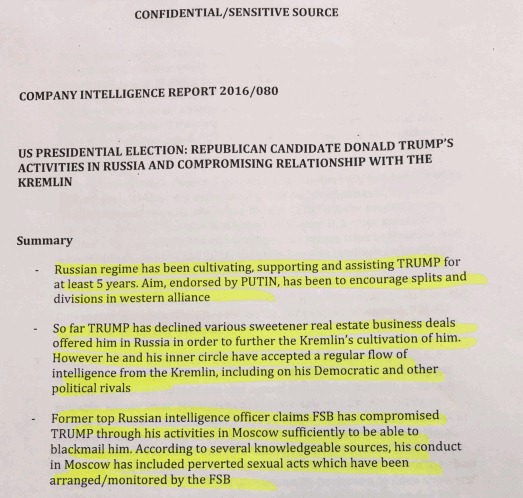
THE REPORT:
Trump Intelligence Allegations

Trump Intelligence Allegations

MORE

Russia Attempts to Hack Electric Grid
Malware associated with a Russian hacking operation, Grizzly Steppe, was found on a Burlington Electric computer. It appears as though Russia was trying to access the power grid; however, the infected computer was not connected to the network. “Vermonters and all Americans should be both alarmed and outraged that one of […]

Russia And Cybersecurity
Cozy Bear and Fancy Bear are two hacking organizations from Russia. Cozy Bear (classified as advanced persistent threat APT29) are believed to be associated with Russian intelligence. Fancy Bear (also known as APT28, Pawn Storm, Sofacy Group, Sednit and STRONTIUM) is a cyber espionage group believed to be sponsored by the […]

bookmark_borderFrance Ups Cybersecurity

France said the number of cyber attacks against the defence ministry have doubled each year. 24,000 attacks had been thwarted in 2016.

Security services have warded off attacks aimed at “tarnishing the image of the ministry as well as strategic attacks – harassment, surveillance, espionage – and even attempts to disrupt our drone systems,” Defence Minister Jean-Yves Le Drian said. “Thankfully, our defences were sufficient and none of these attacks were successful.”

“France reserves the right to respond by all means it deems appropriate,” he said. “That could be through the cyber arsenal at our disposal but also by conventional means. Everything would depend on the effects of the attack.”

“If there was an attempt to influence or manipulate the US presidential election, it would be a very serious incident. If it were led by a state government, it would be an intolerable interference. Targeting a country’s electoral process is an attack on its democratic foundations and its sovereignty, he added. Of course our services have discussed the issue, if only to learn lessons for the future,” said Le Drian

France plans to deploy 2,600 “digital soldiers” by 2019.

bookmark_borderChilling Facts About Antarctica

by Daniel Brouse for The Human Induced Climate Change Experiment

A 1,930 square mile chunk of ice is getting ready to fall off a glacier in Antarctica. In December 2016, a large crack appeared in part of Larsen C ice shelf.

Global warming is increasing the temperature of the ocean water even more than the temperature of the air; however, Andrew Fleming (sensing manager at the British Antarctic Survey) said the ice was being thawed both by warmer air above and by warmer waters below the ice.

The Larsen B ice shelf has already been severely impacted. “Larsen B shattered like car safety glass into thousands and thousands of pieces,” Fleming said. “It disappeared in the space of about a week.”

“If it doesn’t go in the next few months, I’ll be amazed,” project leader Prof Adrian Luckman said. “There hasn’t been enough cloud-free Landsat images but we’ve managed to combine a pair of Esa Sentinel-1 radar images to notice this extension, and it’s so close to calving that I think it’s inevitable.”

bookmark_borderU.S. Security-clearances Hacked

by Daniel Brouse for Membrane Domain Cybersecurity

In 2014 and 2015, there were two major breaches of U.S. government databases holding personnel records and security-clearance files of at least 22.1 million people, including Social Security numbers and some fingerprints, of not only federal employees and contractors but their families and friends.

U.S. officials have privately said the hacks were traced to the Chinese government.

“It is a very big deal from a national security perspective and from a counterintelligence perspective,” FBI Director James B. Comey said. “It’s a treasure trove of information about everybody who has worked for, tried to work for, or works for the United States government.”

The “new number is staggering,” said William R. Dougan, president of the National Federation of Federal Employees. “It is not yet clear how OPM can handle this massive increase, when they were already struggling with the initial 4.2 million. Now, not only do federal employees have to worry about their own personal information being exposed – but they must also worry about their spouse and children having their information compromised.”

“If you have my SF 86, you know every place I’ve lived since I was 18, contact people at those addresses, neighbors at those addresses, all of my family, every place I’ve traveled outside the United States,” Comey said. “Just imagine if you were a foreign intelligence service and you had that data.”

bookmark_borderEnergy, Heat and Global Warming

By Daniel Brouse and Sidd Mukherjee for Sidd’s Science Center

I ask:
Is there anything humans do with energy that results in less heat?

For example, furnaces generate heat, refrigerators generate heat, light bulbs generate heat, computers, cars, fans and even air conditioners create more heat.

Is there anything that we do that has a net loss of thermal energy or does the use of energy (period. both fossil fuel and renewable energy) by humans add to global warming?

Sidd replies:
Not just humans. Anytime energy is converted from one form to another and work is extracted by any agency, not just humans, some is lost as heat energy. That’s the second law of thermodynamics.

But to put it in perspective, lets say you burn a pound of coal, and take all the chemical energy out as heat. The amount of heat you directly obtain is several hundred times smaller than the heat trapped by the carbon dioxide generated over the next many thousand years that it remains in the atmosphere… so, don’t burn coal, oil or any fossil carbon.

Thus, for example conversion of AC to DC electricity can be very close to 100% efficient… but if you take out some of the energy and do work with it, you will lose some energy as heat.

The second law of thermodynamics states that the total entropy of an isolated system always increases over time, or remains constant in ideal cases where the system is in a steady state or undergoing a reversible process. The increase in entropy accounts for the irreversibility of natural processes, and the asymmetry between future and past.

The second law has been expressed in many ways. Its first formulation is credited to the French scientist Sadi Carnot in 1824, who showed that there is an upper limit to the efficiency of conversion of heat to work in a heat engine.