bookmark_borderRussia Hacked 500 Million Yahoo Accounts

The Membrane Domain: Cybersecurity

by the Department of Justice
Office of Public Affairs

A grand jury in the Northern District of California has indicted four defendants, including two officers of the Russian Federal Security Service (FSB), for computer hacking, economic espionage and other criminal offenses in connection with a conspiracy, beginning in January 2014, to access Yahoo’s network and the contents of webmail accounts. The defendants are Dmitry Aleksandrovich Dokuchaev, 33, a Russian national and resident; Igor Anatolyevich Sushchin, 43, a Russian national and resident; Alexsey Alexseyevich Belan, aka “Magg,” 29, a Russian national and resident; and Karim Baratov, aka “Kay,” “Karim Taloverov” and “Karim Akehmet Tokbergenov,” 22, a Canadian and Kazakh national and a resident of Canada.

The defendants used unauthorized access to Yahoo’s systems to steal information from about at least 500 million Yahoo accounts and then used some of that stolen information to obtain unauthorized access to the contents of accounts at Yahoo, Google and other webmail providers, including accounts of Russian journalists, U.S. and Russian government officials and private-sector employees of financial, transportation and other companies. One of the defendants also exploited his access to Yahoo’s network for his personal financial gain, by searching Yahoo user communications for credit card and gift card account numbers, redirecting a subset of Yahoo search engine web traffic so he could make commissions and enabling the theft of the contacts of at least 30 million Yahoo accounts to facilitate a spam campaign.

The charges were announced by Attorney General Jeff Sessions of the U.S. Department of Justice, Director James Comey of the FBI, Acting Assistant Attorney General Mary McCord of the National Security Division, U.S. Attorney Brian Stretch for the Northern District of California and Executive Assistant Director Paul Abbate of the FBI’s Criminal, Cyber, Response and Services Branch.

“Cyber crime poses a significant threat to our nation’s security and prosperity, and this is one of the largest data breaches in history,” said Attorney General Sessions. “But thanks to the tireless efforts of U.S. prosecutors and investigators, as well as our Canadian partners, today we have identified four individuals, including two Russian FSB officers, responsible for unauthorized access to millions of users’ accounts. The United States will vigorously investigate and prosecute the people behind such attacks to the fullest extent of the law.”

“Today we continue to pierce the veil of anonymity surrounding cyber crimes,” said Director Comey. “We are shrinking the world to ensure that cyber criminals think twice before targeting U.S. persons and interests.”

“ The criminal conduct at issue, carried out and otherwise facilitated by officers from an FSB unit that serves as the FBI’s point of contact in Moscow on cybercrime matters, is beyond the pale,” said Acting Assistant Attorney General McCord. “Once again, the Department and the FBI have demonstrated that hackers around the world can and will be exposed and held accountable. State actors may be using common criminals to access the data they want, but the indictment shows that our companies do not have to stand alone against this threat. We commend Yahoo and Google for their sustained and invaluable cooperation in the investigation aimed at obtaining justice for, and protecting the privacy of their users.”

“This is a highly complicated investigation of a very complex threat. It underscores the value of early, proactive engagement and cooperation between the private sector and the government,” said Executive Assistant Director Abbate. “The FBI will continue to work relentlessly with our private sector and international partners to identify those who conduct cyber-attacks against our citizens and our nation, expose them and hold them accountable under the law, no matter where they attempt to hide.”

“Silicon Valley’s computer infrastructure provides the means by which people around the world communicate with each other in their business and personal lives. The privacy and security of those communications must be governed by the rule of law, not by the whim of criminal hackers and those who employ them. People rightly expect that their communications through Silicon Valley internet providers will remain private, unless lawful authority provides otherwise. We will not tolerate unauthorized and illegal intrusions into the Silicon Valley computer infrastructure upon which both private citizens and the global economy rely,” said U.S. Attorney Stretch. “Working closely with Yahoo and Google, Department of Justice lawyers and the FBI were able to identify and expose the hackers responsible for the conduct described today, without unduly intruding into the privacy of the accounts that were stolen. We commend Yahoo and Google for providing exemplary cooperation while zealously protecting their users’ privacy.”

Summary of Allegations

According to the allegations of the Indictment:

The FSB officer defendants, Dmitry Dokuchaev and Igor Sushchin, protected, directed, facilitated and paid criminal hackers to collect information through computer intrusions in the U.S. and elsewhere. In the present case, they worked with co-defendants Alexsey Belan and Karim Baratov to obtain access to the email accounts of thousands of individuals.

Belan had been publicly indicted in September 2012 and June 2013 and was named one of FBI’s Cyber Most Wanted criminals in November 2013. An Interpol Red Notice seeking his immediate detention has been lodged (including with Russia) since July 26, 2013. Belan was arrested in a European country on a request from the U.S. in June 2013, but he was able to escape to Russia before he could be extradited.

Instead of acting on the U.S. government’s Red Notice and detaining Belan after his return, Dokuchaev and Sushchin subsequently used him to gain unauthorized access to Yahoo’s network. In or around November and December 2014, Belan stole a copy of at least a portion of Yahoo’s User Database (UDB), a Yahoo trade secret that contained, among other data, subscriber information including users’ names, recovery email accounts, phone numbers and certain information required to manually create, or “mint,” account authentication web browser “cookies” for more than 500 million Yahoo accounts.

Belan also obtained unauthorized access on behalf of the FSB conspirators to Yahoo’s Account Management Tool (AMT), which was a proprietary means by which Yahoo made and logged changes to user accounts. Belan, Dokuchaev and Sushchin then used the stolen UDB copy and AMT access to locate Yahoo email accounts of interest and to mint cookies for those accounts, enabling the co-conspirators to access at least 6,500 such accounts without authorization.

Some victim accounts were of predictable interest to the FSB, a foreign intelligence and law enforcement service, such as personal accounts belonging to Russian journalists; Russian and U.S. government officials; employees of a prominent Russian cybersecurity company; and numerous employees of other providers whose networks the conspirators sought to exploit. However, other personal accounts belonged to employees of commercial entities, such as a Russian investment banking firm, a French transportation company, U.S. financial services and private equity firms, a Swiss bitcoin wallet and banking firm and a U.S. airline.

During the conspiracy, the FSB officers facilitated Belan’s other criminal activities, by providing him with sensitive FSB law enforcement and intelligence information that would have helped him avoid detection by U.S. and other law enforcement agencies outside Russia, including information regarding FSB investigations of computer hacking and FSB techniques for identifying criminal hackers. Additionally, while working with his FSB conspirators to compromise Yahoo’s network and its users, Belan used his access to steal financial information such as gift card and credit card numbers from webmail accounts; to gain access to more than 30 million accounts whose contacts were then stolen to facilitate a spam campaign; and to earn commissions from fraudulently redirecting a subset of Yahoo’s search engine traffic.

When Dokuchaev and Sushchin learned that a target of interest had accounts at webmail providers other than Yahoo, including through information obtained as part of the Yahoo intrusion, they tasked their co-conspirator, Baratov, a resident of Canada, with obtaining unauthorized access to more than 80 accounts in exchange for commissions. On March 7, the Department of Justice submitted a provisional arrest warrant to Canadian law enforcement authorities, requesting Baratov’s arrest. On March 14, Baratov was arrested in Canada and the matter is now pending with the Canadian authorities.

An indictment is merely an accusation, and a defendant is presumed innocent unless proven guilty in a court of law.

The FBI, led by the San Francisco Field Office, conducted the investigation that resulted in the charges announced today. The case is being prosecuted by the U.S. Department of Justice National Security Division’s Counterintelligence and Export Control Section and the U.S. Attorney’s Office for the Northern District of California, with support from the Justice Department’s Office of International Affairs.

Defendants: At all times relevant to the charges, the Indictment alleges as follows:

Dmitry Aleksandrovich Dokuchaev, 33, was an officer in the FSB Center for Information Security, aka “Center 18.” Dokuchaev was a Russian national and resident.

Igor Anatolyevich Sushchin, 43, was an FSB officer, a superior to Dokuchaev within the FSB, and a Russian national and resident. Sushchin was embedded as a purported employee and Head of Information Security at a Russian investment bank.

Alexsey Alexseyevich Belan, aka “Magg,” 29, was born in Latvia and is a Russian national and resident. U.S. Federal grand juries have indicted Belan twice before, in 2012 and 2013, for computer fraud and abuse, access device fraud and aggravated identity theft involving three U.S.-based e-commerce companies and the FBI placed Belan on its “Cyber Most Wanted” list. Belan is currently the subject of a pending “Red Notice” requesting that Interpol member nations (including Russia) arrest him pending extradition. Belan was also one of two criminal hackers named by President Barack Obama on Dec. 29, 2016, pursuant to Executive Order 13694, as a Specially Designated National subject to sanctions.

Karim Baratov, aka “Kay,” “Karim Taloverov” and “Karim Akehmet Tokbergenov,” 22. He is a Canadian and Kazakh national and a resident of Canada.

Victims: Yahoo; more than 500 million Yahoo accounts for which account information about was stolen by the defendants; more than 30 million Yahoo accounts for which account contents were accessed without authorization to facilitate a spam campaign; and at least 18 additional users at other webmail providers whose accounts were accessed without authorization.

Time Period: As alleged in the Indictment, the conspiracy began at least as early as 2014 and, even though the conspirators lost their access to Yahoo’s networks in September 2016, they continued to utilize information stolen from the intrusion up to and including at least December 2016.


Crimes:

Count(s) Defendant(s) Charge Statute                 18 U.S.C. Conduct Maximum Penalty
1 All Conspiring to commit computer fraud and abuse § 1030(b) Defendants conspired to hack into the computers of Yahoo and accounts maintained by Yahoo, Google and other providers to steal information from them.


First, Belan gained access to Yahoo’s servers and stole information that allowed him, Dokuchaev, and Sushchin to gain unauthorized access to individual Yahoo user accounts.

Then, Dokuchaev and Sushchin tasked Baratov with gaining access to individual user accounts at Google and other Providers (but not Yahoo) and paid Baratov for providing them with the account passwords. In some instances, Dokuchaev and Sushchin tasked Baratov with targeting accounts that they learned of through access to Yahoo’s UDB and AMT (e.g., Gmail accounts that served as a Yahoo user’s secondary account).

10 years
2 Dokuchaev

Sushchin

Belan

Conspiring to engage in economic espionage § 1831(a)(5) Starting on Nov. 4, 2014, Belan stole, and the defendants thereafter transferred, received and possessed the following Yahoo trade secrets:

  • the Yahoo UDB, which was proprietary and confidential Yahoo technology and information, including subscriber names, secondary accounts, phone numbers, challenge questions and answers;
  • the AMT, Yahoo’s interface to the UDB; and
  • Yahoo’s cookie “minting” source code, which enabled the defendants to manufacture account cookies to then gain access to individual Yahoo user accounts.
15 years
3 Dokuchaev

Sushchin

Belan

Conspiring to engage in theft of trade secrets § 1832(a)(5) See Count 2 10 years
4-6 Dokuchaev

Sushchin

Belan

Economic espionage §§ 1831(a)(1), (a)(4), and 2 See Count 2 15 years (each count)
7-9 Dokuchaev

Sushchin

Belan

Theft of trade secrets §§ 1832(a)(1), and 2 See Count 2 10 years (each count)
10 Dokuchaev

Sushchin

Belan

Conspiring to commit wire fraud § 1349 The defendants fraudulently schemed to gain unauthorized access to Yahoo’s network through compromised Yahoo employee accounts and then used the Yahoo trade secrets to gain unauthorized access to valuable non-public information in individual Yahoo user accounts. 20 years
11-13 Dokuchaev

Sushchin

Belan

Accessing (or attempting to access) a computer without authorization to obtain information for the purpose of commercial advantage and private financial gain. §§ 1030(a)(2)(C), 1030(c)(2)(B)(i)-(iii), and 2 The defendants gained unauthorized access to Yahoo’s corporate network and obtained information regarding Yahoo’s network architecture and the UDB. 5 years

(each count)

14-17 Dokuchaev

Sushchin

Belan

Transmitting code with the intent to cause damage to computers. §§ 1030(a)(5)(A), 1030(c)(4)(B), and 2 During the course of their unauthorized access to Yahoo’s network, the defendants transmitted code on Yahoo’s network in order to maintain a persistent presence, to redirect Yahoo search engine users and to mint cookies for individual Yahoo accounts. 10 years (each count)
18-24 Dokuchaev

Sushchin

Belan

Accessing (or attempting to access) a computer without authorization to obtain information for the purpose of commercial advantage and private financial gain. §§ 1030(a)(2)(C), 1030(c)(2)(B)(i)-(iii), and 2 Defendants obtained unauthorized access to individual Yahoo user accounts. 5 years

(each count)

25-36 Dokuchaev

Sushchin

Belan

Counterfeit access device fraud §§ 1029(a)(1), 1029(b)(1), and 2 Defendants used minted cookies to gain unauthorized access to individual Yahoo user accounts. 10 years (each count)
37 Dokuchaev

Sushchin

Belan

Counterfeit access device making equipment §§ 1029(a)(4) Defendants used software to mint cookies for unauthorized access to individual Yahoo user accounts. 15 years
38 Dokuchaev

Sushchin

Baratov

Conspiring to commit access device fraud §§ 1029(b)(2) Defendants Dokuchaev and Sushchin tasked Baratov with gaining unauthorized access to individual user accounts at Google and other Providers and then paid Baratov for providing them with the account passwords. In some instances, Dokuchaev and Sushchin tasked Baratov with targeting accounts that they learned of through access to Yahoo’s UDB and AMT (e.g., Gmail accounts that served as a Yahoo user’s secondary account). 7 ½ years.
39 Dokuchaev

Sushchin

Baratov

Conspiring to commit wire fraud § 1349 See Count 38 20 years
40-47 Dokuchaev

Baratov

Aggravated identity theft § 1028A(a)(1) See Count 38 2 years

bookmark_borderAir Pollution: Getting All Choked Up

By Daniel Brouse

Air pollution may be the largest problem facing the world. Emissions of CO2, methane and other greenhouse gases are causing irreversible climate change. Since the effects of global warming take years to become apparent, many people don’t even notice the change; however, air pollution is already the leading cause of death worldwide. Again, since the pollution can’t be seen with the naked eye, many people are in denial of the dire consequences. 92% of the world’s population lives where outdoor air quality fails to meet the World Health Organization (WHO) guidelines.

In March of 2017, Dr. Margaret Chan, director general of the World Health Organization, said air pollution is “one of the most pernicious threats” facing global public health today and is on a much bigger scale than HIV or Ebola. Dr. Chan attributed the deaths of 600,000 children per year to indoor and outdoor air pollution.

UNICEF Executive Director Anthony Lake said, “Pollutants don’t only harm children’s developing lungs, they can actually cross the blood-brain barrier and permanently damage their developing brains, and, thus, their futures. No society can afford to ignore air pollution.”

“Protecting children from air pollution is not only in their best interests; it is also in the best interests of their societies — a benefit realized in reduced health costs, in increased productivity, in a cleaner, safer environment, and thus, in more sustainable development,” Lake said.

It is estimated that 5-7 million people are dying prematurely every year as a result of air pollution.

The American Lung Association says, “Two types of air pollution dominate in the U.S.: ozone and particle pollution. These two pollutants threaten the health and the lives of millions of Americans. Thanks to the Clean Air Act, the U.S. has far less of both pollutants now than in the past. Ozone pollution is the most widespread pollutant in the U.S. and is also one of the most dangerous.”

Ozone Action Alert Days are a frequent occurrence throughout the United States. During an Ozone Alert, you should not breath outside. During any days near metropolitan areas, you should limit outdoor physical activities as deep breathing causes more severe damage. The young and old are at greater risk at all times.

Particle pollution comes from small particles in exhaust and increase the risk of heart disease, lung cancer and asthma attacks. Particulates can interfere with the growth and work of the lungs.

The Environ Health Perspect Study states, “First and foremost, short-term exposure to particle pollution can kill. Peaks or spikes in particle pollution can last for hours to days. Deaths can occur on the very day that particle levels are high, or within one to two months afterward. Particle pollution does not just make people die a few days earlier than they might otherwise—these are deaths that would not have occurred if the air were cleaner.”

In February of 2017, the EPA released an update on air quality in the U.S.:

Today, pollution levels in many areas of the United States exceed national air quality standards for at least one of the six common pollutants:

  • Although levels of particle pollution and ground-level ozone pollution are substantially lower than in the past, levels are unhealthy in numerous areas of the country. Both pollutants are the result of emissions from diverse sources, and travel long distances and across state lines.

    An extensive body of scientific evidence shows that long- and short-term exposures to fine particle pollution, also known as fine particulate matter (PM2.5), can cause premature death and harmful effects on the cardiovascular system, including increased hospital admissions and emergency department visits for heart attacks and strokes. Scientific evidence also links PM to harmful respiratory effects, including asthma attacks.

    Ozone can increase the frequency of asthma attacks, cause shortness of breath, aggravate lung diseases, and cause permanent damage to lungs through long-term exposure. Elevated ozone levels are linked to increases in hospitalizations, emergency room visits and premature death.

    Both pollutants cause environmental damage, and fine particles impair visibility.

    Fine particles can be emitted directly or formed from gaseous emissions including sulfur dioxide or nitrogen oxides. Ozone, a colorless gas, is created when emissions of nitrogen oxides and volatile organic compounds react.

  • For unhealthy peak levels of sulfur dioxide and nitrogen dioxide, EPA is working with states and others on ways to determine where and how often unhealthy peaks occur. Both pollutants cause multiple adverse respiratory effects including increased asthma symptoms, and are associated with increased emergency department visits and hospital admissions for respiratory illness. Both pollutants cause environmental damage, and are byproducts of fossil fuel combustion.
  • Airborne lead pollution, a nationwide health concern before EPA phased out lead in motor vehicle gasoline under Clean Air Act authority, now meets national air quality standards except in areas near certain large lead-emitting industrial facilities. Lead is associated with neurological effects in children, such as behavioral problems, learning deficits and lowered IQ, and high blood pressure and heart disease in adults.
  • The entire nation meets the carbon monoxide air quality standards, largely because of emissions standards for new motor vehicles under the Clean Air Act.

MORE REFERENCES
Health And Air Quality
Air Pollution Deaths
Air Pollution Killing Millions
Largest Health Risk

bookmark_borderWooten Words Of Wisdom

On March 4, 2017, Victor Wooten gave a “free to the public” seminar in King Of Prussia, Pennsylvania.


Feel

Like a child speaking… learning to communicate in English… how many hours a day did you practice?

If you are playing bass, you are the rhythm. You need time. Listening to timing is more important than techniques, notes and scales. There is no such thing as a wrong note.

Victor was born the youngest of five brothers. The brothers already had a band — guitar, sax, drums and keys — but, they needed a bass player. Victor first learned to play. His brothers encouraged him to just play. Later, he taught himself how to play bass on a four-string guitar.

A question was asked, “I teach music to K-5… how can I teach the children to improvise?”
A: Have them try to play the wrong notes.

Karl McWherter and Victor Wooten

Brad Rau:
What an amazing gift the universe gave me for my birthday. I got the Jason Vieaux a few weeks ago and now Victor Wooten. At one point Victor without looking asked someone to turn any string they wanted out of tune. The he jumped right into playing (be myself by sly) quickly realized the G was tuned down a whole step and starting playing the line up two frets so he ended up playing in tune. They tuned back to normal without missing a beat. You had to be there.


Karl McWherter Photography at The Ardmore Music Hall


bookmark_borderAntarctica And Rising Sea Level

by Daniel Brouse and Sidd Mukherjee

The U.N. weather agency said the Antarctic peninsula has set a heat record of 63.5° Fahrenheit (17.5 degrees Celsius) on March 24, 2015. In March of 2017, there is about 10% less sea ice in Antarctica than the previous record minimum. “One would probably say that the old record was obliterated,” said Jan Lieser, a sea ice scientist at the Hobart-based Antarctic Climate and Ecosystems Co-operative Research Centre.

Antarctica contains 90% of the world’s fresh water as ice. If all the ice melts, sea levels will rise by 60 meters (200 feet). The sea ice melting doesn’t raise the sea level as the ice is already floating. The ice that is above land is a different story.

The problem with the ice in Antarctica is that much of the ice is on land. As the land ice melts or falls into the ocean the sea level rises. Compounding the problem is the elevation of the land. Over the centuries the weight of the ice has caused the land to sink. As the ocean temperature warms, water is starting to seep in under the ice. The warm water under the ice sheet is accelerating the destabilization of the sheet.

“There was a physicist called John Mercer at the Byrd polar research center here at Ohio State, who was warning of WAIS collapse as early as 1968,” said Sidd Mukherjee research physicist at Ohio State University.

Then in 1978 Mercer wrote:
“One warning sign that a dangerous warming is beginning in Antarctica, will be a breakup of ice shelves in the Antarctic Peninsula just south of the recent January 0C isotherm; the ice shelf in the Prince Gustav Channel on the east side of the peninsula, and the Wordie Ice Shelf; the ice shelf in George VI Sound, and the ice shelf in Wilkins Sound on the west side. ”

Each of these shelves is in retreat or gone. Mercer was more correct than he knew. Recent work by Bassis et al. shows that ice shelves collapse shortly after the temperature of the top surface exceeds the 0C melting point through a process called hydrofracture, where water filled crevasses penetrate all the way to the bottom of the shelf. Bassis et al. also pointed out that a cliff of ice higher than 100m (300 ft) is unstable against collapse. These cliff heights are attained where the bedrock is more than 1Km below sea level, as in large parts of WAIS. When the shelves melt leaving cliffs behind which directly face the ocean they will collapse along large sections of WAIS. The more frightening estimates for WAIS deglaciation are on the order of centuries, rather than millennia, indeed decadal time scales cannot be entirely ruled out. We know from past records that sea level can rise as fast as a foot a decade and maintain that rate for five hundred years. Such rates of sea level rise will destroy most coastal cities of the world, since coastal infrastructure cannot be moved inland or protected by seawalls quickly enough.

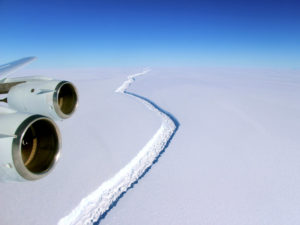
Antarctica Larsen C Ice Crack

In January of 2017, a UK research team discovered a huge increase in a massive 90-mile crack running through the Larsen C shelf (pictured to the right). The crack might soon split off a chunk of ice the size of Delaware. Larson C is part of Eastern Antarctic. Larson A and Larson B have already collapsed.

The Western Antarctic Ice Sheet (WAIS) is the segment of the continental ice sheet that covers West Antarctica. The melting of the West Antarctic ice sheet alone would raise global sea levels by more than 20 feet, according to researchers from the British Antarctic Survey. Over the last several years, WAIS has become unstable. A 2016 study by Khazendar, Rignot, and others adds to the mounting evidence that the threshold for an irreversible disintegration has begun.

“It’s generally accepted that it’s no longer a question of whether the West Antarctic Ice Sheet will melt, it’s a question of when,” said leader Ian Howat, associate professor of earth sciences at Ohio State in a 2016 study published in the journal Geophysical Research Letters. “This kind of rifting behavior provides another mechanism for rapid retreat of these glaciers, adding to the probability that we may see significant collapse of West Antarctica in our lifetimes.”

Ice calving is the breaking of ice chunks from the edge of a glacier. Calving causes mini-tsunamis daily in Antarctica.

The Thwaites Glacier is of great concern. Thwaites Glacier is an unusually broad and fast Antarctic glacier flowing into Pine Island Bay. As the warming temperature of sea water melts the bottom of the glacier, it allows water to enter underneath the ice. A University of Washington study determined that the Thwaites Glacier will gradually melt, leading to an irreversible collapse over the next 200 to 1000 years.

bookmark_borderFlood Insurance and Rising Sea Levels

by Daniel Brouse

Q: Who pays for flood insurance?
A: The United States government, FEMA, covers losses for people that pay flood insurance premiums.

Q: Does your homeowners insurance policy cover you in the event of flooding?
A: No.

Flood insurance coverage is very limited. For instance, basements and belonging in a basement are not covered. Life-time coverage is also limited. If a property has a pay-out in the past, it will be applied to the maximum coverage of the life-time coverage.

As climate change causes extreme weather events and the sea level to rise, houses that are prone to flooding will find it harder and harder to get flood insurance. Without flood insurance, properties located in a flood plain become almost impossible to sell.

For years, the casinos in Atlantic City, NJ have had a plan to float the casinos and move them westward as the sea level rises. Shipping ports face a similar problem, but how can you move a port inland? Coastal areas will need to start a constant and progressive movement to higher ground.

Freddie Mac mortgage says, “Insurance is an essential component of real estate transactions, and flood insurance currently makes it possible to obtain loans for homes in areas of identified flood risk. However, some of the varied impacts of climate change—rising sea levels, changing rainfall and flooding patterns, increasing temperatures—may not be insurable. As a result, some important features of housing finance may have to change. The potential impact of these systemic changes on the financial system is difficult to visualize today.” (More from this article.)

Flood Insurance Index
Global Warming Index

bookmark_borderBottom Of The Ocean Trashed

by Daniel Brouse

EARTH — How much of the Earth have humans polluted? Scientists sent robots to the bottom of the ocean… deeper than man has ever explored. The findings are disturbing.

“We often think deep-sea trenches are remote and pristine, untouched by humans,” says Alan Jamieson, a deep-ocean researcher at the University of Aberdeen, UK. “It’s even higher than in the estuaries of two of the most polluted rivers — the Pearl River and the Liao River — in China.”

“Crustaceans at depths of 10,000 metres contain higher concentrations of chemicals than do some animals in coastal waters.”

The small animals retrieved from the ocean’s bottom contained PCB’s (polychlorinated biphenyls used to make plastics and as anti-fouling agents to stop barnacles from growing on ships’ hulls), as well as, flame retardants (polybrominated diphenyl ethers, PBDEs).

“It’s really surprising to find pollutants so deep in the ocean at such high concentrations,” said Jeffrey Drazen, a marine ecologist at the University of Hawaii.

The findings raise concern about how microbial activities are adversely affected, the impact on the carbon cycle and climate change.

bookmark_borderTerror Threats in the USA

Today there are two groups of terrorists in the United States that rank far above any other groups:
1) Evangelical Christians
2) Anarchists

How do you identify members of these hate groups? Well, the Alt-right (radical and Evangelical Christians) are easy to spot. We keep that “basket of deplorables” in our Cabinet. [See Executive Branch U.S.A. 2017]

Anarchists Symbol
Anarchists Symbol

Q: How do you identify an anarchist?
A: Black masks, the anarchist symbol, flags, etc.
2) They like to set fires, rip things down, break windows, fences and other barriers.
3) You can not pay them; however, they will steal from you. They do not believe in ownership of property nor money. They have no boss.

“A black bloc is a tactical strategy used by anarchists, in which individuals wear black clothing, scarves, sunglasses, ski masks, motorcycle helmets with padding, or other face-concealing and face-protecting items.” — Wikipedia

WARNING: Please do not falsely accuse thy neighbor. Anarchists love to hi-jack peaceful protests and turn them violent and ugly. Do not be fooled. The hi-jackers are NOT the same group as the peaceful protesters. They are not liberal students, paid leftist protesters, black lives matter, anti-war, anti-trump supporters or supporters of any kind.

WARNING II: Do not allow the Alt-right to hi-jack the anarchists or all hell will break loose. (Thank you, The Management)

Anarchists At The Inauguration of the President of the United States

Anarchists At Berkeley University

The Anarchists Vs. The Antichrist
The Alt-right Christians and Anarchists, have the same goal — Armageddon.

The radical Christians want to bring on the Armageddon so the Rapture will occur, and they will be “saved” (aka the cleansing of the Earth.)

The anarchists goal is “abolishing all coercive structures” resulting in the cleansing of the Earth. In order for the anarchists to achieve their goal they must take-out the Alt-right government.

Will these two families fight like South Philly Mob families or Chicago gangs?

See also: Radical Christian Terrorists and the Zombie Apocalypse

bookmark_borderRadical Christian Terrorists and the Zombie Apocalypse

EARTH — Imagine a group of radical Christians taking over the government and trying to bring on the Rapture (aka The Apocalypse) and the Second Coming.

You no longer need to imagine. A conspiracy of Evangelical Christians are trying to facilitate The End Of Times. They want to fulfill biblical prophecies including:

  1. The Revival of the Roman Empire
  2. The Emergence of the Antichrist
  3. The Covenant with Israel
  4. Three Periods Between the Rapture and the Second Coming
  5. The War with Russia
  6. The Great Tribulation: Armageddon

The Radical Christian Terrorists believe they will be “saved” when these events occur.

ESCHATOLOGY
Eschatology is the part of theology concerned with death, judgment, and the final destiny of the soul and of humankind.

THE RAPTURE / ZOMBIE APOCALYPSE
Daniel 12
The Time of the End

2 Many of those who are dead in the ground will awake, these to everlasting life, but the others to disgrace and everlasting contempt.

Thessalonians 4:17
17 Then we who are alive and remain will be caught up together with them in the clouds to meet the Lord in the air, and so we shall always be with the Lord.

In Christian eschatology, the Rapture refers to the prophesied event when “Christian believers who have died will be raised and believers who are still alive and remain shall be caught up together with them (the resurrected dead believers) in the clouds to meet the Lord Jesus Christ in the air.”

APOCALYPSE
The apocalypse is the complete and final destruction of the world as prophesied in the biblical books of Daniel and Revelation (the last book of the Bible.)

The Four Horsemen of the Apocalypse in the book of Revelation are horsemen on white, red, black, and pale horses. The riders are often seen as symbolizing:

  1. Conquest, Pestilence, the Christ or the Antichrist
  2. War
  3. Famine
  4. Death

“The Christian apocalyptic vision is that the four horsemen are to set a divine apocalypse upon the world as harbingers of the Last Judgment.”

Revelation 6:7-8
When the Lamb broke the fourth seal, I heard the voice of the fourth living creature saying, “Come.” I looked, and behold, an ashen (pale) horse; and he who sat on it had the name Death; and Hades was following with him. Authority was given to them over a fourth of the earth, to kill with sword and with famine and with pestilence and by the wild beasts of the earth.

  • The first seal is broken and the first of the four living creatures introduces a white horse whose crowned rider, equipped with a bow, goes out to conquer.
  • The second seal is broken and the second of the four living creatures introduces a red horse, whose rider wields a great sword.
  • The third seal is broken and the third of the four living creatures introduces a black horse, whose rider carries a pair of scales, goes out.
  • The fourth seal is broken and the fourth of the four living creatures introduces an ashen horse comes out, whose rider has the name Death and Hades follows him.
  • The fifth seal is broken revealing the souls of those who had been slain for the “Word of God”.
  • The sixth seal is broken “and there was a great earthquake; and the sun became black as sackcloth made of hair, and the whole moon became like blood; and the stars of the sky fell to the earth, The sky was split apart, every mountain and island were moved out of their places.”
  • Mankind hides themselves in the caves and mountains acknowledging the presence of Him who sits on the throne and the wrath of the Lamb.

bookmark_borderProtectionism: The Costs and Benefits of Trade Wars

by Daniel Brouse

Protectionism is the theory or practice of shielding a country’s domestic industries from foreign competition by restricting imports. There are no known benefits to protectionism. The costs of protectionism include being financially destructive, negatively impacting health and wellness, as well as, causing death. (also see: )

Following are a few examples:

GOLDEN RICE AND THE TRANS PACIFIC PARTNERSHIP
Trade restrictions are often put on agricultural products in an effort for a country to protect its farmers. The result is to harm the general population. Rice is a good example of a crop that is widely protected by trade restrictions. USA Rice states, “The barriers range from ongoing phytosanitary restrictions by Colombia on imports of U.S. paddy rice; a discriminatory and very complex tariff regime in the EU; the trade distorting impact of Thailand’s rice support program; government management of rice imports in Japan and Taiwan; and Korea’s new rice import regime.”

The United States Patent and Trademark Office stated, “Despite current interventions, vitamin A deficiency is the leading killer of children globally (2-3 million annually) and also the leading cause of childhood blindness (500,000 cases annually). Most cases arise in Asia where the staple food eaten by 3.5 billion people daily, white rice, lacks vitamin A sources typically found in meat and leafy vegetables. These deaths and blindness are preventable.”

In 2015, Golden Rice won a humanitarian award. Not only is Golden Rice more nutritious than white rice, it is also less harmful to the environment (since less of it needs to be grown.) There are numerous health benefits from Golden Rice including β-Carotene that provides vitamin A to children. It is estimated that millions of children’s lives could be saved and childhood blindness could be dramatically reduced.

The Trans-Pacific Partnership Agreement (TPP) would have eliminated trade restrictions on Golden Rice by the participating countries.

1930 SMOOT-HAWLEY TARIFF ACT
The Tariff Act of 1930 was signed into law on June 17, 1930 by President Herbert Hoover. The act raised U.S. tariffs on over 20,000 imported products. The tariffs imposed an effective tax rate of 60% on many of the goods. The Act also started a trade war with America’s trading partners resulting in reduced American exports and imports by more than 50% contributing to The Great Depression.

Historians estimate at least 3 million civilians died from the Great Depression in the United States, mostly young children, the elderly and women. The main causes were:

  1. malnutrition
  2. infectious disease
  3. attempted child birth
  4. starvation
  5. suicide

THE SHOE TAX
The shoe tax is a remnant of the Smoot–Hawley Act. United States’ shoe tariffs are 10 times higher than the average U.S. tariff rate. According to the U.S. International Trade Commission, in 2011 shoes accounted for 1 percent of merchandise imports, but  provided 7.9 percent of U.S. tariff revenue.

Regressive taxes disproportionately hurt the poor. A regressive tax “imposes a greater burden (relative to resources) on the poor than on the rich.” The money paid in taxes has a larger impact on the ability of lower-income households to satisfy their basic needs, like food, clothing, healthcare and shelter.

PHARMACEUTICAL TARIFFS
In 2006 the WTO said scrapping the tariffs on medicines and drug ingredients would result in “effective action to improve access to medicines and medical devices needed to treat a wide variety of diseases effectively and ensure that these goods reach patients expeditiously at a lower cost.”

“It is ironic that many of the countries that are in urgent need of cheap medicines also have a significant tax added to drugs and medical devices they import,” said Peter Allgeier, the US ambassador to the WTO.

The National Institute of Health stated:
A group of countries, including members of the European Union, Canada, the United States, Japan, Switzerland, and Norway, agreed to eliminate import tariffs on thousands of finished drugs and intermediate ingredients in the Uruguay round trade talks between 1986 and 1994. As a result, out of an average global trade in drugs worth $145bn between 1999 and 2001, $114bn was covered by the initiative. But almost $33bn is still subject to duty, the joint proposal noted.

AL-SHIFA PHARMACEUTICAL FACTORY
Operation Infinite Reach was the codename for an American cruise missile strike on a pharmaceutical plant in Sudan. After helping Sudan build a pharmaceutical factory, the United States blew it up. Initially, the U.S. claimed the plant was making chemical weapons. Eventually, the U.S. admitted there was no evidence the plant was making chemical weapons. The side-effects to the local population included:

  • no supplies of chloroquine (the standard treatment for malaria)
  • relief workers fleeing the country resulting in starvation
  • fostering the attack of 9/11

The trade disruption is estimated to have killed or maimed hundreds of thousands of people many of which were children.

BABY FORMULA IN CHINA
For years China had stiff tariffs on imported baby formula. The lack of competition forced the price higher and the quality lower. In 2012, China’s consumer quality regulator found an “unusual amount” of mercury in baby formula produced by Yili Industrial Group Co. “At present, the country has no standards on mercury limits in milk powder. But to be responsible to consumers, the company decided to recall all related products,” said the company.

It is unclear how many children have been malnourished or poisoned due to China’s trade policy. Under free-trade agreements, such as the TPP, countries can not put tariffs on the product and the product must meet the health and safety standards of the USA.

bookmark_borderTrade War! What Is It Good For?

By Daniel Brouse

International Economics 101
What do you think of when you hear the term “trade war”?
The costs and benefits to society are very similar to traditional warfare.
1) Financial Cost. A war is expensive. In a trade war, huge tariffs are placed on the purchase of imports. A tariff is a sales tax paid for by the citizen. Quite often this tax can be as high as 45% or the product even banned altogether. The tax is paid by the citizen to their government. The financial loss from the in-efficiency of paying large taxes is a tremendous burden on the country’s own citizens. In addition, there are usually large costs to the private sector. These costs can include high interest rates, inflation and loss of value to liquid assets. The standard of living declines.
2) Casualties / Loss Of Life. Millions of people are maimed or die in a trade war. The easiest examples in recent history would be the impacts on baby formula or pharmaceuticals. Hundreds-of-thousands of children, as well as, adults in need of medication died because these items were targeted in trade wars. Another example is maiming children by targeting vitamin A (causing childhood blindness.) Typically, trade wars impact the most vulnerable first — babies, the sick and the elderly.