bookmark_borderClimate Change: The End of Times

by Daniel Brouse
July 21, 2023

What will the “End of Times” look like?

In the 1990’s, we wrote a paper on the worst-case scenario entitled, “The Impact of Governance & Globalization on Forecasting (The Tunnel Under Thesis).” The theory predicted that forecasting would become increasing difficult. “The result — a figurative, as well as, literal tunneling underground.”

Since that time, forecasting has become increasing more difficult. “In general, as energy is added to a system, the fluctuations in the system increase. So, we expect more storms, more droughts, more wildfires, more floods, more fluctuations of all kinds. What we are saying is that weather conditions will become more volatile due to the impact of humans,” said Mukherjee and Brouse. (2004)

In a report published in Nature entitled Over half of known human pathogenic diseases can be aggravated by climate change, data analyst and associate professor in the Department of Geography and Environment at the University of Hawaii Manoa, Camilo Mora, said climate hazards aggravated 58% of all known human pathogens. That is over half of infectious diseases discovered since the end of the Roman Empire. 58% of an authoritative list of infectious diseases documented to have impacted humanity have already been shown to be aggravated by climatic hazards — a finding the researchers found “shocking,” Mora said.

Movement of people and animals caused by climate is one factor. Warming at higher latitudes allowed vectors and pathogens to survive winter is another factor. The report goes on to say, “The human pathogenic diseases and transmission pathways aggravated by climatic hazards are too numerous for comprehensive societal adaptations, highlighting the urgent need to work at the source of the problem: reducing GHG (Greenhouse Gas) emissions.”

This research reveals more evidence that humans will have difficulty adapting to climate change, especially those in developing countries, Mora said. “The magnitude of the vulnerability when you think about one or two diseases — okay, sure, we can deal with that,” he said. “But when you’re talking about 58% of the diseases, and 58% of those diseases can be affected or triggered in 1,000 different ways. So that, to me, was also revealing of the fact that we’re not going to be able to adapt to climate change.”

In 2023, I wrote the paper, “Climate Change: How Long Is ‘Ever’?“. When we wrote the Tunnel Under Thesis, we forecast these events would not happen for centuries. We underestimated Man’s ignorance and arrogance. Fossil fuel consumption and greenhouse gas emissions have continued to set record highs. Humans have caused chain-reactions resulting in domino-effects, snowball effects, and feedback loops.

Events we thought would not happen in our lifetimes are happening now. My last resort emergency plan was to escape to Canada. (I am a dual citizen.) This summer that plan literally went up in smoke. “Beginning in March 2023, and with increased intensity starting in June, Canada has been affected by an ongoing, record-setting series of wildfires.” — Wikipedia

All of my life I have located my office and bedrooms in the uppermost southern exposure (preferably in the tree canopy.) I love sunlight, elevation, trees, fresh air, and wildlife. It is becoming ever more obvious my dreamlife is coming to an end, and I will be forced to tunnel under. For those forward thinkers, think about your poop. Pumping sewage above ground level will be a major problem at all times. In addition, the inability to pump flood water will become deadly during extreme weather events. In July of 2020 NPR reported, “The remnants of Hurricane Ida dropped unprecedented rainfall on several eastern states, killing dozens of people. Eleven of them were Queens residents who died when their basement apartments flooded.” In August of 2022 CNN reported, “Seoul has vowed to move some of the city’s poorest families out of underground and semi-subterranean homes after 13 people were killed in flooding caused by record rainfall this week, sparking public horror and calls for government accountability.” Drowning in your own poop may result for those unprepared.

Fresh air, water, food, and light will also be problematic; however, your most severe concern will likely be security. Those with supplies will be at high risk of being raped and looted. Good luck!
More From the Human Induced Climate Change Experiment

bookmark_borderYour National Debt

by Daniel Brouse
June 8, 2023

The Economic Monsters: Inflation and Interest Rates
I Economic Forecast = Inflation (2018)
II Inflation Bites (2022)
III U.S. Mass Consumption Results in Global Economic Disparity, Inequity, and Poverty (2023)
IV Investment Recommendation: Savings Bonds / I Bonds (2023)

Part V: Your National Debt

The federal government currently has $31.83 trillion in federal debt. So, what does that mean to you?

Some economists say it doesn’t mean anything. As long as the U.S. dollar remains the world’s reserve currency, the federal government can spend without limit. Other economists disagree.

Here is what to watch for:
1. a declining influence of the dollar as the world reserve currency
The dollar has been falling out of favor with many world economies. The dollar has also been sanctioned to be used by many countries and companies. Though efforts by groups like BRICS (Brazil, Russia, India, China, and South Africa) to form their own reserve currency will likely fail, the overall dependency on the dollar is weakening. The dollar will not be able to go on with “business as usual”.

2. the amount of debt (bills, notes, bonds) being sold by the Treasury
In 2023, Congress suspended the debt ceiling. During the April – June 2023 quarter and the Treasury said, “Treasury expects to borrow $726 billion in privately-held net marketable debt, assuming an end-of-June cash balance of $550 billion. The borrowing estimate is $449 billion higher than announced in January 2023.” Now that the debt ceiling has been suspended the Treasury is staring a $1tn borrowing drive. The trillion-dollar borrowing spree will have many impacts. For instance The Financial Times reports, “analysts fear scale of new issuance following debt ceiling fight will push up yields and suck cash out of deposits.” As investors pull their savings out of bank accounts and put it into high yielding Treasuries, this will put an added burden on the already struggling banking sector and further put into play the role of the Federal Reserve.

3. the amount of national debt being bought by the Federal Reserve
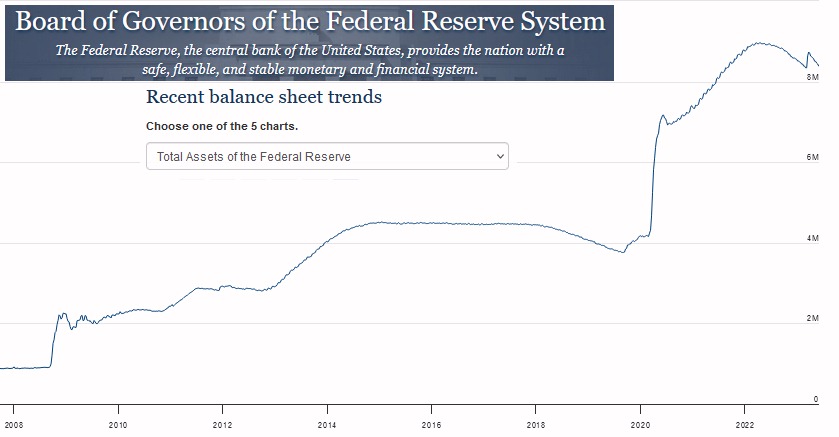
What will the Federal Reserve do? In the Spring of 2022, the Fed said they would not only stop buying Treasuries, but they would also start selling their Treasury assets. Initially, the Fed said the inflation was transitory. They were wrong. In order to fight inflation, the Fed needed to raise interest rates and reduce their assets (Treasuries). The Federal Reserve really shouldn’t be holding assets in the first place. During the financial crisis of 2007-2014, the Federal Reserve started buying trillions of dollars of assets including Treasury securities. Then during the COVID financial crisis, the Fed bought trillions more. In 2022, the Fed did stop buying Treasuries and as the securities matured, the Fed did not participate in as many Treasury rollovers. (Treasury rollover describes the process by which principal payments from maturing Treasury securities held by the SOMA are reinvested in newly auctioned securities.) However, in the graph below you see a sudden uptick in 2023.

Federal Reserve Balance Sheet Assets

The spike in assets in the Spring of 2023 was due to bank failures. The failing banks had billions of dollars in Treasuries that had lost value due to the rising interest rates. When interest rates go up, the value of existing lower yielding securities goes down. So, the Fed bought the devalued assets at full face value. The Fed may also have intervened in the markets to prop up the price of marketable securities in the open market.

What’s Next?
All of these interventions by the Fed have failed to bring inflation down to an acceptable level. Now the Treasury is going to borrow an addition 1 trillion dollars further increasing the demands on borrowing, interest rates, and the banking system. In fact, anything further the Fed does may stoke inflation. If the Fed buys more Treasuries, interest rates will be subsidized lower stimulating inflation. It will in effect be the same as printing money. Rising interest rates will increase the National Debt. Increasing the National Debt will raise interest rates. It is a vicious circle.

While our fiscal and monetary mess is unraveling, the costs of climate change are growing exponentially. Included in the debt ceiling suspension is a provision for unlimited emergency federal spending. Unfortunately this means that the government can continue to ignore the causes of climate change and instead give trillion dollar subsidies to the fossil fuel industry through emergency disaster relief. Yes, another vicious circle — more fossil fuels subsidies result in more climate catastrophes… resulting in more fossil fuel subsidies, etc. The end result will be additional trillions in government borrowing while the standard of living declines.

Recommendations
Given the above, our outlook and recommendations remain the same — persistent inflation and higher interest rates. Individual investors should max-out their annual I Bonds of up to $10k. Leftover saving should be invested in 4-week and 26-week Treasury bills. At maturity securities should be rolled over for the same length of time UNTIL interest rates peak. At that time, longer maturities should be considered.

BONUS
You can make all your transactions commission free at Treasury Direct. Marketable Treasuries are issued at a discounted rate. That means you get paid your interest in advance (giving you an even higher rate of return.)

The Economic Monsters: Inflation and Interest Rates

  1. Economic Forecast = Inflation (2018)
  2. Inflation Bites (2022)
  3. U.S. Mass Consumption Results in Global Economic Disparity, Inequity, and Poverty (2023)
  4. Investment Recommendation: Savings Bonds / I Bonds
  5. Your National Debt

Business & Economics

bookmark_borderThe Collapse of Nature

The World Wildlife Foundation issued a report LIVING PLANET REPORT 2022 showing a near 70% decline in wildlife.

* Monitored populations of vertebrates (mammals, birds, amphibians, reptiles and fish) have seen a devastating 69% drop on average since 1970

* Freshwater species populations have suffered an 83% fall

* The report’s Living Planet Index shows that there is no time to lose in securing a nature-positive society

* Deforestation, human exploitation, pollution, and climate change were the biggest drivers of the loss

Many scientists believe we are living through the sixth mass extinction – the largest loss of life on Earth since the time of the dinosaurs – and that it is being driven by humans.

Tanya Steele, chief executive at WWF-UK, said: “This report tells us that the worst declines are in the Latin America region, home to the world’s largest rainforest, the Amazon. Deforestation rates there are accelerating, stripping this unique ecosystem not just of trees but of the wildlife that depends on them and of the Amazon’s ability to act as one of our greatest allies in the fight against climate change.”

“Despite the science, the catastrophic projections, the impassioned speeches and promises, the burning forests, submerged countries, record temperatures and displaced millions, world leaders continue to sit back and watch our world burn in front of our eyes,” said Steele. “The climate and nature crises, their fates entwined, are not some faraway threat our grandchildren will solve with still-to-be-discovered technology.”

She added: “We need our new prime minister to show the UK is serious about helping people, nature and the economy to thrive, by ensuring every promise for our world is kept. Falling short will be neither forgotten nor forgiven.”

The Human Induced Climate Change Experiment

bookmark_borderTripping Over Tipping Points

by Daniel Brouse
September 12, 2022

Climate change tipping points are positions in an evolving situation that lead to a new and irreversible development.

Some of these tipping points have already been crossed. The methane that escaped from under melting polar ice can not be put back. Melted ice that formed in the Alps 25,000 years ago would take at least 25,000 years to recreate. Permafrost is melting in Greenland, Alaska, Russia, China, and Eastern Europe. As these frozen soils warm, the ground destabilizes, methane is released, well-preserved woolly mammoths are exposed. The Iberdrola group reports, “Melting Siberian permafrost is turning parts of the tundra into muddy landscapes, causing the local flora to disappear and the wildlife that feeds on it to starve. Furthermore, when the permafrost beneath water bodies, such as lakes, melts, the water seeps into the ground and disappears, causing droughts.” None of these changes can easily be restored. Methane is one of the most significant causes of global warming. The release of methane from ancient storage results in a feedback loop — the released methane causes further warming. In turn, the further warming releases more methane.

Climate Tipping Points

“A decade ago we identified a suite of potential tipping points in the Earth system, now we see evidence that over half of them have been activated,” said lead author Professor Tim Lenton, director of the Global Systems Institute at the University of Exeter in 2019.

“The growing threat of rapid, irreversible changes means it is no longer responsible to wait and see. The situation is urgent and we need an emergency response.”

Nine active tipping points:

* Arctic sea ice
* Greenland ice sheet
* Boreal forests
* Permafrost
* Atlantic Meridional Overturning Circulation
* Amazon rainforest
* Warm-water corals
* West Antarctic Ice Sheet
* Parts of East Antarctica

Triggering Multiple Climate Tipping Points

As this study concludes, we have already crossed some tipping points. Tipping points are climate change triggers that will last for 1,000’s or many 1,000’s of years beyond the ending of human emissions.

“Their analysis indicates that even global warming of 1°C, a threshold that we already have passed, puts us at risk by triggering some tipping points. This finding provides a compelling reason to limit additional warming as much as possible.”

We are currently 1.1C above — “risks increase with each tenth of a degree of further warming.”

Research, said: “The world is heading towards 2-3°C of global warming. This sets Earth on course to cross multiple dangerous tipping points that will be disastrous for people across the world. To maintain liveable conditions on Earth, protect people from rising extremes, and enable stable societies, we must do everything possible to prevent crossing tipping points.

CONCLUSION: Exceeding 1.5°C global warming could trigger multiple climate tipping points

“Our assessment provides strong scientific evidence for urgent action to mitigate climate change. We show that even the Paris Agreement goal of limiting warming to well below 2°C and preferably 1.5°C is not safe as 1.5°C and above risks crossing multiple tipping points. Crossing these CTPs can generate positive feedbacks that increase the likelihood of crossing other CTPs. Currently the world is heading toward ~2 to 3°C of global warming; at best, if all net-zero pledges and nationally determined contributions are implemented it could reach just below 2°C. This would lower tipping point risks somewhat but would still be dangerous as it could trigger multiple climate tipping points.”

WARNING:
“Remember these numbers have error bars on them. So if we think a tipping point might not be exceeded at 1.5C, we might be wrong,
and have already exceeded it at 1C,” said climate scientist Sidd Mukherjess.

The Human Induced Climate Change Experiment

bookmark_borderThe Cost of Climate Change: USD 178 trillion

“Time is no longer running out to act on climate change; it’s up,” reports Deloitte. Unchecked climate change could cost the global economy USD 178 trillion over the next 50 years. “The human costs would be far greater: a lack of food and water, a loss of jobs, worsening health and well-being, reduced standard of living.”

Time is no longer running out to act on climate change; it’s up. Download the report.

Time to act—accelerating to zero

With global emissions continuing to rise over the last two decades, we have squandered the chance to decarbonize at our leisure. The global economy needs to execute a rapid, coordinated, sequenced energy and industrial transition that will play out in distinct phases.

* Bold climate plays: Coordination and collaboration set the stage for decarbonization by formulating policies and frameworks for a low-carbon future.
* Accelerating to net zero: Deep investment across systems instigates structural economic adjustments. The decline of emissions-intensive industries would create growing pains for some economies.
* Turning point: Investment in structural economic adjustment is almost complete. Economies would realize the dividend of the transformation and experience net positive growth.
* Low-emission future: Interconnected, low-carbon systems underpin a clean economy that would grow at an increasingly faster rate than its carbon-intensive alternative.

The Human Induced Climate Change Experiment

bookmark_borderWorldwide Droughts

August 2022

There are droughts in North America, South America, Europe, Asia, and Africa.

* UN lists 23 countries that are in severe drought: Afghanistan, Angola, Brazil, Burkina Faso, Chile, Ethiopia, Iran, Iraq, Kazakhstan, Kenya, Lesotho, Mali, Mauritania, Madagascar, Malawi, Mozambique, Niger, Somalia, South Sudan, Syria, Pakistan, the United States and Zambia.

* U.S. officials declared the first-ever water shortage from the Colorado river that serves 40 million people in the West. Water levels at the largest reservoir on the Colorado River — Lake Mead — have fallen to record lows. Along its perimeter, a white “bathtub ring” of minerals outlines where the high water line once stood, underscoring the acute water challenges for a region facing a growing population and a drought that is being worsened by hotter, drier weather brought on by climate change.

* The silvery blue waters of the Great Salt Lake sprawl across the Utah desert, having covered an area nearly the size of Delaware for much of history. For years, though, the largest natural lake west of the Mississippi River has been shrinking. And a drought gripping the American West could make this year the worst yet.

* Baby salmon are dying by the thousands in one California river, and an entire run of endangered salmon could be wiped out in another. Fishermen who make their living off adult salmon, once they enter the Pacific Ocean, are sounding the alarm as blistering heat waves and extended drought in the U.S.

* Extreme drought in northern Mexico has left millions of residents without water.

* From the Atacama Desert to Patagonia, a 13-year megadrought is straining Chile’s freshwater resources to breaking point.

* As Europe’s rivers run dry in a devastating drought that scientists say could prove the worst in 500 years, their receding waters are revealing long-hidden artefacts, from Roman camps to ghost villages and second world war shipwrecks. The so-called “hunger stone” at Děčín is one of dozens in central European rivers engraved to mark their levels during historic droughts – and warn future generations of the famine and hardship likely to follow each time they became visible.

* More and more droughts: How both India and the world is getting affected and what it will lead to. The head of the UN Convention to Combat Desertification, Ibrahim Thiaw, has said that “Humanity is at a crossroads” when it comes to managing drought, and accelerating means of slowing it down must happen “urgently, using every tool we can.

* Pakistan is one of the top 23 countries suffering from a severe drought emergency, a statement issued by the Ministry of Climate Change said. Desertification caused by human and environmental factors has left Pakistan scarred, leading to environmental degradation, loss of soil fertility, loss of biodiversity, and reduction in land productivity, exacerbating the vulnerability of the country’s fragile local communities.

* China issues nationwide drought alert amid extreme heat. A record-breaking 262 weather stations tied or broke their highest temperature on record during the long-running heat wave, which has increased in intensity during the past week. At least 244 cities across China could experience temperatures above 104°F (40°C) on Friday and more than 400 additional cities could see temperatures above 98°F (37°C). The Poyang Lake in central China’s Jiangxi province has shrunk to a quarter of its normal size for this time of year and some 66 rivers in 34 counties in southwestern China have dried up,

* UN food agency scales up assistance for Horn of Africa as millions suffer from drought. Levels of hunger soar in Horn of Africa after back-to-back droughts, threat of famine looms, says World Food Program. Since the start of the year, 9 million more people have slipped into severe food insecurity across Ethiopia, Kenya and Somalia, leaving 22 million people struggling to find enough food to eat, WFP’s regional office in Nairobi said in a statement. “People here have been waiting years for rain – but they cannot wait any longer for life-saving food assistance. The world needs to act now to protect the most vulnerable communities from the threat of widespread famine in the Horn of Africa,” Beasley said.

* In Texas, the heat and lack of rain have uncovered dinosaur tracks from 113 million years ago. “Due to the excessive drought conditions this past summer, the river dried up completely in most locations, allowing for more tracks to be uncovered here in the park,” the Texas Parks and Wildlife Department said in a statement.

* A drought and heat wave in southwestern China have revealed 600-year-old Buddhist statues on a rocky outcrop in the Yangtze River.

The Human Induced Climate Change Experiment

bookmark_borderEurope Drought: And Yes, All Fish Will Die

Water wars… coming to a town near you:
* Europe hydrogeneration is down 20% in France, down 30% in Italy, and down 50% in Spain. And, did you know solar panels are less efficient in high temperatures? There is more resistance in all power lines, too.
* Germany the Rhine water levels fall to new low making it non-navigable for ships
* France is relocating fish into tanks because the water is too warm. Thousands of other fish die due to lack of O2 — “Without rain, the river “will continue to empty. And yes, all fish will die”

Politico reports, Watts going down? Europe’s scorching summer parches hydropower.
“Record-breaking temperatures are starving hydropower plants and raising questions about how to adapt them for the future.”

The Guardian reports, Europe’s rivers run dry as scientists warn drought could be worst in 500 years.
“Crops, power plants, barge traffic, industry and fish populations devastated by parched waterways”

The Human Induced Climate Change Experiment

bookmark_borderClimate Endgame: Exploring Catastrophic Climate Change

Proceedings of the National Academy of Sciences of the United States of America released the study Climate Endgame: Exploring catastrophic climate change scenarios:

Prudent risk management requires consideration of bad-to-worst-case scenarios. Yet, for climate change, such potential futures are poorly understood. Could anthropogenic climate change result in worldwide societal collapse or even eventual human extinction? At present, this is a dangerously underexplored topic. Yet there are ample reasons to suspect that climate change could result in a global catastrophe. Analyzing the mechanisms for these extreme consequences could help galvanize action, improve resilience, and inform policy, including emergency responses.

The Potential for Climate Catastrophe
There are four key reasons to be concerned over the potential of a global climate catastrophe. First, there are warnings from history. Climate change (either regional or global) has played a role in the collapse or transformation of numerous previous societies and in each of the five mass extinction events in Phanerozoic Earth history (38). The current carbon pulse is occurring at an unprecedented geological speed and, by the end of the century, may surpass thresholds that triggered previous mass extinctions. The worst-case scenarios in the IPCC report project temperatures by the 22nd century that last prevailed in the Early Eocene, reversing 50 million years of cooler climates in the space of two centuries.

This is particularly alarming, as human societies are locally adapted to a specific climatic niche. The rise of large-scale, urbanized agrarian societies began with the shift to the stable climate of the Holocene ∼12,000 y ago. Since then, human population density peaked within a narrow climatic envelope with a mean annual average temperature of ∼13 °C. Even today, the most economically productive centers of human activity are concentrated in those areas. The cumulative impacts of warming may overwhelm societal adaptive capacity.
Second, climate change could directly trigger other catastrophic risks, such as international conflict, or exacerbate infectious disease spread, and spillover risk. These could be potent extreme threat multipliers.

Third, climate change could exacerbate vulnerabilities and cause multiple, indirect stresses (such as economic damage, loss of land, and water and food insecurity) that coalesce into system-wide synchronous failures. This is the path of systemic risk. Global crises tend to occur through such reinforcing “synchronous failures” that spread across countries and systems, as with the 2007–2008 global financial crisis (44). It is plausible that a sudden shift in climate could trigger systems failures that unravel societies across the globe.
The potential of systemic climate risk is marked: The most vulnerable states and communities will continue to be the hardest hit in a warming world, exacerbating inequities. Using the medium-high scenario of emissions and population growth, by 2070, around 2 billion people are expected to live in these extremely hot areas. Currently, only 30 million people live in hot places, primarily in the Sahara Desert and Gulf Coast.

Finally, climate change could irrevocably undermine humanity’s ability to recover from another cataclysm, such as nuclear war. That is, it could create significant latent risks (Table 1): Impacts that may be manageable during times of stability become dire when responding to and recovering from catastrophe. These different causes for catastrophic concern are interrelated and must be examined together.

More on Climate Change

bookmark_borderImmigration and the Wage Inflation Spiral

An important factor in our inflation situation is immigration.

The US has stagnant population growth (as does the UK, EU, etc. Japan has a declining population.)

During the Trump administration, the US drastically curtailed immigration. The Biden administration continues to do so today.

The result has been wage inflation. The wage inflation that started in 2018 began the overall inflation spiral that continues today.

A wage inflation spiral happens when the initial wage inflation is canceled out by the price inflation requiring further wage inflation to keep up with the price inflation… the increase prices require more wage inflation for employees to keep pace with the cost of living… the subsequent rise in wages results in the need to raise prices to pay the workers… and round and round we go.

The solutions are to either increase our population (through immigration) and/or increase our productivity by eliminating the need for humans.

How the Inflation Spiral Started: Immigration
The Trump administration’s policy on immigration and building The Wall have a devastating impact on the economy. The U.S. economy is a capitalistic system based on population growth. The birth rate in America is close to zero percent. In order to maintain the standard of living, the country needs to gain millions of people through immigration. The Trump policies have attempted to eliminate immigration.
— Daniel Brouse (2020)

* “Over the course of four years, the Trump administration set an unprecedented pace for executive action on immigration, enacting 472 administrative changes that dismantled and reconstructed many elements of the U.S. immigration system. Humanitarian protections were severely diminished. The U.S.-Mexico border became more closed off. Immigration enforcement appeared more random. And legal immigration became out of reach for many. All of this was accomplished nearly exclusively by the executive branch, with sweeping presidential proclamations and executive orders, departmental policy guidance, and hundreds of small, technical adjustments.” — Migration Policy Institute’s Four Years of Profound Change (2022>

* “After years of wage stagnation, we are finally seeing rising wages,” Donald Trump (State of the Union 2018)
“The Employment Cost Index, a measure of salary and benefit costs, registered a 2.6 percent gain for the full year, tied for the best since 2007.” — CNBC (January 31, 2018)

* From December of 2020 through January of 2022, nominal wages and salaries were up 4.5 percent, the fastest increase since 1983. — Bureau of Labor Statistics (BLS)

ALSO SEE:
The True Costs (and Benefitlessness) of a Trump Economy
The Economic Monsters: Inflation and Interest Rates

bookmark_borderObserved Increases in Well-mixed Greenhouse Gases

2021 saw the largest emissions of greenhouse gases in human history.

The Intergovernmental Panel on Climate Change reported:
The Current State of the Climate

* It is unequivocal that human influence has warmed the atmosphere, ocean and land. Widespread and rapid changes in the atmosphere, ocean, cryosphere and biosphere have occurred.

* Observed increases in well-mixed greenhouse gas (GHG) concentrations since around 1750 are unequivocally caused by human activities. Since 2011 (measurements reported in AR5), concentrations have continued to increase in the atmosphere, reaching annual averages of 410 parts per million (ppm) for carbon dioxide (CO 2), 1866 parts per billion (ppb) for methane (CH 4), and 332 ppb for nitrous oxide (N 2O) in 2019.6 Land and ocean have taken up a near-constant proportion (globally about 56% per year) of CO2 emissions from human activities over the past six decades, with regional differences (high confidence).

* Each of the last four decades has been successively warmer than any decade that preceded it since 1850.

* Human influence is very likely the main driver of the global retreat of glaciers since the 1990s and the decrease in Arctic sea ice area between 1979–1988 and 2010–2019 (decreases of about 40% in September and about 10% in March).

* It is virtually certain that the global upper ocean (0–700 m) has warmed since the 1970s and extremely likely that human influence is the main driver. It is virtually certain that human-caused CO2 emissions are the main driver of current global acidifcation of the surface open ocean.

Anthropological Climate Change and Pollution