bookmark_borderGreenland Is Melting

NASA — Greenland’s snowy surface has been getting darker over the past two decades, absorbing more heat from the sun and increasing snow melt, a new study of satellite data shows. That trend is likely to continue, with the surface’s reflectivity, or albedo, decreasing by as much as 10 percent by the end of the century, the study says.

Greenland's Darkening Ice
Greenland’s Darkening Ice

The Columbia study says:
Greenland’s snowy surface has been getting darker over the past two decades, absorbing more heat from the sun and increasing snow melt, a new study of satellite data shows. That trend is likely to continue, with the surface’s reflectivity, or albedo, decreasing by as much as 10 percent by the end of the century, the study says.

While soot blowing in from wildfires contributes to the problem, it hasn’t been driving the change, the study finds. The real culprits are two feedback loops created by the melting itself. One of those processes isn’t visible to the human eye, but it is having a profound effect.

The results, published in the European Geosciences Union journal The Cryosphere, have global implications. Fresh meltwater pouring into the ocean from Greenland raises sea level and could affect ocean ecology and circulation.

“You don’t necessarily have to have a ‘dirtier’ snowpack to make it dark,” said lead author Marco Tedesco, a research professor at Columbia University’s Lamont-Doherty Earth Observatory and adjunct scientist at NASA Goddard Institute of Space Studies. “A snowpack that might look ‘clean’ to our eyes can be more effective in absorbing solar radiation than a dirty one. Overall, what matters, it is the total amount of solar energy that the surface absorbs. This is the real driver of melting.”

The feedback loops work like this: During a warm summer with clear skies and lots of solar radiation pouring in, the surface starts to melt. As the top layers of fresh snow disappear, old impurities, like dust from erosion or soot that blew in years before, begin to appear, darkening the surface. A warm summer can remove enough snow to allow several years of impurities to concentrate at the surface as surrounding snow layers disappear. At the same time, as the snow melts and refreezes, the grains of snow get larger. This is because the meltwater acts like glue, sticking grains together when the surface refreezes. The larger grains create a less reflective surface that allows more solar radiation to be absorbed. The impact of grain size on albedo – the ratio between reflected and incoming solar radiation – is strong in the infrared range, where humans can’t see, but satellite instruments can detect the change.

“It’s a complex system of interaction between the atmosphere and the ice sheet surface. Rising temperatures are promoting more melting, and that melting is reducing albedo, which in turn is increasing melting,” Tedesco said. “How this accumulates over decades is going to be important, because it can accelerate the amount of water Greenland loses. Even if we don’t have a lot of melting because of atmospheric conditions one year, the surface is more sensitive to any kind of input the sun can give it, because of the previous cycle.”

bookmark_borderOceans Rising at Fastest Rate

A study published in the Proceedings of the National Academy of Sciences states that oceans are rising at a faster rate than any time in the last 3,000 years.

“We can say with 95 percent probability that the 20th-century rise was faster than any of the previous 27 centuries,” said Bob Kopp, a climate scientist at Rutgers University. It is likely that the current sea level rise is the greatest in history; however, it is difficult to research earlier in time.

Mann of Penn State says, “The study nonetheless reiterates the conclusion we reached [in 2011] that the acceleration in sea level rise over the past century is unprecedented over at least the past millennium, and that this acceleration is directly related to the spike in surface temperature over the past century.”

The sea level rise caused primarily by greenhouse gases, could force the emptying of coastal cities.

bookmark_borderThe Fall of the Arctic King

Famous wildlife photographer, Sebastian Copeland, utilized a graphic picture to raise awareness of human induced climate change. “‘For the state of the ice in general, we’re headed into uncharted territory. There’s no doubt about it. The frozen remains of this young bear point to starvation. The faster retreat of the sea ice, a bear’s favoured spot for seal hunting, leads to longer fasting periods and the demise of more animals from starvation.”

Polar Bear Starves Due to Global Warming

More From the Human Induced Climate Change Experiment

bookmark_borderContrails Versus Chemtrails

by Daniel Brouse

When jet engines fly across the sky, there are two different things that happen. Both are likely causing harm to the environment. Neither are being done on purpose. That is to say — there is no conspiracy to spray chemicals. There is no such thing as intentional “chemtrails”.

What is really happening?

#1 — Jet fuel combustion. The jet fuel exhaust that you can’t see is CO2, particulates and gases which contribute to human induced climate change. They are a major cause of global warming and ocean acidification. The European Union states, “Aviation is one of the fastest-growing sources of greenhouse gas emissions. Someone flying from London to New York and back generates roughly the same level of emissions as the average person in the EU does by heating their home for a whole year.”

In 2013, aircraft accounted for nearly 11 percent of carbon dioxide emissions from the U.S. transportation sector, making them responsible for about 3 percent of total U.S. carbon dioxide emissions. (Center for Climate and Energy Solutions)

#2 — Water vapor. Jet engines at high altitude, under certain atmospheric conditions, condense water into droplets to form Condensation trails (contrails). These contrails are the clouds that you can see with the naked eye. Dr. Sidd Mukherjee of the Membrane Domain says, “It is clear that contrails contribute to warming (form high level cirrus that blocks more outgoing radiation than incoming solar) and this effect was seen when air traffic was suspended in 2001.”

Another effect recently studied is caused by jet exhausts generating a layer of ice crystals, ice haze, that promotes a more diffuse type of light. Chuck Long, from the US National Oceanic and Atmospheric Administration (NOAA), said what was occurring is an example of “accidental geoengineering”. He said, “If you look up the definition of geoengineering, it includes large-scale manipulation of parts of the climate system or the environment, and I believe this ice haze from jet traffic does satisfy that requirement.”

The ice haze is scattering the light as it falls on the Earth. The researchers do not think the “sub-visual contrail-generated ice haze” has a major effect on global warming; however, it may have some significant effects on biology, says Prof. Martin Wild of the Swiss Federal Institute of Technology. Plants prefer diffuse light. Mr. Wild explained, “If you have a canopy structure, the direct light is absorbed by the uppermost leaves. Everything below is shaded and so misses out on that energy. But diffuse light can travel deeper into the canopy and can be absorbed by the plants lower down. So in that sense, if you have more diffuse light those lower plants will profit.” What is good for low level plants may be bad for solar panels: “If you’re decreasing the direct light, then you’re decreasing the energy available for those concentrator systems.”

bookmark_borderSignificant Climate Events

National Oceanic and Atmospheric Administration (NOAA)

> November 2015 was the warmest November on record for the globe.
> January-November 2015 (YTD) was the warmest such period on record for the globe.
> September-November (N. Hemisphere fall) was the warmest such period on record for the globe.
> The November 2015 average global sea surface temperature was also the highest on record.

Records date back 136 years.

Climate Events 2015
Climate Events 2015

bookmark_borderDiet And Global Warming

For quite some time, the scientific consensus has been eating meat is worse for the environment than being a vegetarian; however, a new study found a very different result. Lettuce is “over three times worse in greenhouse gas emissions than eating bacon,” according to researchers from the Carnegie Mellon University.

Paul Fischbeck, study co-author and CMU’s professor of social and decisions sciences, said: “Lots of common vegetables require more resources per calorie than you would think. Eggplant, celery and cucumbers look particularly bad when compared to pork or chicken.”

bookmark_borderClimate Change Immigrants and Refugees

By Daniel Brouse

EARTH — As human induced climate change is realized, mammals have started showing patterns of migration. Some conditions are driving animals south due to the loss of their habitat (mostly animals living on ice, such as, seals and polar bears.) Some conditions are allowing animals to migrate further north (like humpback whales.) Some conditions are forcing animals to seek higher ground, as well as, escape salt water intrusion. (eg humans that live on islands)

* NOAA recently concluded that mammals are migrating due to global warming. “Humpback and fin whales are now able to go farther north in most winters, competing with beluga whales for resources,” a scientist for the National Oceanic and Atmospheric Administration said.

* The government of the Marshall Islands has requested climate change refugee status from the United States for former Bikini island residents. “The people of Bikini came back to us and asked us to take this proposal to the US, to request the resettlement trust fund be used to settle people in the US not just the Marshall Islands,” said Tony de Brum, Foreign Minister of the Marshall Islands. “We have not seen the final text of the legislation but the request that went in was on the basis of Kili being uninhabitable because of climate change.”

* In Paris almost 200 countries have ratified a new agreement in an attempt to help mitigate climate change. Included in the deal is $100bn fund to help developing and island countries adapt to global warming.

* Long ago in the United States, FEMA started a forced plan of relocation for homes located in areas prone to flooding.

Chances are large that if you are a mammal you will become a climate change refugee.

More on the Human Induced Climate Change Experiment

bookmark_borderRare Winter Air Quality Alert for Philadelphia

Philadelphia, PA — December 7 and 8, 2015 have been declared “don’t breath in Philly days” by the EPA. It is rare to have a December air quality alert in Philadelphia, PA. It is recommended not to breath in the out-of-doors on alert days. Children, elderly and physically active individuals are most at risk for disease and death.

View the current air quality for Philadelphia.

Philadelphia Air Quality Winter 2015

More on the health risks of air pollution.

Death By Ozone

More on global warming and climate change.

bookmark_borderChina: Air Quality *Red Alert*

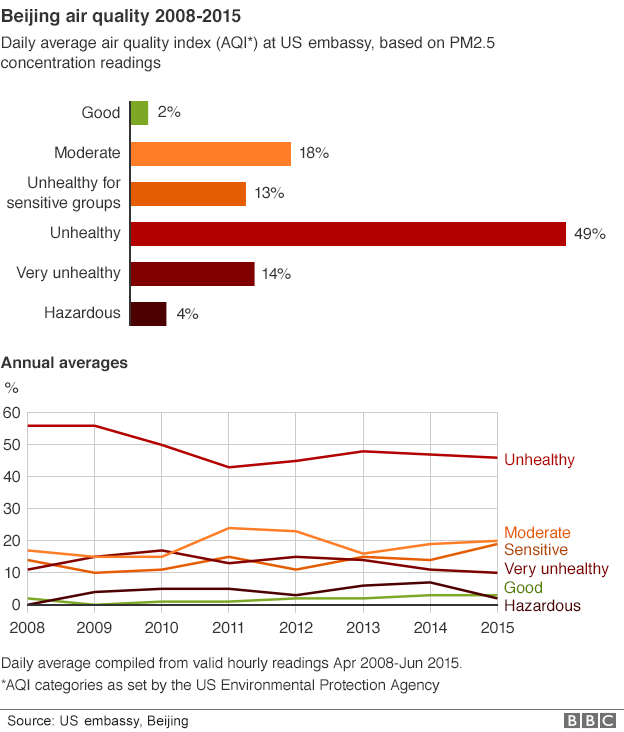
The air pollution in China has become so bad the government has issued their first ever Red Alert. Schools in Beijing are closing and outdoor construction is to cease. The state-run Xinhua news agency says the red alert is the highest possible, and has not been used in the city before.

The air quality is so bad that it is unhealthy to breath. The very young, old and physically active are the most prone to ill-effects. Breathing the air could result in respiratory disease or even death.

Beijing Air Quality
Beijing Air Quality

More on the health risks of air pollution.

More on global warming and climate change.

bookmark_borderLakes Expanding Dangerously

The BBC reports that the glaciers on Mount Everest are melting so fast that they are causing large lakes. No only do the lakes make it difficult to scale the mountain, but if the ice dams break up it could cause massive flooding.

“A decade or so ago, there were individual ponds on the Khumbu glacier but in the past five years or so they have begun to get larger and join up,” said Ann Rowan, who led the field study team from the universities of Sheffield and Leeds.

“Particularly, on the left hand side of the lower reaches of the glacier, there is a series of about seven or eight large ponds that are now starting to link and form a big chain,” she told the BBC.

“There is water flowing from the upper part of the glacier through the series of these ponds and that is going to encourage them to join up.

“At present, the glacier appears to be disintegrating, and may form a few large and potentially hazardous lakes on the glacier surface.”