bookmark_borderClimate Change: the Equation

By Daniel Brouse
August 5, 2023

I’ve been thinking about the giant global warming formula that has been formulating in my head for the last few decades.

Human induced climate change is an exponential component of an unordered system (chaos theory).

Though the equation is complex… too complicated to write down…

I’ve lately begun considering trying to write down a small part of it:
Tipping points and feedback loops are parts of an equation that determine the rate of acceleration in climate change.

What do you think about this?

(t ² * f ²) nth
or
the domino effect * the snowball effect:
(h cos α−(s+d)sin θi+1) * a(1 + r) x

Acceleration, tipping points etc. I know that no simple formula exists for any of these. The reason you can’t write a formula is because they are chaotic systems. Chaos theory is the study of unordered systems; however, trying to write it down helps me quantify what I see in my mind’s eye.

These formulas are similar to what we imagined in 1995:

Abstract
Earth is in a space-time continuum similar to the vortex of a flushing toilet.

if acceleration = velocity/time
and v = speed of light = 2.9979*10^8 m/s
and for the sake of argument we are accelerating at pi (rounded to 15 decimal places) m/s^2
then time = 95426120.77903860 seconds (rounded to 16 significant digits)
= 1104.468990498130 days
= 3.025942439720910 years = roughly 3 years + 9.5 days as relative to the rotation and revolution of the planet earth.

Important note: this is motion at constant speed in a circle. So the speed of light isn’t changing but the direction of motion is, so there is acceleration (= change in velocity, not speed is the acceleration. Velocity has a direction as well as a magnitude, it is a vector, not a scalar like speed.)

a couple other fundamental physical constants to contemplate:
permitivity of free space = 8.854*10^(-12) C^2/(N*m)
permeability of free space = 4(pi)*10^(-7) Wb/(A*m)

SIDD: the tricky part is .. u cannot maintain a constant acceleration like pi m/s^2 on a massive body

In 2023 Sidd added:
On another note, regarding the permeability mu and permittivity epsilon
… those are deeply related to the speed of light thru maxwell’s equations
c=1/sqrt(mu*epsilon)

As for deep contemplation, let me see, in terms of formal schooling
I deeply contemplated those for two years in undergraduate
and about a year and a half in grad school … made my head very pointy.

What you can do today. How to save the planet.

A song about The Human Induced Climate Change Experiment

bookmark_borderA Tipping Point

By Daniel Brouse
August 3, 2023

Push a glass toward the edge of a table and eventually it will fall off on its own. No matter how slowly or meticulously you push… no matter how you weight or fill the glass, it will reach a tipping point and fall off before being pushed completely off the table.

No matter whether you believe the glass is half-empty or half-full, when the tipping point is reached it will plummet out-of-control to its end. This is science not fate, faith, nor belief.

Human induced climate change has resulted in environmental tipping points being breached.

Climate Change Tipping Points

What you can do today. How to save the planet.

A song about The Human Induced Climate Change Experiment

bookmark_borderClimate Change: The End of Times

by Daniel Brouse
July 21, 2023

What will the “End of Times” look like?

In the 1990’s, we wrote a paper on the worst-case scenario entitled, “The Impact of Governance & Globalization on Forecasting (The Tunnel Under Thesis).” The theory predicted that forecasting would become increasing difficult. “The result — a figurative, as well as, literal tunneling underground.”

Since that time, forecasting has become increasing more difficult. “In general, as energy is added to a system, the fluctuations in the system increase. So, we expect more storms, more droughts, more wildfires, more floods, more fluctuations of all kinds. What we are saying is that weather conditions will become more volatile due to the impact of humans,” said Mukherjee and Brouse. (2004)

In a report published in Nature entitled Over half of known human pathogenic diseases can be aggravated by climate change, data analyst and associate professor in the Department of Geography and Environment at the University of Hawaii Manoa, Camilo Mora, said climate hazards aggravated 58% of all known human pathogens. That is over half of infectious diseases discovered since the end of the Roman Empire. 58% of an authoritative list of infectious diseases documented to have impacted humanity have already been shown to be aggravated by climatic hazards — a finding the researchers found “shocking,” Mora said.

Movement of people and animals caused by climate is one factor. Warming at higher latitudes allowed vectors and pathogens to survive winter is another factor. The report goes on to say, “The human pathogenic diseases and transmission pathways aggravated by climatic hazards are too numerous for comprehensive societal adaptations, highlighting the urgent need to work at the source of the problem: reducing GHG (Greenhouse Gas) emissions.”

This research reveals more evidence that humans will have difficulty adapting to climate change, especially those in developing countries, Mora said. “The magnitude of the vulnerability when you think about one or two diseases — okay, sure, we can deal with that,” he said. “But when you’re talking about 58% of the diseases, and 58% of those diseases can be affected or triggered in 1,000 different ways. So that, to me, was also revealing of the fact that we’re not going to be able to adapt to climate change.”

In 2023, I wrote the paper, “Climate Change: How Long Is ‘Ever’?“. When we wrote the Tunnel Under Thesis, we forecast these events would not happen for centuries. We underestimated Man’s ignorance and arrogance. Fossil fuel consumption and greenhouse gas emissions have continued to set record highs. Humans have caused chain-reactions resulting in domino-effects, snowball effects, and feedback loops.

Events we thought would not happen in our lifetimes are happening now. My last resort emergency plan was to escape to Canada. (I am a dual citizen.) This summer that plan literally went up in smoke. “Beginning in March 2023, and with increased intensity starting in June, Canada has been affected by an ongoing, record-setting series of wildfires.” — Wikipedia

All of my life I have located my office and bedrooms in the uppermost southern exposure (preferably in the tree canopy.) I love sunlight, elevation, trees, fresh air, and wildlife. It is becoming ever more obvious my dreamlife is coming to an end, and I will be forced to tunnel under. For those forward thinkers, think about your poop. Pumping sewage above ground level will be a major problem at all times. In addition, the inability to pump flood water will become deadly during extreme weather events. In July of 2020 NPR reported, “The remnants of Hurricane Ida dropped unprecedented rainfall on several eastern states, killing dozens of people. Eleven of them were Queens residents who died when their basement apartments flooded.” In August of 2022 CNN reported, “Seoul has vowed to move some of the city’s poorest families out of underground and semi-subterranean homes after 13 people were killed in flooding caused by record rainfall this week, sparking public horror and calls for government accountability.” Drowning in your own poop may result for those unprepared.

Fresh air, water, food, and light will also be problematic; however, your most severe concern will likely be security. Those with supplies will be at high risk of being raped and looted. Good luck!

More From the Human Induced Climate Change Experiment

bookmark_borderCarbon Offsets: Planting Trees is Greenwashing

By Daniel Brouse
June 28, 2023

This article is in response to “Animal Agriculture is the Leading Cause of Climate Change“.

I said, “About the paper, it is not a good paper… flawed in several ways. The main problem with the paper is it depends on “the potential to sequester over 2000 Giga tons.” No amount of sequestering will solve our problem. Sequestration is only a temporary solution. The most important thing for people to do is stop the use of hydrocarbon based products today… followed by everything else. Minimize consumption of everything.

Plant vegetation sequestration only lasts for several years (with old growth hardwood some sequestration may last up to 100 years.) We wrote a paper on it a few years ago. Though the paper focuses on hemp, it covers all vegetation (The Hemp Myth, Carbon Sinks and the Environment).

Some people argue that we can not abruptly stop the use of fossil fuels or it will cause social unrest. The total collapse of society is inevitable. Even if we stopped using fossil fuels today, we have already baked in a rise of 2 degrees Celsius. “The Earth will exceed 1.5℃ (average global surface temperature over the surface of the earth for ten years) by the 2040’s and a societal collapse will ensue. For the most part, the Earth will be uninhabitable for humans by 2070 UNLESS immediate action is taken.” — Brouse and Mukherjee

The average life of a tree planted for carbon credit sequestration is 7 years. (In addition, “Tree Extinction Due to Human Induced Environmental Stress” is already lowering the life expectancy of all trees.) Climate scientists, such as myself, are against the use of sequestering for carbon credits. Giving carbon offsets for planting trees and allowing for the continued use of fossil fuels is greenwashing and accelerates the pace of climate change.

The Human Induced Climate Change Experiment

bookmark_borderCorsi-Rosenthal Box: The Best Air Purifier

What is a Corsi-Rosenthal Box and how do you build one? The Corsi-Rosenthal Box is a simple DIY air filter and purifier that outperforms and can be more effective than expensive HEPA purifiers.

Corsi-Rosenthal Boxes are made from cardboard, tape, furnace air filters, and a box fan.

Corsi-Rosenthal Box
Corsi-Rosenthal Box

The Corsi-Rosenthal Box was invented by Richard Corsi, PhD, of the University of California-Davis and Jim Rosenthal, CEO of Tex-Air Filters.

“One night, I just scribbled out this idea on a piece of paper,” said Corsi. “It wasn’t an original idea – people had put a single filter on a box fan before. But not with MERV 13 filters.” (MERV — minimum efficiency reporting values — is the measure of how well a filter captures particles. The higher the MERV, the more effective the filter.)

“The Corsi-Rosenthal box outperformed the HEPA filter on every sized particle,” Rosenthal said. “You have such high flow from these fans, way more flow than you get out of a commercial HEPA filter. The air goes through the filter more than once in the same period of time. It may only get 50% of the particles at first. But the second time through, it’s getting much more.”

Corsi-Rosenthal Box Test

Smoke from wildfires in Canada brought record-breaking air pollution to the United States this spring, creating dangerous air quality from Bismarck, N.D., to Denver and Detroit to New York City and Washington. According to a Washington Post analysis of smoke data through June 7 (2023) from Stanford University, 197 air quality monitoring stations have reported all-time high pollution from wildfires.

During the Air Quality Crisis of 2023 the plant-based long-term breathing experiment failed the test. After 4 days in a row of Unhealthy (151 to 200 AQI) to Hazardous (301 and higher AQI) outdoor air quality, the the plant-filtered indoor air quality was unhealthy.

Even with spider plant filled windows and dozens of other plants, humans still suffered from itchy eyes, scratchy throats, and headaches.

Christopher suggested, “You should look into Corsi-Rosenthal… they consistently outperform high-end air filtration systems and it’s a simple DIY project.”

Sidd independently advised, “We are way beyond that (plant filtration). Put in something about Corsi-Rosenthal filters and CO2 monitors to judge ventilation.

Sooo… luckily I had a couple furnace filters, a box fan, and a case of beer. After constructing a crude Corsi-Rosenthal Box, the entire first floor was cleared of noticeable pollutants within 15 minutes. The itchy eyes, scratchy throat, and headache dissipated.

Makeshift / Emergency Corsi-Rosenthal Box

To confirm our results, we brought in the hound dog. Dogs are even more sensitive to air quality. After days of suffering in unhealthy air quality, the hound immediately laid down with his nose in the flow of the circulating Corsi-Rosenthal filtered air.

Conclusion
Air quality is already considered the number one contributing factor to death worldwide. Climate change is making poor air quality even more extreme. A combination of plant and Corsi-Rosenthal filtered air is recommended on a daily basis.

Our experiment was conducted in Southeastern Pennsylvania during an extreme air quality event; however, to our east is Philadelphia. The immediate Philadelphia area rarely has a day of Good air quality. Most summer days are Moderate to Very Unhealthy. To our west is Morgantown and Lancaster County. Even though Lancaster is a much more rural area, it continuously has some of the worst air quality in the world. So it doesn’t really matter where you live, implementing plant and Corsi-Rosenthal filtered air to the daily routine will likely improve your quality and quantity of life.

More on Clean Water, Air, and Healthy Plants
More Things You Can Do to Help the Environment and Your Health


bookmark_borderYour National Debt

by Daniel Brouse
June 8, 2023

The Economic Monsters: Inflation and Interest Rates
I Economic Forecast = Inflation (2018)
II Inflation Bites (2022)
III U.S. Mass Consumption Results in Global Economic Disparity, Inequity, and Poverty (2023)
IV Investment Recommendation: Savings Bonds / I Bonds (2023)

Part V: Your National Debt

The federal government currently has $31.83 trillion in federal debt. So, what does that mean to you?

Some economists say it doesn’t mean anything. As long as the U.S. dollar remains the world’s reserve currency, the federal government can spend without limit. Other economists disagree.

Here is what to watch for:
1. a declining influence of the dollar as the world reserve currency
The dollar has been falling out of favor with many world economies. The dollar has also been sanctioned to be used by many countries and companies. Though efforts by groups like BRICS (Brazil, Russia, India, China, and South Africa) to form their own reserve currency will likely fail, the overall dependency on the dollar is weakening. The dollar will not be able to go on with “business as usual”.

2. the amount of debt (bills, notes, bonds) being sold by the Treasury
In 2023, Congress suspended the debt ceiling. During the April – June 2023 quarter and the Treasury said, “Treasury expects to borrow $726 billion in privately-held net marketable debt, assuming an end-of-June cash balance of $550 billion. The borrowing estimate is $449 billion higher than announced in January 2023.” Now that the debt ceiling has been suspended the Treasury is staring a $1tn borrowing drive. The trillion-dollar borrowing spree will have many impacts. For instance The Financial Times reports, “analysts fear scale of new issuance following debt ceiling fight will push up yields and suck cash out of deposits.” As investors pull their savings out of bank accounts and put it into high yielding Treasuries, this will put an added burden on the already struggling banking sector and further put into play the role of the Federal Reserve.

3. the amount of national debt being bought by the Federal Reserve
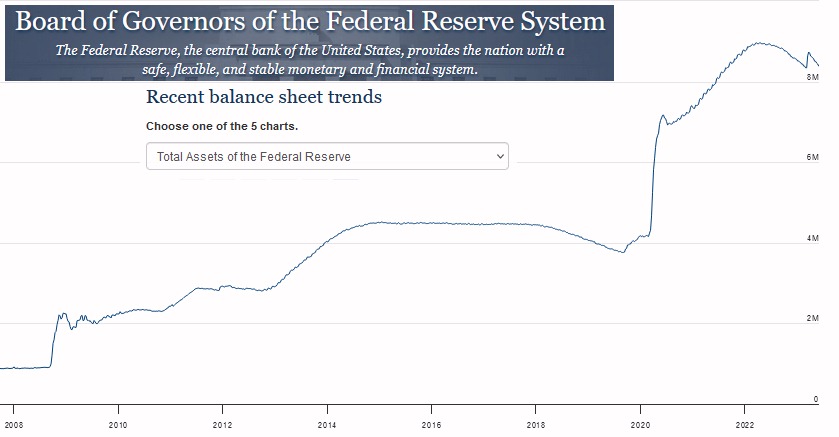
What will the Federal Reserve do? In the Spring of 2022, the Fed said they would not only stop buying Treasuries, but they would also start selling their Treasury assets. Initially, the Fed said the inflation was transitory. They were wrong. In order to fight inflation, the Fed needed to raise interest rates and reduce their assets (Treasuries). The Federal Reserve really shouldn’t be holding assets in the first place. During the financial crisis of 2007-2014, the Federal Reserve started buying trillions of dollars of assets including Treasury securities. Then during the COVID financial crisis, the Fed bought trillions more. In 2022, the Fed did stop buying Treasuries and as the securities matured, the Fed did not participate in as many Treasury rollovers. (Treasury rollover describes the process by which principal payments from maturing Treasury securities held by the SOMA are reinvested in newly auctioned securities.) However, in the graph below you see a sudden uptick in 2023.

Federal Reserve Balance Sheet Assets

The spike in assets in the Spring of 2023 was due to bank failures. The failing banks had billions of dollars in Treasuries that had lost value due to the rising interest rates. When interest rates go up, the value of existing lower yielding securities goes down. So, the Fed bought the devalued assets at full face value. The Fed may also have intervened in the markets to prop up the price of marketable securities in the open market.

What’s Next?
All of these interventions by the Fed have failed to bring inflation down to an acceptable level. Now the Treasury is going to borrow an addition 1 trillion dollars further increasing the demands on borrowing, interest rates, and the banking system. In fact, anything further the Fed does may stoke inflation. If the Fed buys more Treasuries, interest rates will be subsidized lower stimulating inflation. It will in effect be the same as printing money. Rising interest rates will increase the National Debt. Increasing the National Debt will raise interest rates. It is a vicious circle.

While our fiscal and monetary mess is unraveling, the costs of climate change are growing exponentially. Included in the debt ceiling suspension is a provision for unlimited emergency federal spending. Unfortunately this means that the government can continue to ignore the causes of climate change and instead give trillion dollar subsidies to the fossil fuel industry through emergency disaster relief. Yes, another vicious circle — more fossil fuels subsidies result in more climate catastrophes… resulting in more fossil fuel subsidies, etc. The end result will be additional trillions in government borrowing while the standard of living declines.

Recommendations
Given the above, our outlook and recommendations remain the same — persistent inflation and higher interest rates. Individual investors should max-out their annual I Bonds of up to $10k. Leftover saving should be invested in 4-week and 26-week Treasury bills. At maturity securities should be rolled over for the same length of time UNTIL interest rates peak. At that time, longer maturities should be considered.

BONUS
You can make all your transactions commission free at Treasury Direct. Marketable Treasuries are issued at a discounted rate. That means you get paid your interest in advance (giving you an even higher rate of return.)

The Economic Monsters: Inflation and Interest Rates

  1. Economic Forecast = Inflation (2018)
  2. Inflation Bites (2022)
  3. U.S. Mass Consumption Results in Global Economic Disparity, Inequity, and Poverty (2023)
  4. Investment Recommendation: Savings Bonds / I Bonds
  5. Your National Debt

Business & Economics

bookmark_borderClimate Change and Cigarette Litigation

by Daniel Brouse
2016 and 2023

In 2016, I had said: What will create the change needed?
The oil industry is going to be like the tobacco industry. The consumers are going to claim they were misled about the dangers of burning fossil fuels and will file lawsuits against the oil companies. You will not be able to buy oil or get insurance at a reasonable price (similar to what happened to cigarette smokers, or oil could be banned altogether.)

In 2022, WGUR Massachusetts reported, “State attorneys general from around the nation, including here in Massachusetts, are suing fossil fuel companies over climate change. Late last month, the state’s highest court rejected ExxonMobil’s bid to dismiss a lawsuit by Attorney General Maura Healey. And yes, you’ve seen this movie before. The states took Big Tobacco to court, and they won. The 1998 Master Settlement Agreement imposed tight restrictions on how tobacco companies can promote cigarettes, and requires tobacco makers to pay billions of dollars in damages to the states annually, for as long as they do business in the U.S.”

Commonwealth v. Exxon Mobil Corp.
Massachusetts High Court Affirmed Denial of Motion to Dismiss Attorney General’s Climate Change-Related Enforcement Action Against Exxon. The Massachusetts Supreme Judicial Court affirmed a trial court’s denial of Exxon Mobil Corporation’s (Exxon’s) special motion to dismiss the Massachusetts Attorney General’s enforcement action alleging that Exxon’s communications with investors and consumers related to climate change constituted unfair and deceptive practices. Exxon filed the special motion under Massachusetts’s anti-SLAPP (Strategic Litigation Against Public Participation) law, which protects parties exercising their right of petition. The Supreme Judicial Court held that the anti-SLAPP law did not apply to government enforcement actions brought by the Attorney General. The court found that this interpretation was grounded in the statutory language, the rules of construction applicable to enforcement of statutes against the Commonwealth, and the legislative history and purpose of the anti-SLAPP law.

In 2023, the BBC reported, “The findings add to ongoing pressure on the company over what it knew about climate change. Campaigners allege it spread misinformation in order to protect its business interests in fossil fuels and are suing the company in a number of US courts. ExxonMobil’s private research predicted how burning fossil fuels would warm the planet but the company publicly denied the link.”

The report published in Science will be used as evidence against ExxonMobil:
Assessing ExxonMobil’s global warming projections

However, ExxonMobil continues to deny the facts. “This issue has come up several times in recent years and, in each case, our answer is the same: those who talk about how “Exxon Knew” are wrong in their conclusions,” the company told BBC News.

“It really underscores the stark hypocrisy of ExxonMobil leadership, who knew that their own scientists were doing this very high quality modelling work and had access to that privileged information while telling the rest of us that climate models were bunk,” Naomi Oreskes, professor of the history of science at Harvard University, told BBC News.

“Our analysis allows us for the first time to actually put a number on what Exxon knew, which is that the burning of their fossil fuel products was going to heat the planet by about 0.2C of warming every decade,” says co-author Geoffrey Supran, associate professor of environmental science and policy at the University of Miami.

“Their excellent climate modelling was at least comparable in performance to one of the most influential and well-regarded climate scientists of modern history,” Prof Supran said, comparing ExxonMobil’s work to Nasa’s James Hansen who sounded the alarm on climate in 1988.

Prof Oreskes said the findings show that ExxonMobil “knowingly misled” the public and governments. “They had all this information at their disposal but they said very, very different things in public,” she explained.

The research, published in the academic journal Science, also suggests that ExxonMobil had reasonable estimates for how emissions would need to be reduced in order to avoid the worst effects of climate change in a world warmed by 2C or more.

Their scientists also correctly rejected the theory that an ice age was coming at a time when other researchers were still debating the prospect.

The findings add to ongoing pressure on the company over what it knew about climate change. Campaigners allege it spread misinformation in order to protect its business interests in fossil fuels and are suing the company in a number of US courts.

Global Warming and Anthropologic Climate Change

bookmark_borderGreen Energy Technology Stocks

WARNING: an investor should become familiar with their rights and responsibilities as an owner PRIOR to investing.

This is a beginner-intermediate level climate and investor activist portfolio. Stocks are not listed in any particular order. Some of the best performing stocks are not listed because of their questionable environmental impact, business ethics, and country of operation (in particular lithium and cobalt mining.) They are discussed in the advanced portfolio.

The stocks are an educational tool to ownership of the climate crisis. An owner has the duty to understand and implement sustainable practices, human rights, and fiscal responsibility. Investors have particular rights as activists depending on the country of incorporation and operation. In the USA, common shareholders are granted six rights: voting power, ownership, the right to transfer ownership, dividends, the right to inspect corporate documents, and the right to sue for wrongful acts.

Everybody has the responsibility not to pollute.

RYCEY — Rolls Royce / advanced small modular nuclear reactors, green hydrogen and jet engines
LMT — Lockheed Martin / GridStar Flow is an innovative redox flow battery
SSUMY — Sumitomo Electric / redox flow batteries oxidation-reduction reaction of ions of vanadium
MAXN — Maxeon Solar Technologies / designs and manufactures Maxeon and SunPower brand solar panels
NEP – Nextera Energy Partners / portfolio of renewable generation assets consisting of wind and solar projects in North America
HDRO — Defiance Next Gen H2 ETF / green hydrogen
BE — Bloom Energy Corp / fuel cells, green hydrogen
BLDP — Ballard Power Systems Inc / proton exchange membrane fuel cell, green hydrogen
TOSYY — Toshiba Corp / green hydrogen, mini-nuclear plants
BP — British energy / green hydrogen, solar, wind
BAESY — BAE Systems / mini-nuclear development
SIEGY — Siemens / wind, green hydrogen
SMR — Nuscale Power / advanced small modular nuclear reactors
LGO — Largo / vanadium redox flow battery (VRFB)
GWH — ESS Tech Inc / iron flow batteries
FREY — FREYR Battery / semi-solid lithium-ion battery
QS — QuantumScape / develops solid state lithium metal batteries

Sidd said: I haven’t been following publicly traded companies. But for long term bets SSUMI,TOSYY,SIEGY, and surprisingly one that’s not on your list, AEP has some interesting prospects in renewable in spite of their history.

The reason I like Sumitomo, Toshiba, and Siemens is that they are all companies with a long history of bringing large and complicated engineering to market… successfully.

bookmark_borderGlobal Carbon Budget 2022

The Global Carbon Budget 2022 was published by Earth System Science Data.

The report says if emissions aren’t brought down, the world will use up its 1.5-degree-Celsius carbon budget — the amount of CO2 we can emit and stay within 1.5C — within nine years. After go beyond 1.5C the amount of tipping points crossed will bring on irreversible and exponential increasing rates of catastrophic damage.

Global fossil CO2 emissions (including cement carbonation) further increased in 2022, being now slightly above their pre-COVID-19 pandemic 2019 level. The 2021 emission increase was 0.46 GtC yr−1 (1.7 GtCO2 yr−1), bringing 2021 emissions to 9.9 ± 0.5 GtC yr−1 (36.3 ± 1.8 GtCO2 yr−1), same as the 2019 emissions level. Preliminary estimates based on data available suggest fossil CO2 emissions continued to increase by 1.0 % in 2022 relative to 2021 (0.1 % to 1.9 %), bringing emissions of 10.0 GtC yr−1 (36.6 GtCO2 yr−1), slightly above the 2019 level.

Emissions from coal, oil, and gas in 2022 are expected to be above their 2021 levels (by 1.0 %, 2.2 % and −0.2 % respectively). Regionally, emissions in 2022 are expected to have decreased by 0.9 % in China (3.1 GtC, 11.4 GtCO2) and 0.8 % in the European Union (0.8 GtC, 2.8 GtCO2) but increased by 1.5 % in the United States (1.4 GtC, 5.1 GtCO2), 6 % in India (0.8 GtC, 2.9 GtCO2), and 1.7 % in the rest of the world (4.2 GtC, 15.4 GtCO2).

atmospheric CO2 concentration

Anthropologic Climate Change

bookmark_borderMelting of Greenland Ice Cap is Inevitable

“Major sea-level rise caused by melting of Greenland ice cap is ‘now inevitable'”

In 1995, I was convinced climate change was happening at an exponential rate; however, Sidd said we need more data over a longer time period. (The consensus at the time was it was linear, and we had thousands of years to solve the problem.)

It took until 2004 for Sidd to collect enough data. Indeed, we proved it… using sea level rise and Greenland’s ice sheets.

A new study has been published showing that even if we stopped greenhouse gas emissions today, Greenland’s ice sheet would continue to melt raising the sea level by at least 27 centimeters.

The Guardian reported:
“It is a very conservative rock-bottom minimum,” said Prof Jason Box from the National Geological Survey of Denmark and Greenland (Geus), who led the research. “Realistically, we will see this figure more than double within this century.”

“The minimum of 27cm is the sea-level rise deficit that we have accrued to date and it’s going to get paid out, no matter what we do going forward,” said Dr William Colgan, also at Geus. “Whether it’s coming in 100 years or 150 years, it’s coming. And the sea-level rise we are committed to is growing at present, because of the climate trajectory we’re on.”

Colgan said: “If [2012] becomes a normal year, then the committed loss grows to 78cm, which is staggering, and the fact that we’re already flickering into that range [of ice loss] is shocking. But the difference between 78cm and 27cm highlights the [difference] that can be made through implementing the Paris agreement. There is still a lot of room to minimise the damage.”
“There is growing support in the scientific literature for multi-metre levels of rise within the next 100 to 200 years,” said Colgan. A collapse of the colossal east Antarctic ice sheet, which would lead to a 52-metre rise in sea levels if it all melted, could be averted if rapid climate action is taken.

Prof Gail Whiteman, at the University of Exeter, who was not part of the study team, said: “The results of this new study are hard to ignore for all business leaders and politicians concerned about the future of humanity. It is bad news for the nearly 600 million people that live in coastal zones worldwide. As sea levels rise, they will be increasingly vulnerable, and it threatens approximately $1tn of global wealth.” She said political leaders must rapidly scale up funding for climate adaptation and damage.

Read the report from the journal Nature Climate Change: Greenland ice sheet climate disequilibrium and committed sea-level rise

Boycott fossil fuels. Save the planet. Save our souls. (SOS)

More articles on Flood Insurance
Rising Sea Levels

The Human Induced Climate Change Experiment