“The crisis carries a profound warning. As climate change brings more frequent and intense storms, floods, heat waves, wildfires and other extreme events, it is placing growing stress on the foundations of the country’s economy: Its network of roads and railways, drinking-water systems, power plants, electrical grids, industrial waste sites and even homes. Failures in just one sector can set off a domino effect of breakdowns in hard-to-predict ways,” as reported by The New York Times in the article Texas Blackouts Point to Coast-to-Coast Crises Waiting to Happen.
“We are colliding with a future of extremes,” said Alice Hill, who oversaw planning for climate risks on the National Security Council during the Obama administration. “We base all our choices about risk management on what’s occurred in the past, and that is no longer a safe guide.”
“Sewer systems are overflowing more often as powerful rainstorms exceed their design capacity. Coastal homes and highways are collapsing as intensified runoff erodes cliffs. Coal ash, the toxic residue produced by coal-burning plants, is spilling into rivers as floods overwhelm barriers meant to hold it back. Homes once beyond the reach of wildfires are burning in blazes they were never designed to withstand.”
“I am extremely concerned by the lack of emergency-management expertise reflected in Biden’s climate team,” said Samantha Montano, an assistant professor at the Massachusetts Maritime Academy who focuses on disaster policy. “There’s an urgency here that still is not being reflected.”
A White House spokesman, Vedant Patel, said in a statement, “Building resilient and sustainable infrastructure that can withstand extreme weather and a changing climate will play an integral role in creating millions of good paying, union jobs” while cutting greenhouse gas emissions.
“All these issues are converging,” said Robert D. Bullard, a professor at Texas Southern University who studies wealth and racial disparities related to the environment. “And there’s simply no place in this country that’s not going to have to deal with climate change.”
Flood Factor allows you to enter a property address to determine the future risk of severe flooding.
Access data calculated by a team of more than 80 world-renowned experts using decades of peer-reviewed research.
Over 142 million properties, neighborhoods, and cities analyzed
View any home’s Flood Factor and understand what can be done to protect it from flooding.
>FEMA Current Flood Maps by Address
Whether you are in a high risk zone or not, you may need flood insurance because most homeowners insurance doesn’t cover flood damage. If you live in an area with low or moderate flood risk, you are 5 times more likely to experience flood than a fire in your home over the next 30 years. For many, a National Flood Insurance Program’s flood insurance policy could cost less than $400 per year. Call your insurance agent today and protect what you’ve built.
In the study Musculoskeletal involvement of COVID-19, imaging showed evidence the body can attack itself. “There have been emerging reports, however, of an array of neuromuscular and rheumatologic complications related to COVID-19 infection and disease course including myositis, neuropathy, arthropathy, and soft tissue abnormalities. Multimodality imaging supports diagnosis and evaluation of musculoskeletal disorders in COVID-19 patients.”
“In some patients, the nerves are injured and in others, the problem is impaired blood flow,” said Dr. Swati Deshmukh of Northwestern University.
The severity of the COVID illness does not appear to determine these post-COVID conditions. Some of the subjects of the study did not even know they have had COVID-19.
“In some instances, musculoskeletal imaging may even suggest otherwise unrecognized SARS-CoV2 infection.”
“Musculoskeletal disorders can have dire short- and long-term consequences.”
Many post-COVID cases have really high levels of inflammation in their body. It is believed the inflammation is caused by the body’s autoimmune system attacking itself.
“I think it’s important to differentiate between what the virus causes directly and what it triggers the body to do,” Deshmukh said.
When the COVID-19 genome changes, it is called a mutation. When the mutations combine, it is called a variant. When variants combine, it is called a recombination.
The general consensus is SARS-CoV-2 originated from a recombination event. An animal variant combines with a human variant and jumps to humans. When a virus jumps form animals to humans, it is called zoonotic. It is feared recombination events could make SARTS-CoV-2 endemic jumping back and forth between animals and humans.
“Two variants of the SARS-CoV-2 coronavirus that causes covid-19 have combined their genomes to form a heavily mutated hybrid version of the virus. The “recombination” event was discovered in a virus sample in California, provoking warnings that we may be poised to enter a new phase of the pandemic.
The hybrid virus is the result of recombination of the highly transmissible B.1.1.7 variant discovered in the UK and the B.1.429 variant that originated in California and which may be responsible for a recent wave of cases in Los Angeles because it carries a mutation making it resistant to some antibodies,” as reported in NewScientist.
“We may be getting to the point when this is happening at appreciable rates,” says Sergei Pond at Temple University in Pennsylvania, who keeps an eye out for recombinants by comparing thousands of genome sequences uploaded to databases. He says there is still no evidence of widespread recombination, but that “coronaviruses all recombine, so it’s a question of when, not if”.
You asked:
In your opinion – Whats our window to get people vaccinated vs the new variant becoming dominant. Please correct me if I’m wrong – South African Variant not working so well with vaccines. UK Variant is working well with vaccines?
I replied:
Well, it depends what you mean by “people”. Most people in the USA are only talking about themselves, but as you can see by the names of the variants. We need to get 90% of the world population vaccinated. They don’t really know how effective the vaccines will be on the variants, but you are correct… it is believed the South African variant is more evasive and the vaccines are less effective. So, the timeline gets ugly quickly. Current estimates are 7 years for the world to be vaccinated. In 7 years, it is unlikely any of the vaccines will be effective against 7 years of variants. The good news is the mRNA are fairly easy to tweak. Moderna and Pfizer claim they will be able to make boosters for the variants. Probably need a booster every 3-6 months, as long as the variants don’t continue to become more transmissible. The more transmissible the variant the more mutant variants it spawns. In the short term, they believe the UK variant will be dominant in the USA by March.
I’m working on a better way to explain all of this. It’s called “To the nth Degree”. I’m not worried about a mutation. Nor, am I worried about a bunch of mutations ganging up to be a variant. Looking back, I wasn’t worried about variants squared… not even variants cubed. But, when you start talking variants to the nth degree… that’s a different story.
You added:
I think everyone is hoping for the best this summer but with the way the vaccine rollout has been combined with these new variants I feel as if everyone is going to be very disappointed. If we can just untie, mask up and do the right thing for 6 weeks we could tamper down the numbers enough to enjoy a nice summer. I just don’t see this happening.
I’m also trying to wrap my head around a time frame on getting the vaccine (everyone who wants it) vs these new variants taking control. It’s going to be a moot point sooner then later.
I responded:
You are 100% right on. We can not chase this virus with vaccines. We must stop it. As long as it is out of control due to community spread, vaccines will not help. In fact, I’m concerned we may create a vaccine resistant virus. Or, we may have already created a vaccine resistant virus — a zoonotic virus already known to be associated with bats, pangolins, humans, mink, dogs, cats… big cats… lions, tigers, even a puma. We need to remove ourselves from the nth degree.
“So we have a number of examples, around the planet, in which patients’ viruses suddenly have a whole mess of new mutations all at once,” says virologist Jeremy Luban at the University of Massachusetts Medical School. And other cases have likely gone undetected, he says.
“Laboratory experiments have shown that some of those mutations help the virus bypass detection by antibodies.”
The patient went on to get monoclonal antibodies. “Toward the very end of his life, he was treated with monoclonal antibodies, from Regeneron,” Li says. “And shortly thereafter, we saw evidence that suggested the virus was developing resistance or escaping from these antibodies as well.” — From Extraordinary Patient Offers Surprising Clues To Origins Of Coronavirus Variants
There have been discussions about how the COVID-19 mortality rate is declining.
I said:
The mortality rate is probably not declining. In fact, the new variants are likely increasing the mortality rate. The graphs that appear to show the mortality rate declining have more to do with how we are calculating the mortality rate. Compared to how we calculate the flu, the COVID mortality rate is actually around 10-15%. The published numbers are lower because we started including asymptomatic screenings instead of only symptomatic diagnostics.
You asked:
Are you saying the world CHANGED the way it calculates the mortality rate en masse and in a coordinated fashion? Or, are you saying it was and still is calculated wrong?
I replied:
It was not coordinated. It was/is because of the way COVID behaves, so we should not be talking about the mortality rate without making it clear. Traditionally, “a case” is a person showing up at their medical facility (doctor’s office or emergency room) WITH symptoms. “A case” is a doctor’s sick patient case. It has the doctor’s case number, etc. Flu screening tests are not counted in the flu’s mortality rate because they don’t screen for the flu. The more COVID testing of asymptomatic people, the lower the mortality rate will appear to be. It’s not that one way is right / wrong. It is that they are not the same formula.
You asked:
I guess what you’re saying is the flu does not report asymptomatic cases and therefore skews the comparison?
I replied:
Yes. Plus, since last March, screening tests have sky rocketed, so the appearance on the graphs is that the mortality rate is declining. It is not. In fact, the new variants appear to be more deadly. I agree we should identify all asymptomatic cases. I do not agree we should conclude the mortality rate is declining. It is not.
They are testing (screening) more and more people. The more people they test that are not symptomatic, the more it skews the mortality rate. Right now, it is believed the mortality rate is going up. UK, South Africa, Brazil, and California variants are causing more deaths.
You say:
The asymptomatic are just immune, so that certainly REDUCES the true mortality of the disease.
I replied:
No. Asymptomatic are not immune. And, the more asymptomatic people that are tested positive, the more the mortality rate will appear to fall — a false impression. If you want to look at the true mortality rate, it is about 10% in PA (and holding steady.) However, it is more important than ever to test for asymptomatic cases, because 1) asymptomatic cases are spreading the virus 2) asymptomatic cases often result in death or permanent disabilities as a result of COVID side-effects. For instance, many younger people develop multiple inflammatory syndrome, myocardial inflammation, or other deadly conditions.
You asked:
So how is it that asymptomatic cases are not immune?
I replied:
COVID is unlike any other virus we have ever seen… asymptomatic people appear to be just as contagious as symptomatic people. They also appear to develop heart, lung, and brain damage.
Another adds:
I don’t think we have Clarity regarding immunity from having had the disease. There are various studies about the amount of time the antibodies last as well as the variation in the number of antibodies that a person who suffered covid-19 has. Thinking that having the disease creates immunity to the disease is simply basing it on our previous experience of other viruses.
I added:
The original strain of COVID gave immunity on average: antibodies for 90 days and memory T-cells for 5 months. There does not appear to be any immunity to the new variants. And, the longer the virus remains out-of-control ANYWHERE in the world, the more variants will develop.
The worldwide mortality rate went from about 14% (last spring) down to 10% (last summer) and is now on the rise. The decline was likely do to “stay at home”, masking, and other mitigation efforts that helped slow the spread. The more the spread, the more the variants.
To put it another way: Last spring we needed immunity in about 60-75% of the population to reach herd immunity. Now, we need 90% of the world to have immunity to develop herd immunity. (And we have 30% of health care professionals refusing to get vaccinated. in the USA)
Asymptomatic cases should be identified, isolated, and all contacts traced. There currently is no good way to report a mortality rate. Let’s just say it’s way worse than anything we’ve ever seen…. and appears to be getting worse.
You asked:
My understanding regarding the r rate for measles is that it is 15. I thought that the r rate for the original strain of covid-19 is 2.4 and I read that the UK variant has a rate of 2.9. Why are you defining this is the worst we’ve ever seen?
I replied:
With all other viri (including the measles and the flu), the virus is obvious. If you get symptomatic, you are too sick to walk about. Also, knowing you have it, you probably feel it is your moral obligation not to spread it. However, with COVID, many people do not know they are shedding the virus. The result is it’s the worst ever seen. This can be observed in the real world. More drastic measures have been taken to control this virus than any other in history…. yet, more chronically ill victims have resulted. Another way to demonstrate it is: given the drastic change to our lifestyle and economics, this virus has caused more damage than any other… ever. It looks like COVID will have cost the USA 8 trillion dollars for the year. The cost of the flu for the year was $11.2 billion. I think the measles was about $10 million. No other illness, nor war, nor act of god has cost us as much as COVID.
You asked:
Do you have any other articles (perhaps the updated version of the one you attached above) that I might use?
I responded:
I don’t think I’ve written anything else about the problems with COVID mortality statistics. The mortality rate is the lessor of my concerns. My larger concern are people thinking surviving COVID means you recovered from COVID. Or inversely, comparing mortality to “recovered”. Though we don’t know the long term impact until the long term is over, it looks like many millions of Americans (and probably 80 million worldwide) will now have a preexisting condition (such as, Long Haulers Syndrome)… and the pandemic is far from over. Most of my articles o COVID are indexed here: http://membrane.com/COVID-19.html.
And another voice:
And one more thing. Thank you for pointing out that the people “recover“ from COVID-19 there is still so much morbidity out there post infection. We have people that are requiring pacemakers because of myocardial effects, as well as, extensive pulmonary damage due to this virus. I have several friends and colleagues who have had difficulty with their lungs post infection. What we don’t know is the long-term effects that will occur. I myself have no post infection sequelae, but I still don’t know how this could affect my body in the years to come.
I lament:
That is my fear. 1 year out, and I’m still treating my long haulers. My fear is… I could be killing myself over time.
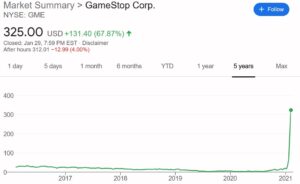
Last week we got to watch the angry young investors invest irrationally making billions of dollars for their favorite hedge funds and the ultra-rich to the tune of 17 billion dollars! Wasn’t that fun?
GameStop (GME) Stock Chart
“Ironically, the army of anti-establishment Reddit traders fattened the fortunes of some of the world’s ultra-rich: Chewy co-founder Ryan Cohen added $1.8 billion; Chinese billionaires Larry Chen and Wang Jianlin added $4.2 billion and $773 million, respectively; and Tootsie Roll CEO Ellen Gordon added $185 million, to name a few.—Andrew Mach”
If you thought that was exciting, stay tuned for the next two weeks as the angry young investors play “Catch the Falling Knife” with their favorite hedge funds. Risk management experts forecast the angry young investors will lose an additional $20 billion to Wall Street.
Spoiler alert: It will be a tragic ending. After the angry young investors put all their money in a bad investment, what will they do next?
You asked: Can you tell me more about the ultra-rich that made billions?
I reply: More important are the hedge funds that made $15-20 billion. You can’t find those numbers easily because they made their money from the positions they already owned (the other side of Melvin Capital’s short sales / puts). There is some reporting you can dig up on it, such as, MUST Asset Management — “GameStop Corp. GME disclosed early Thursday that one of its largest shareholders, South Korea–based MUST Asset Management Inc., no longer held any shares of the videogame and consumer electronics retailer’s shares. MUST had previously owned 3.3 million shares, or about 4.7% of all shares outstanding, which made it GameStop’s ninth largest shareholder, according to data provided by FactSet.”
You question: Are you saying the Reddit gang actually HELPED long position hedge funds as they hurt short position ones?
I respond: Exactly. In this first round 20 billion was transferred from one set of hedge funds to another set of hedge funds. Now, in the next part of the tragedy, the reddit gang will lose their GameStop investment to the same hedge funds… an additional $20 billion or so.
This is a more detailed answer to how puts work using GameStop (GME) as an example:
There are two entities. One owns 100 shares of GME. This entity believes the stock price will remain stable or go up. Lets call this entity U. Another entity thinks the price of the stock will go down. Lets call this entity Melvin.
This transaction took place when the stock price was $5/share.
Melvin comes to U and says I would like to borrow your 100 shares of GME for the next 90 days. Melvin agrees to pay U $1/share for this contract. U gets $100. U gets to keep that money no matter what and gets their 100 shares back in 90 days.
Melvin thinks the stock price is going down in the future… so, Melvin goes out and sells the 100 shares for $5/share. If the price of the stock goes down to $4/share, Melvin can buy back the 100 shares and make $100. (500-400=100). Melvin paid U $100. Melvin breaks even. The most Melvin can make on this deal is $4/share. If the price goes down to $0.01, Melvin can buy back 100/shares for a dollar. 500-100 (contract fee to U)-$1(to buy back the shares) = $399 profit.
On the other hand, if Melvin sells the 100 shares at the market rate of $5/share and the price of the stock goes up, the downside for Melvin is infinite. So, Melvin’s brokerage firm puts limits on how much Melvin can lose. As the price of the stock goes higher, the brokerage firm starts to make “margin calls”. For instance, if the price of the stock goes to $10/share, the brokerage may say Melvin needs to cover half of your shares. Instead of having 100 of U’s shares outstanding, Melvin has to go to the market and buy 50 of U’s shares back at $10/share. Then, if the stock continues to go up to say $15/share, Melvin’s brokerage makes another margin call making Melvin “cover” their outstanding shares by another 50%. Melvin then goes back to the market and buys another 25 shares at $15/share… and so on.
At the end of the 90 days, U get your 100 shares back. U can do with them as U please, and U get to keep the initial $100.
There are no good guys and bad guys. Anyone is allowed to do this. You do not have to be rich or from Wall Street. Instead of playing the side Melvin played, I recommend playing the role of U. It is a riskless way to make money. A smarter way to do this is with an option called a “covered call“.
You say: Interesting you are using “put”. I call this “Sell Short” or “Short Sale” or take a “Short Position.”
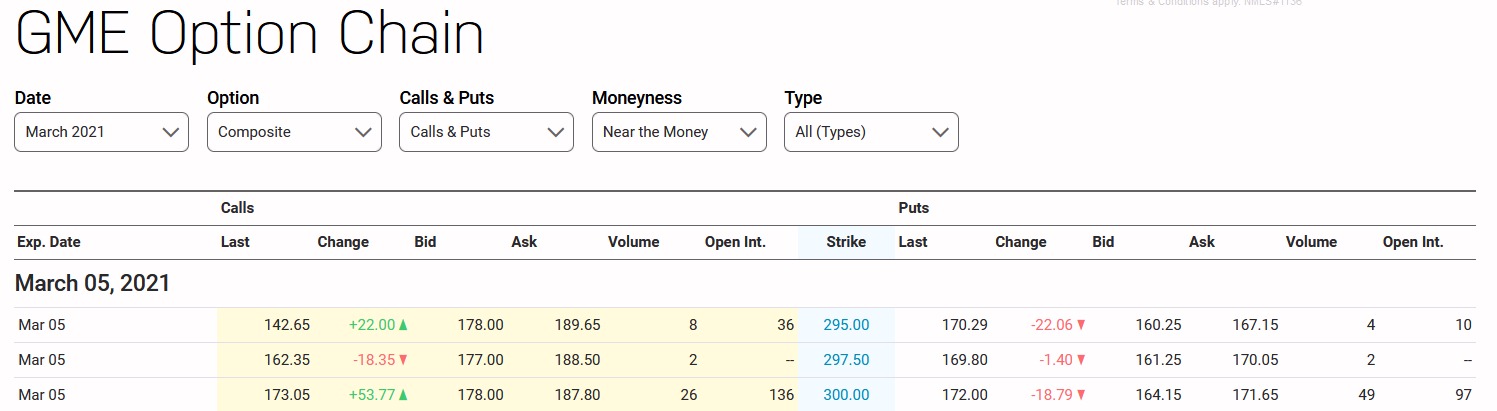
I respond: A put is the writer’s side of the short option — “A short position in a put option is called writing a put. Traders who do so are generally neutral to bullish on a particular stock in order to earn premium income. They also do so to purchase a company’s stock at a price lower than its current market price.” — Investopedia
You can buy 1 put option (a contract on 100 shares) with a strike price of $300 that expires on March 5, 2021 for $172/share. If you pay $17,200, you will get an option that allows you to sell 100 shares of GME stock for $300/share between now and March 5. The last days closing price for GME was $325/share. In the event that GME falls below $300/share, you could exercise the option, buy 100 shares on the open market at the lower price and sell it for $300/share. The stock would have to fall below $128/share for you to make a profit. If you do not exercise the option, you lost your $17,200 investment.
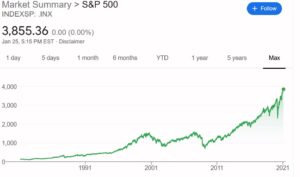
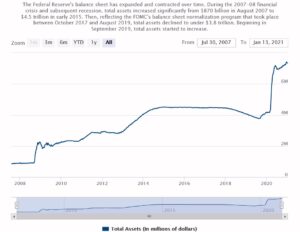
S&P 500 Rise since Fed and Treasury InterventionFederal Reserve Bank Balance Sheet 2020
We were talking about a graph of the record high stock market… and, I said:
You definitely need to keep this graph with it… the main reason the stock market is at this level is because the Federal Reserve has been buying stocks and bonds… lots of them. (That’s over 7 trillion pictured in the graph.) The old, bankers’ saying is “you can’t fight the fed”.
You asked: So, what will happen next?
I replied:
It all depends on how long the Fed can print money. A goodly portion of the bond and equity markets are owned by the Fed. (aka us / socialism / communism) . The US can do this because the dollar is the world reserve currency. Unfortunately for us, the Trump administration has put the dollar’s status in jeopardy. My guess is we have some time… until the dollar implodes. When the dollar implodes, the artificially inflated real estate, bond, and equity markets will collapse. Something like the next 10-20 years all your assets will be worthless.
You asked: do you think Janet will be Yellen and Screamin’ about this practice?
I replied:
Sad to say, no. The gov’t started propping up the private sector in 2008-2009. That was suppose to unwind. There was no unwinding under Yellen…. the real unwinding was suppose to happen under Trump. In 2017, the unwinding stopped… in 2020, the spigot was opened wide and trillions more were pumping in. Now, it is essential to keep the markets from collapsing. Thus, I expect Yellen will be forced to “Buy high and sell low”. Obviously, a failing investment practice.
ETFs are stocks as are Fannie Mae, Freddie Mac, and Ginnie Mae. Nobody knows exactly what the Fed buys, but it is widely believed the Fed started buying S&P 500 ETFs in 2020. In any event, 7 trillion in public and private debt and equities has a significant impact on artificially inflating real estate and the stock market.
You replied:
I understand it as “ETF’s” are “Exchange Traded Funds” and can be ANY investment vehicle.
To your point the Fed is documented to have made ETF Corporate Bond purchases last year …
What I could use your help on is in seeing how the (to Tom’s point) rather nominal $8 billion purchase is causing the dramatic effect seen in the graph.
I responded:
Yes. “An exchange-traded fund is a type of investment fund and exchange-traded product, i.e. they are traded on stock exchanges as stocks.” The reason(s) it bolsters the stock market include: purchases of corporate bond ETFs; purchase of equity based ETFs; purchase of specific corporate debt (eg Amazon, VISA, Kroger); most importantly the lowering of interest rates so that corporations can borrow money at near zero percent and use the money to purchase back their own stock. These are just a few ways the FED is propping up the stock market. Less direct but just as significant is the inflation of real estate (through purchase of mortgage backed securities.) The inflated value of real estate gives individuals the ability to invest (or not cashout) in the stock market. That is to say, if real estate was not inflated right now, people would be cashing out their 401k and IRAs to survive.
The Fed started doing these dirty deals in 2008. When I say dirty deals, I mean using their authority to maintain liquidity in the markets to interfere in private assets and equity. Since 2008, they have gone further and further over the line. In 2008-2009 it was focused mainly on real estate and large purchases (automobiles). In 2020, the Fed added direct and indirect ownership in corporations. For instance, airline debt… $2.2 million in Southwest Airlines debt. This allowed Southwest to borrow billions to keep afloat during the pandemic. Here is an article that explains a lot of it… “the Federal Reserve announced the deployment of additional “tools to support households, businesses, and the U.S. economy overall in this challenging time.” “Overall, $1 trillion in investment-grade bonds have been issued this year, nearly as much as all of 2019, along with tens of billions more in junk bonds from risky companies, which the Fed has also signaled that it would purchase.”
Something that is very important to consider… what is the difference between owning stock in the corporation or junk bonds issued by that corporation? That is to say, what happens to the Fed’s asset when the corporation goes bankrupt? What happens to the Fed’s good bonds when that company is taken over?
You said:
Something we should all remember … zooming back on the nation with a fresh alien perspective is a great exercise and skill …
We have a median household income barely budge since 1980 even after the majority of households went to duel income. It’s about 62,000 against 300% increases in real estate, health insurance and college costs …
Meanwhile market capitalization, cash reserves and productivity for corporations skyrocketed and the wealth gap of a tiny minority of both private individuals and elected officials skyrocketed …
To say “nothing to see here” is impossible if you look from afar …
This is one thing, the Fed, we can focus on for a better understanding. Thanks Daniel Brouse for initiating the discussion.
I add:
Agreed. The best case scenario for the USA would be to eliminate all existing Federal taxes. Establish a Federal pollution tax. Give every American 40k/year stipend.
The FED really does openly keep 2 sets of books. In general, both the Treasury and the Fed do not want to publicly disclose exactly what they are doing. 1) they don’t want to endanger private companies or industries by giving the impression that a company is in trouble 2) they don’t want the markets to undermine their efforts by trying to profit from their actions. A public example of this is in 2008-2009 when all the big banks were forced to take TARP money… whether they needed it or not. [The Fed and the Treasury have two sets of books… one for the public and one that is classified. It’s why we don’t know what stocks they are buying.)
“Making matters worse, the proportion of buybacks funded by corporate bonds reached as high as 30% in both 2016 and 2017,” according to JP Morgan Chase.
The Fed is buying stocks and bonds. And, the Fed is in cahoots with the Treasury (where do you think the Treasury borrows the money from?) The Fed has purchased trillions of dollars in direct and indirect purchase of stocks and bonds. It started in 2008 and continues to this day. US citizens have ownership in many airlines, cruise ships, real estate, General Motors, Chrysler, a multitude of banks and mortgage companies, insurance companies, and much more. That is not to mention the billions and billions lent to corporations to buy back their own stocks. This is the Fed’s money buying stocks. This is The Fed using the money multiplier to bolster the stock market since 2008.
You ask:
I tried to find data on the “stocks” you are referring to and can’t … does one of the articles you attached above have info.
This also pulls in my skepticism that the media is covering everything it should be … but I just can’t find any info so I could use sources.
I reply:
Yes. You can find out about many of the stocks owned by the government. It is a bit tangled. But, you can follow the money. Ask where the money to purchase the assets comes from? A: The Fed. Corporations and the Treasury obtain near zero interest rate money from the Fed. So, in many cases, how the Fed pays for the stocks becomes obscured. It often takes the private sector years so figure out the cash flow. We don’t know that much about 2020… except what was revealed in the CARES act, as well as, the pattern of stock buy backs (there was a big dip in buy backs in the 2nd quarter that coincides with the stock market.) You will have to dig a bit to find the names of the stocks… but they include airlines (Alaska Airlines, Allegiant Air, American Airlines, Delta Air Lines, Frontier Airlines, Hawaiian Airlines, JetBlue Airways, United Airlines, SkyWest Airlines, and Southwest Airlines), cruise ships, and supply chain companies like Amazon and Kruger. Some of the stock buybacks that lineup with the market include MGM, Best Buy, Qualcomm, Kansas City Southern, Lennar, Cummins and Xerox. The acquisition of stocks and stock options from earlier periods has been better routed out by analysts… all of the companies listed in “red” are all on the list: https://projects.propublica.org/bailout/list
You wondered: Am I missing something … these appear to be loans, not stock purchases, yes?
I explain: In 2008 the Federal Reserve and the Treasury colluded on circumventing the restriction on the both the Fed and the Treasury. Now, they are working in concert. You can no longer differentiate between the Fed and the Treasury. Quantitative Easing (QE) and the Troubled Asset Relief Program TARP) completely changed how things worked. (You can see it in the original chart above.) In most instances, the Treasury enters into stock ownership agreements and uses the Fed’s money to complete the deal. So, is it the Fed? or is it the Treasury? is the wrong the question… the right question is “Is it the Fed and treasury? The answer is yes. Now, most of the purchases/deals are under the CARES act. This is in addition to the Fed’s direct investment in public and private bonds, as well as, equities. The Fed is buy ETF’s and individual stocks, as well as… but the public can not find out exactly which ones.
It is very convoluted and in my opinion illegal. Neither the Fed nor the Treasury should be intervening / competing in the private markets. It costs the average citizen a lot of money.
The simplest way to explain is comparing it to an individual trading options with a margin account. In this scenario, the Treasury would be the account holder and the Fed would be the broker — “Buying on margin involves borrowing money from a broker to purchase stock. A margin account increases your purchasing power and allows you to use someone else’s money to increase financial leverage. Margin trading confers a higher profit potential than traditional trading but also greater risks.”
The most important part might be to start with the fact that there should be NO assets on the Fed’s balance sheet. The Fed is suppose to be the banks’ bank… regulating banks to maintain their liquidity and control inflation. Q. Is the Fed part of the government? A. No. The Federal Reserve Banks are not government agencies. The Federal Reserve is quasi-governmental. The Fed is not suppose to lend money to anyone other than member banks and only “overnight” to meet reserve requirements. (Reserve requirements are suppose to be to ensure banks remain solvent.)
Though this is not rocket science, it is convoluted high finance shell games. Very similar to investigating money laundering.
Economics and civics should be taught in every grade K-12 IMHO
A: In 1994, I started a publishing company with another scientist (low temperature physicist and co-builder of the Ohio States supercomputer). The name of the publishing company is The Philadelphia Spirit Experiment. As the name suggests, it is a scientific experiment in the publishing of arts and science. At the time, domain names were free and the world wide web was 6 months old. We wanted a name that both rhymed and made a good scientific pun — everything passes through the Membrane Domain. The KingArthur.com anti-IQ test launched in 1995.
We were the first record company, fine arts, science, technology, math, and engineering publisher on the web. As such, we were the first to analize web traffic. Our monthly audience is over 300 million. Innovations include: the clickable button on a webpage, MP3 distribution, pay-per-download, free streaming music, the web-based video… and interactive games to save the planet (including a $1,000,000 prize to solve the Anthropogenic Global Warming problem.
My areas of expertise include: musicology, geology, meteorology, anthropology, biology, health & wellness, sociology, security, climate change, physics, finance, economics, statistics, computer science, data science, chaos theory, political science, publishing, logic, and philosophy. In general, my aptitude is in science, technology, engineering, and math.