bookmark_borderClimate-Resilient Environment Around Your Home

by Daniel Brouse

Soil is integral to our climate.

What are the best methods to mitigate against climate change by providing wind breaks, shade, moisture retention, and climate control, around my home, as well as prevent soil degradation and desertification?

Creating a sustainable and climate-resilient environment around your home involves a combination of practices that address wind breaks, shade, moisture retention, climate control, and prevention of soil degradation. Here are some effective methods:

  1. Planting Trees and Vegetation:
    • Wind Breaks and Shade: Planting windbreaks, such as rows of trees or shrubs, can protect your home from strong winds and provide shade. Deciduous trees strategically placed on the south and west sides of your home can offer shade during hot seasons while allowing sunlight through during colder seasons.
    • Moisture Retention: Trees and vegetation help retain moisture in the soil by reducing evaporation. Mulching around plants and trees further aids in moisture retention.
    • Climate Control: Trees act as natural air conditioners, cooling the surrounding environment through a process called transpiration. This can contribute to a more comfortable microclimate around your home.
  2. Rainwater Harvesting:
    • Install rain barrels or cisterns to collect rainwater. This harvested water can be used for watering plants, reducing the need for additional irrigation and helping with moisture retention in the soil.
  3. Appropriate Plant Selection:
    • Choose native or drought-resistant plants that are well-suited to your local climate. These plants typically require less water, contribute to soil stability, and are more resilient in the face of climate variability.
  4. Contour Planting and Terracing:
    • Contour planting involves planting along the contour lines of the land to slow down water runoff, promoting infiltration and reducing soil erosion. Terracing is another method to control water runoff on sloped terrain.
  5. Ground Cover and Cover Crops:
    • Planting ground cover or cover crops helps prevent soil erosion, improves moisture retention, and contributes to overall soil health. These plants protect the soil surface from the impact of raindrops and enhance soil structure.
  6. Permeable Surfaces:
    • Use permeable surfaces, such as permeable pavers or gravel, in areas around your home. This allows rainwater to infiltrate into the soil rather than running off, contributing to soil moisture and preventing erosion.
  7. Composting:
    • Implement composting practices to improve soil structure and fertility. Healthy soils are more resistant to erosion, and they can retain moisture better, promoting plant growth.
  8. Integrated Pest Management (IPM):
    • Practice IPM techniques to manage pests without resorting to excessive use of pesticides. Healthy ecosystems are more resilient to climate stresses, and minimizing chemical inputs helps maintain biodiversity and soil health.
  9. Microclimate Planning:
    • Plan your landscaping to create microclimates around your home. For example, placing hard surfaces like rocks or pavement near the home can absorb and release heat, contributing to temperature regulation.
  10. Educate and Involve the Community:
  • Collaborate with neighbors and community members to implement sustainable practices collectively. Building awareness and working together can have a more significant impact on preventing soil degradation and desertification.

By integrating these practices, you can contribute to a more sustainable and climate-resilient environment around your home while mitigating the impacts of climate change and promoting soil health.

The Human Induced Climate Change Experiment

bookmark_borderClimate Change and Chaos Theory

By Daniel Brouse
February 5, 2024

Global warming is caused by an increase in thermal energy. Atmospheric circulation together with ocean circulation is how thermal energy is redistributed throughout the world. Chaos theory offers insights into the complex, nonlinear dynamics of climate systems role in the redistribution of thermal energy. The Earth’s climate is a highly complex and dynamic system, influenced by various factors such as ocean currents, atmospheric circulation, and feedback loops.

Circulation systems of air and/or water include:
* doldrums, trade winds, horse latitudes, prevailing westerlies, polar front zone, and polar easterlies
* each hemisphere has three cells — Hadley cell, Ferrel cell and Polar cell in which air circulates through the entire depth of the troposphere
* usually each hemispheres has two jet streams — a subtropical jet stream and a polar-front jet stream
* waves, tides, currents, downwelling, upwelling move water
* there are over 24 currents — Benguela Current, California Current, Falkland Current, Labrador Current, Brazil Current, Florida Current, Gulf Stream, West Australian Current, Canary Current, Kuroshio Current, North Pacific Current, Somali Current, Antarctic Circumpolar Current, Antarctica Current, Antilles Current, Mozambique Current, North Atlantic Drift, Norwegian Current, Oyashio Current, West Wind Drift, Agulhas Current, South Equatorial Current, Humboldt or Peruvian Current, Monsoon Current
* five major ocean-wide gyres —- the North Atlantic, South Atlantic, North Pacific, South Pacific, and Indian Ocean
* thermohaline (temperature and salinity) circulation systems — Gulf Stream, Atlantic Meridional Overturning circulation (AMOC), Pacific Meridional Overturning Circulation (PMOC)
* ocean-atmosphere oscillations — La Nina / El Niño-Southern Oscillation (ENSO), Antarctic Oscillation (AAO), Arctic Oscillation (AO), Atlantic Multidecadal Oscillation (AMO),
Indian Ocean Dipole (IOD), Madden-Julian Oscillation (MJO), North Atlantic Oscillation (NAO), North Pacific Gyre Oscillation (NPGO), North Pacific Oscillation (NPO), Pacific Decadal Oscillation (PDO), Pacific-North American (PNA) Pattern

How does chaos theory explain thermal energy redistributed throughout the world?

  1. Nonlinear Dynamics:
    • Chaos theory emphasizes the nonlinear dynamics of complex systems, meaning that small changes in initial conditions can lead to disproportionately large and unpredictable outcomes. In the context of climate, this nonlinearity is evident in how the redistribution of thermal energy is influenced by factors like ocean currents and atmospheric circulation, which can exhibit chaotic behavior.
  2. Sensitive Dependence on Initial Conditions:
    • Chaos theory also highlights the concept of sensitive dependence on initial conditions, commonly known as the butterfly effect. In climate systems, small variations in initial conditions, such as temperature or atmospheric pressure, can lead to significant changes in the distribution of thermal energy over time.
  3. Complex Feedback Loops:
    • Climate systems involve intricate feedback loops, where changes in one component can influence others. These feedback loops contribute to the complexity and unpredictability of thermal energy redistribution. Chaos theory helps us understand how these feedback mechanisms can amplify or dampen the effects of perturbations in the system.
  4. Emergent Patterns:
    • Chaos theory recognizes the emergence of complex patterns from seemingly chaotic systems. In climate science, emergent patterns may include large-scale phenomena like El Niño or the Madden-Julian Oscillation, which play roles in redistributing thermal energy on a global scale.
  5. Climate Variability and Change:
    • Chaos theory is particularly relevant in studying climate variability and change. While long-term trends such as global warming are discernible, the inherent chaos in the climate system introduces variability and uncertainty, making it challenging to precisely predict how thermal energy will be redistributed over shorter timescales.
  6. Atmospheric Rivers and Droughts:
    • Atmospheric rivers are concentrated bands of moisture in the atmosphere, and their behavior is influenced by various atmospheric factors. Chaos theory comes into play when trying to predict the exact paths and intensities of atmospheric rivers, especially as small changes in initial conditions can lead to vastly different outcomes over time. Droughts result from complex interactions between atmospheric conditions, precipitation patterns, land use, and water management. Chaos theory highlights the sensitivity of drought conditions to initial conditions and the potential for nonlinear responses, making it difficult to precisely predict the onset, duration, and severity of drought events.

Complex Feedback Loops:

Complex feedback loops in climate science refer to interactions between different components of the Earth’s climate system that can amplify or dampen the effects of initial changes, leading to non-linear and often unpredictable outcomes. These feedback loops play a crucial role in shaping the behavior of the climate system and can influence various climate phenomena, including temperature changes, ice melt, and precipitation patterns.

Tipping points are Critical Milestones that directly impact the rate of acceleration in climate change by multiplying the number and intensity of feedback loops. Identifying and understanding these tipping points is crucial for climate science and policymaking. Crossing multiple tipping points could lead to a domino effect, resulting in a much more rapid and severe climate change than currently projected.

  1. Ice-Albedo Feedback:
    • As the Earth warms, ice and snow melt, reducing the surface area covered by highly reflective materials (high albedo). This leads to a decrease in the Earth’s overall reflectivity, or albedo, as darker surfaces (like open water or bare ground) absorb more solar radiation. The increased absorption of sunlight further warms the surface, accelerating ice melt in a self-reinforcing loop.
  2. Water Vapor Feedback:
    • Warmer temperatures can lead to increased evaporation of water from oceans and other bodies of water. Since water vapor is a greenhouse gas, higher atmospheric water vapor concentrations can enhance the greenhouse effect, trapping more heat and further raising temperatures. This positive feedback loop can contribute to the amplification of global warming.
  3. Carbon Cycle Feedback:
    • The carbon cycle involves the exchange of carbon dioxide (CO2) between the atmosphere, oceans, and terrestrial ecosystems. As the climate warms, it can influence processes like the release of carbon from thawing permafrost or changes in vegetation. The additional release of carbon dioxide can amplify the greenhouse effect, leading to further warming and affecting the carbon cycle in a feedback loop.
  4. Ocean Circulation Feedback:
    • Changes in temperature and salinity affect ocean circulation patterns. Alterations in ocean circulation can, in turn, influence heat distribution across the globe. For example, a slowdown in the Atlantic Meridional Overturning Circulation (AMOC) could impact regional climate patterns and further affect ocean circulation in a complex feedback loop.
  5. Vegetation-Climate Feedback:
    • Climate changes can affect vegetation patterns, altering the amount of sunlight absorbed and the release of water vapor through transpiration. Changes in vegetation cover can influence local and regional climates, creating feedback loops that may further impact ecosystems and climate patterns.
  6. Cloud Feedback:
    • Changes in temperature and atmospheric composition can affect cloud cover and properties. While clouds can both reflect sunlight and trap heat, the net effect depends on factors like cloud altitude and type. Changes in cloud cover and properties can influence the Earth’s radiation balance, creating feedback loops that can either amplify or dampen climate changes.

Chaos theory provides a framework for understanding the inherent complexity, sensitivity, and unpredictability of climate systems, including the redistribution of thermal energy. The interconnectedness of various factors and the nonlinear interactions within the Earth’s climate contribute to the intricate patterns observed in thermal energy distribution on a global scale. Climate models use principles from chaos theory to simulate these dynamic interactions.

The Earth is a climate system. Many subsystems make up our climate. Perhaps the most important factor impacting our climate is us. The biggest influence on climate change is the increase in greenhouse gas concentrations in the Earth’s atmosphere, primarily driven by human activities. The largest drivers of human induced climate change include: burning of fossil fuels, deforestation and land use, industrial processes, agriculture, waste management, and use of fluorinated gases.

Human induced climate change is an exponential component of an unordered system (chaos theory).Chaos theory plays a role in understanding the dynamics and potential unpredictability of social-ecological systems’ impact on climate change. Social-ecological systems encompass the interconnectedness of human societies and the ecosystems they are part of, and their behavior is influenced by a myriad of factors, including human activities, policies, resource use, and environmental changes. Chaos theory contributes insights into the complexity, sensitivity to initial conditions, and potential nonlinearities within these systems.

Here are several aspects in which chaos theory can be relevant to forecasting the impact of social-ecological systems on climate change:

  1. Nonlinear Interactions:
    • Social-ecological systems involve nonlinear interactions between human activities and environmental responses. Small changes in policies, resource management, or societal behaviors can lead to disproportionately large and unpredictable outcomes in terms of climate change impacts.
  2. Sensitivity to Initial Conditions:
    • The sensitivity of social-ecological systems to initial conditions highlights the importance of understanding how small changes or decisions can lead to significant and sometimes unexpected consequences over time. This sensitivity is crucial when forecasting the trajectory of climate change impacts resulting from human activities.
  3. Feedback Loops:
    • Feedback loops within social-ecological systems can amplify or dampen the effects of interventions or changes. For example, policies to reduce greenhouse gas emissions may lead to unforeseen economic or social consequences, creating feedback loops that influence climate change impacts.
  4. Emergent Properties:
    • Chaos theory recognizes emergent properties that arise from the interactions within complex systems. In the context of social-ecological systems, emergent properties may include new social norms, economic trends, or environmental patterns that affect and potentially amplify or mitigate the impacts of climate change.
  5. Thresholds and Tipping Points:
    • Social-ecological systems can exhibit thresholds and tipping points, where small changes gradually accumulate until a critical point is reached, leading to abrupt and sometimes irreversible changes. Chaos theory helps to understand the potential for sudden shifts in behavior within these systems.
  6. Adaptive Capacity:
    • Chaos theory encourages consideration of the adaptive capacity of social-ecological systems. The ability to adapt to changing conditions, learn from experiences, and adjust strategies is essential for forecasting and managing the impacts of climate change within these systems.
  7. Uncertainty and Systemic Risks:
    • Chaos theory underscores the inherent uncertainty in complex systems. Social-ecological systems are subject to systemic risks, where interconnected factors can amplify vulnerabilities. Understanding and managing these uncertainties are crucial for forecasting and responding to climate change impacts.

Incorporating chaos theory into forecasting models for social-ecological systems helps researchers and policymakers recognize the limitations of linear thinking and deterministic approaches. Embracing complexity and uncertainty can lead to more robust and adaptive strategies for addressing the multifaceted challenges posed by climate change within the context of human societies and ecosystems.

Our model attempts to adequately account for humans and forecasts an increase of 9 degrees Celsius above pre-industrial levels.

Toppled Tipping Points: The Domino Effect Brouse and Mukherjee (2023)Tipping Cascades, Social-Ecological Systems, and the Hottest Year in History Brouse (2024)
The Reign of Violent Rain Brouse and Mukherjee (2023)
The Age of Loss and Damage Brouse (2023)
Climate Change Impacts on Flood Risks and Real Estate Values Sidd Mukherjee and Daniel Brouse (2023)

bookmark_borderAtmospheric Rivers and Coastal Erosion

Atmospheric rivers are long, narrow bands of concentrated moisture in the atmosphere that transport large amounts of water vapor. When these atmospheric rivers make landfall, they can bring heavy rainfall over an extended period, leading to increased runoff and potentially contributing to coastal erosion through several mechanisms:

  1. Intense Rainfall: Atmospheric rivers can bring intense and prolonged rainfall, leading to increased runoff from rivers and streams into the coastal areas. This influx of water can contribute to soil erosion and sediment transport, impacting coastal ecosystems.
  2. Flooding: The heavy rainfall associated with atmospheric rivers can cause inland flooding, leading to an increased discharge of water into coastal regions. This excess water can erode coastal land, especially in areas with vulnerable soils.
  3. Storm Surges: In some cases, atmospheric rivers may coincide with storm systems, leading to storm surges along the coast. Storm surges, combined with high winds and heavy rainfall, can intensify erosion along the shoreline.

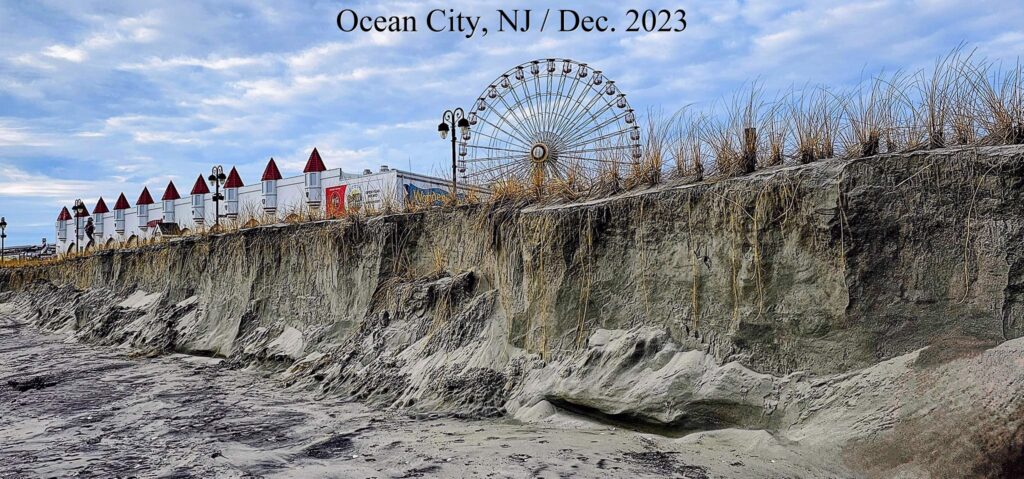
The image shows the Ocean City, New Jersey, shore after an atmospheric river coincided with storm surge.

beach erosion in Ocean City, NJ / December 2023

It’s essential to note that the impact of atmospheric rivers on coastal erosion can vary depending on local topography, land use, and other factors. Coastal erosion is a complex process influenced by a combination of natural and anthropogenic factors, including sea level rise, human activities, and changes in weather patterns.

Owning a Shore Property and Flood Insurance

Extreme Rainfall–surge Hazard Risk Basics and Atmospheric Rivers Brouse (2022)

West Coast Atmospheric Rivers Brouse (2023)

East Coast Atmospheric Rivers Brouse (2023)

Greenland Atmospheric Rivers Mukherjee (2023)

ALSO SEE:
The Reign of Violent Rain Brouse and Mukherjee (2023)
The Age of Loss and Damage Brouse (2023)
Climate Change Impacts on Flood Risks and Real Estate Values Sidd Mukherjee and Daniel Brouse (2023)

bookmark_borderGravity, Sea Level Rise and Surge

by Daniel Brouse and Sidd Mukherjess

In general, the coasts that are seeing the largest storm surges are the same areas that are experiencing the fastest rate of sea level rise. The sea level does not rise at the same rate for most coastlines. Some of the conditions that determine the sea level at any given location include: water temperature (thermal expansion), circulation, ocean floor contour, ice melt, ocean dynamics, and Earth’s uneven gravity field.

Idalia Storm Surge 2023

The Shape of Things to Come
For the foreseeable future, storm surges will offer a good forecast of future sea level rise. Hurricane Idalia’s storm surge (pictured / 2023), brought a 10-15 storm surge to the northern coast of Florida. In 2022, Hurricane Ida brought a 14-20 foot storm surge to the southern coast of Florida. Ida also made landfall in Southeastern USA. Plaquemines Parish on the east bank of the Mississippi River had an estimated storm surge of at least 14 feet. Grand Isle, Louisiana, which was located just east of the landfall, was struck by 10.2 feet and rendered uninhabitable after the storm.

We know these areas of the United States will see sea levels rise at least 10-15 feet because it has already happened. Although it was only for hours, you wouldn’t want to live there during those hours. Not to mention, the frequency of these extreme weather events is rising exponentially. Thus, our recommendation to evacuate Florida now (i.e. Managed Retreat.) The billions of dollars spent to rebuild after Hurricane Ida will all be for naught. Allowing building will needlessly endanger property and lives. Parts of the world have already seen storm surges of 40 feet. I expect most North American coastlines will see sea levels rise, if only temporarily, by 20-40 feet this century. Within a generation, these areas could be submerged most of the time.

Don’t Be Fooled by Relative Variations
The level of the oceans is rising; however, some climate change deniers may try to claim that sea level is receding. Yes, in some instances certain areas will see a decline in the relative sea level. As ice melt accelerates, gravity and glacial isostatic adjustment will have a greater impact on where the sea level rises the most. Greenland is a good example. Greenland has one of the largest land ice sheets. You might think the sea would rise the fastest closest to the melt. “Greenland is like a bowl with large cracks in its sides.” The giant ice mass has sunk the ground, as well as, added a huge mass on top of it. Much of Greenland’s ice melt is just kind-of hanging out in the bowl. Two things are happening to change that:
1) As the ice mass melts, it exerts less gravitational pull on the surrounding water and the water gets pulled toward the equator.
2) At the same time, the Earth is rebounding under the bowl as the mass moves away. Much will depend on the extent and speed of the rebound. Though we don’t know how fast the rebound will happen, NASA has a satellite program gathering better data by measuring the gravitational pull on the satellite (GRACE Tellus Gravity Recovery & Climate Experiment).

At the same time that Greenland is “rising”, many cities are sinking. Alexandria, Amsterdam, Bangkok, Charleston, Miami, New Orleans, New York, Chicago, and Norfolk are all “caving in.” Houston is the 10th-fastest sinking city in the world, and the U.S. city sinking the fastest.

Sidd added, “As the ice melts off Greenland, sea level will rise around Antarctica and drop around Greenland, and as the ice melts in Antarctica, sea will rise around Greenland and drop around Antarctica. In general, sea levels fall where the ice is melting and rise on the other side of the world. There is a small effect on earth rotation and polar direction, but not enough to worry about.”

Measuring Sea Level Rise
So, one of the biggest questions in the future is how do you measure sea level rise? From where the land was pre-industrial, where the land is today, or where the land is tomorrow? In any event, the Earth crossed tipping points which make extreme sea level rise inevitable and irreversible. Planners should plan on it.

Sidd reiterated, “That 270 feet of sea level rise will take a long time. I would be more careful about the violent rain than the ice melt.”

Greenland and the Collapse of the East Antarctic Ice Sheet

Sea Level Rise: Then and Now

Climate Change: Rate of Acceleration

Flood Insurance

The Human Induced Climate Change Experiment

bookmark_borderClimate Change: Atmospheric Rivers

Extreme Rainfall–surge Hazard Risk Basics and Atmospheric Rivers Brouse (2022)

West Coast Atmospheric Rivers Brouse (2023)

East Coast Atmospheric Rivers Brouse (2023)

Greenland Atmospheric Rivers Mukherjee (2023)

ALSO SEE:

Real Estate and Flood Insurance Brouse and Mukherjee (1999 to present)
The Reign of Violent Rain Brouse and Mukherjee (2023)
The Age of Loss and Damage Brouse (2023)
Climate Change Impacts on Flood Risks and Real Estate Values Sidd Mukherjee and Daniel Brouse (2023)

bookmark_borderWest Coast Atmospheric Rivers

by Daniel Brouse

As the Earth warms, the air will hold more moisture. More moisture-laden air moves over land and creates atmospheric rivers (Pineapple Express). The Journal EOS in the article Atmospheric Rivers Spur High-Tide Floods on U.S. West Coast said, “Atmospheric rivers are narrow bands of moisture that travel across the lower troposphere, generally at the leading edges of massive low-pressure systems. At their peak, they can carry as much water through the sky as the Amazon River does on land. They unleash intense winds and heavy rain as they surge across the Pacific Ocean, eventually making landfall on the U.S. West Coast, contributing to many high-tide flooding events.”

The atmospheric rivers also bring heavy rainfall inland causing extreme flooding. In October of 2021 NOAA said, “a convergence of storms brought more than half a foot of rain to parts of the Bay area in addition to strong winds, flash floods, and mud/landslides. They also bring the potential for heavy snow to higher elevations in the Sierra Nevada mountain range.” (Atmospheric River Hits the West Coast)

In December 2022 and January 2023, California experienced nine back-to-back atmospheric rivers; the longest stretch of continuous atmospheric river conditions on record. NOAA went on to report, “Several atmospheric rivers struck in March 2023, bringing heavy rain and snowfall to much of the West. According to the California Department of Water Resources, the statewide snowpack was among the deepest ever recorded for the end of March — 237% of normal.”

In October of 2023, a tropical storm turned into category 5 Hurricane Otis in a record 12-hour intensification. Hurricane expert Kerry Emanual said Otis was supercharged by global warming. Historically, hurricanes’ intensification was driven by ocean surface temperatures. Otis was additionally supercharged by increasing temperatures deeper in the ocean. Hurricane Otis became the strongest on record to hit Mexico’s Pacific coast. NOAA reported, “When Otis first hit, mudslides outside the city in mountainous terrain prevented crews from traveling to the city to provide aid, and according to the Associated Press, the 10,000 troops that were deployed to the area lacked the tools needed to clear mud and downed trees off roads.”

ALSO SEE:
East Coast Atmospheric Rivers Brouse (2023)

The Reign of Violent Rain Brouse and Mukherjee (2023)

The Age of Loss and Damage Brouse (2023)

Climate Change Impacts on Flood Risks and Real Estate Values Sidd Mukherjee and Daniel Brouse (2023)


bookmark_borderThe Snowfall Feedback Loop

by Daniel Brouse
November 26, 2023

Global warming is causing warmer and shorter winters. Not only are White Christmases less frequent, so are icebergs, sea ice, and glaciers. An analysis and maps from NOAA found snowfall is declining globally as temperatures warm due to anthropological climate change.

Snowfall Decline
Snowfall Decline

As the atmosphere’s heat and humidity increase, precipitation is more likely to fall as violent rain or hail than snow. “Eventually the laws of thermodynamics mean that as you keep warming you’re just going to transition more and more of that snow over to rain. You can get away with things for a little bit, and it can hide some trends, but overall the laws of thermodynamics will win out,” said Brian Brettschneider, a climate scientist with the National Weather Service in Alaska.

Justin Mankin, a climate scientist and associate professor of geography at Dartmouth College, said with rising temperatures snowfall will not decline linearly (at a 1-to-1 rate.) Rather, there is a tipping point. Once a certain temperature threshold is reached, “we should expect the losses to accelerate. It means we can expect a lot of the places that haven’t exhibited massive snowfall declines to maybe start to exhibit them with just a little bit more warming.”

Albedo is the reflective nature of snow and measures how much light is reflected without being absorbed when hitting an object (e.g. the fraction of incoming solar radiation that gets reflected back into space). Snow has a very high albedo that reflects most of the light and absorbs very little heat. The snow-albedo feedback loop occurs when the atmosphere gets warmer due to human induced climate change resulting in less snowfall. The less snow reflecting heat back into space, the warmer the earth becomes. The warmer the earth, the less snowfall. The less snowfall, the warmer the earth.

Feedback loops and tipping points are parts of an equation that determine the rate of acceleration in climate change.

The Human Induced Climate Change Experiment

bookmark_borderThe Age of Loss and Damage

by Daniel Brouse

“For people, for other species, for the ecosystems, for the world we live in, we’ve entered the Age of Loss and Damage, but we’re just at the start. What we are seeing already just makes you want to cry,” said Dr. Christopher Trisos (BBC Interview / MP3 Format) from the University of Cape Town. “We can’t eliminate loss and damage. It is here. That said, there is a lot we can do to limit it.”

The 20th-century surface temperature average for Earth was 13.9℃. In the first weeks of July of 2023, the average temperature was 17℃.
Q: Is it possible for humans to survive at temperatures greater than 3℃?
A: Probably not long. Humans have never done it before.

September 6, 2023: “Climate breakdown has begun,” the United Nations Secretary-General Antonio Guterres warned the world after the World Meteorological Organization (WMO) reported the world endure its hottest Northern Hemisphere summer in human history. “The dog days of summer are not just barking, they are biting,” the UN chief said in a statement after the report’s release.

“What we are observing, are not only new extremes but the persistence of these record-breaking conditions, and the impacts these have on both people and planet, are a clear consequence of the warming of the climate system,” C3S’s Climate Change Service Director Carlo Buontempo said.

Climate Breakdown is the most concerning development. Climate breakdown happens when feedback loops are created and tipping points are crossed. Plants will become extinct and many carbon sinks will vanish. The Earth’s temperature will continue to accelerate at an exponential rate no matter what humans do. Food, fresh water, and breathable air will cease to exist. Humans will likely follow in short order.

In October of 2023, the European Space Agency’s Copernicus Climate Change Service calculated that the average temperature for September was 16.38 degrees Celsius (61.48 degrees Fahrenheit) breaking the previous record set in September 2020 by a half-degree Celsius (0.9 degrees Fahrenheit). This is the largest increase in a monthly record high ever.

“It’s just mind-blowing really,” said Copernicus Director Carlo Buontempo. “Never seen anything like that in any month in our records.”

“This is not a fancy weather statistic. It’s a death sentence for people and ecosystems. It destroys assets, infrastructure, harvest,” Imperial College of London climate scientist Friederike Otto said.

On November 20, 2023, the UN’s Emission Gap Report found even if countries carried out their current emissions-reduction pledges, the world would likely continuously exceed +3C degrees of warming this century. Later that day, the International Cryosphere Climate Initiative released State of the Cryosphere Report 2023 saying, “Two degrees is too high. Our message — the message of the Cryosphere — is that this insanity cannot and must not continue. The melting point of ice pays no attention to rhetoric, only to our actions.”

New Economics

Human induced climate change is an exponential component of an unordered system (chaos theory).

The Age of Loss and Damage is a new way of thinking about economics by combining economics, climate science, statistics, and physics. Until now, economic models have been unfit to capture the full extent of climate damage. Traditionally, “integrated assessment models” (IAMs) were used to forecast “shock” events. IAMs use “quadratic function” to calculate GDP losses by squaring the temperature change, yet ignore other methods (such as the exponential function) that are better suited for rapid change. “Climate change is fundamentally different to other shocks because once it has hit, it doesn’t go away,” said Thierry Philipponnat, author of a report by Finance Watch, a Brussels-based public interest NGO on financial issues. “And if the fundamental assumption is flawed, all the rest makes little sense — if any.”

Reuters reported, “Critics say this (IAMs) choice is doomed to underplay the likely impact – particularly if the planet hits environmental tipping points in which damage is not only irreversible but happens at an ever-accelerating rate.” Thierry Philipponnat’s report, Finance in a Hot House World, concludes: “Climate risk is growing to disruptive levels throughout the financial system and the guardians of financial stability urgently need to adapt their tools to regain control.” The report calls for economic models that do not mislead, scenario analyses that prepare the market, and a new prudential tool to address the build-up of systemic climate risk.

Traditional economics is based upon the “costs and benefits” to society. Since there are no known long-term benefits of climate change to society, the Age of Loss and Damage economics focuses on the exponential costs of climate change to society.

Health and Wellness
Humans will experience greater loss and damage to life and quality of life from air pollution, decreasing supply of potable water, extreme weather events, and disease. The greatest short term climate change risk to human health is deadly humid heat (wet-bulb temperature).

Real Estate and Infrastructure
A warmer world will present widespread challenges across many aspects of food-energy-water security and economic development. Infrastructure including roads, bridges, sewer and water plants will become unsustainable. Personal property will suffer loss and damage as homeowners and flood insurance become increasingly difficult to obtain.

In October of 2023 climate scientist Sidd Mukherjee said, “Now I am thinking the violent rain will be a bigger problem before we die… still thinking it through. In the long run, yes, sea level rise will hit big. If you look at the history, it is episodic, and in the fast bits it can go up 3 feet every twenty years for five hundred years. But, the rain intensity is increasing faster today, and drainage cannot cope, whether in the city or out, culverts and such put in over the last hundred years cannot handle. So, I am paying a lot of attention to terrain and drainage far inland from the seacoast (like Ohio.) By drainage I don’t mean just human built. I mean that the natural streams and gullies and ravines have not evolved to a state that can handle the water volumes we see and the worse, larger volumes we will see. So expect huger erosion, steeper slopes to waterways, land collapses and such. Build out your drainage.”

In the spring of 2023, the USA suspended their national debt ceiling. Included in the debt ceiling suspension is a provision for unlimited emergency federal spending. The result is the government can continue to ignore the causes of climate change and instead give trillion-dollar subsidies to the fossil fuel industry through emergency disaster relief. Yes, another vicious circle — more fossil fuels subsidies result in more climate catastrophes resulting in more fossil fuel subsidies, etc. The end result will be additional trillions in government borrowing while the standard of living declines.

According to NOAA, in 2023 (as of November 8), there have been 25 confirmed weather/climate disaster events with losses exceeding $1 billion each to affect United States. These events included 1 drought event, 2 flooding events, 19 severe storm events, 1 tropical cyclone event, 1 wildfire event, and 1 winter storm event. This is the largest number of climate disasters recorded with a notable increase in extreme precipitation events.

Law Suits
What will create the change needed? Loss and damage litigation against oil companies and governments will change world economics.

The oil industry is going to be like the tobacco industry. The consumers are going to claim they were misled about the dangers of burning fossil fuels and will file lawsuits against the oil companies. You will not be able to buy oil or get insurance at a reasonable price (similar to what happened to cigarette smokers.)

Children have filed lawsuits worldwide against their governments over their basic human rights. A district court judge ruled in Held v. Montana that Montana’s Environmental Policy Act, which prohibits the state from considering the climate impact of proposed energy projects, violates the “right to a clean and healthful environment” promised by the state’s constitution.

Also see: Climate Change: How Long Is “Ever”? / Brouse (2023)
The Human Induced Climate Change Experiment

bookmark_borderDeadly Humid Heat in the USA

Deadly humid heat affects billions including the US Midwest this century. “It’s very disturbing,” study co-author Matthew Huber of Purdue University. “It’s going to send a lot of people to emergency medical care.”

The study Greatly enhanced risk to humans as a consequence of empirically determined lower moist heat stress tolerance was conducted by Purdue and George Mason University and published August 15, 2023.

These results indicate that a significant portion of the world’s population will experience — for the first time in human history — prolonged exposures to uncompensable extreme moist heat. Humans will struggle to adapt to these conditions in a warmer world as they will present widespread challenges across many aspects of food–energy–water security, human health, and economic development including in the world’s most populous and most vulnerable regions.

Climate Change and Health

What you can do today. How to save the planet.

Climate Change: The End of Times

The Human Induced Climate Change Experiment

bookmark_borderTipped Tipping Points, Feedback Loops, and the Domino Effect

By Daniel Brouse and Sidd Mukherjee
September 29, 2023

A look at three (3) of the multiple tipping points we appear to have breached and The Domino Effect:

  • Mountain Glacier Loss
  • Collapse of AMOC (Atlantic Meridional Overturning Circulation)
  • Amazon Rainforest Dieback

Crossing one tipping point would be alarming. For instance, crossing the tipping point for ‘mountain glacier loss‘ has immediate consequences: millions of people in Europe will be impacted by the lack of fresh water. Billions of people that live along coasts will be impacted by the saline infiltration and eventually by the submerging of their property. In September of 2022, UNESCO reported accelerated melting of glaciers in World Heritage sites, with glaciers in a third of sites set to disappear by 2050. In September of 2023, the GLAMOS glacier monitoring center found 10% of Swiss glaciers had disappeared in the last 2 years. They do not expect any Swiss glaciers will be left by 2050 no matter what actions are taken. If extreme measures are taken, they anticipate we may be able to save some polar glaciers.

This in and of itself should be alarming; however, it gets worse. Tipping points are parts of feedback loop systems. The ice–albedo feedback loop is an expression of the ability of surfaces to reflect sunlight (heat from the sun). Any loss of ice over a darker surface means the surface will absorb more heat and reflect less heat. This process makes the Earth warmer causing more loss of ice… which in turn causes more warming of the Earth. So, yes, the mountain ice tipping point is quite alarming for both its immediate impact as well as its self-sustaining growth to global warming; but wait, it gets more alarming. The increasing temperatures due to crossing a tipping point cause other tipping points to be toppled (The Domino Effect).

The tipping point for the collapse of AMOC (Atlantic Meridional Overturning Circulation) was thought to be centuries away, at the earliest. In July of 2023, the study Warning of a forthcoming collapse of the Atlantic meridional overturning circulation was published in the journal Nature Communications. “Here we provide statistical significance and data-driven estimators for the time of tipping. We estimate a collapse of the AMOC to occur around mid-century (2025-2095) under the current scenario of future emissions.” The collapse is likely to cause faster sea level rise on the east coast of the US, more severe storms in Europe, and increasing drought in the Sahel in Africa. “From the study of past climate, we know changes in the AMOC have been some of the most abrupt and impactful events in the history of climate,” said Prof. Stefan Rahmstorf, at the Potsdam Institute for Climate Impact Research in Germany and world leading oceanographer. During the last Ice Age, winter temperatures changed by up to 10C within three years in some places. “We are dealing with a system that in some aspects is highly non-linear, so fiddling with it is very dangerous, because you may well trigger some surprises,” he said. “I wish I knew where this critical tipping point is, but that is unfortunately just what we don’t know. We should avoid disrupting the AMOC at all costs. It is one more reason why we should stop global warming as soon as possible.” A feedback loop created by the AMOC tipping point is disruption in weather systems and circulation that cause loss of naturally occurring carbon sinks. One scenario is desertification of the Amazon rainforest.

The tipping point / feedback loop problem is very complex (chaos theory) and exponentially alarming. A third tipping point appears to have been triggered by the summer of 2023 — Amazon Rainforest Dieback. The Amazon is often referred to as ‘the lungs of our planet.’ Not only does the Amazon suck in huge quantities of CO2 and breath out O2, but the Amazon soils also store huge amounts of CO2.  The desertification of the Amazon would result in a release of the carbon as the soils disappeared.

1) much of July was spent at record temperatures +3C
2) the collapse of the Amazon rainforest is likely to happen between +2 – 4C. The collapse of the Amazon is expected to occur because of changing weather patterns and circulation that result in drought.
3) Brazil set up a task force for “unprecedented drought in the Amazon”

Low river levels and hotter waters have killed masses of fish seen floating on river surfaces, contaminating the drinking water, Environment Minister Marina Silva said. “We have a very worrying situation. This record drought has disrupted river transport routes (dropping 30 cm / day) threatening food and water shortages, and a large fish mortality is already beginning.” This was the effect of a periodic El Niño mixing with changes in weather patterns brought by global warming. “We are seeing a collision of two phenomena, one natural which is El Niño and the other a phenomenon produced by humans, which is the change in the Earth’s temperature.” Worsened by climate change, this combination has caused drought not seen before in the Amazon and “is incomparably stronger and could happen more frequently.”

Feedback loops and tipping points are parts of an equation that determine the rate of acceleration in climate change.. Triggering these tipping points results in the CO2 stored in nature to be released. Though we do not know how much carbon is stored in nature, it would be reasonable to assume that the temperature could be pushed from 3 degrees to 6 degrees above pre-industrial levels. Humans cannot thrive above a rise of 1.5 degrees. Humans cannot survive if the temperature rises 6 degrees.

Climate Change Tipping Points

What you can do today. How to save the planet.

Climate Change: The End of Times

The Human Induced Climate Change Experiment