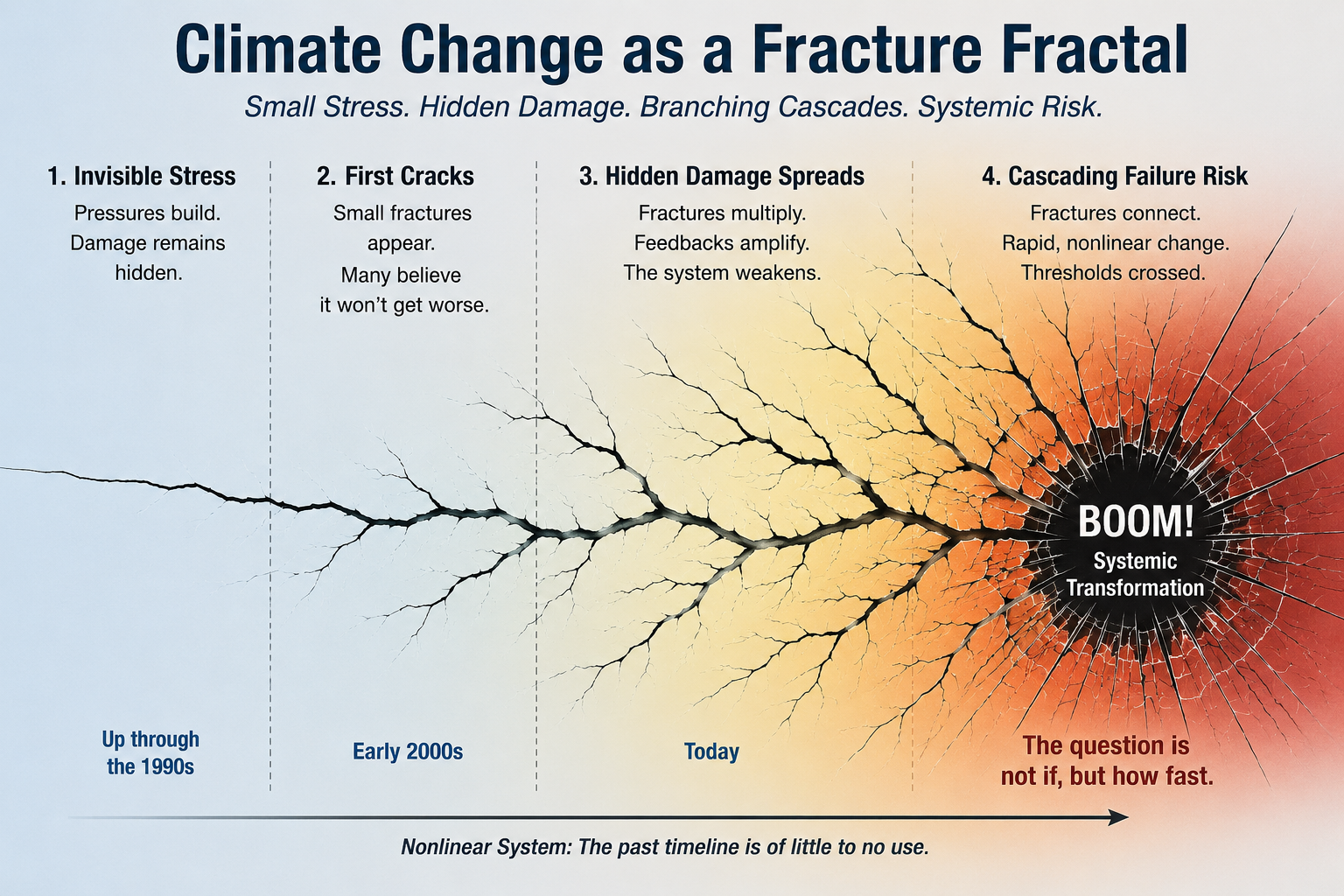
bookmark_borderClimate Change as a Fracture Fractal

In chaos theory, fractal geometry, and fracture mechanics, the pattern you’re describing is usually referred to by several related terms rather than one single universally accepted name:

1. Fracture Fractals

The most common scientific term is fracture fractal or fractal crack pattern.

These occur when a crack propagates through a material and develops:

  • a primary crack (the main line),
  • secondary branches,
  • tertiary “fingers” or microcracks,
  • self-similar branching across scales.

Examples:

  • cracked glass
  • dried mud
  • ice fractures
  • stressed polymers
  • rock fracture networks

2. Dendritic Fractures

If the branching resembles a tree or lightning bolt, it is often called:

Dendritic fracturing

or

Dendritic crack propagation

(“dendrite” means tree-like).

This is common when energy disperses through a material unevenly.


3. Crack Branching Networks

In nonlinear fracture mechanics:

Crack branching
or
branching fracture network

describes the phenomenon where a single crack reaches a critical stress intensity and begins generating daughter cracks.

This is remarkably similar to bifurcation behavior in chaos theory.


4. Lichtenberg Patterns

If the branches become highly fingered and electrical-looking, the geometry resembles:

Lichtenberg figures

https://images.openai.com/static-rsc-4/p7Sp_CHFta7sPjZ-X4WiRjfLsG9loeWHZUM000ZLGvKFdq_y387nOBGCs6cIHqyDNsOuoWVHRSYtHo6aQif1jm0gfeDuJXQ6gVA6WuylQAb366HqI4ZRR9j8odNvFZsdZlqr-A_Tqf9U4YhZ2EFQHC8gnqleSa2DiJxdXCndGwQweBUq2xl5wSF2Y2PsUZiR?purpose=fullsize
https://images.openai.com/static-rsc-4/JQRv-6s41mCxGuGHfql3gaIwnoHG-Z6dDoCP-4IzcHuQ34uG8yPb9C9PfkAmZVNJF8hsmJtv7udSBuVbMt2q1Y3Q6B3vYKc8Xgp96opR0Nwgh-zrmLNu6F39WCIiwoA1p4sU4BWf3YH3JkKdwIu5NCvEwXn7R4aV1ealGDuFb7UCK2Xc7rtDqrCSlar4lujY?purpose=fullsize
https://images.openai.com/static-rsc-4/ZsgDf8iKfToaKkwt1imiSXncSnKjAzRgasYBvnpxvMFVJ_8mUQAqAwg4f9jSJvu8sBeeqWraPnXxYVJvHxwXeI38jZChW73omV7s_ip_HRfCp0MiTfX0Dw889pzycxn-KSsn-i-5abkgc-P8RRJtkwol6Tx8Qve7pVWFkmxmuZ0XMkoMVlIHZ_1Kv5sjzU-M?purpose=fullsize

7

These appear in:

  • lightning strikes
  • dielectric breakdown
  • plasma discharges
  • some glass fractures

They are often analyzed using fractal mathematics.


5. Diffusion-Limited Aggregation (DLA)

From fractal theory, one of the closest mathematical analogs is:

Diffusion-Limited Aggregation

The branching structure often resembles:

  • cracks
  • lightning
  • river networks
  • fungal growth

and exhibits classic fractal scaling.


For the “Cracked Windshield” Climate Analogy

The term that may fit best is:

Fractured Attractor or Cracked Fractal

Those are not standard textbook terms, but they are scientifically meaningful metaphors.

It is essentially describing:

A nonlinear system whose original attractor has become unstable, causing stress to propagate through a branching network of feedbacks and bifurcations.

In chaos-theory language, that is very close to:

  • attractor destabilization
  • cascading bifurcations
  • fracture networks
  • branching criticality
  • percolation cascades

For a climate paper, it would probably be called:

“A Fractured Attractor: Crack Propagation and Cascading Bifurcations in Coupled Climate–Economic Systems”

or simply

“Climate Change as a Fracture Fractal”

because it immediately conveys the image of a small crack evolving into a branching network of instability.

bookmark_borderOzone Feedbacks From Carbon Combustion

Tropospheric Ozone, Ecosystem Collapse, and the Failure of Biofuel Narratives

Daniel Brouse & Sidd Mukherjee

May 9, 2026


Abstract

Tropospheric ozone has emerged as one of the most underestimated systemic threats within the climate crisis. While carbon dioxide remains the primary driver of anthropogenic warming, ground-level ozone functions as a powerful secondary feedback mechanism capable of weakening ecosystems, reducing agricultural productivity, impairing forest carbon sequestration, and accelerating climate instability. Contrary to prevailing narratives, biofuels are not inherently climate-neutral or climate-positive when analyzed within full atmospheric and ecological contexts. All forms of carbon combustion generate ozone precursors, and many biofuels produce equivalent or greater ozone-forming emissions than fossil fuels due to lower combustion efficiency and elevated volatile organic compound (VOC) emissions.

This paper examines the interconnected relationships among fossil fuel combustion, biofuel combustion, tropospheric ozone formation, ecosystem degradation, wildfire amplification, and declining net primary productivity (NPP). We synthesize recent peer-reviewed findings alongside long-term field observations from Pennsylvania forests demonstrating substantial canopy decline, reduced productivity, and increasing forest mortality consistent with ozone stress and nonlinear climate feedback dynamics.

The evidence suggests that tropospheric ozone is no longer merely an air-quality issue but a central driver of cascading ecological destabilization. The weakening of global carbon sinks—including tropical forests, temperate forests, and boreal systems—may represent one of the earliest indicators of systemic climate tipping behavior.


1. Introduction

Biofuels are widely promoted as a solution to climate change under the assumption that they are “carbon neutral” or even “carbon negative.” This assumption is increasingly inconsistent with observed atmospheric chemistry, ecosystem behavior, and lifecycle analysis.

All forms of carbon combustion produce nitrogen oxides (NOx), volatile organic compounds (VOCs), and other ozone precursors. Under sunlight, these compounds react photochemically to form tropospheric ozone (O₃), a highly reactive phytotoxic pollutant. Unlike stratospheric ozone, which protects life from ultraviolet radiation, tropospheric ozone damages living tissue, impairs plant function, and contributes directly to respiratory and cardiovascular disease.

In many cases, biofuels generate ozone-forming emissions equal to or greater than those produced by fossil fuels due to incomplete combustion characteristics and elevated VOC release. Ethanol-blended fuels are particularly notable for increasing ozone precursor formation under high-temperature atmospheric conditions.

The widespread adoption of ethanol blending in the United States following the Renewable Fuel Standard (RFS) of 2005 coincided with measurable ecological deterioration in several regions, including Pennsylvania. Ethanol blending requirements—commonly 10% in gasoline and substantially higher concentrations in some diesel-related applications—corresponded with observable reductions in plant productivity and increasing forest decline beginning in the early 2000s.

The climate implications extend far beyond local pollution. Tropospheric ozone weakens one of Earth’s most critical climate defense systems: the biosphere itself.


2. Tropospheric Ozone and Ecosystem Degradation

2.1 Ozone as a Phytotoxic Pollutant

Ground-level ozone enters plant leaves through stomata, microscopic openings responsible for gas exchange during photosynthesis. Once inside plant tissue, ozone initiates oxidative stress, damages cellular structures, and triggers stomatal closure.

This process produces several cascading effects:

  • Reduced photosynthetic efficiency
  • Lower carbon uptake
  • Decreased growth rates
  • Impaired water regulation
  • Increased susceptibility to drought and heat stress
  • Greater vulnerability to pests and disease

The result is declining net primary productivity (NPP), reduced ecosystem resilience, and ultimately forest mortality.

Tropospheric ozone therefore acts not merely as a pollutant but as a systemic destabilizer of planetary carbon regulation.


3. Evidence of Declining Forest Productivity

3.1 Tropical Forest Carbon Sink Decline

A landmark 2024 study published in Nature Geoscience (“Reduced productivity and carbon drawdown of tropical forests from ground-level ozone exposure”) found that anthropogenic ozone pollution reduced tropical forest net primary productivity by approximately 17% globally since 2000.

Key findings included:

  • Up to 10.9% regional productivity losses in Asia
  • A global reduction of approximately 0.29 petagrams of carbon sequestration annually
  • Accelerating declines in forest carbon drawdown capacity

These findings indicate that ozone pollution is directly weakening the planet’s natural carbon sinks at a globally significant scale.

Rather than mitigating warming, damaged forests increasingly fail to absorb atmospheric CO₂ efficiently, allowing greenhouse gas accumulation to accelerate.


3.2 Pennsylvania Long-Term Forest Observations

Our own long-term field observations in Pennsylvania illustrate these dynamics with alarming clarity.

Since approximately 2003, old-growth forests monitored across multiple intervals have exhibited:

  • Roughly 40% foliage loss
  • Significant canopy thinning
  • Approximately 33% reductions in canopy height
  • Increased rates of premature mortality

These observations mirror global findings associated with ozone stress, heat stress, and hydrological disruption.

Importantly, these declines have occurred even in mature forest systems historically considered resilient. The implications are profound: if old-growth forests are destabilizing, then planetary carbon sink reliability may already be deteriorating faster than current climate models assume.


4. Ozone Feedback Loops and Nonlinear Climate Dynamics

4.1 Interconnected Feedback Systems

Tropospheric ozone participates in a series of reinforcing nonlinear feedback loops:

Fossil fuel and biofuel combustion
→ increased ozone precursors
→ higher ozone concentrations
→ reduced forest productivity
→ weaker carbon sequestration
→ increased atmospheric CO₂
→ greater warming and drought
→ more wildfire activity
→ additional CO₂ and ozone precursor emissions

This cycle is self-reinforcing.

Higher temperatures further accelerate photochemical ozone formation, especially in industrial and transportation-dense regions.

The result is not linear warming but cascading systemic destabilization.


4.2 Wildfire Amplification

Ozone-stressed forests are increasingly vulnerable to wildfire ignition and spread.

Wildfires then:

  • Release massive quantities of stored carbon
  • Produce additional ozone precursors
  • Destroy future carbon sequestration capacity
  • Accelerate desertification and ecosystem collapse

This relationship creates a dangerous compounding mechanism where forests transition from climate stabilizers into climate accelerators.

Recent observations suggest that global forests may already be shifting from net carbon sinks toward net carbon sources.


5. The Amazon and Large-Scale Carbon Sink Failure

The Amazon rainforest represents one of the clearest examples of ozone-driven systemic vulnerability.

Tropospheric ozone impairs photosynthesis throughout the Amazon basin, weakening tree resilience while warming and deforestation intensify drought frequency and severity.

As forest health declines:

  • Carbon sequestration weakens
  • Fire vulnerability rises
  • Regional rainfall recycling diminishes
  • Large-scale dieback risk increases

The Amazon’s hydrological system is critically important for South American rainfall generation. Forest degradation therefore compounds both carbon and water-cycle disruption.

If tipping thresholds are crossed, the Amazon could transition irreversibly from one of Earth’s largest carbon sinks into a major carbon emitter.


6. Human Health Implications

Tropospheric ozone is also a major public health threat.

Chronic ozone exposure is strongly associated with:

  • Asthma
  • Chronic respiratory disease
  • Cardiovascular stress
  • Increased hospitalizations
  • Premature mortality

Children, the elderly, and vulnerable populations face disproportionate risk.

The same combustion systems driving climate destabilization are simultaneously degrading human health.

Thus, ozone feedbacks represent a dual crisis:

  • ecosystem destabilization,
  • and worsening public health outcomes.

7. Rethinking Biofuel Narratives

The assumption that biofuels are inherently sustainable ignores several critical realities:

  • All carbon combustion generates ozone precursors
  • Monocrop agriculture often degrades soils and biodiversity
  • Annual carbon cycling does not create durable carbon sinks
  • Land-use conversion can increase net emissions
  • Ozone pollution undermines ecosystem carbon uptake

Claims of “carbon-negative” biofuels frequently fail to account for:

  • full lifecycle emissions,
  • atmospheric chemistry,
  • ozone formation,
  • ecosystem degradation,
  • and carbon sink impairment.

Replacing one combustion-based system with another does not resolve the underlying atmospheric feedback mechanisms.


8. Conclusion

Tropospheric ozone is emerging as one of the most important yet underrecognized feedback mechanisms in the climate system.

Its impacts extend across:

  • forests,
  • agriculture,
  • hydrology,
  • biodiversity,
  • public health,
  • and atmospheric carbon regulation.

The evidence increasingly suggests that ozone pollution is helping transform global forests from carbon sinks into carbon sources, accelerating climate instability through interconnected nonlinear feedback loops.

This changes the policy discussion fundamentally.

The climate crisis is no longer solely about reducing CO₂ emissions. It is also about preserving the biosphere’s remaining ability to regulate climate through carbon uptake and ecological resilience.

Addressing ozone requires integrated systems-level policy:

  • reducing fossil fuel combustion,
  • reconsidering combustion-based biofuel strategies,
  • limiting NOx and VOC emissions,
  • protecting forests,
  • and recognizing the interconnected nature of climate, biodiversity, atmospheric chemistry, and human health.

Failure to address these feedbacks risks accelerating Earth toward irreversible ecological tipping points.

The question is no longer whether these nonlinear feedback systems exist.

The question is how rapidly they are now accelerating.


References

bookmark_borderWar and Economics Reality

The latest developments surrounding negotiations reveal a fragile and highly conditional pause in hostilities—one that is already being overshadowed by deeper structural disruptions in energy, trade, and global markets.


Status of Negotiations

Frozen Assets

A senior Iranian official has confirmed that part of the agreement to reopen the Strait during the ceasefire period includes the unfreezing of approximately $30 billion in Iranian oil and gas revenues. This represents a significant financial concession and a key incentive for temporary de-escalation.

Sanctions as the Core Demand

While President Trump has expressed optimism about reaching a “quick” deal, Iranian officials continue to emphasize that any lasting agreement must include:

  • Full lifting of international sanctions
  • Potential compensation for war-related damages

Without these elements, Iran has signaled that any agreement would remain temporary and conditional.


The Nuclear Sticking Point

One of the most significant barriers to a long-term resolution remains Iran’s nuclear program.

  • U.S. Proposal: 20-year suspension of all nuclear activity
  • Iran’s Position: 3–5 year limitation with continued oversight

This gap is substantial and reflects fundamentally different strategic objectives. For the U.S., the goal is long-term containment; for Iran, the focus is near-term sovereignty and flexibility.


Reality on the Ground: Trade Still Frozen

Despite the framework of a ceasefire, the physical reality tells a different story:

  • Very few, if any, ships are currently moving through the Strait
  • Maritime risk remains elevated due to security concerns and uncertainty
  • Insurance costs and logistical barriers continue to deter commercial traffic

In effect, the Strait may be “open” in theory—but not yet in practice.


Supply Chain Distortions

Fertilizer Flows Reversing

U.S. fertilizer buyers are now redirecting shipments out of the country, driven by higher prices overseas. This creates a paradox:

  • Domestic supply tightens
  • Global buyers outcompete U.S. demand
  • Food production costs may rise domestically

This is a clear example of how global pricing pressures can override national supply priorities.


Oil Industry Recovery Timeline

Industry sources indicate that full operational recovery could take a minimum of two years, even under stable conditions.

This reflects:

  • Infrastructure damage
  • Logistical bottlenecks
  • Persistent geopolitical risk

In other words, even a successful ceasefire does not quickly restore normalcy.


Market Behavior: Signals or Noise?

Perhaps the most puzzling element is market reaction.

  • Stock market indexes remain near record highs
  • Oil futures have declined sharply, in what some view as an overreaction to optimistic headlines
  • Major announcements have coincided with market closures or low-liquidity periods

The timing and magnitude of these movements raise questions about whether markets are:

  • Reacting to incomplete information
  • Overweighting political signaling
  • Or potentially reflecting more complex dynamics behind the scenes

A Pattern Worth Watching

These developments are not occurring in isolation. They fit into a broader pattern of:

  • Sudden policy announcements
  • Sharp, short-term market moves
  • Ongoing scrutiny around transparency and information flow

While definitive conclusions are difficult to draw, such patterns continue to attract attention from analysts and regulators alike.


Final Thought

The current moment reflects a disconnect between headline progress and underlying reality.

  • Negotiations are active—but unresolved
  • The Strait may be reopening—but remains functionally constrained
  • Markets appear stable—but are sending mixed signals

The result is a system in limbo: neither at war nor at peace, neither stable nor fully disrupted.

And in that uncertainty, the risks—economic, geopolitical, and structural—continue to accumulate beneath the surface.

bookmark_borderCase Study: Climate–Supply Chain–Pandemic Coupling and Hidden Economic Costs

by Daniel Brouse

March 26, 2026

The true economic cost of climate change is amplified through interconnected system dynamics, where localized climate shocks propagate through global supply chains and interact with concurrent systemic risks. A prominent example is the coupling of drought, semiconductor production, and the COVID-19 pandemic.


1. Climate Shock: Water Scarcity and Semiconductor Production

The 2018–2019 drought in Taiwan exposed the sensitivity of critical infrastructure to hydroclimatic variability. Semiconductor manufacturing is highly water-intensive; TSMC consumes on the order of 150,000 tonnes of water per day. During drought conditions, water allocation was prioritized toward industrial production, constraining agricultural systems while exposing a critical vulnerability in global semiconductor supply chains.


2. Supply Chain Propagation

Semiconductors are foundational inputs across multiple sectors, including automotive manufacturing, consumer electronics, telecommunications, and industrial systems. Disruptions propagated globally, producing:

  • Production delays
  • Inventory shortages
  • Cross-sector price increases

This propagation can be generalized as:

Local Shock -> Supply Chain Disruption -> Global Economic Impact

This reflects networked nonlinear amplification, where tightly coupled systems transmit localized perturbations across global scales.


3. Compound Shock: Pandemic Interaction

The emergence of COVID-19 amplified these disruptions through labor shortages, logistical constraints, and demand shocks.

Research by Camilo Mora indicates that climate hazards have aggravated approximately 58% of known human pathogenic diseases, highlighting that climate change acts as a systemic risk multiplier across environmental, biological, and economic domains.


4. Quantifying the Economic Signal

Although precise attribution remains complex, multiple estimates provide order-of-magnitude bounds:

  • Semiconductor shortages (2020–2022): ~$200–500 billion global GDP impact
  • Supply chain disruptions: major contributor to post-pandemic inflation
  • Secondary effects: reduced productivity, delayed investment, increased costs

These represent propagated economic losses, not direct climate damages.


5. Hidden and Long-Term Costs

The full cost extends beyond observed economic signals:

  • Long-term health impacts (e.g., persistent multi-system effects)
  • Labor force contraction and productivity loss
  • Chronic disease burden and healthcare costs
  • Capital misallocation and reduced efficiency

This implies:

Observed Economic Impact << True Systemic Cost

6. Quantifying Underestimation

Define:

  • O(t) = observed economic losses
  • T(t) = true economic losses
  • alpha = underestimation factor

Then:

T(t) = alpha * O(t),   where alpha > 1

Based on integrated assessment models and disaster economics literature, a conservative estimate is:

2 <= alpha <= 5

This implies that true economic impacts may be 2x to 5x larger than observed values.


7. Impact on Doubling Time

Because growth is exponential, underestimation compresses the effective doubling time.

Observed doubling time:

T_d_observed = ln(2) / k

True doubling time:

T_d_true = ln(2) / (k + ln(alpha)/delta_t)

Approximation:

T_d_true ≈ T_d_observed / log2(alpha)

Examples:

  • If alpha = 2 → T_d_true ≈ 0.7 * T_d_observed
  • If alpha = 4 → T_d_true ≈ 0.5 * T_d_observed

Thus:

  • Observed economic doubling time ≈ 8 years
  • Adjusted true doubling time ≈ 4–6 years

8. System Dynamics Interpretation

This case demonstrates that climate change behaves as a complex adaptive system characterized by:

  • Nonlinear amplification
  • Cross-sector coupling
  • Cascading failures
  • Delayed and hidden costs

Small perturbations (e.g., drought) can produce disproportionately large global outcomes, especially when interacting with concurrent shocks.


9. Implications

The presence of hidden and amplified costs implies:

  • Observed damages underestimate true impacts
  • Reported doubling times are conservative
  • Nonlinear acceleration is stronger than observed

This reinforces the conclusion that climate impacts are accelerating through higher-order dynamics (including positive third derivatives) and cascading feedbacks consistent with nonlinear instability.


Part II – Climate Debt vs. Sovereign Debt: A Doubling-Time Framework for Systemic Risk

Abstract

This section introduces a comparative framework between sovereign financial debt and an implied “climate debt,” defined as the cumulative and compounding economic costs of climate change. By modeling both systems as exponential processes, we demonstrate that climate-related liabilities exhibit significantly shorter doubling times due to higher effective growth rates. This divergence provides further evidence of nonlinear amplification and higher-order dynamics in climate–economic systems.


1. Conceptual Framework

Sovereign debt and climate-related economic damages can both be represented as compounding liabilities:

D(t) = D_0 * e^(r * t)

Where:

  • D(t) = total liability at time t
  • D_0 = initial value
  • r = effective growth rate
  • t = time

The doubling time is:

T_d = ln(2) / r

This formulation allows direct comparison between financial and climate-driven systems.


2. Financial Debt Baseline

As of 2025–2026, total U.S. federal debt is approximately:

D_f ≈ $40 trillion

The effective weighted-average interest rate on this debt is approximately:

r_f ≈ 0.03–0.034

This yields a doubling time:

T_d_f = ln(2) / r_f ≈ 20–23 years

This relatively long doubling time reflects institutional controls, monetary policy intervention, and refinancing structures (U.S. Department of the Treasury; Congressional Budget Office).


3. Climate Debt Approximation

We define climate debt as the total economic liability arising from:

  • Physical damages (storms, floods, wildfires)
  • Infrastructure degradation
  • Health impacts
  • Supply chain disruptions
  • Long-term productivity loss

Given substantial underestimation in reported damages, we assume a conservative baseline:

D_c ≈ $40 trillion

This is consistent with integrated assessments suggesting that climate damages may reach several multiples of annual global GDP under high-emissions scenarios (Intergovernmental Panel on Climate Change; Swiss Re).


4. Effective Growth Rate of Climate Damages

Empirical observations indicate that climate-related economic damages are growing at an accelerated rate. Based on observed doubling times of billion-dollar disasters (~8 years), we estimate:

r_c ≈ 0.10–0.15

This reflects:

  • Nonlinear amplification
  • Increasing exposure
  • Feedback-driven escalation

(National Oceanic and Atmospheric Administration; Intergovernmental Panel on Climate Change)


5. Doubling-Time Comparison

Applying the exponential model:

Financial Debt:

T_d_f ≈ 20–23 years

Climate Debt:

T_d_c (10%) ≈ 6.9 years
T_d_c (15%) ≈ 4.6 years

This yields:

T_d_c << T_d_f

or equivalently:

r_c >> r_f

6. Divergence Over Time

Over a 20-year horizon:

Financial Debt:

D_f(20) ≈ 40T * e^(0.032 * 20) ≈ $75–80 trillion

Climate Debt:

At 10%:

D_c(20) ≈ 40T * e^(2.0) ≈ $296 trillion

At 15%:

D_c(20) ≈ 40T * e^(3.0) ≈ $804 trillion

Thus:

Climate Debt / Financial Debt ≈ 4× to 10× (within ~20 years)

7. Nonlinear Amplification Mechanisms

The divergence between financial and climate debt is driven by structural differences:

Financial Debt

  • Policy-constrained
  • Adjustable via interest rates and taxation
  • Governed by institutional frameworks

Climate Debt

  • Driven by physical processes
  • Amplified by feedback loops
  • Coupled across environmental and economic systems

These amplification pathways include:

  • Topographic amplification of flooding
  • Increasing infrastructure exposure
  • Intensification of extreme events
  • Insurance withdrawal and financial contagion

(Marshall Burke et al., 2015; Solomon Hsiang et al., 2017)


8. Higher-Order Dynamics and Instability

The climate system exhibits higher-order dynamics:

dD/dt > 0
d²D/dt² > 0
d³D/dt³ > 0

Where:

  • First derivative: impacts increasing
  • Second derivative: acceleration increasing
  • Third derivative: acceleration of acceleration increasing

This third-derivative behavior (“jerk”) indicates a system approaching nonlinear instability, where growth rates themselves are increasing over time.


9. Implications

The key implication is that climate debt behaves as a high-interest compounding liability:

Climate Debt behaves like a liability with 3–5× faster doubling time than sovereign debt.

Because:

dD_c/dt >> dD_f/dt

It follows that:

Total System Risk → Dominated by Climate Debt over time

10. Conclusion

This analysis demonstrates that:

  1. Financial debt grows at a relatively modest rate (~3%), with doubling times of ~20–23 years.
  2. Climate-related economic damages grow substantially faster (~10–15%), with doubling times of ~5–7 years.
  3. This divergence leads to a rapid expansion of climate liabilities relative to sovereign debt.
  4. The presence of higher-order dynamics (d³D/dt³ > 0) suggests that current estimates are likely conservative.
  5. Within one to two decades, climate debt may exceed financial debt by an order of magnitude, representing a dominant source of systemic risk.

These findings reinforce the broader conclusion that climate change is not merely an environmental issue, but a rapidly accelerating financial liability governed by nonlinear dynamics. More importantly, these systems are interconnected through reinforcing feedback loops. As climate-related damages increase alongside sovereign debt burdens, upward pressure on effective interest rates is likely to emerge, driven by heightened risk, fiscal strain, and capital reallocation. This dynamic compounds long-term liabilities, increasing the probability of unsustainable debt trajectories for future generations. If left unmitigated, such coupled dynamics may accelerate systemic financial instability and elevate the risk of broader economic disruption.

References

  • Intergovernmental Panel on Climate Change (2023). Sixth Assessment Report
  • Camilo Mora et al. (2022). Climate hazards and infectious disease
  • Swiss Re (2022). Sigma Report
  • Daron Acemoglu et al. (2012). Network effects in macroeconomics
  • Marshall Burke et al. (2015). Climate impacts on economic output
  • U.S. Department of the Treasury Congressional Budget Office Intergovernmental Panel on Climate Change National Oceanic and Atmospheric Administration Swiss Re Marshall Burke et al. (2015) Solomon Hsiang et al. (2017)

bookmark_borderAn Introduction to Advanced Anthropogenic Global Warming

Black Zombie Fires and Green Unicorn Algae

A Call to Citizen Scientists

by Daniel Brouse and Sidd Mukherjee

March 4, 2026

This paper is an invitation.

Much about anthropogenic global warming is no longer debated in serious scientific circles.
We know the primary driver: fossil fuel combustion.
We know the agent: humans.

The frontier is no longer basic attribution.

The frontier is tipped tipping points — interacting feedback systems that are accelerating in nonlinear ways.

We are no longer asking whether warming is occurring.

We are asking:

  • How many feedback loops are already active?

  • How tightly are they coupled?

  • How fast are they amplifying one another?


Physics Review

In Anthropogenic Global Warming 101, we reviewed a foundational concept: Earth’s climate is a nonlinear, highly coupled dynamical system composed of the atmosphere, oceans, cryosphere, lithosphere, and biosphere. These components exchange energy continuously across multiple spatial and temporal scales.

Global warming represents an increase in total thermal energy within this integrated system. Incoming solar radiation is absorbed and converted into heat. Under natural conditions, much of that energy is radiated back to space. Greenhouse gases alter this balance, increasing energy retention.

Advanced climate science does not simply study temperature rise. It studies the redistribution, transformation, and amplification of energy within the Earth system.

The phrase global warming is widely misunderstood. While it correctly describes a rise in average surface temperature, it understates the real risk: a rapid increase in total system energy. Temperature is only the initial signal. Once excess energy accumulates, it is transferred, converted, and expressed through atmospheric circulation, ocean dynamics, hydrological cycling, and ecological responses.

Global warming is therefore the beginning of climate change — not its endpoint.

Excess trapped thermal energy is continually transformed into other forms, including:

  • Kinetic Energy (stronger winds, faster storm systems)
  • Gravitational Potential Energy (enhanced vertical convection, intensified precipitation)
  • Latent Heat (phase changes driving hurricanes and atmospheric rivers)
  • Radiant Energy (infrared trapping and feedback amplification)
  • Chemical Energy (biogeochemical feedbacks, wildfire combustion)
  • Electrical Energy (increased lightning frequency in convective systems)
  • Mechanical Work (coastal erosion, glacier flow acceleration, ocean mixing)

For a deeper explanation, see:
From Heat to Motion: How Thermal Energy Transforms Across Physical Systems

In 2025, global mean temperatures exceeded the long-recognized 1.5°C threshold. To a casual observer, that number may sound small. In a nonlinear system, it is not.

Small shifts in average temperature translate into large, destabilizing shifts in gradients — temperature gradients, pressure gradients, and moisture gradients. Those gradient changes alter circulation patterns, intensify convection, amplify hydrological extremes, and increase momentum transfer.

What emerges are not merely “weather events,” but what are more accurately described as:

Extreme energy events.

Understanding climate change requires thinking not in degrees —
but in joules.

And in how those joules move.


Tipping Points Igniting a Domino Effect

We long suspected that tipping points would eventually trigger self-sustaining feedback loops.

Now they have.

What even seasoned systems analysts did not fully anticipate was the speed of interaction — how rapidly destabilized systems would begin reinforcing one another.

Economic, physical, and ecological subsystems are no longer evolving independently. They are synchronizing.

Abstract models are becoming measurable reality.


Cascading System Failures

Climate destabilization will not unfold as a smooth curve. It behaves like a complex adaptive system under stress:

One subsystem weakens → accelerates another → feeds back into the first.

Consider one example:

  • A slowdown of the Atlantic Meridional Overturning Circulation (AMOC) alters ocean heat distribution.

  • Tropics warm further; the Arctic amplifies.

  • Ice melt accelerates.

  • Freshwater input further destabilizes AMOC.

Simultaneously:

  • Drought intensifies in the Amazon.

  • Forest dieback reduces carbon sequestration.

  • Atmospheric CO₂ rises further.

  • Warming accelerates.

  • Ice melt intensifies again.

This is not linear decline.
It is compounding interaction.


The Domino Effect

By the early 2000s, we articulated what we called the Nonlinear Acceleration Hypothesis:

Climate feedback loops do not act independently.
They interact synergistically — a cascade of tipped tipping points in which each destabilized system accelerates the next.

At the time, it was largely theoretical.

By 2024, the acceleration was visible to the layperson.

As Sidd once said:
“Just look out your window.”


Black Zombie Fires and Green Unicorn Algae

The names sound poetic.

The processes are not.

Permafrost: From Gradual Thaw to Persistent Combustion

Old assumption:
Permafrost thaw would unfold gradually over centuries.

Observed reality:
Peatlands and thawed soils are igniting. Some overwinter beneath snowpack as “zombie fires,” re-emerging in spring.

Implications:

  • Accelerated CO₂ release

  • Methane oxidation uncertainties

  • Poorly constrained combustion vs. direct methane escape

What is certain: release rates are faster than many early models anticipated.


Ice Sheets: Linear Mass Loss Meets Nonlinear Biology

Greenland’s cumulative mass loss appeared near-linear for decades.

Then an additional feedback surfaced.

Windblown mineral dust from exposed proglacial sediments deposits phosphorus onto the ice surface. Algae bloom. The surface darkens. Albedo drops. Melt accelerates.

Add wildfire aerosols from Canada and Siberia.

Now the system looks like this:

Glacial retreat → sediment exposure
Wildfire intensification → aerosol transport
Nutrient deposition → algal blooms
Surface darkening → accelerated melt

Regional systems interconnect across continents.

I found myself thinking:

Glacial retreat alters wind and rain patterns —
transporting sediment and aerosols onto remaining ice sheets.
Surface darkening becomes biological terraforming.
Algae blooms spread.
Feedbacks cascade.

Not abstractly.
Visibly.
Now.

Black zombie fires.
Green unicorn algae.

Strange names for very real feedbacks.


A New Research Frontier

In the 1990s, we underestimated one variable:

Human delay.

We assumed mitigation would begin in earnest.

It did not.

Now we observe potential doubling in intensity or frequency of certain climate impacts on timescales of 2–10 years — not centuries.

The apparent acceleration has compressed from millennial-scale shifts to multi-decade nonlinear surges.


The Network Problem

The core challenge is not one catastrophic event.

It is understanding the network.

Possible active feedbacks include:

  • Boreal forests shifting from sink to source

  • Ocean stratification weakening biological carbon pumps

  • Soil microbial regime shifts under heat stress

  • Aerosol–cloud interactions altering precipitation

  • Jet stream persistence amplifying drought–flood oscillations

  • Hydroclimatic whiplash intensifying desertification

We may never catalog every feedback.

But we can observe patterns of nonlinear acceleration.


Why This Matters

This is the first human-driven climate shift of planetary scale.

The defining feature of this century may not be warming alone — but the nonlinear acceleration of interacting systems.

The question is no longer:

Do feedbacks exist?

The question is:

How many are already active?
How tightly coupled are they?
How quickly are they amplifying?


An Invitation

If you are a citizen scientist, systems thinker, data analyst, physicist, economist, ecologist — or simply observant —

This is your frontier.

Start with what you can see.

Look out your window.

Hydroclimatic Whiplash

Periods of prolonged drought followed by atmospheric river deluges.
Dry soils harden. Vegetation weakens. Then extreme rainfall arrives.

The result:

  • Reduced infiltration

  • Increased runoff

  • Severe flooding

  • Topsoil loss

  • Infrastructure failure

Are drought-to-deluge swings becoming more intense where you live?
Are rainfall events arriving in shorter, more violent bursts?

This is not random variability.
It is energy redistribution in a warming atmosphere.


Temperature Gradient Shifts

Arctic amplification weakens the equator-to-pole temperature gradient.
The jet stream elongates, stalls, and meanders.

Consequences:

  • Persistent heat domes

  • Prolonged cold-air outbreaks

  • Stalled storm systems

  • Multi-day severe weather outbreaks

Are you noticing unusually long hot spells?
Lingering cold snaps?
Storm systems that seem to “park” over regions?

These are gradient-driven dynamical responses.


Pressure Gradient Intensification

Warmer oceans and altered pressure contrasts fuel rapid storm intensification.

Watch for:

  • Bomb cyclones forming explosively

  • Hurricanes undergoing rapid intensification near landfall

  • Stronger mid-latitude wind fields

Warmer water adds latent heat.
Latent heat lowers central pressure.
Lower pressure accelerates wind fields.
Stronger winds increase ocean mixing and moisture flux.

The loop reinforces.

Are storms strengthening faster than historical norms?


Wildfire–Carbon–Albedo Feedback

Heat dries forests.
Drought stresses vegetation.
Wildfires intensify.

Wildfires:

  • Release CO₂ and black carbon

  • Deposit soot on ice and snow

  • Reduce albedo

  • Accelerate melt

Accelerated melt further alters circulation and precipitation patterns.

Have fire seasons lengthened where you are?
Is smoke now a recurring seasonal feature?


Permafrost–Methane Feedback

Thaw exposes organic carbon.
Microbes activate.
Methane and CO₂ are released.

In some regions:
Peat ignites.
“Zombie fires” overwinter.

Combustion is accelerating carbon release beyond even conservative thaw projections, while ozone pollution is reducing plant productivity and weakening natural carbon sinks.

What is happening to the forests out your window?


Ocean Stratification Feedback

Warmer surface waters increase stratification.
Nutrient mixing weakens.
Biological carbon pumps decline.

Reduced ocean uptake means more CO₂ remains in the atmosphere.

At the same time:
Marine heatwaves intensify.
Coral bleaching accelerates.
Food webs destabilize.

What changes are you observing in the ocean and along your coast?


Vegetation Stress Feedback

Heat + ozone + drought reduce photosynthesis.
Carbon sequestration weakens.
Forests transition from sinks to sources.

Reduced evapotranspiration further intensifies local heat and drought.

What changes are you observing in the plants and trees around you?


The Pattern to Watch

The key signal is not a single event.

It is coupling.

  • Drought amplifies wildfire.

  • Wildfire alters albedo.

  • Albedo loss accelerates melt.

  • Melt shifts circulation.

  • Circulation shifts alter rainfall.

  • Rainfall variability intensifies drought.

Each subsystem feeds another.

You do not need a supercomputer to begin noticing.

You need:

  • Curiosity

  • Pattern recognition

  • Access open datasets—or even better, start collecting your own observations right outside your window

  • Willingness to test hypotheses

The frontier is not abstract.

It is visible.

It is measurable.

It is accelerating.

Look out your window.

Then ask:

Are these events isolated —
or are they reinforcing one another?

That question is where advanced climate science begins.

Advanced climate science is no longer confined to institutions.

The models are open.
The data are public.
The signals are visible.

Just look out your window.

And then look deeper.


* Our probabilistic, ensemble-based climate model — which incorporates complex socio-economic and ecological feedback loops within a dynamic, nonlinear system — projects that global temperatures are becoming unsustainable this century. This far exceeds earlier estimates of a 4°C rise over the next thousand years, highlighting a dramatic acceleration in global warming. We are now entering a phase of compound, cascading collapse, where climate, ecological, and societal systems destabilize through interlinked, self-reinforcing feedback loops.

Easy-to-Read Resources

Tipping points and feedback loops drive the acceleration of climate change. When one tipping point is breached and triggers others, the cascading collapse is known as the Domino Effect.

The Climate Crisis: Violent Rain | Deadly Humid Heat | Health Collapse | Extreme Weather Events | Insurance | Trees and Deforestation | Soil | Rising Sea Level | Food and Water | Updates

The Human Induced Climate Change Experiment

bookmark_borderSolutions to the Fossil Fuel Economy and the Myths Accelerating Climate and Economic Collapse

Summary: Solutions to the Fossil Fuel Economy and the Myths Accelerating Climate and Economic Collapse

http://membrane.com/global_warming/Basic-Economics.html

In this paper, Daniel Brouse argues that climate change and misguided economic policies are converging to create systemic risks that threaten both global capitalism and human habitability. He frames climate change as a nonlinear system driven by tipping points and feedback loops; once breached, these triggers can cascade into a “Domino Effect” of economic and ecological collapse.

The paper criticizes dominant political trends—high taxes on productivity, protectionism, nationalism, populism, and anti-immigration sentiment—arguing that they undermine long-term economic growth. Income taxes, in particular, are described as suppressing productivity and capital formation. In contrast, Brouse advocates shifting taxation away from labor and toward resource consumption—especially fossil fuels. He proposes steep direct taxes on coal, oil, and natural gas to accelerate decarbonization and send clear market signals.

Climate change is presented not only as an environmental issue but as a systemic financial threat. Rising climate-related disasters are straining insurers and could destabilize the broader financial system. Pollution and warming are also driving public health crises that threaten to overwhelm healthcare systems and government entitlement programs.

The paper strongly defends immigration as essential to economic sustainability. With aging populations and declining birth rates, Brouse argues that large-scale immigration is necessary to sustain GDP growth and maintain Social Security and Medicare. Without it, fiscal imbalance becomes mathematically unavoidable.

Looking forward, he outlines two paths:

  1. Preserve the current economic structure by embracing large-scale immigration.
  2. Undertake systemic reform by replacing income taxes with consumption and pollution taxes while aggressively phasing out fossil fuels and investing in clean energy.

The paper concludes with a stark climate warning. Updated modeling that incorporates social-ecological feedback loops projects potential warming of up to 9°C—far beyond earlier estimates. At such levels, large regions could become uninhabitable due to extreme heat, sea-level rise, food system collapse, and mass migration. The climate system, he argues, is entering a phase of compound risk and cascading breakdown.

The central message: economic myths and political short-termism are accelerating both climate and financial instability. Immediate structural reform—economically and energetically—is essential to prevent cascading collapse.

bookmark_borderPrime Time: Ancient Timekeeping, Number Theory, and the Biology of Survival

By Daniel Brouse / January 24, 2026

The ancient Babylonians (flourishing c. 2000 BCE) constructed the mathematical skeleton upon which modern timekeeping still rests. Their sexagesimal (base-60) numerical system—likely chosen for its exceptional divisibility—gave us the 60-minute hour and the 360-degree circle. Sixty is divisible by 2, 3, 4, 5, and 6, making it uniquely suited for astronomical calculation.

Babylonian astronomer-priests meticulously recorded lunar phases, planetary motions, and eclipses over centuries. These observations allowed them to detect periodicities and construct predictive cycles—early forms of time series analysis. In essence, they transformed celestial motion into structured mathematics. Time became measurable, divisible, and forecastable.

Yet mathematics does not belong solely to human civilization. In a striking example from evolutionary biology, prime numbers appear embedded in the life cycles of periodical cicadas.

Prime Life Cycles: Mathematics as an Evolutionary Strategy

Certain species of North American periodical cicadas (genus Magicicada) emerge synchronously every 13 or 17 years—both prime numbers. After spending over a decade underground as nymphs, entire broods surface in massive, synchronized events.

The evolutionary advantage of these prime-numbered cycles lies in predator avoidance.

Most predators operate on shorter, often composite reproductive cycles—2, 3, 4, or 6 years. When prey species follow composite cycles, overlaps with predators occur more frequently. Prime-numbered emergence intervals minimize this synchronization.

For example:

  • A predator with a 4-year cycle would overlap with a 12-year cicada every 12 years.
  • But with a 13-year cicada, overlap occurs only every 52 years (4 × 13).
  • With a 17-year cicada, overlap with a 4-year predator happens only every 68 years.

Because prime numbers share no divisors other than 1 and themselves, they minimize coincident periodic alignment. In mathematical terms, primes maximize the least common multiple between interacting cycles. In ecological terms, they reduce predictable synchronization with predators.

This is not accidental numerology. Population models show that prime-numbered periodicity confers strong selective advantage in environments with cyclic predation pressure. Over evolutionary time, natural selection effectively “solved” a number theory optimization problem.

Ancient Plagues and Cyclical Swarms

Biblical and ancient Near Eastern accounts of locust plagues describe overwhelming, seemingly apocalyptic swarms. While locust cycles are not prime-numbered like cicadas, their mass emergences are also governed by environmental triggers, population density thresholds, and nonlinear feedbacks.

In both cases—cicadas and locusts—we observe biological systems operating on periodic, threshold-driven dynamics. Ancient observers, including the Babylonians and later Hebrew chroniclers, documented these cycles carefully. Although they lacked formal number theory, they recognized recurring temporal patterns—early empirical timekeeping grounded in ecological observation.

Ironically, what appeared to ancient societies as divine timing or supernatural plague may also represent one of the earliest intersections of mathematics, ecology, and recorded history.

Nonlinear Timing Across Systems

The deeper insight connecting Babylonian astronomy and cicada biology is periodicity under constraint.

  • The Babylonians mapped celestial cycles using divisible composite numbers.
  • Cicadas evolved prime-numbered life cycles to avoid ecological resonance.
  • Both systems reveal how timing interacts with structure.
  • Both illustrate that periodic systems can produce stability—or chaos—depending on synchronization.

In complex systems theory, resonance amplifies interaction. Desynchronization dampens it. Prime periodicity is, in effect, a biological strategy of controlled desynchronization.

Nature, long before formal mathematics, discovered the power of prime numbers.

bookmark_borderWailing into the Warming Seas

Can Whales Adapt to Climate Change? (Adaptation III)

by Daniel Brouse

Whales are among the most influential organisms in Earth’s climate and ocean systems. They migrate vast distances, cycle nutrients through the water column, and sequester enormous amounts of carbon. When a whale dies, its body sinks to the seafloor, locking carbon away for centuries—making whales one of the planet’s most effective natural carbon sinks.

Given their size, intelligence, and evolutionary longevity, it is tempting to assume whales will adapt to climate change. But history—and physics—suggest otherwise. Like penguins and polar bears before them, whales may instead become another early indicator of systemic ecological failure. Their decline would not signal weakness, but the collapse of the tightly coupled systems they depend upon.

Climate change is now destabilizing the Arctic marine food web from the bottom up. Because whales sit near the top of that web, even small disruptions below propagate upward, compounding into existential threats.

This is not a gradual decline. It is a nonlinear, cascading collapse.

The Arctic Food Web: A Precision System Built on Cold

Arctic ecosystems evolved under remarkably stable conditions: cold temperatures, predictable sea ice, and tightly synchronized seasonal timing. Productivity depended not just on how much energy entered the system, but when.

Whales evolved to exploit this precision.

Climate change is now breaking that timing.

1. Zooplankton Collapse: The Foundation Is Shifting

Why Zooplankton Matter

Large, lipid-rich Arctic zooplankton—especially copepods like Calanus glacialis and krill—form the energetic foundation of the Arctic marine ecosystem. Baleen whales depend on them directly or through fish that feed on them.

These organisms are rich in fats precisely because survival in cold environments demands dense energy storage.

Climate Disruptions

Warming waters are favoring smaller, southern copepod species that:

  • Contain far less fat

  • Provide fewer calories per unit effort

  • Require whales to feed longer for diminishing returns

Meanwhile:

  • Sea ice loss reduces ice algae, a critical early-season food source

  • Phytoplankton blooms now occur earlier, often before zooplankton hatch

  • The timing mismatch breaks evolutionary synchrony

Result

Whales must consume dramatically more prey—or fail to meet basic energetic needs.

This is especially dangerous for:

  • Bowhead whales

  • Right whales

  • Gray whales, which are already experiencing mass starvation events

2. Krill Declines and Redistribution

Krill are exquisitely sensitive to:

  • Temperature

  • Sea ice extent

  • Ocean acidity

Climate Impacts

  • Loss of sea ice removes krill nursery habitat

  • Ocean acidification interferes with shell formation

  • Increased stratification reduces nutrient mixing

In response:

  • Some krill populations are shifting poleward

  • Others are collapsing entirely

Result

Historic whale feeding grounds are becoming unreliable—or empty.

3. Schooling Fish: Keystone Species in Retreat

Arctic whales also rely on schooling fish such as:

  • Arctic cod (a keystone species)

  • Capelin

  • Herring

  • Sand lance

Climate Impacts

  • Arctic cod decline rapidly as waters warm

  • Temperate fish move north, but are:

    • Less fatty

    • Less predictable

    • Poor substitutes

Fish distributions are shifting faster than whales can adapt migratory behaviors.

Result

Whales increasingly arrive at ancestral feeding grounds only to find:

  • The wrong prey

  • Too little prey

  • Or prey arriving weeks too early or too late

4. Sea Ice Loss Breaks the Arctic’s Biological Clock

Sea ice is not merely habitat—it is the timing mechanism of the Arctic.

What Ice Once Controlled

  • Light penetration

  • Bloom initiation

  • Predator–prey synchronization

What Happens Without It

  • Blooms occur earlier and chaotically

  • Energy moves inefficiently through the food web

  • Primary productivity sinks unused to the seafloor

Result

Less energy reaches whales at the top of the food chain.

This is a classic trophic energy short-circuit.

5. Compounding Stressors: Competition, Noise, and Risk

As Arctic waters open:

  • Shipping traffic increases

  • Industrial fishing expands northward

  • Underwater noise rises dramatically

Whales now face:

  • Competition with commercial fisheries

  • Vessel strikes

  • Acoustic masking that disrupts feeding

  • Longer migrations with lower food payoff

Hunger forces risk-taking. Risk increases mortality.

6. Observable Collapse Signals Already Underway

These impacts are no longer theoretical. We are already observing:

  • Mass gray whale die-offs

  • Emaciated whales washing ashore

  • Reduced calf survival

  • Altered migration timing

  • Increased entanglements as whales forage desperately

Whales and Cascading Collapse

Whale decline illustrates the mechanics of compound climate collapse:

  1. Physical forcing

    • Warming, ice loss, acidification

  2. Biological disruption

    • Plankton shifts and timing failure

  3. Ecological breakdown

    • Energy starvation at higher trophic levels

  4. Megafaunal stress and decline

    • Whales as sentinels of system failure

This is the same collapse architecture seen in penguins and polar bears—now playing out in the oceans.

Conclusion

Climate change is not simply warming the Arctic.
It is rewiring the Arctic food web, dismantling the timing, energy flow, and stability upon which whales evolved.

Whales depend on:

  • Cold-adapted plankton

  • Ice-timed productivity

  • High-fat prey

As those disappear, the outcome is unavoidable:

Less food. Lower energy intake. Higher mortality. Population decline.

Whales may not fail because they cannot adapt—but because the system they evolved within is collapsing faster than biology allows.

Like penguins on land and polar bears on ice, whales may soon become another voice in the growing wail of a planet crossing irreversible thresholds.


* Our probabilistic, ensemble-based climate model — which incorporates complex socio-economic and ecological feedback loops within a dynamic, nonlinear system — projects that global temperatures are becoming unsustainable this century. This far exceeds earlier estimates of a 4°C rise over the next thousand years, highlighting a dramatic acceleration in global warming. We are now entering a phase of compound, cascading collapse, where climate, ecological, and societal systems destabilize through interlinked, self-reinforcing feedback loops.

We examine how human activities — such as deforestation, fossil fuel combustion, mass consumption, industrial agriculture, and land development — interact with ecological processes like thermal energy redistribution, carbon cycling, hydrological flow, biodiversity loss, and the spread of disease vectors. These interactions do not follow linear cause-and-effect patterns. Instead, they form complex, self-reinforcing feedback loops that can trigger rapid, system-wide transformations — often abruptly and without warning. Grasping these dynamics is crucial for accurately assessing global risks and developing effective strategies for long-term survival.

What Can I Do?
The single most important action you can take to help address the climate crisis is simple: stop burning fossil fuels. There are numerous actions you can take to contribute to saving the planet. Each person bears the responsibility to minimize pollution, discontinue the use of fossil fuels, reduce consumption, and foster a culture of love and care. The Butterfly Effect illustrates that a small change in one area can lead to significant alterations in conditions anywhere on the globe. Hence, the frequently heard statement that a fluttering butterfly in China can cause a hurricane in the Atlantic. Be a butterfly and affect the world.

Tipping points and feedback loops drive the acceleration of climate change. When one tipping point is breached and triggers others, the cascading collapse is known as the Domino Effect.

The Climate Crisis: Violent Rain | Deadly Humid Heat | Health Collapse | Extreme Weather Events | Insurance Collapse | Forest Collapse | Soil Collapse | Rising Sea Level | Food and Water Collapse | Updates

The Human Induced Climate Change Experiment

bookmark_borderThe Real Cost of Fossil Fuels: How Trump’s Policies Accelerate Economic Collapse

by Daniel Brouse
December 10, 2025

Fossil-fuel combustion isn’t just environmentally destructive — it is the single most expensive human activity in the global economy. The illusion of “affordable energy” collapses the moment you account for the actual economic costs: healthcare burdens, lost productivity, infrastructure damage, climate-driven disasters, agricultural losses, ecosystem collapse, and trillions in government subsidies that mask the true market price of oil, gas, and coal.

When you add these direct and indirect costs together, the losses outweigh the benefits by trillions of dollars every single year.

Yet Donald Trump continues to weaponize disinformation, promoting anti-economic, white-nationalist energy policies built entirely on propaganda—not reality. And the data proves it.

Energy Prices: What Actually Happened

Trump repeatedly claims he “made energy cheap” and “brought prices down.”
That is a lie.

Here are the actual numbers:

Gasoline

  • January 2016: $1.70/gallon
  • December 2025: ~$2.99/gallon
    ➡️ ↑ 76% increase

Natural Gas (Henry Hub Spot)

  • January 2016: ~$1.60 per MMBtu
  • December 2025: ~$5.08 per MMBtu
    ➡️ ↑ 217% increase

The truth is blunt:
Fuel prices are dramatically higher today than when Trump first took office—and that volatility is a direct consequence of policy choices, not some inevitable market swing. The biggest financial hit isn’t just at the gas pump, but on every electric bill in the country. Natural gas is still the backbone of U.S. power generation, so when its price spikes, electricity costs rise right along with it.

Trump made the situation dramatically worse by opening U.S. natural gas to heightened global demand, driving domestic prices even higher. And instead of strengthening the most affordable, stable, and sustainable energy sources—solar and wind—he’s actively undermined them. The result is a manufactured energy crisis that harms households, businesses, and the long-term health of the U.S. economy.

Trump’s Economic Agenda: A Blueprint for Collapse

Modern economic debates have been hijacked by emotional rhetoric and short-term political wins. But basic economics tells us:

  • Protectionism and tariffs shrink economies.
  • Nationalism and anti-immigration policies reduce labor supply, innovation, and GDP growth.
  • Populist attacks on institutions increase risk, weaken currency stability, and scare away investment.
  • Deregulation of fossil fuels amplifies long-term costs while accelerating climate-driven economic shocks.

These are not theoretical risks.
They are happening right now.

Capitalism Is Becoming Uninsurable

Perhaps the most alarming warning comes from Gunther Thallinger of Allianz SE, one of the world’s largest global insurers:

The pace and scale of climate-related destruction is beginning to exceed the insurance industry’s ability to function.

Insurance is the keystone stabilizer of capitalism.
If insurers can no longer price risk:

  • mortgages fail
  • banks collapse
  • property markets implode
  • businesses cannot operate
  • governments cannot finance disaster recovery
  • investment markets unravel

This is how capitalism collapses from within — not through ideology, but through mathematical certainty.

Climate Change: A Cascading, Nonlinear Health Crisis

Climate change is not just melting ice sheets.
It is unraveling the biological, ecological, and medical systems humans depend on.

Warming temperatures trigger reinforcing health feedback loops:

  • extreme heat → cardiovascular deaths → weakened population resilience
  • air pollution → chronic disease → higher mortality + healthcare costs
  • food system instability → malnutrition → reduced cognitive development
  • ecosystem collapse → infectious disease spread → rising pandemics
  • infrastructure failures → water contamination → chronic illness

These loops interact, amplify, and accelerate one another.
They are nonlinear, meaning each degree of warming creates exponentially greater harm.

This translates directly into:

  • shorter life expectancy
  • declining quality of life
  • skyrocketing healthcare costs
  • reduced labor productivity
  • shrinking economic output
  • destabilized communities
  • massive, permanent losses in human capital

The Bottom Line

Trump’s fossil-fuel agenda isn’t just anti-science.
It is anti-economic, anti-health, and anti-American.

By clinging to the most expensive and destructive energy system ever created, we are:

  • sabotaging our economy
  • accelerating financial collapse
  • undermining national security
  • destabilizing global markets
  • shortening human life
  • destroying the conditions necessary for civilization to function

A livable future — and a stable economy — requires recognizing that clean energy is not a cost.
It is the only economic path that ensures survival.

* Our probabilistic, ensemble-based climate model — which incorporates complex socio-economic and ecological feedback loops within a dynamic, nonlinear system — projects that global temperatures are becoming unsustainable this century. This far exceeds earlier estimates of a 4°C rise over the next thousand years, highlighting a dramatic acceleration in global warming. We are now entering a phase of compound, cascading collapse, where climate, ecological, and societal systems destabilize through interlinked, self-reinforcing feedback loops.

What Can I Do?
The single most important action you can take to help address the climate crisis is simple: stop burning fossil fuels. There are numerous actions you can take to contribute to saving the planet. Each person bears the responsibility to minimize pollution, discontinue the use of fossil fuels, reduce consumption, and foster a culture of love and care. The Butterfly Effect illustrates that a small change in one area can lead to significant alterations in conditions anywhere on the globe. Hence, the frequently heard statement that a fluttering butterfly in China can cause a hurricane in the Atlantic. Be a butterfly and affect the world.

→ “Solutions to the Fossil Fuel Economy and the Myths Accelerating Climate and Economic Collapse.“

The Climate Crisis: Violent Rain | Deadly Humid Heat | Health Collapse | Extreme Weather Events | Insurance | Trees and Deforestation | Soil | Rising Sea Level | Food and Water | Updates

Tipping points and feedback loops drive the acceleration of climate change. When one tipping point is toppled and triggers others, the cascading collapse is known as the Domino Effect.

The Human Induced Climate Change Experiment

Gasoline and Gas Prices 2016 to 2026

Trumpenomics

bookmark_borderOne Death Every Minute: How Climate Change is Unraveling Human Health

By Daniel Brouse
November 3, 2025

A recent report from The Lancet Countdown on Health and Climate Change has issued a stark warning: extreme heat is now killing one person every minute across the globe — and the toll is rising. The report, authored by more than 128 experts from institutions including the World Health Organization (WHO), reveals that escalating temperatures driven by human activity are triggering a worldwide public health emergency.

Key Findings

  • One death per minute: The surge in heat-related deaths now equates to roughly one fatality every minute worldwide.
  • Rising exposure: The average person has endured 19 days per year of life-threatening heat over the past four years — nearly all attributed to human-caused warming.
  • Severe health impacts: Extreme heat leads to heatstroke, dehydration, kidney injury, and worsens existing heart and lung diseases.
  • Disproportionate vulnerability: The elderly, children, and those with chronic illnesses are at greatest risk.
  • Economic collapse in slow motion: In 2024 alone, extreme heat caused the loss of 639 billion labor hours, inflicting devastating economic damage — especially in the world’s poorest nations.

But this crisis extends far beyond heatwaves. Climate change is fueling a cascade of interconnected health breakdowns, each reinforcing the next.


The Expanding Web of Climate-Driven Disease

Climate change is no longer just an environmental issue — it is a full-scale health crisis. Rising global temperatures are destabilizing natural systems and triggering multiple biological feedback loops. These feedbacks are not linear; they are exponential, amplifying one another to accelerate global illness, premature death, and systemic collapse.

1. Infectious Disease Pathogens

  • Zoonotic spillover: Deforestation, warming, and habitat loss drive animals and humans into closer contact, enabling viruses like Ebola, COVID-19, and avian flu to spread faster.
  • Vector expansion: Mosquitoes and ticks are colonizing new latitudes and altitudes, carrying malaria, dengue, and Zika into regions previously untouched.

2. Environmental Pathogens and Pollution

  • Airborne toxins: Ground-level ozone, PM2.5, and wildfire smoke inflame lungs, weaken immunity, and contribute to millions of premature deaths each year.
  • Chronic disease link: Air pollution intensifies cardiovascular disease, COPD, asthma, cancer — and even neurological decline.
  • Pandemic amplification: Pollution exposure increased vulnerability to severe COVID-19 outcomes, creating a deadly synergy between chronic exposure and infection.

3. Climate Extremes and Cellular Breakdown

  • Accelerated aging: Chronic heat exposure damages tissues, shortens telomeres, and accelerates cellular aging.
  • Disease amplification: These cellular changes heighten risk for cancer, dementia, diabetes, and cardiovascular disease — all worsened by pollution and infection.
  • Mental health crisis: Heat stress fuels spikes in anxiety, depression, and suicide rates, adding psychological strain to the physical toll.

Epigenetic Damage: The Invisible Legacy of Climate Stress

At the molecular level, climate stress leaves biological fingerprints. Epigenetic changes — chemical modifications that control how genes are switched on or off — form the link between environmental damage and disease.

  • Extreme heat, ozone, and viral infection (including COVID-19) are known to induce epigenetic modifications.
  • These shifts can activate high-risk genes tied to cancer, diabetes, cardiovascular disease, and neurodegeneration.
  • When multiple climate stressors overlap, the effects don’t just accumulate — they compound, deepening vulnerability across multiple organ systems.

Even more concerning is their transgenerational impact. Stress-induced epigenetic changes in parents can alter gene expression in their offspring, predisposing future generations to disease before they are even born. The climate crisis is literally writing itself into our DNA.

Systemic Breakdown: The Health Infrastructure Tipping Point

As these biological, environmental, and social stressors converge, health systems face compound overload — more patients, fewer resources, and skyrocketing costs. Hospitals and clinics are already struggling with surging heat-related emergencies, air-quality illnesses, and vector-borne infections.
The reinforcing nature of these crises pushes public health infrastructure toward collapse, undermining economies and shortening lifespans.


Conclusion: Converging Crises, Urgent Response

The climate crisis is a health emergency on a planetary scale. The interaction between infectious disease, pollution, and extreme heat forms a web of compounding damage that is shortening lives and destabilizing societies.

Without immediate, coordinated action — including the rapid phaseout of fossil fuels, global investment in climate-resilient healthcare, and regulation of pollutants — these feedback loops will accelerate beyond control.

This is not just about saving the planet’s ecosystems.
It is about saving ourselves.

The Climate Crisis: Deadly Humid Heat | Health Collapse | Extreme Weather Events | Insurance

The Human Induced Climate Change Experiment