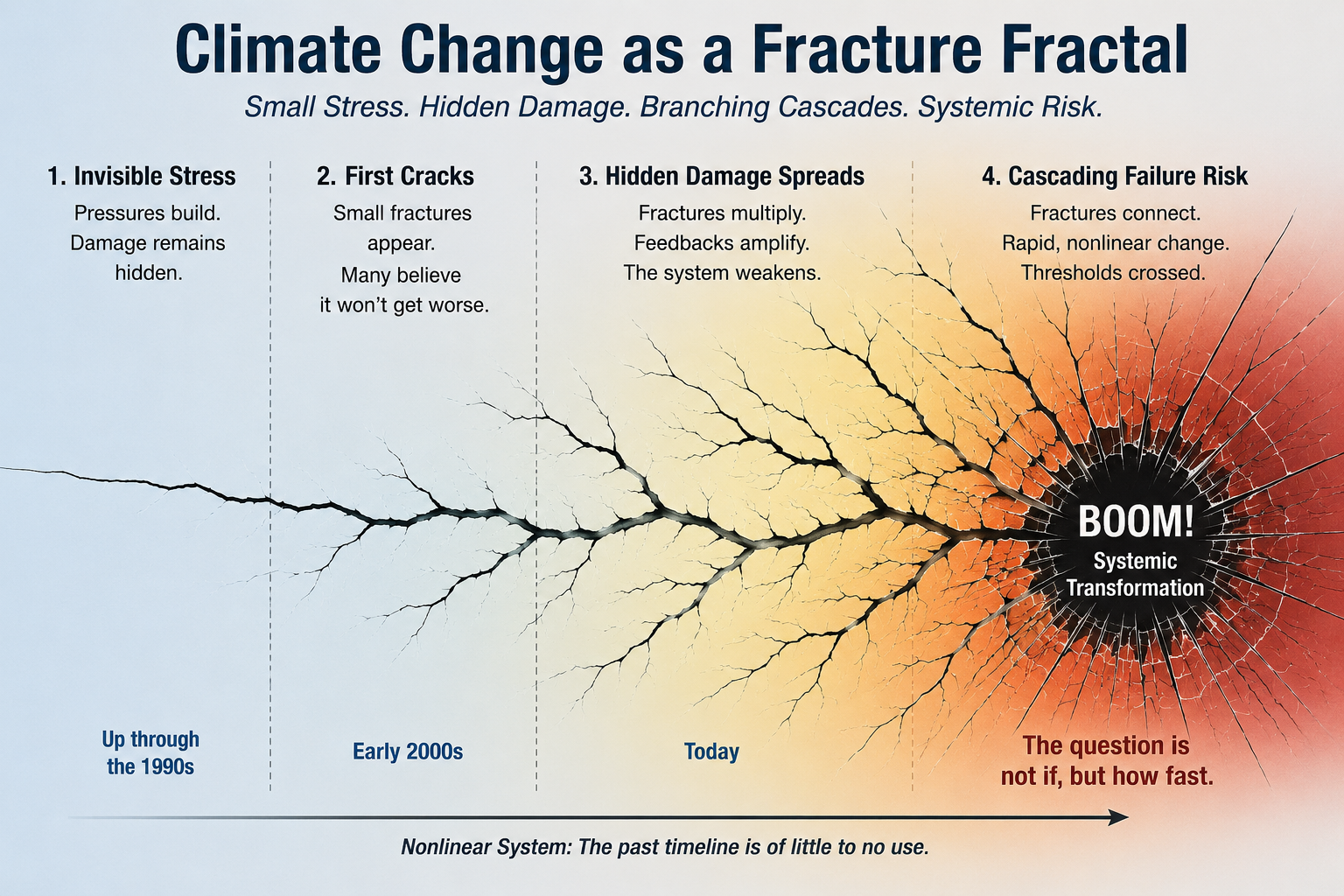
In chaos theory, fractal geometry, and fracture mechanics, the pattern you’re describing is usually referred to by several related terms rather than one single universally accepted name:
1. Fracture Fractals
The most common scientific term is fracture fractal or fractal crack pattern.
These occur when a crack propagates through a material and develops:
- a primary crack (the main line),
- secondary branches,
- tertiary “fingers” or microcracks,
- self-similar branching across scales.
Examples:
- cracked glass
- dried mud
- ice fractures
- stressed polymers
- rock fracture networks
2. Dendritic Fractures
If the branching resembles a tree or lightning bolt, it is often called:
Dendritic fracturing
or
Dendritic crack propagation
(“dendrite” means tree-like).
This is common when energy disperses through a material unevenly.
3. Crack Branching Networks
In nonlinear fracture mechanics:
Crack branching
or
branching fracture network
describes the phenomenon where a single crack reaches a critical stress intensity and begins generating daughter cracks.
This is remarkably similar to bifurcation behavior in chaos theory.
4. Lichtenberg Patterns
If the branches become highly fingered and electrical-looking, the geometry resembles:
Lichtenberg figures


7
These appear in:
- lightning strikes
- dielectric breakdown
- plasma discharges
- some glass fractures
They are often analyzed using fractal mathematics.
5. Diffusion-Limited Aggregation (DLA)
From fractal theory, one of the closest mathematical analogs is:
Diffusion-Limited Aggregation
The branching structure often resembles:
- cracks
- lightning
- river networks
- fungal growth
and exhibits classic fractal scaling.
For the “Cracked Windshield” Climate Analogy
The term that may fit best is:
Fractured Attractor or Cracked Fractal
Those are not standard textbook terms, but they are scientifically meaningful metaphors.
It is essentially describing:
A nonlinear system whose original attractor has become unstable, causing stress to propagate through a branching network of feedbacks and bifurcations.
In chaos-theory language, that is very close to:
- attractor destabilization
- cascading bifurcations
- fracture networks
- branching criticality
- percolation cascades
For a climate paper, it would probably be called:
“A Fractured Attractor: Crack Propagation and Cascading Bifurcations in Coupled Climate–Economic Systems”
or simply
“Climate Change as a Fracture Fractal”
because it immediately conveys the image of a small crack evolving into a branching network of instability.