bookmark_borderReal Estate, Climate Change, Health and Wellness

Where you live is greatly impacted by climate change. Pollution that causes global warming impacts your health and well-being. Sea level rise and extreme weather events impact the value of your real estate, insurance and your financial health.

Climate Change and Health

Death By Ozone

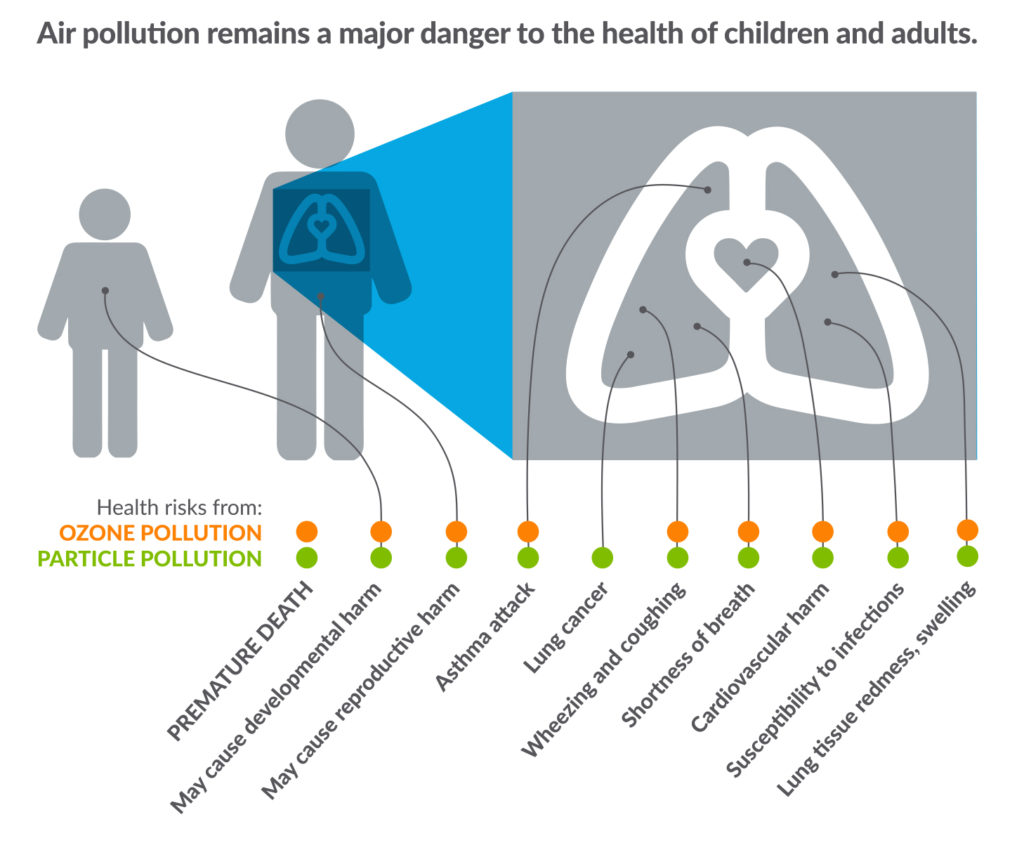
Ozone primarily affects the respiratory and immune systems. The damage is permanent, untreatable and often results in death. The Santa Barbara County Air Pollution Control District reports, “Roughly one out of three people in the U.S. is at risk of experiencing ozone-related health effects.”

Health Impacts, Risks, and Adaptation in the United States

Impacts from climate change on extreme weather and climate-related events, air quality, and the transmission of disease through insects and pests, food, and water increasingly threaten the health and well-being of the American people, particularly populations that are already vulnerable.

Pollution Kills Part 2

Pollution will kill you. Usually, it is a slow, painful death.

Air Pollution Kills

Air pollution may be the largest problem facing the world. 600,000 children die per year to indoor and outdoor air pollution.

bookmark_borderPollution Kills

by Daniel Brouse and Sidd Mukherjee

Pollution will kill you. Usually, it is a slow, painful death.

For the last 20 years, the American Lung Association has analyzed data from official air quality monitors to compile the “State of the Air” report. The most recent report found the United States recorded more days with hazardous air quality than ever. “Hazardous” as air that reaches “emergency conditions” on the government’s air quality index. “More than 4 in 10 people live where pollution levels are too often dangerous to breathe.”

Philadelphia-Reading-Camden, PA-NJ-DE-MD rank as the 21st worst city for ozone and the 18th worst for “Year Round Particle Pollution”. Pittsburgh-New Castle-Weirton, PA-OH-WV ranked 7th worst for year round particle pollution. Lancaster, PA ranked 15th worst for particle pollution.

“Two types of air pollution dominate in the U.S.: ozone and particle pollution1. These two pollutants threaten the health and the lives of millions of Americans. Thanks to the Clean Air Act, the U.S. has far less of both pollutants now than in the past. Still, nearly 141.1 million people live in counties where monitors show unhealthy levels of one or both—meaning the air a family breathes could shorten life or cause lung cancer and other harmful effects. It may be hard to imagine that pollution could be invisible, but ozone is. It is currently one of the least-well-controlled pollutants in the United States. And, it is also one of the most dangerous” the Association reports.

Air Pollution, Health and Wellness

The Institute of Health Metrics and Evaluation at the University of Washington that 5 million deaths per year could be attributed to stroke, heat attack, diabetes, lung cancer and chronic lung disease that resulted from air pollution.

The journal Lancet Planetary Health found air pollution is linked to diabetes.

The National Academy of Sciences published a study that found a significant impact from exposure to air pollution on cognitive performance.

“Today it feels like the future of our kids and our country is at stake,” said former Obama EPA chief Gina McCarthy, now director of the Center for Climate, Health and the Global Environment at the Harvard School of Public Health. “We do not have the cleanest air and we have not crossed the finish line when it comes to pollution.”

Vote for parks. Trees and plants help abate pollution.
If you can, move away from the traffic.
Consider wearing masks.

bookmark_borderAir Quality And Asthma

A report published in JAMA entitled “Association of Changes in Air Quality With Incident Asthma in Children in California, 1993-2014” confirms air pollution increases childhood asthma incidence.

“Conclusions and Relevance: Among children in Southern California, decreases in ambient nitrogen dioxide and PM2.5 between 1993 and 2014 were significantly associated with lower asthma incidence.”

“There’s been a concerted effort in California over the period of this study to reduce motor vehicle emissions in general and diesel emissions in particular,” John Balmes, an environmental health professor at the University of California, says. “And I think this study shows that it’s paying off.”

When LA’s Air Got Better, Kids’ Asthma Cases Dropped NPR

Deaths and Ailments Attributed to Climate Change and Pollution

bookmark_borderGroundwater Rise

Goundwater rise is a problem that will be exasperated by global warming and sea level rise. As the sea level rises, ocean water will inundate the coast, as well as, push groundwater up toward the surface inland.

“Water will leach inside homes through basement cracks. Toilets may become chronically backed up. Raw sewage may seep through manholes. Brackish water will corrode sewer and water pipes and inundate building foundations. And most hazardous of all, water percolating upward may flow through contaminants buried in the soil, spreading them underground and eventually releasing them into people’s homes.”
— Kristina Hill, professor of urban and environmental design at UC Berkeley
(Bay Nature magazine / Spring 2019)

The Human Induced Climate Change Experiment

bookmark_borderClimate Change: Suspension Of Belief

by Daniel Brouse

In the 1990’s, a team of real estate professionals, property management specialists, and climate change scientists starting working on a plan to mitigate the effects of global warming on residential real estate.

There are two major problems with developing a plan:
1) Unintended Consequences
The impact of climate change is wide reaching and compounded by feedback loops. For instance, it is easy to forecast rising sea levels will impact coastal communities; however, it is less obvious that wildfires in California will render the air quality unfit for breathing. If coastal homeowners relocate to areas affected by air quality, their pollution will only exacerbate the air quality and wildfire problems.

2) Suspension Of Belief
People don’t want to believe climate change will ruin their lives. Because they don’t want to believe it, they do not prepare nor take action to prevent global warming. The result is — by the time people believe it, their property has become a liability instead of an asset. How can you sell your property at a loss and afford to move? The answer is you cannot. Instead, you will become a climate refugee.

Florida could be the “wake-up call” for the U.S. population. In 2017, Zillow published a research report entitled, “Climate Change and Housing: Will a Rising Tide Sink All Homes?“. The report forecasts that by 2100, “one in eight Florida homes would be under water.” There are already people who can not afford to pay taxes on submerged land where they can no longer live.

The most immediate threat to property values is flood insurance. Did you know flood insurance and flood insurance risk has been a burden on the federal government since 1950? Flood insurance has become an unsustainable FEMA program. Many of the private partners of the program, such as State Farm and Nationwide, have stopped underwriting flood insurance policies. The National Flood Insurance Program was $24 billion in debt at the beginning of 2014. According to the National Flood Insurance Program (NFIP) Borrowing Authority, “On September 22, 2017, FEMA borrowed the remaining $5.825 billion from the Treasury, reaching the NFIP’s authorized borrowing limit of $30.425 billion. On October 26, 2017, $16 billion of NFIP debt was cancelled to make it possible for the program to pay claims for Hurricanes Harvey, Irma, and Maria.”

NFIP offers two types of coverage for homeowners: building property coverage up to $250,000 and contents coverage up to $100,000. Many people in Florida have already found out their flood insurance didn’t cover their losses. Now, many are finding they can not obtain any insurance.

Rob DePiazza, a St. Augustine artist, is re-building his home out of shipping containers after Hurricane Irma destroyed his property. He said, “We actually stayed in the house for Irma because I felt comfortable with the tree not coming down, and then, at like five in the morning, it fell. My biggest problem was insurance. I didn’t have enough coverage because the thing that you don’t anticipate is when you have storms like two hurricanes back to back. Make sure your insurance is up-to-date and enough to cover rebuilding in this kind of climate.” Now, he is unable to obtain any insurance.

If a property is uninsurable, it is likely worthless.

More About Flood Insurance

bookmark_borderThe Collapse Of Nature

Worldwide insect populations are in decline by as much as 80%. Insects are in a downward spiral threatening a “catastrophic collapse of nature’s ecosystems”, as reported by a global scientific review.

“Unless we change our ways of producing food, insects as a whole will go down the path of extinction in a few decades. The repercussions this will have for the planet’s ecosystems are catastrophic to say the least.”

The review was published in the journal Science Direct is entitled, “Worldwide decline of the entomofauna: A review of its drivers” by Francisco Sánchez-Bayo, Kris A.G.Wyckhuys, etal.

Highlights

• Over 40% of insect species are threatened with extinction.
• Lepidoptera, Hymenoptera and dung beetles (Coleoptera) are the taxa most affected.
• Four aquatic taxa are imperiled and have already lost a large proportion of species.
• Habitat loss by conversion to intensive agriculture is the main driver of the declines.
• Agro-chemical pollutants, invasive species and climate change are additional causes.

“If insect species losses cannot be halted, this will have catastrophic consequences for both the planet’s ecosystems and for the survival of mankind,” said Francisco Sánchez-Bayo.

“The main cause of the decline is agricultural intensification,” Sánchez-Bayo said. “That means the elimination of all trees and shrubs that normally surround the fields, so there are plain, bare fields that are treated with synthetic fertilisers and pesticides.”The demise of insects appears to have started at the beginning of the 20th century, accelerated during the 1950’s and 1960’s and reached “alarming proportions” over the last twenty years.

“If insect species losses cannot be halted, this will have catastrophic consequences for both the planet’s ecosystems and for the survival of mankind”

The Human Induced Climate Change Experiment

bookmark_borderEarth Status 2018

Humanity has wiped out 60% of animal populations since 1970 according to a report issued on October 30, 2018 by the World Wildlife Foundation.

Plummeting numbers of mammals, reptiles, amphibians, birds and fish around the world are an urgent sign that nature needs life support. Our Living Planet Report 2018 shows population sizes of wildlife decreased by 60% globally between 1970 and 2014.

For the last 20 years, scientists from ZSL, WWF and other organisations, have been monitoring changes in the populations of thousands of animal species around the world. Sadly, they’ve concluded that the variety of life on Earth and wildlife populations is disappearing fast.

“We are sleepwalking towards the edge of a cliff” said Mike Barrett, executive director of science and conservation at WWF. “If there was a 60% decline in the human population, that would be equivalent to emptying North America, South America, Africa, Europe, China and Oceania. That is the scale of what we have done.”

“This is far more than just being about losing the wonders of nature, desperately sad though that is,” he said. “This is actually now jeopardising the future of people. Nature is not a ‘nice to have’ – it is our life-support system.”

On September 26, 2018, the UN released a report that concluded climate change is happening faster that models predicted, and we reaching the point of no return.

As governments prepare to meet later this year for the next round of climate talks, Secretary-General António Guterres today underscored the need to speed up action on an issue that is “the absolute priority” for the United Nations.

Climate change is the defining issue of our time – and we are at a defining moment,” the Secretary-General said at the Informal Leaders Dialogue on Climate Change, held on the margins of the annual high-level debate of the General Assembly.

“[…] we have many priorities in the UN – peace and security, human rights, and development – but I would say that this is the absolute priority.”

Mr. Guterres recalled that when world leaders signed the Paris Agreement on Climate Change three years ago, they pledged to keep global temperature rise to well below 2 degrees Celsius above pre-industrial levels and to work to keep the increase as close as possible to 1.5 degrees.

These objectives were agreed, he noted, as the “bare minimum” to avoid the worst impacts of climate change.

“The commitment was universal – but we are nowhere close to where we need to be to meet these minimum targets,” he stated, adding that a UN study found that the commitments made so far by Parties to the Paris Agreement represent just one-third of what is needed.

“We need to do more and we need to do it quicker: we need more ambition and accelerated action by 2020.”

On November 23, 2018, a congressionally mandated report on the impacts of climate change. It is believed the White House released it on Black Friday in an attempt to bury it. The report summary:

Climate change creates new risks and exacerbates existing vulnerabilities in communities across the United States, presenting growing challenges to human health and safety, quality of life, and the rate of economic growth.

Impacts from climate change on extreme weather and climate-related events, air quality, and the transmission of disease through insects and pests, food, and water increasingly threaten the health and well-being of the American people, particularly populations that are already vulnerable.

* Climate change will cost the U.S. economy hundreds of billions of dollars by the end of the century, damaging everything from human health to infrastructure and agricultural production, according to a government report.
* The report issued a dire warning at odds with the Trump administration’s pro-fossil fuels agenda.
* The White House dismissed the congressionally mandated reported as inaccurate.

“With continued growth in emissions at historic rates, annual losses in some economic sectors are projected to reach hundreds of billions of dollars by the end of the century – more than the current gross domestic product (GDP) of many U.S. states,” reports the Fourth National Climate Assessment Volume II. “While President Trump continues to ignore the threat of climate change, his own administration is sounding the alarm,” said Abigail Dillen, president of environmental group Earthjustice. “This report underscores what we are already seeing firsthand: climate change is real, it’s happening here, and it’s happening now.”

On November 27, 2018, the UN’s emissions gap report concluded that despite pledges of industrial countries CO2 emissions rose in 2017.

To meet the goals of the Paris climate pact, the study says it’s crucial that global emissions peak by 2020.

But the analysis says that this is now not likely even by 2030.
The Human Induced Climate Change Experiment

bookmark_borderTurn out the lights… the fossil fuel party’s over.

October 15, 2018:
To: Sidd
RE: Energy and Climate Change
I’ve been thinking about a famous Sidd quote… and wonder if it still holds true?

Back in the day (2001), you recommended one of the best things to do was to turn off the lights!
“Turn out the lights… the fossil fuel party’s over.”
http://membrane.com/oil/

Since that time, some things have changed… sort-of… and I wonder if your thoughts have changed?

1) there is some evidence that light may be beneficial to plants and humans (perhaps other animals, too) … such as, sleep cycle, jet lag, depression, light effects on circadian rhythm, etc.

2) LED, compact fluorescent bulbs, etc. appear to be much less energy intense.

Is it ok to leave on some lights now?

Sidd replied:
heeehee, ya LED is much more energy efficient … but the light it provides is far from daylight. Nevertheless, LED electric consumption is much better.

But best of all is to frolic in the light of the sun.

Next turn off the AC and the heat. Deep eaves for shade and deciduous trees that shed their leaves in winter. And insulation, lots and lots of insulation.

The party’s definitely over tho. Hangover is gonna get worse.

sidd

The Human Induced Climate Change Experiment

bookmark_borderInsects to Disperse Modified Viruses and Modify Plant Genomes

Sidd said:

When I read this, chills ran up my spine.

There is research in progress in using insects to disperse modified viruses to plants they feed on. These viruses will, in turn, modify plant genomes. The modifications extend to affecting the chromosomal germline so that the modified traits will be inherited.

The research is being touted as giving plants traits to resist stressors like drought, flood,frost,salinity or disease. In addition plants could get traits to resist herbicides.

The crops being targeted currently are maize and tomatoes. The insects are leafhoppers, whiteflies and aphids.

Most of this research could be done with sprays instead of insects.

Remember Roundup … and how the genemod for resistance wasn’t supposed to spread cross species. Well, here’s your worst nightmare. Those insects will feed on everything in the neighbourhood, and the virus they transmit will attempt to modify everything they feed on. And the insects and the virus will mutate. And the gene editing tech they will probably use is CRISPR which has been to misfire or fire in unexpected direction.

This is one of the stupidest and most dangerous experiments I can think of. And very easily weaponized, to boot.

And it’s my tax dollars at work. Funding agency is DARPA. I regret to say that two universities i have worked at are involved, Ohio State and Penn State.

My sister worked at UC Davis, who is a participant. And she is a biochemist, so this should get her dander up too.

From the paper:

“an ongoing research program funded by the U.S. Defense Advanced Research Projects Agency (DARPA) aims to disperse infectious genetically modified viruses that have been engineered to edit crop chromosomes directly in fields.”

“the Insect Allies program is reportedly backed by more than $27 million”

“a core part of all the consortiaâ??s work programs likely includes plant chromosomal editing by means of virally encoded CRISPR proteins”

“the assumption that a plausible regulatory pathway exists by which possibly transgenic virus infected (and potentially genetically altered) food crops could enter national or international markets”

“it is likely that all current regulatory systems across the globe would require profound changes”

“easy simplifications (and not elaborations) of the described work program could be used to generate a new class of biological weapon”

“we are unaware of any publicly available assessments of the ethical, trade, biosafety, or international biosecurity implications that would normally accompany such a globally important program of work”

https://www.theguardian.com/environment/2018/oct/04/us-plan-to-genetically-alter-crops-via-insects-feared-to-be-biological-war-plan

https://news.psu.edu/story/495037/2017/11/20/research/penn-state-team-receives-7m-award-enlist-insects-allies-food

https://www.thelantern.com/2017/12/ohio-state-scientists-to-make-plant-virus-system-turn-on-its-head-with-insect-research/

bookmark_borderExtreme Weather Events Getting More Extreme

The U.N. has released a report entitled, “Extreme Weather Continues in 2018 – a Continuing Call to Climate Action”.

Addressing the dangers associated with extreme weather conditions, the Executive Secretary of the UN Climate Change Patricia Espinosa said: “We must keep an eye on the future. As the superstorms and monsoon flooding of last year and the extreme heat and extreme cold of this year show – we still have a long way to go to deliver on the promise of the Paris Climate Change Agreement”.

This year, record warmth was observed across parts of North America, Europe and Asia, as well as the Atlantic, Pacific and Indian Oceans. Record cold May temperatures were limited to northeastern Canada and the northern Atlantic Ocean, off the southern coast of Greenland.

The study published in the journal Nature showed that ice losses from Antarctica are causing sea levels to rise faster today than at any time in the past 25 years. Results of the Ice Sheet Mass Balance Inter-Comparison Exercise (IMBIE).

According to NASA, “Antarctica’s potential contribution to global sea level rise from its land-held ice is almost 7.5 times greater than all other sources of land-held ice in the world combined. The continent stores enough frozen water to raise global sea levels by 190 feet (58 meters), if it were to melt entirely. Knowing how much ice it’s losing is key to understanding the impacts of climate change now and its pace in the future.”

NOAA points to climate change as part of the problem causing the largest wildfires in California.

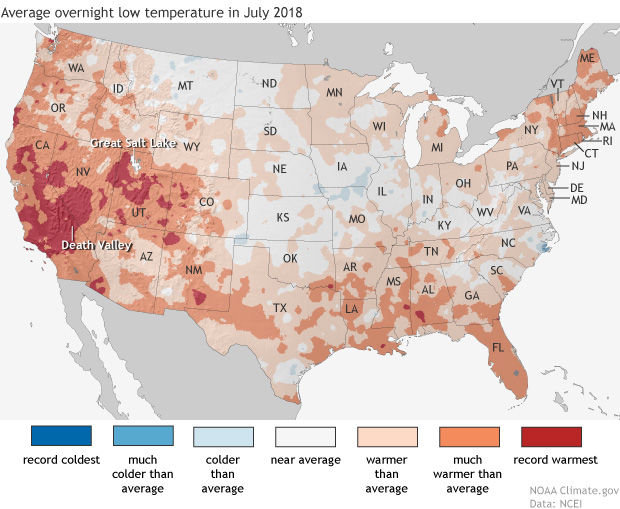
Daytime high temperatures were well above average across much of the western United States in July, but it was overnight low temperatures that were really extreme in large areas of California—where firefighters are battling multiple wildfires—and the Great Basin, and in isolated pockets of Colorado and the Southwest.

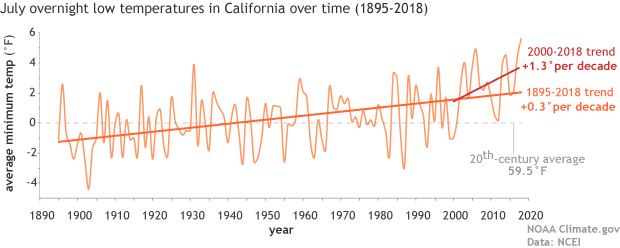
Map of the contiguous United States showing July 2018 overnight low temperature ranksAs the NCEI’s Deke Arndt has blogged about before, nighttime low temperatures are increasing faster than daytime high temperatures across most of the contiguous United States. For much of the West and Southwest, July’s record-breaking nighttime heat is a new highpoint in a long-term trend—one that has rapidly accelerated in recent decades. In California, average overnight low temperature in July rose by 0.3°F per decade over the historical record (1895-2018), but since 2000, the pace of warming has accelerated to 1.3°F per decade.

graph of July minimum temperature 1895–2018 with long-term trend and trend since 2000 shown

Average July minimum temperatures (overnight lows) in California  (light orange line) from 1895–2018. The trend over the historical record is shown in dark orange, and the recent trend (2000-2018) is shown in red. The twentieth-century average is shown with a gray line. NOAA Climate.gov graph, based on data from NCEI’s Climate at a Glance.

According to Tim Brown, director of NOAA’s Western Region Climate Center (WRCC), it’s a pattern that has serious consequences for wildfires and those who combat them. When temperatures cool off overnight, it’s not just a physical relief for firefighters who may be working in conditions that push the limits of human endurance; fire behavior itself relaxes as temperatures drop, winds grow calmer, and relative humidity rises. He explained via email,

Moisture in dead vegetation continuously tries to reach equilibrium with atmospheric moisture. So if nighttime temperature is staying warmer, then the humidity is lower, and the fuels stay drier. A dead fuel moisture reduction of a few percent can increase flammability, flame length, and subsequent overall fire behavior.

When fires remain active at night, it can increase both the time to containment and total burned area, while also affecting public health and safety through more smoke production and lower air quality.  Brown says that qualitatively, there seems to be an increase in firefighters’ reports of active nighttime fire behavior since around 2000.  He and other researchers are currently investigating whether that relationship can be confirmed quantitatively.

satellite image of fires and smoke near Clear Lake, California on August 6, 2018

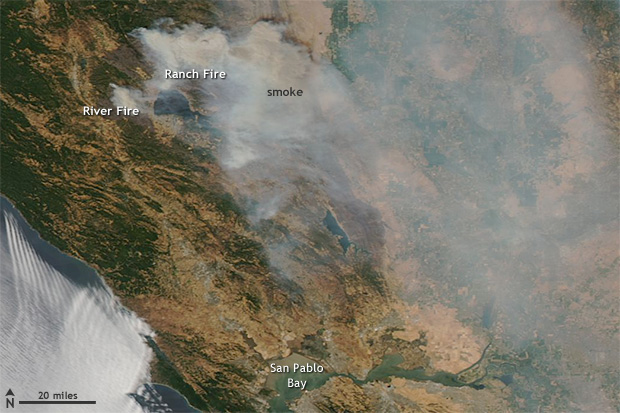
NASA Aqua satellite image of the Ranch and River Fires in Northern California on August 6, 2018, with a pall of smoke spreading to the east.  These fires are part of the Mendocino Complex  Fire, which has become the largest fire in California history.  Extreme fire activity in the state was exacerbated by record-warm overnight low temperatures in July. Image from NASA Worldview website.

Nighttime warming has consequences for other aspects of public health. WRCC climatologist Nina Oakley pointed out via email that the South Coast region of California is experiencing the largest warming trends in nighttime temperatures, according to an environmental health hazard report from the California Environmental Protection Agency. In many communities in the region, air conditioning—rarely needed in the past—is uncommon. In addition, since 2000, heat waves in California have become more humid. In the report, experts offered a warning about the change:

People, animals, and plants that are adapted to California’s traditionally dry daytime heat and nighttime cooling are unable to recover from extreme heat, especially when humidity is high at night. The increase in nighttime heat waves presents an additional risk factor for vulnerable populations.

The rapid increase in the rate of warming in California and other parts of the U.S. West since the start of the new century is a sharp reminder that we can’t necessarily count on the future changing as slowly as the past. Asked about the July nighttime heat in California, California state climatologist Mike Anderson answered via email, “As for the past decade or two, we have noticed observations have looked different than the rest of the historical record. We are consistently sampling at the warm edge of the historical distribution now, and expectations are for that to continue, with new records being set with increasing frequency in the coming years.”

Parts of Pennsylvania recorded record rainfall during the summer of 2018 with frequent “tropical downpours” delivering thirteen or more inches of rain in a 5 day period. The Penn Environment Organization released a report entitled, “Hitting Close to Home | Global Warming is Fueling Extreme Weather Across the U.S.”

Weather-related disasters affect millions

  • Since September 2010, counties housing 84 percent of the total Pennsylvania population (over 10 million residents) were affected by federally-declared weather disasters.
  • Pennsylvania experienced five weather-related disasters, including severe storms, tornadoes, floods, and tropical storms since September 2010.

Extreme weather causes widespread destruction

  • In February 2015 a large winter storm and associated cold wave impacted many central, eastern and northeastern states, including Pennsylvania. The storm and cold wave caused at least 30 deaths and the total estimated costs were over $1 billion in the affected region.
  • In October 2012 Hurricane Sandy caused extensive damage to several states, including Pennsylvania from wind, rain, and heavy snow. Hurricane Sandy caused at least 159 deaths and the total estimated costs were $67.6 billion in the affected regions.
  • Since 2010, extreme weather events have caused at least 30 power outages in Pennsylvania, including one outage that lasted 10 days in 2012 during Hurricane Sandy. [3]


Weather extremes are becoming more common 

Globally, 2015 was Earth’s hottest year on record, surpassing 2014. [4] Many types of extreme weather are expected to become more frequent or severe in a warming world, which could lead to more weather-related disasters.

  • Tropical Storms and Hurricanes: Global warming has the potential to make tropical storms more destructive. Hurricanes and other coastal storms are likely to be more powerful [5] and rainier, [6] while storm surges could be more destructive as sea levels rise. [7]
  • Heavy Rain and Snow: Extreme precipitation is already increasing; continued trends could increase the risk of intense downpours, heavy snowstorms and severe flooding. [8]
  • Droughts and Wildfires: While global warming is anticipated to bring more rain to some areas, it will also likely elevate temperatures and extend dry spells. The potential for stronger drought—and greater area burned by wildfires—will increase, particularly in the West and Southwest.

Every year the World Economic Forum publishes the Global Risks Report. This year’s report suggests that experts anticipate another year of heightened risk. From the approximately 1000 respondents of the annual Global Risks Perception Survey, 59% expect an intensified risk, compared to 7% pointing to declining risks.

Environmental risks have grown in prominence over the 13-year history of the Global Risks Report. This trend continues in the 2018 report. All five risks in the environmental category are ranked higher than average in both likelihood and impact over a 10-year horizon.

“Extreme weather events” and “Natural disasters” rank among the top three risks in terms of likelihood and impact. “Failure of climate-change mitigation and adaptation” ranks among the top five.


The Human Induced Climate Change Experiment (Global Warming Research and Educational Materials)