bookmark_borderClimate-Driven Health Collapse: The Compounding Feedback Loops of Disease, Pollution, and Extreme Weather

by Daniel Brouse — July 26, 2025

Climate change is not just an environmental issue — it is a cascading health crisis. As rising global temperatures disrupt natural systems, they initiate multiple interconnected health feedback loops that reinforce and amplify one another. These loops do not operate in isolation, nor do they follow a predictable or linear trajectory. Instead, the breakdown of one subsystem accelerates the collapse of others, resulting in nonlinear, compounding effects that degrade both the quality and quantity of human life.

Health Feedback Loops: Not Just Additive — Exponential

There are at least three major categories of climate-related health stressors that interact and reinforce each other:

1. Infectious Disease Pathogens

  • Zoonotic diseases such as COVID-19, Ebola, and avian influenza are spreading more rapidly due to deforestation, warming temperatures, and habitat loss — conditions that increase human-animal contact and vector range.

  • Climate-sensitive vectors (like mosquitoes) expand into new regions, introducing dengue, malaria, and Zika to previously unaffected populations.

2. Environmental Pathogens & Pollution

  • Ground-level ozone, particulate matter (PM2.5), and wildfire smoke directly damage lungs and weaken immune response.

  • Air pollution is responsible for millions of premature deaths annually and is a major co-factor in cardiovascular disease, chronic obstructive pulmonary disease (COPD), asthma, and cancer.

  • Pollution exposure also increases the risk of infection, as seen with COVID-19 morbidity patterns.

3. Climate Extremes & Cellular Breakdown

  • Prolonged exposure to extreme heat accelerates biological aging, damaging tissues and shortening telomeres at a cellular level.

  • These changes increase the likelihood of chronic diseases such as cancer, dementia, and diabetes — all of which are also made worse by pollution and infection.

  • Heat stress also undermines mental health and increases rates of depression, anxiety, and even suicide.

Epigenetic Changes: The Molecular Convergence of Climate Stressors

A critical link between these health risks is the role of epigenetic changes — chemical modifications that influence how genes are expressed without altering the DNA sequence itself. These changes act like a dimmer switch or on/off toggle for genes, activating or silencing certain genetic pathways.

  • Extreme heat, ozone exposure, and COVID-19 infection are all known to trigger epigenetic modifications.

  • These shifts can activate high-risk genes linked to cancer, diabetes, cardiovascular conditions, and neurological disorders.

  • When multiple stressors are present, these epigenetic changes do not just add up — they compound, increasing long-term vulnerability across multiple organ systems.

This molecular-level disruption represents a shared mechanism across climate-related health threats, amplifying the feedback loops that push individuals toward chronic illness and premature death. It also raises concerns about transgenerational impacts, where stress-induced epigenetic changes in one generation may increase disease risk in the next.

Case Study: COVID-19 and Air Pollution — A Deadly Feedback Loop

Consider how air pollution and COVID-19 create a self-reinforcing health spiral:

  1. Long-term air pollution exposure causes underlying conditions (respiratory disease, cardiovascular disease, immune suppression).

  2. Infection with COVID-19 worsens these existing conditions, leading to more severe illness and higher mortality risk.

  3. Post-infection, continued pollution exposure leads to long COVID complications and recurring hospitalizations.

  4. The repeated cycle exhausts the body’s defenses — a negative feedback loop that continues until systemic collapse or death.

This is not a hypothetical. It is happening now.

Health System Overload and the Tipping Point

When these health stressors converge, they don’t just affect individuals — they strain public health systems, increase medical costs, and undermine economic productivity. The reinforcing nature of these loops means we are hurtling toward tipping points in healthcare infrastructure, workforce resilience, and population longevity.

Conclusion: Converging Crises, Urgent Response

The climate crisis is also a health crisis. The compounding effects of infectious disease, environmental pollution, and extreme heat form a web of destabilization that shortens lives and overwhelms systems. Without rapid action to reduce greenhouse gas emissions, regulate pollutants, and build climate-resilient healthcare systems, these feedback loops will escalate beyond control.

References:

Tipping points and feedback loops drive the acceleration of climate change. When one tipping point is toppled and triggers others, the cascading collapse is known as the Domino Effect.

The Human Induced Climate Change Experiment

bookmark_borderThree Economic Shocks Hitting You This Month: Health, Nutrition, and Education Under Attack

by Daniel Brouse
July 19, 2025

Starting this month, three interconnected economic impacts will begin hitting households and communities across the country—especially in rural areas—threatening health, nutrition, and education in ways that will ripple through local economies.

1. Health: Rising Insurance Costs and Rural Hospital Closures
Key parts of the Affordable Care Act are expiring, with average health insurance premiums expected to rise by 15%. This increase won’t just burden individuals with private insurance; it will trigger a chain reaction as more people are priced out of coverage, increasing the number of uninsured. Hospitals and health systems—particularly rural facilities already operating on thin margins—will face additional financial strain as uncompensated care rises. Simultaneously, reductions in Medicaid funding will further destabilize rural healthcare infrastructure, with many hospitals expected to close, leaving large geographic areas without critical health services and further harming local economies.

2. Nutrition: SNAP Cuts and Community Health
Millions of recipients of SNAP (food stamp) benefits will lose eligibility this month due to new policy changes and funding cuts. The immediate consequence will be increased food insecurity, with families struggling to meet basic nutritional needs. Poor nutrition leads to chronic health issues, which will add to the strain on already overburdened healthcare systems, particularly in rural areas. Additionally, the reduction in SNAP spending will remove millions of dollars in local food purchases, hurting grocery stores, farmers markets, and small businesses in these communities, creating a cascading economic slowdown.

3. Education: Public Broadcasting and the Erosion of Free Education
Congressional rescission of previously allocated funds will slash federal support for public broadcasting in the Philadelphia region and beyond. Local stations like WHYY (Philadelphia’s NPR and PBS affiliate), WDIY (Lehigh Valley Public Radio), WPSU (State College region), and WXPN (Philadelphia’s nonprofit public radio station) will face significant funding cuts, reducing their ability to deliver free educational programming, independent news, and arts coverage. This is more than just a cultural loss; it undermines local education efforts, diminishes civic engagement, and removes crucial platforms for local artists and scientists. Communities already struggling with underfunded educational systems, particularly in rural areas, will be hardest hit by these cuts.

The Broader Ripple Effects
These three impacts are deeply interconnected:

  • Reduced nutrition leads to increased healthcare needs.

  • Reduced access to education and independent media weakens community knowledge, civic participation, and local arts ecosystems.

  • Healthcare and nutrition crises drive local economic contraction, business closures, and further community decline.

Musicians, educators, healthcare workers, and small business owners are already raising alarms. As these cuts take effect, the strain will move beyond individuals to entire communities, deepening inequality and accelerating the decline of rural America’s economic and cultural vitality.

Trumpenomics: The Decline of the US

The Human Induced Climate Change Experiment

bookmark_borderWalk the Poop Before You Talk the Transition

By Daniel Brouse

July 18, 2025

Now that many people are finally waking up to the collapse of the climate and social systems, I hope my background as an economist focused on risk management can help illuminate the path forward. Ideally, we would have followed sound risk management decades ago to avoid reaching this crisis point. But here we are, and so we must shift to Plan B: A New Economy.

The Real Sustainability Test

Everyone talks about sustainability, but few understand what it requires at the most basic level: the ability to feed yourself and manage your waste without destroying your ecosystem.

Before we can credibly debate carbon markets, degrowth, or circular economies, we need to prove we can survive a single day in a truly self-sustaining way:

✅ Feed yourself for a day using methods that do not degrade soil, water, or biodiversity and that could scale for years.
✅ Secure clean water in a way that is sustainable long-term, without polluting the source or requiring massive energy inputs.
✅ Dispose of your own waste safely, ensuring you do not contaminate soil or water, or create disease vectors that harm your community or yourself.

The single most important thing you can do: go the distance.
Bury your waste far away from where you live, eat, drink, and grow your food. This simple action protects your water, your soil, and your health—more effectively than any untested high-tech solution.

Sustaining yourself for a day sounds simple until you try it. So, first do it. Once you can do it for a day, you need to scale it to weeks, months, and years—and then to your family, friends, and community.

The Hardest Part: Human Waste

Here’s the hard truth: the most important part of transitioning to a new economy is how you handle your poop.

Everyone wants to talk about electrification, AI, and green jobs, but no one wants to talk about the sanitation systems that prevent us from killing ourselves and our environment. Yet if we cannot manage our waste sustainably, any talk of a “sustainable economy” is hollow.

Before you join debates about transitioning to a post-carbon world, demonstrate you can literally walk the poop before you talk the transition.

Why Indigenous Practices Matter

This is not a new challenge. Indigenous communities across North America managed to live sustainably for millennia, disposing of human waste in ways that protected water sources, preserved soil health, and maintained community health.

They:

  • Buried waste away from water sources and habitation areas.

  • Moved camps periodically to prevent overloading any one location.

  • Used natural cover materials (soil, ash, plant matter) to accelerate decomposition and reduce contamination risks.

These practices were not merely cultural—they were effective, practical risk management strategies rooted in a deep understanding of land stewardship.

A Thought Experiment (That Should Become Reality)

If you think your solutions will save the world, start by proving you can:

  • Feed yourself for one day, sustainably.

  • Manage your waste for one day, sustainably.

  • Scale it to your family and community.

If your solutions fail at this basic level, they will fail at the societal level too. Conversely, if you can solve these fundamental challenges, you will be equipped with the grounded knowledge and humility needed to help design a real transition strategy for a collapsing climate and society.

Indigenous American Indians

Here is a clear, evidence-based overview on how many Indigenous American Indian communities traditionally managed human waste to avoid contaminating soil and water:

1️⃣ General Principles

  • Burial at a distance
    Waste was typically buried away from camps and water sources, using small personal latrines or digging cat holes, ensuring pathogens did not enter water supplies.

  • Site rotation
    Camps and waste sites were moved periodically, preventing concentration of waste in one location.

  • Choice of location
    Latrines were placed:

    • Downwind from camps

    • Far from streams, springs, or rivers (commonly 100+ feet)

    • On higher or well-drained ground to reduce runoff risk.


2️⃣ Region-Specific Practices

  • Plains & Nomadic Tribes (e.g., Lakota, Comanche)

    • Dug shallow pits when staying in one place.

    • Covered waste with soil and natural materials.

    • Moved frequently, allowing the environment to naturally decompose waste.

  • Southwest (e.g., Hopi, Pueblo)

    • In permanent villages, used designated latrine areas outside the living quarters.

    • Some used ash or sand to cover waste, aiding desiccation and reducing odors and flies.

  • Pacific Northwest & Woodlands

    • Waste was buried away from water sources, critical in forested or riparian zones.

    • Camps were often near water, but latrines were carefully sited at a safe distance and covered.

  • Arctic & Subarctic (e.g., Inuit)

    • In frozen conditions, waste was sometimes frozen and disposed of in designated snow areas.

    • In summer, waste was placed far from freshwater sources.


3️⃣ Why This Protected Soil and Water

✅ Burial with soil isolated pathogens from insects and animals.

✅ Distance from water reduced fecal contamination, protecting drinking and fishing sources.

✅ Organic decomposition in small, distributed quantities allowed soil microbes and sunlight to neutralize pathogens naturally.

✅ Rotation and mobility prevented soil overload and nutrient leaching in a single location.


4️⃣ Important Context

  • While Indigenous practices varied widely across regions and tribes, their relationship with land emphasized maintaining the health of water and soil.

  • There was no single universal method, but core principles of burial, distance, and rotation were nearly universal.

  • The single most important thing you can do: go the distance.
    Bury your waste far away from where you live, eat, drink, and grow your food. This simple action protects your water, your soil, and your health—more effectively than any high-tech solution you don’t actually use.

Trumpenomics: The Decline of the US

The Human Induced Climate Change Experiment

bookmark_borderThe Optimism Paradox: Climate Collapse vs. Capitalism Collapse

by Daniel Brouse
July 16, 2025

The future forecast is, paradoxically, more optimistic than it has been in decades—but not for reasons most would celebrate.

The Brutal Climate Reality

The reality is that most humans will not survive the climate collapse if we continue on our current path. We are likely facing a future where 90% of mammals will perish and 100% of humans could be wiped out due to heat stress, crop failures, water scarcity, flooding, disease spread, and social collapse as warming accelerates.

Any survival guidance shared now is only for a short-term window to buy time, not as a permanent solution. Based on current trajectories:

  • There is an 80% chance catastrophic climate collapse will begin within 30 years.

  • There is a 98% probability it will occur within this century if we do not immediately end fossil fuel combustion and deforestation.

The Irony of Hope: Capitalism’s Imminent Collapse

Ironically, there is “good news” regarding breaking the climate trajectory—the collapse of capitalism may outpace climate collapse, reducing emissions and consumption by force rather than choice.

The climate crisis itself is cracking the foundations of capitalism:

  • The insurance industry forecasts its own collapse within 30 years due to uninsurable climate risks.

  • States like Florida, California, and Louisiana have abandoned private market capitalism for socialized hazard insurance as large swathes of zip codes become uninsurable.

  • Agricultural yields and supply chains are failing, destabilizing food markets.

  • Migration crises triggered by heat and flooding are straining labor markets and social systems.

Timing: Climate vs. Capitalism Collapse

However, capitalism’s collapse remains too slow relative to the pace of climate breakdown.

  • Since 2024, the domino effect of tipping points—glacier melt, AMOC slowdown, Amazon dieback, and wet-bulb heat events—has become undeniably visible, accelerating climate collapse exponentially.

  • This means even if emissions stopped today, feedback loops will continue to intensify warming.

To meaningfully slow climate breakdown, capitalism would need to collapse within the next 2–5 years to halt emissions and consumption rapidly enough to matter.

Trump to the Rescue (Ironically)

Who would have thought Trump could be the “savior” here?

His policies—exponential national debt expansion, reckless fiscal decisions, the largest regressive tax (tariff) increases in history, anti-immigration crackdowns, and mass deportations—have accelerated systemic instability.

The net effect:

  • The probability of capitalism collapsing within the next 2–5 years has now risen to 78%.

If this collapse occurs before the climate dominoes irreversibly lock in additional degrees of warming, it may reduce emissions by force, giving the planet a slim chance to stabilize below the worst thresholds of uninhabitability.

The Takeaway

We are living in the optimism paradox:

  • The collapse of capitalism may be the only thing that can slow the collapse of climate systems.

  • But the window for capitalism to collapse in time is narrow and closing.

We must prepare for what comes next, both to navigate the collapse and to envision what system might replace capitalism in a way that aligns with planetary limits.

Trumpenomics: The Decline of the US

The Human Induced Climate Change Experiment

bookmark_borderWhere Will Be Safe? The Future of Human Habitation on a Rapidly Collapsing Earth

by Daniel Brouse and Sidd Mukherjee
July 15, 2025


Q: Where will be safe to live in the coming years as climate change accelerates?

Great question.

The simple answer is: “Underground.”

The habitability of Earth’s surface will become increasingly complicated as tipping points and cascading system failures accelerate. For the next 30 years, it will likely still be possible to live above ground if you remain nomadic with enough money and power—but keep in mind, the value of money will rapidly erode, and what counts as “wealth” will change, becoming increasingly difficult to protect and secure.

In this part of the world, the Appalachian Trail will likely become a primary trade and migration route, but it will be extremely dangerous due to raping, pillaging, and collapse of social structures. If cannibalism becomes widespread, you will need to ensure you do not become livestock.

Sea Level “Surges” Will Accelerate Collapse

We are going to start seeing “surges” in sea level rise where, instead of millimeters of rise per year, some years will suddenly see feet of rise in a single year, likely 2–3 feet per year for several consecutive years. When this happens, places like Philadelphia and Camden will become uninhabitable overnight. Infrastructure, sewer systems, water treatment, and energy grids will fail in these low-lying regions, forcing mass migration and amplifying societal collapse.

These surges will not only drown infrastructure but will contaminate freshwater systems, disable transport routes, and spread disease. Expect these rapid shifts to happen episodically and without much warning, making it impossible for most people to adapt in place.

Underground: The Last Option

Within 30 years, much of Earth’s surface will likely become uninhabitable due to deadly wet-bulb heat, violent storms, flooding, and societal collapse. At that point, finding a secure underground living space will become the objective.

However, underground living brings its own challenges:

  • Food production without sunlight.

  • Water access and purification.

  • Sanitation: The hardest part will be sewage removal and flood control.

  • Flash floods will increase, contaminating underground spaces with sewage and disease.

  • Underground dwellings will be at risk of collapse or drowning during extreme weather.

  • People living in below-grade housing already have the highest mortality during flash floods, a risk that will only increase.

The Short Window of Nomadism

In the coming decades, if you have the means, nomadic relocation may temporarily work as you chase the last habitable microclimates. However, this window is closing quickly as tipping points and system failures compound.

Local community resilience, underground flood-resistant infrastructure, and developing off-grid water and food systems will matter far more than money in the world we are heading toward.

Conclusion

Where will it be safe? Nowhere for long. The collapse will come in waves:

  • Economic collapse,

  • Infrastructure collapse,

  • Social collapse,

  • Environmental collapse.

The final wave will be surface uninhabitability, forcing humanity underground if it wishes to survive. This will be a harsh, disease-ridden, and resource-constrained existence requiring preparation far beyond bug-out bags and solar panels.

If you want to survive, think beyond climate denial and political distraction. Think engineering, hydrology, sanitation, and nutrition, not just “location.” The sooner we face this reality, the better we can prepare.

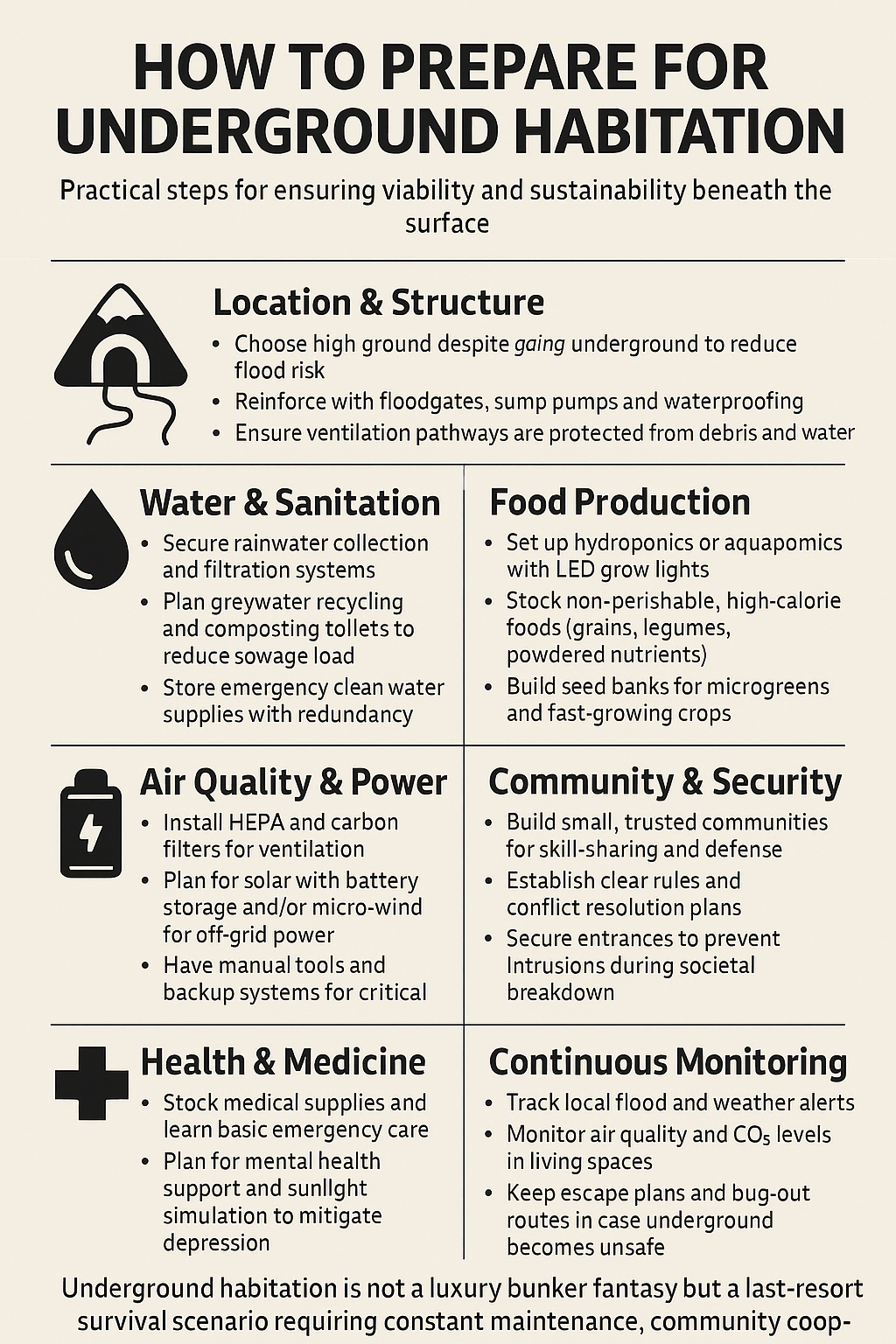
How to Prepare for Underground Habitation

 Location & Structure

  • Choose high ground despite going underground to reduce flood risk.

  • Reinforce with floodgates, sump pumps, and waterproofing.

  • Ensure ventilation pathways are protected from debris and water.

Water & Sanitation

  • Secure rainwater collection and filtration systems.

  • Plan greywater recycling and composting toilets to reduce sewage load.

  • Store emergency clean water supplies with redundancy.

Food Production

  • Set up hydroponics or aquaponics with LED grow lights.

  • Stock non-perishable, high-calorie foods (grains, legumes, powdered nutrients).

  • Build seed banks for microgreens and fast-growing crops.

Air Quality & Power

  • Install HEPA and carbon filters for ventilation.

  • Plan for solar with battery storage and/or micro-wind for off-grid power.

  • Have manual tools and backup systems for critical needs.

 Community & Security

  • Build small, trusted communities for skill-sharing and defense.

  • Establish clear rules and conflict resolution plans.

  • Secure entrances to prevent intrusions during societal breakdown.

Health & Medicine

  • Stock medical supplies and learn basic emergency care.

  • Plan for mental health support and sunlight simulation to mitigate depression.

  • Maintain physical fitness to handle manual labor and emergencies.

Continuous Monitoring

  • Track local flood and weather alerts.

  • Monitor air quality and CO2 levels in living spaces.

  • Keep escape plans and bug-out routes in case underground becomes unsafe.

Remember:
Underground habitation is not a luxury bunker fantasy; it is a last-resort survival scenario requiring constant maintenance, community cooperation, and adaptability in a rapidly collapsing climate system.


Underground Living Guide

Underground Living Guide

The Human Induced Climate Change Experiment

bookmark_borderNine Tipping Points Crossed: The Domino Collapse of Earth’s Climate Systems

by Daniel Brouse and Sidd Mukherjee
July 13, 2025

Human-induced climate change has now crossed at least nine critical tipping points, each triggering irreversible shifts in the Earth’s climate system. These tipping points are not isolated; they are interconnected, and their cascading effects amplify each other in a self-reinforcing feedback loop that accelerates global climate disruption.

The nine tipping points include:

  1. Greenland Ice Sheet Collapse

  2. West Antarctic Ice Sheet Collapse

  3. Labrador-Irminger Seas / SPG Convection Collapse

  4. East Antarctic Subglacial Basins Collapse

  5. Arctic Winter Sea Ice Collapse

  6. East Antarctic Ice Sheet Collapse

  7. Amazon Rainforest Dieback

  8. Boreal Permafrost Collapse

  9. Atlantic Meridional Overturning Circulation (AMOC) Collapse

These are not in strict chronological order, as the tipping points are dynamically interconnected, but the sequence of total collapse impacts the severity and global reach of the consequences.

As my colleague Sidd noted, “Number 7 might be first.”

The Amazon Rainforest Dieback

For decades, Sidd and I have researched the ozone feedback loop, an often-overlooked but critical piece of the climate crisis puzzle. Ozone, a byproduct of carbon combustion, does not act as a greenhouse gas itself but severely disrupts the Earth’s ability to manage greenhouse gases indirectly.

Tropospheric ozone pollution damages the stomata of plant leaves, which are microscopic openings essential for absorbing CO₂ during photosynthesis. This impairment drastically reduces plant productivity, health, and growth, weakening one of the planet’s most vital carbon sinks. Recent studies indicate that ozone poisoning has already reduced the productivity of plant CO₂ absorption by approximately 30%, undermining the natural carbon removal capacity of the Amazon and other forests.

As the Amazon’s ability to sequester carbon weakens, it becomes increasingly vulnerable to higher temperatures and intensified droughts, which are themselves driven by regional deforestation and climate change. Ozone-induced reductions in CO₂ uptake further weaken tree health, making the forest more susceptible to wildfires, pest outbreaks, and large-scale mortality.

Once the Amazon crosses its tipping threshold, large-scale dieback becomes irreversible, releasing immense quantities of stored carbon from vegetation and soils into the atmosphere. This shifts the Amazon from being a powerful carbon sink to a significant carbon source, accelerating global warming and reinforcing a destructive feedback loop that drives further regional drying and forest decline.

The Amazon also plays a critical role in recycling water across South America. As forest cover declines, this water recycling function weakens, reducing rainfall locally and regionally, amplifying drought, and hastening the ecosystem’s collapse. If current trends continue, the Amazon is poised to transform from the world’s largest carbon sink into a catastrophic carbon emitter, with devastating consequences for global climate stability and biodiversity.

Why This Matters Now

These tipping points are no longer theoretical warnings—they are unfolding in real time, compounding their effects and accelerating systemic collapse. Each tipping point increases the likelihood of crossing additional tipping points, fueling the domino effect of climate destabilization.

From the loss of polar ice sheets raising sea levels, to the collapse of ocean circulation patterns disrupting weather and food systems, to the dieback of the Amazon intensifying warming and reducing rainfall, these interlinked crises are now reshaping our world at a pace faster than traditional models predicted.

We are witnessing the transition from linear climate change to non-linear, system-wide collapse. It is critical for policymakers, scientists, and the public to recognize that mitigation and adaptation strategies must account for these cascading tipping points to avoid deeper, irreversible damage to the Earth’s systems and human civilization.

The Human Induced Climate Change Experiment

bookmark_borderAmerica’s Hidden War in Gaza: Christian Zionism, Genocide, and the Silencing of Dissent

by Daniel Brouse
July 12, 2025

Doesn’t anyone in the United States realize the U.S. now has boots on the ground in Gaza, participating directly in genocide. Under President Trump, a private military force disguised as a “humanitarian” organization has been deployed, with American citizens in combat roles actively shooting unarmed, starving men, women, and children who are desperately seeking aid.

I think this denialism has mostly to do with the fear of appearing antisemitic. Trump has launched a coordinated intimidation campaign specifically designed to silence anti-genocide voices, labeling any criticism of Israel’s actions in Gaza as antisemitism to shut down debate and dissent.

On top of that, many in the Jewish community have grown up surrounded by misinformation and false narratives that equate supporting human rights for Palestinians with hating Jewish people. I’ve had many Jewish friends—who don’t even realize that I’m Semitic myself—call me out for expressing these views, accusing me of being antisemitic when, in reality, I’m standing against genocide and for the dignity of all people.

We also need to focus on the Christian Zionists who are really driving this agenda. Many don’t realize that Trump, Stephen Miller, and the MAGA movement are not working to protect Jewish people; they are pushing an extremist Christian Zionist ideology that views the mass extermination of Jews as part of their prophecy to bring about the “Second Coming” and the “End Times.” They are using Israel and weaponizing Jewish communities for their own apocalyptic agenda, and in reality, their long-term goal is the elimination of Jews, not their protection.

We need to separate criticism of a government’s actions from hatred of a people. Standing against ethnic cleansing, apartheid, and mass murder should never be confused with bigotry. The fact that it so often is reflects how deeply these false narratives have taken hold in our society—and how urgently we need to challenge them.

The Christian Zionist Agenda: Ethnic Cleansing as Prophecy

There should be no doubt in anyone’s mind: what you are witnessing is an ethnic cleansing of the Palestinian people, orchestrated by a white supremacist, racist, Evangelical Christian, antisemitic U.S. government. This is not simply about geopolitical interests or security; it is a religiously fueled, extremist project.

Trump, along with his “supervisor of racism” Stephen Miller, are leading figures among Christian Zionists who believe they are fulfilling prophecy by bringing on the “Second Coming” and the “End of Times.” This belief system calls for an apocalyptic war and the eradication of Jews and Muslims from “The Holy Land,” to clear the way for Jesus’ return on the Temple Mount.

In this worldview, the systematic starvation, mass displacement, and extermination of Palestinians is not a tragedy to be avoided, but a goal to be achieved. This ideology, once confined to fringe pulpits, has captured the highest levels of U.S. power and is now directly shaping foreign and military policy in Gaza.

Christian Zionists are weaponizing religion to justify genocide, using U.S. military might and taxpayer funding to implement policies rooted in ethnic cleansing. This is not an abstract theological debate—it is the material reality of bombs falling on children, food blockades starving families, and bullets killing people at aid lines.

Evangelical Christianity and Israel
If you’re curious about the driving force behind US support for Israel, it’s ironically rooted in Evangelical Christianity. Many Evangelical Christians believe they can hasten the “second coming of Christ” by bringing about the apocalypse. According to their interpretation of the Bible, this involves Israel reclaiming Jerusalem, Jesus returning, and ultimately eliminating all Jews. For numerous “Christian Zionists,” especially influential evangelists aligned with the Republican Party, support for Israel is less about political strategy and more about its supposed role in biblical prophecy. In this worldview, war is not something to be avoided but embraced as a divine necessity—an inevitable and even celebratory step toward Jesus’ rule from the Temple Mount in Jerusalem. The fate of Jews and Palestinians is, to put it mildly, seen as collateral damage.

Trumpenomics: The Decline of the US

bookmark_borderAmerica’s Secret War in Gaza: U.S. Boots on the Ground in Genocide, Funded by You

by Daniel Brouse
July 11, 2025

I’m starting to realize that hardly anyone in the United States knows the truth: the U.S. now has boots on the ground in Gaza, participating directly in genocide. Under President Trump, a private military force disguised as a “humanitarian” organization has been deployed, with American citizens in combat roles actively shooting unarmed, starving men, women, and children who are desperately seeking aid.

This militia, operating under the Gaza Humanitarian Foundation (GHF)—a company quietly incorporated in Delaware—has murdered hundreds of civilians under the banner of “aid distribution.” It is not just part of an extermination effort; it is systematically starving civilians, destroying what remains of their shelter and water sources, and preparing for the mass deportation of millions from their homeland. This is nothing less than the total depopulation of Gaza to clear the way for Trump’s vision: to build a resort on the ruins.

Remember, Trump already named a development in the Golan Heights after himself during his first term, right after moving the U.S. embassy to Jerusalem. The current plan goes even further, turning genocide into real estate and mass murder into a business model.

This administration is not merely enabling genocide with weapons sales or diplomatic cover; it is actively participating in war crimes with American boots, American bullets, and American bombs dropped on babies. And it is all funded by you. Your tax dollars are paying for the bullets tearing through children’s bodies. Your tax dollars are financing the starvation of families under siege. Your tax dollars are building the siege walls around Gaza, enforcing an apartheid system, and bulldozing entire neighborhoods.

This is not a faraway conflict we can ignore while claiming innocence. This is direct, on-the-ground participation in genocide, carried out with full impunity, in your name, with your money.

It is time to stop pretending we do not know. The question is: Now that you know, what will you do about it?

The Christian Zionist Agenda: Ethnic Cleansing as Prophecy

There should be no doubt in anyone’s mind: what you are witnessing is an ethnic cleansing of the Palestinian people, orchestrated by a white supremacist, racist, Evangelical Christian, antisemitic U.S. government. This is not simply about geopolitical interests or security; it is a religiously fueled, extremist project.

Trump, along with his “supervisor of racism” Stephen Miller, are leading figures among Christian Zionists who believe they are fulfilling prophecy by bringing on the “Second Coming” and the “End of Times.” This belief system calls for an apocalyptic war and the eradication of Jews and Muslims from “The Holy Land,” to clear the way for Jesus’ return on the Temple Mount.

In this worldview, the systematic starvation, mass displacement, and extermination of Palestinians is not a tragedy to be avoided, but a goal to be achieved. This ideology, once confined to fringe pulpits, has captured the highest levels of U.S. power and is now directly shaping foreign and military policy in Gaza.

Christian Zionists are weaponizing religion to justify genocide, using U.S. military might and taxpayer funding to implement policies rooted in ethnic cleansing. This is not an abstract theological debate—it is the material reality of bombs falling on children, food blockades starving families, and bullets killing people at aid lines.

And it is happening right now, in your name, with your money.

Trumpenomics: The Decline of the US

bookmark_border“A Camp, Not a State”: Israel’s Plan to Confine Palestinians in Gaza Draws Global Outrage

by Daniel Brouse
July 11, 2025

Israeli Minister Israel Katz has confirmed that the Israeli government is planning to establish what it calls a “humanitarian city” in southern Gaza—on the ruins of what was once Rafah before it was decimated by Israeli bombings. Human rights experts warn that this plan amounts to building a concentration camp in Gaza under the false pretense of humanitarian aid.

Under Katz’s plan, Israel would first force 600,000 Palestinians into the area and eventually concentrate the entire population of over 2 million Palestinians there. Entry into the camp would require screening by Israeli authorities, effectively creating a prison where Palestinians can neither move freely nor escape the humanitarian catastrophe unfolding around them.

If logistical conditions align, Israel intends to establish this camp during a temporary 60-day ceasefire currently being discussed by the U.S. and other mediators. However, legal experts argue that such a plan is a clear violation of international law and a crime against humanity. “It is all about population transfer to the southern tip of the Gaza Strip in preparation for deportation outside the Strip,” Israeli human rights lawyer Michael Sfard told The Guardian. “While the government still calls the deportation ‘voluntary,’ people in Gaza are under so many coercive measures that no departure can be seen in legal terms as consensual.”

A U.S.-Backed Operation
According to Reuters, the U.S.-backed Gaza Humanitarian Foundation (GHF) has prepared a parallel plan to create “Humanitarian Transit Areas” in Gaza. While marketed as safe zones, these areas would serve to concentrate Palestinians under tight control, aiming to replace Hamas’ governance in Gaza and further align with U.S. President Donald Trump’s “vision for Gaza.” Trump has previously described his plan as turning Gaza into a “Riviera,” which in practice would mean the ethnic cleansing of the Strip for future development while erasing its indigenous population.

Al Jazeera reports that it has obtained satellite images showing extensive bulldozing and flattening of what remains of Rafah, clearing the land for this planned “camp.” Meanwhile, the GHF has shut down three of its four aid distribution sites, leaving the population with even fewer means of survival. At the sole remaining site, 20 women and children were reportedly shot in a single day while attempting to obtain food, adding to the hundreds of starving Palestinians who have been shot by GHF and Israeli forces while seeking aid.

Exporting Ethnic Cleansing Abroad
President Trump’s role in these plans has been further revealed through his recent meetings with five leaders of African nations. While publicly framed as economic and diplomatic discussions, credible sources confirm that the primary agenda was to secure agreements for accepting mass deportations of immigrants from the United States and the forced expulsion of Palestinians from Gaza.

Regionally, Egypt, Jordan, Lebanon, Iran, and Iraq have refused to participate in this ethnic cleansing agenda, leaving the U.S. and Israel scrambling to pressure or incentivize other nations into accepting deported Palestinians. Human rights observers warn that the move to forcibly confine Palestinians into a single encampment under armed control is a prelude to mass deportation, mirroring dark chapters of ethnic cleansing throughout history.

Why This Matters
This plan is not a security measure or a humanitarian initiative. It is a calculated, systematic effort to erase a people from their land under the guise of aid and counterterrorism, backed by the world’s most powerful governments. It violates every principle of human rights and international law, threatening to set a dangerous precedent for how powerful states can displace entire populations with impunity.

The world cannot afford to look away. What is unfolding in Gaza is not only a tragedy for Palestinians; it is a test of whether the international community will stand up against genocide and the criminalization of resistance, or whether it will remain complicit in the name of political expediency.

Evangelical Christianity and Israel
If you’re curious about the driving force behind US support for Israel, it’s ironically rooted in Evangelical Christianity. Many Evangelical Christians believe they can hasten the “second coming of Christ” by bringing about the apocalypse. According to their interpretation of the Bible, this involves Israel reclaiming Jerusalem, Jesus returning, and ultimately eliminating all Jews. For numerous “Christian Zionists,” especially influential evangelists aligned with the Republican Party, support for Israel is less about political strategy and more about its supposed role in biblical prophecy. In this worldview, war is not something to be avoided but embraced as a divine necessity—an inevitable and even celebratory step toward Jesus’ rule from the Temple Mount in Jerusalem. The fate of Jews and Palestinians is, to put it mildly, seen as collateral damage.

Trumpenomics: The Decline of the US

bookmark_borderWeaponizing Aid: Netanyahu, Trump, and the Ethnic Cleansing of Gaza

Israeli Prime Minister Benjamin Netanyahu’s extended visit to the United States is not about peace or security—it is about expediting the ethnic cleansing of Gaza with direct assistance from the U.S. government. Behind closed doors, Netanyahu and President Trump are aligning their governments to advance plans that violate international law and deepen the genocide unfolding in Gaza.

One part of this plan has already surfaced in Congress: a push for the approval of an additional half-billion dollars in funding for Trump’s so-called “humanitarian” organization, the Gaza Humanitarian Foundation (GHF). While the name suggests relief and aid, the reality is far more sinister. GHF is a private corporation established in Delaware in coordination with Trump, functioning as a heavily armed private security force under the guise of humanitarian assistance.

GHF uses aid as a weapon while simultaneously starving the population it claims to serve. Reports from the ground indicate that while Palestinians are forced into “aid lines” under siege conditions, GHF personnel have been actively executing hundreds of unarmed women and children seeking food and water. This systematic violence and deprivation are clear violations of the Genocide Convention and the Fourth Geneva Convention, yet they continue with the backing of U.S. political leaders and taxpayer dollars.

The strategy is deliberate: starve, displace, and terrorize Gaza’s population while consolidating control under the false narrative of “humanitarian intervention.” Meanwhile, the push for more funding underlines the hypocrisy of U.S. foreign policy, where resources are channeled not to save lives but to facilitate forced displacement and extermination under the banner of “security.”

Netanyahu’s meetings with congressional leaders and Trump are not about ceasefire negotiations—they are about scaling up the infrastructure of genocide while shielding themselves from accountability. Each day this alliance continues, the human toll in Gaza grows, and the moral standing of the United States further erodes.

It is critical to expose the reality of GHF’s operations and the broader agenda being orchestrated between Netanyahu and Trump. Aid cannot be used as a weapon. Starvation cannot be disguised as policy. Extrajudicial executions cannot be covered up under the label of “security.” The world must recognize and resist this escalating campaign of ethnic cleansing before it becomes an irreversible stain on the global conscience.


Evangelical Christianity and Israel
If you’re curious about the driving force behind US support for Israel, it’s ironically rooted in Evangelical Christianity. Many Evangelical Christians believe they can hasten the “second coming of Christ” by bringing about the apocalypse. According to their interpretation of the Bible, this involves Israel reclaiming Jerusalem, Jesus returning, and ultimately eliminating all Jews. For numerous “Christian Zionists,” especially influential evangelists aligned with the Republican Party, support for Israel is less about political strategy and more about its supposed role in biblical prophecy. In this worldview, war is not something to be avoided but embraced as a divine necessity—an inevitable and even celebratory step toward Jesus’ rule from the Temple Mount in Jerusalem. The fate of Jews and Palestinians is, to put it mildly, seen as collateral damage.

Trumpenomics: The Decline of the US