bookmark_borderSudden Sea Level Pulses: How “Cork Release” Ice-Sheet Failures Could Rapidly Reshape Global Coastlines

By Daniel Brouse and Sidd Mukherjee

November 25, 2025

Introduction: The Shift From Gradual to Abrupt Sea Level Rise

Sea level rise (SLR) is one of the most revealing indicators of the accelerating pace of climate change. A century ago, global SLR was doubling roughly every 100 years. Ten years ago the doubling time had collapsed to a decade. By 2023, the doubling time had plunged to only two years.

This extraordinary acceleration led us to focus on a much more dangerous and poorly modeled phenomenon:

Sudden Sea Level Pulses (SSLPs) — rapid, stepwise jumps in sea level triggered by abrupt ice-sheet failures, subglacial “cork release” events, and ice-shelf structural collapse.

These pulses are not hypothetical. They are beginning to occur.

Examples include:

  • Greenland Subglacial Flood: A massive outburst where trapped meltwater burst through the ice, demonstrating the potential for sudden hydrofracture.
  • Alaska’s Mendenhall Glacier Outburst: A glacial flood that produced rapid, dangerous water-level increases downstream.

A detailed overview is archived at:
http://membrane.com/global_warming/Greenland-Ouburst.html

These events reveal something ice-sheet models have not yet fully integrated: meltwater can accumulate beneath ice until pressure surpasses structural integrity, causing the ice surface to fail catastrophically — a “cork release.” When this occurs at scale, sea levels can jump not millimeters per year, but multiple feet per year.

Why This Matters: The Risk of Abrupt, Multi-Foot Sea Level Jumps

The public still imagines sea level rise as a slow, linear process. But the Earth system does not behave linearly. When hydrofracture and ice-cliff collapse become common, we could face:

  • Multi-foot sea level increases within a single decade
  • 1–3 feet of rise within a single year in extreme pulse scenarios
  • Little or no time for adaptation in cities like Miami, New York, Mumbai, Lagos, and Shanghai

Current global climate models fail to incorporate most “cork release” pathways because:

  • Subglacial water transport is poorly mapped
  • Meltwater storage and pressurization are not well parameterized
  • Ice-shelf fracture mechanics are only partially resolved
  • Positive feedback loops — such as meltwater-driven lubrication and ice-cliff collapse — are not modeled dynamically

The Greenland outburst events show that ice sheets can undergo abrupt, nonlinear failures — far faster than infrastructure, economies, or governance systems can adapt.

Sidd summarized it best:

“Under-ice hydrology is hard to observe… but once enough pressure builds, ice doesn’t melt — it fractures.”

Antarctica: The System Most Likely to Produce Catastrophic Pulses

While Greenland contributes meaningfully to long-term SLR, Antarctica is the critical risk for abrupt sea level pulses.

The East Antarctic Ice Sheet (EAIS)

  • Holds ~170 feet of potential sea level rise
  • Once thought stable for millennia
  • Now showing early signs of warming-driven destabilization
  • Marine-based sectors may begin collapsing this century

The West Antarctic Ice Sheet (WAIS)

  • Highly vulnerable
  • Resting on retrograde (downward-sloping) bedrock
  • Warm ocean water is eroding the shelves from below
  • Pinning points are failing, which removes the natural “brakes”

Sidd’s assessment:

Greenland: “Effectively lost,” 100–300 years, +20 ft
West Antarctica: Likely collapse within decades to ~100 years, +10 ft

Total plausible rise by 2125: 20–30 feet, with the possibility of sudden pulses:

“We could dawdle along at half an inch a year, then see a few years at a foot per year.”

New Evidence: The Impending Failure of Thwaites Eastern Ice Shelf (TEIS)

In November 2025, Advancing Earth and Space Sciences published a landmark study:
“Evolution of Shear-Zone Fractures Presages the Disintegration of Thwaites Eastern Ice Shelf”
(https://agupubs.onlinelibrary.wiley.com/doi/10.1029/2025JF008352)

The TEIS is a keystone structure. Once it collapses, the glacier behind it — the “Doomsday Glacier” — will accelerate dramatically. The study found:

Key Findings

  1. Long-term shear fracturing (2002–2017):
    Large fractures formed parallel to flow as the shelf strained against its pinning point.
  2. Recent explosive tensile fracturing (2017–2022):
    Smaller, orthogonal fractures began proliferating, indicating that structural integrity is failing.
  3. Dynamic destabilization:
    Satellite and GPS data reveal velocity perturbations rippling across the shelf as fractures expand — a sign of imminent collapse.
  4. Transition of the pinning point from stabilizer to destabilizer:
    Echoing Benn et al. (2022), the pinning point now increases fracture stress instead of reducing it.
  5. Self-reinforcing feedback loop:
    The shelf appears to be entering the “damage-acceleration-damage” feedback proposed by Lhermitte et al. (2020), a hallmark of impending disintegration.

What This Means

When TEIS collapses — an event many glaciologists now expect within years to a decade — Thwaites Glacier could:

  • accelerate dramatically
  • initiate ice-cliff collapse
  • trigger multi-foot sea level pulses within short timescales

This is the largest currently unfolding structural failure in the cryosphere.

Cork-Release Events: A Distinct Class of Tipping Point

We define a “cork release” event as:

A sudden failure of ice or subglacial pressure systems causing rapid, high-volume discharge of water or ice into the ocean.

These events include:

  • subglacial lake drainage
  • rapid ice-shelf collapse
  • meltwater-driven hydrofracture
  • ice-cliff structural failure

Unlike gradual melt, cork-release events:

  • are nonlinear
  • occur suddenly
  • accelerate with warming
  • have global consequences within months to years
  • are triggered by thresholds that are difficult to predict

This makes them one of the most dangerous — and least modeled — climate feedbacks.

Conclusion: The Urgent Need to Model Abrupt Sea Level Change

The climate system is not simply warming. It is accelerating, destabilizing, and producing events far outside historical norms. Sea level rise will not be a smooth curve; it will be stepwise, punctuated by abrupt pulses.

To prepare for what is coming, climate science and adaptation planning must incorporate:

  • ice-shelf fracture dynamics
  • under-ice hydrology
  • subglacial pressurization
  • ice-cliff collapse physics
  • nonlinear feedbacks
  • sudden sea level pulse scenarios

Human systems are built for gradual change. The cryosphere is not.

The question is no longer if abrupt sea level pulses will occur — but how soon, how large, and how many.

* Our probabilistic, ensemble-based climate model — which incorporates complex socio-economic and ecological feedback loops within a dynamic, nonlinear system — projects that global temperatures are becoming unsustainable this century. This far exceeds earlier estimates of a 4°C rise over the next thousand years, highlighting a dramatic acceleration in global warming. We are now entering a phase of compound, cascading collapse, where climate, ecological, and societal systems destabilize through interlinked, self-reinforcing feedback loops.

What Can I Do?
The single most important action you can take to help address the climate crisis is simple: stop burning fossil fuels. There are numerous actions you can take to contribute to saving the planet. Each person bears the responsibility to minimize pollution, discontinue the use of fossil fuels, reduce consumption, and foster a culture of love and care. The Butterfly Effect illustrates that a small change in one area can lead to significant alterations in conditions anywhere on the globe. Hence, the frequently heard statement that a fluttering butterfly in China can cause a hurricane in the Atlantic. Be a butterfly and affect the world.

→ “Solutions to the Fossil Fuel Economy and the Myths Accelerating Climate and Economic Collapse.“
Tipping points and feedback loops drive the acceleration of climate change. When one tipping point is toppled and triggers others, the cascading collapse is known as the Domino Effect.

The Human Induced Climate Change Experiment

bookmark_borderA Treasury Secretary Out of His Depth: Bessent’s Bungled Defense of Rising Prices and Tariff Failures

The Treasury Secretary offered up a last-ditch, visibly strained defense on NBC’s Meet the Press while discussing the administration’s sudden decision to roll back tariffs on a range of food products. What followed was one of the most awkward and revealing interviews of the administration’s economic team to date.

When journalist Kristen Welker pressed Bessent, 63, with the obvious question — “Isn’t the fact that you’re rolling back tariffs an admission that they ultimately do drive up prices?” — he interrupted abruptly with a bizarre deflection:

“Kristen, how much does your arm weigh?”

Welker, understandably taken aback, tried to steer the conversation back to the facts. But Bessent doubled down:

“You know how much you weigh, and you get on the scale every morning. Inflation is a composite number and we look at everything, so we are trying to push down the things we can control.”

Instead of answering the straightforward economic question, the Treasury Secretary offered a metaphor that made no economic sense and evaded the issue entirely. He then launched into a broad — and equally unconvincing — defense of the administration’s economic record, insisting that energy prices were “flattening” and that “other prices will follow,” despite consumer data showing the opposite trend.

This exchange came immediately after Bessent visibly stumbled while attempting to explain a contradiction now central to Trump’s economic policy. Months ago, he enthusiastically claimed that tariffs were good for consumers. Today, Trump is being forced to roll back tariffs on essential consumer goods because prices for everyday items — including staples like bananas and coffee — have surged under the tariff regime.

The contradiction is not subtle. It is not complicated. And Bessent was unable to reconcile it.

A Treasury Secretary Without the Basics

Many observers are now openly questioning why Bessent is Treasury Secretary at all. His résumé only deepens the concern:

  • No prior experience in government finance or macroeconomic policy
  • Previously a hedge fund manager, not an economist
  • Before that, a history teacher, with no discernible background in fiscal or monetary analysis
  • No published economic work, no record of policy scholarship, and no demonstrated expertise in inflation mechanics, taxation, or global trade

In short, nothing in his background suggests even a foundational understanding of the economic tools he is now attempting — unsuccessfully — to defend on national television.

The administration’s tariff policies have been widely criticized by economists across the political spectrum for raising prices, dampening consumer demand, and contributing to a broader economic slowdown. Sunday’s interview only underscored what many feared: the nation’s chief economic policymaker cannot explain the consequences of his own policies and appears unfamiliar with basic economic principles.

What should have been a straightforward discussion about tariffs and consumer prices instead became an uncomfortable display of confusion, deflection, and economic incoherence — raising even deeper concerns about who is steering the country’s financial policy at one of the most volatile moments in modern economic history.

Trumpenomics

bookmark_borderThe Non-Linear Acceleration of Climate Change: Evidence, Confirmation, and the Emerging Domino Effect

By Sidd Mukherjee and Daniel Brouse
November 22, 2025

In the 1990s, we developed what became known as The Non-Linear Acceleration Hypothesis—the proposition that climate change is not progressing linearly but is accelerating exponentially. Working together, with Sidd’s background as a Doctor of Physics from Ohio State and my own experimental and observational analyses, we produced the foundational evidence for this theory. By the early 2000s, our work had evolved into a recognized climate framework, validated repeatedly through independent replication and supported by an expanding body of empirical data. Over the decades, this body of confirmation has solidified into the scientific consensus we see today.

Shrinking Doubling Times and Escalating Impacts

One of the most compelling indicators of nonlinear acceleration is the dramatic contraction of the doubling time of climate impacts—the interval in which damage effectively doubles due to interacting feedback processes. In the mid-20th century, the doubling time was on the order of 100 years. By the early 2000s, it had fallen to 10 years, and recent analyses show that it has now plunged to approximately 2 years.

This means that the impacts of climate change today are twice as severe as they were two years ago. If the doubling time remains constant, they will be four times worse in two years, eight times worse in four years, and potentially sixty-four times worse within a decade. These estimates are conservative; the doubling period continues to shorten as feedbacks intensify. With no meaningful global mitigation underway, the trajectory is unmistakable and vastly more catastrophic than previously projected.

Hansen’s Confirmation of the Acceleration Hypothesis

We have long regarded Dr. James E. Hansen as one of the principal founders of modern climate science. In April 2025, Hansen’s paper Global Warming Acceleration: Impact on Sea Ice provided a direct, data-driven confirmation of our hypothesis. His analysis demonstrated that global warming is accelerating, and that climate sensitivity is higher than IPCC estimates, fundamentally altering expectations for 21st-century warming.

Hansen concluded that IPCC models underestimate both climate sensitivity and key feedback processes. Under current emissions levels, he projects that warming by 2100 is likely to exceed 7°C, dramatically raising the probability of crossing multiple climate tipping points.

In November 2025, Hansen, Kharecha, and Morgan published Warning! This “Colorful Chart” Is Censored by IPCC, offering further confirmation.

Accelerated Forcing Growth

Their analysis centers on a chart showing the five-year running mean of the annual increase in greenhouse gas forcing. Over the past 15 years, they find that the rate of increase has surged to ~0.5 W/m² per decade—far higher than IPCC projections. This acceleration is not reflected in IPCC scenarios and is fundamentally incompatible with its claims of remaining “pathways” to 1.5°C or 2°C.

Implications for Climate Scenarios

  • Current forcing trajectories align closely with RCP 8.5, the high-end “business-as-usual” pathway.
  • They diverge sharply from RCP 2.6, the scenario often used for policy optimism.
  • Achieving RCP 2.6 today would require $2.4–5 trillion per year using current technology.
  • RCP 2.6 also presumes unrealistic levels of biomass burning plus carbon capture, which Hansen calls politically and practically unviable.

Critique of IPCC’s Modeling and Transparency

Hansen and colleagues argue that the IPCC relies too heavily on Integrated Assessment Models (IAMs), which they describe as opaque “dark boxes”—tools that embed assumptions that are rarely examined in public-facing science.

They highlight that:

  • Scientists have not adequately communicated the severity of accelerating forcings.
  • Carbon pricing is vastly more effective than prescriptive international agreements.
  • Missed opportunities since the Montreal Protocol have allowed forcings to climb unchecked.
  • Early COP negotiations excluded nuclear power from the Clean Development Mechanism—a decision they view as scientifically indefensible.

Climate Sensitivity and Near-Term Risk

Hansen’s findings, along with related analyses, suggest climate sensitivity in the range of 4–5°C per CO₂ doubling, substantially above many IPCC estimates. They warn that without extraordinary action within the next 5–10 years, Earth could be locked into a high-warming trajectory that destabilizes major climate systems.

Strengths of Hansen’s Argument

  • Data-driven approach grounded in measured forcings with ~10% uncertainty.
  • Clear policy relevance connecting forcing to cost, mitigation feasibility, and economic risk.
  • Strong emphasis on accelerating risk, consistent with observed feedback behavior.
  • Valid critique of IAM transparency, echoing long-standing concerns within the scientific community.

Broader Implications

If Hansen et al. are correct, the window for avoiding catastrophic warming is significantly narrower than models suggest. Their work underscores the need for:

  • Greater transparency in climate modeling
  • Rapid implementation of carbon pricing
  • Reevaluation of technological pathways
  • Public communication that aligns with empirical reality

Their findings also increase the urgency of addressing the accelerating feedback loops we identified decades ago.

The Domino Effect: Cascading Tipping Points

Building on nonlinear thermodynamics and chaos theory, we now know that climate tipping points are not isolated events—they interact. As major systems destabilize, they trigger secondary failures, creating a cascade of compounded impacts.

Our recent synthesis of 2024–2025 data shows:

  • CO₂ concentrations, fossil fuel emissions, and global temperatures all reached record highs.
  • Natural carbon sinks are beginning to convert into carbon sources.
  • Feedbacks across ice loss, ocean circulation, albedo decline, and atmospheric chemistry are synchronizing.
  • These interactions are driving what we call the Domino Effect—a system-wide cascade that threatens global habitability within this century.

* Our probabilistic, ensemble-based climate model — which incorporates complex socio-economic and ecological feedback loops within a dynamic, nonlinear system — projects that global temperatures are becoming unsustainable this century. This far exceeds earlier estimates of a 4°C rise over the next thousand years, highlighting a dramatic acceleration in global warming. We are now entering a phase of compound, cascading collapse, where climate, ecological, and societal systems destabilize through interlinked, self-reinforcing feedback loops.

What Can I Do?
The single most important action you can take to help address the climate crisis is simple: stop burning fossil fuels. There are numerous actions you can take to contribute to saving the planet. Each person bears the responsibility to minimize pollution, discontinue the use of fossil fuels, reduce consumption, and foster a culture of love and care. The Butterfly Effect illustrates that a small change in one area can lead to significant alterations in conditions anywhere on the globe. Hence, the frequently heard statement that a fluttering butterfly in China can cause a hurricane in the Atlantic. Be a butterfly and affect the world.

→ “Solutions to the Fossil Fuel Economy and the Myths Accelerating Climate and Economic Collapse.“

Tipping points and feedback loops drive the acceleration of climate change. When one tipping point is toppled and triggers others, the cascading collapse is known as the Domino Effect.

The Human Induced Climate Change Experiment

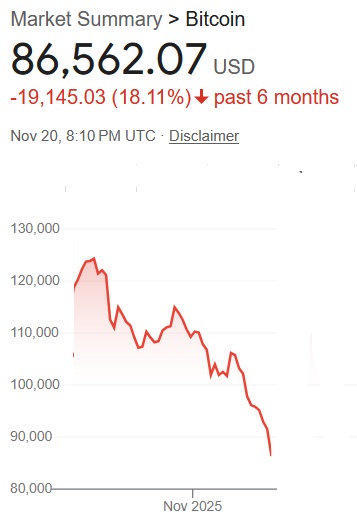
bookmark_borderHow Bitcoin’s Shift to a Risk-Off Asset Is Rewiring Market Dynamics

By Daniel Brouse November 20, 2025

Bitcoin has fallen from $120,000 to under $90,000 in just six weeks. What’s behind the move?
Two forces are doing most of the work:

  1. Leverage
  2. A fundamental shift in how markets classify Bitcoin—from risk-on to risk-off

1. Leverage: The Amplifier Behind the Drop

While we can’t pin down an exact percentage of leveraged Bitcoin exposure, it is unquestionably large, reflexive, and sensitive to volatility.

  • Cumulative open interest in perpetual BTC futures recently climbed to about $43.6 billion, indicating enormous leveraged positioning.
  • Leveraged ETFs now represent nearly 25% of open interest on the CME, and some estimates put total market leverage even higher.

When BTC softens, margin calls begin. Loans are called, collateral thresholds are breached, and automated liquidations kick in. Those liquidations create forced selling, which drives prices lower—triggering still more liquidations. It’s a classic cascade: leverage doesn’t just add fuel; it adds momentum to both rallies and crashes.


2. Bitcoin’s Identity Crisis: From Risk-On Hedge to Risk-Off Liability

For years, Bitcoin was lumped in with gold as a “risk-on” inflation hedge. When deficits ballooned, inflation expectations rose, or geopolitical stress intensified, BTC often rallied.

But that perception has flipped. Entire macro trading systems are now treating Bitcoin as a risk-off asset—something to dump, not buy, when stress rises.

Why the reversal?

  • Bitcoin has become tightly intertwined with leveraged speculative flows.
  • Institutional quant desks increasingly treat BTC as a proxy for market liquidity, not inflation.
  • Rising real yields and tighter financial conditions have made Bitcoin behave less like digital gold and more like a high-beta liquidity sponge.

When markets rotate into fear, Bitcoin isn’t the refuge—it’s the first asset sold in bulk.


3. The Stock Market Parallel: A Leverage Environment Ripe for Contagion

To understand the broader implications, it helps to look backward. The 1929 crash was fueled by roughly 10% leverage in equities. Today, by many measures, equity leverage is above that threshold, once you include:

  • Margin debt
  • Options exposure
  • Leveraged volatility products
  • Structured derivatives
  • High-frequency strategies embedding synthetic leverage

Since “Liberation Day’s” correction, traders have again viewed equities as a risk-on bet. But here’s the critical shift:
Many algorithmic trading models now treat Bitcoin’s behavior as a signal for equity risk.

Meaning:

  • When Bitcoin sells off in a risk-off pattern
  • Models assume broader liquidity stress is rising
  • So the algorithms reduce equity exposure right alongside Bitcoin

This creates a cross-asset feedback loop that didn’t exist a few years ago.


4. The New Market Regime: Bitcoin as a Sentiment Barometer

Bitcoin’s transformation from a risk-on hedge to a risk-off trigger is reshaping market structure:

  • Bitcoin weakness → signals liquidity stress
  • Liquidity stress → triggers systematic de-risking
  • Systematic de-risking → amplifies equity volatility
  • Heightened equity volatility → creates more Bitcoin selling

In other words, Bitcoin—once touted as a portfolio diversifier—is increasingly becoming a sentiment accelerant. It now behaves not like gold, but like a voltage meter for market fragility.

5. Is Bitcoin Speculative?

A: Yes, very speculative. And there’s a deeper issue that rarely gets discussed: it’s unlikely Bitcoin will ever fully regain its old “digital gold” status because its long-term vulnerabilities are fundamentally different from those of a physical asset like gold.

Gold exists in the real world. You can hold it, store it, bury it, vault it — and none of that depends on software, electricity, networks, miners, or cryptographic standards remaining unbroken for decades.

Bitcoin, by contrast, relies on a long chain of non-tangible systems: a functioning global internet, distributed mining infrastructure, long-term cryptographic stability, wallet software, recovery mechanisms, and digital interfaces that all must operate flawlessly. If any link in that chain fails, the ability to access or verify ownership can collapse. And with quantum computing likely to break the underlying cryptographic algorithms, Bitcoin’s current security model—and therefore its value—could be rendered effectively worthless.

That dependency stack makes it far more fragile than physical gold — and that fragility is exactly why many investors now treat Bitcoin as pure speculation rather than a durable store of value.

Bitcoin Price November 2025

bookmark_borderThe Trade Deficit Shrinks — and So Does America’s Economic Pulse

The U.S. trade deficit for August 2025 came in at $59.6 billion, down sharply from a revised $78.2 billion in July. On the surface, this might look like good news for an administration obsessed with shrinking the trade gap. In reality, it is a warning sign — and yet another indictment of Trump’s misguided, economically illiterate trade agenda.

A Smaller Trade Deficit Isn’t a Victory — It’s a Symptom of Weakness
This month’s narrowing was driven almost entirely by a drop in imports, not a boom in exports. That distinction matters. When the U.S. imports less while exporting the same amount, it doesn’t signal economic strength. It signals that consumers and businesses are pulling back, buying fewer goods, delaying purchases, and tightening their belts.

Yes, the change may superficially boost GDP in the quarter — but only because of the way GDP accounting treats imports, not because real economic conditions improved. The underlying truth is the opposite: U.S. economic momentum is slowing.

Trump’s Trade War: A Case Study in Economic Misunderstanding
Trump continues to push the debunked narrative that trade deficits are an economic threat. This belief is not just wrong — it’s dangerous. His policies reflect a fundamental misunderstanding of trade, capital flows, and the basic mechanics of a modern global economy.

For decades, economists have been clear:

  • Trade deficits are not inherently harmful.

  • They often reflect a strong dollar, high consumer demand, and a robust investment climate.

  • Americans benefit from lower-cost imported goods, which raise purchasing power and living standards.

  • Dollars spent on imports frequently return as foreign investment in the U.S., including in Treasury securities, real estate, and American companies — strengthening financial markets and keeping interest rates lower.

Trump’s fixation on eliminating the deficit ignores all of this and instead pushes policies that raise consumer prices, destabilize supply chains, and threaten American jobs, especially in industries dependent on global inputs.

Today’s Numbers Reveal the Truth Hidden Beneath the Headlines
A shrinking deficit due to falling imports is not a sign of a booming America. It is a sign of a cooling domestic economy. Consumers are spending less. Importers are ordering less. Businesses are becoming more cautious.

Trump may tout this as a win. In reality, it’s a red flag — one that economists and anyone paying attention should recognize immediately.

The administration can celebrate a smaller deficit if it wants. But the data tell a different story: America didn’t suddenly start winning; Americans simply started buying less.

Trumpenomics

bookmark_borderThe Growing Threat to Press Freedom: How Trump’s Influence Is Reaching Beyond U.S. Borders

When a reporter asked him about Epstein, he responded by snapping, “Quiet. Quiet, piggy.”

It is becoming increasingly difficult — and dangerous — to report on Donald Trump. This trend began in the United States and is now extending into the United Kingdom. Trump’s attacks on the press, combined with the increasingly aggressive behavior of his followers, have turned journalism into something that is not only economically risky but, in many cases, physically hazardous.

In the U.S., Trump has sued broadcasters, newspapers, educational institutions, and even scientific organizations. He has also called for — and in some cases initiated — criminal investigations into perceived adversaries. These tactics have created a chilling effect across the industry. News organizations must now factor in legal exposure, targeted harassment, and even threats of violence when covering stories that mention Trump.

This dynamic was highlighted by the December 2024 settlement of Trump’s defamation lawsuit against ABC News and George Stephanopoulos. The suit centered on Stephanopoulos’s on-air statement that Trump had been found “liable for rape” in the E. Jean Carroll civil case. In reality, the jury found him liable for sexual abuse — a legally significant distinction, though morally equivalent in every meaningful sense. Under normal circumstances, ABC would have fought and almost certainly won the case. But as the old lyric from Sonny Curtis of The Crickets put it: “I fought the law and the law won”; today, it often feels like you can’t fight Trump’s legal machinery and win. For many newsrooms, capitulation now appears safer than confrontation.

On November 18, 2025, Trump again demanded that ABC’s broadcast license be revoked after ABC News White House correspondent Mary Bruce asked why he has not released the Jeffrey Epstein files.

“Your news is so fake and so wrong,” Trump snapped at Bruce in the Oval Office during a meeting with Saudi Crown Prince Mohammed bin Salman.

This was not an isolated attack. FCC Chair Brendan Carr had previously threatened ABC’s broadcast license over remarks made by late-night host Jimmy Kimmel regarding the assassination of conservative activist Charlie Kirk — an extraordinary escalation that further blurs the line between regulatory authority and political retaliation.

Tragically ironic, this entire exchange took place while Trump was sitting beside — and actively making deals with — the Saudi crown prince he has now designated a major non-NATO ally. This is the same Crown Prince Mohammed bin Salman whom U.S. intelligence concluded ordered the killing of Washington Post journalist Jamal Khashoggi.

MBS has called Khashoggi’s murder “painful” for Saudi Arabia, even as he pledges nearly $1 trillion in U.S. investments — a reminder that for Trump, political loyalty and money appear to matter far more than justice for an American journalist murdered on foreign soil.


GLOBAL STRONGARM

But this pressure is no longer confined to the United States. The U.S. right wing is actively coordinating with the U.K. right wing, and this alliance is increasingly affecting British media institutions — especially the BBC. At the center of this shift is Sir Robbie Gibb, a powerful and highly controversial figure whose influence is reshaping the BBC’s editorial culture.

Trump has already initiated legal action against the BBC, a move widely seen as an extension of Gibb’s internal pressure campaign. The dispute stems from a BBC documentary on January 6th — an impartial production that included voices from the MAGA movement explaining their support for Trump. Despite this, Gibb seized on a specific edit of Trump’s January 6 speech to accuse the BBC of violating journalism standards, giving Trump a pretext to launch litigation and intensify efforts to intimidate the network.

It’s also important to note that the documentary was not broadcast in the United States and was geographically restricted from streaming, meaning its reach was limited — yet it still triggered disproportionate political retaliation. And, worth underscoring: Panorama’s “Trump: A Second Chance?” aired on 28 October 2024, before the U.S. election. Trump went on to win that election, raising even more questions about the intent behind the lawsuit. If there was no U.S. broadcast, no U.S. audience, and no demonstrable harm — and Trump won — then on what grounds can he claim $1 billion in damages? The litigation appears far less about injury and far more about intimidation.

Who Is Sir Robbie Gibb?

Appointment by Boris Johnson:
Gibb was appointed as a non-executive director to the BBC Board in 2021, during Boris Johnson’s administration. He was reappointed for a second term in May 2024.

Political Roles:
Before joining the board, Gibb served as Theresa May’s Director of Communications — placing him firmly inside the upper ranks of Conservative Party leadership.

Media Involvement:
After leaving government, Gibb worked with GB News, a right-wing broadcaster, and participated in a consortium that acquired The Jewish Chronicle. His resume blends political strategy with media influence, making him a uniquely positioned figure in shaping public narratives.


Why His Role at the BBC Is Controversial

Accusations of Bias and Political Interference:
Reports from The Guardian and other outlets describe Gibb as leading internal campaigns alleging “systemic bias” within the BBC — particularly regarding coverage of Trump, the Gaza conflict, and trans rights. These accusations have been used to exert pressure on editors and producers.

Influence on Editorial Decisions:
Insiders say Gibb has pushed for specific hires, such as Michael Prescott, who authored a memo criticizing BBC editorial standards. Such moves have raised concerns that the BBC Board is directly shaping newsroom decisions rather than maintaining a healthy, independent distance.

Alignment With the Global Right Wing:
Gibb’s political loyalties, combined with his media roles, make him a key conduit between U.K. conservatism and U.S. right-wing politics. This has created fertile ground for cross-Atlantic coordination — including Trump-aligned intimidation campaigns aimed at the BBC.


A Cross-Border Threat to Democracy

The erosion of press freedom is no longer a contained, domestic issue. Trump’s strategy — using legal pressure, public attacks, and political alliances to intimidate the press — is now being exported and replicated.

The combination of transnational political coordination, aggressive legal tactics, and direct editorial influence poses a grave threat to independent journalism. If this continues, the public may soon find itself with a press corps too intimidated to report the truth about the most powerful political figures on either side of the Atlantic.

Democracy cannot function without a free press — and the warning signs are becoming impossible to ignore.

Related Articles

The Battle for Free Speech: Jimmy Kimmel vs. MAGA Media Monopoly

Trump Faces Over 300 Lawsuits for Executive Overreach and Harm to U.S. Citizens

The Silencing of America: Journalism, Protest, and the Rise of Fear
It’s terrifying to watch American journalism go silent — not because reporters don’t care, but because many of us know exactly what happens when we speak the truth now.

The Death of the First Amendment: Trump’s War on Free Speech 
On September 18, 2025, Donald Trump declared that any television network critical of him would risk having its broadcast license revoked.

Trumpenomics: The Decline of the US

bookmark_borderThe Physics of Violent Rain: Turning Ordinary Storms Into Catastrophic Events

by Daniel Brouse and Sidd Mukherjee
November 18, 2025

We’ve been working specifically on the physics of what we now call violent rain, and once you fully understand latent heat, the entire climate system reveals a deeper and far more alarming complexity. Latent heat is not just a chapter in a textbook; it is the engine behind much of Earth’s atmospheric power. But the energy budget is only the entry point. The way that energy manifests — through momentum, turbulence, pressure gradients, and flow dynamics — is some of the most elegant, and now increasingly dangerous, mathematics in climate science.

The fatal mistake many people make is equating “global warming” strictly with warmer temperatures. The additional heat does not simply remain as heat. It is continually exchanged, transformed, and expressed throughout the climate system. It reappears as massive increases in atmospheric moisture, sharper pressure differentials, explosive updrafts, and an atmosphere filled with stored potential energy waiting for the right trigger to be released.

A warmer atmosphere can hold about 7% more water for every 1°C of warming. Over the full temperature anomaly we are now entering, this increased capacity nearly doubles the amount of moisture available to A warmer atmosphere can hold about 7% more water for every 1°C of warming. Over the full temperature anomaly we are now entering, this increased capacity nearly doubles the amount of moisture available to storms. This is not theoretical — it is already transforming rainfall dynamics worldwide. Parts of the world, especially the poles, are now experiencing temperature anomalies that remain more than 22°C above normal for extended periods, supercharging atmospheric moisture and destabilizing global circulation patterns.

One of the most overlooked consequences of this added energy is the rise in both raindrop size and raindrop count. Larger droplets fall faster, strike harder, and inject more energy into the air column, intensifying turbulence. Upon impact with the ground, they deliver far more kinetic energy than raindrops did even a generation ago. Using the momentum relation p = mv:

  • As mass increases, momentum increases.
  • As velocity increases, momentum increases.

More momentum means more turbulence, more kinetic energy, and more destructive rainfall.

People already sense this intuitively — the louder impact of rain on roofs, water bouncing higher off pavement, and downpours that feel physically heavier — but few connect these sensations to the underlying physics.

The destructive power of violent rain actually begins before the drops reach the ground. As storms intensify, raindrops become larger and wind velocities rise, accelerating them horizontally and vertically. Because both m (mass) and v (velocity) increase, each raindrop carries significantly more momentum than in past climates.

Stronger horizontal winds effectively act as a second gravitational pull, increasing the angle and force of impact. This is why wind-driven rain can sting the skin, shred crops, strip leaves from trees, and erode soils far more quickly than vertical rainfall alone. The increased velocity also injects more energy into the air column, amplifying turbulence, updraft strength, and pressure gradients — processes that feed storm intensification.

Once the water reaches the ground, flow dynamics dominate. Force scales with the square of velocity (v²), and density multiplies that force dramatically:

  • A 20 mph wind exerts 4× the force of a 10 mph wind.
  • A 40 mph wind exerts 16× the force.
  • A 60 mph wind exerts 36× the force.

Now apply the same physics to water, which is ~800 times denser than air:

  • A shallow 10 mph sheet of runoff exerts 800× the force of a 10 mph wind.
  • At 20 mph, the force becomes 3,200×.
  • At 40 mph — common in debris-laden flash floods — the force jumps to 12,800×.

When storms produce larger raindrops and faster-moving rain, driven by extreme heat anomalies and stronger wind fields, the resulting flows carry exponentially greater destructive potential. This is why hillsides fail more quickly, roads wash out more often, and floodwaters rise and accelerate with far greater violence in a warming climate — and why these events are unfolding years to decades ahead of earlier projections.

As rainfall intensity spikes, so do these destructive flow forces. This is why modern storms overwhelm culverts, stormwater systems, levees, dams, and hillside soils. It’s why slopes liquefy, bridges scour, and infrastructure collapses in events that used to be considered “routine.”

The mathematics is beautiful — but the consequences are devastating. Violent rain is not a metaphor — it is the physical expression of a climate system carrying far more energy, mass, and momentum than it did just a few decades ago. And every additional fraction of a degree adds more fuel to that system.

For anyone watching closely, the evidence is not abstract. It’s outside your window.

The Climate Crisis: Violent Rain | Extreme Weather Events | Insurance | Soil | Updates

The Human Induced Climate Change Experiment

bookmark_borderTrump’s New Healthcare Pitch: Populist Rhetoric, Policy Confusion, and Economic Reality

On November 8 and November 18, 2025, Donald J. Trump posted on Truth Social:

“I am recommending to Senate Republicans that the Hundreds of Billions of Dollars currently being sent to money-sucking Insurance Companies in order to save the bad Healthcare provided by [the] Affordable Care Act, BE SENT DIRECTLY TO THE PEOPLE SO THAT THEY CAN PURCHASE THEIR OWN, MUCH BETTER, HEALTHCARE, and have money left over.”

News outlets including The Economic Times, WBMA, and Becker’s Payer Issues confirmed the statement and reported on its implications.

What Trump Claims

Trump argues that federal subsidies supporting Affordable Care Act (ACA) plans should no longer go to insurance companies. Instead, he proposes sending those funds “directly to individuals,” framed as a way to bypass insurers and supposedly empower consumers with more choice and better coverage.

What the Policy Actually Means

While the message sounds populist — “give the money to the people, not the insurers” — the proposal reveals a fundamental misunderstanding of how healthcare markets and subsidies work:

1. ACA subsidies do not go to insurers as a “gift.”
They reduce premiums for individuals. Insurers receive the subsidy only because they are providing the actual coverage. Redirecting these funds directly to consumers without regulating plan standards would effectively eliminate guaranteed essential benefits, caps on out-of-pocket costs, and protections for the sick.

2. Sending money “directly to individuals” is a euphemism for deregulating the insurance market.
This is an old proposal: replace the ACA with under-regulated, low-coverage “junk plans,” shifting the burden of cost onto consumers. People with preexisting conditions — more than half the U.S. population — would face significantly higher premiums or lose coverage entirely.

3. The math doesn’t work.
ACA subsidies are calibrated to actual market premiums. Sending the same dollar amount to individuals without requiring insurers to offer affordable, comprehensive plans guarantees that premiums will surge, forcing families to make up the difference out of pocket.

4. It mirrors Trump’s 2017 sabotage of cost-sharing subsidies.
That move immediately increased premiums by 20–40% in many states and raised the federal deficit. Economists widely expect the same outcome — only worse — if subsidies are dismantled at the structural level.

Why Economists Call This “Unworkable”

Trump’s proposal would effectively dismantle the ACA without offering a functional replacement, a scenario every major nonpartisan economic and health-policy institution has warned against. The likely consequences include:

  • Higher costs for consumers, not lower
  • Collapse of the individual insurance market
  • Reduced coverage quality
  • Loss of protections for millions
  • Large increases in the deficit due to insurance market re-pricing

This isn’t a reform—it’s a return to the pre-ACA chaos where insurers could deny coverage, drop patients, or create plans that covered little beyond catastrophic events.

Populist Packaging, Policy Vacuum

Trump’s post frames the ACA as a “bad” system propped up by “money-sucking insurance companies,” a narrative designed to evoke anger rather than convey policy clarity. In practice, the proposal would weaken consumer protections, raise out-of-pocket costs, and destabilize the insurance market.

The rhetoric may sound appealing — cut out the middleman! — but healthcare doesn’t work like sending out stimulus checks. Healthcare requires functioning risk pools, regulated coverage standards, and stable markets. Removing these foundations destabilizes the entire system.

The Bottom Line

Trump’s proposal isn’t a plan to improve healthcare.
It is a plan to defund the ACA, cripple insurance markets, and shift the burden of healthcare costs back onto American families — while marketing the move as empowerment.

What looks like a simple slogan is, in reality, a dramatic policy shift with serious economic and health consequences.

Trumpenomics

bookmark_borderEarth at the Threshold: CO₂ Acceleration, Systemic Feedback Loops, and the Coming Era of Rapid Sea-Level Rise

by Daniel Brouse and Sidd Mukherjee
November 17, 2025

CO₂ is only one component in a vast, interconnected climate system — but it remains the most significant driver of human-caused warming. While water vapor, clouds, aerosols, and ocean circulation all play essential roles, CO₂ is the primary forcing mechanism we directly control. And today, it is rising at a speed unprecedented in Earth’s recent geological history.

According to the World Meteorological Organization (2025) and the Global Carbon Project (2025), the year 2024 marked the most extreme convergence of climate records ever observed. Atmospheric CO₂ levels reached 422.7 ppm, the highest in three million years, with a record annual increase of 3.75 ppm. Monthly readings peaked at 426.91 ppm in June 2024 — a value that would have been unimaginable even a generation ago.

Accelerating Emissions and the Collapse of “Natural Buffers”

Global fossil fuel and cement emissions rose to 37.4 gigatons of CO₂ in 2024, a 0.8% increase from 2023. The growth was driven by:

  • Coal expansion across Asia

  • Post-pandemic industrial rebound

  • Sharp increases in liquefied natural gas (LNG) production, particularly in the United States

While often marketed as a “bridge fuel,” methane leakage from LNG infrastructure — over 80 times more potent than CO₂ over 20 years — has erased its supposed climate advantage. These cumulative emissions are now overwhelming the buffering capacity of the oceans, cryosphere, and biosphere.

This record convergence signals a fundamental phase transition in the Earth system. Regions that once absorbed carbon, stabilized temperature, and moderated climate extremes are now flipping into self-reinforcing feedback loops. What was once a slow climb in global heat content is now taking on the characteristics of nonlinear acceleration.

Glaciers, Cryosphere Collapse, and the Finality of “Point of No Return”

The WMO issued one of its starkest warnings in 2023:

“The world’s glaciers melted at dramatic speed last year and saving them is effectively a lost cause…
Antarctic sea ice fell to its lowest extent on record.
Some European glaciers are literally off the charts.”

WMO Secretary-General Petteri Taalas summarized the situation bluntly:

“We have already lost the melting-of-the-glaciers game.
The CO₂ concentration is now simply too high.”

In the Swiss Alps alone, 6.2% of total glacier mass vanished in a single summer, the greatest loss in the entire observational record.

Taalas further warned that disappearing glaciers will:

  • Reduce global freshwater supply

  • Impair agriculture

  • Destabilize river transport and hydrology

  • Accelerate sea-level rise far beyond prior projections

For decades, sea-level rise was expected to unfold over millennia. But with runaway CO₂ growth and feedback amplification, that timeline is rapidly collapsing into decades.

How Fast Could Sea Levels Rise? A Scientific Exchange

A natural question follows:
Could this trigger the fastest sea-level rise in Earth’s history?

Physicist Sidd Mukherjee offered the following expert assessment:

“It depends on what you mean by ‘ever.’
In terms of human civilization: yes, likely.”

He notes:

  • The total global ice inventory can produce ~200 feet of sea-level rise.

  • Greenland and West Antarctica may already be committed to collapse.

Breakdown of likely contributions:

  • Greenland: ~20 feet over 100–300 years

  • West Antarctica: ~10 feet, potentially in decades to a century

Average over a century:

  • ~20 feet → 2 inches per year (50 mm/year), 10x the current rate

But the average masks the danger. Sea-level rise will likely arrive in pulses, not a smooth curve:

“We could dawdle along at half an inch per year, then suddenly experience a couple of years with a foot of rise annually.”

If CO₂-equivalent concentrations can be stabilized near 500 ppm, there may still be a chance to preserve East Antarctica, the largest remaining ice sheet. But if it destabilizes:

“Expect another couple hundred feet of sea-level rise.”

A Civilization-Level Threshold

We are now witnessing the early stages of a global system crossing into a new and dangerous mode of operation — one defined by:

  • Rapid CO₂ accumulation

  • Collapsing carbon sinks

  • Accelerating ocean heat storage

  • Cryosphere destabilization

  • Intensified extreme weather

The question is no longer whether these changes are occurring, but how quickly, and how prepared we are for the consequences.

Humanity is approaching — and in some cases passing — thresholds that earlier generations believed were centuries away. The decisions made in the next decade will determine whether sea-level rise is measured in inches, feet, or tens of feet within a single human lifetime.

WARNING

* Our probabilistic, ensemble-based climate model — which incorporates complex socio-economic and ecological feedback loops within a dynamic, nonlinear system — projects that global temperatures are becoming unsustainable this century. This far exceeds earlier estimates of a 4°C rise over the next thousand years, highlighting a dramatic acceleration in global warming. We are now entering a phase of compound, cascading collapse, where climate, ecological, and societal systems destabilize through interlinked, self-reinforcing feedback loops.

What Can I Do?
The single most important action you can take to help address the climate crisis is simple: stop burning fossil fuels. There are numerous actions you can take to contribute to saving the planet. Each person bears the responsibility to minimize pollution, discontinue the use of fossil fuels, reduce consumption, and foster a culture of love and care. The Butterfly Effect illustrates that a small change in one area can lead to significant alterations in conditions anywhere on the globe. Hence, the frequently heard statement that a fluttering butterfly in China can cause a hurricane in the Atlantic. Be a butterfly and affect the world.

Tipping points and feedback loops drive the acceleration of climate change. When one tipping point is toppled and triggers others, the cascading collapse is known as the Domino Effect.

The Climate Crisis: Violent Rain | Deadly Humid Heat | Health Collapse | Extreme Weather Events | Insurance | Trees and Deforestation | Soil | Rising Sea Level | Food and Water | Updates

The Human Induced Climate Change Experiment

bookmark_borderEstate Planning & Real Estate Ownership: What Property Owners Should Know

by Daniel Brouse

November 16, 2025

Many property owners don’t realize they already have a form of estate plan in place—simply through how their name is listed on the deed. Whether you own a home, a vacant lot, or an investment property, the structure of your ownership determines what happens to the property when you die, who inherits it, and who inherits the associated liabilities.

Even without a will or trust, your deed sets the foundation of your estate plan. It controls how the property transfers, whether probate is required, and what financial or legal obligations pass to heirs or co-owners.

Below is a clear overview of how real estate ownership works and why reviewing your deed is essential.


1. Your Deed: The First Part of Your Estate Plan

Every deed contains key language describing how the property is owned. That language determines:

  • Whether the property avoids probate
  • Whether your will applies
  • Who inherits your ownership interest
  • Who inherits your financial obligations
  • How creditors can pursue the property

Most co-owned properties fall into one of two structures:


Two Primary Forms of Real Estate Co-Ownership

1. Joint Tenancy (Joint Tenants with Right of Survivorship)

Who can use it:
Anyone — spouses, partners, siblings, friends, investors, etc.

Key features:

  • Each owner has an equal share
  • Automatic right of survivorship
    (When one owner dies, their share transfers instantly to the surviving owners)
  • Avoids probate
  • Can be broken unilaterally by selling or transferring an interest
    (This converts the ownership to Tenancy in Common, which has no survivorship rights)

Example:
If three siblings own a property as joint tenants and one dies, the surviving two automatically inherit that share.


2. Tenants by the Entirety

Who can use it:
Married couples (and in some states, legally joined partners).

Key features:

  • The couple is treated as one legal entity
  • Automatic survivorship
  • Strong creditor protection:
    A creditor of one spouse alone generally cannot force the sale of the property
  • Neither spouse can sever the ownership unilaterally — both must agree

Example:
If one spouse dies, the surviving spouse automatically becomes 100% owner. A creditor pursuing only the deceased spouse cannot attach the home.


Key Differences (Simplified)

FeatureJoint TenantsTenants by the Entirety
Who can ownAnyoneMarried couples only
SurvivorshipYesYes (automatic)
Can one person break it?YesNo
Creditor protectionLimitedStrong
Created byDeed languageDeed + marital status

In plain English:

  • Joint Tenancy = Equal co-owners with survivorship, but anyone can break it.
  • Tenants by the Entirety = Married couple acting as one unit, with strong protections.

2. Who Owns Your Property If You Die?

This depends entirely on what your deed says.

If your deed includes rights of survivorship:

The co-owner(s) inherit automatically — your will does not apply.

If your deed has no survivorship language:

Your share becomes part of your estate, and probate is required.

If you are the sole owner:

Your property passes into your estate, and the executor must resolve:

  • Outstanding assessments
  • Debts tied to the property
  • Liens
  • Transfer restrictions
  • Title complications
  • Ongoing HOA/POA obligations, if applicable

This process can be lengthy and costly.


3. Assets vs. Liabilities: What Your Heirs Actually Inherit

When you pass real estate to someone, you are not only giving them property—you are transferring everything attached to it, such as:

  • Unpaid taxes
  • HOA/POA dues
  • Special assessments
  • Fines
  • Liens
  • Compliance obligations
  • Exposure to lawsuits

Some heirs accept property willingly; others may walk away once they realize the financial burden.


4. A Practical Example: Why Understanding Ownership Matters

Suppose you own a property and owe:

  • Unpaid dues
  • A special assessment
  • Fines
  • Attorney fees
  • Other community association charges

If you pass away:

  • Your estate or your co-owner(s) are responsible for the full amount
  • The property cannot be sold or transferred until the debt is satisfied
  • Creditors may attach liens or seek judgment
  • In some cases, the property may be forced into a sheriff sale or tax sale

If you have co-owners:

  • All co-owners are jointly and severally liable
  • Creditors can seek 100% of the debt from any one owner

These issues often surprise families who expected a simple inheritance.


5. Liability Exposure from Property Ownership

Real estate ownership can carry more than financial obligations. In certain situations—especially where infrastructure, shared property, or HOA/POA governance is involved—owners may be exposed to:

  • Civil liability
  • Joint and several liability for damages
  • Responsibility for the full cost of claims, not just their share
  • Legal action connected to negligence affecting common property
  • Potential criminal liability in extreme cases involving regulatory failures

If a community-governed asset fails (e.g., a dam, roadway, retaining structure, or safety feature), and investigations attribute fault to the association, every owner listed on the deed may be named in legal actions, depending on state law and circumstances.


Final Thoughts

Your deed isn’t just a piece of paper — it is a legally binding estate plan that determines:

  • Who inherits your property
  • Who inherits your debts
  • Whether probate is required
  • Whether your will matters
  • How creditors can pursue the property
  • How easily your heirs can sell or transfer the property
  • What legal exposure you leave behind

Given the financial and legal implications of property ownership, this is an excellent time to:

  • Review your deed
  • Confirm your form of ownership
  • Discuss survivorship planning
  • Update or create a will
  • Consider whether a trust is appropriate
  • Consult an estate attorney if you have questions

Real estate is often the most valuable—and most complicated—asset people pass on. Understanding your deed now can save your heirs significant time, cost, and stress later.

PART 2:  Can a well-executed will reduce confusion and streamline the process when grief is scrambling your thoughts?

A well-executed will can reduce confusion — but it really depends on what “well-executed” means to the heirs, creditors, and debtors involved. In some situations, a solid will is critically important. In others, it’s almost irrelevant.

What many people don’t realize is that, in most cases, a will still goes through probate — a court process that often becomes a breeding ground for disputes. In fact, the best way to “avoid probate issues” is to structure your estate so that there is nothing left to fight about, not simply to rely on the will.

A classic example: a mother dies before the father. If the home and major assets were jointly owned, the mother’s will is meaningless with respect to those items. Even if she leaves “the keys to the kingdom” to her son, he still doesn’t get them — everything passes automatically to the surviving spouse. This misunderstanding frequently leads to bad outcomes, like children suing a surviving parent because they don’t understand how estate law actually works. In turn, that parent often changes their own will out of frustration or self-protection.

That’s why, when we talk about a “well-executed” will, the best approach is to make it as future-proof and universal as possible. Ideally, your assets and liabilities should already be set up to transfer automatically — through titling, beneficiary designations, and proper structuring — so that the will becomes largely irrelevant for probate and litigation purposes. A will should be a fallback, not the main mechanism.