bookmark_borderThe Real Cost of Fossil Fuels: How Trump’s Policies Accelerate Economic Collapse

by Daniel Brouse
December 10, 2025

Fossil-fuel combustion isn’t just environmentally destructive — it is the single most expensive human activity in the global economy. The illusion of “affordable energy” collapses the moment you account for the actual economic costs: healthcare burdens, lost productivity, infrastructure damage, climate-driven disasters, agricultural losses, ecosystem collapse, and trillions in government subsidies that mask the true market price of oil, gas, and coal.

When you add these direct and indirect costs together, the losses outweigh the benefits by trillions of dollars every single year.

Yet Donald Trump continues to weaponize disinformation, promoting anti-economic, white-nationalist energy policies built entirely on propaganda—not reality. And the data proves it.

Energy Prices: What Actually Happened

Trump repeatedly claims he “made energy cheap” and “brought prices down.”
That is a lie.

Here are the actual numbers:

Gasoline

  • January 2016: $1.70/gallon
  • December 2025: ~$2.99/gallon
    ➡️ ↑ 76% increase

Natural Gas (Henry Hub Spot)

  • January 2016: ~$1.60 per MMBtu
  • December 2025: ~$5.08 per MMBtu
    ➡️ ↑ 217% increase

The truth is blunt:
Fuel prices are dramatically higher today than when Trump first took office—and that volatility is a direct consequence of policy choices, not some inevitable market swing. The biggest financial hit isn’t just at the gas pump, but on every electric bill in the country. Natural gas is still the backbone of U.S. power generation, so when its price spikes, electricity costs rise right along with it.

Trump made the situation dramatically worse by opening U.S. natural gas to heightened global demand, driving domestic prices even higher. And instead of strengthening the most affordable, stable, and sustainable energy sources—solar and wind—he’s actively undermined them. The result is a manufactured energy crisis that harms households, businesses, and the long-term health of the U.S. economy.

Trump’s Economic Agenda: A Blueprint for Collapse

Modern economic debates have been hijacked by emotional rhetoric and short-term political wins. But basic economics tells us:

  • Protectionism and tariffs shrink economies.
  • Nationalism and anti-immigration policies reduce labor supply, innovation, and GDP growth.
  • Populist attacks on institutions increase risk, weaken currency stability, and scare away investment.
  • Deregulation of fossil fuels amplifies long-term costs while accelerating climate-driven economic shocks.

These are not theoretical risks.
They are happening right now.

Capitalism Is Becoming Uninsurable

Perhaps the most alarming warning comes from Gunther Thallinger of Allianz SE, one of the world’s largest global insurers:

The pace and scale of climate-related destruction is beginning to exceed the insurance industry’s ability to function.

Insurance is the keystone stabilizer of capitalism.
If insurers can no longer price risk:

  • mortgages fail
  • banks collapse
  • property markets implode
  • businesses cannot operate
  • governments cannot finance disaster recovery
  • investment markets unravel

This is how capitalism collapses from within — not through ideology, but through mathematical certainty.

Climate Change: A Cascading, Nonlinear Health Crisis

Climate change is not just melting ice sheets.
It is unraveling the biological, ecological, and medical systems humans depend on.

Warming temperatures trigger reinforcing health feedback loops:

  • extreme heat → cardiovascular deaths → weakened population resilience
  • air pollution → chronic disease → higher mortality + healthcare costs
  • food system instability → malnutrition → reduced cognitive development
  • ecosystem collapse → infectious disease spread → rising pandemics
  • infrastructure failures → water contamination → chronic illness

These loops interact, amplify, and accelerate one another.
They are nonlinear, meaning each degree of warming creates exponentially greater harm.

This translates directly into:

  • shorter life expectancy
  • declining quality of life
  • skyrocketing healthcare costs
  • reduced labor productivity
  • shrinking economic output
  • destabilized communities
  • massive, permanent losses in human capital

The Bottom Line

Trump’s fossil-fuel agenda isn’t just anti-science.
It is anti-economic, anti-health, and anti-American.

By clinging to the most expensive and destructive energy system ever created, we are:

  • sabotaging our economy
  • accelerating financial collapse
  • undermining national security
  • destabilizing global markets
  • shortening human life
  • destroying the conditions necessary for civilization to function

A livable future — and a stable economy — requires recognizing that clean energy is not a cost.
It is the only economic path that ensures survival.

* Our probabilistic, ensemble-based climate model — which incorporates complex socio-economic and ecological feedback loops within a dynamic, nonlinear system — projects that global temperatures are becoming unsustainable this century. This far exceeds earlier estimates of a 4°C rise over the next thousand years, highlighting a dramatic acceleration in global warming. We are now entering a phase of compound, cascading collapse, where climate, ecological, and societal systems destabilize through interlinked, self-reinforcing feedback loops.

What Can I Do?
The single most important action you can take to help address the climate crisis is simple: stop burning fossil fuels. There are numerous actions you can take to contribute to saving the planet. Each person bears the responsibility to minimize pollution, discontinue the use of fossil fuels, reduce consumption, and foster a culture of love and care. The Butterfly Effect illustrates that a small change in one area can lead to significant alterations in conditions anywhere on the globe. Hence, the frequently heard statement that a fluttering butterfly in China can cause a hurricane in the Atlantic. Be a butterfly and affect the world.

→ “Solutions to the Fossil Fuel Economy and the Myths Accelerating Climate and Economic Collapse.“

The Climate Crisis: Violent Rain | Deadly Humid Heat | Health Collapse | Extreme Weather Events | Insurance | Trees and Deforestation | Soil | Rising Sea Level | Food and Water | Updates

Tipping points and feedback loops drive the acceleration of climate change. When one tipping point is toppled and triggers others, the cascading collapse is known as the Domino Effect.

The Human Induced Climate Change Experiment

Gasoline and Gas Prices 2016 to 2026

Trumpenomics

bookmark_borderThe New Era of Economic Uncertainty: How Trump’s Tariff Shock Is Breaking America’s Forecasting Models

Economic forecasting has always carried uncertainty, but under Trump’s current fiscal and trade agenda, that uncertainty has exploded to levels not seen in a century. Policies that economists—left, right, and center—have avoided for 100 years are suddenly being deployed at massive scale. Chief among them: unprecedented import taxation and the largest tariff regime in modern U.S. history.

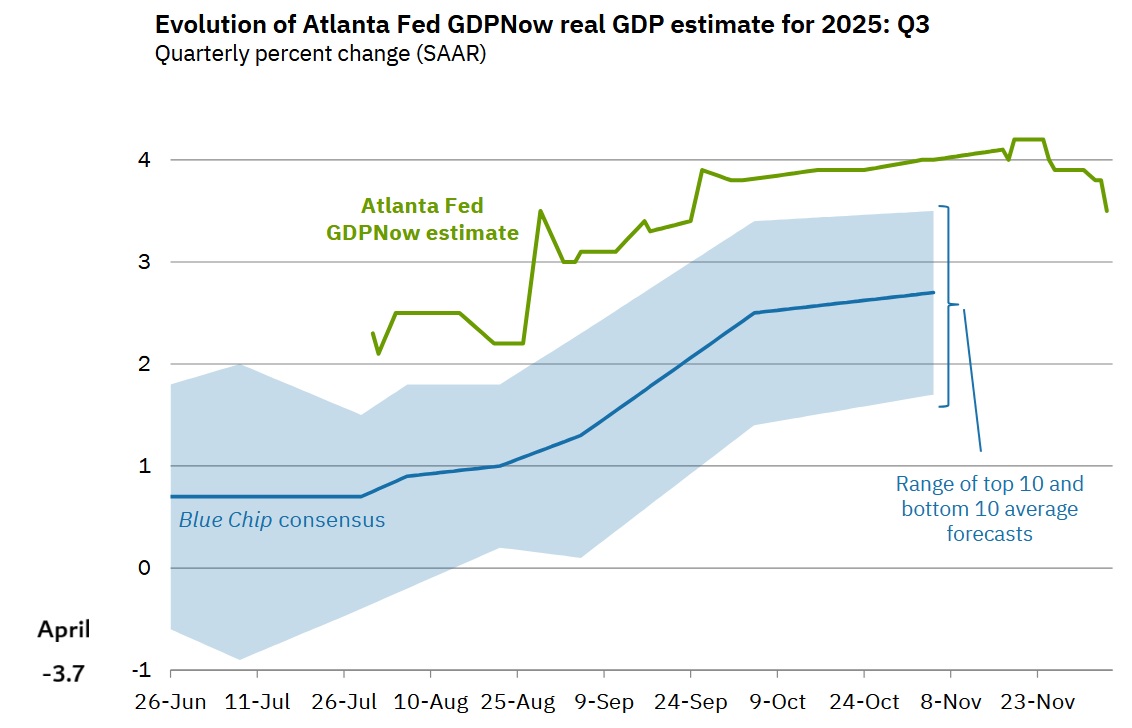
These policies are not just economically risky—they’re actively destabilizing the tools we rely on to understand the economy. Even the Atlanta Fed’s GDPNow model, one of the most respected real-time forecasting systems, has struggled to capture the resulting volatility.

The First Shockwave: GDP Collapses in Early 2025

During the first quarter of 2025, the GDPNow model projected real GDP growth (seasonally adjusted annual rate) at –3.7%. The contraction was so sharp that it fell off the scale of standard graph displays.

Crucially, this collapse wasn’t caused by consumer demand or business investment falling apart—it was almost entirely due to the way imports and exports are measured in GDP accounting. With Trump’s tariff schedule looming, businesses launched a massive, front-loaded rush to import goods before the tax hikes hit, causing an artificial spike in imports that mechanically pushed GDP downward.

This is not normal economic behavior. It’s panic behavior—created by policy.

The Tariff Whiplash Effect: Forecasts Go Wild

Once the early-year import surge ended, import levels cratered. Because imports are subtracted in GDP calculations, this plunge created the opposite effect: a predicted surge in GDP growth for late 2025.

Initial projections showed GDPNow spiking to around 5% in Q3 and Q4.

But those optimistic spikes never fully materialized.

The tariffs had a far more damaging, persistent effect on supply chains than anticipated. Import volumes fell harder and for longer than models historically assume possible.

As a result, GDP appears to have briefly peaked at about 4% in November 2025, followed by a rapid decline.

Where the Economy Is Heading Now

Current forecasts show GDP falling sharply again, with projections targeting near 0% growth in the first two quarters of 2026.

And this time, the uncertainty is extreme. Economists describe today’s forecast bands as “cone-of-uncertainty levels wider than during COVID,” because:

  • Tariff effects are non-linear and historically unprecedented
  • Supply chains are behaving unpredictably
  • Consumer prices are destabilizing
  • Business investment is freezing due to policy confusion

In short: upside potential is tiny, but downside risk is enormous.

The Supreme Court Wildcard

One of the biggest unknowns is the upcoming Supreme Court ruling on whether Trump’s “retaliatory tariffs” are even legal.

If the Court invalidates them abruptly:

  • Imports could surge again
  • Supply chains would be thrown into chaos
  • Businesses would need to reprice and reorder instantly
  • GDP models would again be blindsided

If the Court upholds them, the U.S. remains locked into a historically high-tariff regime that suppresses imports, raises prices, and slows growth.

Either outcome carries major economic shock potential.

Additional Policy Risks on the Horizon

Forecasting also remains clouded by several other Trump-era policy disruptions, each of which could individually affect GDP growth but collectively pose massive systemic risk:

  • Immigration restrictions, which could worsen labor shortages and reduce potential GDP
  • Healthcare policy uncertainty, especially around ACA destabilization
  • Expansion of fossil fuel subsidies, which distort investment flows and long-term energy costs
  • Budgetary unpredictability due to inconsistent fiscal priorities

All of these factors compound the difficulty of projecting the next 12–18 months.

Conclusion: The U.S. Is Entering an Economically Uncharted Era

The combination of unprecedented tariffs, volatile trade behavior, unstable supply chains, and sweeping policy changes has pushed the U.S. economy into a state where traditional forecasting tools are struggling to keep up.

This is not just “normal economic noise.”
This is a result of anti-economic policy design, implemented at a scale large enough to break the models themselves.

Until the policy environment stabilizes—and until the Supreme Court resolves key legal uncertainties—the U.S. economy is likely to remain on a knife’s edge, with enormous downside risk and extremely limited upside potential.

2025 GDP
2025 GDP

Trumpenomics

bookmark_borderAmerica’s Water Crisis: Climate Change Is Reshaping Freshwater Security in the U.S.

by Daniel Brouse / December 5, 2025

Much of the United States is already experiencing severe, measurable impacts of climate change on freshwater availability. These changes are not abstract predictions — they are unfolding in real time, impacting drinking water supplies, agriculture, ecosystems, and energy production. From the rapidly drying West to the saltwater-intruded aquifers of Florida and New Jersey, the nation’s water security is under unprecedented strain.

The Western U.S.: From Drought to Permanent Aridification

For decades, the Western United States has cycled through droughts, but the current crisis is fundamentally different. Scientists increasingly refer to the region’s condition not as a drought — which implies a temporary deviation — but aridification, a long-term drying driven by rising temperatures.

Record Lows in Major Reservoirs

The Colorado River Basin, which serves 40 million people across seven states and Mexico, is the clearest example of how climate change is reshaping water security.

Lake Mead

Lake Mead, the country’s largest reservoir, has dropped to the lowest levels since it was filled in the 1930s. The enormous white “bathtub ring” etched into its canyon walls is visible proof of its historic decline.

In 2021, the federal government declared the first-ever Tier 1 water shortage, triggering mandatory cuts — most notably for Arizona and Nevada. Mead’s decline has grown so severe that it threatens hydroelectric generation at the Hoover Dam.

Lake Powell

Upstream, Lake Powell has fared no better. Water levels have approached the minimum power pool, the threshold below which the Glen Canyon Dam’s turbines can no longer operate. Federal officials have had to take emergency actions, including releasing water from upstream reservoirs and withholding water traditionally sent downstream.

Unprecedented Federal Mandates and Local Water Restrictions

The worsening crisis has forced all levels of government to intervene:

1. Federal Water Reductions

The Bureau of Reclamation has required massive cuts — 2 to 4 million acre-feet annually across the basin.

  • Arizona lost 18% of its entire Colorado River allocation in a single year.

2. Urban Water Conservation

Cities dependent on the river — including Las Vegas, Phoenix, and Los Angeles — have introduced aggressive conservation programs and, in some cases, mandatory rationing. Despite efforts to diversify water portfolios, long-term water security remains precarious.

3. Agricultural Fallout

Agriculture, which consumes roughly 70–80% of Colorado River water, is being forced into drastic measures. Farmers are:

  • shifting away from water-intensive crops,
  • adopting new irrigation technologies, or
  • fallowing land entirely.

The economic implications reach far beyond the farm gate.

How Climate Change Is Driving the Collapse

The Colorado River Compact, signed in 1922, dramatically overestimated the river’s annual flow. Climate change has transformed a historically strained system into an outright failing one.

Reduced Snowpack and Early Melt

Warmer winters mean less snowfall in the Rockies and Sierra Nevada. What snow does fall melts too early, disrupting the timing of spring runoff — the pulse that has always sustained the river through summer.

Increased Evaporation and Soil Moisture Loss

Higher temperatures accelerate evaporation from reservoirs and rivers. Meanwhile, parched soils absorb more water before it reaches tributaries and main stems.

A 2023 study found that human-caused warming has removed the equivalent of an entire Lake Mead from the basin since 2000.

This is not natural variability — it is climate-driven hydrological destabilization.

The Pacific Northwest: Myths and Realities of the Lower Snake River Dams

Some political voices claim the lower Snake River dams are essential for regional energy security. The data says otherwise:

  • They contribute less than 4% of the Northwest’s electricity.
  • They operate at a small fraction of theoretical capacity.
  • As run-of-river dams, they offer minimal storage — unlike major storage systems such as Grand Coulee.
  • They require tens of millions in taxpayer subsidies to remain operational.
  • They are a leading driver of salmon population collapse, threatening tribal treaty rights and devastating ecosystems and fisheries.

Labeling dam removal as “climate craziness” ignores hydrology, ecology, economics, and modern grid modeling.

Florida: Freshwater on the Brink

While the West grapples with aridification, Florida faces a different climate-driven threat: saltwater intrusion.

Saltwater Invading Drinking Water Aquifers

South Florida’s primary freshwater source, the Biscayne Aquifer, is becoming increasingly contaminated as rising sea levels push saltwater inland. This process accelerates when rainfall declines, river flows weaken, and groundwater pumping intensifies.

Emergency Water Purchases in Tampa

A stark illustration of the crisis:

  • Tampa is currently buying 10 million gallons of water per day,
  • an action officials describe as “very rare” — especially this early in the year.

Saltwater intrusion and diminished river flows are forcing utilities into emergency measures far earlier than in previous decades. And this isn’t just a Florida problem — it’s unfolding across the Eastern U.S.

Along the Delaware River, saltwater has been pushing farther upstream than ever recorded, killing cedar forests in New Jersey and threatening Philadelphia’s drinking water supply. Large stretches of the East Coast and Gulf Coast are experiencing the same accelerating pattern.

Louisiana’s coastline remains deeply damaged and largely infertile even decades after Hurricane Katrina, and successive storms have further degraded ecosystems and freshwater systems across Louisiana, Alabama, Texas, and the Florida Panhandle.

Climate-driven hydrological collapse is no longer a regional issue — it’s a national one.

A National Crisis: Different Regions, Same Driver

From the drying reservoirs of the West to the compromised aquifers of the Southeast, America’s water systems are being reshaped by the same underlying force: climate-driven hydrological disruption.

The consequences are already visible:

  • collapsing reservoirs
  • failing aquifers
  • disappearing snowpack
  • rising salinity
  • ecological devastation
  • increased water costs
  • declining hydroelectric capacity
  • agricultural instability
  • regional economic stress

This is not a future scenario — it is the present, and it is accelerating.

* Our probabilistic, ensemble-based climate model — which incorporates complex socio-economic and ecological feedback loops within a dynamic, nonlinear system — projects that global temperatures are becoming unsustainable this century. This far exceeds earlier estimates of a 4°C rise over the next thousand years, highlighting a dramatic acceleration in global warming. We are now entering a phase of compound, cascading collapse, where climate, ecological, and societal systems destabilize through interlinked, self-reinforcing feedback loops.

What Can I Do?
The single most important action you can take to help address the climate crisis is simple: stop burning fossil fuels. There are numerous actions you can take to contribute to saving the planet. Each person bears the responsibility to minimize pollution, discontinue the use of fossil fuels, reduce consumption, and foster a culture of love and care. The Butterfly Effect illustrates that a small change in one area can lead to significant alterations in conditions anywhere on the globe. Hence, the frequently heard statement that a fluttering butterfly in China can cause a hurricane in the Atlantic. Be a butterfly and affect the world.

Tipping points and feedback loops drive the acceleration of climate change. When one tipping point is breached and triggers others, the cascading collapse is known as the Domino Effect.

The Human Induced Climate Change Experiment
bookmark_borderFlorida at the Front Line: How Accelerating Sea-Level Rise Is Reshaping the State in Real Time

by Daniel Brouse
December 5, 2025

Florida faces a long list of climate-driven threats — extreme heat, stronger hurricanes, toxic algal blooms, and collapsing insurance markets — but accelerating sea-level rise (SLR) sits at the center of nearly all of them. Although the current rise of a few millimeters per year may sound trivial, the reality is anything but. Sea-level rise is no longer linear; it is entering a phase of nonlinear, exponential acceleration, and Florida is already experiencing the consequences.

1. Sea-Level Acceleration: From Millimeters to Centimeters

Sea level has been rising for a century, but what matters most is the rate of change. Historically, it took roughly a century for the rate to jump from ~3 mm/year to ~6 mm/year. Now, that doubling has happened in just eight years.

This exponential acceleration is driven by:

  • Rapid ice-sheet melt in Greenland and Antarctica
  • Thermal expansion of superheated oceans
  • Slowing ocean circulation (including the AMOC)
  • Increased land subsidence in coastal regions

If current trends hold — and most projections underestimate nonlinear behavior — Florida could see centimeters per year within the next decade and experience multiple surge-years this century where sea levels jump over a foot in a single year due to ice-sheet pulses and ocean heat anomalies.

This is not a distant scenario. It is unfolding now.

2. Everyday Flooding: Surge Without a Storm

Storm surge is no longer just a hurricane problem. Florida now experiences regular tidal flooding with no storms at all, as “sunny-day floods” push seawater into streets, yards, and infrastructure simply because the baseline sea level is higher.

Consequences include:

• Infrastructure decay

Saltwater corrodes electrical systems, sewer lines, bridges, roads, pumps, and underground cables. Critical infrastructure in Miami-Dade, Tampa Bay, the Keys, and Jacksonville is suffering chronic damage.

• Soil and ecosystem collapse

Saltwater intrusion destroys soil structure, kills vegetation, and converts freshwater wetlands into ghost forests.

• Drinking-water contamination

Saltwater is infiltrating freshwater aquifers — especially the Biscayne Aquifer — which supply millions of Floridians with drinking water.

One striking example of the water crisis:

“VERY RARE”: Tampa is currently purchasing about 10 million gallons of water per day — something officials say almost never happens this early in the year.
Saltwater intrusion and low river flows are driving emergency purchases months ahead of schedule.

3. Insurance Market Collapse: Climate as an Economic Wrecking Ball

Extreme saltwater events, chronic flooding, stronger hurricanes, and skyrocketing property risk have triggered a full-scale insurance meltdown in Florida.

The results:

  • Dozens of private insurers have left the state
  • Those remaining have raised premiums by 50–200%
  • Auto insurance rates are rising due to saltwater-related electronics failures and flood losses
  • Citizens Property Insurance — the taxpayer-funded state insurer of last resort — is now the largest insurer in Florida

This means the financial burden is shifting directly onto Florida taxpayers, even if they live nowhere near the coast.

4. The Bottom Line

Florida’s sea-level rise is not “millimeters that don’t matter.”
It is:

  • Accelerating at a historically unprecedented rate
  • Flooding infrastructure even on sunny days
  • Salting soils and destroying ecosystems
  • Contaminating drinking water
  • Collapsing the private insurance market
  • Forcing taxpayers to absorb billions in risk

Florida is already living in the future the rest of the country is headed toward. The question is no longer if sea-level rise will reshape the state, but how fast and how prepared communities will be for what’s coming next.

* Our probabilistic, ensemble-based climate model — which incorporates complex socio-economic and ecological feedback loops within a dynamic, nonlinear system — projects that global temperatures are becoming unsustainable this century. This far exceeds earlier estimates of a 4°C rise over the next thousand years, highlighting a dramatic acceleration in global warming. We are now entering a phase of compound, cascading collapse, where climate, ecological, and societal systems destabilize through interlinked, self-reinforcing feedback loops.

What Can I Do?
The single most important action you can take to help address the climate crisis is simple: stop burning fossil fuels. There are numerous actions you can take to contribute to saving the planet. Each person bears the responsibility to minimize pollution, discontinue the use of fossil fuels, reduce consumption, and foster a culture of love and care. The Butterfly Effect illustrates that a small change in one area can lead to significant alterations in conditions anywhere on the globe. Hence, the frequently heard statement that a fluttering butterfly in China can cause a hurricane in the Atlantic. Be a butterfly and affect the world.

Tipping points and feedback loops drive the acceleration of climate change. When one tipping point is breached and triggers others, the cascading collapse is known as the Domino Effect.

The Human Induced Climate Change Experiment

bookmark_borderSmall Businesses Are the First Casualties of Trump’s Tariff Economy — And the Jobs Data Proves It

The latest employment numbers reveal exactly why small businesses are suing President Trump over his tariff policies: tariffs hit small firms and lower-income consumers the hardest, functioning as a stealth tax that now adds anywhere from 20% to over 50% to the cost of many goods compared with last year.

And the results are now undeniable.

Record Small Business Bankruptcies and a Collapse in Hiring

Small business bankruptcies have surged to record highs, and the newest job numbers show the situation is accelerating.

According to the November 2025 ADP National Employment Report, the private sector saw a net loss of 32,000 jobs. That decline was driven entirely by small businesses, which shed an alarming 120,000 workers in just one month.

ADP’s chief economist, Dr. Nela Richardson, called small firms “a canary in the coal mine” — the first to suffer when consumer demand weakens and operating costs spike. Pay growth for small-firm workers also fell far behind that of larger companies, underscoring how badly the sector is being squeezed.

This isn’t a blip. It’s a structural failure created by policy.

Tariffs Are Functioning as a Massive, Regressive Tax

Unlike large corporations, small businesses don’t have the financial cushion, global supply chains, or pricing power to absorb sudden spikes in import costs. They pay tariffs up front, while their customers — mostly working- and middle-class households — face higher prices at checkout.

That’s why small businesses are paying the equivalent of 20% to over 50% more in real taxes compared with last year. U.S. import prices (excluding the tariff) show that foreign exporters have been raising their prices in dollars. This indicates they are not absorbing much, if any, of the tariff cost.


Tariffs are taxes. And these taxes are crippling the very businesses that drive local economies and job creation.

The Administration Blames… Democrats?

In stark contrast to economic reality, U.S. Secretary of Commerce Howard Lutnick declared that the weak job numbers were not caused by tariffs, but instead blamed:

  • the recent government shutdown, and
  • mass deportations,
    as if those weren’t also direct consequences of Trump’s own policies.

Tariffs raised business costs.
The shutdown weakened demand.
Mass deportations removed workers and consumers.
Every explanation points back to the same place.

The Lawsuit Before the Supreme Court

The reason small businesses are currently suing the administration — in a case now before the U.S. Supreme Court — is precisely because Trump’s tariff actions have caused severe, measurable financial harm.

If the Court rules the tariffs illegal (as multiple lower courts already have), businesses want the right to recover the money they were forced to pay. Without that ruling, many of them won’t survive.


Small businesses are not just numbers on a spreadsheet — they’re the backbone of the U.S. economy. And right now, Trump’s tariff regime is breaking that backbone.

Trumpenomics

bookmark_borderTariffs, Protectionism, and Economic Self-Harm: Why Costco’s Lawsuit Exposes a Bigger National Problem

Costco Has Sued the U.S. Government — and It Highlights the Bigger Failure of Trump’s Tariff Policy

Costco has filed suit against the U.S. government — specifically U.S. Customs and Border Protection — to preserve its ability to receive a full refund on tariffs it has already paid, should the Supreme Court ultimately rule that President Trump’s tariffs were illegal.

This case is not just about Costco. It is a symptom of the deeper economic damage caused by tariffs and protectionism.

Key Details of the Lawsuit

1. Purpose of the Suit

Filed on November 28, 2025, in the U.S. Court of International Trade, Costco’s lawsuit is not intended to strike down the tariffs directly. Instead, it aims to protect Costco’s right to reclaim the money it paid in tariffs — money that may have been unlawfully collected.

2. The “Liquidation” Deadline

Costco faces a crucial December 15, 2025 deadline for certain import entries to be liquidated (finalized by Customs). Once an entry is liquidated, an importer can permanently lose the right to challenge those charges or receive a refund.

Costco says Customs refused to extend the deadline, leaving the company no choice but to sue immediately to avoid losing millions.

3. Legal Foundation of the Challenge

The lawsuit cites earlier rulings by the Court of International Trade and the Federal Circuit, both of which determined that Trump misused the International Emergency Economic Powers Act (IEEPA).
Those courts concluded the law did not give him the authority to impose the tariffs he enacted.

This core legal issue is now before the Supreme Court.

4. The Supreme Court’s Role

The Supreme Court heard arguments last month and is expected to rule soon on whether the tariffs were illegal. Costco’s lawsuit ensures that if the Court rules against Trump’s authority, Costco will be positioned to receive a refund — potentially tens or hundreds of millions of dollars.

5. Part of a Larger Corporate Pushback

Costco is not alone. Major companies including Revlon, Bumble Bee Foods, and Kawasaki Motors have filed similar suits to preserve their rights to reimbursement. Collectively, these legal actions highlight the widespread financial harm caused by the tariffs.

How Tariffs and Protectionism Damage the Economy

Tariffs Are Taxes on Americans — Not on Foreign Countries

Politicians promote tariffs as “making other countries pay,” but that is unequivocally false.
U.S. businesses pay the tariffs. U.S. consumers pay the higher prices. Tariffs are simply a hidden sales tax.

Tariffs Raise Inflation

Economists across the political spectrum agree: tariffs raise the cost of imported goods, and those costs ripple through supply chains, forcing companies to raise prices.
Trump’s tariffs have contributed significantly to higher costs for:

  • food
  • electronics
  • vehicles
  • building materials
  • clothing
  • household goods

The Costco lawsuit underscores how much corporate America has been forced to absorb — or pass on to consumers.

Protectionism Destroys Jobs Rather Than Creating Them

Tariffs are often sold as “protecting American jobs,” but the historical and empirical record shows:

  • Far more jobs rely on inexpensive imported inputs
  • Retaliatory tariffs reduce U.S. exports
  • Supply chains become strained
  • Manufacturing declines instead of growing

Every time the U.S. has leaned into protectionism (Smoot-Hawley in the 1930s, steel tariffs in the 2000s, Trump’s first-term tariffs), jobs were lost and recessions worsened.

Tariffs Undermine Global Confidence in the U.S. Economy

The Costco lawsuit points to a growing crisis:
If companies believe U.S. policy is arbitrary, unpredictable, or politically motivated, they lose confidence in the U.S. market.

This raises borrowing costs, increases volatility, and weakens the dollar — the exact opposite of what a healthy global reserve currency requires.

Protectionism Hurts Small Businesses the Most

Large companies like Costco can file lawsuits and hedge against risk.
Small businesses cannot. They simply face:

  • higher costs
  • lower profits
  • reduced competitiveness
  • bankruptcy risk

Protectionism is a tax on the middle class and a subsidy for the politically connected.

Conclusion: Costco’s Case Is a Warning Sign

The Costco lawsuit illustrates a much broader economic truth:

Tariffs and protectionism are not “America First.”
They are inflationary, economically destructive, and legally unstable.

If the Supreme Court rules the tariffs illegal, the U.S. will be forced to face an even harder reality:
The economic damage was unnecessary, self-inflicted, and entirely avoidable.

Trumpenomics

bookmark_borderInstant Engineering: How AI Shrinks Design Cycles From Weeks to Hours

by Daniel Brouse
December 1, 2025

Today, NVIDIA and Synopsys announced a major expansion of their strategic partnership—backed by a $2 billion equity investment from NVIDIA—to “reimagine engineering and design” through AI, accelerated computing, and advanced digital twin technologies. This collaboration is not just a business deal; it marks the beginning of a fundamental shift in how humanity designs and prototypes everything from microchips to entire industrial systems.

Below is an expanded explanation of what this partnership means, why it matters, and how AI will collapse engineering timelines from weeks to hours.

A New Era in Design: From Atoms to Entire Systems

NVIDIA founder and CEO Jensen Huang framed the partnership around a bold promise:

Engineers will soon be able to simulate and prototype “at unprecedented speed and scale, from atoms to transistors, from chips to complete systems.”

This reflects a transformative leap in engineering capability. Historically, design workflows have been bottlenecked by:

  • Slow simulation cycles
  • Fragmented tools
  • Manual design iteration
  • Limited ability to model complex interactions
  • Long fabrication or prototyping queues

Huang’s emphasis on “fully functional digital twins inside the computer” signifies AI’s role not merely in optimizing the process, but inverting it. Instead of building physical prototypes and testing them, engineers will design, test, break, redesign, and validate entire systems virtually—with physics-accurate fidelity.

What Makes This Acceleration Possible?

1. AI-Driven Generative Design

Generative AI—powered by domain-specific models trained on millions of design patterns—can produce optimized designs automatically.

This includes:

  • Circuit layouts
  • Mechanical components
  • Chip floorplans
  • Thermal and fluid dynamics solutions
  • Integrated system architectures

Traditionally, an engineer might spend a week refining a chip layout.
AI can now produce hundreds of layouts in seconds, rank them, simulate them, and deliver the top candidates for human review.

2. Real-Time Simulation With Accelerated Computing

NVIDIA’s GPUs and Synopsys’s electronic design automation (EDA) tools create an environment where:

  • Electromagnetic simulations
  • Stress/strain analysis
  • Thermal modeling
  • Logic verification
  • Signal integrity testing

…run thousands of times faster than CPU-based workflows.

Design loops that once required overnight compute jobs now run in real time or near-real time.

3. Digital Twins With Full Physical Fidelity

Digital twins are not new, but until recently they suffered from three constraints:

  1. Insufficient compute power
  2. Limited model resolution
  3. Inability to represent real-world physics accurately

NVIDIA’s Omniverse and Synopsys’s design software now integrate to build physically accurate, AI-enhanced twins of:

  • Chips
  • Circuit boards
  • Mechanical assemblies
  • Entire factories
  • Power grids
  • Autonomous systems
  • Data centers

These twins allow engineers to test every design decision before building anything tangible.

How We Go From Weeks to Hours

Below is a breakdown of major stages in engineering and how AI compresses each one.

Stage 1 — Concept Generation

Old timeline: Days to weeks
New timeline: Minutes

AI generates thousands of design variations immediately. Engineers pick the best few to refine.

Stage 2 — Simulation & Validation

Old timeline: Hours to days per simulation
New timeline: Seconds to minutes

Accelerated computing + AI surrogate models reduce simulation time by orders of magnitude.

For example:

  • A fluid-dynamics simulation that used to take 10 hours now runs in under a minute using GPU-enhanced physics ML models.

Stage 3 — Automatic Optimization

Old timeline: Weeks of iterative human tuning
New timeline: Continuous real-time optimization

AI systems automatically tune designs for:

  • Weight reduction
  • Efficiency
  • Heat dissipation
  • Costs
  • Manufacturability
  • Reliability

This used to require entire engineering teams.
Now the system learns constraints and improves itself iteratively.

Stage 4 — Virtual Prototyping & Testing

Old timeline: Physical prototypes built over months
New timeline: Virtual prototypes created instantly

Digital twins allow:

  • Stress tests
  • Failure mode analysis
  • Lifecycle predictions
  • Production cost modeling

—all without lifting a screwdriver.

Stage 5 — Manufacturing Integration

Old timeline: Manual translation into manufacturing specs
New timeline: Automatic export into manufacturing-ready blueprints

CAD → CAM → fabrication workflows become AI-driven and fully synchronized.

Industry Impacts: Beyond Chips

Huang noted that this partnership will affect “industries of all kinds.”
Here’s what that means in practice:

Automotive

Design and validate entire EV platforms virtually before any physical assembly.

Aerospace

Run millions of aerodynamic simulations per day.
AI designs wings, heat shields, internal components.

Semiconductors

Full-stack chip design—from atomic modeling to full SoC layout—done collaboratively by AI systems.

Energy

Design and simulate power grids, microreactors, battery chemistries, and renewable systems at unprecedented scale.

Manufacturing

Create digital factories and optimize production lines before installation.

What This Really Means

Across engineering disciplines, the development timeline is about to collapse:

  • Chips: From 18–24 months → potentially under 6 months
  • Vehicles: From 5–7 years → under 2 years
  • Product prototypes: From weeks → hours
  • Daily design adjustments: From overnight → real time

This is not automation replacing engineers.
It is augmentation at a historic scale—engineers gaining superpowers.

Conclusion: A Step Toward Instant Engineering

The NVIDIA–Synopsys partnership represents the next phase of industrial evolution:
Engineering as a real-time, AI-driven, simulation-native workflow.

With AI generating designs, GPUs simulating them instantly, and digital twins validating entire systems before they physically exist, time becomes the variable engineers no longer worry about.

What previously required weeks of effort will compress to hours, and what demanded entire teams will be attainable by a single engineer working alongside intelligent systems.

This partnership doesn’t just speed up engineering.
It rewrites the physics of productivity.

bookmark_borderTrump’s Fiscal Volatility and the Rising Global Risk: How Political Interference Is Destabilizing the Dollar and the World Economy

There are several interlocking elements of Donald Trump’s fiscal and political strategy that are increasingly destabilizing the global economy. As international markets grow more risk-averse, the persistent uncertainty surrounding U.S. institutions — particularly the financial and judicial systems — is eroding confidence in the dollar. The global economy still relies on the dollar as its primary reserve currency, so even subtle shifts in trust can have outsized effects.

That erosion is now visible. Eurozone lenders with substantial dollar-denominated operations are being warned to bulk up their liquidity and capital buffers in anticipation of potential volatility triggered by Trump’s actions. On Wednesday, the European Central Bank issued a pointed warning: the growing instability around U.S. fiscal policy, political pressure on independent institutions, and tariff-driven disruptions could expose the global financial system to a dangerous squeeze.

The ECB has been quietly sounding the alarm since Trump’s tariff escalations and his public pressure campaign on the Federal Reserve rattled confidence in the spring. The issue is not who chairs the Fed — the chair does not unilaterally set interest rates. What matters is the perception of political influence. When a president attempts (or even appears) to steer central bank decisions, the credibility of the institution erodes. For a reserve-currency nation, credibility is not just a virtue — it is the foundation of global financial stability.

In its latest Financial Stability Review, the ECB sharpened its language. It emphasized that the handful of major eurozone banks heavily exposed to the dollar must prepare for the possibility of sudden, Trump-induced volatility.

“Capital headroom could be needed to absorb … higher currency volatility and counterparty credit risk,” the ECB wrote in its twice-yearly report. “Banks should hold liquid U.S. dollar assets to counterbalance outflows and act as a stabilising intermediary.”

The ECB also reiterated broader concerns: inflated stock market valuations, historically high global debt, trade tariffs that undermine supply chains, and the unpredictable growth of stablecoins — all factors that amplify systemic fragility.

The pattern is unmistakable. Trump’s fiscal destabilization is not confined to the United States — it radiates outward, magnifying global risk, weakening trust in the dollar, and forcing foreign institutions to brace for shocks they did not create.

The world is preparing for turbulence. The question is whether the United States is.

Trumpenomics

bookmark_borderThe Collapse Point: How Climate Change Is Breaking Insurance — and Capitalism With It

by Daniel Breouse / November 26, 2025

As extreme weather accelerates, humanity is nearing a tipping point where insurance — and the economic system built upon it — may no longer function. One of the world’s largest insurers, Allianz SE, has issued an unusually blunt warning: the climate crisis is destabilizing global capitalism from within, and the breakdown has already begun.

Allianz board member Gunther Thallinger, who also chairs the company’s investment board, argues that rising temperatures and worsening climate disasters are pushing many risks past the limits of insurability. And when insurance fails, everything built on top of it — mortgages, real estate markets, infrastructure investment, business lending, and even municipal budgets — begins to unravel.

His message is simple and grim:
“Heat and water destroy capital.”

Flooded homes lose value. Overheated cities become uninhabitable. Billion-dollar infrastructure corrodes, warps, or burns. Entire asset classes are degrading in real time.

The consequences ripple far beyond insurance claims. They threaten the foundational assumptions of modern capitalism itself.

A Financial System on the Brink

The planet is currently on track for 2.2°C to 3.4°C of warming — well beyond the thresholds that insurers, governments, and markets are designed to withstand. Global temperatures have already surpassed 1.5°C and are projected to blow past 3°C within a decade.

At that level of heating:

  • The number and severity of disasters become too frequent to price.
  • Extreme losses arrive faster than insurers can rebuild capital.
  • Governments cannot bail out the private sector at the required scale.
  • Entire regions become economically nonviable.

The numbers already paint the picture of an economy under siege:

  • $2 trillion in climate-related damages from 2013–2023 (Aviva).
  • $400 billion in 2024 alone (Gallagher RE).
  • A fivefold increase in annual weather-related losses in Europe since the 1980s.

Insurers like Zurich now openly state that achieving net-zero emissions by 2050 is essential to prevent systemic collapse.

Thallinger’s warning:
We may not have until 2050.

In California, major carriers have already stopped writing home insurance in fire-prone regions. In Florida, companies are fleeing as storm intensities shred actuarial models. These are not hypotheticals — they are the first cracks in the global financial foundation.

When the Math Breaks Down

Insurance only works when the risks are measurable and the premiums remain affordable. Climate change destroys both conditions.

Thallinger is explicit:

“As temperatures rise to 1.5°C, 2°C, 3°C, insurers will no longer be able to offer coverage. The premiums required exceed what people or companies can pay. This is already happening.”

If insurance fails:

  • Banks cannot issue mortgages.
  • Developers cannot secure financing.
  • Cities cannot bond infrastructure.
  • Home values collapse.
  • Industries become stranded.
  • Governments face spiraling bailout demands they cannot meet.

This is the hidden climate tipping point — a systemic failure that happens quietly, through spreadsheets and canceled policies, before it erupts into a full-blown economic crisis.

What the Industry Says Must Happen (and Why It Isn’t Happening)

Klaus-Peter Röhler, another Allianz board member, outlines what is required to keep insurance viable:

1. Massive prevention and adaptation

Climate-resilient building codes, flood defenses, and infrastructure upgrades.
Europe has completed only 5% of its planned flood protection projects.
At the current pace, it will take 100 years to finish.

2. Risk-based pricing

Political pressure often forces insurers to keep premiums artificially low — a recipe for insolvency. Without prices that reflect real risk, insurers collapse sooner.

3. Government stop-loss support for extreme events

Governments should backstop only the rarest, most catastrophic disasters — not routine damage that should be prevented through better planning.

No country has successfully implemented this triad.
Some, notably the United States, demonstrate what happens when policymakers block these measures:

  • California: Wildfire risk makes coverage unavailable at any price.
  • Florida: Storm losses and dysfunctional regulation have triggered an insurance exodus.
  • State-run bailout insurers are failing under the load.

The lesson is clear: Insurability is not guaranteed.
It must be preserved — and it is being lost region by region.

What Happens Next

Allianz emphasizes that policyholders, governments, and insurers all have roles to play — but adaptation can only delay collapse if emissions continue rising.

Without rapid decarbonization:

  • More regions will become uninsurable.
  • Financial shocks will cascade into housing, banking, and municipal finance.
  • Capitalism, which relies on pricing risk, will have no mechanism to allocate it.
  • Entire coastal and heat-exposed regions could lose economic viability.

We are approaching a world in which the question will not be whether people can afford insurance — but whether insurance can afford people.

The Real Tipping Point Isn’t Just Environmental — It’s Economic

Climate change is often framed as a humanitarian crisis or an environmental challenge. It is far more than that.

It is a capital destruction engine operating on a planetary scale.

Insurance is simply the first part of the system to falter, because it is the first to directly feel the mathematical impossibility of infinite losses on a finite balance sheet. But what follows is not limited to insurers:

  • Mortgage markets fail.
  • Municipal bond markets seize up.
  • Infrastructure investment dries out.
  • Property values collapse.
  • Supply chains face continuous disruption.
  • Governments pick up costs they cannot bear.
  • Capitalism enters an unmanageable risk spiral.

Unless warming is rapidly halted, we will cross a line where risk can no longer be transferred, financed, or recovered.

That is the collapse point.

* Our probabilistic, ensemble-based climate model — which incorporates complex socio-economic and ecological feedback loops within a dynamic, nonlinear system — projects that global temperatures are becoming unsustainable this century. This far exceeds earlier estimates of a 4°C rise over the next thousand years, highlighting a dramatic acceleration in global warming. We are now entering a phase of compound, cascading collapse, where climate, ecological, and societal systems destabilize through interlinked, self-reinforcing feedback loops.

What Can I Do?
The single most important action you can take to help address the climate crisis is simple: stop burning fossil fuels.

Tipping points and feedback loops drive the acceleration of climate change. When one tipping point is toppled and triggers others, the cascading collapse is known as the Domino Effect.

The Human Induced Climate Change Experiment

bookmark_borderRecord Deficit, Falling Confidence, and Rising Prices: Today’s Economic Data Paints a Bleak Picture

The U.S. economy delivered another round of troubling signals today, November 25, 2025, as new data from multiple federal agencies showed weakening consumer confidence, persistent inflation pressures, and a federal deficit spiraling far beyond expectations — despite record tariff revenue.

A Deficit Explosion Masked by Tariff Receipts

The U.S. Treasury Department reported a $284 billion federal budget deficit for October, a figure significantly worse than analysts had projected. What makes the number even more alarming is that it came despite record-breaking tariff revenue — revenue that was supposed to “pay down the deficit” under the administration’s claims.

Instead, higher tariffs have functioned like a stealth tax on American consumers, raising prices while failing to stabilize federal finances. Any short-term revenue boost is being swamped by:

  • Declining economic activity
  • Slowing consumer spending
  • Rising interest costs on the national debt
  • Lower income tax receipts from a weakening labor market

The result is a fiscal picture deteriorating faster than any point since the early pandemic.

Producer Prices Rising Again — Especially Energy

The Bureau of Labor Statistics reported that the Producer Price Index (PPI) rose 0.3% in September, driven largely by higher energy costs — costs that have surged under the administration’s tariff-heavy trade agenda and expanded fossil fuel subsidies.

Key details:

  • PPI (YoY): +2.7%
  • Core PPI (ex. food & energy): +0.1% for the month, +2.6% YoY

These increases signal that inflationary pressures are not abating, and many of these wholesale price increases typically pass through to consumers in subsequent months.

Consumer Confidence Plunges to a 7-Month Low

The most immediate sign of economic stress is coming from households.

The Conference Board’s Consumer Confidence Index dropped from 95.5 in October to 88.7 in November, its lowest level since April. The decline was broad and severe:

  • Consumers expect worsening business conditions
  • Their current financial situations have deteriorated
  • Expectations of future income growth have declined
  • Confidence in the labor market has weakened noticeably
  • The recent government shutdown further eroded trust and stability

A sustained drop in confidence typically precedes slower holiday spending, weaker hiring, and reduced investment — creating a negative feedback loop that deepens economic downturns.

What Today’s Data Really Means

Taken together, these indicators show an economy:

  • Struggling under the weight of tariffs, which have raised costs while reducing imports and slowing output
  • Weakening from the bottom up, as consumers face rising prices and falling confidence
  • Running dangerously large deficits, even at a time when tariff revenues are unusually high

This is the same pattern seen in past economies strained by protectionism and political instability: higher prices, slower growth, and worsening fiscal health.

Tariffs were promised to make America stronger.
Instead, they’re making everything more expensive — while the deficit keeps climbing anyway.

Trumpenomics