bookmark_borderThe Non-Linear Acceleration of Climate Change: Evidence, Confirmation, and the Emerging Domino Effect

By Sidd Mukherjee and Daniel Brouse
November 22, 2025

In the 1990s, we developed what became known as The Non-Linear Acceleration Hypothesis—the proposition that climate change is not progressing linearly but is accelerating exponentially. Working together, with Sidd’s background as a Doctor of Physics from Ohio State and my own experimental and observational analyses, we produced the foundational evidence for this theory. By the early 2000s, our work had evolved into a recognized climate framework, validated repeatedly through independent replication and supported by an expanding body of empirical data. Over the decades, this body of confirmation has solidified into the scientific consensus we see today.

Shrinking Doubling Times and Escalating Impacts

One of the most compelling indicators of nonlinear acceleration is the dramatic contraction of the doubling time of climate impacts—the interval in which damage effectively doubles due to interacting feedback processes. In the mid-20th century, the doubling time was on the order of 100 years. By the early 2000s, it had fallen to 10 years, and recent analyses show that it has now plunged to approximately 2 years.

This means that the impacts of climate change today are twice as severe as they were two years ago. If the doubling time remains constant, they will be four times worse in two years, eight times worse in four years, and potentially sixty-four times worse within a decade. These estimates are conservative; the doubling period continues to shorten as feedbacks intensify. With no meaningful global mitigation underway, the trajectory is unmistakable and vastly more catastrophic than previously projected.

Hansen’s Confirmation of the Acceleration Hypothesis

We have long regarded Dr. James E. Hansen as one of the principal founders of modern climate science. In April 2025, Hansen’s paper Global Warming Acceleration: Impact on Sea Ice provided a direct, data-driven confirmation of our hypothesis. His analysis demonstrated that global warming is accelerating, and that climate sensitivity is higher than IPCC estimates, fundamentally altering expectations for 21st-century warming.

Hansen concluded that IPCC models underestimate both climate sensitivity and key feedback processes. Under current emissions levels, he projects that warming by 2100 is likely to exceed 7°C, dramatically raising the probability of crossing multiple climate tipping points.

In November 2025, Hansen, Kharecha, and Morgan published Warning! This “Colorful Chart” Is Censored by IPCC, offering further confirmation.

Accelerated Forcing Growth

Their analysis centers on a chart showing the five-year running mean of the annual increase in greenhouse gas forcing. Over the past 15 years, they find that the rate of increase has surged to ~0.5 W/m² per decade—far higher than IPCC projections. This acceleration is not reflected in IPCC scenarios and is fundamentally incompatible with its claims of remaining “pathways” to 1.5°C or 2°C.

Implications for Climate Scenarios

  • Current forcing trajectories align closely with RCP 8.5, the high-end “business-as-usual” pathway.
  • They diverge sharply from RCP 2.6, the scenario often used for policy optimism.
  • Achieving RCP 2.6 today would require $2.4–5 trillion per year using current technology.
  • RCP 2.6 also presumes unrealistic levels of biomass burning plus carbon capture, which Hansen calls politically and practically unviable.

Critique of IPCC’s Modeling and Transparency

Hansen and colleagues argue that the IPCC relies too heavily on Integrated Assessment Models (IAMs), which they describe as opaque “dark boxes”—tools that embed assumptions that are rarely examined in public-facing science.

They highlight that:

  • Scientists have not adequately communicated the severity of accelerating forcings.
  • Carbon pricing is vastly more effective than prescriptive international agreements.
  • Missed opportunities since the Montreal Protocol have allowed forcings to climb unchecked.
  • Early COP negotiations excluded nuclear power from the Clean Development Mechanism—a decision they view as scientifically indefensible.

Climate Sensitivity and Near-Term Risk

Hansen’s findings, along with related analyses, suggest climate sensitivity in the range of 4–5°C per CO₂ doubling, substantially above many IPCC estimates. They warn that without extraordinary action within the next 5–10 years, Earth could be locked into a high-warming trajectory that destabilizes major climate systems.

Strengths of Hansen’s Argument

  • Data-driven approach grounded in measured forcings with ~10% uncertainty.
  • Clear policy relevance connecting forcing to cost, mitigation feasibility, and economic risk.
  • Strong emphasis on accelerating risk, consistent with observed feedback behavior.
  • Valid critique of IAM transparency, echoing long-standing concerns within the scientific community.

Broader Implications

If Hansen et al. are correct, the window for avoiding catastrophic warming is significantly narrower than models suggest. Their work underscores the need for:

  • Greater transparency in climate modeling
  • Rapid implementation of carbon pricing
  • Reevaluation of technological pathways
  • Public communication that aligns with empirical reality

Their findings also increase the urgency of addressing the accelerating feedback loops we identified decades ago.

The Domino Effect: Cascading Tipping Points

Building on nonlinear thermodynamics and chaos theory, we now know that climate tipping points are not isolated events—they interact. As major systems destabilize, they trigger secondary failures, creating a cascade of compounded impacts.

Our recent synthesis of 2024–2025 data shows:

  • CO₂ concentrations, fossil fuel emissions, and global temperatures all reached record highs.
  • Natural carbon sinks are beginning to convert into carbon sources.
  • Feedbacks across ice loss, ocean circulation, albedo decline, and atmospheric chemistry are synchronizing.
  • These interactions are driving what we call the Domino Effect—a system-wide cascade that threatens global habitability within this century.

* Our probabilistic, ensemble-based climate model — which incorporates complex socio-economic and ecological feedback loops within a dynamic, nonlinear system — projects that global temperatures are becoming unsustainable this century. This far exceeds earlier estimates of a 4°C rise over the next thousand years, highlighting a dramatic acceleration in global warming. We are now entering a phase of compound, cascading collapse, where climate, ecological, and societal systems destabilize through interlinked, self-reinforcing feedback loops.

What Can I Do?
The single most important action you can take to help address the climate crisis is simple: stop burning fossil fuels. There are numerous actions you can take to contribute to saving the planet. Each person bears the responsibility to minimize pollution, discontinue the use of fossil fuels, reduce consumption, and foster a culture of love and care. The Butterfly Effect illustrates that a small change in one area can lead to significant alterations in conditions anywhere on the globe. Hence, the frequently heard statement that a fluttering butterfly in China can cause a hurricane in the Atlantic. Be a butterfly and affect the world.

→ “Solutions to the Fossil Fuel Economy and the Myths Accelerating Climate and Economic Collapse.“
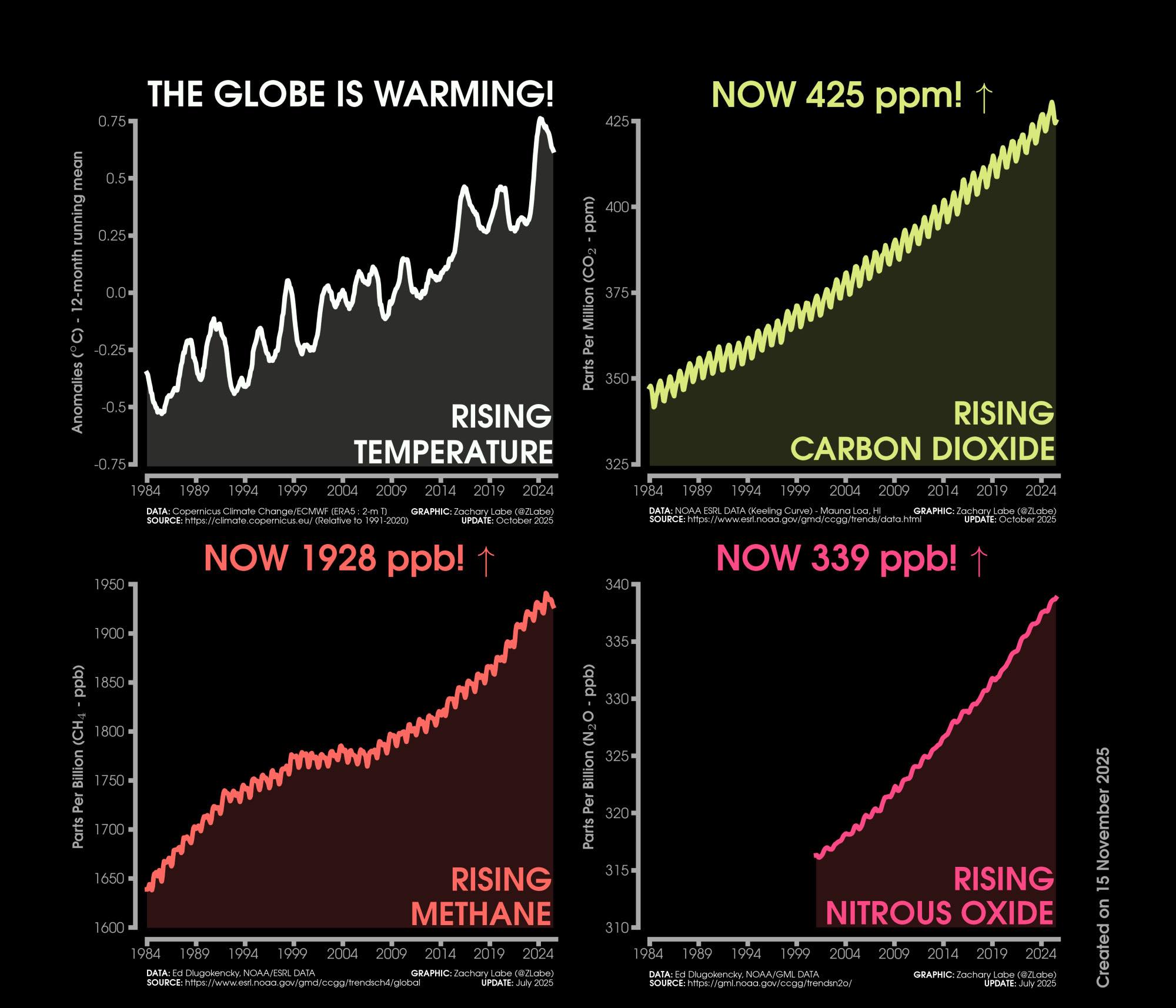
Tipping points and feedback loops drive the acceleration of climate change. When one tipping point is toppled and triggers others, the cascading collapse is known as the Domino Effect.

The Human Induced Climate Change Experiment

bookmark_borderThe Epstein Files Cover-Up: Trump’s Two-Term Obstruction Exposed

“…At my direction, the Dept. of Justice has already turned over close to fifty thousand pages of documents to Congress. Do not forget — The Biden Admin did not turn over a SINGLE file or page related to Democrat Epstein, nor did they ever even speak about him. Democrats have used the “Epstein” issue, which affects them far more than the Republican Party, in order to try and distract from our AMAZING Victories…” – President Donald J. Trump

This is classic Trump projection.
The only administration that actually blocked Epstein files — twice — was Trump’s.

During his first term:

  • Trump’s DOJ fought the Miami Herald’s FOIA requests.

  • His appointees appealed court orders that would’ve unsealed Epstein documents.

  • Barr and Sessions withheld FBI files, internal DOJ memos, and the full immunity list tied to Epstein’s 2008 deal.

  • Trump publicly defended Acosta, Prince Andrew, and even said “I wish her well” about Ghislaine Maxwell. His DOJ acted accordingly: protect, delay, obstruct.

During his second term:

  • Trump’s DOJ used “ongoing investigation” excuses to slow-walk or deny disclosures.

  • They invoked executive privilege to block Congress when the documents related to Trump allies, donors, or Mar-a-Lago associates.

  • The “50,000 pages” he brags about are the same redundant, low-value materials delayed since his first term — and they were released only once Republicans controlled the narrative.

Meanwhile, the fact he omits:
Most major Epstein releases — including thousands of pages of Maxwell case documents and FBI summaries — came out under Biden, because Biden’s DOJ didn’t fight the courts.

Trump spent years blocking the files.
Now he pretends he liberated them.

This isn’t transparency — it’s revisionism.

Trumpenomics: The Decline of the US

bookmark_borderThe Growing Threat to Press Freedom: How Trump’s Influence Is Reaching Beyond U.S. Borders

When a reporter asked him about Epstein, he responded by snapping, “Quiet. Quiet, piggy.”

It is becoming increasingly difficult — and dangerous — to report on Donald Trump. This trend began in the United States and is now extending into the United Kingdom. Trump’s attacks on the press, combined with the increasingly aggressive behavior of his followers, have turned journalism into something that is not only economically risky but, in many cases, physically hazardous.

In the U.S., Trump has sued broadcasters, newspapers, educational institutions, and even scientific organizations. He has also called for — and in some cases initiated — criminal investigations into perceived adversaries. These tactics have created a chilling effect across the industry. News organizations must now factor in legal exposure, targeted harassment, and even threats of violence when covering stories that mention Trump.

This dynamic was highlighted by the December 2024 settlement of Trump’s defamation lawsuit against ABC News and George Stephanopoulos. The suit centered on Stephanopoulos’s on-air statement that Trump had been found “liable for rape” in the E. Jean Carroll civil case. In reality, the jury found him liable for sexual abuse — a legally significant distinction, though morally equivalent in every meaningful sense. Under normal circumstances, ABC would have fought and almost certainly won the case. But as the old lyric from Sonny Curtis of The Crickets put it: “I fought the law and the law won”; today, it often feels like you can’t fight Trump’s legal machinery and win. For many newsrooms, capitulation now appears safer than confrontation.

On November 18, 2025, Trump again demanded that ABC’s broadcast license be revoked after ABC News White House correspondent Mary Bruce asked why he has not released the Jeffrey Epstein files.

“Your news is so fake and so wrong,” Trump snapped at Bruce in the Oval Office during a meeting with Saudi Crown Prince Mohammed bin Salman.

This was not an isolated attack. FCC Chair Brendan Carr had previously threatened ABC’s broadcast license over remarks made by late-night host Jimmy Kimmel regarding the assassination of conservative activist Charlie Kirk — an extraordinary escalation that further blurs the line between regulatory authority and political retaliation.

Tragically ironic, this entire exchange took place while Trump was sitting beside — and actively making deals with — the Saudi crown prince he has now designated a major non-NATO ally. This is the same Crown Prince Mohammed bin Salman whom U.S. intelligence concluded ordered the killing of Washington Post journalist Jamal Khashoggi.

MBS has called Khashoggi’s murder “painful” for Saudi Arabia, even as he pledges nearly $1 trillion in U.S. investments — a reminder that for Trump, political loyalty and money appear to matter far more than justice for an American journalist murdered on foreign soil.


GLOBAL STRONGARM

But this pressure is no longer confined to the United States. The U.S. right wing is actively coordinating with the U.K. right wing, and this alliance is increasingly affecting British media institutions — especially the BBC. At the center of this shift is Sir Robbie Gibb, a powerful and highly controversial figure whose influence is reshaping the BBC’s editorial culture.

Trump has already initiated legal action against the BBC, a move widely seen as an extension of Gibb’s internal pressure campaign. The dispute stems from a BBC documentary on January 6th — an impartial production that included voices from the MAGA movement explaining their support for Trump. Despite this, Gibb seized on a specific edit of Trump’s January 6 speech to accuse the BBC of violating journalism standards, giving Trump a pretext to launch litigation and intensify efforts to intimidate the network.

It’s also important to note that the documentary was not broadcast in the United States and was geographically restricted from streaming, meaning its reach was limited — yet it still triggered disproportionate political retaliation. And, worth underscoring: Panorama’s “Trump: A Second Chance?” aired on 28 October 2024, before the U.S. election. Trump went on to win that election, raising even more questions about the intent behind the lawsuit. If there was no U.S. broadcast, no U.S. audience, and no demonstrable harm — and Trump won — then on what grounds can he claim $1 billion in damages? The litigation appears far less about injury and far more about intimidation.

Who Is Sir Robbie Gibb?

Appointment by Boris Johnson:
Gibb was appointed as a non-executive director to the BBC Board in 2021, during Boris Johnson’s administration. He was reappointed for a second term in May 2024.

Political Roles:
Before joining the board, Gibb served as Theresa May’s Director of Communications — placing him firmly inside the upper ranks of Conservative Party leadership.

Media Involvement:
After leaving government, Gibb worked with GB News, a right-wing broadcaster, and participated in a consortium that acquired The Jewish Chronicle. His resume blends political strategy with media influence, making him a uniquely positioned figure in shaping public narratives.


Why His Role at the BBC Is Controversial

Accusations of Bias and Political Interference:
Reports from The Guardian and other outlets describe Gibb as leading internal campaigns alleging “systemic bias” within the BBC — particularly regarding coverage of Trump, the Gaza conflict, and trans rights. These accusations have been used to exert pressure on editors and producers.

Influence on Editorial Decisions:
Insiders say Gibb has pushed for specific hires, such as Michael Prescott, who authored a memo criticizing BBC editorial standards. Such moves have raised concerns that the BBC Board is directly shaping newsroom decisions rather than maintaining a healthy, independent distance.

Alignment With the Global Right Wing:
Gibb’s political loyalties, combined with his media roles, make him a key conduit between U.K. conservatism and U.S. right-wing politics. This has created fertile ground for cross-Atlantic coordination — including Trump-aligned intimidation campaigns aimed at the BBC.


A Cross-Border Threat to Democracy

The erosion of press freedom is no longer a contained, domestic issue. Trump’s strategy — using legal pressure, public attacks, and political alliances to intimidate the press — is now being exported and replicated.

The combination of transnational political coordination, aggressive legal tactics, and direct editorial influence poses a grave threat to independent journalism. If this continues, the public may soon find itself with a press corps too intimidated to report the truth about the most powerful political figures on either side of the Atlantic.

Democracy cannot function without a free press — and the warning signs are becoming impossible to ignore.

Related Articles

The Battle for Free Speech: Jimmy Kimmel vs. MAGA Media Monopoly

Trump Faces Over 300 Lawsuits for Executive Overreach and Harm to U.S. Citizens

The Silencing of America: Journalism, Protest, and the Rise of Fear
It’s terrifying to watch American journalism go silent — not because reporters don’t care, but because many of us know exactly what happens when we speak the truth now.

The Death of the First Amendment: Trump’s War on Free Speech 
On September 18, 2025, Donald Trump declared that any television network critical of him would risk having its broadcast license revoked.

Trumpenomics: The Decline of the US

bookmark_borderThe Climate Has Entered a Runaway Phase: Why “1.5°C” No Longer Describes Our Reality

By Daniel Brouse and Sidd Mukherjee
November 17, 2025

Q: What is happening with climate change?
A: It is accelerating at an exponential rate — far faster than the public narrative or old models suggest.

For years, the world was taught to focus on “holding global warming to 1.5°C.” But that number has quietly become meaningless. Not only have we likely crossed it already, the real danger is not the temperature itself — it is the tipping points that crossing that threshold has set in motion. These tipping points have triggered cascading, self-reinforcing feedback loops that are now reshaping Earth’s systems with unprecedented speed.

We are not approaching a climate crisis.
We are living inside its accelerating phase.

Why the “Global Average Temperature” Is a Misleading Metric

A global average masks extremes — the very extremes that dictate human survival.

A 3°C rise in the global mean may sound manageable, but that average blends together oceans, land, and atmosphere. Because oceans absorb ~90% of excess heat and warm far more slowly, they artificially depress the global mean. Meanwhile, the land and atmosphere — the parts humans inhabit — are warming far faster.

And nowhere is this clearer than at the poles.

The Arctic: 20× Faster Warming and Localized Surges Above 22°C

The Arctic is not warming at “four times” the global rate — it is already warming at more than 20 times the global rate in certain intervals, with localized anomalies exceeding 22°C above historical norms.

This is the engine room of planetary destabilization.

Why does this matter?

1. The moisture multiplier

For every 1°C increase, the atmosphere can hold 7% more moisture.
At +22°C anomalies, Arctic air can now hold:

22 × 7% = 154% more moisture

This surplus water vapor fuels:

  • dramatically faster sea level rise

  • explosive increases in extreme rainfall

  • larger, faster, more destructive raindrops

  • intensifying storms, hurricanes, and atmospheric rivers

Momentum of falling rain scales with mass × velocity; velocity and wind damage scale with the square of flow speed; water is 800× denser than air. The result is a nonlinear explosion in destructive power.

2. Accelerated feedback loops

An Arctic 20× hotter than average accelerates:

  • loss of sea ice

  • albedo collapse

  • permafrost thaw

  • methane release

  • stratospheric moisture injections

  • atmospheric and oceanic circulation disruption

These amplify global warming on a time-compressed schedule: not centuries, but years to decades

Oceans: Silent Heat Storage With Catastrophic Potential

A deep-ocean analysis revealed that even the abyss is warming.
A mere 0.1°C increase in deep-ocean temperature represents a staggering accumulation of heat. If redistributed to land, that heat would equate to ~35°C of warming — incompatible with human life.

In 2025, the entire Pacific is 1.6°C above average, a six-sigma anomaly — virtually impossible under natural variability. This is a planetary red alert.

Two Critical Thresholds

1.5°C – Tipping point activation

≈9°C – Human survivability limit for land and air temperatures

Both are being breached rapidly in localized regions.

Cascading Feedbacks: A System Moving Toward Runaway Behavior

In just ten days of July 2025, the U.S. saw:

  • hundreds of flash floods

  • multiple “1-in-1,000-year” rainfall events

  • widespread infrastructure failures across multiple states

This isn’t “bad weather.”
This is an unstable climate system undergoing phase transition.

Permafrost: From Slow Thaw to Permanent Fire

Old models assumed gradual thaw over millennia.

Reality:

  • formerly frozen landscapes now burn year-round

  • methane and CO₂ release is orders of magnitude faster

  • vast carbon stores are now entering the atmosphere on human timescales

  • fires may partially “flare” methane into CO₂ — but the overall emissions surge is catastrophic

The real uncertainty isn’t if this feedback accelerates warming; it’s how fast and how far it will go.

Ozone: The Overlooked Feedback Harming Ecosystems and Humans

Combustion doesn’t only emit CO₂ — it forms tropospheric ozone, a potent plant toxin.

Ozone exposure:

  • reduces plant growth 10–40%

  • kills sensitive species

  • weakens forests and crops

  • makes ecosystems more vulnerable to drought, heat, pests, and fire

Global forests — the planet’s lungs — have already shifted from carbon sinks to carbon sources.

In our Pennsylvania field site, old-growth trees have lost:

  • ~40% of foliage since 2003

  • ~33% of canopy height

This mirrors global patterns of vegetation decline and reduced carbon uptake.

And ozone harms humans directly:

  • triggers asthma

  • increases cardiovascular stress

  • causes premature death

  • disproportionately affects children and the elderly

The ozone-wildfire-warming feedback loop is now one of the strongest multipliers of climate instability.

A Planet in Nonlinear Transition

These are not distant projections.
These are real-time runaway feedbacks already visible across ecosystems, oceans, and the atmosphere.

The climate system is now governed by compound nonlinear interactions:

  • Arctic amplification

  • ocean heat accumulation

  • ozone stress

  • runaway wildfires

  • permafrost collapse

  • accelerating hydrological extremes

Each amplifies the others in ways models struggle to capture.

The central scientific question is no longer:

“Will feedback loops accelerate warming?”

It is now:

“How much time is left before cascading feedbacks overwhelm natural and human systems?”

Our research is focused on precisely this:
mapping the speed, scale, and irreversibility of climate feedbacks — and determining how close Earth is to thresholds that will define the trajectory of human civilization.


bookmark_borderEarth at the Threshold: CO₂ Acceleration, Systemic Feedback Loops, and the Coming Era of Rapid Sea-Level Rise

by Daniel Brouse and Sidd Mukherjee
November 17, 2025

CO₂ is only one component in a vast, interconnected climate system — but it remains the most significant driver of human-caused warming. While water vapor, clouds, aerosols, and ocean circulation all play essential roles, CO₂ is the primary forcing mechanism we directly control. And today, it is rising at a speed unprecedented in Earth’s recent geological history.

According to the World Meteorological Organization (2025) and the Global Carbon Project (2025), the year 2024 marked the most extreme convergence of climate records ever observed. Atmospheric CO₂ levels reached 422.7 ppm, the highest in three million years, with a record annual increase of 3.75 ppm. Monthly readings peaked at 426.91 ppm in June 2024 — a value that would have been unimaginable even a generation ago.

Accelerating Emissions and the Collapse of “Natural Buffers”

Global fossil fuel and cement emissions rose to 37.4 gigatons of CO₂ in 2024, a 0.8% increase from 2023. The growth was driven by:

  • Coal expansion across Asia

  • Post-pandemic industrial rebound

  • Sharp increases in liquefied natural gas (LNG) production, particularly in the United States

While often marketed as a “bridge fuel,” methane leakage from LNG infrastructure — over 80 times more potent than CO₂ over 20 years — has erased its supposed climate advantage. These cumulative emissions are now overwhelming the buffering capacity of the oceans, cryosphere, and biosphere.

This record convergence signals a fundamental phase transition in the Earth system. Regions that once absorbed carbon, stabilized temperature, and moderated climate extremes are now flipping into self-reinforcing feedback loops. What was once a slow climb in global heat content is now taking on the characteristics of nonlinear acceleration.

Glaciers, Cryosphere Collapse, and the Finality of “Point of No Return”

The WMO issued one of its starkest warnings in 2023:

“The world’s glaciers melted at dramatic speed last year and saving them is effectively a lost cause…
Antarctic sea ice fell to its lowest extent on record.
Some European glaciers are literally off the charts.”

WMO Secretary-General Petteri Taalas summarized the situation bluntly:

“We have already lost the melting-of-the-glaciers game.
The CO₂ concentration is now simply too high.”

In the Swiss Alps alone, 6.2% of total glacier mass vanished in a single summer, the greatest loss in the entire observational record.

Taalas further warned that disappearing glaciers will:

  • Reduce global freshwater supply

  • Impair agriculture

  • Destabilize river transport and hydrology

  • Accelerate sea-level rise far beyond prior projections

For decades, sea-level rise was expected to unfold over millennia. But with runaway CO₂ growth and feedback amplification, that timeline is rapidly collapsing into decades.

How Fast Could Sea Levels Rise? A Scientific Exchange

A natural question follows:
Could this trigger the fastest sea-level rise in Earth’s history?

Physicist Sidd Mukherjee offered the following expert assessment:

“It depends on what you mean by ‘ever.’
In terms of human civilization: yes, likely.”

He notes:

  • The total global ice inventory can produce ~200 feet of sea-level rise.

  • Greenland and West Antarctica may already be committed to collapse.

Breakdown of likely contributions:

  • Greenland: ~20 feet over 100–300 years

  • West Antarctica: ~10 feet, potentially in decades to a century

Average over a century:

  • ~20 feet → 2 inches per year (50 mm/year), 10x the current rate

But the average masks the danger. Sea-level rise will likely arrive in pulses, not a smooth curve:

“We could dawdle along at half an inch per year, then suddenly experience a couple of years with a foot of rise annually.”

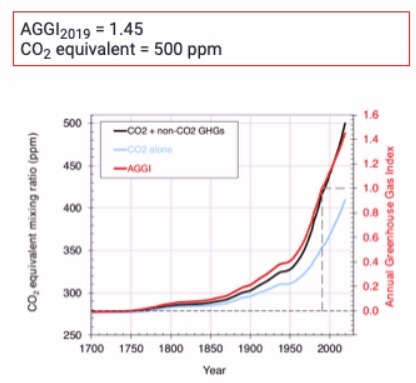
If CO₂-equivalent concentrations can be stabilized near 500 ppm, there may still be a chance to preserve East Antarctica, the largest remaining ice sheet. But if it destabilizes:

“Expect another couple hundred feet of sea-level rise.”

A Civilization-Level Threshold

We are now witnessing the early stages of a global system crossing into a new and dangerous mode of operation — one defined by:

  • Rapid CO₂ accumulation

  • Collapsing carbon sinks

  • Accelerating ocean heat storage

  • Cryosphere destabilization

  • Intensified extreme weather

The question is no longer whether these changes are occurring, but how quickly, and how prepared we are for the consequences.

Humanity is approaching — and in some cases passing — thresholds that earlier generations believed were centuries away. The decisions made in the next decade will determine whether sea-level rise is measured in inches, feet, or tens of feet within a single human lifetime.

WARNING

* Our probabilistic, ensemble-based climate model — which incorporates complex socio-economic and ecological feedback loops within a dynamic, nonlinear system — projects that global temperatures are becoming unsustainable this century. This far exceeds earlier estimates of a 4°C rise over the next thousand years, highlighting a dramatic acceleration in global warming. We are now entering a phase of compound, cascading collapse, where climate, ecological, and societal systems destabilize through interlinked, self-reinforcing feedback loops.

What Can I Do?
The single most important action you can take to help address the climate crisis is simple: stop burning fossil fuels. There are numerous actions you can take to contribute to saving the planet. Each person bears the responsibility to minimize pollution, discontinue the use of fossil fuels, reduce consumption, and foster a culture of love and care. The Butterfly Effect illustrates that a small change in one area can lead to significant alterations in conditions anywhere on the globe. Hence, the frequently heard statement that a fluttering butterfly in China can cause a hurricane in the Atlantic. Be a butterfly and affect the world.

Tipping points and feedback loops drive the acceleration of climate change. When one tipping point is toppled and triggers others, the cascading collapse is known as the Domino Effect.

The Climate Crisis: Violent Rain | Deadly Humid Heat | Health Collapse | Extreme Weather Events | Insurance | Trees and Deforestation | Soil | Rising Sea Level | Food and Water | Updates

The Human Induced Climate Change Experiment

bookmark_borderUSDA Orders States to Halt Full SNAP Payments — Trump’s Directive Threatens Millions of Families and Children

In a stunning and deeply troubling move, the U.S. Department of Agriculture (USDA) has ordered all states to “immediately undo” actions they’ve taken to issue full Supplemental Nutrition Assistance Program (SNAP) benefits to eligible families. This directive, originating from the Trump administration, effectively reverses state efforts to maintain food security for low-income households amid economic uncertainty and political dysfunction.

The SNAP program — formerly known as food stamps — is the nation’s cornerstone against hunger, serving over 40 million Americans, including approximately 20 million children. By instructing states to reduce or suspend full benefits, the USDA is targeting the most vulnerable segment of the population — families with children. According to the Center on Budget and Policy Priorities (CBPP), more than half of all SNAP recipients are children, and these benefits provide essential nutrition that supports healthy growth, cognitive development, and school performance.

Under the Trump directive, millions of children stand to lose consistent access to meals. Many will be forced to rely on overstretched school lunch programs or local food pantries that are already struggling to meet record demand. Pediatric nutritionists warn that even short-term food insecurity can have long-term consequences, including weakened immune systems, developmental delays, and lower educational outcomes.

Economists emphasize that this decision is not only cruel but also economically reckless. SNAP has long been one of the most effective automatic stabilizers in the U.S. economy. Each dollar in SNAP benefits generates between $1.50 and $1.80 in total economic activity, circulating money directly into grocery stores, farms, and local businesses. Reducing benefits now will remove billions in purchasing power from the economy, further weakening communities already suffering from inflation, layoffs, and stagnant wages.

The timing could not be worse. Consumer confidence has fallen sharply, and October 2025 saw the highest number of layoff announcements in more than two decades. Taking food off children’s tables in the midst of this downturn will exacerbate both economic and humanitarian crises.

Politically, the USDA’s action exposes the Trump administration’s widening gap between populist rhetoric and policy reality. While Trump continues to claim he champions “working Americans,” his administration’s actions — from tariff-driven price increases to cuts in social safety programs — have disproportionately hurt working-class families. The rollback of full SNAP payments is just the latest in a pattern of policies that prioritize ideology over empathy, and short-term optics over long-term stability.

If fully implemented, this SNAP rollback could become one of the most devastating federal policy reversals in decades — a moral and economic failure that undermines the nation’s children, widens inequality, and deepens poverty in the world’s wealthiest country.

Trumpenomics

bookmark_borderDon the Con: How Trump Cemented His Legacy as the Dumbest World Leader in History

Trump said it best, “Smart people don’t like me.”

Trump is going down in history as the dumbest president in American history; however, that title may not be “biggly” enough for him. He is now being recognized globally as the dumbest world leader in history — a man who has willfully ignored, denied, and lied about established science, accelerating a planetary crisis that has already cost millions of lives. Trump’s science denial directly resulted in millions of preventable COVID deaths in his first term. Now, he is endangering the entire population of the world.

Trump has repeatedly dismissed climate science as a “hoax,” “bullshit,” and “the green scam.” At the United Nations, he called climate change a “con” — an irony lost on no one, coming from “Don the Con” himself, a man whose business empire was built on deceit, bankruptcies, and fraud. His record now includes criminal convictions, civil judgments, and an unparalleled legacy of scientific ignorance.

This year, Trump refused to cooperate with the COP30 global climate summit in Brazil, further cementing America’s retreat from global climate leadership. With global emissions nearly doubling in the last 33 years, few would argue that progress has met expectations. Worse, the post-COVID global consensus on tackling climate change is fracturing — led by Trump’s renewed campaign of climate disinformation and economic coercion. His administration’s new trade tariffs pressure allies such as Japan, the EU, and South Korea to buy more U.S. fossil fuels, directly undermining global decarbonization efforts.

Trump’s absence from COP30 drew sharp rebukes from world leaders. “For small island states, the climate crisis is not past tense or future tense. It is our reality. We have no way to run, no way to hide,” said Antigua and Barbuda’s Prime Minister Gaston Browne. Chilean President Gabriel Boric accused Trump of spreading “lies” about the climate crisis, while Colombian President Gustavo Petro declared, “Mr. Trump is against humankind.”

As Trump abandons both people and planet, others are stepping into the leadership void. California Governor Gavin Newsom announced he will attend COP30 in Brazil, representing the world’s fourth-largest economy. Newsom aims to strengthen climate partnerships, promote clean-energy investments, and showcase California’s model for creating jobs while cutting toxic pollution.

“As the President of the United States turns his back on people and the planet, California is inking global partnerships focused on creating jobs and cutting toxic pollution,” Newsom said. “The economic winners of the 21st century are those who build the clean-energy future. We’re doing that right now — and showing the world that climate action means jobs, clean air, and lower costs.”

While Trump clings to fossil-fueled fantasies and falsehoods, California and the world are moving forward without him. History will remember Trump not as a leader, but as a warning — a living example of how ignorance, arrogance, and greed can conspire to imperil the planet itself.

The Great Race Against Time: Trump vs. Mother Nature

Donald Trump has consistently dismissed the science of climate change, calling it a hoax and dismissing policies aimed at addressing it as “The Green New Scam.” His repeated use of the phrase “Drill, Baby, Drill” symbolizes an energy policy that prioritizes fossil fuel extraction over sustainable alternatives. These policies have only intensified the climate crisis, posing severe risks not only to the environment but to the global economy as well. If left unchecked, Donald Trump’s economic and environmental policies will render the planet uninhabitable for future generations.

The evidence is irrefutable: climate change is accelerating at an alarming pace, and the associated costs—both economic and human—are rising exponentially. Immediate, decisive action is essential to reduce greenhouse gas emissions and prevent further environmental collapse. Our updated climate model, now grounded in chaos theory and incorporating complex social-ecological factors within a dynamic, non-linear framework, predicts that global temperatures could increase by up to 9°C this century—far surpassing the previous estimate of a 4°C rise over the next thousand years. Such extreme warming will render large portions of the planet uninhabitable within this century, threatening the stability of ecosystems and human societies alike.


* Our probabilistic, ensemble-based climate model — which incorporates complex socio-economic and ecological feedback loops within a dynamic, nonlinear system — projects that global temperatures are becoming unsustainable this century. This far exceeds earlier estimates of a 4°C rise over the next thousand years, highlighting a dramatic acceleration in global warming. We are now entering a phase of compound, cascading collapse, where climate, ecological, and societal systems destabilize through interlinked, self-reinforcing feedback loops.

What Can I Do?
The single most important action you can take to help address the climate crisis is simple: stop burning fossil fuels. There are numerous actions you can take to contribute to saving the planet. Each person bears the responsibility to minimize pollution, discontinue the use of fossil fuels, reduce consumption, and foster a culture of love and care. The Butterfly Effect illustrates that a small change in one area can lead to significant alterations in conditions anywhere on the globe. Hence, the frequently heard statement that a fluttering butterfly in China can cause a hurricane in the Atlantic. Be a butterfly and affect the world.

→ “Solutions to the Fossil Fuel Economy and the Myths Accelerating Climate and Economic Collapse.“

The Human Induced Climate Change Experiment

bookmark_borderTrumpenomics: A Manufactured Meltdown

Trumpenomics is crashing the economy at a record pace. The torrent of bad news is so rapid it’s becoming difficult to track in real time.

1. Imports Collapse: The Statistical Mirage Vanishes

U.S. imports just fell nearly 44% — the largest drop ever recorded. This was no surprise. It’s exactly what serious economists expected following the artificial spikes in growth earlier this year.

The first quarter GDP was negative, followed by two quarters of modestly positive growth — both of which were statistical illusions, not signs of recovery. Those gains were largely the result of how imported inventories are counted in national accounts. Once those temporary boosts washed out, the underlying weakness became undeniable.

Now, we are likely entering a sharp economic contraction, perhaps already crossing into recession territory. Consumption is slowing. Business investment is falling. Real wages are stagnant amid persistent inflationary pressure. The illusion of growth has given way to the reality of systemic decline.

2. The Human Factor: Immigration and Innovation Under Attack

Compounding the downturn is the economic fallout of white nationalism and xenophobic policy. Over the past five years, immigrants have driven nearly 80% of U.S. GDP growth — fueling productivity, entrepreneurship, and labor force expansion. Restricting immigration at this scale is more than socially regressive; it’s economically suicidal.

The loss of immigrant labor is already reducing output, raising prices, and crippling industries from agriculture to healthcare. America’s innovation pipeline — once the envy of the world — is drying up as skilled immigrants look elsewhere. When policy turns away the very people who build the future, decline is inevitable.

3. Credibility Collapse: America as an Unreliable Partner

Equally alarming is the erosion of U.S. credibility abroad. The administration’s disregard for truth, consistency, and the rule of law has shredded confidence among global partners. America — once the cornerstone of international stability — is increasingly seen as erratic, insular, and untrustworthy.

As a result, alliances and supply chains are being restructured. Nations are pivoting toward more predictable trading partners, leaving the U.S. isolated just as global cooperation is most needed to manage economic, environmental, and geopolitical risks.

4. The Fed Cut That Raised Rates

One of the clearest signs of dysfunction is the recent disconnect between Federal Reserve policy and market reaction. In early November 2025, the Fed cut its benchmark lending rate by 25 basis points — yet mortgage rates rose by 20 basis points almost immediately.

This seemingly paradoxical outcome exposes how little Trump understands about economics. The federal funds rate affects only short-term loans between banks, not long-term borrowing like mortgages. Those longer-term rates are governed by the bond market — where investors demand yields that compensate for inflation and risk.

When the Fed cuts rates under political pressure, investors interpret it as a sign that inflation risk is increasing. To protect themselves, they demand higher yields. In other words, Trump’s push for lower rates caused higher rates, because the market sees through the manipulation.

The result? A credibility crisis at the very heart of U.S. monetary policy. Markets no longer trust that the Fed is acting independently, and once that trust erodes, confidence — and stability — quickly follow.

5. Job Cuts Surge: The Human Toll of Economic Chaos

The human impact is already visible. In October 2025, U.S. employers announced 153,074 layoffs — the highest October total in more than 20 years, according to Challenger, Gray & Christmas.

Much of this is driven by cost-cutting and the rapid adoption of artificial intelligence in sectors like technology, logistics, and finance. For the year, total job cuts have surpassed 1 million, the highest since the pandemic in 2020. Yet, instead of cushioning the transition or investing in retraining, the administration continues to destabilize institutions and stoke division — widening the gap between workers and wealth.

6. The Inevitable Reckoning

The recipe for disaster is already baked in:

  • Weakening growth and collapsing imports.

  • Stagnant wages and soaring inflation.

  • Political interference in the Fed.

  • Attacks on the judiciary and rule of law.

  • Isolation from allies and markets.

What we are witnessing is not a natural business cycle — it is a politically induced economic crisis, one made worse by denial, ideology, and short-term thinking.

Trumpenomics isn’t just failing — it’s accelerating America’s decline. And unless the U.S. restores institutional integrity, global credibility, and a rational approach to policy, this contraction may become the defining economic collapse of our generation.

Trumpenomics

bookmark_borderTrump’s Socialism Irony: The “Flee to Florida” Fantasy Meets Climate Reality

Donald Trump recently warned that New Yorkers would “flee to Florida” after Zohran Mamdani’s electoral win — a comment loaded with irony so deep it borders on parody.

Because here’s the reality: Florida is the first U.S. state to effectively socialize its homeowner’s insurance system. The state government, through taxpayer-backed programs, now functions as the largest insurer in Florida — not because of policy brilliance, but because the private insurance market has collapsed under climate risk.

Florida’s Insurance Crisis: Climate Economics in Real Time

Insurers are pulling out of Florida at an alarming rate. The combination of rising sea levels, record ocean temperatures, and intensified hurricanes has made underwriting private property insurance virtually impossible without massive losses.

To stop the economic free fall, Florida created Citizens Property Insurance Corporation, a state-run, taxpayer-funded insurer of last resort. But “last resort” has now become the main insurer for millions of Floridians.

In other words, Florida — under Republican leadership — has already implemented one of the largest socialized insurance systems in America.

And it’s not just homeowners. The same taxpayer dollars now subsidize storm damage, rebuild barrier islands, and prop up flood-prone developments that market forces have already declared uninsurable.

The Ironic Twist: Republicans Out-Socializing the Democrats

While Trump rails against “socialism” and climate action, his own party’s policies in Florida are the definition of state intervention — massive public bailouts of a failing private market.

The Republican narrative that “the free market will fix it” collapses the moment actuarial math meets reality. The insurance industry — one of the most risk-sensitive sectors on Earth — is already voting with its feet. You can’t deregulate physics. You can’t legislate away rising seas.

Trump’s Climate Denial Meets Florida’s Sinking Future

Trump continues to deny climate change while boasting about the “freedom” of a state literally drowning in taxpayer-subsidized losses. The truth is, Florida is ground zero for the managed retreat that climate science has warned about for decades.

That retreat is no longer theoretical — it’s baked into the insurance system.

  • Entire neighborhoods are losing coverage.

  • Mortgage lenders are reassessing property values.

  • Some coastal properties are becoming effectively unsellable.

Meanwhile, Trump insists New Yorkers will “flee” to a state where the market has already acknowledged defeat — not because of politics, but because of physics, math, and water.

Conclusion: The Free Market Can’t Swim

The irony couldn’t be sharper: Trump denies the crisis that his own state’s economic collapse proves is real.

Florida is not the land of freedom; it’s the first laboratory for climate socialism — where denial meets its inevitable price tag, and taxpayers are left to pay for what markets already know:
Climate denial is the most expensive ideology on Earth.

Trumpenomics

The Human Induced Climate Change Experiment

bookmark_borderTrump’s Tariffs Face Supreme Court Scrutiny: Economic, Legal, and Fiscal Fallout Looms

The U.S. Supreme Court on Wednesday appeared skeptical of the sweeping tariffs imposed by former President Donald Trump on much of the world, questioning both their legality and their unprecedented reach.

In a rare show of bipartisan concern, both conservative and liberal justices challenged the Trump administration’s interpretation of executive power under the International Emergency Economic Powers Act (IEEPA) — a 1977 law intended for narrow, national-security-related emergencies, not broad economic interventions.

Solicitor General D. John Sauer, defending the tariffs, argued that Trump’s actions were “regulatory,” not fiscal. “These are regulatory tariffs,” Sauer said. “They are not revenue-raising tariffs. The fact that they raise revenue was only incidental.”

Justice Sonia Sotomayor pushed back, saying, “You say tariffs are not taxes, but that’s exactly what they are. They’re generating money from American citizens — revenue.”

Conservative Justice Neil Gorsuch expressed similar unease, noting that Trump declared an “international emergency” over trade imbalances and fentanyl trafficking to bypass Congress. “What happens when the president simply vetoes legislation to take these powers back?” Gorsuch asked. “It’s a one-way ratchet toward the continual accretion of power in the executive branch and away from the people’s elected representatives.”

Other conservative justices, including Chief Justice John Roberts, Amy Coney Barrett, Brett Kavanaugh, and Samuel Alito, pressed Sauer on whether Trump had overstepped constitutional boundaries that reserve taxation and revenue measures for Congress.

Economic Fallout of a Reversal

If the Supreme Court strikes down the tariffs as illegal, the economic consequences could be profound. Many of Trump’s tariffs — ranging from 10% to as high as 50% on imports from nations such as India, Brazil, China, and Canada — were imposed in direct violation of World Trade Organization (WTO) agreements and bilateral trade treaties.

A ruling invalidating the tariffs would not only erode U.S. credibility on the global stage but could also trigger retaliatory claims from U.S. trading partners seeking compensation for lost exports and retaliatory duties. American exporters, already burdened by global counter-tariffs, could face renewed uncertainty just as global trade volumes are beginning to recover from pandemic disruptions.

Economically, a reversal could produce short-term market volatility as importers seek refunds and supply chains recalibrate. However, over the long term, restoring lawful, rules-based trade would likely stabilize markets, reduce consumer prices, and improve international confidence in U.S. economic leadership.

Fiscal Shock: Tariff Refunds and Rising Deficits

The fiscal consequences of declaring Trump’s tariffs unlawful could be staggering. Since the tariffs were enacted, the U.S. Treasury has collected roughly $151 billion in customs duties in the latter half of fiscal year 2025 alone — a nearly 300% increase from the same period in 2024, according to the Committee for a Responsible Federal Budget.

If courts require refunds to importers for illegally collected tariffs, the government could owe hundreds of billions of dollars, instantly swelling the federal deficit. Analysts estimate potential refund liabilities could reach $500 billion to $1 trillion when interest, penalties, and economic damages are included.

That would erase much of the short-term “revenue gain” touted by Trump’s supporters and substantially worsen the national debt, which already ballooned by $9 trillion across Trump’s two terms — more than under any president in U.S. history.

Global Credibility at Stake

Beyond dollars and deficits, the broader cost is diplomatic. Declaring the tariffs illegal would reinforce that the United States violated its own trade commitments, weakening U.S. moral and legal authority in the global economic order it helped build.

For decades, the U.S. has been viewed as a stabilizing force in global commerce. Trump’s unilateral tariffs — often imposed without consultation or evidence — undermined that reputation. A Supreme Court ruling against them would serve as both a legal correction and a warning shot: that economic nationalism, when untethered from law, carries immense risks not just for the economy but for America’s credibility as a global leader.

Trumpenomics