bookmark_borderQuantifying the Climate Tax: The Full Ledger of Harm

Macro-Welfare Frameworks vs. Economic Justice Valuation in the United States

Daniel Brouse and Sidd Mukherjee


I. Introduction

A. Research Problem

Climate change imposes large and growing costs on the United States, yet there is still no centralized national ledger that captures the full burden in a unified way. Conventional economic indicators—especially GDP, insured losses, and direct disaster tallies—systematically undercount the real cost of climate disruption because they omit or minimize non-market harms such as premature mortality, reduced life expectancy, chronic illness, degraded quality of life, ecological destabilization, and the unequal distribution of climate damages across vulnerable populations.

A narrow GDP-centered framework also fails to capture a second dimension of climate cost: accountability. A large share of today’s climate burden is not simply the product of random weather volatility. It is the cumulative result of delayed mitigation, externalized damages, underpriced emissions, regulatory failure, and in some cases decades of deception regarding the risks of fossil-fuel dependence. That means climate accounting must confront not only what climate change is costing the economy, but also what it should cost under a framework of social justice and deterrence.

B. Thesis Statement

Evaluating the 2025 U.S. cost of climate change requires moving beyond direct disaster losses and beyond GDP-centered accounting. Using a dual-lens approach, it compares:

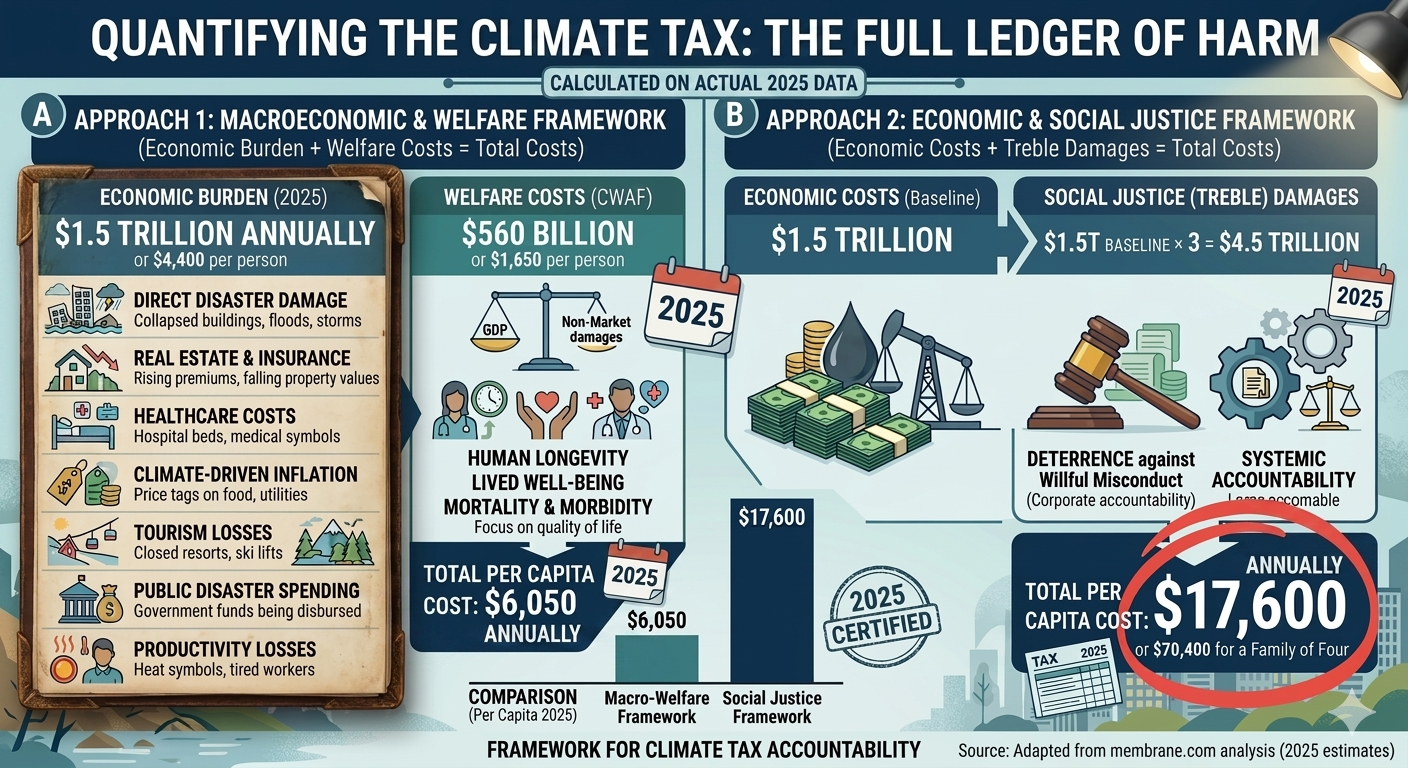
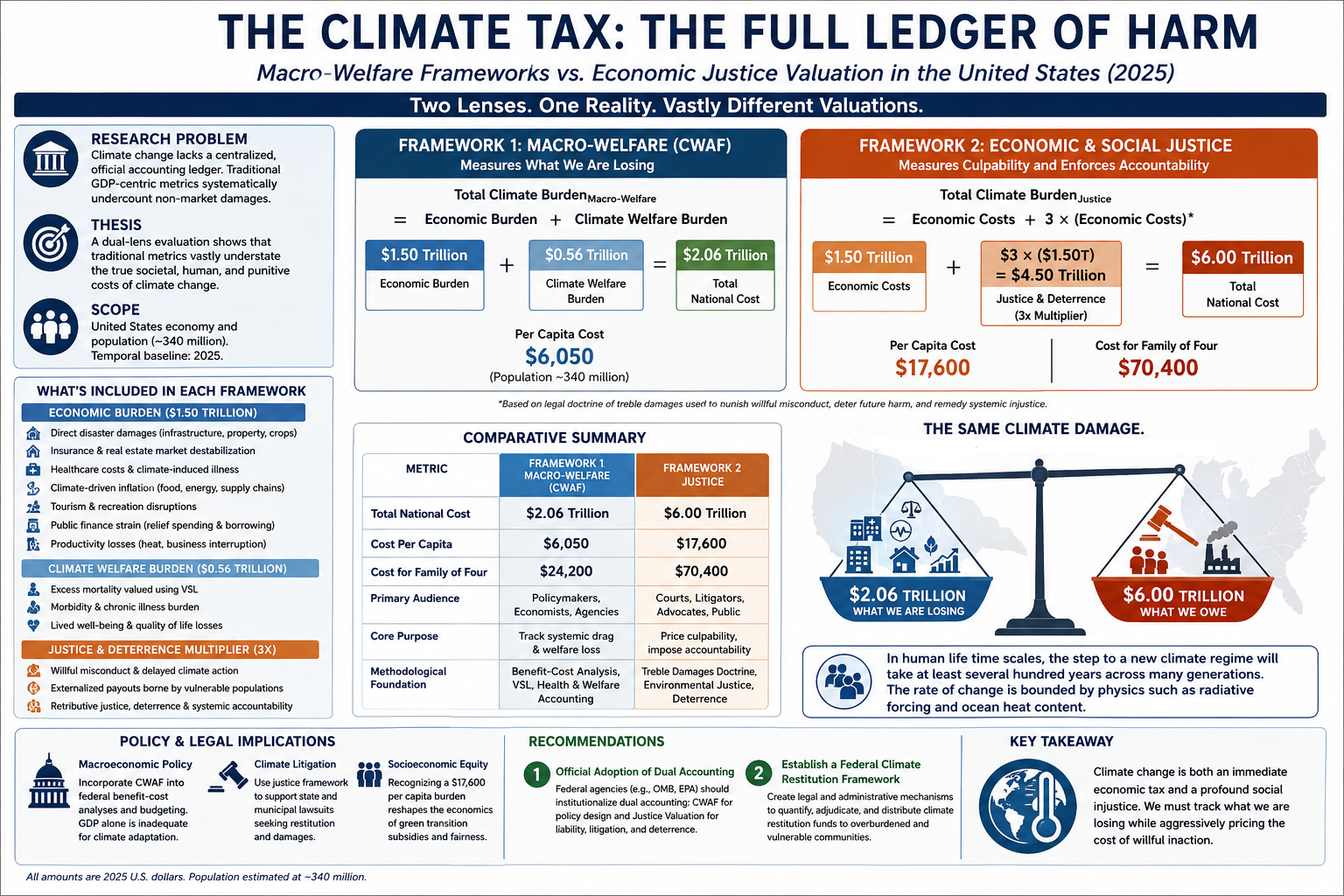
  • a Macroeconomic and Welfare Framework, which estimates the 2025 U.S. climate burden at approximately $2.06 trillion, or about $6,050 per person, and
  • an Economic and Social Justice Framework, which applies a treble-damages logic to climate-linked economic harms and yields a 2025 burden of approximately $6.0 trillion, or about $17,600 per person.

The core claim is that traditional economic metrics substantially understate the true societal burden of climate change. Climate damages should be understood not only as macroeconomic drag and welfare erosion, but also as a form of externalized injury with distributive, ethical, and potentially punitive dimensions.

C. Scope of the Study

This study focuses on the United States in calendar year 2025. Per-capita values are based on a U.S. population baseline of approximately 340 million residents. The analysis is national rather than state-specific and is intended as a high-level accounting framework rather than a final litigation damages model.


II. Methodology 1: The Macroeconomic and Welfare Framework

A. Conceptual Architecture

The first framework combines two components:

  1. Economic burden: the direct and indirect market-facing costs imposed by climate change in 2025; and
  2. Climate welfare burden: the non-market human costs associated with mortality, life-expectancy loss, morbidity, and degraded quality of life.

The core accounting identity is:

Total Climate Burden (Macro-Welfare) = Economic Burden + Climate Welfare Burden

For 2025, the study uses the following central values:

$1.50T + $0.56T = $2.06T

On a per-capita basis:

$2.06T / 340M = $6,059 ≈ $6,050 per person

This can also be expressed as:

$4,400 + $1,650 = $6,050

where:

  • $4,400 per person is the estimated economic burden, and
  • $1,650 per person is the estimated climate welfare burden.

B. The Economic Burden Baseline: $1.5 Trillion ($4,400 per Capita)

The economic burden baseline is designed to capture the direct and indirect market-facing cost of climate change in the United States in 2025. It includes seven broad categories of loss.

1. Direct disaster damages

This category includes physical destruction from hurricanes, inland flooding, wildfires, convective storms, drought-related losses, heat-related infrastructure damage, and other extreme-weather events. It covers residential, commercial, public-sector, insured, and uninsured losses.

2. Real estate and insurance destabilization

Climate change is increasingly priced into property markets and insurance markets through higher premiums, policy nonrenewals, shrinking insurability, reserve stress, and geographic repricing of risk. These effects act as a quasi-tax on households, businesses, and municipalities even in years without a single catastrophic event.

3. Healthcare and health-insurance costs

Heat stress, wildfire smoke, respiratory disease, cardiovascular strain, injuries, mental-health burdens, and other climate-related medical effects increase both direct healthcare spending and insurance costs. These costs are counted here only insofar as they represent market expenditures rather than welfare losses already captured separately in the climate welfare framework.

4. Climate-driven inflation and household cost pressure

Climate shocks increase the price of food, electricity, water, transportation, and household essentials through crop disruption, supply-chain interruption, infrastructure stress, and energy-demand spikes. These effects function as a hidden climate tax on households and are treated as part of the economic burden.

5. Tourism and recreation losses

Climate volatility disrupts beach economies, ski industries, lake and river recreation, outdoor events, park visitation, and seasonal tourism revenue. The direct revenue loss belongs in the economic burden, while the lost enjoyment and diminished lived experience belong more naturally in the welfare framework.

6. Public finance and fiscal burden

Federal, state, and local governments increasingly absorb climate costs through disaster relief, infrastructure repair, emergency response, insurance backstops, and climate-related borrowing. These expenditures represent real public resource costs even when financed through debt.

7. Productivity losses

Heat stress, smoke exposure, flooding, power outages, transportation interruption, and business downtime reduce labor productivity and economic output. These losses are among the most undercounted but economically significant climate costs.

Taken together, these categories produce a 2025 U.S. economic burden estimate of approximately $1.5 trillion.

On a per-capita basis:

$1.50T / 340M = $4,412 ≈ $4,400 per person

This figure is intended as an integrated estimate of the market-facing annual climate burden imposed on the United States in 2025.


C. The Climate Welfare Accounting Framework (CWAF): $560 Billion ($1,650 per Capita)

The second component of Framework 1 is the Climate Welfare Accounting Framework (CWAF), which measures the direct erosion of human well-being from climate change. CWAF is designed to capture losses that do not appear clearly in GDP or conventional market accounts, including premature mortality, reduced life expectancy, chronic morbidity, and diminished quality of life.

1. CWAF structure

CWAF is organized around three pillars:

  • Pillar A: Mortality valuation
  • Pillar B: Life-expectancy loss
  • Pillar C: Morbidity and quality-of-life loss

The raw component identity is:

CWAF(raw) = A + B + C

Using the central estimates in this framework:

  • A = $375B
  • B = $80B
  • C = $180B

So the raw component sum is:

$375B + $80B + $180B = $635B

However, because mortality, life-year loss, and morbidity estimates can overlap at the margins even after careful structuring, the framework applies a conservative overlap adjustment and presents a central CWAF estimate of approximately $560 billion rather than the full raw sum of $635 billion.

Thus:

  • CWAF raw central estimate = $635B
  • CWAF adjusted central estimate ≈ $560B

On a per-capita basis:

$560B / 340M = $1,647 ≈ $1,650 per person

2. Pillar A: Mortality valuation

Pillar A estimates the welfare cost of climate-attributable premature mortality using the Value of a Statistical Life (VSL) framework used in federal regulatory analysis.

The stylized formula is:

A = D × VSL

where:

  • D = estimated climate-attributable premature deaths in 2025
  • VSL = value of a statistical life

Pillar A is treated as a contemporaneous willingness-to-pay valuation of mortality risk, not as a decomposition of life-years. Because Pillar A values mortality using a contemporaneous VSL, discounting is primarily relevant to Pillar B and to any portion of Pillar C that reflects future streams of lost healthy life rather than same-year welfare loss.

3. Pillar B: Life-expectancy loss

Pillar B captures the welfare loss associated with reductions in healthy life expectancy caused by heat exposure, smoke exposure, chronic disease burdens, and other climate-linked pathways that may not appear as immediate mortality events in a single-year accounting frame.

The stylized formula is:

B = Σ(LYᵢ × VSLY)

where:

  • LYᵢ = climate-attributable life-years lost for group i
  • VSLY = value of a statistical life-year

Pillar B is constructed as a non-overlapping residual welfare component and is not derived by mechanically decomposing Pillar A’s VSL estimate into life-years. Instead, it captures life-expectancy and health losses not already subsumed within the mortality valuation framework used in Pillar A. Put differently, Pillar A (VSL-based mortality valuation) captures the welfare equivalent of premature mortality as a contemporaneous risk realization, while Pillar B is calibrated to exclude mortality already captured in Pillar A and instead reflects residual life-expectancy and morbidity effects not subsumed by VSL valuation.

4. Pillar C: Morbidity and quality-of-life loss

Pillar C estimates the welfare cost of climate-driven morbidity, including heat-related illness, smoke-related respiratory burdens, mental-health stress, chronic disease aggravation, and other forms of degraded physical and psychological well-being.

The stylized formula is:

C = Σ(Qᵢ × Vᵢ)

where:

  • Qᵢ = quantity of climate-attributable morbidity burden for condition i
  • Vᵢ = monetized welfare value associated with that burden

This pillar can be operationalized using QALY, DALY, or related health-welfare valuation methods.


D. Summary of Framework 1

The Macroeconomic and Welfare Framework yields the following 2025 estimate:

$1.50T + $0.56T = $2.06T

Per capita:

$2.06T / 340M = $6,059 ≈ $6,050 per person

For a family of four:

4 × $6,050 = $24,200

Framework 1 therefore estimates that climate change imposed a 2025 macro-welfare burden of roughly $2.06 trillion on the United States, equivalent to about $6,050 per person or $24,200 for a family of four.


III. Methodology 2: The Economic and Social Justice Framework

A. Conceptual Architecture

Framework 2 asks a different question. Instead of measuring only the annual economic and welfare burden of climate change, it asks what the ledger would look like if climate damages were valued through a justice and deterrence lens, analogous to legal doctrines that multiply proven damages in response to willful misconduct, fraud, or socially destructive externalization of harm.

This framework begins with the same $1.5 trillion economic damage baseline used in Framework 1, but applies a treble-damages logic to those economic damages only.

Let:

E = Economic Climate Damages = $1.5T

Then the justice framework is:

Justice Cost = E + 3E = 4E

Substituting the 2025 baseline:

$1.5T + 3($1.5T) = $6.0T

Equivalently:

4 × $1.5T = $6.0T

On a per-capita basis:

$6.0T / 340M = $17,647 ≈ $17,600 per person

For a family of four:

4 × $17,600 = $70,400

Why the treble multiplier is applied only to the $1.5T economic burden

The treble-damages multiplier is applied only to the market-facing economic damage ledger ($1.5T), not to the CWAF welfare component ($560B). This choice is intentional. The justice framework is designed as a liability-style multiplier on economic damages—that is, on direct and indirect market harms such as property destruction, insurance destabilization, healthcare spending, public fiscal outlays, productivity loss, and climate-driven price pressures. By contrast, the CWAF already monetizes non-market welfare harms such as mortality risk, life-expectancy degradation, and morbidity-related quality-of-life loss. Trebling those welfare values would risk both conceptual double counting and an analytically awkward punitive replication of already-imputed welfare losses. Accordingly, Framework 2 should be understood as a justice-weighted escalation of the economic climate ledger, not as a trebling of the entire macro-welfare burden.

This framework is therefore not presented as a conventional welfare-economics estimate. It is a normative legal-economic framework designed to reflect accountability, deterrence, and the uneven distribution of climate harm.


B. The Legal Foundation of Treble Damages

Treble damages are a long-established feature of U.S. law in contexts where ordinary compensation is considered inadequate to deter or punish egregious misconduct. They appear most prominently in:

  • Antitrust law, including the Sherman Act
  • Civil racketeering actions, including RICO-based claims
  • False Claims Act enforcement, where fraud against the public fisc can trigger multiplied damages

The logic of treble damages is not merely compensatory. It is also punitive and deterrent. Trebling recognizes that some harms are imposed through conduct sufficiently reckless, deceptive, or socially damaging that ordinary compensation fails to capture either the full social cost or the need for institutional deterrence.


C. Application to Climate Justice

The justice framework applies this legal logic to climate damages on the theory that a substantial share of modern climate costs reflects not only physical climate change, but also delayed mitigation, historic externalization of damages, and sustained campaigns of misinformation or obstruction that prolonged fossil-fuel dependence and delayed adaptation.

Three considerations motivate the treble-damages approach:

1. Willful misconduct and delayed action

If major emitters or institutions knowingly delayed action while externalizing foreseeable climate harms onto the public, then a purely compensatory accounting of damages may understate the true social cost of that conduct.

2. Unequal distribution of harm

Climate damages are not evenly distributed. Lower-income households, communities of color, medically vulnerable populations, outdoor workers, and disaster-prone regions often bear disproportionate burdens. A justice framework therefore recognizes that climate losses are not merely aggregate economic losses but also distributional injuries.

3. Deterrence and accountability

A damages framework that merely reimburses a fraction of direct losses may fail to deter future misconduct. A justice-oriented framework treats climate damages as the basis for a larger accountability regime aimed at shifting incentives, strengthening disclosure, and pricing the cost of willful inaction.


IV. Comparative Analysis

A. Aggregate Results

The two frameworks produce sharply different valuations of the 2025 U.S. climate burden.

MetricFramework 1: Macro-WelfareFramework 2: Justice
Economic burden baseline$1.50 trillion$1.50 trillion
Welfare burden (CWAF)$0.56 trillion—
Treble-damages penalty on economic burden—$4.50 trillion
Total national cost$2.06 trillion$6.00 trillion
Cost per capita$6,050$17,600
Cost for family of four$24,200$70,400

Framework 1 estimates the full annual burden of climate change on the economy and on human welfare. Framework 2 estimates the justice-weighted accountability cost of climate harm if society chose to treat delayed mitigation and externalized damages as punishable economic injury.

B. Analytical Differences Between the Frameworks

1. Audience and institutional use

Framework 1 is primarily relevant to:

  • fiscal policy analysts
  • macroeconomists
  • central banks
  • public-health planners
  • federal agencies conducting benefit-cost analysis

Framework 2 is more relevant to:

  • litigators
  • state attorneys general
  • municipal plaintiffs
  • tort scholars
  • climate-justice advocates

2. Philosophical foundation

Framework 1 measures systemic drag, welfare erosion, and hidden social cost. It asks: What is climate change costing the country in real economic and human terms right now?

Framework 2 measures culpability, deterrence, and social restitution. It asks: What would climate damages look like if society priced not only the injury itself, but also the institutional misconduct that helped produce and intensify it?

3. Risk allocation

Framework 1 reveals the extent to which climate change already functions as a hidden national tax on households, businesses, and governments. Framework 2 goes further by reallocating that burden conceptually back toward those who knowingly profited while imposing climate costs on others.


V. Policy, Legal, and Economic Implications

A. Macroeconomic Policy

The first implication is that GDP alone is no longer an adequate climate accounting tool. A country can rebuild after a flood, spend more on medical care, or borrow more for disaster relief, and those expenditures may still appear as positive economic activity in national accounts even as the underlying social condition worsens.

Incorporating macro-welfare climate accounting into federal analysis would improve:

  • Office of Management and Budget benefit-cost analysis
  • federal adaptation planning
  • public-health prioritization
  • insurance and housing policy
  • long-run fiscal projections

A climate burden of roughly $2.06 trillion in 2025, or about $6,050 per person, implies that climate change already functions as a material macroeconomic drag on the United States.

B. Climate Litigation and Tort Reform

The second implication is legal. The justice framework provides a conceptual bridge between aggregate climate economics and climate liability. If climate damages are increasingly litigated through state, municipal, and public-nuisance actions, a framework that translates economic harm into a deterrence-oriented damages structure may become increasingly relevant.

This does not mean courts should automatically adopt a 3x multiplier in climate litigation. Rather, it suggests that climate damages can be conceptualized not merely as diffuse acts of nature, but as partly socialized harms linked to historic patterns of concealment, delay, and cost externalization.

C. Socioeconomic Equity

A third implication concerns equity. If the annual climate burden is framed as $17,600 per person under a justice-based model, the economics of adaptation, resilience spending, green infrastructure, household subsidies, and climate restitution look very different. The scale of the burden implies that aggressive decarbonization and resilience investment may be economically justified not merely as environmental policy, but as partial relief from a large and regressive climate tax.


VI. Limitations

Several limitations should be acknowledged.

A. Framework 1 limitations

The macro-welfare framework is a synthetic accounting model rather than a single-source official estimate. Its economic burden baseline aggregates multiple categories of loss that are themselves subject to uncertainty, overlap, and incomplete attribution. The CWAF component similarly relies on bounded welfare estimates rather than a single fully observed national health ledger.

B. Framework 2 limitations

The justice framework is explicitly normative. It is not a standard welfare-economic estimate and should not be confused with a measured national-income loss. Its treble-damages logic is best understood as a legal-economic thought experiment grounded in deterrence and accountability rather than as a conventional national-accounts statistic.

C. Attribution limitations

Not every harmful event in 2025 can be cleanly attributed to climate change, and climate-health pathways remain unevenly measured across disease categories, geographies, and populations. As with all climate-damages accounting, results depend partly on attribution choices, valuation assumptions, and the treatment of overlap among categories.


VII. Conclusion

A. Restatement of Main Findings

This study develops a dual accounting of the 2025 U.S. climate burden.

Under the Macroeconomic and Welfare Framework, climate change imposed an estimated burden of:

$1.50T + $0.56T = $2.06T

equivalent to roughly:

$2.06T / 340M = $6,059 ≈ $6,050 per person

or:

4 × $6,050 = $24,200 for a family of four

Under the Economic and Social Justice Framework, applying a treble-damages logic to the $1.5 trillion economic burden yields:

$1.5T + 3($1.5T) = $6.0T

equivalent to roughly:

$6.0T / 340M = $17,647 ≈ $17,600 per person

or:

4 × $17,600 = $70,400 for a family of four

B. Final Synthesis

Climate change now functions in the United States as both an immediate economic tax and a profound social injustice. The first framework measures what the country is losing in output, health, welfare, and resilience. The second asks what those losses would look like if climate harm were treated not merely as misfortune, but as a large-scale social injury intensified by delayed action, externalized damages, and institutional failure.

The gap between $2.06 trillion and $6.0 trillion is therefore not a contradiction. It reflects two different but complementary questions:

  1. What is climate change costing the United States right now?
  2. What should climate damages cost if accountability and deterrence are taken seriously?

C. Future Research Directions

Future work should extend this framework in at least four directions:

  1. State-level and metropolitan climate-tax estimates, especially for high-risk regions facing acute insurance, flood, heat, or wildfire stress
  2. Sector-specific justice multipliers, particularly for fossil-fuel litigation and public-finance exposure
  3. Improved climate-health attribution models, especially for smoke exposure, heat mortality, chronic disease aggravation, and infectious disease pathways
  4. Dynamic multi-year climate ledgers that track the compounding interaction of direct disaster losses, welfare erosion, and legal liability over time

Appendix A. Summary Tables

A1. Framework 1: Macro-Welfare Burden

ComponentAggregate CostPer Capita
Economic burden baseline$1.50 trillion$4,400
Climate Welfare Accounting Framework (CWAF)$0.56 trillion$1,650
Total Framework 1 burden$2.06 trillion$6,050

A2. CWAF Raw Component Structure

CWAF PillarLowCentralHigh
Mortality cost$225B$375B$562.5B
Life expectancy loss cost$40B$80B$140B
Morbidity / quality-of-life cost$100B$180B$280B
Total welfare cost (raw component sum)$365B$635B$982.5B

Note: The raw central sum of $635B is conservatively adjusted downward in the CWAF headline estimate to approximately $560B to account for overlap risk across mortality, life-year loss, and morbidity channels.

A3. Framework 2: Justice-Based Burden

ComponentAggregate CostPer Capita
Economic burden baseline$1.50 trillion$4,400
Treble-damages penalty on economic burden$4.50 trillion$13,200
Total Framework 2 burden$6.00 trillion$17,600

Appendix B. Formula Summary

Framework 1

  • Total Climate Burden (Macro-Welfare) = Economic Burden + Climate Welfare Burden
  • $1.50T + $0.56T = $2.06T
  • $2.06T / 340M = $6,059 ≈ $6,050 per person
  • $4,400 + $1,650 = $6,050

Economic Burden Baseline

  • $1.50T / 340M = $4,412 ≈ $4,400 per person

CWAF

  • CWAF(raw) = A + B + C
  • A = $375B
  • B = $80B
  • C = $180B
  • $375B + $80B + $180B = $635B
  • CWAF(adjusted central estimate) ≈ $560B
  • $560B / 340M = $1,647 ≈ $1,650 per person

CWAF Pillars

  • A = D × VSL
  • B = Σ(LYᵢ × VSLY)
  • C = Σ(Qᵢ × Vᵢ)

Framework 2

  • E = Economic Climate Damages = $1.5T
  • Justice Cost = E + 3E = 4E
  • $1.5T + 3($1.5T) = $6.0T
  • $6.0T / 340M = $17,647 ≈ $17,600 per person
  • 4 × $17,600 = $70,400 per family of four

References

Federal valuation guidance: mortality risk, VSL, and benefit-cost analysis

U.S. Department of Transportation. (2021). Departmental Guidance on Valuation of a Statistical Life in Economic Analysis. Office of the Secretary of Transportation. Available at: https://www.transportation.gov/office-policy/transportation-policy/revised-departmental-guidance-on-valuation-of-a-statistical-life-in-economic-analysis

U.S. Department of Transportation. (2021). Valuation of a Statistical Life Guidance. Office of the Secretary of Transportation. Available at: https://www.transportation.gov/resources/value-of-a-statistical-life-guidance

U.S. Department of Transportation. (2025). Economic Values Used in Analyses. Office of the Secretary of Transportation. Available at: https://www.transportation.gov/regulations/economic-values-used-in-analysis

U.S. Environmental Protection Agency. (2010). Guidelines for Preparing Economic Analyses. National Center for Environmental Economics, U.S. EPA, Washington, DC. Available at: EPA Guidelines for Preparing Economic Analyses

U.S. Environmental Protection Agency. (2026). Mortality Risk Valuation. Environmental Economics, U.S. EPA. Available at: https://www.epa.gov/environmental-economics/mortality-risk-valuation

Dockins, C., Maguire, K. B., Newbold, S., Simon, N. B., Krupnick, A., & Taylor, L. O. (2018). What’s in a Name? A Systematic Search for Alternatives to “VSL”. U.S. Environmental Protection Agency, Environmental Economics Working Paper Series, Working Paper No. 2018-01. Available at: https://www.epa.gov/environmental-economics/working-paper-whats-name-systematic-search-alternatives-vsl


Social cost of carbon, climate damages, and climate-economy valuation

Interagency Working Group on the Social Cost of Greenhouse Gases, United States Government. (2021). Technical Support Document: Social Cost of Carbon, Methane, and Nitrous Oxide Interim Estimates under Executive Order 13990. Washington, DC. Available at: Interagency Working Group Technical Support Document

Rennert, K., Errickson, F., Prest, B. C., Rennels, L., Newell, R. G., Pizer, W., Kingdon, C., Wingenroth, J., Cooke, R., Parthum, B., Smith, D., Cromar, K., Diaz, D., Moore, F. C., Müller, U. K., Mendelsohn, R., Anthoff, D., Rose, S., & Waldhoff, S. (2022). “Comprehensive evidence implies a higher social cost of CO₂.” Nature, 610, 687–692.

Carleton, T. A., Jina, A., Delgado, M. T., Greenstone, M., Houser, T., Hsiang, S., Hultgren, A., Jisu, K., McCusker, K., Nath, I., Rising, J., Rode, A., Seo, H. K., Viaene, A., Yuan, J., & Zhang, A. T. (2022). “Valuing the global mortality consequences of climate change accounting for adaptation costs and benefits.” The Quarterly Journal of Economics, 137(4), 2037–2105.


U.S. climate impacts, health burden, and national assessment context

U.S. Global Change Research Program. (2023). Fifth National Climate Assessment. Washington, DC: U.S. Global Change Research Program. Available at: https://nca2023.globalchange.gov/

Romanello, M., Di Napoli, C., Green, C., Kennard, H., Lampard, P., Scamman, D., Walawender, M., Ali, Z., et al. (2024). “The 2024 report of the Lancet Countdown on health and climate change: facing record-breaking threats from delayed action.” The Lancet.
(Use the final journal citation details/DOI exactly as published in the version you relied on.)

World Health Organization. (2023). Climate change and health. Geneva: World Health Organization. Available at: https://www.who.int/news-room/fact-sheets/detail/climate-change-and-health


Legal and justice-framework authorities for treble damages and climate accountability framing

Clayton Act, 15 U.S.C. § 15. Private antitrust actions; treble damages provision. Available at: https://www.law.cornell.edu/uscode/text/15/15

Racketeer Influenced and Corrupt Organizations Act (RICO), 18 U.S.C. § 1964(c). Civil remedies; treble damages provision. Available at: https://www.law.cornell.edu/uscode/text/18/1964

False Claims Act, 31 U.S.C. §§ 3729–3733. Civil liability and damages provisions for fraud against the United States. Available at: https://www.law.cornell.edu/uscode/text/31/3729
bookmark_borderThe Welfare Cost of Climate Change in the United States

A Per-Capita Estimate of Mortality, Morbidity, and Life-Expectancy Loss in 2025

Daniel Brouse and Siddhartha Mukherjee
June 2026


Abstract: Climate Welfare Accounting Framework (CWAF)

Climate change is often discussed in terms of physical damages, disaster losses, or aggregate effects on GDP. Those measures are important, but they understate a central reality: climate change is also a direct and growing threat to human welfare. It shortens lives, worsens health, erodes quality of life, and imposes diffuse costs on households that are only partly captured by property-damage accounting or macroeconomic output statistics.

The Climate Welfare Accounting Framework (CWAF) develops a bottom-up estimate of the welfare cost of climate change in the United States in 2025, expressed on a per-capita basis. Rather than valuing climate damage solely through destroyed assets or reduced output, the analysis focuses on three human-centered pillars of welfare loss: (1) climate-attributable mortality, (2) life-expectancy loss from chronic climate-linked environmental exposure, and (3) non-fatal morbidity and quality-of-life impairment. These pillars are monetized using standard welfare-economics tools: the Value of a Statistical Life (VSL), the Value of a Statistical Life Year (VSLY), and quality-adjusted/disability-adjusted life-year frameworks (QALY/DALY).

The CWAF estimates that the annual welfare cost of climate change in the United States in 2025 plausibly falls in a range of approximately $350 billion to $900 billion, with a central estimate near $560 billion, equivalent to roughly $1,650 per person using a U.S. population of 340 million. This estimate is intentionally narrower than a full “all-in” climate burden because it focuses on human welfare damages rather than total economic damages such as property losses, insurance-market destabilization, or climate-driven inflation. However, it captures a category of harm that GDP-centric approaches systematically undercount: the direct erosion of human health, longevity, and lived well-being.

The central implication is that climate change should be understood not only as a physical hazard or macroeconomic drag, but as a large and already measurable welfare tax on American life. Any estimate of the cost of climate change that omits mortality, chronic health degradation, and quality-of-life loss risks understating the true burden by a wide margin.


1. Introduction and Conceptual Framework

1.1 Climate change as a welfare problem, not only a GDP problem

Public and policy discussion of climate change often emphasizes sea-level rise, billion-dollar disasters, infrastructure damage, insurance losses, and aggregate economic output. Those categories matter. But they are not the whole story. Climate change also imposes a less visible but increasingly severe burden through human suffering: deaths from extreme heat and smoke, chronic respiratory disease, cardiovascular stress, lost healthy years of life, mental-health deterioration after disasters, vector-borne disease expansion, and reduced daily functioning in an increasingly hostile environment.

A climate impact that leaves GDP unchanged but increases premature death, chronic illness, anxiety, or lost years of healthy life is still a real welfare loss. In that sense, climate change is not merely an ecological or macroeconomic challenge. It is a growing assault on human well-being itself.

This framework therefore asks a different question from most climate-damage studies:

What was the welfare cost of climate change to the average person in the United States in 2025 once mortality, chronic health loss, and quality-of-life impairment are monetized using standard economic valuation tools?

That question is narrower than asking for the “total cost of climate change,” but it is also deeper in one crucial respect. It moves the accounting framework away from damaged property and toward damaged lives.

1.2 The core metric: willingness to pay and welfare valuation

The welfare framework used here draws on the standard economics of willingness to pay (WTP) for risk reduction and health preservation. Modern environmental cost-benefit analysis does not attempt to “price a human life” in a literal sense. Rather, it estimates how much people are willing to pay for small reductions in mortality risk or for improvements in health and longevity. When aggregated across a large population, those small risk reductions produce the familiar concept of the Value of a Statistical Life (VSL). Similarly, health losses that reduce expected years of life or quality of life can be monetized using the Value of a Statistical Life Year (VSLY) or QALY/DALY-based approaches.

This framework therefore defines the annual U.S. climate welfare cost as the sum of three monetized components:

Total Welfare Cost=Mortality Cost+Life-Expectancy Loss Cost+Morbidity / Quality-of-Life Cost

1.3 Scope of the analysis

The CWAF is bounded in five ways.

First, geographically, it focuses on the United States. The framework is designed to estimate the domestic welfare burden of climate change within a single national context, using U.S.-specific mortality, health, demographic, and valuation assumptions. It does not attempt to measure climate-related welfare losses borne outside the United States, nor does it capture cross-border spillovers except to the extent that they are already reflected in observed U.S. health outcomes.

Second, temporally, it estimates the annual welfare burden for 2025. The year 2025 is used as a baseline because it reflects a contemporary climate state characterized by substantial heat exposure, wildfire smoke, extreme-weather disruption, and rising public-health stress, while still allowing comparison with current U.S. policy metrics and population data. The CWAF is therefore an annual snapshot rather than a cumulative historical estimate or a long-run integrated projection.

Third, conceptually, the CWAF measures only human welfare losses—not the full economic burden of climate change. It does not attempt to monetize property destruction, infrastructure loss, insurance-market destabilization, food-price inflation, agricultural losses, public disaster spending, or other macroeconomic and fiscal costs except insofar as those phenomena are already embodied in mortality, morbidity, or life-expectancy degradation. In that sense, the CWAF is a welfare-centered companion estimate, not a replacement for broader all-in climate cost accounting.

Fourth, the CWAF is intentionally conservative with respect to climate-linked health burdens that are biologically plausible, increasingly documented, or partially visible in public-health data, but not yet fully attributable or consistently monetized in the U.S. climate-damages literature. Climate-sensitive infectious disease burdens are included only where a direct and empirically identified climate causal mechanism has been established; multifactorial pandemic events are excluded absent clear attribution linkage. These omitted or only partially captured pathways may include climate-sensitive infectious disease burdens; shifts in the ecology, seasonality, and geographic range of disease vectors and pathogens; waterborne and fungal disease exposure; and reproductive, maternal, neonatal, and developmental harms associated with heat, smoke, ozone, and related environmental stressors. They may also include portions of mental-health and social-trauma burdens—such as post-disaster psychological injury, chronic smoke and heat stress, displacement anxiety, and other nonfatal quality-of-life losses—that are not fully captured in annual morbidity accounting. Major pandemic events involving multifactorial drivers are not treated as climate-attributable costs unless a clearly identifiable climate-sensitive causal pathway has been established. Accordingly, these health-related pathways are not separately estimated except where they are already reflected in observed mortality, morbidity, or life-expectancy losses.

Fifth, the CWAF is bounded by an evidentiary attribution rule. It includes only welfare losses that can be linked to climate change through reasonably defensible attribution, exposure-response evidence, or clearly climate-sensitive causal pathways. Harms that may be climate-relevant in a broader systemic sense but remain too indirect, speculative, weakly quantified, or insufficiently attributable for bottom-up annual estimation are excluded. This attribution boundary is intended to keep the framework conservative and to reduce the risk of overstating climate-attributable welfare loss.

Taken together, these boundaries imply that the CWAF should be interpreted as a lower-bound estimate of the human welfare burden of climate change in the United States in 2025 rather than as a comprehensive measure of the nation’s total climate-related losses.

For an economic cost analysis, see: The Cost of Climate Change in the United States (2025)


2. Literature Review and Methodology

2.1 Relationship to the Social Cost of Carbon literature

The modern climate-economics literature provides two foundational starting points for welfare-based climate accounting.

The first is the U.S. Social Cost of Carbon (SCC) framework, used by federal agencies to estimate the monetized damages caused by an additional ton of CO₂ emissions. The SCC is intended to capture a broad set of climate damages, including agricultural losses, flood damages, energy costs, and human health effects. In practice, however, the SCC is typically used as a marginal emissions metric for regulatory analysis rather than as a direct estimate of the annual welfare burden already being experienced by a specific population. Moreover, some damages remain underrepresented because of data limitations, omitted morbidity pathways, and the difficulty of valuing non-market harms.

The second foundation is the emerging empirical work of the Climate Impact Lab, which has advanced a more spatially explicit, bottom-up architecture for climate damages through the Data-driven Spatial Climate Impact Model (DSCIM). This literature is especially important because it links climate variables to sector-specific damages—mortality, labor, agriculture, energy demand—using reduced-form empirical damage functions rather than highly aggregated macroeconomic assumptions.

The CWAF draws from both traditions but differs in emphasis. Rather than estimating the marginal damage of an extra ton of CO₂, it estimates the annual welfare burden of the climate state already experienced in 2025 by U.S. residents. Rather than using a top-down GDP damage function, it uses a bottom-up damage aggregation focused on mortality, life expectancy, and morbidity.

2.2 Why a bottom-up welfare approach

A top-down macroeconomic estimate asks how climate change affects GDP, consumption, or aggregate output. Those estimates are useful, but they can miss or obscure welfare losses that do not neatly pass through measured production. A rise in asthma, heat-related hospitalizations, anxiety after repeated evacuations, or shortened lifespan from chronic smoke exposure may impose enormous human costs even if the national accounts only partially register them.

For that reason, the CWAF uses a bottom-up welfare damage function:

  1. Estimate climate-attributable health harms (deaths, years of life lost, morbidity burden).
  2. Monetize each category using a welfare-consistent valuation metric (VSL, VSLY, QALY/DALY).
  3. Aggregate across categories, while taking care to avoid double counting.
  4. Divide by population to express the burden in per-capita terms.

2.3 Avoiding double counting

A major methodological issue is overlap between the three pillars.

  • Pillar A: Mortality values the welfare loss from climate-attributable deaths using VSL.
  • Pillar B: Life expectancy values chronic erosion of expected years of life from climate-linked exposures that are not already counted as acute mortality events in Pillar A.
  • Pillar C: Morbidity / quality of life values non-fatal health loss and reduced well-being, excluding any years or deaths already monetized in Pillars A or B.

This structure is necessary because VSL, VSLY, and QALY/DALY measures all touch related aspects of health loss. The objective is not to count every injury three times, but to build a defensible partition of welfare harm into: deaths, lost life-years, and reduced healthy life.

2.4 Core valuation assumptions

The CWAF uses the following baseline welfare parameters for 2025:

  • Population: 340 million U.S. residents based on U.S. Census mid-year population estimates (~340 million residents)
  • VSL central value: $12.5 million per statistical life
    (consistent with the U.S. Department of Transportation’s 2022 base-year VSL and broadly within the range of current federal practice; DOT’s 2025 table reports $14.2 million for 2025 values, while EPA guidance remains under revision and has historically used lower inflation-adjusted values)
  • VSLY range: $300,000–$500,000 per life-year, central estimate $400,000
  • QALY/DALY monetization anchor: $300,000–$500,000 per healthy year lost, aligned with the VSLY range for consistency

The choice of $12.5 million as the central VSL is deliberate. It is conservative relative to some 2025 federal updates but materially above older EPA guidance values that reflect earlier base years. Because the goal is to estimate current welfare loss in a 2025 climate context, a current-dollar VSL benchmark is appropriate.

Because Pillar A values mortality using a contemporaneous Value of a Statistical Life (VSL) consistent with U.S. Department of Transportation regulatory guidance U.S. Department of Transportation, discounting is primarily relevant to Pillar B and any portion of Pillar C that reflects future streams of lost healthy life rather than same-year welfare loss. The VSL framework itself is grounded in willingness-to-pay for marginal mortality risk reductions as defined in U.S. Environmental Protection Agency mortality risk valuation practice U.S. Environmental Protection Agency.


3. Empirical Framework: Quantifying the Three Pillars

3A. Pillar A — Mortality Costs (VSL Approach)

3A.1 Concept

The mortality pillar captures the welfare cost of premature deaths attributable to climate change in 2025. These deaths arise through several channels:

  • extreme heat
  • wildfire smoke / PM₂.₅ exposure
  • severe storms, floods, and other acute climate-related disasters
  • secondary climate-sensitive pathways, including some cardiovascular and respiratory stress amplified by heat and pollution

The relevant empirical task is to estimate how many deaths in 2025 are attributable not merely to weather in general, but to anthropogenic climate change’s incremental effect on weather and environmental conditions.

3A.2 Data logic

In a full implementation, the preferred mortality estimate would be built from epidemiological dose-response functions linked to climate-attributable exposure changes. That is, one would estimate:

  1. the additional heat exposure, smoke exposure, and hazard intensity attributable to anthropogenic warming;
  2. the mortality response to those exposures;
  3. the resulting annual climate-attributable excess deaths.

The CWAF does not claim a fully new epidemiological mortality model. Instead, it constructs a plausible 2025 mortality range using the literature on heat mortality, wildfire smoke mortality, and climate-linked disaster deaths as a welfare-accounting baseline.

3A.3 2025 mortality estimate

For 2025, a reasonable national range for climate-attributable excess deaths in the United States is set at:

  • Low estimate: 18,000 deaths
  • Central estimate: 30,000 deaths
  • High estimate: 45,000 deaths

These figures are meant to capture not only direct heat deaths officially coded as such, but also the broader mortality burden associated with climate-amplified heat stress, smoke exposure, and climate-linked hazard conditions. They are therefore substantially larger than narrow “named disaster” fatality counts. This is consistent with the broader climate-health literature, which increasingly finds that heat and particulate exposure can generate large mortality burdens that are undercounted in conventional disaster statistics.

3A.4 Monetization

Mortality cost is valued as:

Mortality Cost = Climate-Attributable Deaths × VSL

Using a VSL of $12.5 million, the resulting 2025 mortality burden is:

  • Low:
    18,000×$12.5 million=$225 billion
  • Central:
    30,000×$12.5 million=$375 billion
  • High:
    45,000×$12.5 million=$562.5 billion

3A.5 Per-capita mortality burden

Dividing by 340 million people:

  • Low: $225B / 340M ≈ $662 per person
  • Central: $375B / 340M ≈ $1,103 per person
  • High: $562.5B / 340M ≈ $1,654 per person

Thus, under this framework, mortality is the single largest welfare component of climate damages in 2025.


3B. Pillar B — Life Expectancy Loss (VSLY Approach)

3B.1 Why mortality alone is not enough

Mortality counts capture the welfare cost of deaths that occur in 2025, but they do not fully capture the erosion of expected life-years caused by chronic climate-linked environmental stress. A person may not die in 2025 but may nonetheless lose months or years of life expectancy because of cumulative exposure to smoke particulates, repeated heat stress, worsening ozone, or chronic cardiopulmonary strain.

This matters because climate harm is not only about whether someone dies this year. It is also about how much healthy life is being quietly shaved off across the population.

Pillar A (VSL-based valuation) is treated as a contemporaneous willingness-to-pay measure for marginal mortality risk and is not decomposed into life-year equivalents; Pillar B is constructed independently using life-expectancy and morbidity accounting and is not derived from VSL. The CWAF does not mechanically decompose VSL into life-year equivalents; Pillar B uses independent life-expectancy and morbidity valuation methods rather than VSL back-calculation.

3B.2 Conceptual definition

The life-expectancy pillar captures the value of years of life lost (YLL) from chronic climate-linked exposure that are not already represented in the mortality pillar’s annual death count.

In practice, this includes:

  • long-run smoke and PM₂.₅ exposure associated with wildfire regimes
  • repeated extreme heat stress and its cardiovascular consequences
  • ozone and air-quality degradation linked to climate-sensitive atmospheric chemistry
  • cumulative environmental stress that advances mortality risk without necessarily showing up as a discrete “death event” in 2025

3B.3 Valuation metric: VSLY

To monetize life-expectancy loss, the CWAF uses the Value of a Statistical Life Year (VSLY). VSLY translates the broader VSL concept into a value per life-year rather than per death. The literature contains a range of plausible values; here the central assumption is:

  • VSLY central value: $400,000 per life-year
  • Sensitivity range: $300,000–$500,000

3B.4 2025 life-year loss estimate

A conservative national estimate for climate-linked chronic life-year loss in 2025 is:

  • Low: 100,000 life-years lost
  • Central: 200,000 life-years lost
  • High: 350,000 life-years lost

These are not deaths. They are the aggregate loss of expected life-years across the U.S. population from climate-related environmental degradation not already captured in Pillar A.

3B.5 Monetization

Life-Expectancy Cost=Climate-Linked Life-Years Lost×VSLY

Using a central VSLY of $400,000:

  • Low:
    100,000×$400,000=$40 billion
  • Central:
    200,000×$400,000=$80 billion
  • High:
    350,000×$400,000=$140 billion

3B.6 Per-capita life-expectancy burden

  • Low: $40B / 340M ≈ $118 per person
  • Central: $80B / 340M ≈ $235 per person
  • High: $140B / 340M ≈ $412 per person

This is smaller than the mortality pillar but still economically large, and it captures a category of harm that disappears entirely in property-damage accounting.


3C. Pillar C — Morbidity and Quality-of-Life Costs (QALY/DALY Approach)

3C.1 The non-fatal burden of climate change

A large share of climate harm does not kill people but makes them sicker, more disabled, more anxious, and less able to function. This includes:

  • chronic asthma and respiratory exacerbation from wildfire smoke
  • heat exhaustion, kidney stress, and cardiovascular strain
  • injuries and mental-health trauma associated with floods, fires, and storms
  • vector-borne diseases such as Lyme disease or West Nile expansion
  • pregnancy risks, sleep disruption, and psychiatric stress linked to chronic heat exposure and repeated climate shocks

These are not “minor” costs simply because they do not always end in death. They are direct losses of healthy life.

3C.2 Valuation approach

To capture these losses, the CWAF uses a QALY/DALY-style framework. In essence:

  • a full healthy year is worth 1.0 QALY
  • illness, disability, pain, anxiety, or chronic impairment reduce quality-adjusted life
  • those lost healthy-year equivalents can be monetized using a value benchmark aligned with VSLY

The CWAF therefore values lost healthy life-years at $400,000 per full healthy year lost, with sensitivity bounds of $300,000–$500,000.

3C.3 Estimating 2025 morbidity burden

For 2025, a reasonable national range for climate-attributable healthy life-year loss is:

  • Low: 250,000 healthy years lost
  • Central: 450,000 healthy years lost
  • High: 700,000 healthy years lost

This aggregate includes reduced quality of life from respiratory illness, heat illness, smoke exposure, mental-health burden, and other non-fatal climate-sensitive health effects. It is intentionally conservative relative to the number of total affected individuals because most people experience only a fraction of a lost healthy year rather than a full year of disability.

3C.4 Monetization

Morbidity Cost=Healthy Life-Years Lost×Value per Healthy Year

Using $400,000 per healthy year:

  • Low:
    250,000×$400,000=$100 billion
  • Central:
    450,000×$400,000=$180 billion
  • High:
    700,000×$400,000=$280 billion

3C.5 Per-capita morbidity burden

  • Low: $100B / 340M ≈ $294 per person
  • Central: $180B / 340M ≈ $529 per person
  • High: $280B / 340M ≈ $824 per person

4. Integration, Discounting, and Uncertainty

4.1 Aggregated welfare cost for 2025

Summing the three pillars gives the annual 2025 U.S. welfare burden of climate change. Per-capita values are based on a U.S. population of approximately 340 million.

Low estimate

  • Mortality: $225B
  • Life expectancy: $40B
  • Morbidity / quality of life: $100B

Total Low=$365 billion

Per capita:

$365B / 340M ≈ $1,074 per person

Central estimate

  • Mortality: $375B
  • Life expectancy: $80B
  • Morbidity / quality of life: $180B

Total Central=$635 billion

Per capita:

$635B / 340M ≈ $1,868 per person

High estimate

  • Mortality: $562.5B
  • Life expectancy: $140B
  • Morbidity / quality of life: $280B

Total High=$982.5 billion

Per capita:

$982.5B / 340M ≈ $2,890 per person

4.2 A more conservative central estimate

The raw central estimate above is approximately $635 billion, or about $1,868 per person. However, because mortality, life-expectancy loss, and morbidity estimates may still overlap at the margins even after careful structuring, the CWAF adopts a more conservative headline presentation to avoid overstating aggregate welfare loss. It therefore presents the 2025 welfare burden of climate change in the United States as follows:

  • Central estimate: approximately $560 billion
  • Plausible range: $350 billion to $900 billion
  • Per-capita central estimate: approximately $1,650 per person

These figures should be interpreted as conservative welfare estimates rather than precise point measurements. The central estimate reflects a downward adjustment from the raw component sum to account for residual overlap risk across mortality, life-expectancy loss, and morbidity channels, while the plausible range modestly compresses the raw low–high component totals to reflect the same concern and to avoid presenting overlap-prone tails as point estimates.

The plausible range is asymmetrically compressed relative to the raw component bounds to reflect overlap uncertainty affecting additive aggregation more strongly at the lower tail than proportional scaling of upper-bound component estimates.

4.3 Discounting

Discounting is the process of converting future welfare losses into their present-value equivalent in 2025 dollars. Discounting is most relevant when climate-linked life-expectancy loss or morbidity in 2025 generates losses that unfold over future years—for example, through reduced remaining life expectancy, chronic illness, or persistent quality-of-life impairment.

Because the CWAF is primarily an annual 2025 burden estimate rather than a multi-decade present-value model, discounting plays a smaller role here than it would in a long-run integrated assessment of climate damages. Most costs in the framework are annualized within 2025. However, discounting becomes important when translating lost future life-years or future morbidity burdens associated with 2025 climate exposure into a present-value welfare estimate. Because Pillar A values mortality using a contemporaneous VSL, discounting is primarily relevant to Pillar B and any portion of Pillar C that reflects future streams of lost healthy life rather than same-year welfare loss. Discounting is applied only to future streams of life-years and morbidity associated with 2025 exposures and not to contemporaneous VSL-based mortality valuation.

For consistency with emerging federal practice and the intergenerational character of climate harm, the CWAF recommends using a social discount rate of 2 percent or lower for climate-health welfare analysis. A low discount rate is appropriate because climate damages unfold over long horizons, many harms fall on younger cohorts and future households, and higher discount rates can sharply understate the present value of persistent mortality and morbidity losses.

Pillar A (mortality valuation using VSL) and Pillar B (life-expectancy loss using VSLY-style valuation) are treated as non-additive representations of distinct welfare channels and are calibrated to avoid double-counting of the same mortality event across instantaneous and lifetime welfare measures.

4.4 Adaptation and the adaptation deficit

Observed health damages in 2025 already embed some degree of autonomous adaptation:

  • households purchase air conditioning,
  • cities open cooling centers,
  • public-health agencies issue smoke advisories,
  • individuals change behavior during heat and smoke events.

These responses reduce direct health losses, but they do not eliminate them. They also create offsetting economic expenditures—higher utility bills, medical costs, equipment purchases, and public emergency spending. In welfare terms, adaptation reduces some mortality and morbidity, but it does not erase the underlying climate burden; it simply changes its composition.

The fact that substantial mortality and morbidity persist despite adaptation is itself evidence of an ongoing adaptation deficit.


5. Discussion and Policy Implications

5.1 The average masks unequal burden

The national per-capita estimate is useful for scale, but it masks large differences in who bears the burden.

Climate-health welfare costs are not evenly distributed. They fall disproportionately on:

  • low-income households with limited cooling access
  • elderly populations vulnerable to heat and cardiopulmonary stress
  • outdoor workers exposed to heat and smoke
  • communities in wildfire-prone, flood-prone, and heat-island regions
  • populations with preexisting respiratory or cardiovascular illness
  • communities with weaker healthcare access and weaker adaptive infrastructure

This means the welfare cost of climate change is not only a national average burden. It is also a mechanism of environmental injustice and distributional inequality.

5.2 Why welfare costs differ from GDP costs

A central implication of the CWAF is that GDP-based climate accounting is incomplete. GDP losses capture lost output, damaged capital, and reduced consumption. They do not necessarily capture the welfare cost of:

  • dying earlier,
  • living with chronic respiratory disease,
  • enduring repeated smoke exposure,
  • suffering heat stress and lost healthy life,
  • bearing psychological trauma after repeated climate shocks.

A climate policy that avoids mortality and morbidity may yield welfare benefits far larger than its effect on annual GDP. Conversely, a society could maintain output while silently absorbing a growing burden of pain, illness, and shortened lives. That is why a welfare-based lens is essential.

5.3 Relationship to the Social Cost of Carbon

The CWAF estimate is not itself a social cost of carbon, because it does not divide total damage by tons of emissions. But it has direct implications for SCC estimation and for federal cost-benefit analysis.

If annual climate welfare harms in the United States alone are already on the order of hundreds of billions of dollars, then climate-health damages deserve far greater weight in:

  • SCC model calibration,
  • regulatory impact analyses,
  • public-health planning,
  • adaptation investment,
  • environmental justice screening,
  • and climate litigation over damages and liability.

In other words, the SCC should not be thought of merely as a carbon-pricing number. It is also a compressed expression of avoided human suffering.


6. Conclusion

The CWAF argues that climate change in the United States should be measured not only in damaged property or lost GDP, but in lost welfare: deaths, shortened lives, chronic illness, and degraded quality of life.

Using a bottom-up framework built around mortality (VSL), life expectancy loss (VSLY), and morbidity/quality-of-life loss (QALY/DALY), the CWAF estimates that the 2025 U.S. welfare cost of climate change plausibly falls in a range of $350 billion to $900 billion, with a central estimate of roughly $560 billion. On a per-capita basis, that implies an annual burden of approximately $1,650 per person, with a broader plausible range of roughly $1,000 to $2,650 per person.

This is not the full cost of climate change. It excludes many property, infrastructure, insurance, and macroeconomic channels that appear in broader all-in damage estimates. But it captures something those approaches often miss: the direct monetized cost of human harm.

The broader lesson is that climate change is already functioning as a welfare tax on American life. It reduces the quantity of life through premature mortality, reduces the length of life through chronic environmental stress, and reduces the quality of life through illness, disability, anxiety, and recurring exposure to an increasingly unstable climate system. Any serious climate accounting framework that ignores those dimensions will understate the true burden of climate change.


References (Structured by Functional Role)

1. Mortality Valuation (VSL / VSLY Foundation)

These sources define the economic value assigned to mortality risk reductions used in Pillar A.

U.S. Environmental Protection Agency (EPA).
Mortality Risk Valuation. Environmental Economics Division, Office of Policy.

https://www.epa.gov/environmental-economics/mortality-risk-valuation

U.S. Department of Transportation (DOT).
Guidance on Treatment of the Economic Value of a Statistical Life (VSL) in U.S. Departmental Analyses.
Office of the Secretary of Transportation, Revised Guidance (2016).

https://www.transportation.gov/regulations/guidance-treatment-economic-value-statistical-life-vsl-us-departmental-analyses

Viscusi, W. Kip.
The Value of a Statistical Life. Foundations and Trends in Microeconomics, various edition


2. Climate Damage / Integrated Assessment Modeling

These sources inform structural approaches to translating physical climate impacts into economic or welfare damages.

Nordhaus, William D.
Integrated Assessment Models of Climate Change (DICE Framework). Yale University, multiple publications.

Climate Impact Lab.
Empirical Damage Functions for Climate Change and the Social Cost of Carbon. University of Chicago, Rhodium Group, Rutgers University, and partners. Technical documentation and working papers.

Interagency Working Group on Social Cost of Greenhouse Gases (IWG).
Technical Support Document: Social Cost of Carbon, Methane, and Nitrous Oxide. Executive Office of the President of the United States.

National Academies of Sciences, Engineering, and Medicine (NASEM).
Valuing Climate Damages: Updating Estimation of the Social Cost of Carbon Dioxide. National Academies Press, 2017.


3. Health Burden Accounting (Morbidity, DALYs, QALYs)

These sources support translation of health outcomes into welfare-equivalent measures.

World Health Organization (WHO).
Global Health Estimates and Methods for DALY/QALY Construction. Geneva: WHO Technical Reports.

Institute for Health Metrics and Evaluation (IHME).
Global Burden of Disease (GBD) Study: Comparative Risk Assessment and Cause-of-Death Database. University of Washington.


4. Climate and Environmental Exposure Data

These sources provide empirical climate exposure baselines used in linking environmental conditions to health outcomes.

National Oceanic and Atmospheric Administration (NOAA).
Climate Extremes Index, Temperature Anomaly Records, and Extreme Weather Datasets. U.S. Department of Commerce.

Centers for Disease Control and Prevention (CDC).
Climate and Environmental Health Surveillance Reports. Atlanta, GA.


5. Population, Scaling, and Per-Capita Normalization

These sources support population denominators and macroeconomic scaling.

U.S. Bureau of Economic Analysis (BEA).
National Income and Population Accounts. U.S. Department of Commerce.

U.S. Census Bureau.
Population Estimates for the United States (2025 baseline projections).


6. Theoretical Foundations (Welfare Economics / Uncertainty)

These sources provide conceptual justification for welfare valuation under uncertainty.

Nordhaus, William D.
Economic Approaches to Climate Change Uncertainty and Discounting.

Pindyck, Robert S.
Climate Change Policy: What Do the Models Tell Us? Journal of Economic Literature.

Kahneman, Daniel & Tversky, Amos.
Prospect Theory: An Analysis of Decision under Risk. Econometrica, 1979.


Citation-to-Model Traceability Map (CWAF Structure)

This framework links specific model components to source families:

Pillar A — Mortality Cost

  • Primary basis: EPA + DOT VSL guidance
  • Theoretical support: Viscusi (VSL literature)
  • Scaling: BEA / Census population

Pillar B — Life Expectancy Loss

  • Core methodology: VSLY / life-year valuation extensions
  • Health burden conversion: WHO + IHME (DALY structure)
  • Discounting logic: Nordhaus / Pindyck (intertemporal welfare)

Pillar C — Morbidity / Quality of Life

  • Disability weights: IHME GBD
  • QALY/DALY translation: WHO burden methodology
  • Climate linkage structure: Climate Impact Lab + CDC exposure literature

Aggregate CWAF Construction

  • Integrated damage logic: NASEM + Climate Impact Lab
  • Welfare framing: EPA / DOT valuation standards
  • Macro consistency checks: BEA / Census scaling

Notes on Interpretation

  1. This is a hybrid empirical–structural framework, not a single-source model.
  2. No single institution provides full CWAF parameterization; values are synthesized across health, economic, and climate literatures.
  3. The framework prioritizes conservative welfare accounting, consistent with federal VSL guidance and epidemiological attribution constraints.

Appendix A. Raw Component-Sum Summary Table (Before Overlap Adjustment)

PillarLowCentralHigh
Mortality cost$225B$375B$562.5B
Life expectancy loss cost$40B$80B$140B
Morbidity / quality-of-life cost$100B$180B$280B
Total welfare cost (raw component sum)$365B$635B$982.5B
Per capita (raw component sum)$1,074$1,868$2,890

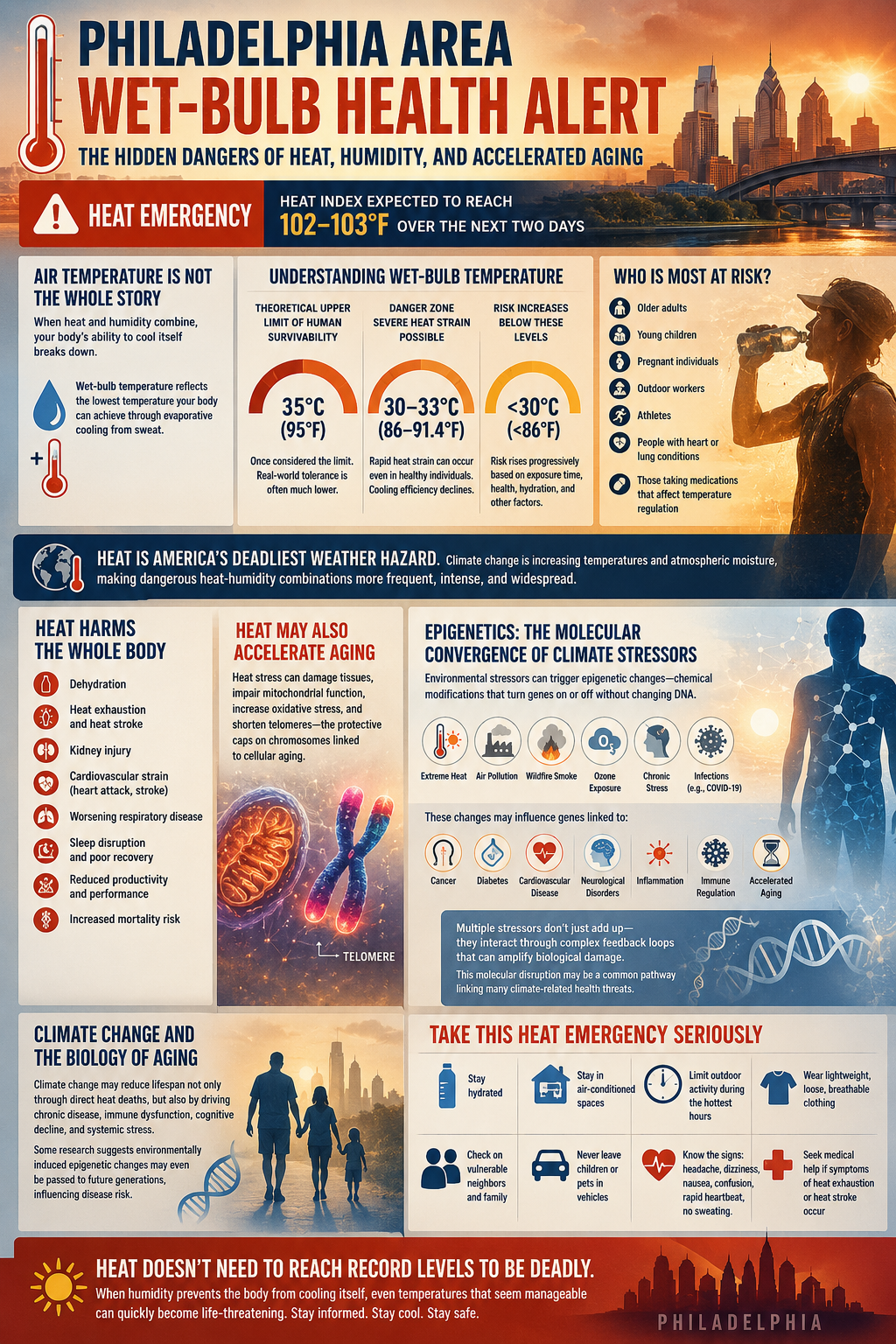
bookmark_borderPhiladelphia Area Wet-Bulb Health Alert: The Hidden Dangers of Heat, Humidity, and Accelerated Aging

Heat Risks Are Higher Than Many Realize

The Philadelphia region is currently under a heat emergency, with heat index values expected to reach approximately 102–103°F over the next two days. While many people focus on air temperature alone, the greater threat often comes from the dangerous combination of heat and humidity.

One of the best measures of this combined stress is wet-bulb temperature, which reflects the lowest temperature the body can achieve through evaporative cooling from sweat. As humidity rises, the body’s ability to cool itself declines, increasing the risk of heat exhaustion, heat stroke, organ damage, and death.

For years, scientists considered a wet-bulb temperature of 35°C (95°F) to be the theoretical upper limit of human survivability. More recent physiological and climate-chamber studies, however, suggest that real-world tolerance is often substantially lower, particularly during prolonged exposure, physical activity, direct sunlight, poor air circulation, or inadequate hydration.

Research increasingly indicates that wet-bulb temperatures in the range of 30–33°C (86–91.4°F) can produce severe heat strain even in healthy adults. At these levels, the body’s natural cooling mechanisms begin to lose effectiveness, causing internal temperatures to rise and placing increasing stress on virtually every organ system.

Heat Stress Begins Before the Extreme Thresholds

Importantly, dangerous heat conditions do not begin at a single threshold. Human thermoregulation deteriorates progressively as heat and humidity increase.

Risk rises substantially for:

  • Older adults
  • Young children
  • Pregnant individuals
  • Outdoor workers
  • Athletes
  • Individuals with cardiovascular disease
  • People with respiratory illnesses
  • Those taking medications that impair temperature regulation

The duration of exposure also matters. Even conditions that appear manageable can become dangerous after several hours, especially when nighttime temperatures remain elevated and prevent the body from recovering.

Heat: America’s Deadliest Weather Hazard

Heat remains one of the deadliest weather-related hazards in the United States, often causing more fatalities than floods, hurricanes, tornadoes, or lightning.

As climate change warms the atmosphere, the air can hold more water vapor, increasing humidity levels and making dangerous heat-humidity combinations more common. This trend is expanding the geographic reach of extreme heat events and increasing their frequency, intensity, and duration.

For many regions, including the Philadelphia metropolitan area, what were once rare heat emergencies are becoming increasingly routine.

The Growing Health Consequences of Extreme Heat

Exposure to elevated temperatures affects far more than comfort. Heat places stress on nearly every system in the human body and is associated with:

  • Dehydration
  • Heat exhaustion and heat stroke
  • Acute kidney injury
  • Cardiovascular strain
  • Increased risk of heart attack and stroke
  • Worsening respiratory disease
  • Sleep disruption and impaired recovery
  • Reduced physical and cognitive performance
  • Lower labor productivity
  • Increased mortality risk

Researchers are also finding evidence that repeated heat exposure may accelerate the aging process itself.

Emerging studies suggest that heat stress can damage tissues, impair mitochondrial function, increase oxidative stress, and contribute to the shortening of telomeres—the protective caps on chromosomes that are closely associated with cellular aging.

These findings suggest that climate change may influence health not only through immediate heat-related illness but also through long-term biological wear and tear.

Epigenetics: The Molecular Convergence of Climate Stressors

One of the most important emerging areas of climate-health research involves epigenetics—chemical modifications that influence how genes are expressed without changing the underlying DNA sequence.

These mechanisms function somewhat like biological dimmer switches, turning genes on or off in response to environmental conditions.

Increasing evidence suggests that extreme heat, particularly when combined with other environmental stressors, may trigger epigenetic changes throughout the body.

These stressors include:

  • Air pollution
  • Wildfire smoke
  • Ground-level ozone
  • Chronic psychological stress
  • Infectious diseases such as COVID-19
  • Exposure to environmental toxins

Research indicates that epigenetic alterations may influence genes associated with:

  • Cancer
  • Diabetes
  • Cardiovascular disease
  • Neurological disorders
  • Inflammation
  • Immune system regulation
  • Metabolic dysfunction
  • Accelerated aging

Critically, these environmental stressors do not operate independently. Their impacts may interact through complex biological pathways, creating feedback loops that amplify overall physiological damage.

This molecular-level disruption may represent a common underlying mechanism linking many seemingly separate climate-related health threats.

Climate Change and the Biology of Aging

The implications are profound.

Climate change may affect human health not only through direct heat-related deaths and injuries, but also through the gradual amplification of chronic disease, immune dysfunction, cognitive decline, and systemic physiological stress across entire populations.

Researchers are increasingly examining whether repeated exposure to extreme heat and other environmental stressors may contribute to accelerated biological aging at the population level.

Some scientists are also investigating the possibility of transgenerational effects, where environmentally induced epigenetic changes in one generation may influence disease susceptibility and health outcomes in future generations.

While this field remains an active area of research, the evidence increasingly suggests that climate change is not simply altering the environment around us—it may also be influencing biological processes within us.

Take This Heat Emergency Seriously

If you live in the Philadelphia area, take this heat emergency seriously.

  • Stay hydrated.
  • Limit outdoor activities during the hottest hours of the day.
  • Seek air-conditioned environments whenever possible.
  • Wear lightweight, breathable clothing.
  • Check on elderly relatives, neighbors, and vulnerable individuals.
  • Never leave children or pets in vehicles.
  • Watch for signs of heat exhaustion and heat stroke.

Heat does not need to reach record-breaking levels to become life-threatening.

When humidity prevents the body from cooling itself effectively, temperatures that may seem manageable can rapidly become dangerous. As climate change continues to intensify extreme heat events, understanding the risks posed by wet-bulb temperatures may become increasingly important for protecting public health.

* Our probabilistic, ensemble-based climate model — which incorporates complex socio-economic and ecological feedback loops within a dynamic, nonlinear system — projects that global temperatures are becoming unsustainable this century. This far exceeds earlier estimates of a 4°C rise over the next thousand years, highlighting a dramatic acceleration in global warming. We are now entering a phase of compound, cascading collapse, where climate, ecological, and societal systems destabilize through interlinked, self-reinforcing feedback loops.

We examine how human activities — such as deforestation, fossil fuel combustion, mass consumption, industrial agriculture, and land development — interact with ecological processes like thermal energy redistribution, carbon cycling, hydrological flow, biodiversity loss, and the spread of disease vectors. These interactions do not follow linear cause-and-effect patterns. Instead, they form complex, self-reinforcing feedback loops that can trigger rapid, system-wide transformations — often abruptly and without warning. Grasping these dynamics is crucial for accurately assessing global risks and developing effective strategies for long-term survival.

Feedback Loops → Tipping Points → Domino Effect
Feedback loops amplify climate change and can push interconnected Earth systems past critical tipping points. As tipping points are crossed, they can trigger additional feedback loops and destabilize other climate systems. This cascading “Domino Effect” compresses timescales, accelerates change, and increases the risk of rapid, nonlinear climate transformations.

The Climate Crisis: Violent Rain | Deadly Humid Heat | Health Collapse | Extreme Weather Events | Insurance | Trees and Deforestation | Soil | Rising Sea Level | Food and Water | Updates

bookmark_borderHeat Stress, Environmental Stressors, and the Limits of Human Adaptability

A Follow-Up to Heat Stress, Human Survivability, and the Emerging Physiological Limits of Climate Change

http://membrane.com/global_warming/Heat-Survivability-Thresholds.html

Q: How Adaptable Are Humans to Rising Heat and Compounding Environmental Stressors?

A: Far less adaptable than many assume.

Modern humans (Homo sapiens) are approximately 200,000 years old, with some of our closest ancestral lineages dating back roughly 140,000 years. One of the oldest known oral traditions may provide a remarkable example of humanity’s long environmental memory: the story of the Seven Sisters of the Pleiades.

The Pleiades are a cluster of stars in the Taurus constellation. Today, six stars are easily visible to the naked eye, yet many ancient traditions across the world describe seven visible sisters. Some researchers suggest these stories may preserve observations from many tens of thousands of years ago, before stellar movement made the seventh star difficult to see without magnification.

Among the oldest continuous cultural traditions associated with the Pleiades are the Dreaming stories of Aboriginal Australians. These interconnected “songlines” span much of the Australian continent, linking ecological knowledge, astronomy, navigation, and seasonal cycles across dozens of language groups and cultures.

First Nations Australians are also among the earliest groups to recognize localized ecological disruptions associated with anthropogenic climate change. Their approximately 65,000 years of continuous connection to Country produced highly localized ecological calendars based not on fixed months, but on relationships among plants, animals, weather patterns, and stars. This deep environmental literacy enabled them to track subtle shifts in ecosystems long before modern climate science emerged.

Yet even populations with millennia of environmental adaptation have limits.

Although Aboriginal Australians survived in some of the harshest climates on Earth, they have not escaped the physiological and societal burdens associated with environmental stress. Today, Indigenous Australians continue to experience significantly lower life expectancy compared to non-Indigenous populations, reflecting the complex interaction of environmental, social, economic, and health stressors.

There are important lessons in this history:

Long-term adaptation over thousands of years is fundamentally different from rapid climate destabilization unfolding over mere decades.


Heat, Health, and Compounding Stressors

The dangers of rising temperatures extend far beyond mass casualty events during heatwaves.

Heat exposure increasingly functions as a chronic, whole-body stressor capable of degrading human health over time.

Recent analyses estimate that the average person now experiences roughly 19 days per year of potentially life-threatening heat exposure, with most of that increase attributable to human-caused climate warming.

The impacts extend well beyond heatstroke.

Prolonged exposure to elevated temperatures contributes to:

  • dehydration,
  • kidney injury,
  • cardiovascular strain,
  • worsening respiratory disease,
  • impaired sleep and recovery,
  • reduced labor productivity,
  • and increased mortality risk.

Emerging research also indicates that chronic heat exposure can accelerate biological aging by damaging tissues, impairing mitochondrial function, and shortening telomeres at the cellular level.

These processes are associated with elevated risks of:

  • diabetes,
  • dementia,
  • cardiovascular disease,
  • immune dysfunction,
  • and several forms of cancer.

Heat stress also significantly affects mental health, increasing rates of:

  • anxiety,
  • depression,
  • aggression,
  • cognitive impairment,
  • and suicide risk.

The cumulative burden of these stressors becomes even more dangerous when combined with pollution exposure, infectious disease, nutritional instability, and economic stress.


Adaptation Timescales Matter

Arguments that humans have “always adapted” to heat fundamentally misunderstand the timescale problem.

Human adaptation historically occurred across evolutionary and cultural timescales spanning thousands of years.

Modern climate destabilization is unfolding within decades.

This compression of time severely limits both biological adaptation and societal infrastructure response.

The challenge is not simply rising temperature — it is the accelerating interaction of multiple environmental stressors occurring simultaneously within highly interconnected systems.


Epigenetic Changes: The Molecular Convergence of Climate Stressors

One of the most important emerging areas of research involves epigenetics — chemical modifications that influence how genes are expressed without changing the underlying DNA sequence itself.

These mechanisms function somewhat like biological dimmer switches, activating or suppressing genetic pathways in response to environmental conditions.

Extreme heat, particularly when combined with:

  • air pollution,
  • wildfire smoke,
  • ozone exposure,
  • chronic stress,
  • and infections such as COVID-19,

is increasingly associated with epigenetic modification.

Research suggests these changes may influence genes linked to:

  • cancer,
  • diabetes,
  • cardiovascular disease,
  • neurological disorders,
  • inflammation,
  • immune regulation,
  • and accelerated aging.

Critically, when multiple environmental stressors occur simultaneously, their effects may not simply add together — they may compound through interacting biological feedback loops.

This molecular-level disruption may represent a shared underlying mechanism connecting many climate-related health threats.

The implications are profound.

Climate change may not only reduce lifespan through direct heat mortality, but also through the gradual amplification of chronic disease, immune dysfunction, cognitive decline, and systemic physiological stress across entire populations.

Researchers are also increasingly concerned about potential transgenerational effects, where environmentally induced epigenetic changes in one generation may influence disease susceptibility in the next.


Conclusion

Climate change is not simply an environmental crisis.

It is increasingly a physiological, neurological, immunological, and societal stress crisis operating across multiple interconnected systems simultaneously.

The question is no longer whether humans can survive occasional extreme heat events.

The emerging scientific question is:

How well can human biology, infrastructure, healthcare systems, economies, and societies adapt to accelerating, compounding environmental stressors occurring at historically unprecedented rates?

Current evidence suggests the limits may be approaching far sooner than previously assumed.

bookmark_borderThe Future: Feedback Loops and the Limits of Human Adaptation

Introduction: Bounded — But Potentially Extreme

Q: What is the most likely future climate scenario?

A: Accelerating climate disruption driven by interacting feedback loops.

The good news is that physics places limits on the absolute worst-case outcomes. Earth is not expected to undergo a runaway Venus-style greenhouse effect in which oceans boil away and the atmosphere becomes permanently uninhabitable.

The danger facing humanity is different — and arguably more immediate.

The true risk is rapid, nonlinear climate acceleration occurring within thermodynamic bounds: a trajectory capable of producing severe ecological disruption, widespread biodiversity collapse, destabilization of global food and water systems, large-scale migration, economic fragmentation, and profound stress on human civilization.

Current evidence increasingly suggests that warming is not progressing through simple linear relationships alone. Multiple climate feedback mechanisms are now interacting simultaneously, amplifying one another through what can best be described as a cascading “Domino Effect” of destabilized Earth systems.

While uncertainties remain, current research increasingly points toward two dominant warming pathways over the next century.


The Two Most Likely Climate Pathways

Current Policy Trajectory (~3–4°C Warming)

This pathway reflects scenarios in which emissions plateau or decline slowly without deep structural reductions in fossil-fuel dependence.

Even under this comparatively moderate scenario, the world would experience:

  • chronic extreme heat,
  • intensified droughts and flooding,
  • major agricultural disruption,
  • accelerating sea-level rise,
  • ecosystem destabilization,
  • and substantial economic stress.

Large portions of the subtropics and tropics would experience increasingly dangerous wet-bulb temperatures, while many coastal megacities would face escalating flooding risks and infrastructure instability.


High-Feedback / Tipping Cascade Scenario (~4–7°C Warming)

This increasingly likely high-risk pathway assumes that major climate feedback loops begin substantially amplifying warming beyond direct human emissions alone.

These feedbacks include:

  • weakening land carbon sinks,
  • accelerating boreal and Arctic wildfires,
  • permafrost thaw,
  • methane release,
  • forest dieback,
  • declining biosphere productivity,
  • ozone-driven reductions in photosynthesis,
  • altered atmospheric circulation,
  • and destabilization of polar ice systems.

Under this scenario, the climate system increasingly becomes self-reinforcing.

The central concern is no longer simply how much carbon humans emit directly, but how strongly Earth’s own feedback systems begin adding additional greenhouse gases while simultaneously weakening natural carbon removal systems.


The World at ~3–7°C Warming

A world experiencing 3–7°C of warming would be profoundly transformed environmentally, biologically, economically, and socially.

The resulting conditions would not represent merely a “warmer version” of today’s civilization. They would constitute a fundamentally different planetary operating environment.


Extreme Heat and Wet-Bulb Stress

Extreme heatwaves would become routine across much of the planet, especially in tropical, subtropical, and low-income regions.

Of particular concern are rising wet-bulb temperatures — combinations of heat and humidity at which the human body can no longer effectively cool itself through sweating.

Once wet-bulb temperatures approach critical physiological thresholds, even healthy individuals resting in the shade can experience:

  • heat exhaustion,
  • organ failure,
  • cardiovascular collapse,
  • and death after prolonged exposure.

This represents one of the clearest biological limits confronting human civilization under severe warming scenarios.


Rising Seas and Infrastructure Collapse

Sea-level rise would intensify coastal flooding, saltwater intrusion, erosion, and storm-surge damage.

Major urban centers, ports, industrial zones, and transportation networks would face escalating instability.

The economic consequences would extend far beyond coastlines, disrupting:

  • global trade,
  • insurance systems,
  • supply chains,
  • energy infrastructure,
  • and freshwater access.

Climate migration pressures would increase substantially as populations relocate away from increasingly uninhabitable regions.


Ecosystem Collapse and Biodiversity Loss

Warming at this scale would likely trigger widespread ecological restructuring.

Expected impacts include:

  • mass coral reef die-offs,
  • accelerating rainforest decline,
  • collapse of Arctic ecosystems,
  • expanding desertification,
  • and widespread species extinction.

Many ecosystems evolved within relatively stable climatic ranges and may not adapt quickly enough to the pace of modern warming.

As biodiversity declines, ecosystem resilience weakens further, increasing the likelihood of cascading ecological failures.


Agricultural Destabilization and Food Insecurity

Climate change threatens agriculture through multiple simultaneous stressors:

  • heat stress,
  • water scarcity,
  • ozone damage,
  • soil degradation,
  • shifting precipitation patterns,
  • and expanding pest and pathogen ranges.

Crop viability would progressively shift toward higher latitudes and elevations.

At the same time, many historically productive agricultural regions could become increasingly difficult to farm reliably.

This raises the risk of chronic food insecurity, volatile food prices, geopolitical instability, and humanitarian crises.


Crossing Climate Tipping Points

Perhaps most importantly, severe warming increases the probability of crossing major climate tipping elements.

Potential tipping systems include:

  • Greenland Ice Sheet collapse,
  • West Antarctic Ice Sheet destabilization,
  • Amazon rainforest dieback,
  • boreal forest collapse,
  • Atlantic circulation weakening,
  • and large-scale methane release from thawing permafrost.

Once critical thresholds are crossed, some processes may become partially self-sustaining over centuries or millennia.

This introduces the possibility of long-term warming amplification even if human emissions later decline.


Human Biology Under Climate Stress

Reproductive Stress and Fertility Decline

Climate change is increasingly emerging as a reproductive health issue.

Environmental stressors associated with warming — including extreme heat, pollution exposure, wildfire smoke, endocrine-disrupting chemicals, malnutrition, and chronic psychological stress — directly affect fertility and pregnancy outcomes.

Declining Fertility

High ambient temperatures impair spermatogenesis, contributing to:

  • lower sperm counts,
  • reduced motility,
  • altered morphology,
  • and hormonal disruption.

For women, heat stress may interfere with:

  • ovulation,
  • follicular development,
  • menstrual regularity,
  • and reproductive hormone balance.

Large-scale demographic studies have observed measurable declines in birth rates approximately nine months following major heatwaves.


Adverse Pregnancy Outcomes

Extreme heat and air pollution exposure — particularly fine particulate matter (PM2.5) and wildfire smoke — increase systemic inflammation and oxidative stress.

These conditions are associated with elevated risks of:

  • miscarriage,
  • stillbirth,
  • preterm birth,
  • low birth weight,
  • and developmental complications.

Epigenetics and Long-Term Biological Stress

A growing area of concern involves epigenetic changes — chemical modifications that influence how genes are expressed without altering the DNA sequence itself.

These changes function like biological switches, activating or silencing genetic pathways in response to environmental conditions.

Chronic exposure to:

  • pollution,
  • heat stress,
  • malnutrition,
  • environmental toxins,
  • psychological stress,
  • and sleep disruption

may contribute to harmful epigenetic changes associated with:

  • inflammation,
  • immune dysfunction,
  • metabolic disease,
  • neurological disorders,
  • accelerated aging,
  • and reduced resilience to future stressors.

Researchers are also investigating potential transgenerational effects, in which environmentally induced epigenetic stress in one generation may increase disease vulnerability in subsequent generations.


Pathogen Expansion Versus Immune Suppression

Perhaps even more concerning is the difference in adaptation timescales between humans and pathogens.

Viruses, bacteria, fungi, and parasites evolve rapidly over short timescales, while human biological adaptation occurs slowly across many generations.

As warming expands tropical and subtropical conditions into new regions:

  • mosquitoes,
  • ticks,
  • fungal pathogens,
  • and waterborne diseases

are expected to spread into populations with limited immunity and inadequate infrastructure preparedness.

At the same time, climate-related stressors — including heat exposure, pollution, malnutrition, dehydration, and chronic physiological stress — weaken immune system performance.

In effect, while human biological adaptation proceeds slowly, many pathogens and environmental stressors are accelerating rapidly under changing climate conditions.


Psychological and Social Stress

Climate instability also produces profound psychological consequences.

Increasing climate anxiety, displacement pressures, food insecurity, economic instability, and disaster exposure contribute to:

  • chronic stress,
  • depression,
  • trauma,
  • social fragmentation,
  • and declining long-term reproductive confidence.

Many individuals are already reporting declining “fertility aspirations” due to uncertainty surrounding future planetary habitability.


Evolutionary Lag and Maladaptation

Modern human civilization evolved during an unusually stable climatic period known as the Holocene.

Agriculture, cities, infrastructure, political systems, and global trade networks were all built around relatively predictable environmental conditions.

Rapid climate destabilization threatens to outpace the adaptive capacity of many biological and societal systems simultaneously.

When a species adapts too slowly to environmental change, this is known as an evolutionary lag.

If environmental disruption becomes severe enough that survival and reproduction can no longer be maintained effectively, the result becomes maladaptation — or an evolutionary trap.

Historically, such processes have contributed to mass extinction events throughout Earth’s history.


PART II

Extreme Energy Events: Immediate and Escalating Risks

While many long-term climate threats continue to develop over decades, some of the most dangerous impacts are already unfolding in real time through what can be described as extreme energy events — high-energy atmospheric events driven by excess heat accumulating within the Earth system.

These include:

  • deadly humid heat,
  • violent rainfall and flash flooding,
  • atmospheric instability,
  • wildfire outbreaks,
  • drought intensification,
  • and cascading public health emergencies.

Unlike slower-moving environmental changes, these events directly translate excess atmospheric energy into immediate human mortality, infrastructure failure, economic disruption, and declining quality of life.


A Growing Public Health Emergency

Health feedback loops, violent rain, and deadly humid heat are now contributing to a rapidly accelerating rise in climate-related illness and mortality.

This emerging lethal triad — disease, extreme heat, and extreme precipitation — demonstrates that climate change is no longer a distant environmental concern. It is increasingly becoming a systemic public health emergency.

These stressors do not operate independently. Instead, they interact and amplify one another through cascading feedback loops:

  • heat worsens ozone formation and air pollution,
  • pollution weakens respiratory and cardiovascular health,
  • flooding spreads pathogens and contaminates water systems,
  • infrastructure failures reduce emergency response capacity,
  • and chronic stress weakens immune resilience.

The result is a compounding system of interconnected risks.


Deadly Humid Heat

All 50 U.S. states — including Alaska — are already experiencing dangerous humid-heat conditions and recurring heat advisories.

Large regions of the United States and other parts of the world are becoming increasingly difficult to inhabit safely during portions of the year due to prolonged heat exposure and rising humidity.

Of particular concern are rising wet-bulb temperatures — a combined measure of heat and humidity that determines whether the human body can cool itself through sweating.

In some regions, wet-bulb temperatures are now approaching physiological danger thresholds where prolonged outdoor survival becomes impossible, even for healthy individuals with access to water and shade.

This represents one of the clearest biological limits confronting human civilization under accelerating warming scenarios.


Violent Rainfall and Atmospheric Instability

At the same time, violent rainfall events are increasing in frequency and intensity.

A warmer atmosphere holds substantially more moisture — approximately 7% more water vapor per degree Celsius of warming. This increases the likelihood of:

  • hyper-intense downpours,
  • atmospheric river events,
  • flash flooding,
  • stalled storm systems,
  • and destructive rainfall extremes.

These events already cause:

  • hundreds to thousands of deaths annually,
  • billions in infrastructure damage,
  • agricultural disruption,
  • water contamination,
  • and long-term economic instability.

In many regions, stormwater systems, drainage infrastructure, and emergency services were never designed for this new level of atmospheric energy.


1. Hot-Humid Heat Events: The Biology of Lethal Heat

In a warming climate, the combination of extreme heat and humidity may become the most immediate direct threat to human survival.

Mortality Risks

Heat Stroke and Multi-Organ Failure

When humidity becomes too high, sweating loses effectiveness as a cooling mechanism.

At sufficiently elevated wet-bulb temperatures, core body temperature begins rising uncontrollably, leading to:

  • heat stroke,
  • neurological dysfunction,
  • cellular breakdown,
  • cardiovascular collapse,
  • and multi-organ failure.

Even healthy individuals cannot survive prolonged exposure under these conditions without artificial cooling.


Cardiovascular and Renal Stress

Extreme heat forces the cardiovascular system to work far harder in order to move heat away from internal organs toward the skin.

This dramatically increases the risk of:

  • heart attacks,
  • strokes,
  • dehydration,
  • electrolyte imbalance,
  • and acute kidney injury.

Outdoor workers, elderly populations, children, and individuals without reliable cooling access face especially high risks.


Quality-of-Life Impacts

The Energy Poverty Trap

As heat intensifies, survival increasingly depends on continuous access to air conditioning.

This creates a dangerous dependency on electrical infrastructure precisely when energy systems are under maximum strain.

During major heatwaves:

  • power demand surges,
  • grids become unstable,
  • blackouts become more likely,
  • and indoor spaces can rapidly become lethal.

This disproportionately affects low-income communities already struggling with energy costs.


Loss of Labor Capacity

Extreme heat also reduces the number of safe outdoor working hours available each day.

Agriculture, construction, logistics, transportation, and emergency services become increasingly difficult to sustain safely during prolonged heatwaves.

Workers may face a choice between:

  • severe health risks,
  • reduced income,
  • or complete labor disruption.

Over time, this degrades household economic stability and broader economic productivity.


2. Violent Rain and Flash Flooding: The Chaos of Uncontrolled Water

As the atmosphere stores more heat and moisture, rainfall events become increasingly concentrated and destructive.

Instead of steady precipitation, warming favors shorter-duration but far more intense rainfall extremes.


Mortality Risks

Drowning and Physical Trauma

Flash floods can develop within minutes, overwhelming roads, vehicles, homes, and low-lying communities before evacuation is possible.

Floodwaters often contain:

  • debris,
  • collapsed infrastructure,
  • sewage,
  • chemicals,
  • and landslide material.

These conditions create high risks of:

  • drowning,
  • blunt-force trauma,
  • electrocution,
  • and building collapse.

Waterborne Disease Outbreaks

Extreme rainfall frequently overwhelms sewage and drainage systems, allowing contaminated water to mix with drinking supplies.

This increases the risk of:

  • cholera,
  • leptospirosis,
  • gastrointestinal infections,
  • mosquito-borne disease expansion,
  • and mold-related respiratory illness.

Stagnant floodwaters also create breeding grounds for mosquitoes and pathogens.


Quality-of-Life Impacts

Displacement and Housing Instability

Flooding destroys homes, transportation networks, and public infrastructure.

Even after floodwaters recede, chronic moisture intrusion and toxic mold growth can make buildings unsafe for long periods.

This contributes to:

  • displacement,
  • respiratory illness,
  • economic instability,
  • and long-term psychological stress.

Infrastructure and Supply Chain Breakdown

Violent rainfall events can:

  • collapse bridges,
  • wash out roads,
  • disable power systems,
  • disrupt hospitals,
  • and interrupt food and medical supply chains.

Communities may lose access to:

  • clean drinking water,
  • emergency services,
  • fuel,
  • communications,
  • and healthcare.

As these disruptions compound, societal resilience weakens further.


Intersecting Climate Impacts

Event TypePrimary Mortality DriversMajor Quality-of-Life Disruptions
Hot-Humid HeatHeat stroke, cardiovascular failure, kidney injuryBlackouts, labor loss, indoor confinement
Violent RainDrowning, trauma, waterborne diseaseDisplacement, mold exposure, infrastructure collapse

A System Under Increasing Stress

Extreme energy events illustrate how climate change transforms excess atmospheric heat into cascading human consequences.

The danger is not simply higher temperatures alone.

The danger emerges from interacting systems under stress:

  • biological limits,
  • energy infrastructure,
  • water systems,
  • agriculture,
  • healthcare,
  • labor capacity,
  • and economic stability.

When multiple systems fail simultaneously, the impacts become nonlinear.

Climate change is therefore not merely an environmental issue. It is increasingly a systemic risk multiplier capable of destabilizing the interconnected foundations of modern civilization.


Conclusion

If humanity continues accelerating climate change at the current pace, we are likely to face many of the same environmental stresses associated with ancient greenhouse worlds:

  • extreme heat,
  • expanding drought,
  • ecosystem disruption,
  • declining biosphere productivity,
  • atmospheric instability,
  • and increasing difficulty sustaining large-scale agriculture and stable civilizations.

Unlike ancient species, however, modern human civilization is deeply dependent upon highly interconnected infrastructure systems vulnerable to rapid environmental disruption.

The challenge is therefore not simply survival at the level of individual organisms, but maintaining the stability of the complex technological, agricultural, economic, and social systems upon which billions of people depend.

In essence, humanity is increasingly entering a planetary system operating under climatic conditions fundamentally hostile to modern human physiology and modern civilization simultaneously.

The greatest uncertainty is no longer whether climate change will occur.

The central question is how rapidly interacting climate feedback systems, ecological destabilization, and human maladaptation will accelerate once critical thresholds are crossed.

bookmark_borderThe Accidental Fascist Hunter

How a Climate Investigation Uncovered Ecofascist Networks

Introduction

This paper documents how an investigation into climate science denial led to the identification of ecofascist ideology embedded within elite networks.

I did not set out to become what some now call a “fascist hunter.” The investigation began narrowly, focused on institutional influence and regulatory manipulation. It evolved into something far larger — the exposure of an ideological framework that treats environmental collapse not as a crisis to prevent, but as a mechanism of selective survival.

Phase I: The Institutional Inquiry

The investigation began with a focused institutional question:

Were challenges to the EPA’s Endangerment Finding and coordinated regulatory rollbacks driven primarily by economic motives — specifically the fossil fuel industry’s long-documented strategy of financing climate denial narratives?

The CO₂ Coalition and the Department of Energy’s Climate Working Group (DOE CWG) were central nodes of analysis.

The economic motive was clear and well documented: protect fossil capital, delay regulation, manufacture doubt.

That part of the investigation was straightforward.

Phase II: The Ideological Shift

As correspondence, affiliations, and rhetoric were analyzed, a second pattern emerged.

This was not merely economic denialism.

It was ideological normalization of ecofascism.

Ecofascism reframes environmental collapse as beneficial — even desirable — if it reduces populations deemed inferior, excessive, or expendable. It merges environmental crisis with authoritarian hierarchy, racialized survival logic, and elite domination theory.

This is not speculation. It is evidenced in language.

The release of the Epstein Files provided explicit confirmation of ideological alignment between climate minimization and eugenic framing.

Publicly released materials include statements attributed to Jeffrey Epstein such as:

“I liked the argument that more CO₂ is good for plants.”
“Maybe climate change is a good way of dealing with overpopulation — the earth’s forest fire. Potentially a good thing for the species.”

Combined with statements reflecting explicit eugenic ideology:

“Executions of the elderly and infirm make sense.”
“African music has lots of beats and little development — no accident. It mirrors their learning process.”

This is not conventional policy disagreement.

This is eliminationist logic.

Where traditional denial protects capital investment, ecofascism rationalizes unequal human survival.

Phase III: Scientific Foundation — Acceleration

My climate work dates to the 1990s, when we analyzed whether sea-level rise and temperature increases were accelerating.

The core question was mathematical: Is climate change linear, or is it nonlinear and accelerating?

Rather than assuming constant growth, we examined second-order rate-of-change — whether the rate itself was increasing.

Core Mathematical Insight

When feedback amplification increases the growth constant over time:Td(t)=ln⁡(2)k(t)T_d(t) = \frac{\ln(2)}{k(t)}Td​(t)=k(t)ln(2)​

Where:

  • Td(t)T_d(t)Td​(t) = doubling time
  • k(t)k(t)k(t) = time-dependent growth constant
  • ln⁡\lnln = natural logarithm

When k(t)k(t)k(t) increases due to feedback loops, doubling times collapse.

By the early 2000s, multiple independent datasets supported nonlinear acceleration:

  • Surface and tropospheric temperature
  • Greenland and Antarctic ice mass balance
  • Wildfire frequency and burned area
  • Ocean heat content
  • Hydrological extremes

Observed impact doubling times declined from roughly ~100 years (pre-industrial baseline), to ~10 years by 2010, and to approximately 2–5 years by 2024 in certain high-sensitivity indicators.

Under compressed doubling intervals of ~1.5–2 years, cumulative impacts can increase by a factor of 64 (2⁶) within a decade.

That is not linear change.

That is system instability.

Phase IV: The Convergence

Until February 2026, I had not encountered ecofascism as an operational category in my investigative work.

Now it is central.

The convergence point is this:

Climate denial that is knowingly false
+
Rhetoric that frames collapse as beneficial
+
Elitist eugenic ideology

Ecofascism

If someone promotes demonstrably false climate claims — not out of ignorance, but with the intent to delay mitigation while expressing indifference toward disproportionate harm to vulnerable populations — that is not mere misinformation.

That is ideological weaponization.

There is no rational basis for saying 1 + 1 = 89.

Likewise, there is no empirical basis for claiming modern anthropogenic climate change is purely natural. When such claims are made repeatedly, despite overwhelming evidence to the contrary, intent must be examined.

The lie becomes structural.

And when the structural outcome of that lie disproportionately harms populations already deemed inferior by those promoting it, the ideological alignment becomes clear.


Qualifications

1. Climate Science

In the 1990s, we independently analyzed acceleration dynamics in climate indicators. Our work examined doubling times and nonlinear feedback compression using empirical datasets.

This was not speculative modeling. It was data-driven analysis of observed acceleration.

2. Ethics, Logic, and Investigative Journalism

I hold a philosophy degree, graduated with a 4.0 GPA, and was inducted into Phi Sigma Tau, the international honor society for philosophy, with formal expertise in ethics, logic, and linguistics.

I have investigated organized crime, municipal corruption, and institutional misconduct. I understand retaliation, intimidation, and disinformation tactics.

This investigation fits the same structural pattern.

Unintended Consequences

It was not my intention to uncover what appears to be an international ideological network.

So far, ecofascist patterns have been identified in the U.S., Canada, the U.K., EU member states, Russia, Indonesia, Australia, and New Zealand.

Exposure carries risk.

Publishing quickly and publicly is not theatrical — it is strategic documentation. Transparency is protection.


Initial Findings

Based on two years of combined denialism and ecofascism analysis:

  • ~10% appear to understand the science and knowingly promote harmful narratives consistent with ecofascist ideology.
  • ~90% do not understand the science but adopt denialist rhetoric as identity reinforcement.
  • A measurable subset demonstrate impaired abstract reasoning capacity, making them highly susceptible to manipulation and propaganda.

This is ongoing research.

The dataset now includes tens of thousands of observed interactions.

Fortunately, a growing network of citizen scientists has begun assisting in documentation and data collection.


Conclusion: The Rise of the Fascist Hunter

This was not a chosen role.

It emerged from evidence.

When denial transitions from economic self-interest to eliminationist indifference, the moral frame changes.

We are no longer debating policy cost curves.

We are confronting ideological frameworks that treat ecological collapse as selective purification.

Identifying that shift is no longer optional.

It is necessary.

RESOURCES:

bookmark_borderSystemic Infrastructure Risk in a Nonlinear Climate: Economic and Public Safety Implications for the United States

Daniel Brouse and Sidd Mukherjee
February 8, 2026

Abstract

One of the largest and fastest-growing economic costs of climate change in the United States is infrastructure degradation and failure. Intensifying extreme weather events — including flooding, windstorms, heat waves, and heavy precipitation — are stressing systems that were designed for a more stable 20th-century climate. Because many of the nation’s most densely populated cities are located along coasts and low-lying river systems, the risks are both geographically concentrated and nationally significant. This paper examines emerging infrastructure failures as indicators of systemic climate risk and outlines the compounding economic and public health implications.

1. Infrastructure Exposure in Coastal and Riverine Cities

Urban America is disproportionately situated in vulnerable zones: coastal plains, estuaries, and floodplains. These regions now face accelerating risks from sea-level rise, storm surge, extreme rainfall, and groundwater intrusion.

Philadelphia represents a clear example of multi-directional vulnerability. Located at the confluence of the Delaware and Schuylkill Rivers and influenced by tidal dynamics, the city faces increasing flood frequency alongside saltwater intrusion into drinking water and wastewater systems.

The historic Fairmount Water Works, a symbol of early American engineering, now faces what local officials describe as an existential threat — “adapt or collapse.” Pennsylvania already endures more flooding events than any other U.S. state, and the intensity of rainfall has measurably increased in recent decades. Aging stormwater and combined sewer systems were not engineered for present precipitation extremes.

(See also:
http://membrane.com/global_warming/Brandywine-Creek.html)

2. Compounding Costs: Pollution and Public Health

Infrastructure damage is only one dimension of climate-related economic cost. Air pollution — amplified by heat, wildfire smoke, and stagnant atmospheric conditions — compounds healthcare burdens.

Fine particulate matter (PM2.5) remains one of the leading contributors to premature mortality in the United States. Tropospheric ozone, formed through photochemical reactions intensified by heat, damages lung tissue and reduces agricultural productivity. These are not isolated environmental concerns; they represent measurable costs in healthcare expenditures, lost labor productivity, and long-term morbidity.

(See also:
http://membrane.com/global_warming/Trees-for-Climate-Change.html)

3. Cascading Infrastructure Failure: Washington, D.C. Sewer Collapse

On January 19, 2026, a major sewer pipeline collapsed near Washington, D.C., triggering a cascading infrastructure emergency. Following the structural failure, snowmelt and ice increased groundwater infiltration into the system, raising flow volumes beyond temporary bypass capacity.

Subsequent pump clogging caused additional sewage overflows even after the main break had been rerouted. This sequence illustrates a broader pattern: infrastructure failures are no longer isolated mechanical breakdowns but compound events intensified by climate-driven hydrological volatility.

Such cascading stress reveals systemic fragility in aging urban systems under nonlinear climate pressure.

4. Record Wind Extremes: Wyoming, December 2025

On December 17, 2025, Wyoming experienced one of the most extreme wind events in its recorded history.

  • Peak Gust: 144 mph near Smoot, Wyoming
  • Location: Mount Coffin weather station
  • Additional Extremes: 123 mph in Red Canyon; 121 mph in Lincoln County

These wind speeds approach Category 4 hurricane intensity — occurring inland, outside tropical systems. Such events signal increasing atmospheric energy within mid-latitude systems.

Transportation and Public Safety Impacts

  • Dozens of semi-trucks were blown over on December 17 alone.
  • Between December 9–12, Wyoming Highway Patrol responded to 39 blowovers.
  • Major freight corridors (I-80, I-25) required closures.

These events are not merely episodic disruptions. They expose freight systems, insurance structures, and roadway design standards that were calibrated to historical wind distributions — distributions that are shifting.

5. Insurance and Fiscal Implications

Infrastructure stress is increasingly socialized through public insurance systems. Florida now operates effectively as the largest insurer of residential property in the state after repeated private insurer withdrawals. This represents implicit public assumption of escalating climate risk.

Nationally, approximately 10% of high-risk ZIP codes have become effectively uninsurable or subject to severe premium escalation. This trend signals market recognition of structural climate exposure before federal policy fully accounts for it.

As climate volatility accelerates, risk is transferred from private capital markets to taxpayers.

6. Conclusion

Climate change is no longer a distant environmental issue; it is an infrastructure and fiscal stability issue. Extreme weather events are interacting with aging systems, increasing failure frequency and repair costs. Urban water systems, transportation networks, freight corridors, and insurance markets are all experiencing structural stress.

As current trends continue, large portions of U.S. infrastructure — particularly in coastal and riverine regions — are becoming economically and physically unsustainable. Adaptation investments are no longer optional; they are prerequisites for maintaining fiscal stability, public safety, and long-term economic viability.

The central economic question is no longer whether infrastructure will be affected, but whether adaptation can proceed quickly enough to prevent cascading fiscal and public safety crises. Equally important is a more difficult policy question: should strategic managed retreat be implemented sooner rather than later to minimize long-term losses and systemic risk?

The Human Induced Climate Change Experiment

bookmark_borderPersistent SARS-CoV-2, Epigenetic Disruption, and the Neuroimmune Pathway: A Framework for Understanding and Managing Long COVID

by Daniel Brouse
February 3, 2026

COVID-19 and Long COVID are not simply acute respiratory illnesses. They represent a multi-system, persistent, and epigenetically disruptive disease process with long-lasting effects on the body, the brain, and society as a whole. Even a single SARS-CoV-2 infection can trigger biological changes that unfold over months or years, influencing immune regulation, mitochondrial function, autonomic stability, chronic disease risk, and economic productivity.

Persistent Viral Reservoirs

A growing body of research suggests that in some individuals, viral fragments — and possibly replication-competent virus — may persist in tissue reservoirs long after a person tests negative on standard nasal PCR tests. Viral RNA and protein fragments have been identified in organs and brain tissue months to years after initial infection. Clinically, this persistence may manifest as:

  • Brain fog

  • Debilitating fatigue

  • Dysautonomia

  • Loss of taste or smell

  • Night sweats

  • Autoimmune-like symptoms

In my own case, addressing the persistent component brought substantial relief. Post-infection mRNA vaccination appeared to stimulate a more targeted immune response, enhancing viral clearance and significantly reducing symptoms. The vaccine effectively “re-alerted” the immune system to residual viral antigens, strengthening its ability to suppress or eliminate lingering viral activity.

While symptoms became manageable, persistence is only one dimension of the disease.

Epigenetic and Organ-Level Consequences

SARS-CoV-2 infection also induces epigenetic modifications — chemical changes that alter gene expression without changing DNA sequences. These changes can:

  • Activate pro-inflammatory pathways

  • Accelerate biological aging

  • Influence cardiovascular and metabolic risk

  • Alter immune regulation

  • Increase vulnerability to neurological and autoimmune conditions

In addition, organ damage — including microvascular injury and endothelial dysfunction — may persist even after symptomatic recovery.

For most individuals infected with COVID-19, some degree of epigenetic alteration and tissue injury likely occurs. At present, there are no direct therapies that “reverse” these molecular changes. Management therefore focuses on stabilizing immune regulation, improving cellular energy production, and reducing systemic inflammation.

Long COVID as a Neuroimmune Disorder

The paper “Postural Orthostatic Tachycardia Syndrome, Myalgic Encephalomyelitis/Chronic Fatigue Syndrome and Long COVID as Neuroimmune Disorders” synthesizes emerging research linking Long COVID, POTS, and ME/CFS under a shared neuroimmune and autonomic dysfunction framework. These conditions appear to involve:

  • Chronic immune activation

  • Impaired mitochondrial energy production

  • Autonomic nervous system dysregulation

  • Microvascular abnormalities

This integrative view aligns with clinical experience and with earlier hypotheses advanced by Dr. Ade Wentzel and Robert Miller.

Mitochondrial Support: Rebuilding Cellular Energy

Fatigue in Long COVID and related conditions is strongly associated with impaired mitochondrial function and disrupted ATP production. Supporting cellular energy systems is therefore central.

Interventions with clinical support include:

  • Niacin (Vitamin B3) — supports NAD⁺ pathways essential for mitochondrial energy metabolism

  • CoQ10 (ubiquinol)

  • L-carnitine

  • Magnesium

  • B-vitamin complex

  • Omega-3 fatty acids

Niacin, in particular, may play a key role by restoring NAD⁺ balance, improving redox function, and supporting mitochondrial resilience.

These interventions do not “cure” Long COVID, but they may improve functional capacity and reduce symptom severity. Any supplementation should be coordinated with a clinician, particularly for individuals on specialized nutrition regimens such as TPN.

Calming Chronic Inflammation

Because persistent immune activation drives much of the symptom burden, reducing systemic inflammation is equally important. Foundational strategies include:

  • Consistent, restorative sleep

  • Gentle, non-crashing movement (short walks, stretching)

  • Mediterranean-style anti-inflammatory nutrition when feasible

  • Stress modulation practices (breathing exercises, mindfulness)

These approaches reduce downstream inflammatory signaling and help stabilize autonomic function over time.

A Working Framework

Long COVID appears to operate along two interacting axes:

  1. Persistent viral and immune dysregulation

  2. Epigenetic and mitochondrial disruption

Post-infection vaccination may help resolve viral persistence in some individuals. Mitochondrial support and anti-inflammatory lifestyle strategies may mitigate the chronic downstream effects.

The emerging framework is not about a single miracle treatment. It is about restoring immune precision, rebuilding cellular energy production, and calming systemic inflammation. As research evolves, this integrative model offers a practical and biologically grounded path forward for managing a complex, multi-system condition.

bookmark_borderYouth Mental Health in the Era of Accelerating Climate Extremes: Psychological Trauma, Agency, and the Emerging Molecular Health Crisis

Daniel Brouse
February 2, 2026

Abstract

Recent peer-reviewed research published in Nature (2026), PNAS, and a January 2026 analysis in Taylor & Francis Online converges on a stark conclusion: climate change now constitutes a measurable and escalating threat to youth mental health. Extreme weather exposure, chronic climate disruption, and perceived governmental inaction are driving significant increases in post-traumatic stress disorder (PTSD), depression, anxiety, and climate-related distress among children and adolescents worldwide.

Approximately half of reported psychological burden appears directly linked to lived exposure to climate disasters; the remaining burden reflects a crisis of agency — young people’s recognition of existential threat coupled with limited power to alter outcomes. Simultaneously, escalating heat exposure and pollution are exerting measurable biological stress at the cellular and epigenetic level. Together, these findings suggest that climate change is not only an environmental and economic emergency but a multi-generational public health crisis spanning mental and physical domains.

1. Introduction

The climate system’s accelerating instability is increasingly mirrored in the psychological health of younger generations. Unlike abstract environmental concerns of prior decades, today’s youth are growing up amid direct, recurrent, and intensifying exposure to floods, hurricanes, tornadoes, extreme rainfall, landslides, drought, extreme heat, bomb cyclones, wind shear events, hailstorms, wildfires, and zoonotic disease outbreaks.

The cumulative effect is no longer speculative. It is clinically observable.

Research in Nature (2026) and related analyses demonstrate that climate change is contributing to measurable increases in PTSD, depression, anxiety disorders, and chronic distress among children and adolescents. Many young people report feelings of betrayal and abandonment, citing perceived governmental inaction in the face of escalating evidence.

2. Widespread Distress and Solastalgia

A defining feature of this crisis is the phenomenon of solastalgia — often described as “homesickness while still at home.”

Unlike eco-anxiety, which is anticipatory fear about future environmental collapse, solastalgia arises when one’s immediate home environment is visibly degraded. It is the distress of watching familiar landscapes burn, flood, dry, or decay.

Key findings indicate:

  • Increasing climate-related disasters and heat exposure are directly associated with higher rates of anxiety, depression, and PTSD in children.
  • Communities repeatedly exposed to extreme events exhibit compounding psychological harm.
  • Emotional distress often intensifies when environmental change alters identity, place attachment, and cultural continuity.

The PTSD reported by youth is frequently rooted in direct lived experience — evacuations, home loss, displacement, community destruction, and prolonged instability.

3. Direct Exposure and the Paradox of Agency

A study published in PNAS finds that direct experience with climate-related disasters correlates strongly with increased eco-anxiety and functional impairment. However, the same exposure can also catalyze adaptation behaviors and activism.

This introduces a paradox.

Approximately 50% of mental health burden appears to stem from direct trauma exposure. The remaining burden relates to agency — or lack thereof.

Children and adolescents possess the cognitive capacity to understand the existential dimensions of climate destabilization. Their distress is amplified not by ignorance, but by insight. What compounds the trauma is the recognition that decision-making power rests largely with adults whose responses are often perceived as insufficient, dismissive, or delayed.

The psychological strain thus reflects both trauma and moral injury.

4. Climate Change as a Dual Health Crisis

The emerging data suggest that climate change must be understood as both a mental and physical health emergency.

4.1 Heat Mortality and Rising Exposure

  • Global heat-related deaths now approximate one fatality per minute during peak periods.
  • Over the past four years, the average person has endured approximately 19 days annually of life-threatening heat exposure, largely attributable to anthropogenic warming.
  • Extreme heat contributes to heatstroke, dehydration, acute kidney injury, cardiovascular stress, and respiratory complications.
  • Heat exposure worsens pre-existing heart and lung diseases and increases hospitalization rates.

Heat stress also directly exacerbates depression, anxiety, aggression, and suicide risk.

5. Climate Extremes and Cellular Breakdown

Prolonged exposure to extreme heat accelerates biological aging. Research indicates:

  • Tissue damage linked to chronic heat stress.
  • Telomere shortening, a marker of accelerated cellular aging.
  • Increased risk of chronic diseases including cancer, dementia, and diabetes.

These risks are compounded by pollution exposure and infectious disease burden. Climate-related stressors do not act in isolation; they interact and amplify vulnerability across organ systems.

6. Epigenetic Changes: The Molecular Convergence of Climate Stressors

A critical and emerging dimension of this crisis involves epigenetic modification — chemical changes that regulate gene expression without altering the underlying DNA sequence.

Epigenetic mechanisms function as molecular switches, activating or silencing genes in response to environmental stimuli.

Extreme heat, tropospheric ozone exposure, and COVID-19 infection have all been associated with epigenetic alterations linked to:

  • Cardiovascular disease
  • Diabetes
  • Cancer susceptibility
  • Neurodegenerative disorders
  • Immune dysregulation

When multiple stressors occur simultaneously — heat, pollution, infection, psychological trauma — their effects compound rather than merely accumulate. These converging stressors may increase lifetime disease risk and potentially influence transgenerational health outcomes.

This represents a shared biological pathway through which climate destabilization translates into long-term systemic illness.

7. Intergenerational Implications

The possibility that stress-induced epigenetic modifications may influence subsequent generations raises profound ethical and policy implications. Climate-driven biological stress today may shape disease risk tomorrow.

Thus, the youth mental health crisis is not an isolated psychological phenomenon. It is embedded within broader ecological, physiological, and social systems undergoing rapid destabilization.

8. Conclusion

The emerging research makes clear that climate change is a cascading public health emergency affecting both mind and body.

Youth mental distress reflects:

  • Direct trauma from climate disasters,
  • Chronic environmental degradation (solastalgia),
  • Existential awareness without adequate agency.

Simultaneously, climate stressors are accelerating cellular aging, increasing chronic disease risk, and potentially altering gene expression across generations.

Addressing climate anxiety cannot be separated from addressing climate change itself. Tangible mitigation, adaptation, and accountability are not only environmental imperatives — they are mental health interventions.

Recognizing adult responsibility in driving this crisis may be uncomfortable. Yet acknowledging that responsibility may be the first step toward restoring both ecological stability and psychological resilience.

The climate crisis is no longer abstract. It is lived, felt, and embodied — particularly by those who will inherit its consequences.

The Human Induced Climate Change Experiment

bookmark_borderPolar Bear Plunge: Will Humans Follow? (Adaptation Part II)

Polar Bear Plunge: Will Humans Follow?

Adaptation Part II

Daniel Brouse
December 14, 2025

Abstract

In The Plight of the Penguin: Will Humans Follow? (Adaptation Part I), I examined how multiple penguin species—despite short-term behavioral flexibility—are failing to adapt to the pace and scale of anthropogenic climate change. This second paper extends that analysis to the Arctic, focusing on polar bears as a living stress test for biological adaptation under rapid warming. Together, penguins and polar bears frame the planetary poles as early-warning systems for human survivability. While limited genetic and epigenetic responses are emerging in some species, the evidence suggests that nonlinear climate dynamics and cascading feedback loops are outpacing adaptive capacity—first in wildlife, and increasingly in humans.

I. From Penguins to Polar Bears: A Shared Signal

Penguin populations across the Southern Hemisphere are undergoing rapid collapse as climate change, ocean warming, disrupted food webs, and direct human exploitation destabilize their ecosystems. While a handful of species show limited, short-term adaptability, the majority are now projected to decline irreversibly within this century.

The Emperor Penguin, African Penguin, Yellow-eyed Penguin, Erect-crested Penguin, Galápagos Penguin, Macaroni Penguin, and Southern Rockhopper Penguin have all failed to adapt to accelerating environmental change. Current projections place several of these species on extinction trajectories within decades—some potentially much sooner.

These collapses are not isolated ecological tragedies. They are biological signals. Penguins evolved for cold, stable systems; when those systems destabilize beyond critical thresholds, even highly specialized and once-resilient species fail. This same pattern—rapid environmental change overwhelming adaptive capacity—now appears in the Arctic.

II. Polar Bears: The Arctic’s Canary

Polar bears (Ursus maritimus) provide one of the clearest real-time examples of how climate change drives species toward physiological and ecological limits. The Arctic is warming between three and twenty times faster than the global average, making it an early indicator of future conditions elsewhere.

Sea ice loss is the single most important driver of polar bear decline. Bears depend on stable ice platforms to hunt seals; as these platforms vanish, bears are forced into longer swims, nutritional stress, isolation, and reproductive failure. This season alone, polar bears have been documented swimming up to 80 miles in search of ice and prey. Many juveniles do not survive these journeys.

As a result, polar bear populations across most regions are declining rapidly, with increasing mortality among cubs and subadults.

III. A Glimmer of Adaptation — and Its Limits

There is, however, a narrow and sobering glimmer of hope: genetic response under extreme stress.

Recent research led by Alice Godden, building on earlier University of Washington work, examined blood samples from polar bear populations in northeastern and southeastern Greenland. The southeastern group inhabits a significantly warmer climate zone—conditions similar to what much of the Arctic is expected to experience later this century.

In this southern population, researchers identified differences in gene activity related to:

  • Heat stress response
  • Aging
  • Metabolism and digestion

These findings suggest that climate stress is actively influencing gene regulation. As Godden noted, this may represent the first documented case of rising temperatures driving genomic change in a mammal.

In the Springer Nature paper “Diverging transposon activity among polar bear sub-populations inhabiting different climate zones,” the authors describe how transposable elements (TEs)—mobile sections of DNA—are behaving differently across subpopulations. These elements can accelerate genetic change under environmental stress.

In essence, different groups of polar bears are experiencing different sections of their DNA being activated or altered at different rates, closely linked to their local climate conditions. Godden described this as a form of the species being forced to “rewrite its own DNA”—a desperate survival mechanism in response to melting sea ice.

IV. Why This Does Not Mean Polar Bears Are Safe

Despite this remarkable finding, the implications are grim. The same research estimates that two-thirds of the global polar bear population could be gone by 2050, with total extinction likely by the end of the century if current warming trends continue.

The Arctic Ocean has repeatedly recorded record-high temperatures in recent years. Reduced sea ice has:

  • Eliminated hunting platforms
  • Increased fasting duration
  • Forced dietary shifts toward low-fat, plant-based or scavenged food sources

These changes are driving physiological stress and may be altering body composition and morphology. Adaptation, in this context, does not mean recovery—it means buying time.

As Godden emphasized, these findings do not reduce extinction risk. At best, they offer a narrow genetic blueprint for how adaptation might occur—if warming slows enough to allow it.

V. Humans and the Myth of Superior Adaptation

A common assumption is that humans, by virtue of intelligence and technology, will adapt where other species fail. This belief is not supported by the bulk of current scientific evidence.

Unlike polar bears, whose genetic shifts may offer limited resilience, human biological changes under climate stress are increasingly maladaptive. Even more troubling, many of these changes are epigenetic and transgenerational—meaning they can be passed on to future generations.

Adaptation, in humans, is beginning to resemble degradation.

VI. Climate Extremes and Cellular Breakdown

The health impacts of climate change are no longer abstract projections; they are measurable and accelerating.

  • One death per minute: Heat-related mortality now averages roughly one fatality per minute worldwide.
  • Rising exposure: Over the past four years, the average person has experienced 19 days per year of life-threatening heat, nearly all attributable to human-caused warming.
  • Severe health impacts: Extreme heat causes heatstroke, dehydration, kidney injury, and exacerbates cardiovascular and respiratory disease.

Prolonged heat exposure accelerates biological aging, damages tissues, and shortens telomeres at the cellular level. These processes increase the risk of:

  • Cancer
  • Dementia
  • Diabetes
  • Cardiovascular disease

Mental health is also affected. Heat stress correlates with increased rates of depression, anxiety, aggression, and suicide.

VII. Epigenetics: The Molecular Convergence of Climate Stressors

A critical mechanism linking these outcomes is epigenetic change—chemical modifications that regulate gene expression without altering DNA sequences. These changes act like dimmer switches, activating or silencing genes in response to environmental conditions.

Climate-related stressors that drive epigenetic change include:

  • Extreme heat
  • Ozone and air pollution exposure
  • Infectious disease, including COVID-19

All three are directly connected to fossil fuel combustion and climate destabilization.

When multiple stressors act simultaneously, epigenetic effects compound rather than add, increasing vulnerability across multiple organ systems. Genes associated with cancer, metabolic disease, cardiovascular dysfunction, and neurological disorders become more likely to activate.

Of particular concern is evidence that some epigenetic changes are heritable, raising the specter of transgenerational decline—where reduced health, shortened lifespan, and heightened disease risk are passed forward even if environmental conditions later stabilize.

VIII. Conclusion: A Narrowing Window

Penguins and polar bears are not merely victims of climate change; they are indicators. Their struggles reveal the limits of biological adaptation under rapid, nonlinear environmental change.

Polar bears show that even when genetic flexibility exists, it may only delay extinction—not prevent it. Humans, meanwhile, appear to be accumulating biological damage faster than beneficial adaptation.

The lesson is stark: adaptation without mitigation is failure postponed. The window for preserving both human health and planetary biodiversity is closing, and no species—no matter how intelligent—can out-evolve a collapsing climate system.

The choice is no longer whether change is coming, but whether we act quickly enough to remain biologically capable of surviving it.

* Our climate model — which incorporates complex social-ecological feedback loops within a dynamic, non-linear system — projects that global temperatures could rise by up to 9°C (16.2°F) within this century. This far exceeds earlier estimates of a 4°C rise over the next thousand years, signaling a dramatic acceleration of warming.

We analyze how human activities (such as deforestation, fossil fuel use, and land development) interact with ecological processes (including carbon cycling, water availability, and biodiversity loss) in ways that amplify one another. These interactions do not follow simple cause-and-effect patterns; instead, they create cascading, interconnected impacts that can rapidly accelerate system-wide change, sometimes abruptly. Understanding these dynamics is essential for assessing risks and designing effective climate adaptation and mitigation strategies.

The Climate Crisis: Violent Rain | Deadly Humid Heat | Health Collapse | Extreme Weather Events | Insurance | Trees and Deforestation | Soil | Rising Sea Level | Food and Water | Updates

Tipping points and feedback loops drive the acceleration of climate change. When one tipping point is breached and triggers others, the cascading collapse is known as the Domino Effect.

The Human Induced Climate Change Experiment