bookmark_borderRating Bedtime Snacks for Heart & Gut Health

Rating Bedtime Snacks

The Best—and Worst—Bedtime Snacks for Blood Pressure, Cholesterol, and the Gut Microbiome

For general health, when you eat can matter almost as much as what you eat. A common approach is to consume the largest meal earlier in the day, make the afternoon meal smaller, and avoid eating late at night—often using a cutoff somewhere around 6–8 p.m. Much of the research on meal timing has focused on weight management and metabolic health, where limiting late-night calories can be beneficial.

There is also evidence that eating large meals late in the day may adversely affect blood pressure and metabolic regulation. At the same time, the body’s circadian rhythm appears to influence the gut microbiome, including the timing of microbial activity and, potentially, the composition of the bacterial community.

But there is an important distinction: if your weight is under control, your overall diet is healthy, and you are genuinely hungry at bedtime, does having a small snack necessarily undermine your health?

Not necessarily.

The question then becomes what you choose to eat. A small, nutrient-dense bedtime snack can provide an opportunity to add fiber, polyphenols, healthy fats, and other beneficial nutrients without turning late-night eating into a high-calorie event.

So, if you are going to have a bedtime snack, why not make it a healthy one?

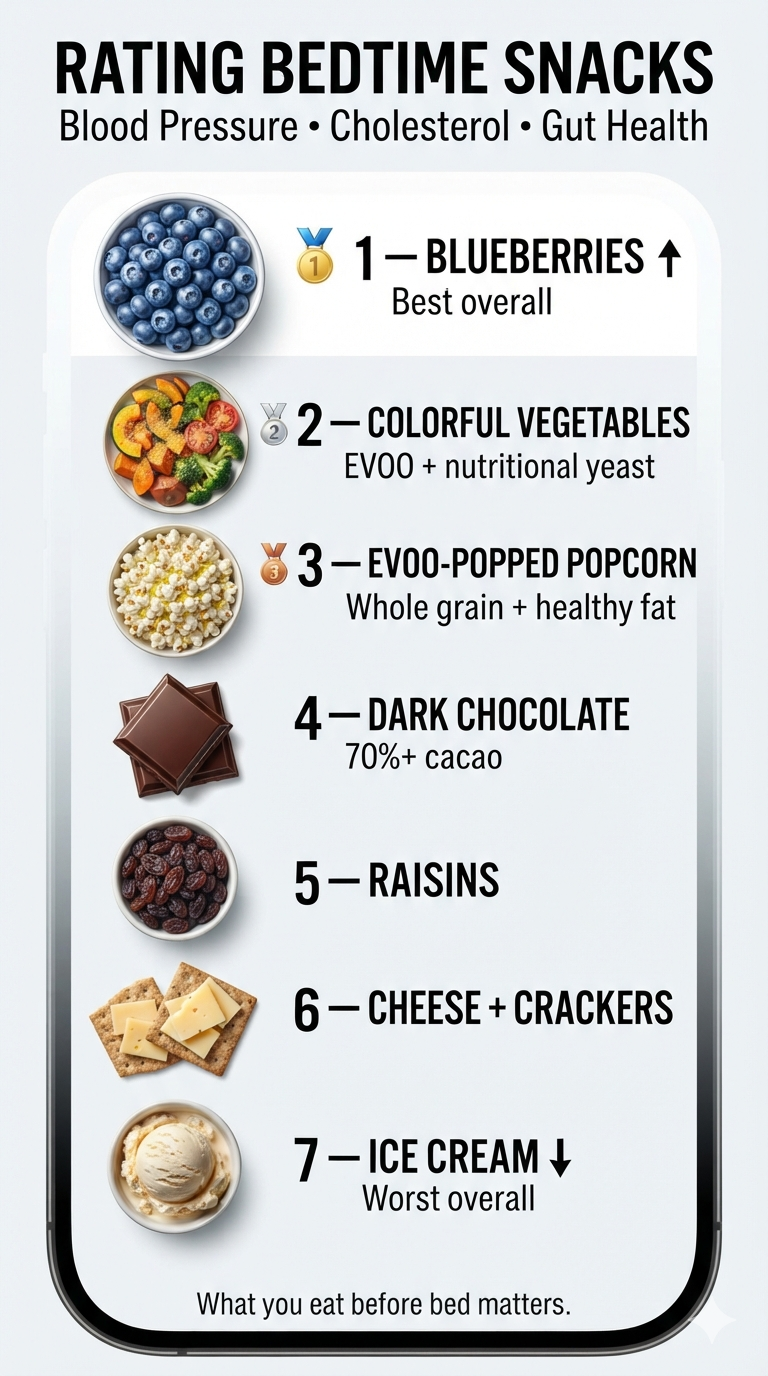
Here is how these common bedtime snacks rank when considering their combined effects on blood pressure, cholesterol, and gut microbiome health.


1. Blueberries — Best Overall

Why they rank first: Blueberries are packed with polyphenols that can support beneficial gut bacteria. They also provide dietary fiber, including soluble fiber, which can contribute to healthy cholesterol levels.

Their high concentration of antioxidant compounds may also support endothelial function and cardiovascular health, making blueberries an excellent choice when blood-pressure and heart health are priorities.

Best choice: Fresh or frozen blueberries without added sugar.


2. Mixed Sautéed Vegetables

Why they rank second: Vegetables provide a diverse range of prebiotic fibers that support a healthy gut microbiome. They are also excellent sources of potassium and magnesium, minerals that help regulate blood pressure and support healthy blood-vessel function.

For added heart-health benefits, sauté your vegetables in extra-virgin olive oil (EVOO). Choosing a variety of colors helps broaden the range of plant compounds and nutrients in the meal.

A combination of squash, sweet potato, tomatoes, and broccoli makes an especially nutritious mix, providing different types of fiber, vitamins, minerals, and protective plant compounds.

For an additional nutritional boost, sprinkle on nutritional yeast. Nutritional yeast is a plant-based food ingredient that is often fortified with niacin and other B vitamins, making it an easy way to add nutrients along with a savory, cheese-like flavor.

Best approach: Use minimal added salt and let the vegetables, EVOO, herbs, spices, and nutritional yeast provide most of the flavor.


3. Popcorn Popped in Extra-Virgin Olive Oil

Why it ranks third: When prepared with a modest amount of extra-virgin olive oil, popcorn combines the benefits of a 100% whole grain with the heart-healthy monounsaturated fats and polyphenols found in EVOO.

Popcorn provides dietary fiber that supports digestive and gut health and can contribute to healthy cholesterol levels. EVOO adds oleic acid and polyphenols, providing beneficial plant compounds along with healthy unsaturated fat.

The key is portion control. Using approximately 1–2 teaspoons of EVOO provides its nutritional benefits without adding excessive calories. For an additional nutritional boost, sprinkle on nutritional yeast instead of salt.

Air-Popped vs. EVOO-Popped

Air-popped popcorn remains the better choice if minimizing calories is the primary objective. But for the broader combination of cholesterol, blood pressure, gut health, and nutritional density, popcorn prepared with a modest amount of EVOO is arguably the stronger overall snack.

The added oil does increase calories, but it also improves the nutritional profile by supplying healthy unsaturated fat and additional polyphenols.

Best preparation: Pop the corn in 1–2 teaspoons of EVOO, use minimal salt, and flavor with herbs, nutritional yeast, and spices rather than butter or heavily salted toppings.


4. Dark Chocolate

Why it ranks fourth: High-quality dark chocolate, particularly varieties containing 70% cacao or more, is rich in flavanols. These compounds can promote nitric oxide production and support healthy blood-vessel function and blood pressure.

Dark chocolate also contains polyphenols that may interact favorably with the gut microbiome.

It ranks below vegetables and EVOO-popped popcorn because it is considerably more calorie-dense and can contain meaningful amounts of saturated fat and added sugar, depending on the product.

Dark Chocolate Choices

Some examples of dark chocolate with relatively high cacao percentages include:

  • Dove Promises Deepest Dark — 82% cacao
  • Ghirardelli Intense Dark — 60%, 72%, 86%, 92%, and 100%
    • The 72% and 86% varieties provide a good balance between higher cacao content and a smoother taste.
  • Lindt Excellence — 70%, 78%, 85%, 90%, 95%, and 99%
    • The 70% and 85% varieties are widely available options.
  • Green & Black’s Organic — 70% and 85%
  • Alter Eco / Endangered Species — approximately 72% to 88%
    • Premium options with high cacao percentages.

5. Raisins

Why they rank fifth: Raisins provide potassium, fiber, and other nutrients, but drying concentrates their natural sugars.

A large serving immediately before bed can therefore provide a substantial sugar load. Fresh fruit generally provides more water and volume for the same amount of sugar, making it a stronger overall choice.

Raisins aren’t necessarily unhealthy—they simply don’t offer the same combination of benefits as fresh berries, vegetables, or whole-grain popcorn prepared with EVOO.


6. Cheese and Crackers

Why they rank sixth: Cheese provides protein and calcium, but many varieties are relatively high in saturated fat and sodium. Depending on the type and portion, these can work against efforts to maintain healthy cholesterol and blood pressure.

Standard crackers can compound the problem because they are often made with refined flour and contain significant amounts of added sodium.

Better choice: If choosing cheese and crackers, select a lower-sodium cheese and whole-grain, lower-sodium crackers, and keep the portion modest.


7. Ice Cream — Worst Overall

Why it ranks last: Ice cream is typically high in saturated fat and refined or added sugar, while providing relatively little fiber or other nutrients that support cardiovascular and gut health.

Regularly consuming large amounts can work against healthy LDL cholesterol levels and overall cardiometabolic health. Its combination of added sugar, saturated fat, and low fiber also makes it a poor choice for supporting a diverse and healthy gut microbiome.

An occasional small serving is unlikely to undo an otherwise healthy diet, but as a regular bedtime snack, ice cream is the weakest choice on this list.


The Final Ranking

BEST → WORST

🥇 1. Blueberries
🥈 2. Mixed Sautéed Vegetables
🥉 3. EVOO-Popped Popcorn
4. Dark Chocolate ≥70% Cacao
5. Raisins
6. Cheese & Crackers
7. Ice Cream


BONUS!

The #1 overall nut is also best eaten as a bedtime snack.

Rank & Nut TypeKey Health Mechanisms⏰ Best Time to Eat
🥇 1. PistachiosLowest fat but highest potassium of all tree nuts to aggressively manage blood pressure. Packed with prebiotic fibers and unique polyphenols that directly support the growth of gut-lining, anti-inflammatory bacteria like Roseburia.Late Evening (1 hour before bed) — They contain natural melatonin and healthy fats that promote stable nighttime blood sugar and deep sleep.

The Bottom Line

If you are going to eat before bed, the goal shouldn’t simply be to find the food with the fewest calories. Instead, look for foods that provide fiber, polyphenols, healthy fats, potassium, magnesium, and other beneficial nutrients while keeping portions reasonable.

For combined blood pressure, cholesterol, and gut microbiome health, the strongest choices on this list are blueberries, colorful vegetables prepared with EVOO, and EVOO-popped popcorn.

And if you want something sweet, a small portion of high-cacao dark chocolate is a substantially better choice than ice cream.

Late-night eating isn’t automatically unhealthy. What—and how much—you eat matters.
bookmark_borderMoney Moves People: Why Demand Destruction May Be the Fastest Path Beyond Fossil Fuels

by Daniel Brouse

2026: The New Economic Reality

Money moves people.

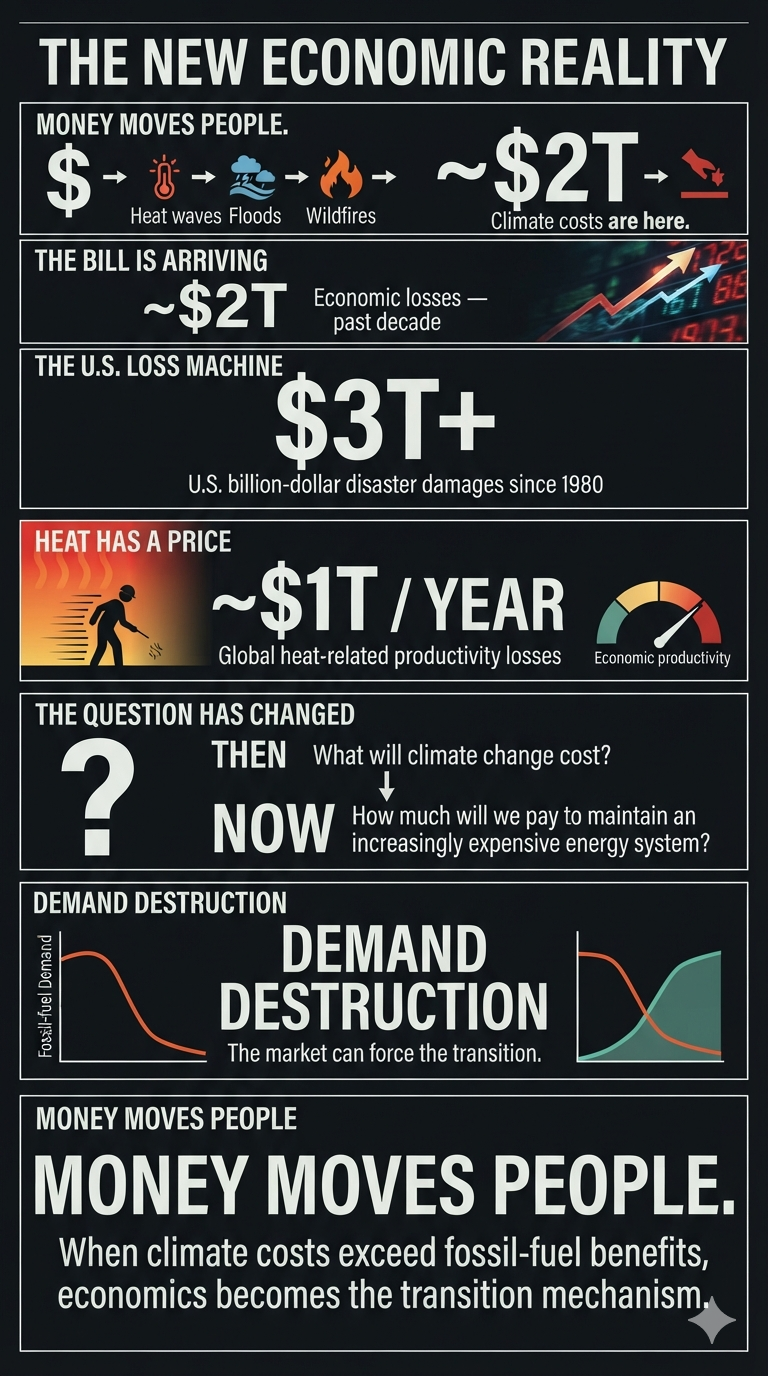
The climate costs of fossil-fuel dependence are increasingly outweighing its benefits—not in some distant future, but here and now. We are moving beyond arguments about what climate change might cost decades from today. Across the Western world, climate impacts are already imposing costs of hundreds of billions of dollars in real time.

Insurance is only one part of the story.

Infrastructure, agriculture, transportation, labor productivity, public health, energy systems, and financial markets are all beginning to absorb the cost of a destabilizing climate. The economic question is therefore changing. It is no longer simply:

“What will climate change cost us?”

It is increasingly:

“How much are we willing to pay to preserve an energy system that is becoming progressively more expensive to maintain?”

Climate Stress Is Becoming an Economic Stress Test

The physical infrastructure of the global economy is already being affected.

Maersk CEO Vincent Clerc has warned that climate change is putting increasing pressure on European waterways and that substantial infrastructure investment will be needed to keep the Rhine operating as a critical transportation artery.

But the economic importance of waterways extends far beyond shipping.

Rivers, lakes, and reservoirs are also critical components of the energy, industrial, agricultural, municipal, and ecological systems that support modern economies.

When water levels fall or water temperatures rise, power plants can be affected directly. Thermoelectric and nuclear power plants rely heavily on water for cooling. If river flows become too low, or water temperatures become too high, operators may be forced to reduce generation or temporarily shut down units because sufficient cooling capacity is no longer available or because thermal discharge limits are exceeded.

That creates an economic chain reaction:

Lower river flows or higher water temperatures
↓
Reduced cooling capacity
↓
Reduced power generation
↓
Tighter electricity supplies
↓
Higher electricity prices and grid stress
↓
Higher operating costs for industry and consumers

The same waterways that transport fuel, raw materials, agricultural products, chemicals, and manufactured goods can therefore also be essential to producing the electricity needed to move and manufacture those goods.

Water is simultaneously a transportation system, cooling system, industrial input, agricultural resource, and ecological asset.

When that system becomes unstable, multiple economic sectors can be affected at the same time.

Low water levels can also restrict the movement of coal, oil, natural gas, grain, chemicals, construction materials, and other bulk commodities. Barges may have to reduce their loads or make more trips to transport the same volume of goods. In some cases, alternative transportation by rail or truck becomes necessary, increasing fuel consumption, congestion, labor costs, and emissions.

Flooding creates the opposite problem.

Excess water can damage ports, locks, bridges, rail connections, roads, warehouses, industrial facilities, and electrical infrastructure. A waterway can therefore become economically disruptive at both extremes—too little water and too much water.

Agriculture is similarly exposed. Rivers and reservoirs provide irrigation, livestock water, and municipal supplies. Persistent drought can reduce agricultural output while increasing competition among farmers, cities, industry, ecosystems, and energy producers for increasingly scarce water.

There is also a less visible economic cost: water temperature itself is becoming an economic variable.

Warmer rivers can reduce their ability to absorb additional heat from industrial processes and power-plant cooling systems. At the same time, warmer water can stress aquatic ecosystems, fisheries, and drinking-water systems, creating additional regulatory, treatment, and ecological costs.

This produces a broader economic concept that is often missed in conventional disaster accounting:

Waterway disruption is not a single-sector problem. It is a systems problem.

The Rhine and Danube are not simply waterways. They are components of Europe’s economic infrastructure. They connect ports, factories, power plants, farms, cities, mines, warehouses, rail networks, and consumers. When climate conditions interfere with their operation, the economic consequences propagate through the system. A river does not have to disappear to create an economic crisis. It only has to become less reliable. And reliability is one of the most valuable—and often least visible—assets in a modern economy.

The Economic Toll of Extreme Weather

Global extreme weather and natural disasters are generating enormous economic losses. Recent estimates from the International Chamber of Commerce, insurers including Swiss Re, and disaster-loss tracking organizations show that severe convective storms, wildfires, floods, and other extreme events are producing annual losses measured in the hundreds of billions of dollars.

The first half of 2026 alone has already produced approximately $100 billion in global economic losses, while the cumulative economic toll over the past decade has reached roughly $2 trillion, according to recent assessments.

And the year is not over.

The second half of the year normally includes the peak of the North Atlantic hurricane season, creating the potential for another substantial wave of losses.

The Major Economic Drivers

Escalating annual losses.
Global disaster losses continue to accumulate at extraordinary levels. The combined economic losses from 2022 and 2023 alone have been estimated at roughly $451 billion.

The concentration of U.S. losses.
The United States remains a major source of global insured catastrophe losses. By June 2026, the country had already experienced 12 billion-dollar weather and climate disasters, with estimated losses totaling approximately $31.9 billion.

Severe convective storms.
Hail, tornadoes, straight-line winds, and other severe thunderstorms have become an increasingly persistent source of financial losses. The United States recorded a record 21 billion-dollar severe-convective-storm events in 2025.

Extreme heat and productivity.
The economic damage from climate change is not limited to destroyed buildings and infrastructure. Heat reduces worker productivity, particularly in construction, agriculture, manufacturing, and outdoor occupations. Global heat-related productivity losses have been estimated at roughly 1% of world GDP annually—around $1 trillion.

The long-term U.S. bill.
U.S. billion-dollar weather and climate disasters have generated cumulative damages exceeding $3 trillion since systematic tracking began in 1980.

The Trajectory Is the Story

Recent U.S. disaster statistics illustrate the increasing economic burden:

YearBillion-Dollar EventsEstimated DamageMajor Loss Drivers
202523~$115 billionSevere storms, wildfires
202427~$182.7 billionSevere storms, tropical cyclones, extreme heat
202328$145+ billionSevere storms and other extreme events

The important point is not that every individual disaster can be attributed exclusively to climate change.

The economic signal emerges from the frequency, intensity, persistence, and cumulative cost of extreme conditions.

Climate change does not need to create every storm, flood, drought, or wildfire to transform the economics of risk. It only needs to increase the probability, severity, or duration of damaging events enough to alter the cost structure of society.

That is already happening.

“Demand Destruction” Is Our Friend

This brings us to one of the most powerful—and least appreciated—economic mechanisms in the energy transition:

Demand destruction.

The International Energy Agency has projected that global oil demand will decline more sharply than previously expected in 2026, forecasting a reduction of approximately 1.6 million barrels per day.

The significance extends beyond the number itself.

As an economist, I am less concerned with establishing a specific date by which the world must eliminate fossil fuels than I am with changing the economic forces that sustain fossil-fuel demand.

That distinction matters.

People do not necessarily change because someone wins an argument about climate science. They change because incentives change. Prices change. Risk changes. Availability changes. And eventually, behavior changes.

Money Moves People

I am unlikely to change the minds of the roughly 20% of Americans who are ideologically committed to policies that accelerate fossil-fuel dependence.

But that leaves the vast majority of the population. And economics can do much of the work. Integrated Climate Stewardship begins with reducing unnecessary consumption.

Consumerism drives energy demand, resource extraction, pollution, waste, and habitat destruction. Every unnecessary unit of consumption represents another demand for energy and materials somewhere in the global economy.

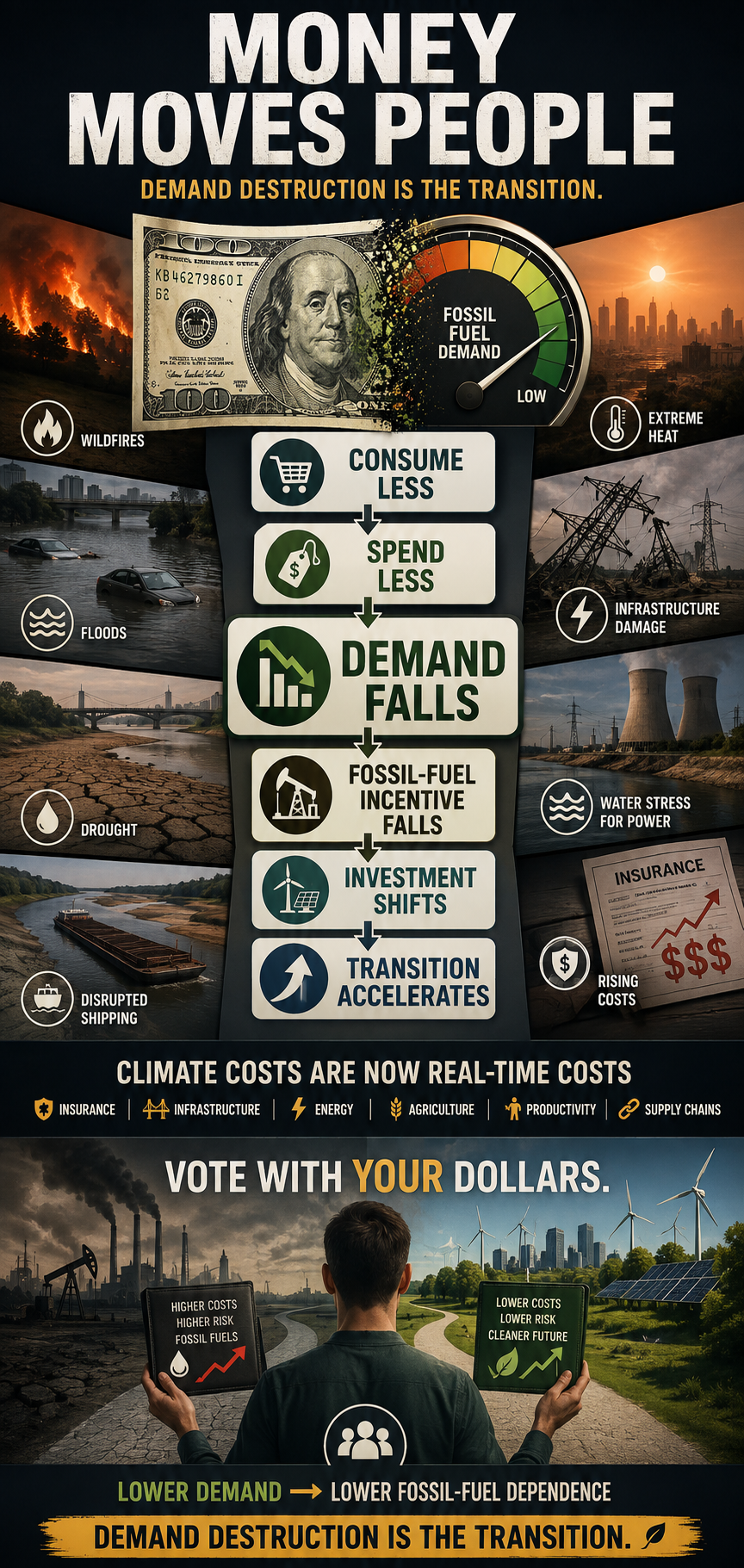
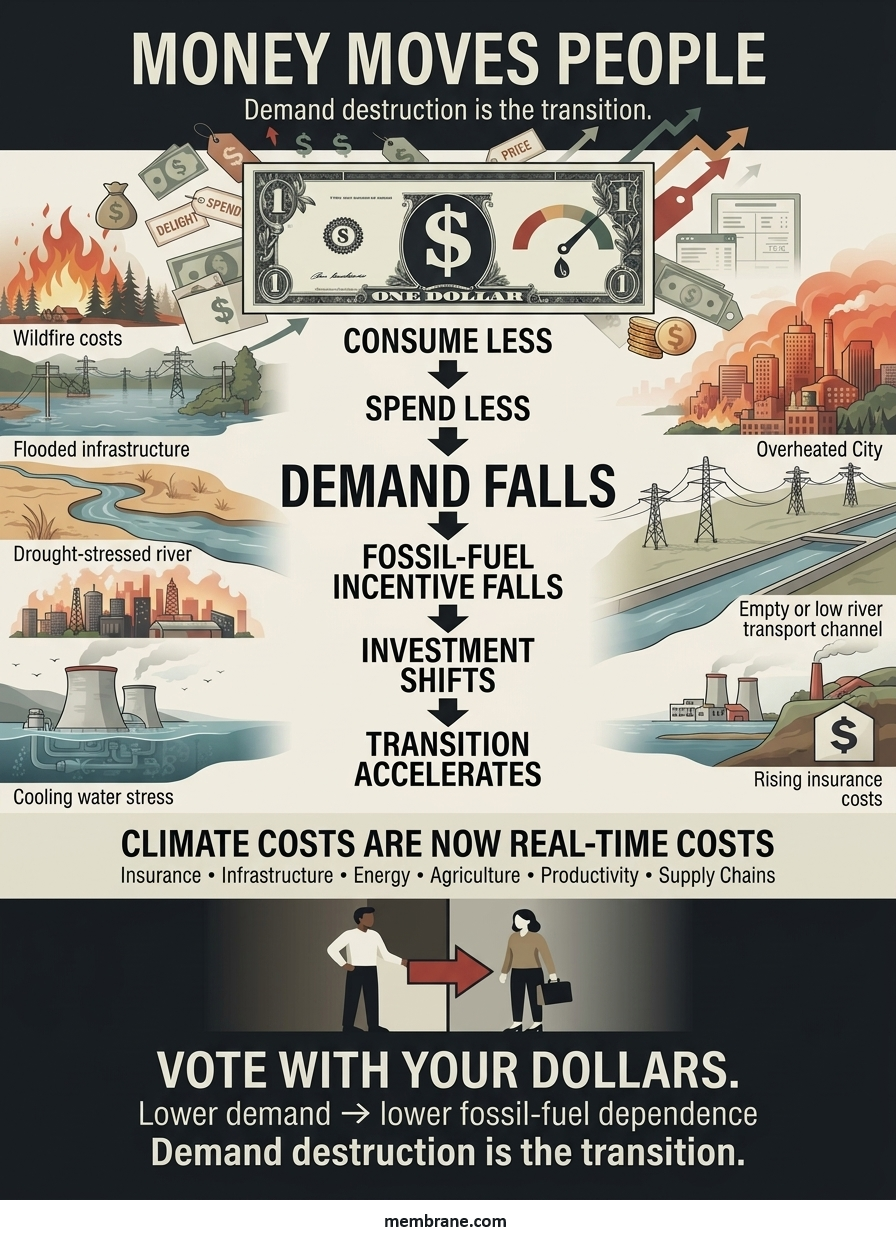
Consume less, and demand falls.

Demand falls, and the economic incentive to produce falls.

That is the mechanism.

The Economics of Personal Climate Stewardship

Today, only a small fraction of Americans appear to be pursuing a deliberately structured net-zero lifestyle through continuous behavioral reductions, efficiency improvements, and intentional balancing. But this does not mean the model cannot scale. The critical question is how climate stewardship is presented.

If reducing climate impact is framed exclusively as sacrifice, people resist. If it is framed as economic self-interest, the equation changes.

What happens when people discover that reducing unnecessary consumption can save them thousands of dollars a year?

What happens when energy efficiency lowers household expenses?

When smaller vehicles reduce fuel, maintenance, and insurance costs?

When reducing waste means buying fewer things that do not provide meaningful value?

When local production and durable goods become economically attractive?

When conservation becomes synonymous with financial resilience?

The behavior does not have to begin with ideology.

It can begin with a household budget.

Vote With Your Dollars

This is where the remaining majority of the population becomes economically important.

When millions of people begin making purchasing decisions based on cost, durability, efficiency, resilience, and environmental impact, they collectively alter demand.

When demand changes, markets respond. When fossil-fuel demand declines, the economic incentive to extract, refine, transport, and sell fossil fuels declines with it. This is fundamentally different from waiting for governments to impose every change from the top down. It is a bottom-up economic transition.

People do not have to agree about everything.

They do not have to become climate activists.

They do not even have to agree about climate policy.

They simply have to discover that some forms of consumption are no longer worth what they cost.

The Feedback Loop

The process can become self-reinforcing:

Lower unnecessary consumption
↓
Lower household costs
↓
Lower energy and resource demand
↓
Reduced fossil-fuel demand
↓
Lower economic incentive for fossil-fuel expansion
↓
Greater investment in alternatives and efficiency
↓
Further reductions in fossil-fuel demand

This is an economic feedback loop.

And unlike many climate-policy debates, it does not require everyone to agree on the destination before beginning the journey.

Demand Destruction Is the Transition

The transition away from fossil fuels is often described as a supply problem:

How quickly can we replace coal, oil, and natural gas?

But there is another side of the equation.

How quickly can we reduce the demand that makes fossil-fuel extraction profitable?

That may ultimately be the more powerful question.

We do not need to convince every person to become an environmentalist.

We need to make lower-carbon choices increasingly rational economic choices.

The climate crisis is already generating enormous costs. Insurance premiums are rising. Infrastructure is being stressed. Agricultural productivity is being disrupted. Heat is reducing labor capacity. Extreme weather is destroying capital. Supply chains are becoming more vulnerable.

These costs are not theoretical.

They are appearing on balance sheets, household budgets, insurance statements, government budgets, and corporate earnings reports.

The economic system is beginning to receive the bill.

And money moves people.

Demand destruction is not the enemy of the energy transition.

Demand destruction is the transition.

bookmark_borderJuly 2026: The Record Heat Was Especially Dangerous After Sunset

by Daniel Brouse

July 2026 was officially the hottest month ever recorded for the contiguous United States since national records began in 1895. According to the National Oceanic and Atmospheric Administration (NOAA), the average temperature across the Lower 48 reached 76.9°F—about 3.3°F above the 20th-century average and roughly 0.1–0.2°F warmer than the previous July records set during the Dust Bowl era in 1936 and the exceptional heat of 2012.

But the most important part of this record may not have been the daytime heat.

It was the heat that refused to leave at night.

The nighttime record is the real warning signal

July’s average daytime maximum temperature was 89.5°F, which was 2.9°F above average and ranked as the sixth-warmest month on record for average high temperatures.

The average overnight minimum temperature, however, reached 64.2°F—an extraordinary 3.7°F above average. That was the warmest average minimum temperature ever recorded for the contiguous United States, surpassing the previous record, set in July 2022, by 0.7°F.

That distinction matters.

A hot afternoon is dangerous, but a hot afternoon followed by a substantial nighttime cooldown gives the human body, vegetation, soils, buildings, infrastructure, and electrical systems an opportunity to recover.

When nighttime temperatures remain elevated, that recovery period disappears.

July 2026 therefore represents more than another record for daytime heat. It demonstrates an increasingly important characteristic of a warming climate: the thermal baseline is rising around the clock.

Why nighttime temperatures matter so much

Nighttime cooling is a fundamental part of Earth’s daily heat cycle.

After sunset, the land surface normally loses energy through infrared radiation. As the surface cools, the air near the ground cools as well. This produces the familiar drop from afternoon highs to early-morning lows.

Greenhouse-gas-driven warming interferes with that process. A warmer atmosphere contains more heat and can emit more infrared radiation back toward the surface. Increased atmospheric moisture can further enhance this effect because water vapor is itself a powerful greenhouse gas.

Cloud cover, humidity, soil moisture, wind, urbanization, and atmospheric circulation also influence how much the temperature falls overnight.

The result is not simply that afternoons become hotter. The floor beneath the temperature curve rises. That is critically important because the minimum temperature determines how much accumulated heat is actually released before the next day begins. If an afternoon reaches 100°F but the temperature falls to 65°F overnight, the body and environment experience a meaningful period of relief. If that same afternoon is followed by an 82°F night, the next day begins with the system already carrying a substantial heat load.

This is why nighttime warming can transform an episodic heatwave into a cumulative heat event.

The human body needs nighttime recovery

The human body is particularly vulnerable to persistent nighttime heat because sleep is one of the primary periods available for physiological recovery.

During sleep, the body normally reduces its core temperature. A hot bedroom makes that process more difficult. Higher nighttime temperatures can increase sweating, heart rate, dehydration, and thermal stress while disrupting normal sleep.

Research examining hundreds of thousands of U.S. respondents found that increases in nighttime temperatures were associated with more reports of insufficient sleep, with particularly strong effects during summer.

The consequences extend beyond simply feeling tired the next morning.

Repeated nights of inadequate sleep can impair cognitive performance, mood, immune function, metabolic regulation, and the ability to cope with additional heat stress.

Nighttime heat therefore creates a potentially dangerous cycle:

Hot day → inadequate nighttime cooling → poor sleep and incomplete recovery → greater vulnerability the next day → another hot day.

Research specifically examining nighttime warming has also found significant associations between hot nights and mortality. One modeling study concluded that nighttime warming could become an increasingly important component of future heat-related mortality, with the mortality risk on hot nights substantially higher than on days without hot nighttime conditions.

More recent multicountry research likewise finds that hot nights themselves contribute independently to heat-related mortality risk.

In other words, nighttime heat is not merely an inconvenience between two hot days. It is itself a health hazard.

The agricultural implications are equally important

Plants do not stop metabolizing when the sun goes down.

At night, plants continue to respire. They consume stored energy and undergo physiological processes that are essential for growth, reproduction, and recovery from daytime stress. When nighttime temperatures remain unusually high, respiration increases and plants can consume more of the carbohydrates they produced during the day.

Research involving wheat has demonstrated this effect experimentally. A field study found that artificially increasing nighttime temperatures by 2°C reduced grain yield, with yield declining by approximately 1.9% for every 1°C increase in nighttime temperature in the experiment.This is especially significant because nighttime warming can affect crops even when daytime temperatures do not become dramatically more extreme.

A crop can therefore experience a double burden:

More daytime heat stress + less nighttime physiological recovery.

Higher nighttime temperatures can also increase water loss and alter plant stomatal behavior, while warmer soils can accelerate moisture loss and biological activity. For agriculture, the problem is not simply the temperature at noon. It is the accumulated thermal stress across the entire 24-hour cycle.

Nighttime heat also keeps the landscape from resetting

The same principle applies beyond human beings and crops.

Soils need to cool.

Water bodies need to release heat.

Buildings need to dissipate stored heat.

Urban infrastructure needs to shed the energy accumulated during the day.

Even ecosystems depend upon daily temperature cycles.

When nights remain warm, all of these systems begin the following day from a higher thermal starting point.

This can become particularly important during prolonged heatwaves. Consider two hypothetical heatwaves with identical daytime highs:

Heatwave A:
100°F day → 65°F night → 100°F day → 65°F night

Heatwave B:
100°F day → 82°F night → 100°F day → 82°F night

The daytime maximum is identical.

But Heatwave B is vastly more difficult for people, plants, buildings, soils, and ecosystems because the system never receives the same opportunity to cool.

That is the hidden dimension of persistent heat.

Nighttime warming can amplify the consequences of daytime warming

It is important to be precise here: rising nighttime temperatures should not be described as a standalone climate “feedback” in the strict physical sense. Rather, nighttime warming is both a consequence of increased heat retention in the climate system and an amplifier of the impacts produced by daytime warming.

The distinction matters.

The physical climate system contains genuine feedbacks—such as increased atmospheric water vapor, declining snow and ice, and changes in soil moisture—that can amplify warming.

Nighttime warming is an important expression of those processes at the surface.

And once it occurs, it can amplify consequences across other systems.

For example:

Higher greenhouse-gas concentrations → greater atmospheric heat retention → warmer nights → less nighttime recovery → greater human heat stress → greater vulnerability to the next day’s heat.

A parallel agricultural pathway is:

Warmer nights → increased plant respiration and physiological stress → reduced recovery → lower productivity → greater vulnerability to subsequent heat and drought.

This is why minimum temperatures deserve far more attention than they traditionally receive.

The energy system feels it too

There is another important consequence: electricity demand.

Hot afternoons increase air-conditioning demand. But when temperatures remain high overnight, air conditioners continue operating long after sunset.

That extends the period of peak or elevated electricity demand and reduces the opportunity for buildings to naturally cool.

Instead of a system experiencing:

high demand → nighttime relief → recovery

the grid can experience:

high demand → continued overnight demand → high demand again.

This becomes especially problematic when multiple consecutive days and nights are exceptionally warm.

The result is a compound infrastructure stress rather than a single afternoon peak.

Nighttime temperatures reveal accumulated heat

There is also a deeper climate signal embedded in minimum temperatures.

Daytime temperatures can be strongly influenced by short-term weather conditions, including sunshine, wind, soil moisture, and atmospheric circulation. Minimum temperatures are also affected by these factors, but persistently elevated nighttime temperatures can reveal something particularly important: the atmosphere and surface are retaining more heat between sunset and sunrise.

That makes nighttime minimums an important indicator of how the climate system is changing.

July 2026 provides an extraordinary example.

The United States did not merely experience exceptionally hot afternoons.

It experienced exceptionally warm mornings.

The average minimum temperature was 3.7°F above normal—an even larger anomaly than the daytime maximum—and established a national record by a substantial margin.

That is why the July 2026 record deserves to be examined differently from a conventional heat record.

The most important number may be 64.2°F, not 89.5°F.

A warmer baseline changes what “extreme” means

There is another consequence that is easy to overlook.

As nighttime temperatures rise, the definition of a dangerous heat event changes.

Historically, a very hot day followed by a relatively cool night allowed the human body and natural systems to partially recover. But as the nighttime baseline rises, temperatures that once represented nighttime relief can themselves become hazardous.

The result is a compression of the daily thermal cycle.

The difference between daytime and nighttime temperatures becomes smaller, while the entire 24-hour temperature profile shifts upward. This means climate change is not simply producing more extreme peaks. It is elevating the entire thermal floor.

And once that floor rises sufficiently, heat becomes persistent rather than episodic.

July 2026 fits into a larger global pattern

The U.S. record occurred within an exceptionally warm global month. According to the Copernicus Climate Change Service, July 2026 was the joint-second-warmest July globally, tied with July 2024. Global ocean surface temperatures outside the polar regions were the highest recorded for any July, with developing El Niño conditions contributing to the unusually warm ocean state.

NOAA also reports that El Niño is continuing to strengthen and is expected to persist into early 2027, adding another natural source of variability to an already substantially warmer climate background.

El Niño can help explain why a particular period becomes exceptionally warm, but it does not explain away the long-term warming trend. Natural variability operates on top of a climate system whose baseline has been shifted upward by human-caused greenhouse-gas emissions.

That distinction is essential.

The warning hidden in the overnight record

July 2026 should therefore not be remembered simply as the month when the United States broke another temperature record. It should be remembered as a month when the nighttime thermal floor rose dramatically. The record daytime heat was dangerous. The record nighttime heat made it harder to recover from that danger.

For people, that means poorer sleep and greater cumulative heat stress. For agriculture, it means less nighttime recovery and additional physiological stress. For buildings and power systems, it means less overnight cooling and prolonged energy demand. For soils and ecosystems, it means less opportunity to shed accumulated heat.

And for the climate system itself, it is another indication that the traditional rhythm of hot day → cool night → recovery is being disrupted.

That is the significance of rising nighttime temperatures.

A hotter afternoon creates heat stress. A hotter night prevents the system from recovering from it.

When both happen repeatedly, heat stops behaving like a series of isolated events and begins behaving like a persistent environmental load.

That may ultimately be one of the most consequential—and least appreciated—features of a warming climate.

bookmark_borderThe Hydration Myth: Why You Don’t Need Eight Glasses of Water a Day

by Daniel Brouse

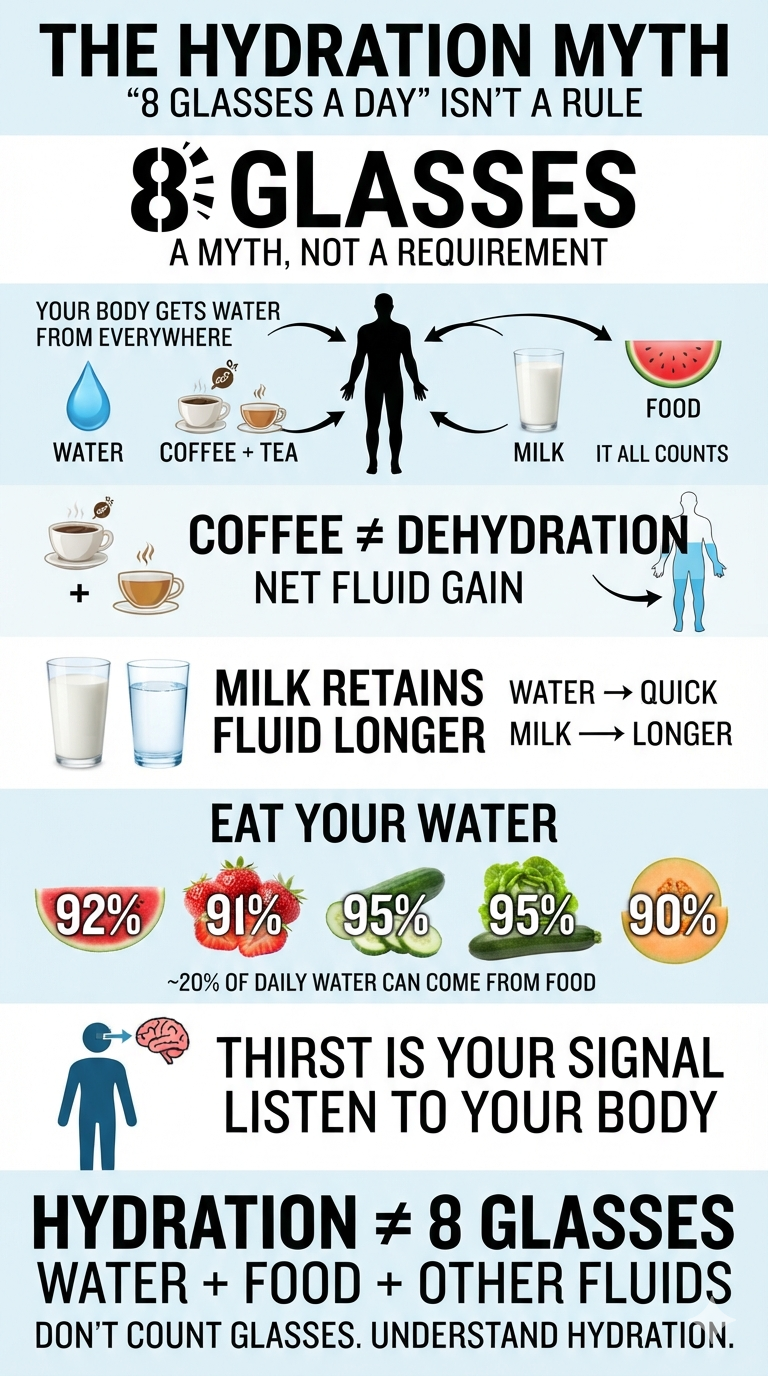
The rule to drink six to eight glasses of water a day is a myth.

The standard recommendation to drink six to eight glasses of water every day is a popular health myth that is not supported by scientific evidence. While it may serve as a convenient baseline, there is no universal requirement for everyone to drink a fixed number of glasses of water each day.

Your actual hydration needs depend heavily on your body size, health, activity level, diet, and local weather conditions.

Why the “Eight Glasses” Rule Is Flawed

It Omits Food Sources

You get roughly 20% of your daily water from food. Fruits and vegetables can contain extraordinarily high amounts of water, meaning hydration doesn’t come exclusively from what you drink.

It Counts Only Water

Coffee, tea, milk, juice, and other beverages all contribute directly to your daily fluid intake. Your body doesn’t somehow exclude the water in those beverages simply because it isn’t plain water.

Another persistent hydration myth is that coffee and tea are so diuretic that drinking them causes you to lose more fluid than you consume.

That’s not true.

It Ignores Your Body

For most healthy adults, your natural thirst mechanism is an incredibly precise indicator of when you need to drink. When you’re thirsty, drink. When you’re not thirsty, there is no scientific reason to force yourself to consume an arbitrary number of glasses simply because a popular rule says you should.

Milk Is More Hydrating Than Plain Water

Milk is actually more hydrating than plain water and keeps you hydrated for a longer period of time.

Plain water is excellent for rapid hydration, but it moves through the digestive system quickly and can result in faster fluid loss through urination. Milk contains water along with electrolytes, carbohydrates, protein, and other nutrients that slow fluid movement and help the body retain the water longer. Studies have found that milk produces less fluid loss than plain water.

This makes milk an especially effective hydrating beverage when longer-lasting fluid retention matters.

Eat Your Water

Some of the most hydrating foods on the planet are also among the most nutritious.

Melons and Berries

Watermelon: Composed of 92% water and packed with the antioxidant lycopene and potassium.

Strawberries: Contain 91% water alongside high amounts of vitamin C and inflammation-fighting fiber.

Cantaloupe: Made of 90% water and provides more than half your daily vitamin A needs per cup.

Crunchy and Leafy Vegetables

Cucumbers: Boast the highest water content of any solid food at 95% water, plus vitamin K.

Celery: Contains 95% water and provides a natural source of hydrating potassium and sodium.

Zucchini: Made of 94% water and delivers gut-friendly fiber that slows nutrient absorption.

Lettuce: Iceberg and romaine are approximately 95% water, providing an easy, volume-based hydration boost.

Liquids and Soups

Plain Yogurt or Kefir: Approximately 85% water while also providing calcium, protein, and gut-healthy probiotics.

Broths and Bouillons: Provide a high-moisture base loaded with electrolytes such as sodium, which helps the body retain fluids and prevents rapid fluid loss.

The Bottom Line

Hydration is not about hitting an arbitrary number of glasses.

Your body gets water from food and beverages—not just from plain water. Your hydration needs change with your size, activity, health, diet, temperature, and humidity.

So forget the eight-glass rule.

Drink when you’re thirsty. Eat water-rich foods. Drink more when you’re sweating or exposed to heat. And stop treating plain water as the only source of hydration.

Your body already has a sophisticated hydration system.

Listen to it.

bookmark_borderIntegrated Climate Stewardship: The Fossil Fuel Question and Answer

Question:

I use phasing out in a way that means completely ending the use and production of fossil fuels down to zero. Phasing down means a gradual reduction or scaling back in FF use over time without specifying a complete stop. Would add or alter that in any way?

How would you define differntiate ‘transition away’?

Reply:

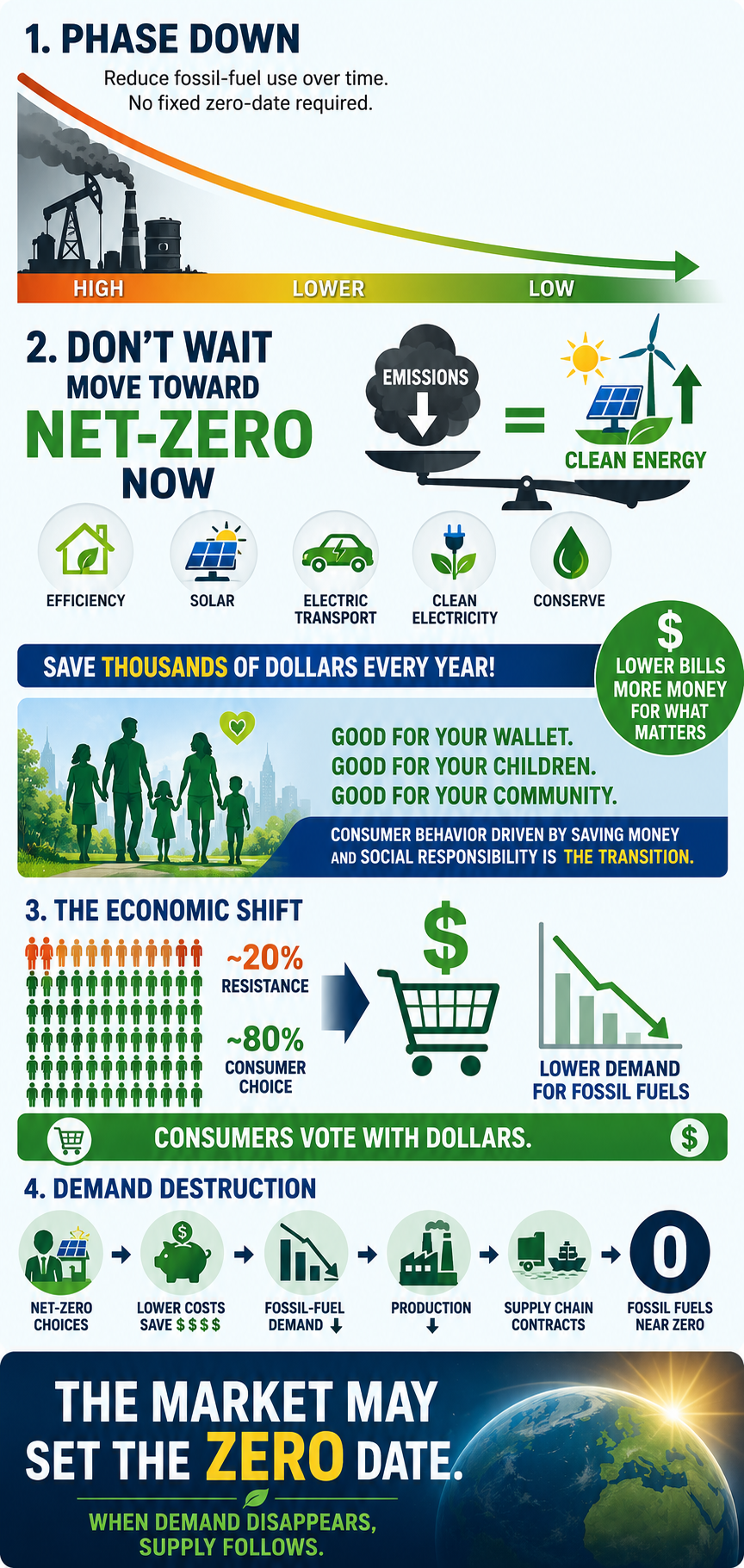
I would slightly modify your definition of “phasing down” to: “a gradual reduction or scaling back in fossil-fuel use over time without specifying a date for complete cessation.”

There are really two separate issues for me:

1. For this generation, I prefer net-zero carbon emissions as the immediate goal. If someone isn’t already moving toward net-zero, I think they should start now. We don’t need to wait for a theoretical future phase-out date to begin reducing emissions.

2. As both a climatologist and an economist, I’m not convinced that setting a specific date for the complete elimination of fossil fuels is ultimately what matters. In the U.S., roughly 20% of the population appears ideologically committed to policies that would accelerate climate change. Nothing I say or do is likely to change that.

But that still leaves roughly 80% of the population—and I think economics is going to do much of the work.

Right now, perhaps only ~0.5% of Americans are seriously attempting a structured net-zero lifestyle through continuous behavioral reductions and intentional balancing. As more people discover that net-zero can actually save them thousands of dollars a year while also leaving a better environment for their children and grandchildren, I expect consumer behavior to change.

When the remaining ~79.5% begin voting with their dollars, fossil-fuel demand will fall. That creates demand destruction, which ultimately means suppliers will have less and less reason to produce fossil fuels.

So, ironically, I don’t think we necessarily need to establish the exact date when fossil fuels reach zero. The market may establish that date for us. The “complete stop” happens when there is no longer sufficient demand to sustain the fossil-fuel supply chain.

Question:

When you use the term net zero is it with the understanding that the “net” component allows continuous greenhouse gas emissions under the assumption that unproven removal technologies or flawed offsets will balance them out later, delaying necessary fossil fuel phaseouts?

Net zero is a contentious term within my community and I want to be clear that I understand how you see and apply it.

Reply:

That’s an important distinction. When I use the term net-zero, I’m talking about it at the personal/lifestyle level, and I am not using “net” to justify continuing to emit greenhouse gases while assuming that unproven technologies or questionable offsets will clean up the problem later.

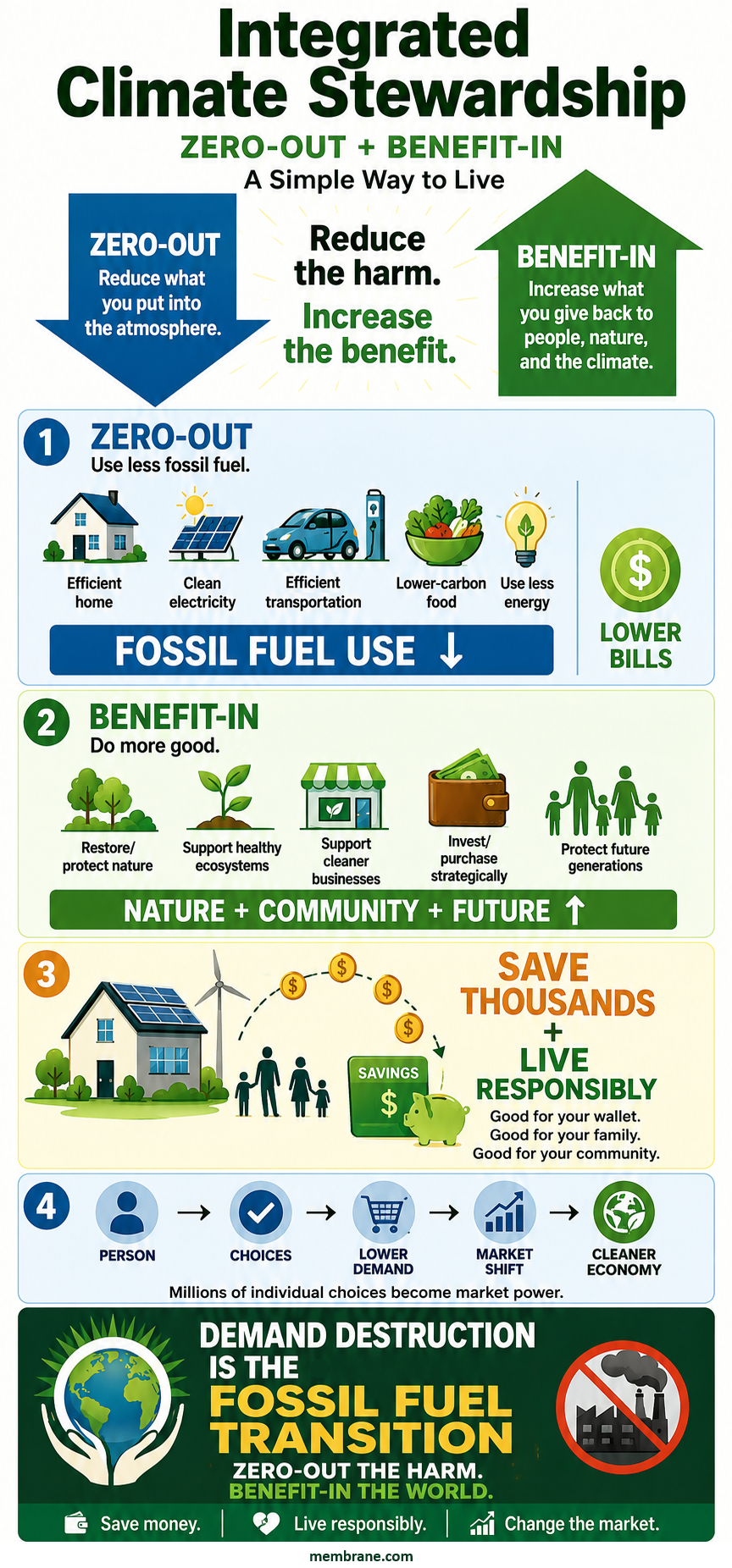
What I mean is closer to “Holistic Net-Zero Living” or “Integrated Climate Stewardship”: reducing and, wherever realistically possible, zeroing out the emissions associated with my own lifestyle first, while also taking responsibility for the impacts I can’t immediately eliminate.

For me, that means a 360-degree carbon strategy:

ZEROING OUT / STRUCTURAL DECARBONIZATION

  • Electrifying transportation and home energy
  • Increasing energy efficiency
  • Using clean electricity
  • Reducing fossil-fuel consumption as close to zero as practical
  • Reducing high-carbon consumption, including dietary choices

BEYOND MY DIRECT FOOTPRINT

  • Supporting ecosystem restoration and conservation
  • Protecting forests and biodiversity
  • Supporting businesses and technologies that accelerate decarbonization
  • Using my purchasing and investment decisions to create economic demand for cleaner alternatives

So I’m not saying, “Keep emitting and someone will remove it later.” Quite the opposite. The first priority is eliminating the emissions themselves.

I think of the “net” component as recognizing that an individual cannot instantly eliminate every indirect emission associated with modern life. Rather than pretending those emissions don’t exist, I try to compensate through additional positive actions while continuously working to reduce the underlying footprint.

Ultimately, my goal isn’t simply to achieve a favorable carbon-accounting number. It’s to change the way I live so that my actual fossil-fuel demand approaches zero—and to use my economic choices to help make that transition happen systemically.

That’s why I sometimes think “holistic net-zero living” or “integrated climate stewardship” communicates what I mean better than simply saying “net-zero.”

Question:

Why continue using the language of ‘net zero’? What economic model do you see best aligns w/ what you have outlined?

Reply:

Haaha… good questions.

A: I’m actually in the process of writing the paper that officially changes my language from “net-zero” to “Integrated Climate Stewardship.” So thank you for pushing me on that. I think the new terminology better captures what I’ve been trying to describe.

B: I’m also working on the economic model, and that one is considerably trickier—not because of the terminology, but because AI is changing the underlying economics so rapidly.

I see AI as a double-edged sword. On one edge, as AI replaces more human labor and productivity, the human contribution to economic production could eventually become a much smaller share of GDP. AI may also be capable of producing enormous amounts of economic value with far less energy per unit of output than traditional human labor and many existing production systems.

But the other edge of that sword is wealth distribution.

If the ownership of AI, capital, and productive capacity becomes increasingly concentrated, we could see extraordinary productivity growth occurring alongside increasingly unjust wealth inequality. We could potentially solve one problem—resource and energy efficiency—while creating another: who actually owns and benefits from the productivity?

That’s the economic model I’m wrestling with now: how do we build an economy where AI-driven productivity, decarbonization, consumer savings, and environmental stewardship reinforce each other while the resulting wealth is broadly distributed?

That may ultimately be a much bigger economic question than the climate transition itself.

Question:

Have you been sitting with the economic of degrowth in all of this then? Sounds like there is that tension in what is being considered.

Reply:

Yes. I’ve been sitting with the economics of degrowth quite a bit. And I think there’s an interesting tension here.

Traditional capitalism is fundamentally tied to population growth, human labor, productivity, and consumption. But AI potentially breaks that relationship. If technology increasingly replaces human labor, then economic growth can continue—even accelerate—while the economic value of human labor declines, perhaps dramatically.

So I’m not sure the future necessarily looks like “degrowth.” It may be something stranger: exponential technological growth occurring alongside declining human labor demand, an aging population in the developed regions of the world, and potentially declining population worldwide.

That raises a much bigger question: if human labor is no longer the primary engine of economic value, what exactly are we trying to maximize—and how should the economy distribute the benefits of that productivity?

That’s the economic model I’m wrestling with right now.

Question:

What about lands and waters in these considerations?

Can we agree that what we need must be either mined or grown?

Raw materials come from somewhere with significant externalities — often left out of economic theory.

My other issue is the assumptive ghost of interest-bearing-debt as a driver of unnecessary growth.

Reply:

Yes—and I think land, water, and raw materials have to be part of the model. My initial modeling, however, is pointing toward a very different problem than the one we traditionally assume.

If AI continues improving itself, productivity could eventually become extraordinarily resource-efficient. Very little additional human labor—and potentially much less land, water, or energy per unit of economic output—may be required for productivity and growth. At the same time, consumers could be forced to consume much less because their income from labor is declining. And as solar and other clean-energy technologies continue becoming cheaper, the pressure for some forms of mining and extraction could decline as well.

That brings me back to your point about interest-bearing debt. I think sovereign debt may become the critical part of the equation.

Productivity gains and abundant cheap clean energy are profoundly deflationary. Deflation sounds wonderful for consumers in theory—but not if it is accompanied by collapsing labor income. You could have falling costs and prices while households simultaneously lose the purchasing power needed to buy anything.

Now add governments facing enormous debt obligations while their traditional tax base is shrinking because human labor is becoming less economically valuable. Governments could increasingly rely on interest-bearing debt to finance poverty reduction, redistribution, and some form of basic income.

And that creates a potentially nasty feedback loop: AI-driven productivity → declining labor income → shrinking tax base → rising sovereign debt → greater reliance on monetary expansion → inflationary pressure.

Historically, severe sovereign debt problems have sometimes been resolved through substantial currency devaluation and inflation. I’m not saying hyperinflation is inevitable—but it is one of the risks I’m now modeling.

The really strange possibility is that we could simultaneously have exponential productivity, increasingly abundant cheap energy, falling costs of production—and increasing economic hardship for ordinary people.

In other words, the problem may not ultimately be whether the planet can produce enough. It may be whether humans can maintain enough income, purchasing power, and economic agency to participate in the abundance that AI creates.

That, to me, is where the economic model gets really interesting.

bookmark_borderThe Future of Energy Is Not Static

By Daniel Brouse
Economist & Climatologist
Membrane Domain USA
August 10, 2026

I’m not certain what the future holds. I don’t think anyone can be.

But I’m also not convinced that the future of fossil fuels can be projected simply by looking at today’s production levels and assuming they will continue indefinitely.

There is a very real possibility that economics, energy security, technological substitution, and even economic disruption could phase out fossil fuels much faster than most people expect.

In fact, some of the data already point in that direction.

The Energy Transition Is Already Moving

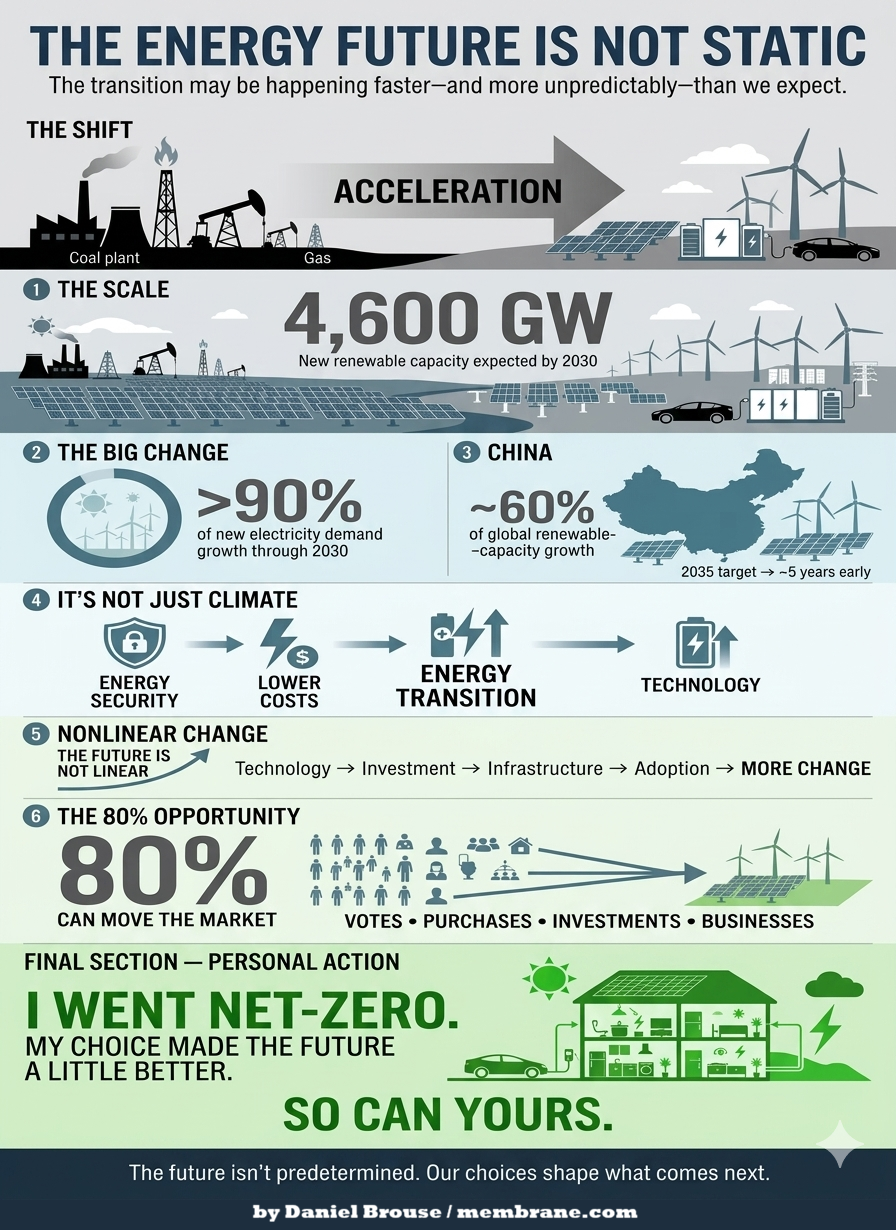
The International Energy Agency estimates that global renewable capacity will increase by roughly 4,600 GW between 2025 and 2030—an extraordinary expansion roughly equivalent to the combined current power capacity of China, the European Union, and Japan.

Solar PV is expected to account for almost 80% of that expansion.

Even more significant is what this means for the growth of electricity demand. Renewables are expected to provide more than 90% of the increase in global electricity generation through 2030.

This is not simply a distant prediction about some hypothetical future energy system. It represents an enormous investment already underway.

And the transition is happening particularly rapidly in China.

China is now responsible for nearly 60% of global renewable-capacity growth. In 2025 alone, it added roughly 314 GW of solar capacity and is on track to reach its 2035 wind-and-solar target approximately five years early.

Whatever one’s views on climate policy, these numbers are difficult to dismiss.

The global energy system is changing.

And it is changing rapidly.

This Isn’t Just About Climate Policy

There is another factor that deserves considerably more attention: energy security.

The transition away from fossil fuels is not being driven exclusively by environmental concerns. Increasingly, it is also becoming an economic and strategic imperative.

The disruption of oil and gas flows through critical transportation routes such as the Strait of Hormuz demonstrates the vulnerability inherent in an energy system dependent upon globally traded fossil fuels.

For Europe and Asia in particular, domestic renewable generation, energy storage, electrification, and efficiency increasingly represent something more than climate policy.

They are energy-security assets.

A solar panel or wind turbine doesn’t need to be transported through a geopolitical chokepoint every time it generates electricity. Once installed, domestic renewable resources can reduce exposure to international fuel-price shocks, supply disruptions, and geopolitical conflicts.

That changes the economic calculation.

And it is one reason I believe the energy transition may prove considerably more nonlinear than many conventional forecasts assume.

The Future May Be Nonlinear

I agree that we shouldn’t pretend we know exactly what the future holds.

My point is almost the opposite.

The future may be much more nonlinear than either of us can confidently predict.

Technologies don’t necessarily replace one another gradually. Once a technology becomes sufficiently cheap, reliable, scalable, and convenient, adoption can accelerate rapidly.

The same thing can happen with infrastructure.

Battery storage becomes cheaper. Electric vehicles become more capable. Solar becomes less expensive. Transmission improves. Heat pumps become more efficient. Businesses discover that electrification can reduce operating costs. Consumers begin choosing technologies that save them money.

Each development can reinforce the others.

And once enough pieces of the system change, the economics of the entire energy system can change with them.

This is why simply extrapolating today’s fossil-fuel production into the future can be misleading.

Could “Drill, Baby, Drill” Backfire?

There is an irony here.

Policies intended to expand U.S. fossil-fuel production could potentially accelerate the transition they are intended to slow if they contribute to greater volatility, geopolitical exposure, or investment in alternatives.

Consider what could happen during a serious economic downturn.

A major recession could cause substantial demand destruction. Businesses would consume less energy. Consumers would drive less and purchase fewer goods. Industrial production would decline.

Fossil-fuel consumption could fall sharply.

That would potentially undermine the very industry that policies designed around expanding fossil-fuel production are intended to strengthen.

There is no guarantee this will happen. But that’s precisely the point.

The future contains feedback loops.

Economic conditions affect energy demand. Energy prices affect technology adoption. Technology affects investment. Investment affects infrastructure. Infrastructure affects energy prices and security. Geopolitical events affect all of them.

The result is a system capable of changing much faster than a simple linear projection would suggest.

This Isn’t an All-or-Nothing Choice

I’m not trying to create another online debate.

I’m simply pointing out that the data show a transition already underway—and its speed is anything but static.

And perhaps the most important point is that this isn’t an all-or-nothing proposition.

Every increment of transition matters.

Every electric vehicle displaces some gasoline consumption. Every solar panel replaces some electricity that otherwise might have come from fossil fuels. Every efficiency improvement reduces energy demand. Every battery installation makes intermittent renewable energy more useful. Every business that electrifies reduces some exposure to fossil-fuel prices.

The more we transition, the more reasonable—and manageable—the future becomes.

We don’t need to transform the entire energy system overnight.

We need to keep moving.

Technology Is Changing More Than Energy

There is another reason I remain optimistic.

Ironically, AI and rapidly advancing technology are accelerating climate science at a pace that may eventually rival the acceleration of climate change itself.

Research that once took years can increasingly be explored in hours.

Large datasets can be analyzed in ways that weren’t previously practical. Relationships between variables can be identified more quickly. Models can be tested, refined, and compared at extraordinary speed.

I’ve been able to identify hundreds of interacting feedbacks and relationships that weren’t even being seriously considered just a few years ago.

That doesn’t mean every hypothesis will be correct.

It means our ability to investigate complex systems is expanding extraordinarily quickly.

And that gives me reason for optimism.

Humans have an extraordinary capacity to adapt, innovate, and solve difficult problems—especially when we are sufficiently motivated to do so.

The future is not predetermined.

What we do now can still make an enormous difference in what comes next.

The 80% Question

A final thought concerns something that initially struck me as particularly concerning.

Roughly 20% of Americans appear to be actively fighting the energy transition.

At first, I found that almost dumbfounding. I expected the number to be closer to less than 2%.

But there is another way to look at it.

That still leaves roughly 80% of the population.

And if that 80% chooses to act—through voting, investment, purchasing decisions, business decisions, and simply choosing where to spend their dollars—the market can move remarkably quickly.

We don’t necessarily have to fight the remaining 20%.

We can vote with our dollars.

Markets respond to demand.

If enough consumers and businesses choose alternatives, capital will follow. Manufacturers will respond. Infrastructure will change. Companies will adapt.

And eventually, the fossil-fuel industry will have to adapt as well—or gradually lose market share.

That is the power of an energy transition driven not only by government policy, but by millions of individual economic decisions.

My Choice. Your Choice. Our Future.

I went net-zero years ago.

If I can do it, anybody can.

I don’t claim that my individual decision changed the world.

But my choice made the future a little better than it otherwise would have been.

And so can yours.

The future of energy isn’t predetermined by today’s production numbers, today’s political battles, or today’s assumptions.

It will be shaped by billions of decisions made by consumers, businesses, investors, engineers, scientists, and governments.

Some of those decisions will be political.

Many will be economic.

Some will be technological.

And countless others will be personal.

That’s why I don’t think the question is whether we can predict exactly what the energy system will look like in 10, 20, or 30 years.

We can’t.

The more important question is:

What direction are we moving—and how much can our choices influence where we ultimately arrive?

The transition is already underway.

Its speed is accelerating.

And the future is still ours to shape.

bookmark_borderScience Is Science: Confronting Denialism and Ecofascism

About Denialism and Ecofascism: Science Is Science

The Observation
Glad to know you’re watching out! At the same time, this divisiveness—when we desperately need everyone to pull together because it’s a CRISIS, right?—makes me somehow deeply sad.

That’s a big job right there… How do we reach those who seem furthest away from any kind of understanding? We need both a Winston Churchill and a Mahatma Gandhi in this endeavor…

The Response
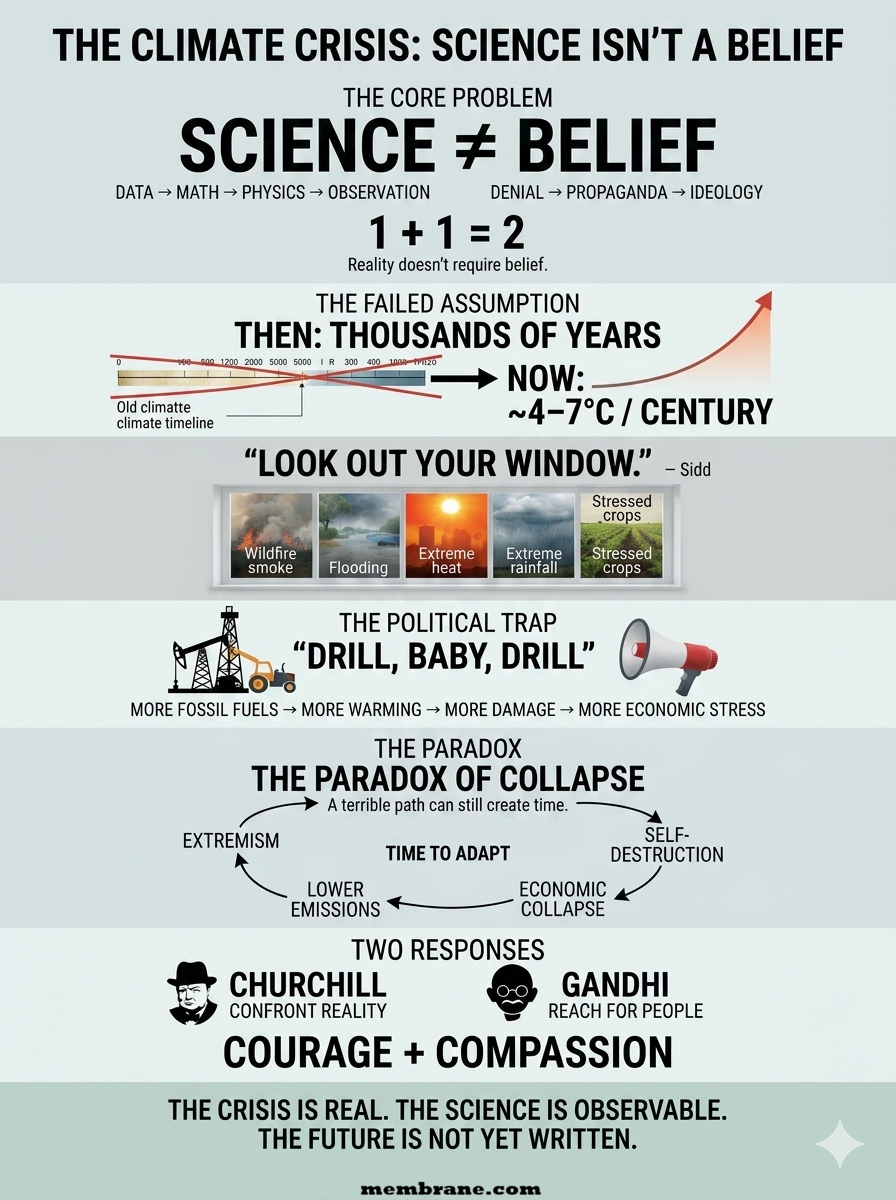
Agreed. Both denialism and ecofascism are ideologies that ultimately defy logic. In very different ways, they can become a kind of combination of self-destruction and destruction of others.

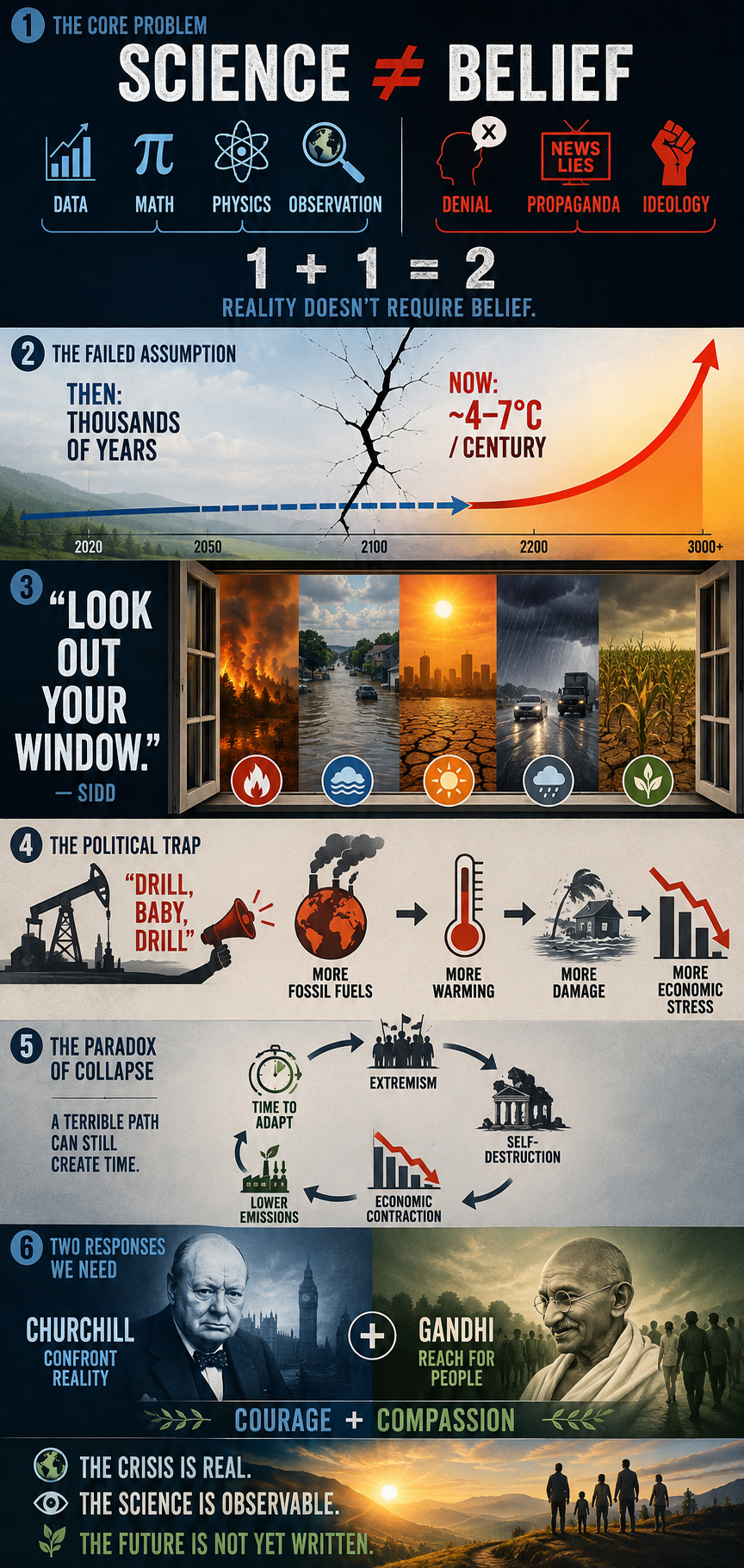
I’ve spent years battling misinformation, propaganda, and rhetoric. To the best of my knowledge, neither Sidd nor I have successfully converted—or even educated—a single committed denier. Climate science has somehow been transformed into a “belief” system. But science has nothing to do with belief. 1 + 1 = 2. If someone refuses to “believe” that, what exactly can you do?

From the beginning, our work has been based on observations, data, mathematics, and the laws of physics. So yes, I think this is at the heart of the crisis. When we started this work, we genuinely believed humanity would eventually take action. We thought we had thousands, if not tens of thousands, of years to adapt. That was the one thing we got wrong.

A couple of years ago, after explaining my continuing attempts to reach climate deniers, I asked Sidd what we could possibly do. His response was essentially, “Dude, just tell them to look out their window.” It sounds simplistic, but there is profound truth in it. The consequences are becoming increasingly difficult to deny.

Since then, we’ve had to rebuild much of our modeling. A +4°C world within thousands of years is no longer the worst-case scenario we worry about. The possibility of 4–7°C of warming within a century has become a much more serious concern in our work.

And then there is the political dimension. The rise of white-nationalist and authoritarian governments in the U.S. and elsewhere has made an already difficult problem considerably harder. Paradoxically, though, history offers one small reason for hope: fascism ultimately fails. It is inherently self-destructive.

The “drill, baby, drill” mentality is economically and environmentally self-defeating. A severe economic contraction could, ironically, buy humanity some time for adaptation while drastically reducing emissions. That is hardly the future anyone should want, but history has repeatedly demonstrated that systems built on extremism and authoritarianism eventually consume themselves.

So yes—we desperately need both the Churchill and Gandhi dimensions: the willingness to confront reality without flinching, and the willingness to keep reaching for people rather than giving up on them. I’m just not sure humanity has ever faced a crisis where we needed both quite this badly.

bookmark_borderAmericans Are Feeling the Heat—But Fewer Believe Climate Change Is Happening

by Daniel Brouse

An AP-NORC poll reveals a deeply troubling contradiction in the American public’s understanding of climate change: Americans are increasingly experiencing the effects of extreme heat, yet fewer now believe climate change is actually happening.

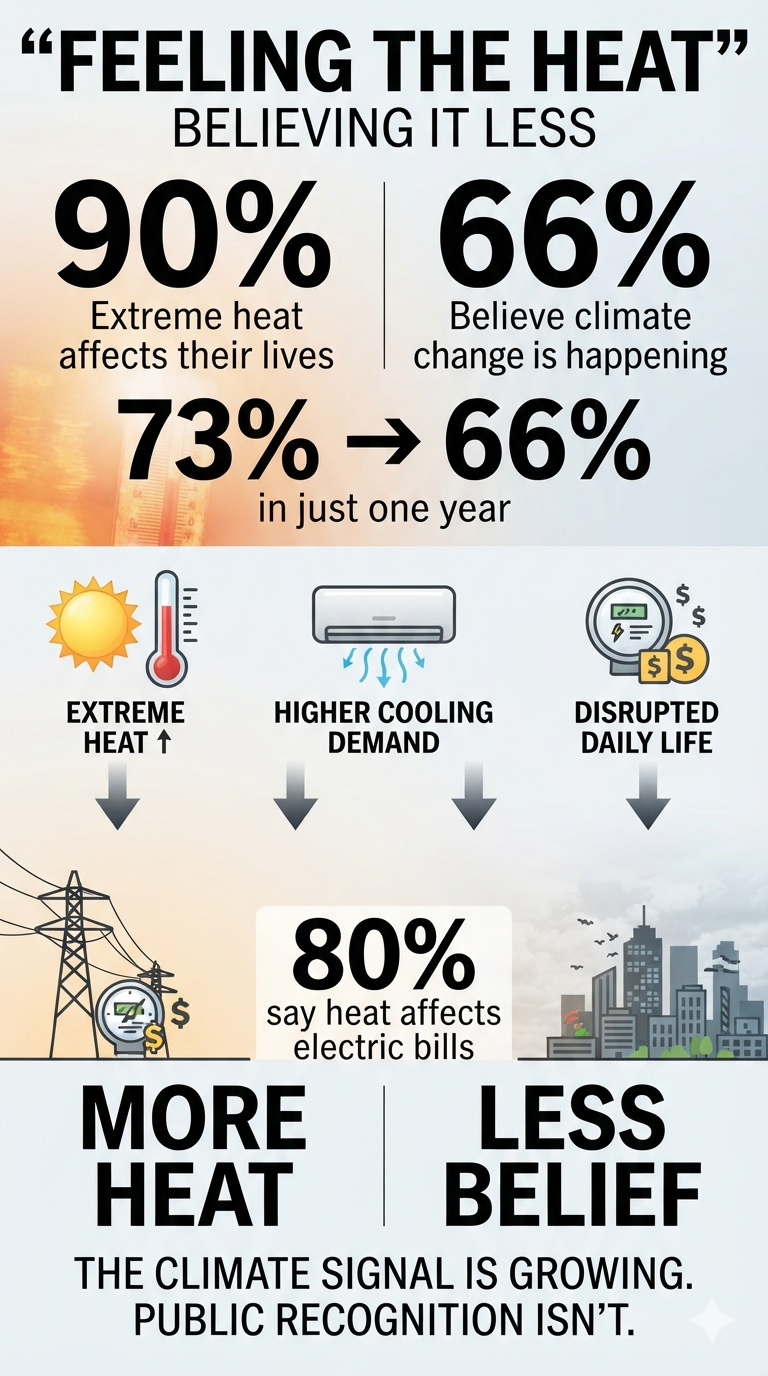
According to the poll, just 66% of Americans say climate change is happening, down sharply from 73% a year ago. That seven-percentage-point decline is particularly alarming because it comes at a time when Americans are reporting increasingly direct and disruptive experiences with extreme heat.

The disconnect raises an important question: How can people increasingly experience the consequences of a changing climate while becoming less likely to recognize climate change as the cause?

Extreme Heat Is Becoming Personal

The same poll found that 90% of Americans say extreme heat has affected their lives in some way, up from 83% in July 2024.

The impacts aren’t confined to abstract concerns about the environment. Americans report that extreme heat is affecting everyday life, including:

  • Electricity bills
  • Outdoor activities
  • Sleep
  • Travel and vacations
  • Daily routines

Perhaps most significantly, about 80% say extreme heat has affected their electricity bills, up from 69% in 2024.

In the Midwest, the increase is even more striking: 44% now say extreme heat has had a major impact on their electricity bills, compared with 29% two years ago.

That is climate change translated into something tangible: a higher household expense.

The Perception–Attribution Gap

The most important finding may not be the increase in heat-related disruption. It may be the growing gap between what Americans experience and what they believe is causing it.

The survey presents two seemingly contradictory trends:

90% say extreme heat has affected their lives.

Yet only 66% say climate change is happening.

And that 66% figure is down from 73% just one year ago.

This is a remarkable perception–attribution gap.

Americans can recognize that summers are becoming more difficult, electricity costs are rising, outdoor activities are being disrupted and extreme heat is affecting sleep—without necessarily connecting those experiences to a changing climate.

The result is a potentially dangerous disconnect between physical reality and public understanding.

Political Division Is Part of the Explanation

Political ideology continues to play an enormous role in how Americans interpret climate-related experiences.

Democrats are substantially more likely than Republicans to describe extreme heat as having a major impact on their lives. But that doesn’t mean Republicans aren’t experiencing the same heat.

The distinction is increasingly about interpretation and attribution.

People across the political spectrum can experience the same 100-degree day. They can experience the same oppressive humidity, pay the same higher electricity bill and face the same restrictions on outdoor activity.

But they may reach very different conclusions about why it is happening.

That distinction matters because climate change doesn’t require public agreement in order to produce physical consequences.

Climate Change Is Becoming an Economic Issue

The AP-NORC findings also demonstrate why climate change should not be viewed exclusively as an environmental issue.

Extreme heat creates a chain of consequences:

Higher temperatures → greater air-conditioning demand → higher electricity consumption → increased household costs

But that is only one pathway.

Extreme heat can also affect worker productivity, agriculture, infrastructure, public health, insurance losses and energy-grid reliability.

The household electricity bill may therefore be only the first visible economic manifestation of a much larger systemic problem.

The public doesn’t need to understand atmospheric physics to experience these consequences.

They simply need to notice that something is different.

The Most Alarming Finding Isn’t the Heat

The increase in extreme-heat impacts is concerning, but the seven-point decline in belief that climate change is happening may be even more alarming.

The country is experiencing a growing number of climate-related disruptions while simultaneously becoming less certain—or less willing—to identify climate change as the underlying cause.

That creates a dangerous situation for public policy.

Democratic societies depend upon the public recognizing problems before governments can effectively address them. If the physical impacts become increasingly severe while public recognition of their underlying causes declines, political pressure for adaptation and mitigation can weaken precisely when the need for action is growing.

This creates a potential feedback loop:

More climate disruption → greater personal impacts → greater economic costs → political polarization → weaker recognition of climate change → less public support for climate action → greater future vulnerability

That is not merely a communications problem.

It is a systemic risk.

Experience Is Increasing Faster Than Understanding

The AP-NORC poll doesn’t measure the physical climate system. It measures what Americans are experiencing and what they believe.

Those are different things.

The survey cannot establish how much of an individual’s electricity bill, sleep disruption or outdoor inconvenience is attributable specifically to climate change. Establishing those causal relationships requires observational climate data and scientific attribution studies.

But the poll does reveal something extremely important about the human response to climate change.

The consequences are becoming increasingly personal while public recognition of climate change is moving in the opposite direction.

That should concern everyone, regardless of political affiliation.

The challenge is no longer simply convincing people that the climate is changing.

It is explaining why their increasingly familiar experiences—extreme heat, higher cooling demand, disrupted outdoor activities, poor sleep and growing economic costs—are connected to a much larger physical system.

Americans may not agree about climate change.

But increasingly, they are living with its consequences.

And the most alarming finding from this poll is that as those consequences become harder to escape, fewer Americans say climate change is actually happening: 66% today, compared with 73% a year ago.

America Is an International Outlier on Climate Change

The decline in American belief becomes even more concerning when viewed against the rest of the world.

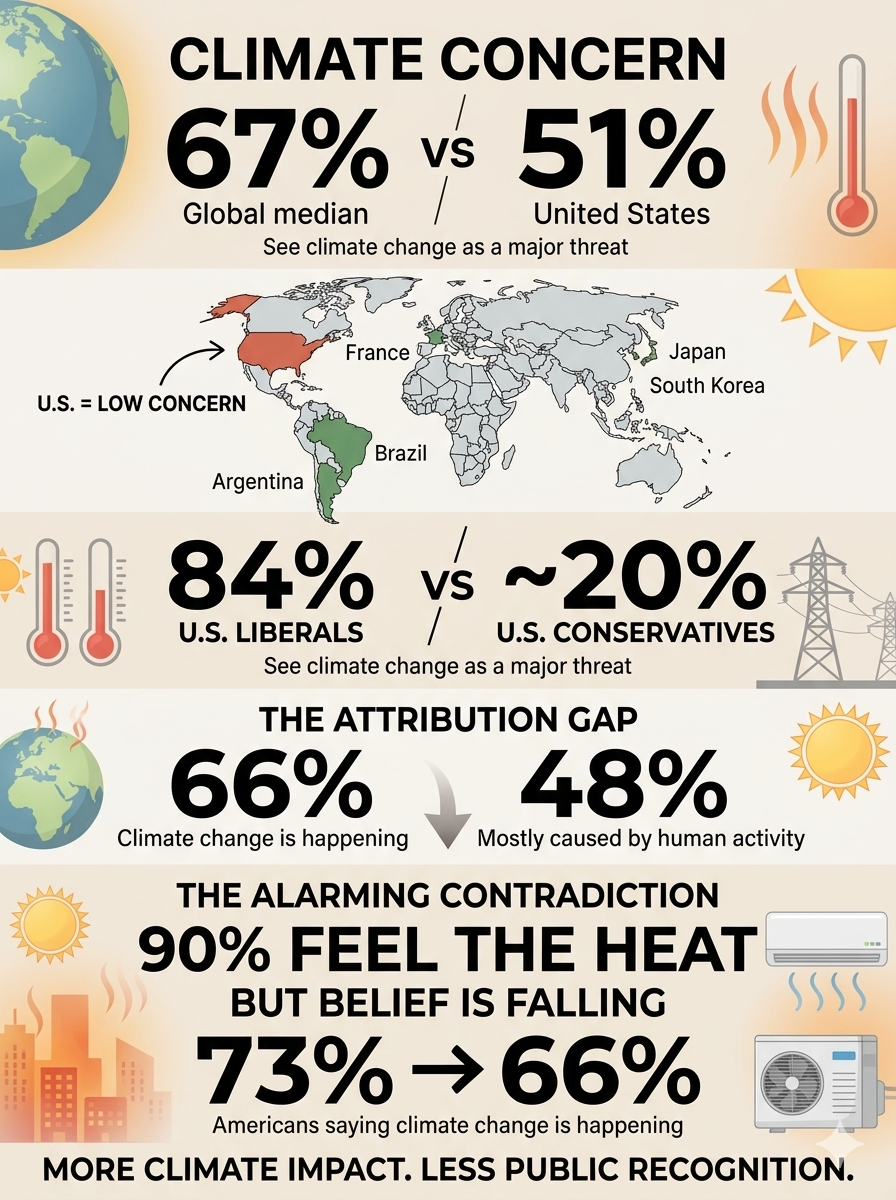
A 2025 Pew Research Center international survey of 25 countries found that a global median of 67% of respondents considered climate change a major threat to their country. In the United States, however, only 51% said the same—a gap of 16 percentage points.

The U.S. was among the least concerned countries surveyed. Americans were less likely than respondents in 13 of the 16 high-income countries included in the survey to view climate change as a major threat. In countries such as Argentina, Brazil, France, Japan and South Korea, roughly 80% of respondents regarded climate change as a major threat.

The difference is particularly striking because the United States is not insulated from climate impacts. Americans are experiencing extreme heat, rising cooling demand, disrupted outdoor activities and other consequences of a warming climate, yet concern about climate change remains comparatively low.

The American Divide Is Also Unusually Political

The international comparison becomes even more revealing when political ideology is considered.

Pew found that approximately 84% of U.S. liberals regarded climate change as a major threat, compared with only about 20% of U.S. conservatives. That enormous gap makes the United States an international outlier in the degree to which climate change has become politically polarized.

The result is a remarkable paradox.

Americans across the political spectrum can experience the same heat wave, pay the same electricity bill and endure the same disruption to their daily lives. Yet they may reach dramatically different conclusions about what those experiences mean.

The disagreement therefore isn’t simply about the physical environment. It is increasingly about how Americans interpret the physical environment.

Believing the Climate Is Changing Is Not the Same as Accepting Why

Another Pew measure illustrates the problem even more clearly.

In 2026, only 48% of Americans said the Earth is warming mostly because of human activity. That is substantially lower than the 66% who currently say climate change is happening in the AP-NORC poll.

The difference is crucial.

A person can acknowledge that the climate is changing without accepting that human activity is primarily responsible for that change. Others may accept human-caused warming but disagree about its severity, consequences or appropriate policy response.

This creates several layers of public perception:

Is the climate changing?

↓

Is human activity causing it?

↓

Is it becoming dangerous?

↓

Should government and society act?

Americans can answer those questions very differently.

An Alarming Combination

Taken together, the international and domestic polling reveals a troubling pattern:

90% — say extreme heat has affected their lives

80% — say heat has affected their electricity bills

73% → 66% — Americans saying climate change is happening

51% — Americans calling climate change a major national threat

48% — Americans saying warming is mostly caused by human activity

The numbers measure different things and should not be treated as interchangeable. But together they reveal a striking disconnect between experience, attribution and concern.

The United States is already an international outlier in climate skepticism and political polarization. Now, at a time when Americans report increasingly personal impacts from extreme heat, the share saying climate change is happening has fallen seven percentage points in only one year.

That may be the most troubling finding of all.

The physical climate signal is becoming harder to escape, while public recognition of that signal is moving in the opposite direction.

bookmark_borderClimate Change Impacts and You: The Rising Cost of a Changing Climate

by Daniel Brouse

Introduction

Climate change is no longer simply a future environmental threat. It is increasingly affecting American households through higher costs, declining air quality, extreme heat, infrastructure disruptions, property damage, and changing patterns of disease.

Although catastrophic floods, hurricanes, wildfires, and other disasters dominate the headlines, the most widespread climate impact may be less dramatic: the steady financial pressure climate change places on everyday household budgets. Food prices, insurance premiums, utility bills, and the costs of maintaining homes and communities are all increasingly influenced by a changing climate.

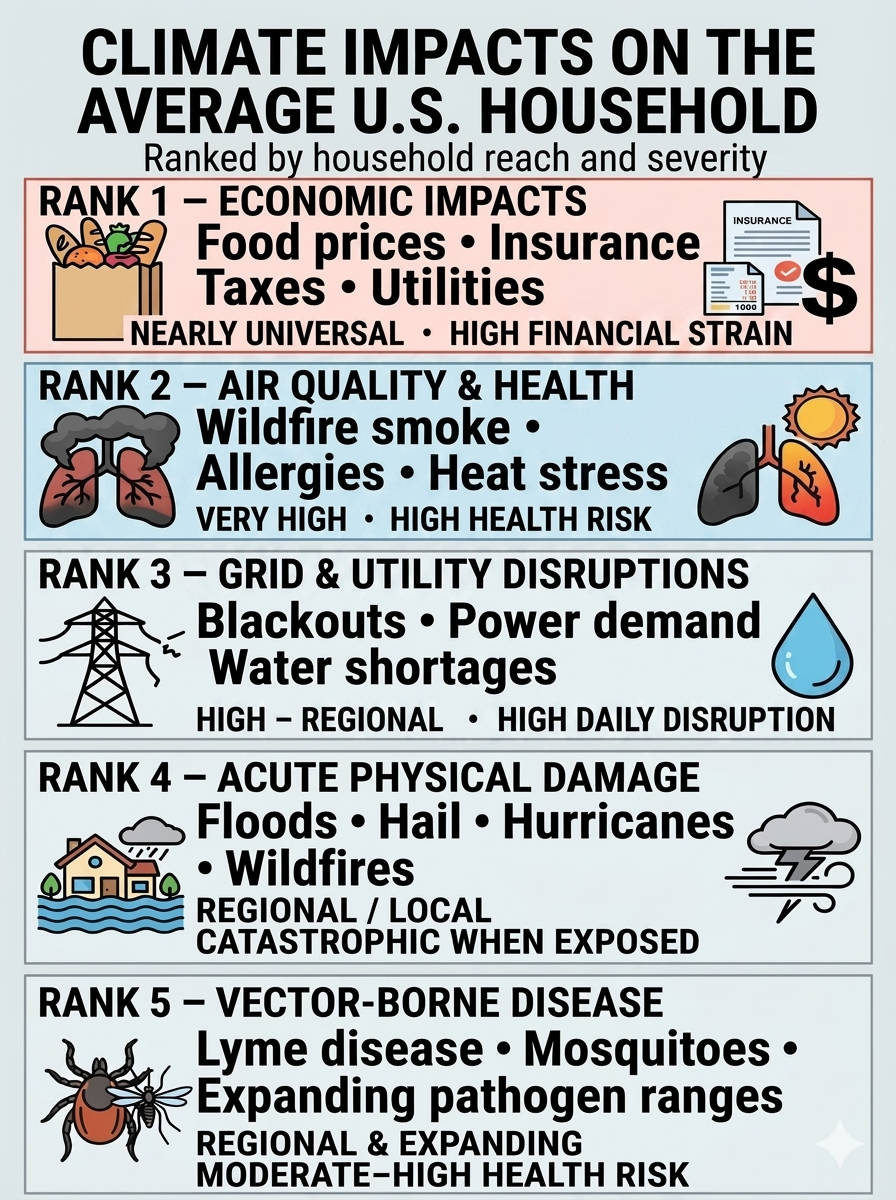
The impacts are not distributed equally. Some are nearly universal, while others are concentrated in particular regions or communities. The ranking below therefore considers two factors: how widely households are exposed and how severely the impact can disrupt everyday life.

Ranking of Climate Impacts on the Average U.S. Household

RankImpact CategoryPrimary Household ThreatsUbiquitySeverity
1Economic ImpactsFood inflation, insurance premiums, taxes, utility costsNearly universalHigh financial strain
2Air Quality & Chronic HealthWildfire smoke, longer allergy seasons, heat stressVery highHigh health risk
3Grid & Utility DisruptionsBlackouts, heat-related demand, water shortagesHigh, but regionalHigh daily disruption
4Acute Physical DamageFloods, hail, hurricanes, wildfiresRegional/localCatastrophic when exposed
5Vector-Borne DiseasesLyme disease, mosquitoes, expanding pathogen rangesRegional and expandingModerate to high health risk

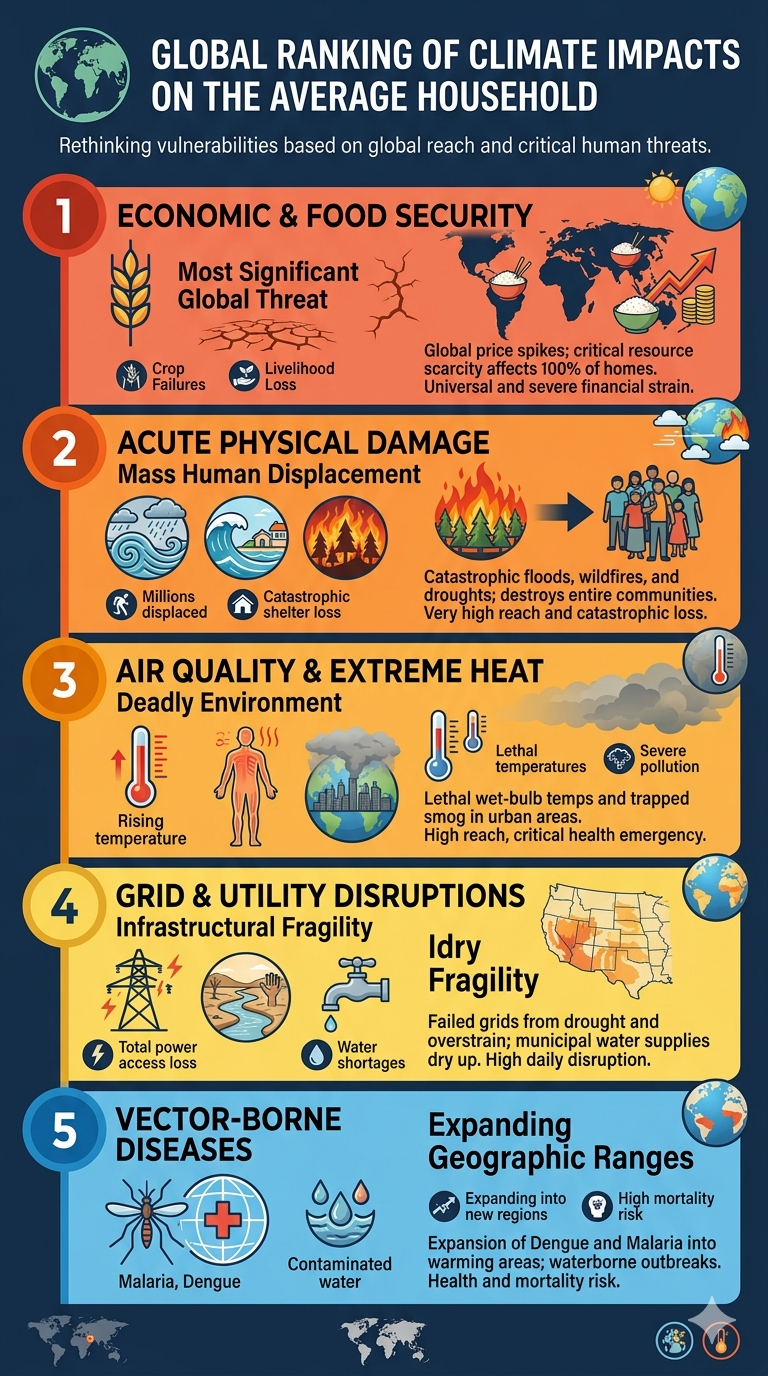
Global Ranking of Climate Impacts on the Average Household

The ranking below shifts the order of impacts based on global reach and the immediate threat to human life and livelihoods across developing and developed nations alike.

RankImpact CategoryPrimary Global Household ThreatsUbiquitySeverity
1Economic & Food SecurityGlobal food price spikes, crop failures, loss of agricultural livelihoodsUniversal (100% of homes)Extreme financial/survival strain
2Acute Physical DamageCatastrophic monsoon flooding, sea-level rise, mega-wildfires, historic droughtsVery High (Millions displaced)Catastrophic loss of shelter
3Air Quality & Extreme HeatLethal wet-bulb temperatures, severe dust/smoke pollution, urban heat islandsHigh (Equatorial & Urban zones)Critical health emergency
4Grid & Utility DisruptionsTotal lack of power access, severe municipal water shortages, drying river basinsHigh (Varies by infrastructure)High daily survival disruption
5Vector-Borne DiseasesMalaria, Dengue fever expansion, waterborne cholera outbreaksExpanding (Sub-tropical regions)High health and mortality risk

1. Economic Impacts: The Most Universal Climate Burden

Economic impacts rank first because households do not have to live in a flood zone, wildfire corridor, or hurricane-prone region to pay the economic costs of climate change. Climate-related costs increasingly reach Americans through food prices, insurance premiums, utility bills, taxes, public fees, and the rising cost of maintaining homes and infrastructure.

Climate change can therefore function as a cost multiplier, increasing expenses both directly and indirectly.

Climate-Driven Food Inflation

Drought, extreme heat, excessive rainfall, and other weather disruptions can reduce agricultural yields and interfere with food production and supply chains. Because food markets are interconnected, production losses in one region can influence prices far beyond the location of the original climate event.

The effects can reach everyday staples and commodities such as coffee, wheat, corn, beef, fruits, and vegetables.

The result is a climate-related cost that can reach virtually every household through the grocery bill—even when the household is hundreds or thousands of miles from the drought, flood, or heatwave affecting agricultural production.

The Insurance Crisis

Insurance is one of the clearest mechanisms through which climate risk is transferred directly to households.

As floods, hurricanes, wildfires, severe storms, and other disasters generate increasingly costly losses, insurers may respond by raising premiums, increasing deductibles, restricting coverage, or withdrawing from particularly high-risk markets.

For homeowners, climate risk can therefore produce a double financial burden:

higher insurance costs + higher uninsured exposure.

In some locations, the problem extends beyond affordability. Homeowners may find that certain types of coverage are difficult or impossible to obtain through conventional private insurance markets.

Rising Utility Costs

Hotter summers increase demand for air conditioning. As temperatures remain elevated for longer periods, households may need to run cooling systems more frequently and for longer durations.

That increases electricity consumption while simultaneously placing additional stress on the power grid.

Climate change can therefore affect household budgets through both higher energy consumption and the cost of maintaining a more resilient electrical system.

Water systems can face similar pressures. Drought, declining water supplies, flooding, and changing precipitation patterns may require communities to invest in new reservoirs, treatment capacity, pipelines, drainage systems, and other infrastructure.

Those investments ultimately have to be paid for.

Taxes, Assessments, and Public Costs

One of the least visible climate costs is the portion that reaches households through government budgets rather than private markets.

When climate-related disasters become more costly, governments must spend more on emergency response, disaster recovery, infrastructure repair, flood protection, stormwater management, wildfire preparedness, water systems, coastal protection, and long-term climate adaptation.

Those expenses can eventually reach households through:

  • Property taxes used to finance infrastructure repairs and resilience projects.
  • Special assessments and municipal fees for stormwater, drainage, flood control, and other local projects.
  • Higher utility rates needed to upgrade vulnerable water and electrical systems.
  • State and federal taxes that help finance disaster recovery, emergency response, agricultural assistance, infrastructure rebuilding, and resilience programs.
  • Public insurance and disaster programs when private insurance markets cannot absorb the full cost of catastrophic losses.

This creates an important economic chain:

Climate hazard → physical damage → insurance losses → government response → infrastructure spending → taxes, fees, and utility costs.

The household may never experience the original flood, wildfire, hurricane, or drought, yet it can still participate in paying the bill.

Rising Property and Maintenance Costs

Climate stress can also increase the cost of owning and maintaining a home.

More intense rainfall can require improved drainage. Stronger storms can increase demand for roofing and exterior repairs. Heat can accelerate deterioration of infrastructure and building materials. Flooding and wildfire risk can require additional mitigation measures.

At the same time, widespread disasters can create temporary shortages of construction materials, contractors, equipment, and skilled labor, increasing repair costs.

The Hidden Climate Cost

Taken together, these effects mean that climate change does not have to destroy your home to affect your household finances.

A household can experience climate-related costs through:

  • Higher grocery prices
  • Higher insurance premiums
  • Higher electricity and water bills
  • Higher taxes and public fees
  • Higher repair and maintenance costs

Together, these expenses create a growing household climate burden—even when a family never experiences a major climate disaster firsthand.

The important point is that climate change is not simply a collection of isolated disasters. It is increasingly an economic force that propagates through markets, insurance systems, government budgets, and household expenses.

For the average American household, this may ultimately be the most widespread way climate change is experienced: not as one catastrophic event, but as a persistent accumulation of additional costs.

2. Air Quality & Chronic Health: A Widespread Physical Exposure

Climate change also affects the quality of the air people breathe.

Wildfire Smoke

Wildfire smoke can travel hundreds or even thousands of miles, carrying fine particulate matter such as PM₂.₅ into communities far from the original fire.

These particles can penetrate deep into the respiratory system and aggravate existing respiratory and cardiovascular problems. As wildfire activity and smoke exposure increase in some regions, air-quality impacts are no longer limited to communities immediately adjacent to fires.

Longer Allergy Seasons

Warmer temperatures can alter plant growing seasons and extend periods of pollen production.

For people with asthma or seasonal allergies, longer or more intense pollen seasons can mean more days of symptoms, greater medication use, and reduced quality of life.

Heat Stress

Rising baseline temperatures also increase the frequency and duration of dangerous heat.

Homes without adequate cooling, outdoor workplaces, and communities with limited access to cooling resources can be particularly vulnerable. Extreme heat is not merely uncomfortable—it can place substantial physiological stress on the human body.


3. Grid & Utility Disruptions: Climate Stress on Essential Infrastructure

Modern households depend on electricity, water, transportation, telecommunications, and other infrastructure every day.

Climate extremes can place additional stress on these systems.

Power Grid Failures

Extreme heat can push electricity demand toward peak levels as households and businesses increase air-conditioning use.

At the same time, extreme weather can damage transmission lines, substations, transformers, and other infrastructure.

The consequences can range from higher electricity costs to localized outages and, under severe conditions, prolonged disruptions to essential services.

Water Scarcity

Drought can reduce reservoir levels, groundwater availability, and other sources of municipal water.

Communities may respond with conservation requirements, watering restrictions, infrastructure investments, or higher water costs.

Water stress can therefore become both an environmental problem and a household financial problem.


4. Acute Physical Damage: Catastrophic Where It Strikes

Floods, hurricanes, wildfires, severe thunderstorms, hail, and high winds can cause enormous damage to homes, vehicles, businesses, and infrastructure.

This category ranks fourth not because the damage is minor, but because exposure is geographically concentrated.

A household directly hit by a major disaster can experience losses vastly greater than those associated with ordinary climate-related inflation.

Floods and Flash Floods

Intense rainfall can overwhelm drainage systems and produce rapid flooding in locations that may not have traditionally been considered high-risk.

Coastal communities also face storm surge and rising sea levels that can increase the consequences of major storms.

Severe Hail and Wind

Severe convective storms can produce damaging hail and straight-line or tornadic winds.

Roofing, siding, windows, vehicles, and other property can be damaged within minutes, creating repair costs that are often compounded by rising construction and insurance expenses.

Wildfires

Wildfires can destroy homes and communities directly while also creating secondary effects through smoke, evacuation, infrastructure disruption, and insurance losses.


5. Vector-Borne Diseases: A Smaller but Expanding Risk

Climate change can also alter the geographic range and seasonal activity of disease-carrying organisms.

Tick-Borne Illnesses

Changes in temperature and seasonal conditions can affect the distribution and activity of ticks and their hosts.

In some regions, this may increase opportunities for exposure to Lyme disease and other tick-borne illnesses.

Mosquito-Borne Diseases

Changing temperature and precipitation patterns can also influence mosquito populations and the geographic conditions suitable for certain mosquito-borne diseases.

The importance of this category varies considerably by region, but changing environmental conditions can alter the boundaries of disease risk over time.

Other Pathogens

Environmental changes can also affect exposure to less common infectious diseases, including tularemia (rabbit fever), which can be transmitted through several pathways involving ticks, biting flies, infected animals, or contaminated environments.


The Basics: How Climate Change Reaches Your Household

Climate change may seem like a global-scale phenomenon, but its consequences increasingly arrive through very ordinary parts of daily life.

Your Wallet: A Rising Cost of Living

Climate change can function like a hidden cost multiplier, increasing expenses directly and indirectly.

  • Higher grocery bills: Weather extremes can disrupt agricultural production and food supply chains.
  • Higher insurance premiums: Increasing disaster losses can raise premiums, deductibles, and coverage costs.
  • Higher utility bills: Hotter temperatures increase cooling demand and electricity consumption.
  • Higher repair costs: Disasters can increase demand for construction materials, contractors, and replacement vehicles.
  • Higher infrastructure costs and taxes: Communities may need to spend more on flood protection, stormwater systems, water supplies, roads, and electrical infrastructure.

The result is that climate change does not need to destroy your house to affect your household finances.


Your Health: New Physical Strains

A warmer climate can change the environmental conditions in which people live.

Extended Allergy Seasons

Longer growing seasons and changing pollen patterns can increase exposure for people with seasonal allergies and asthma.

Heat Stress

More frequent and intense heat events increase risks of heat exhaustion, heatstroke, dehydration, and other heat-related illnesses.

Air Pollution

Wildfire smoke and other climate-related air-quality problems can expose people to unhealthy concentrations of fine particulate matter.

Vector-Borne Disease

Changing environmental conditions can alter the geographic and seasonal ranges of ticks, mosquitoes, and other disease vectors.


Your Environment: Infrastructure and Safety

Climate change also affects the physical systems surrounding your home.

Property Damage

Flooding, severe storms, wildfires, hail, and high winds can damage homes, vehicles, and personal property.

Travel Disruptions

Flooded roads, damaged bridges, severe storms, wildfire smoke, and extreme heat can disrupt transportation and cause delays.

Power and Water Reliability

Extreme heat, drought, storms, and other hazards can put additional pressure on electricity and water systems.

These disruptions can affect people even when their own property escapes direct physical damage.


What You Can Do

Climate change is a global problem, but households can take practical steps to reduce both personal vulnerability and unnecessary expense.

Audit Home Energy

Improve insulation, use efficient lighting and appliances, and manage heating and cooling more efficiently.

Prepare for Emergencies

Maintain a basic emergency kit, understand local flood and wildfire risks, and have a plan for prolonged power outages.

Protect Your Property

Keep gutters and drainage systems clear, maintain trees and vegetation around structures, and understand your property’s exposure to flooding, wind, wildfire, and other hazards.

Reduce Waste

Reducing food waste, conserving water, and using energy efficiently can lower household costs while reducing resource demand.

Know Your Insurance

Review deductibles, exclusions, flood coverage, and other policies before disaster strikes. Standard homeowners insurance does not necessarily cover every major climate-related hazard.


The Bottom Line

Climate change is often discussed in terms of distant environmental consequences, but for American households, the most immediate effects are increasingly personal and financial.

You may encounter climate change as:

a higher grocery bill,
a larger insurance premium,
a higher electric bill,
a smoky summer afternoon,
a longer allergy season,
a power outage,
a flooded road,
a damaged roof,
or a greater risk of heat stress.

The most dramatic climate disasters will continue to make the headlines. But the deeper transformation may be quieter: climate change is becoming embedded in the ordinary economics and infrastructure of everyday life.

The question is no longer simply what will climate change do to the planet?

It is increasingly:

What will climate change cost you?

bookmark_borderClimate Change Hotspots: Highest Risk Over the Next Decade

by Daniel Brouse

Climate Change Hotspots: Highest Risk Over the Next Decade

  • Africa (Sahel, Horn & Sub-Saharan): Desertification, megadroughts, crop failures, water shortages, catastrophic flooding, and expanding disease.
  • South & Southeast Asia: Deadly heat, glacier-fed flash floods, super-typhoons, coastal erosion, and marine heatwaves threatening hundreds of millions.
  • Western North America & Central America: Flash droughts, extreme wildfire seasons, stronger tropical storms, and widespread agricultural collapse.
  • South America (Amazon & Andes): Amazon rainforest approaching savannization, while glacial loss threatens freshwater supplies for millions.
  • Mediterranean Europe: Rapid drying, chronic water scarcity, declining crop yields, and unprecedented wildfire risk.
  • Oceania: Rising seas threaten low-lying island nations, while Australia’s interior faces intensifying megadroughts and catastrophic fire weather.
  • Arctic: Fastest-warming region on Earth, with accelerating permafrost thaw, infrastructure failure, coastal erosion, and powerful climate feedbacks.