by Daniel Brouse
Introduction
Climate change is no longer simply a future environmental threat. It is increasingly affecting American households through higher costs, declining air quality, extreme heat, infrastructure disruptions, property damage, and changing patterns of disease.
Although catastrophic floods, hurricanes, wildfires, and other disasters dominate the headlines, the most widespread climate impact may be less dramatic: the steady financial pressure climate change places on everyday household budgets. Food prices, insurance premiums, utility bills, and the costs of maintaining homes and communities are all increasingly influenced by a changing climate.
The impacts are not distributed equally. Some are nearly universal, while others are concentrated in particular regions or communities. The ranking below therefore considers two factors: how widely households are exposed and how severely the impact can disrupt everyday life.
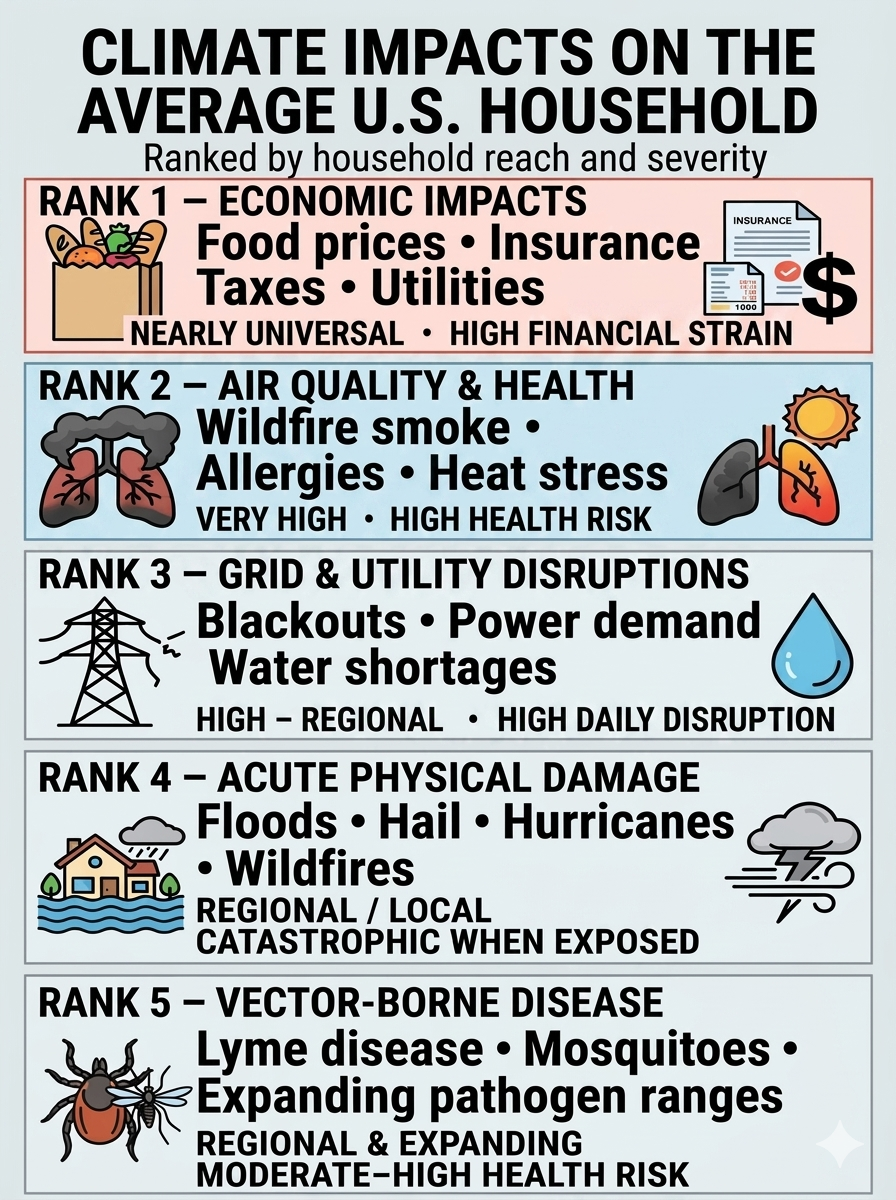
Ranking of Climate Impacts on the Average U.S. Household
| Rank | Impact Category | Primary Household Threats | Ubiquity | Severity |
|---|---|---|---|---|
| 1 | Economic Impacts | Food inflation, insurance premiums, taxes, utility costs | Nearly universal | High financial strain |
| 2 | Air Quality & Chronic Health | Wildfire smoke, longer allergy seasons, heat stress | Very high | High health risk |
| 3 | Grid & Utility Disruptions | Blackouts, heat-related demand, water shortages | High, but regional | High daily disruption |
| 4 | Acute Physical Damage | Floods, hail, hurricanes, wildfires | Regional/local | Catastrophic when exposed |
| 5 | Vector-Borne Diseases | Lyme disease, mosquitoes, expanding pathogen ranges | Regional and expanding | Moderate to high health risk |
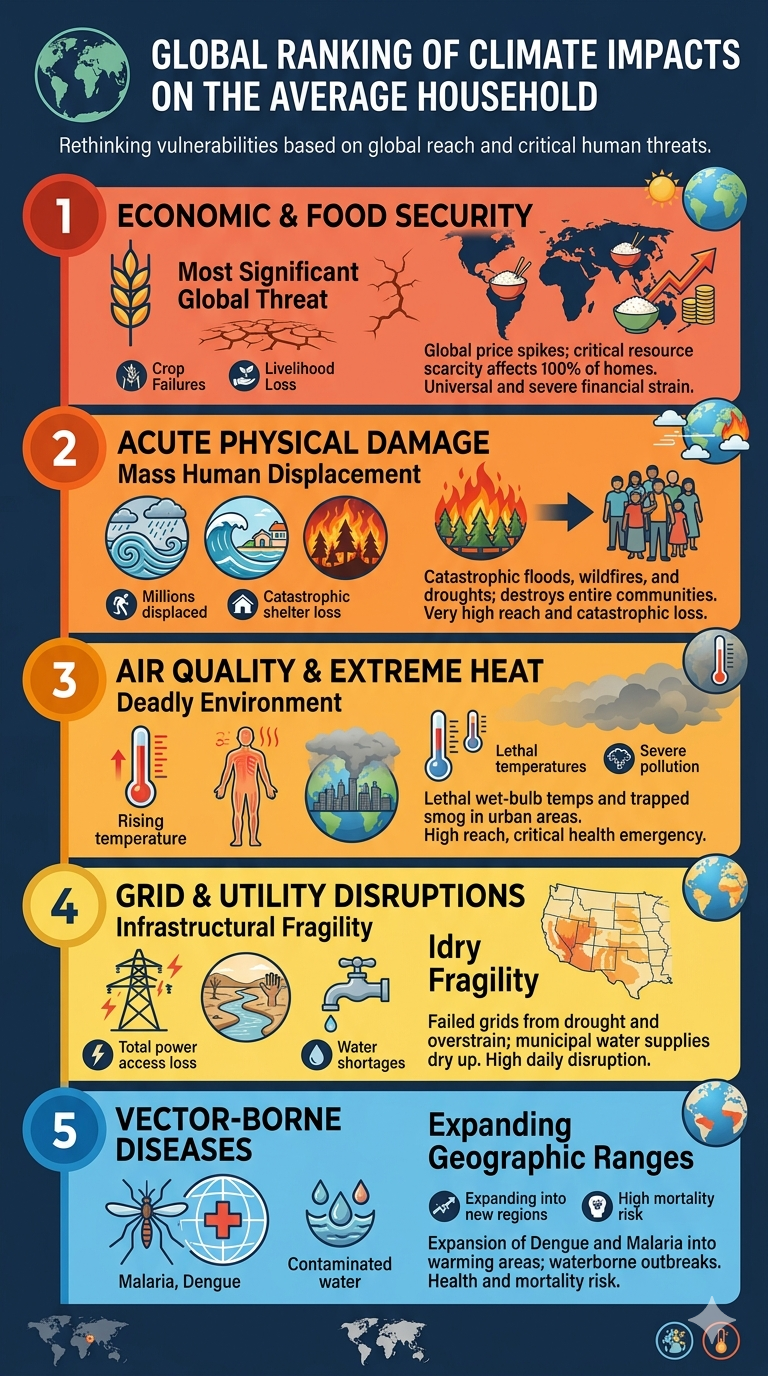
Global Ranking of Climate Impacts on the Average Household
The ranking below shifts the order of impacts based on global reach and the immediate threat to human life and livelihoods across developing and developed nations alike.
| Rank | Impact Category | Primary Global Household Threats | Ubiquity | Severity |
|---|---|---|---|---|
| 1 | Economic & Food Security | Global food price spikes, crop failures, loss of agricultural livelihoods | Universal (100% of homes) | Extreme financial/survival strain |
| 2 | Acute Physical Damage | Catastrophic monsoon flooding, sea-level rise, mega-wildfires, historic droughts | Very High (Millions displaced) | Catastrophic loss of shelter |
| 3 | Air Quality & Extreme Heat | Lethal wet-bulb temperatures, severe dust/smoke pollution, urban heat islands | High (Equatorial & Urban zones) | Critical health emergency |
| 4 | Grid & Utility Disruptions | Total lack of power access, severe municipal water shortages, drying river basins | High (Varies by infrastructure) | High daily survival disruption |
| 5 | Vector-Borne Diseases | Malaria, Dengue fever expansion, waterborne cholera outbreaks | Expanding (Sub-tropical regions) | High health and mortality risk |
1. Economic Impacts: The Most Universal Climate Burden
Economic impacts rank first because households do not have to live in a flood zone, wildfire corridor, or hurricane-prone region to pay the economic costs of climate change. Climate-related costs increasingly reach Americans through food prices, insurance premiums, utility bills, taxes, public fees, and the rising cost of maintaining homes and infrastructure.
Climate change can therefore function as a cost multiplier, increasing expenses both directly and indirectly.
Climate-Driven Food Inflation
Drought, extreme heat, excessive rainfall, and other weather disruptions can reduce agricultural yields and interfere with food production and supply chains. Because food markets are interconnected, production losses in one region can influence prices far beyond the location of the original climate event.
The effects can reach everyday staples and commodities such as coffee, wheat, corn, beef, fruits, and vegetables.
The result is a climate-related cost that can reach virtually every household through the grocery bill—even when the household is hundreds or thousands of miles from the drought, flood, or heatwave affecting agricultural production.
The Insurance Crisis
Insurance is one of the clearest mechanisms through which climate risk is transferred directly to households.
As floods, hurricanes, wildfires, severe storms, and other disasters generate increasingly costly losses, insurers may respond by raising premiums, increasing deductibles, restricting coverage, or withdrawing from particularly high-risk markets.
For homeowners, climate risk can therefore produce a double financial burden:
higher insurance costs + higher uninsured exposure.
In some locations, the problem extends beyond affordability. Homeowners may find that certain types of coverage are difficult or impossible to obtain through conventional private insurance markets.
Rising Utility Costs
Hotter summers increase demand for air conditioning. As temperatures remain elevated for longer periods, households may need to run cooling systems more frequently and for longer durations.
That increases electricity consumption while simultaneously placing additional stress on the power grid.
Climate change can therefore affect household budgets through both higher energy consumption and the cost of maintaining a more resilient electrical system.
Water systems can face similar pressures. Drought, declining water supplies, flooding, and changing precipitation patterns may require communities to invest in new reservoirs, treatment capacity, pipelines, drainage systems, and other infrastructure.
Those investments ultimately have to be paid for.
Taxes, Assessments, and Public Costs
One of the least visible climate costs is the portion that reaches households through government budgets rather than private markets.
When climate-related disasters become more costly, governments must spend more on emergency response, disaster recovery, infrastructure repair, flood protection, stormwater management, wildfire preparedness, water systems, coastal protection, and long-term climate adaptation.
Those expenses can eventually reach households through:
- Property taxes used to finance infrastructure repairs and resilience projects.
- Special assessments and municipal fees for stormwater, drainage, flood control, and other local projects.
- Higher utility rates needed to upgrade vulnerable water and electrical systems.
- State and federal taxes that help finance disaster recovery, emergency response, agricultural assistance, infrastructure rebuilding, and resilience programs.
- Public insurance and disaster programs when private insurance markets cannot absorb the full cost of catastrophic losses.
This creates an important economic chain:
Climate hazard → physical damage → insurance losses → government response → infrastructure spending → taxes, fees, and utility costs.
The household may never experience the original flood, wildfire, hurricane, or drought, yet it can still participate in paying the bill.
Rising Property and Maintenance Costs
Climate stress can also increase the cost of owning and maintaining a home.
More intense rainfall can require improved drainage. Stronger storms can increase demand for roofing and exterior repairs. Heat can accelerate deterioration of infrastructure and building materials. Flooding and wildfire risk can require additional mitigation measures.
At the same time, widespread disasters can create temporary shortages of construction materials, contractors, equipment, and skilled labor, increasing repair costs.
The Hidden Climate Cost
Taken together, these effects mean that climate change does not have to destroy your home to affect your household finances.
A household can experience climate-related costs through:
- Higher grocery prices
- Higher insurance premiums
- Higher electricity and water bills
- Higher taxes and public fees
- Higher repair and maintenance costs
Together, these expenses create a growing household climate burden—even when a family never experiences a major climate disaster firsthand.
The important point is that climate change is not simply a collection of isolated disasters. It is increasingly an economic force that propagates through markets, insurance systems, government budgets, and household expenses.
For the average American household, this may ultimately be the most widespread way climate change is experienced: not as one catastrophic event, but as a persistent accumulation of additional costs.
2. Air Quality & Chronic Health: A Widespread Physical Exposure
Climate change also affects the quality of the air people breathe.
Wildfire Smoke
Wildfire smoke can travel hundreds or even thousands of miles, carrying fine particulate matter such as PM₂.₅ into communities far from the original fire.
These particles can penetrate deep into the respiratory system and aggravate existing respiratory and cardiovascular problems. As wildfire activity and smoke exposure increase in some regions, air-quality impacts are no longer limited to communities immediately adjacent to fires.
Longer Allergy Seasons
Warmer temperatures can alter plant growing seasons and extend periods of pollen production.
For people with asthma or seasonal allergies, longer or more intense pollen seasons can mean more days of symptoms, greater medication use, and reduced quality of life.
Heat Stress
Rising baseline temperatures also increase the frequency and duration of dangerous heat.
Homes without adequate cooling, outdoor workplaces, and communities with limited access to cooling resources can be particularly vulnerable. Extreme heat is not merely uncomfortable—it can place substantial physiological stress on the human body.
3. Grid & Utility Disruptions: Climate Stress on Essential Infrastructure
Modern households depend on electricity, water, transportation, telecommunications, and other infrastructure every day.
Climate extremes can place additional stress on these systems.
Power Grid Failures
Extreme heat can push electricity demand toward peak levels as households and businesses increase air-conditioning use.
At the same time, extreme weather can damage transmission lines, substations, transformers, and other infrastructure.
The consequences can range from higher electricity costs to localized outages and, under severe conditions, prolonged disruptions to essential services.
Water Scarcity
Drought can reduce reservoir levels, groundwater availability, and other sources of municipal water.
Communities may respond with conservation requirements, watering restrictions, infrastructure investments, or higher water costs.
Water stress can therefore become both an environmental problem and a household financial problem.
4. Acute Physical Damage: Catastrophic Where It Strikes
Floods, hurricanes, wildfires, severe thunderstorms, hail, and high winds can cause enormous damage to homes, vehicles, businesses, and infrastructure.
This category ranks fourth not because the damage is minor, but because exposure is geographically concentrated.
A household directly hit by a major disaster can experience losses vastly greater than those associated with ordinary climate-related inflation.
Floods and Flash Floods
Intense rainfall can overwhelm drainage systems and produce rapid flooding in locations that may not have traditionally been considered high-risk.
Coastal communities also face storm surge and rising sea levels that can increase the consequences of major storms.
Severe Hail and Wind
Severe convective storms can produce damaging hail and straight-line or tornadic winds.
Roofing, siding, windows, vehicles, and other property can be damaged within minutes, creating repair costs that are often compounded by rising construction and insurance expenses.
Wildfires
Wildfires can destroy homes and communities directly while also creating secondary effects through smoke, evacuation, infrastructure disruption, and insurance losses.
5. Vector-Borne Diseases: A Smaller but Expanding Risk
Climate change can also alter the geographic range and seasonal activity of disease-carrying organisms.
Tick-Borne Illnesses
Changes in temperature and seasonal conditions can affect the distribution and activity of ticks and their hosts.
In some regions, this may increase opportunities for exposure to Lyme disease and other tick-borne illnesses.
Mosquito-Borne Diseases
Changing temperature and precipitation patterns can also influence mosquito populations and the geographic conditions suitable for certain mosquito-borne diseases.
The importance of this category varies considerably by region, but changing environmental conditions can alter the boundaries of disease risk over time.
Other Pathogens
Environmental changes can also affect exposure to less common infectious diseases, including tularemia (rabbit fever), which can be transmitted through several pathways involving ticks, biting flies, infected animals, or contaminated environments.
The Basics: How Climate Change Reaches Your Household
Climate change may seem like a global-scale phenomenon, but its consequences increasingly arrive through very ordinary parts of daily life.
Your Wallet: A Rising Cost of Living
Climate change can function like a hidden cost multiplier, increasing expenses directly and indirectly.
- Higher grocery bills: Weather extremes can disrupt agricultural production and food supply chains.
- Higher insurance premiums: Increasing disaster losses can raise premiums, deductibles, and coverage costs.
- Higher utility bills: Hotter temperatures increase cooling demand and electricity consumption.
- Higher repair costs: Disasters can increase demand for construction materials, contractors, and replacement vehicles.
- Higher infrastructure costs and taxes: Communities may need to spend more on flood protection, stormwater systems, water supplies, roads, and electrical infrastructure.
The result is that climate change does not need to destroy your house to affect your household finances.
Your Health: New Physical Strains
A warmer climate can change the environmental conditions in which people live.
Extended Allergy Seasons
Longer growing seasons and changing pollen patterns can increase exposure for people with seasonal allergies and asthma.
Heat Stress
More frequent and intense heat events increase risks of heat exhaustion, heatstroke, dehydration, and other heat-related illnesses.
Air Pollution
Wildfire smoke and other climate-related air-quality problems can expose people to unhealthy concentrations of fine particulate matter.
Vector-Borne Disease
Changing environmental conditions can alter the geographic and seasonal ranges of ticks, mosquitoes, and other disease vectors.
Your Environment: Infrastructure and Safety
Climate change also affects the physical systems surrounding your home.
Property Damage
Flooding, severe storms, wildfires, hail, and high winds can damage homes, vehicles, and personal property.
Travel Disruptions
Flooded roads, damaged bridges, severe storms, wildfire smoke, and extreme heat can disrupt transportation and cause delays.
Power and Water Reliability
Extreme heat, drought, storms, and other hazards can put additional pressure on electricity and water systems.
These disruptions can affect people even when their own property escapes direct physical damage.
What You Can Do
Climate change is a global problem, but households can take practical steps to reduce both personal vulnerability and unnecessary expense.
Audit Home Energy
Improve insulation, use efficient lighting and appliances, and manage heating and cooling more efficiently.
Prepare for Emergencies
Maintain a basic emergency kit, understand local flood and wildfire risks, and have a plan for prolonged power outages.
Protect Your Property
Keep gutters and drainage systems clear, maintain trees and vegetation around structures, and understand your property’s exposure to flooding, wind, wildfire, and other hazards.
Reduce Waste
Reducing food waste, conserving water, and using energy efficiently can lower household costs while reducing resource demand.
Know Your Insurance
Review deductibles, exclusions, flood coverage, and other policies before disaster strikes. Standard homeowners insurance does not necessarily cover every major climate-related hazard.
The Bottom Line
Climate change is often discussed in terms of distant environmental consequences, but for American households, the most immediate effects are increasingly personal and financial.
You may encounter climate change as:
a higher grocery bill,
a larger insurance premium,
a higher electric bill,
a smoky summer afternoon,
a longer allergy season,
a power outage,
a flooded road,
a damaged roof,
or a greater risk of heat stress.
The most dramatic climate disasters will continue to make the headlines. But the deeper transformation may be quieter: climate change is becoming embedded in the ordinary economics and infrastructure of everyday life.
The question is no longer simply what will climate change do to the planet?
It is increasingly:
What will climate change cost you?