bookmark_borderThe Future of Humanity: +4°-7°C

by Daniel Brouse

Introdution

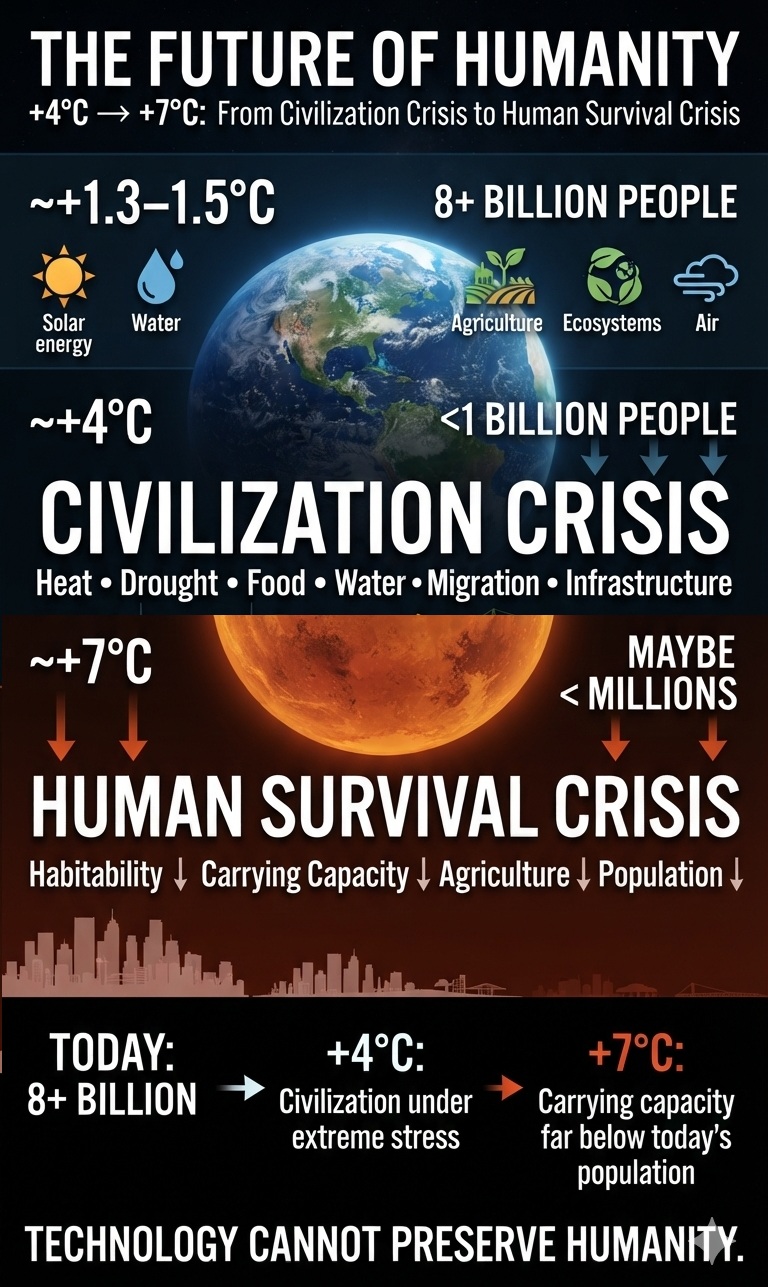
🌎 THE FUTURE OF HUMANITY

+4°C → +7°C: From Civilization Crisis to Human Survival Crisis

What happens to humanity if Earth doesn’t stop at +2°C or +3°C—but eventually reaches +4°C and then +7°C?

There is no scientifically established population number for a +7°C Earth.

But the physical constraints are becoming increasingly clear.

At approximately +4°C, humanity could face a civilization-scale crisis:

🔥 Extreme heat
💧 Water shortages
🌾 Agricultural disruption
🏙️ Infrastructure failures
🌍 Mass migration
⚡ Energy-system stress

Over the following centuries, continued warming toward +7°C could transform the question entirely.

The issue would no longer be simply:

How do we adapt civilization to a hotter planet?

It becomes:

How many humans can the planet physically support?

Technology could keep some people alive through underground facilities, controlled environments, hydroponic agriculture, protective equipment and advanced energy systems.

But there is an enormous difference between keeping thousands or millions of people alive in artificial environments and maintaining a civilization of 8+ billion people.

Today’s population depends upon the Earth providing enormous services essentially for free:

☀️ Solar energy
💧 Rainfall and freshwater
🌾 Productive soils
🌳 Ecosystems
🌬️ Breathable air
🌊 Functioning oceans
🌡️ Manageable temperatures
🌱 Outdoor agricultural space

At +7°C, humanity could increasingly have to manufacture artificially what the Earth currently provides naturally.

And that creates a fundamental problem:

Energy requires infrastructure.
Infrastructure requires materials.
Materials require mining and manufacturing.
Manufacturing requires energy and water.

Technology can extend human habitability.

But technology cannot be assumed to recreate the Earth for eight billion people.

The path from +4°C to +7°C could therefore represent a transition from:

Fighting to preserve civilization

to

Fighting to preserve humanity itself.

The Future of Humanity: +4°-7°C

The most likely scenario is for the planet to warm approximately 4°C by 2150, with the potential for +7°C over the longer term.

That raises an unavoidable question:

How many humans could survive on a planet that is +7°C warmer than the preindustrial Earth?

There are no official, peer-reviewed demographic consensus figures projecting an exact human population at +7°C of global warming. A +7°C scenario lies far beyond the temperature range of conventional climate projections for this century, so mainstream climate models do not provide a precise population forecast for such a world.

That does not mean the consequences are unknowable.

Scientists can examine the physical limits of human habitability, agricultural production, water availability, ecosystem function, infrastructure, energy requirements, and planetary carrying capacity. Taken together, these factors point toward a potentially catastrophic contraction of human population.

1. Planetary Carrying Capacity Could Fall Below One Billion

Climate scientists have previously addressed the question of Earth’s carrying capacity under extreme warming.

Hans Joachim Schellnhuber, former director of the Potsdam Institute for Climate Impact Research, has stated that at approximately +4°C, Earth’s sustainable carrying capacity could fall below one billion people.

At +7°C, the situation would be vastly more hostile.

The implied carrying capacity could therefore be a small fraction of today’s eight billion people. Under extreme-risk scenarios, humanity could potentially be reduced to a few million survivors concentrated in the remaining habitable regions, including high-latitude areas and highly protected technological environments.

There is no peer-reviewed demographic model establishing a precise population at +7°C. The absence of such a number should not be confused with evidence that the current population could be maintained.

The fundamental issue is carrying capacity.

A planet capable of supporting more than eight billion people under today’s climatic conditions does not necessarily retain that capacity after the climate system has been pushed several additional degrees beyond the historical range.

2. Physical Limits of Human Habitability

The most fundamental constraint is not economics.

It is thermodynamics.

Sherwood and Huber’s 2010 study examined the physiological limits imposed by extreme combinations of temperature and humidity. Their work established the importance of the 35°C wet-bulb temperature threshold as an approximate upper limit for human heat dissipation under extreme conditions.

At a wet-bulb temperature of 35°C, the human body can no longer effectively shed metabolic heat to the surrounding environment.

Even a healthy, hydrated, unclothed person resting in the shade with adequate air movement eventually becomes unable to maintain a safe core temperature.

A global warming level approaching +7°C would create regions in which these extreme combinations of heat and humidity become increasingly common.

The regions affected would include large portions of the tropics and subtropics, the Middle East, parts of Asia, and other heavily populated regions. This is not simply a matter of discomfort. At sufficiently high heat and humidity, the human body physically loses the ability to cool itself. Protective technology can delay the problem. It cannot eliminate the underlying thermodynamic limit.

3. Abrupt Carrying-Capacity Collapse

Population collapse does not require every human being to suddenly reach a temperature at which survival becomes impossible. It can occur when the systems supporting civilization cross critical thresholds. Mathematical population models have examined what happens when environmental carrying capacity suddenly declines because of severe environmental crises.

One such study published in Chaos, Solitons & Fractals modeled a hypothetical situation in which Earth’s sustainable carrying capacity abruptly fell to approximately two billion people. When carrying capacity suddenly becomes lower than the existing population, the model produces an extremely rapid population decline.

The population can fall by half within only a few decades. This is important because climate change does not operate as a single-variable problem. A collapse in agricultural production can cause food shortages. Food shortages can produce price shocks and famine. Famine can produce migration. Migration can produce political instability. Political instability can disrupt energy production and transportation. Energy shortages can further reduce agricultural production.

The resulting system is nonlinear.

Once multiple critical systems begin failing simultaneously, population decline can accelerate dramatically.


Earth Today vs. Earth at +7°C

MetricCurrent Era (~1.3–1.5°C)Potential Earth at +7°C
Global population~8.3 billionUnquantified, but potentially reduced to hundreds of millions or less
Human climate nicheMost humans live within a relatively narrow range of climatic conditionsLarge regions experience temperatures and humidity increasingly hostile to human survival
AgricultureGlobalized and heavily dependent on predictable climate, water, fertilizers and energySevere disruption of traditional outdoor agriculture, particularly in the tropics and mid-latitudes
Food productionPrimarily solar-powered outdoor agricultureIncreasing dependence on artificial environments and technologically controlled agriculture
WaterLarge-scale freshwater systems support cities and agricultureIncreasing drought, heat, evaporation and competition for water
Outdoor laborPossible across most populated regionsIncreasingly restricted by dangerous heat and humidity
InfrastructureDesigned around the historical climateIncreasingly stressed by extreme heat, storms, drought, flooding and water shortages
Primary mortality risksAging, disease, accidents and conventional disastersHeatstroke, famine, water shortages, disease, conflict and systemic infrastructure failure
CivilizationNatural ecosystems provide enormous life-support servicesIncreasing portions of the natural life-support system must be artificially replaced

Ultimately, a +7°C world is not simply a difficult demographic scenario.

It represents an extreme threat to the carrying capacity of Earth and to the technological civilization that currently supports billions of people.


Why Couldn’t Humans Simply Adapt?

A reasonable question is:

Why couldn’t humans simply adapt?

Why not wear protective clothing or cooling suits?

Why not live underground?

Why not grow hydroponic food?

Why not build artificial environments and maintain the current population?

Humans are extraordinarily adaptable.

Technology already allows small populations to survive in environments that would otherwise be extremely hostile.

Humans live in Antarctica.

Humans operate submarines.

Humans live in deserts.

Astronauts survive in space.

The problem is not whether technology can keep some humans alive.

The problem is whether technology can sustain eight billion humans in artificial environments after the natural environment has become hostile to large-scale civilization.

That creates fundamental bottlenecks involving energy, materials, infrastructure, maintenance, food production and thermodynamics.


1. The Hydroponic Energy Paradox

To feed eight billion people entirely indoors, humanity would have to replace much of the free energy currently supplied by the Sun. Traditional agriculture obtains solar energy directly. Millions of square kilometers of agricultural land receive sunlight without humanity having to manufacture the photons.

Indoor agriculture changes the equation. Artificial lighting must be produced. Water must be pumped. Nutrients must be circulated. Temperature and humidity must be controlled. Carbon dioxide must be managed. Air must be circulated. Crops must be harvested. The systems must be maintained continuously.

The Scale

Feeding eight billion people entirely indoors would require an enormous quantity of electricity for lighting, climate control, pumping, ventilation, automation and food processing.

The energy requirement would be many times greater than the amount of energy currently available to the human race for ordinary food production and could approach or exceed the scale of the entire existing global energy system depending on the crops and technologies used.

And food is not merely calories.

Humanity requires carbohydrates, proteins, fats, vitamins, minerals, animal feed, oils and a tremendous diversity of agricultural products.

The Catch-22

If that additional energy comes from fossil fuels, the energy system accelerates climate warming.

If it comes from renewable energy, enormous quantities of solar panels, wind turbines, transmission lines, batteries and other infrastructure must be manufactured and maintained.

If it comes from nuclear energy, enormous quantities of reactors, fuel-cycle infrastructure, cooling systems, transmission systems and industrial capacity must be maintained.

In every case, the artificial food system becomes dependent upon an enormous industrial infrastructure.

And that infrastructure itself must survive a +7°C world.


2. Environmental Degradation of Critical Machinery

Humanity cannot run a global civilization strictly from underground. Resources must still be extracted from the surface. Minerals must be mined. Construction materials must be manufactured. Energy systems must be maintained. Transportation systems must operate. Food-production systems require machinery. Factories require workers. The coolant problem becomes increasingly important. Mechanical and industrial systems must ultimately reject waste heat. Power plants, industrial equipment, refrigeration systems, data centers and other large-scale machinery rely on heat-transfer systems.

As surrounding air and water become hotter, the temperature difference available for rejecting heat becomes smaller. Cooling therefore becomes increasingly difficult and energy intensive. The problem is not that every machine instantly stops working at +7°C.

The problem is that the amount of energy and infrastructure required to keep machines operating rises while the surrounding civilization is simultaneously being subjected to increasing environmental stress.

Protective Suits

Humans can wear cooled protective suits or specialized thermal equipment. Such equipment can allow people to work temporarily in environments that would otherwise be dangerous.

But the suits require:

  • electricity
  • cooling
  • air filtration
  • communications
  • maintenance
  • replacement parts
  • charging
  • trained personnel

A protective suit can keep an individual alive.

It cannot make the surface environment normal.

It cannot eliminate the need to mine resources, maintain roads, operate ports, manufacture machinery, repair electrical grids, produce food and maintain global supply chains.

A civilization in which workers can safely operate outdoors only for limited periods becomes fundamentally different from today’s civilization.


3. The Enormous Resource Footprint of Underground Civilization

Housing eight billion people underground would require the largest engineering project in human history. Thousands of subterranean cities would have to be constructed.

The required quantities of:

  • concrete
  • steel
  • copper
  • electrical equipment
  • ventilation equipment
  • pumps
  • elevators
  • water systems
  • sewage systems
  • air filtration
  • cooling systems
  • power generation
  • energy storage
  • communications
  • transportation
  • food-production equipment

would be enormous.

Excavating underground cities would itself require enormous quantities of energy and heavy machinery. Concrete production would add another major industrial burden. The systems would also require continuous maintenance.

Ventilation and Air

An underground population of billions would require enormous systems for:

  • supplying breathable air
  • removing carbon dioxide
  • controlling humidity
  • filtering pollutants
  • managing waste
  • maintaining pressure
  • controlling temperature

A single systemic failure in an underground city’s ventilation or power system could produce immediate mass casualties.

The larger and more interconnected the system becomes, the greater the consequences of systemic failure.


4. Underground Civilization Still Depends on the Surface

Moving underground does not eliminate dependence on the natural world.

An underground civilization would still need:

Energy.

Energy requires power plants and transmission systems.

Minerals.

Minerals require mining.

Food.

Food requires agriculture or industrial food-production systems.

Water.

Water must be obtained, transported and treated.

Machinery.

Machines require factories, raw materials and replacement parts.

Human labor.

Workers must maintain the systems.

Waste disposal.

Waste must be processed and ultimately incorporated into material cycles.

Therefore, an underground civilization would not actually be independent of the surface.

It would be more dependent on a functioning industrial system.


5. The Psychological and Biological Reality

Human beings are not genetically adapted to live permanently inside completely artificial environments.

Humans evolved within complex natural ecosystems under natural cycles of sunlight, darkness, temperature, seasons, atmospheric conditions, microbial exposure and biological diversity.

A completely artificial environment would impose enormous psychological and biological stresses.

Long-term confinement, artificial lighting, restricted environments, isolation and separation from natural ecosystems create substantial physiological and psychological challenges.

The problem extends beyond human psychology.

Natural ecosystems provide services that artificial systems would have to replace:

  • water purification
  • decomposition
  • nutrient cycling
  • pollination
  • soil formation
  • carbon storage
  • atmospheric regulation
  • biological pest control

The more completely humans isolate themselves from the natural environment, the more of these services must be replaced technologically.

Every replacement system requires energy and maintenance.


6. The Fundamental Problem: Scale

This is the central issue.

Technology could undoubtedly allow a sliver of humanity to survive conditions that would otherwise be fatal.

A few million highly organized people living in underground facilities, protected environments or high-latitude regions could potentially survive conditions under which conventional civilization could not.

The problem is maintaining eight billion people.

There is an enormous difference between:

keeping a few thousand people alive in Antarctica

and

maintaining billions of people inside an artificial global biosphere.

The first has already been demonstrated.

The second has not.

The eight-billion-person civilization exists because the planet provides enormous quantities of environmental services essentially for free. The Sun provides energy. Rain provides water. Soils grow crops. Oceans regulate heat. Forests and wetlands process water and carbon. Natural ecosystems recycle nutrients. The atmosphere provides breathable air. Outdoor agriculture converts sunlight into food without humanity having to construct the entire system artificially.

A +7°C Earth would place increasing portions of those services under extreme stress.

Humanity could replace some of them.

Replacing all of them, for eight billion people, indefinitely is a completely different problem.


The Catch-22 of Technological Survival

The technological solution creates its own dependency chain:

Climate warming

↓

Natural systems become less reliable

↓

Artificial systems replace natural services

↓

Artificial systems require enormous amounts of energy

↓

Energy systems require enormous industrial infrastructure

↓

Industrial infrastructure requires mining, water, transportation and stable ecosystems

↓

Those systems are themselves damaged by climate change

↓

Maintenance becomes increasingly difficult

↓

Artificial life-support systems become increasingly vulnerable

This is the fundamental problem.

Technology does not eliminate environmental carrying capacity.

It extends it by using energy and resources.

But the energy and resources required to extend carrying capacity become increasingly difficult to obtain as the planetary environment deteriorates.


The Real Question

The real question is therefore not:

“Can a human being survive +7°C?”

A human can survive an extraordinary range of environments with sufficient technology.

The real question is:

“Can eight billion humans maintain a technologically advanced global civilization on a planet that is +7°C warmer?”

That is an entirely different question.

The answer depends on whether enough food, water, energy, materials, infrastructure and habitable space remain available to support the enormous interconnected system required to maintain billions of people.

At +7°C, every one of those requirements becomes more difficult.

And the problems interact. Food shortages affect political stability. Political instability affects energy production. Energy shortages affect water systems. Water shortages affect agriculture. Agricultural failures affect food supplies. Infrastructure failures affect everything.

The result is a coupled nonlinear system in which multiple simultaneous stresses can produce consequences far larger than any individual stress alone.


Summary of the Collapse

The path to a +7°C world does not require humanity to suddenly jump from today’s climate into an uninhabitable planet.

It can happen progressively.

The first major threshold is approximately +4°C of global warming over the next century.

At +4°C, humanity would still exist in enormous numbers. Civilization would still operate. Technology would still function. Many regions would remain habitable. But the environmental conditions supporting today’s eight-billion-person civilization would be profoundly degraded. Agriculture would face increasing heat and drought. Freshwater supplies would become increasingly stressed. Extreme heat would restrict outdoor labor across large regions. Coastal regions would face accelerating sea-level rise.

Ecosystems would be increasingly disrupted. Food production, water systems, energy infrastructure and transportation would become increasingly vulnerable to compound climate extremes.

The result would not necessarily be the immediate collapse of civilization.

It would be the beginning of a progressive contraction in Earth’s effective carrying capacity. And +4°C would not necessarily be the end of the warming process.

If greenhouse-gas emissions, climate feedbacks and Earth-system changes continue to push the planet beyond +4°C, warming could continue over the following centuries toward +7°C or more.

That changes the problem fundamentally.

At +7°C, the issue is no longer simply whether humanity can adapt its agriculture, infrastructure and cities to a warmer climate. The issue becomes whether the Earth can continue to provide the environmental foundation required to support billions of people at all.

Technology would undoubtedly allow some portion of humanity to survive a +7°C world. Highly protected underground facilities, high-latitude settlements, artificial environments, hydroponic agriculture, protective equipment and advanced energy systems could preserve human life under conditions that would otherwise be lethal. But that does not demonstrate that eight billion people could be sustained.

The current population of approximately eight billion is supported by a planetary system that provides enormous services essentially for free:

  • solar energy
  • rainfall
  • productive soils
  • natural ecosystems
  • breathable air
  • functioning oceans
  • manageable temperatures
  • outdoor agricultural space
  • natural water cycles
  • global biological productivity

At +4°C, humanity would increasingly struggle to maintain those services.

At +7°C, humanity could increasingly be forced to manufacture them.

Air would have to be conditioned.

Water would have to be increasingly purified and transported.

Food would increasingly require controlled environments.

Temperature would have to be artificially regulated.

Nutrients would have to be recycled.

Natural ecosystem services would increasingly have to be replaced by industrial systems.

The resource and energy requirements would become enormous. And every artificial replacement creates another dependency.

Energy requires infrastructure. Infrastructure requires materials. Materials require mining and manufacturing. Manufacturing requires energy and water. Energy and water systems depend upon functioning infrastructure and ecosystems.

The result is a civilization increasingly dependent upon an industrial system that is itself operating under increasingly hostile environmental conditions.

This creates a fundamental progression:

Today → +4°C → +7°C

Stable planetary support → severely degraded planetary support → radically reduced planetary carrying capacity

At approximately +4°C, the central problem becomes maintaining civilization under extreme environmental stress.

At approximately +7°C, the central problem becomes maintaining humanity itself at anything approaching today’s population.

The transition would not necessarily be smooth. Climate systems, ecosystems, food systems and human societies are nonlinear. Carrying capacity can decline gradually for a time and then fall rapidly when multiple thresholds are crossed.

A decline in agricultural productivity can trigger food shortages. Food shortages can trigger migration. Migration can destabilize political systems. Political instability can disrupt energy and transportation systems. Energy failures can disrupt water and food production. Those failures can further reduce carrying capacity.

The process can therefore become a positive feedback loop of environmental degradation and societal contraction.

A +7°C world could produce a catastrophic contraction in human carrying capacity, potentially reducing the population by billions.

The exact surviving population cannot be known in advance.

It could be hundreds of millions.

It could be far lower.

Under extreme technological survival scenarios, only a small fraction of today’s population could remain. The critical point is not the precise number.

The critical point is that the carrying capacity of a +7°C Earth could be radically below the population that exists today.

And that creates an important distinction between the next century and the centuries that follow.

The +4°C world is a civilization-scale crisis.

The +7°C world could become a human-survival crisis.

Humanity does not merely inhabit the planet.

Human civilization is a product of the planet’s environmental stability.

The civilization supporting eight billion people was built within a remarkably narrow range of climatic conditions. Push the planet several degrees beyond that range and humanity must increasingly substitute technology for the natural systems that made civilization possible in the first place.

Technology can preserve pockets of humanity. Technology can extend human habitability.

Technology cannot be assumed to reproduce the entire Earth system for eight billion people.

The path from +4°C to +7°C therefore represents more than another three degrees of warming.

It represents a potential transition from adapting civilization to a changing planet to attempting to manufacture an artificial planet capable of sustaining humanity.

That is the ultimate carrying-capacity problem.

At +4°C, humanity may be fighting to preserve civilization.

At +7°C, humanity may be fighting to preserve humanity itself.
bookmark_borderWhen Climate Change Hits the Wallet: Insurance, Interest Rates, and Taxes

by Daniel Brouse

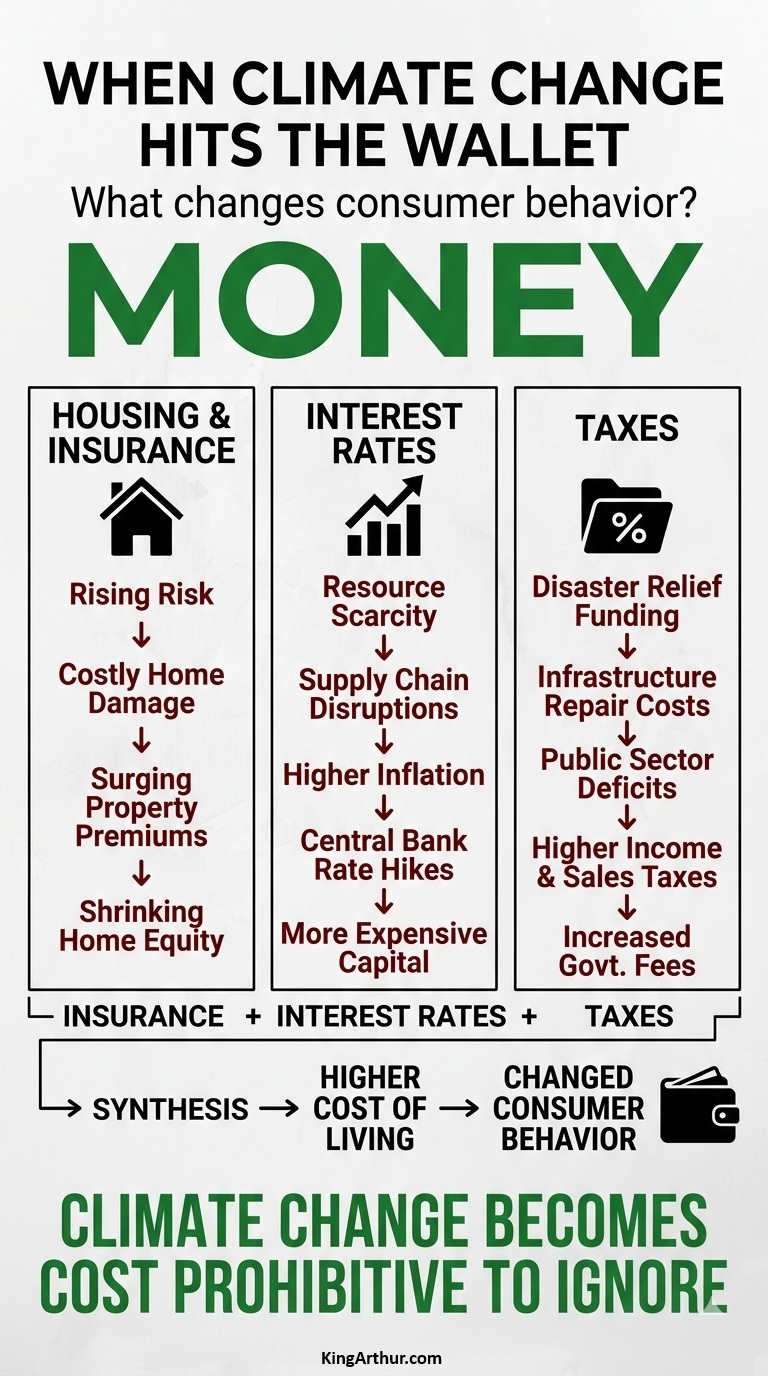
What will change consumer behavior when it comes to climate change?

Money. Insurance, interest rates, and taxes.

Most consumers do not substantially change their behavior until doing nothing becomes cost prohibitive.

For years, we assumed that climate change was unlikely to change consumer behavior in the near term. Climate change seemed too distant, too gradual, and too abstract to overcome the immediate economic incentives that drive everyday decisions.

That is now observably changing.

Climate change is increasingly entering the household economy through three powerful financial mechanisms:

Insurance. Interest rates. Taxes.

These mechanisms can transform climate change from an environmental issue that consumers can ignore into an economic reality they cannot.

Insurance

The United States, Australia, and parts of Asia and Latin America face some of the heaviest disruptions in insurance markets from climate change. The climate-driven insurance crisis is no longer just a problem for insurance companies. It has triggered a massive shift in housing and financial markets.

As climate risks increase, insurers are raising premiums, increasing deductibles, restricting coverage, and withdrawing from markets where losses have become too great.

That directly affects consumers.

Because most people rely on banks and mortgages to purchase homes, the withdrawal of insurers directly threatens both property values and mortgage stability. A home that cannot be affordably insured becomes more difficult to finance, sell, and maintain as an investment.

The chain is straightforward:

Climate change → insurance losses → higher premiums → reduced insurability → declining property values → mortgage disruption

This creates a powerful economic incentive for consumers to change where they live, what they buy, how they build, and how they protect their property.

Insurance therefore has become one of the first places where climate change forces consumer behavior to change—not through persuasion, but through price.

Interest Rates

Climate change is also becoming a financial problem through the cost of borrowing.

Developing and climate-vulnerable nations bear the heaviest burden. Climate change directly drives up sovereign bond yields, contributes to credit-rating downgrades, and locks vulnerable countries into a punishing vicious cycle of debt and disaster. A landmark 2026 report by ActionAid International revealed that across 65 of the world’s most climate-vulnerable countries, debt servicing is projected to consume a staggering 65% of all government revenue in 2026.

The mechanism is another accelerating feedback loop:

Climate disaster → economic losses → declining government revenue → increased borrowing → higher debt costs → reduced adaptive capacity → greater vulnerability

The consequences do not remain confined to developing nations.

The approximately $2 trillion annual climate-driven fiscal drain acts as a massive structural accelerator for interest rates in the United States. It does not directly determine daily Federal Reserve rate decisions. Instead, this enormous and growing economic burden alters the underlying macroeconomic conditions that the Federal Reserve and bond markets use to price capital.

Climate damage requires money. Rebuilding requires money. Infrastructure adaptation requires money. Insurance losses require money. Government deficits require money. And when the demand for capital rises while economic productivity and fiscal capacity are simultaneously pressured, the cost of capital rises.

Consumers ultimately experience that cost through mortgages, automobile loans, credit cards, business financing, and other forms of debt.

Taxes

Climate change affects taxation at both ends of the global economic spectrum.

Low-income developing nations face catastrophic losses in baseline tax revenue as climate disasters destroy crops, businesses, infrastructure, and productive capacity.

At the same time, wealthy economies are rapidly restructuring their tax systems around carbon emissions, energy production, subsidies, and the transition to lower-carbon energy.

The result is another financial feedback loop:

Climate damage → economic losses → reduced tax base → increased government spending → greater fiscal pressure → higher taxes and fees

In the United States, the financial impact of climate change is not represented by a single “climate tax.”

Instead, the costs are absorbed across federal, state, and local tax systems.

Local governments face increasing costs for damaged infrastructure, emergency response, stormwater management, roads, bridges, utilities, and other public services. Those costs ultimately have to be paid by taxpayers.

Property taxes can therefore become another mechanism through which climate change reaches the household balance sheet.

At the federal and state levels, climate-related disaster costs, infrastructure requirements, energy policies, and changes in taxation can add additional fiscal pressure.

Consumers may never see a line on their tax bill labeled “climate change.” They do not have to. They simply see the bill go up.

The Consumer Climate Feedback Loop

Insurance, interest rates, and taxes are not isolated financial effects.

They interact.

A homeowner faces higher insurance premiums because of increasing climate risk. Higher insurance costs increase the cost of homeownership. Reduced insurance availability threatens property values and mortgage financing. Climate-related disasters increase government expenditures. Government spending increases borrowing and tax pressure. Higher borrowing costs increase the cost of mortgages and other consumer debt.

The feedback loop becomes:

Climate disruption → financial losses → insurance increases → property and mortgage pressure → government spending → higher taxes and borrowing costs → higher household costs → changed consumer behavior

This is the critical transition.

Consumers do not necessarily have to become convinced by climate science before climate change changes their behavior. They only have to experience its economic consequences. A homeowner who can no longer afford insurance behaves differently. A buyer who cannot obtain a mortgage behaves differently. A family facing higher property taxes behaves differently. A business facing higher borrowing costs behaves differently. A community facing rapidly increasing infrastructure costs behaves differently.

The financial system can therefore become the transmission mechanism through which climate change reaches individual consumer decisions.

Ending Synthesis: When Climate Change Becomes Cost Prohibitive

The question is not whether climate change will eventually affect consumer behavior.

The question is when the financial consequences become large enough that consumers can no longer ignore them.

That threshold is already being crossed in parts of the world.

Insurance makes climate risk visible through premiums and availability.

Interest rates transmit climate-related economic and fiscal disruption into the cost of capital.

Taxes distribute the growing costs of climate damage, adaptation, infrastructure, and energy transition across households and businesses.

Together, they create a socioeconomic feedback loop:

Climate change → economic disruption → financial disruption → higher household costs → consumer behavior → market disruption → further economic pressure

This may prove far more powerful than climate messaging alone.

People can ignore a temperature graph.

They can dismiss a scientific projection.

They can debate climate policy.

But they cannot easily ignore an insurance cancellation, a mortgage that costs hundreds of dollars more each month, or a tax bill that keeps rising.

That is why money may ultimately become the mechanism that changes consumer behavior on climate change.

Climate change does not have to become universally accepted before it changes what people do.

It only has to become cost prohibitive to ignore.

Simplified Social Media Version

💰 WHEN CLIMATE CHANGE HITS THE WALLET

What will actually change consumer behavior when it comes to climate change?

Money.

Insurance. Interest rates. Taxes.

For years, climate change was largely treated as an environmental issue. But that is changing as climate risk increasingly enters the household economy.

🏠 Insurance premiums and availability are being affected by rising climate risks.

💰 Climate-related economic and fiscal pressures are affecting the cost of capital.

🧾 The growing costs of climate damage, adaptation, infrastructure, and energy transition are increasingly flowing through tax systems.

These forces can reinforce one another:

Climate change → financial disruption → higher household costs → changed consumer behavior

Consumers may ignore a temperature graph. They are much less likely to ignore an insurance cancellation, a higher mortgage payment, or a rising tax bill.

Climate change does not have to be universally accepted before it changes behavior.

It only has to become cost prohibitive to ignore.

New paper:
“When Climate Change Hits the Wallet: Insurance, Interest Rates, and Taxes”

bookmark_borderClimate Denialism and the Domino Effect

by Daniel Brouse

From Climate Shock to Food Disruption, Economic Shock, Migration, Political Instability, and Conflict

Abstract

Climate change is often discussed as a sequence of individual environmental impacts: higher temperatures, droughts, floods, crop failures, sea-level rise, wildfires, and ecosystem degradation. This framing can obscure a more consequential property of the climate system: climate shocks propagate through interconnected socioeconomic systems.

A drought does not end when rainfall declines. It can reduce crop production, increase food prices, damage household incomes, increase inflationary pressure, weaken economic stability, contribute to displacement and migration, intensify political tensions, and, under particular conditions, increase the risk of conflict. Conflict then further reduces the capacity of societies to adapt to subsequent climate shocks.

This paper describes that process as the Climate Domino Effect:

Climate disruption → crop losses → food prices → economic instability → migration → political instability → conflict → reduced adaptive capacity → greater vulnerability to the next climate shock

That is the Domino Effect. Denialism has become part of the feedback loop—delaying recognition, obstructing action, weakening resilience, and ultimately amplifying the consequences and accelerating the climate crisis.

This is not a claim that climate change mechanically causes war. Conflict has many causes, including governance failures, inequality, poverty, institutional weakness, geopolitical competition, and historical grievances. Rather, climate change can act as a risk multiplier, adding stress to systems already operating near their limits.

The distinction is important for understanding climate denialism. Denialism often treats climate impacts as isolated, manageable, or geographically contained. A systems perspective reveals a different problem: the impacts are coupled. As individual stresses interact, the resulting socioeconomic response can become nonlinear.

This concept also connects to the framework developed in Approaching Singularity: Third Derivatives, Nonlinear Collapse, and Coupled Climate–Economic Instability, which proposes that climate and economic systems should be examined not only through their levels and rates of change, but through changing rates of acceleration and increasingly strong coupling between subsystems.

The central warning is therefore not simply that climate change produces more damage. It is that climate shocks can progressively reduce the very economic, political, and institutional capacity required to respond to the next shock.


1. Introduction: Climate Change Is a System Problem

Climate change is commonly represented as a gradual increase in global temperature. That representation is scientifically useful, but incomplete.

Temperature is only one variable in an interconnected Earth system. Climate change affects precipitation, soil moisture, agricultural productivity, water availability, ecosystems, ocean conditions, infrastructure, insurance markets, commodity prices, public finances, migration patterns, and political stability.

The consequences therefore do not remain within the physical climate system.

A climate shock can become an economic shock.

An economic shock can become a social shock.

A social shock can become a political shock.

And political instability can reduce a society’s ability to respond to the next physical shock.

The result is a feedback structure rather than a simple linear sequence.

The basic socioeconomic pathway can be represented as:

Climate disruption

↓

Crop losses

↓

Food prices

↓

Economic instability

↓

Migration

↓

Political instability

↓

Conflict

↓

Reduced adaptive capacity

↓

Greater vulnerability to subsequent climate disruption

This is the Domino Effect.

Each individual event may be understandable in isolation. The danger emerges from their interaction.


2. The Climate Domino Effect

The term “domino effect” describes a system in which one event increases the probability of subsequent events.

In a climate–economic system, the dominoes are not independent.

They are coupled.

A drought can reduce agricultural production. Reduced production can increase prices. Higher prices can reduce household purchasing power. Economic stress can increase migration. Large-scale migration can place additional pressure on housing, infrastructure, labor markets, public services, and political institutions. Political instability can contribute to civil unrest or conflict in vulnerable settings.

The IPCC has explicitly identified cascading relationships among climate impacts, food insecurity, migration, political instability, and conflict. It also emphasizes that the relationship between climate change and conflict is mediated by factors such as governance, socioeconomic development, state capacity, inequality, and existing conflict.

This distinction is essential.

The Domino Effect is not:

Climate change causes war.

It is:

Climate change can introduce or intensify stresses that propagate through already vulnerable socioeconomic systems, increasing the probability of additional destabilizing outcomes.

That is a substantially more defensible proposition.


3. First Domino: Climate Disruption

The first domino is the physical climate shock.

Examples include:

  • drought
  • extreme heat
  • flooding
  • wildfire
  • changing precipitation
  • prolonged growing-season disruption
  • tropical cyclones
  • compound heat and drought
  • water scarcity
  • ecosystem degradation

The critical feature is not simply the magnitude of an individual event.

It is the interaction between the event and the system receiving the shock.

A drought occurring in a resilient agricultural economy with abundant water reserves, strong infrastructure, functioning insurance markets, and substantial fiscal capacity may produce limited long-term disruption.

The same drought occurring in a poor region with depleted soils, limited irrigation, weak institutions, high food dependence, and existing political instability can produce cascading consequences.

Thus:

Climate risk = physical hazard × exposure × vulnerability × system connectivity

The same physical forcing can therefore produce radically different socioeconomic outcomes.


4. Second Domino: Crop Losses

Food production is particularly sensitive to climate variability.

Agriculture depends simultaneously upon temperature, precipitation, soil moisture, water availability, growing-season timing, pollination, pests, disease, and ecosystem functioning.

Climate change can therefore affect food production through multiple pathways simultaneously.

The IPCC reports that climate change can increase food insecurity through direct effects on production as well as cascading effects on food prices and household incomes. It also identifies increasing risks to food production at higher warming levels.

This is where the Domino Effect begins to move from the physical climate system into the economic system.

A failed harvest is not merely an agricultural statistic.

It represents lost income for producers, reduced supply for consumers, increased demand for imports, increased competition for remaining supplies, and potentially higher government expenditures.

A local climate shock can consequently become a regional or global market shock.


5. Third Domino: Food Prices

Food prices are a critical transmission mechanism.

When agricultural production declines while demand remains relatively stable, markets respond through price increases.

For wealthy households, a food-price increase may be inconvenient.

For households already spending a large fraction of their income on food, it can become an existential economic shock.

The IPCC identifies food-price increases associated with reduced agricultural production and global food-price shocks as an important pathway connecting climate variability with social and political instability.

The important nonlinear characteristic is that the social response to price increases is not necessarily proportional to the price increase.

A 5% increase may be absorbed.

A much larger increase may force households to:

  • reduce food consumption
  • substitute cheaper foods
  • sell productive assets
  • withdraw children from school
  • take on debt
  • migrate
  • seek informal employment
  • rely on government assistance

The economic system therefore has thresholds.

Once those thresholds are crossed, the response can change rapidly.


6. Fourth Domino: Economic Instability

Food-price shocks rarely remain confined to food.

Food is part of the broader inflation system.

Agricultural losses can affect:

  • consumer prices
  • wages
  • interest rates
  • trade balances
  • government subsidies
  • household debt
  • corporate profitability
  • currency stability
  • sovereign finances

At the same time, climate disasters impose direct costs through damaged infrastructure, lost production, insurance claims, emergency spending, and reconstruction.

The result can be a feedback loop:

Climate damage

↓

Economic losses

↓

Reduced fiscal capacity

↓

Reduced investment in resilience

↓

Greater vulnerability

↓

Larger future losses

This feedback is central to the coupled climate–economic framework developed in Approaching Singularity. That paper describes the interaction as:

increasing climate impacts → rising economic losses → reduced adaptive capacity → increased vulnerability → further impacts.

The critical concept is adaptive capacity.

A society does not merely experience climate shocks.

It can become less capable of absorbing them.


7. Fifth Domino: Migration

When livelihoods become unsustainable, people move.

Migration is not inherently a failure.

Indeed, migration can be an important adaptation mechanism.

The World Bank identifies climate change as an increasingly important driver of internal migration because of impacts on livelihoods and the livability of exposed locations. Its Groundswell analysis projected that climate change could drive as many as 216 million internal migrants across six regions by 2050 under a pessimistic scenario, while also finding that early climate action and resilient development could substantially reduce the scale.

This distinction matters.

There are at least three possible responses to climate stress:

Adaptation

People change how and where they live.

Migration

People move toward areas with better economic and environmental conditions.

Forced displacement

People move because remaining has become dangerous or economically impossible.

The socioeconomic Domino Effect becomes particularly dangerous when large populations are forced to move while destination communities are simultaneously experiencing economic stress.

Migration then becomes another source of pressure on the receiving system.


8. Sixth Domino: Political Instability

Migration does not automatically produce political instability.

Political outcomes depend upon institutions, resources, public policy, social cohesion, inequality, and the capacity of governments to manage change.

But when climate-driven migration occurs simultaneously with food inflation, unemployment, housing shortages, fiscal stress, and declining public services, political tensions can increase.

The IPCC describes social tipping processes in which climate impacts interact with economic, social, and political stressors that reduce adaptive capacity and overwhelm resilience. Once such a threshold is crossed, mutually reinforcing instability can produce livelihood insecurity, migration, food insecurity, impoverishment, political conflict, and changes in political regimes.

This is an important concept:

A climate shock can weaken the political system’s ability to manage the next climate shock.

That is feedback.


9. Seventh Domino: Conflict

Conflict is the most frequently overstated component of the climate Domino Effect.

Climate change does not have a simple causal relationship with armed conflict.

Wars have political, economic, historical, ethnic, religious, territorial, and geopolitical causes.

The scientific literature therefore generally treats climate change as one factor among many.

The IPCC reports that food-price increases associated with reduced agricultural production can be associated with conflict risk and civil unrest under certain circumstances. However, it also emphasizes that other factors—including poverty, weak governance, low state capacity, inequality, and existing conflict—can be more influential.

The correct systems interpretation is therefore:

Climate stress

Existing socioeconomic vulnerability

Weak institutions

Resource competition

Food insecurity

Political grievances

→

Increased risk of instability and conflict

Climate change can function as a risk multiplier rather than a single cause.


10. The Final Domino: Reduced Adaptive Capacity

This is the most important part of the entire sequence.

The chain does not necessarily end with conflict.

Conflict can damage the very systems needed to adapt.

War can destroy:

  • agricultural infrastructure
  • roads
  • electrical grids
  • water systems
  • hospitals
  • schools
  • housing
  • financial institutions
  • government capacity

It can also divert resources from adaptation toward emergency security spending.

The resulting feedback becomes:

Climate disruption

↓

Crop losses

↓

Food-price increases

↓

Economic instability

↓

Migration

↓

Political instability

↓

Conflict

↓

Infrastructure and institutional damage

↓

Reduced adaptive capacity

↓

Greater vulnerability

↓

Larger consequences from the next climate shock

This transforms the original sequence into a positive feedback loop.


11. From Dominoes to Feedback

The distinction between a sequence and a feedback loop is fundamental.

A simple sequence would be:

A → B → C → D

A feedback system is:

A → B → C → D → A

The second system behaves very differently.

Once the final state feeds back into the initial condition, the system can amplify itself.

The climate–economic system can therefore be represented as:

Climate shock

→ agricultural disruption

→ food-price shock

→ economic stress

→ migration

→ political instability

→ conflict

→ reduced adaptive capacity

→ increased vulnerability to climate shock

This is no longer merely a chain of events.

It is a coupled nonlinear system.


12. Connection to “Approaching Singularity”

The framework developed in Approaching Singularity: Third Derivatives, Nonlinear Collapse, and Coupled Climate–Economic Instability argues that climate and economic systems should be examined as coupled systems rather than isolated variables. The paper proposes that increasing impacts, increasing acceleration, and potentially increasing acceleration of impacts can create a regime characterized by nonlinear amplification, increasing instability, and declining predictability.

The paper expresses the conceptual progression as:

dI/dt > 0

Impacts are increasing.

d²I/dt² > 0

The rate of increase is accelerating.

d³I/dt³ > 0

The acceleration itself is increasing.

The third derivative should be understood carefully. Its existence in a particular dataset does not by itself establish that the entire climate–economic system is approaching a mathematical singularity. That stronger interpretation requires rigorous statistical testing, robust datasets, uncertainty analysis, and careful specification of the underlying variables.

But the conceptual value of the framework is substantial.

It focuses attention on a question often missed by conventional trend analysis:

Is the system merely changing faster, or is the rate at which it is changing itself changing?

That question becomes especially important when climate and socioeconomic processes are coupled.


13. Climate Shock and Economic Shock Are Not Independent

Traditional economic analysis often treats climate damage as an external shock.

A hurricane damages infrastructure.

A drought reduces agricultural output.

A flood damages property.

The economic model then calculates the resulting loss.

But a coupled system behaves differently.

Climate change can alter the economic system’s underlying conditions.

For example:

Climate warming

→ higher disaster losses

→ higher insurance costs

→ insurance withdrawal

→ falling property values

→ reduced investment

→ weaker tax base

→ reduced government capacity

→ less adaptation

→ greater future losses

This is a feedback loop rather than a one-time economic loss.

Approaching Singularity identifies several economic mechanisms that can amplify climate impacts, including infrastructure stress, insurance-market withdrawal, capital mispricing, and sovereign fiscal pressure.


14. Why Denialism Is Particularly Dangerous in a Coupled System

Denialism is often understood as simply rejecting climate science.

That is too narrow.

In a complex system, denial can also take the form of fragmentation.

One accepts:

  • droughts

but rejects their connection to food prices.

One accepts:

  • food inflation

but rejects its relationship to climate disruption.

One accepts:

  • migration

but treats it as entirely independent of environmental conditions.

One accepts:

  • political instability

but ignores the cumulative stresses preceding it.

One accepts:

  • conflict

but treats it as unrelated to the underlying resource and economic stresses.

The result is a fragmented interpretation of a coupled system.

Each domino is acknowledged individually while the chain connecting them is denied.

This is a particularly powerful form of denial because no single statement necessarily has to be false.

The denial occurs at the level of system relationships.


15. The Denialism of “It’s Only Weather”

A drought can be dismissed as weather.

A flood can be dismissed as weather.

A hurricane can be dismissed as weather.

A heat wave can be dismissed as weather.

But climate change does not require every individual event to be unprecedented.

The relevant question is whether changing climatic conditions alter the frequency, intensity, persistence, spatial distribution, or consequences of hazards.

The economic system then integrates those events over time.

One flood may be recoverable.

Repeated floods can destroy insurability.

One drought may be manageable.

Repeated droughts can exhaust groundwater and financial reserves.

One food-price shock may be absorbed.

Repeated shocks can destabilize household finances and government budgets.

Thus the relevant variable is not merely:

How bad was this event?

It is also:

How frequently are shocks occurring, how strongly are they interacting, and how much recovery capacity remains between them?


16. The Recovery-Time Problem

This introduces another important nonlinear mechanism.

Suppose a society experiences:

Shock → recovery → shock → recovery → shock

If recovery occurs completely between shocks, resilience may remain relatively stable.

But suppose:

Shock → partial recovery → shock → partial recovery → shock

Now damage accumulates.

Eventually:

Shock → insufficient recovery → shock → insufficient recovery → systemic stress

The system’s state changes even if the individual shocks do not become dramatically larger.

This produces an important climate-risk concept:

The danger may arise not only from stronger shocks, but from shorter intervals between shocks.

If the recovery time becomes longer than the interval between disturbances, cumulative vulnerability increases.

That provides another mechanism connecting climate acceleration to socioeconomic instability.


17. The Domino Effect and Adaptive Capacity

Adaptive capacity should therefore be treated as a dynamic variable.

It is not a fixed characteristic of a country.

It can increase through:

  • infrastructure investment
  • diversified food systems
  • resilient agriculture
  • stronger institutions
  • disaster preparedness
  • social safety nets
  • economic diversification
  • ecosystem restoration
  • climate mitigation

But it can also decline through:

  • repeated disasters
  • debt
  • economic contraction
  • infrastructure destruction
  • institutional breakdown
  • conflict
  • displacement
  • loss of human capital

Thus:

Adaptive capacity ↑ → vulnerability ↓

but:

Climate shocks ↑ → economic damage ↑ → adaptive capacity ↓ → vulnerability ↑

This creates the possibility of a dangerous feedback:

The more shocks a vulnerable system experiences, the less capable it may become of absorbing the next shock.


18. Why the Domino Effect Is Not Deterministic

A critical qualification must remain central.

The Domino Effect is a risk framework, not a deterministic prediction.

Climate disruption does not inevitably produce:

crop failure → famine → migration → war.

Societies can interrupt the chain.

For example:

Climate shock

→ agricultural loss

→ emergency food imports

→ targeted financial assistance

→ infrastructure investment

→ successful recovery

The dominoes stop.

That is precisely why adaptive capacity matters.

Institutions can absorb shocks.

Markets can redistribute resources.

Governments can provide assistance.

Communities can adapt.

International cooperation can reduce cascading effects.

The existence of nonlinear risk does not mean collapse is inevitable.

It means that the consequences of failing to interrupt the cascade can become disproportionately large.


19. The Strategic Implication

The most effective response to the Domino Effect is therefore not simply to address each domino independently.

It is to strengthen the connections that can stop the cascade.

Prevent crop losses

through:

  • resilient agriculture
  • water management
  • soil conservation
  • ecosystem protection
  • crop diversification

Reduce food-price shocks

through:

  • diversified supply chains
  • strategic reserves
  • social safety nets
  • reduced dependence on vulnerable production regions

Protect economic stability

through:

  • resilient infrastructure
  • appropriate insurance mechanisms
  • diversified economies
  • climate-risk disclosure
  • fiscal preparedness

Manage migration

through:

  • planned relocation
  • adaptation investment
  • housing
  • infrastructure
  • employment opportunities

Strengthen political stability

through:

  • effective institutions
  • equitable resource allocation
  • transparent governance
  • social protection

Reduce conflict risk

through:

  • diplomacy
  • resource cooperation
  • humanitarian assistance
  • conflict prevention
  • international coordination

Every intervention that prevents one domino from falling can prevent the next domino from falling.


20. Climate Denialism Versus Systems Thinking

The fundamental difference can therefore be summarized as follows.

Fragmented thinking

Drought is weather.

Food prices are economics.

Migration is politics.

Conflict is geopolitics.

Climate change is an environmental issue.

Each problem is placed into a separate category.

Systems thinking

Climate disruption can affect agriculture.

Agricultural disruption can affect food prices.

Food prices can affect household and national economies.

Economic stress can affect migration.

Migration and economic stress can affect political stability.

Political instability can increase conflict risk.

Conflict can destroy adaptive capacity.

Reduced adaptive capacity increases vulnerability to the next climate shock.

The second framework recognizes the connections between systems.

That is the essential insight of the Domino Effect.


21. Toward a Coupled Climate–Economic Risk Framework

The next generation of climate-risk analysis should therefore move beyond isolated measurements.

Instead of asking only:

How much has global temperature increased?

we should also ask:

  • How quickly are climate impacts changing?
  • How quickly are they accelerating?
  • How frequently are shocks occurring?
  • How much recovery occurs between shocks?
  • Which systems are coupled?
  • Where are thresholds emerging?
  • Is adaptive capacity increasing or decreasing?
  • Are climate shocks beginning to synchronize with economic shocks?
  • Are socioeconomic feedbacks amplifying physical climate impacts?

This is the conceptual bridge between the Domino Effect and the singularity framework.

The objective is not to predict a precise date of collapse.

It is to identify whether a system is moving from:

stable

→ stressed

→ nonlinear

→ self-amplifying

→ potentially unstable

before the final transition occurs.


22. Conclusion

Climate change is not simply a collection of environmental problems.

It is a source of systemic risk.

A climate shock can become a food shock.

A food shock can become an economic shock.

An economic shock can become a migration shock.

Migration and economic stress can contribute to political instability.

Political instability can increase the risk of conflict.

Conflict can destroy infrastructure, institutions, human capital, and financial resources.

Those losses reduce adaptive capacity.

Reduced adaptive capacity increases vulnerability to the next climate shock.

The resulting system can therefore be represented as:

Climate disruption → crop losses → food prices → economic instability → migration → political instability → conflict → reduced adaptive capacity → greater climate vulnerability

This is the Climate Domino Effect. Denialism has become part of the feedback loop—delaying recognition, obstructing action, weakening resilience, and ultimately amplifying the consequences and accelerating the climate crisis.

Its significance lies not in claiming that climate change inevitably produces any particular social outcome. Rather, it demonstrates how climate stress can propagate through interconnected systems and how those systems can feed back upon one another.

That is precisely why climate denialism is so consequential.

When the problem is treated as a collection of isolated events, each domino can be dismissed individually.

When the problem is understood as a coupled system, the relationships become impossible to ignore.

The central risk is therefore not merely that climate change produces increasingly severe individual events.

It is that the interval between shocks may shrink, the interactions among shocks may strengthen, and the capacity to recover may decline.

At that point, the climate system and socioeconomic system are no longer responding independently.

They are interacting.

And when interconnected systems begin amplifying one another, the rate of change can become as important as the amount of change itself.

That is the central question raised by the coupled climate–economic framework:

Are we approaching a regime in which climate impacts, economic instability, and declining adaptive capacity increasingly reinforce one another?

Answering that question requires moving beyond temperature alone and toward a systems-based analysis of energy, acceleration, coupling, thresholds, feedbacks, and resilience.


References

Brouse, D., & Mukherjee, S. (2026). Approaching Singularity: Third Derivatives, Nonlinear Collapse, and Coupled Climate–Economic Instability. The paper develops the third-derivative/accelerating-acceleration framework and examines nonlinear coupling between climate and economic systems.

IPCC (2022). Climate Change 2022: Impacts, Adaptation and Vulnerability — Chapter 5: Food, Fibre and Other Ecosystem Products. The IPCC documents cascading relationships among climate impacts, food production, food prices, household incomes, food insecurity, migration, political instability, and conflict.

IPCC (2022). Climate Change 2022: Impacts, Adaptation and Vulnerability — Figure 8.11. The IPCC describes social tipping points in which climate impacts interact with economic, social, and political stressors, reducing adaptive capacity and potentially producing cascading instability.

IPCC (2022). Climate Change 2022: Impacts, Adaptation and Vulnerability — Chapter 7. The IPCC reviews pathways connecting climate variability, food-price shocks, civil unrest, migration, and conflict while emphasizing the importance of governance and socioeconomic conditions.

World Bank (2021). Groundswell: Acting on Internal Climate Migration. The World Bank identifies climate change as an increasingly important driver of internal migration and projects substantial climate-related population movement under higher-impact scenarios.

World Bank (2024). Country Climate and Development Reports — From Climate Crisis to a New Development Agenda. The World Bank documents the interaction among climate shocks, food insecurity, livelihoods, migration, and development vulnerability.

bookmark_borderOil Shipping Costs Explode: From ~$16,000 to More Than $1.2 Million a Day

The cost of transporting crude oil by the world’s largest oil tankers has reached extraordinary levels.

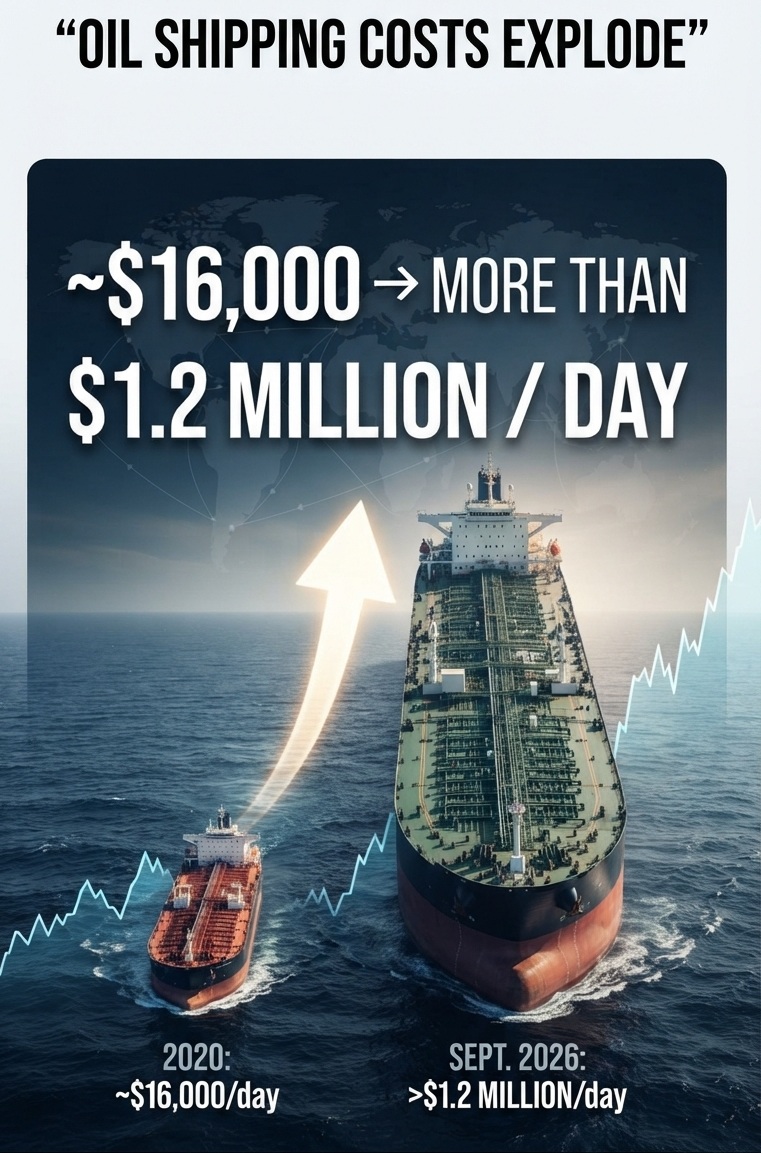
On the benchmark TD3C route — a 270,000-metric-ton Very Large Crude Carrier (VLCC) traveling from the Middle East Gulf to China — daily time-charter-equivalent (TCE) earnings have surged from roughly $16,000/day in 2020 to more than $1.2 million/day in September 2026.

That is not simply a large increase. It represents an extraordinary transformation in the economics of moving oil by sea.

From $16,000 to $1.2 Million a Day

PeriodApprox. TD3C Daily Rate/TCEWhat Was Driving the Market
2020~$16,000/dayPandemic-era demand collapse and abundant tanker capacity
2025~$35,000/day average*Tightening tanker fundamentals, geopolitical rerouting and limited fleet growth
September 2026$1,212,503/dayMiddle East conflict, disruption around the Strait of Hormuz, rerouting and severe tanker scarcity

*McQuilling reported a TD3C average earning of approximately $35,136/day for the first eight months of 2025, rather than $160,000/day.

The 2020 figure is also consistent with contemporary tanker-market estimates. McQuilling projected the TD3C round-trip voyage at approximately $16,200/day for 2020.

Then came 2026.

The $1.2 Million-a-Day Shock

In September 2026, the TD3C benchmark moved into territory rarely seen in modern tanker shipping.

The Baltic Exchange reported that the TD3C rate rose to Worldscale 1,140, corresponding to a round-trip TCE of approximately $1,212,503 per day for a standard Baltic VLCC.

Earlier in September, the same benchmark had already exceeded $1 million/day, with the Baltic assessment reaching approximately $1.099 million/day on September 15.

The surge reflects an extraordinary combination of factors:

  • disruption to Middle Eastern oil-export routes;
  • sharply reduced traffic through the Strait of Hormuz;
  • attacks and security risks affecting regional shipping;
  • longer and more complicated voyages;
  • ships being tied up in shuttle and ship-to-ship operations;
  • and a limited number of immediately available VLCCs.

Reuters reported on September 21 that only 17 commodity vessels transited the Strait of Hormuz over the weekend, compared with 37 the previous week and a pre-conflict average of about 125 vessels per day.

Why Shipping Costs Matter

Oil does not simply move from the wellhead to the refinery.

It has to be transported.

When the cost of transporting a cargo of crude suddenly multiplies, the consequences extend through the entire energy system.

At today’s extreme tanker rates, transportation itself can represent a substantial portion of the delivered cost of crude. The Wall Street Journal reported that VLCC charter costs had exceeded $1 million/day, equivalent to roughly $26 per barrel on the affected voyages.

That means the disruption is not merely a problem for shipowners and oil traders.

It can affect:

oil producers → tanker operators → refiners → fuel distributors → consumers

Higher transportation costs can therefore add pressure to gasoline, diesel, jet fuel and other petroleum products even when the underlying price of crude oil is moving differently.

An Extraordinary Comparison

The scale of the change is easier to see this way:

2020: ~$16,000/day
↓
2025: ~$35,000/day average
↓
September 2026: $1,212,503/day

From the approximate 2020 level to the September 2026 TD3C assessment, the daily TCE increased by roughly 75×.

That is an extraordinary change in the economics of moving a single cargo of oil.

And it demonstrates something important about modern energy systems:

When a critical transportation chokepoint is disrupted, the cost of moving energy can become a crisis of its own.

A market under extreme stress

The current rate should not be interpreted as a normal annual shipping cost. It is a spot-market benchmark during an exceptional geopolitical disruption. Rates can move dramatically in either direction as vessel availability, security conditions, oil flows and trade routes change.

But the magnitude of the September 2026 spike is unmistakable.

The cost of moving oil by VLCC has gone from tens of thousands of dollars per day to more than $1.2 million per day.

That is a remarkable indicator of just how much stress has entered the global oil-transportation system.

bookmark_borderPlug-And-Play Solar

Plug-and-play solar is becoming available around the world—and it could make solar power dramatically simpler and more accessible.

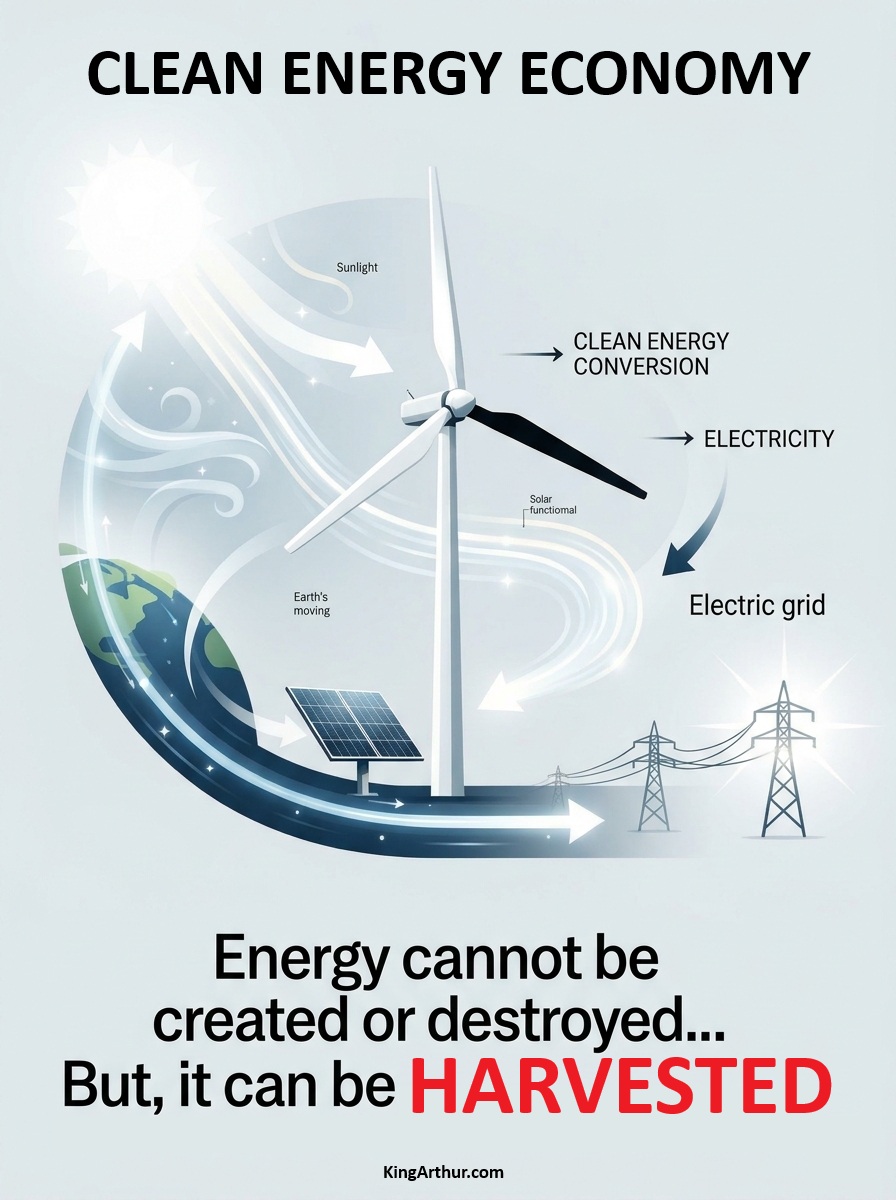
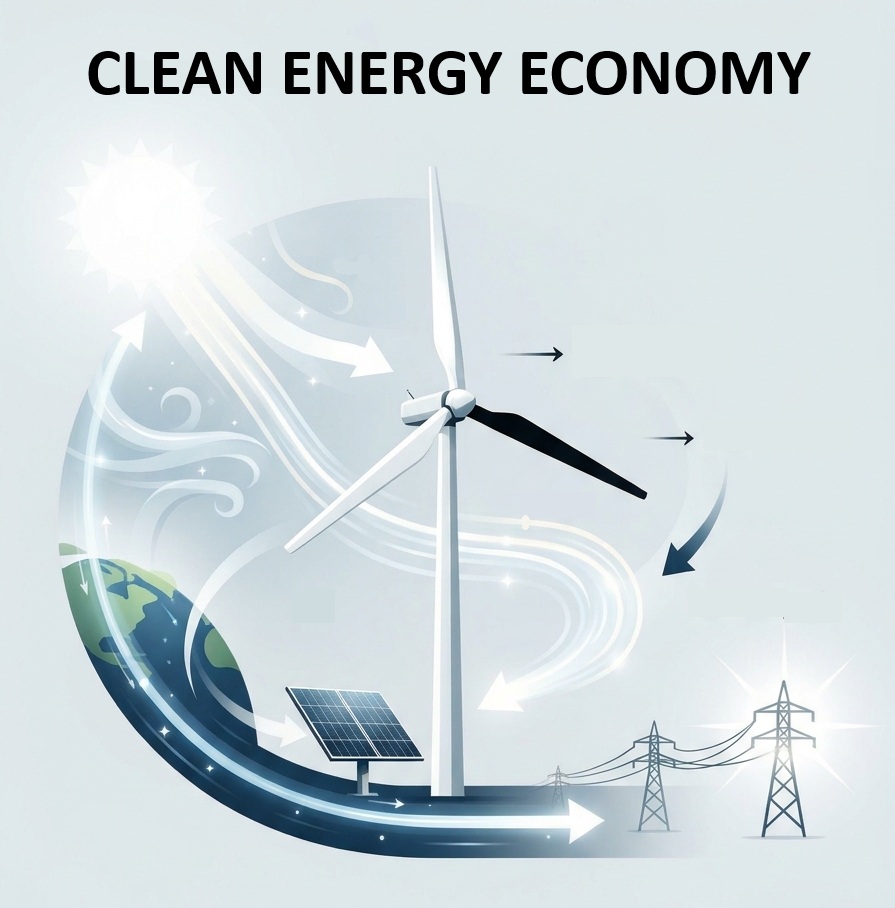
Plug-and-play solar is part of the emerging clean energy economy. Unlike conventional rooftop solar, these small systems can be installed with minimal equipment and, where permitted, connected directly to an existing electrical outlet. That makes solar potentially accessible to renters, apartment dwellers, condominium owners, and homeowners who cannot install a conventional rooftop system.

Cheaper and Healthier

Plug-and-play solar can reduce electricity costs because sunlight is free and the system produces electricity without ongoing fuel purchases. It also generates electricity without the combustion-related air pollutants produced by fossil-fuel power generation.

Instead of buying fuel from a utility to generate electricity somewhere else, a plug-in solar system can capture sunlight right from a balcony, patio, yard, or other suitable location and produce electricity at the point of use.

The basic idea is remarkably simple:

Sunlight → Solar panel → Inverter → Household outlet → Electricity

Great Britain Opens the Door

Great Britain has taken a major step toward making plug-in solar widely accessible. Beginning August 27, 2026, new rules established a legal framework for plug-in solar panels and other plug-in microgenerators.

Under the new framework, qualifying certified systems can connect to standard 13-amp domestic sockets, subject to safety requirements and output limits. Plug-in solar kits can produce up to 800 watts, and users must notify the local electricity network operator. The UK government says the systems could save households up to £110 per year and provide as much as 20% of average household electricity use.

Ofgem has also approved changes to the distribution code intended to facilitate plug-in solar while maintaining requirements for network safety, supply quality, and system operability.

The United States Is Moving State by State

The situation in the United States is less straightforward. There is currently no single nationwide legal framework for plug-in solar. Instead, states are beginning to establish their own rules.

As of September 2026, nine states have enacted legislation specifically addressing plug-in or balcony solar: Utah, Colorado, Maryland, Maine, Vermont, Connecticut, New Hampshire, Virginia, and New Jersey.

Meanwhile, additional states are considering plug-in-solar legislation. California and New York, among others, have active legislative efforts, illustrating how quickly the regulatory landscape is changing.

Plug-and-play solar is therefore more than another solar product. It represents a shift toward small, distributed, consumer-installed energy generation—putting a small power plant within reach of people who may never own a house with a conventional solar roof.

The sun is already there. Plug-and-play solar makes it easier to use.

☀️ THE CLEAN ENERGY ECONOMY

Harmony Hare says:

🔌 PLUG-AND-PLAY SOLAR IS CHEAPER AND HEALTHIER

Solar power doesn’t have to mean a massive rooftop installation.

Plug-and-play solar is changing the equation.

A small solar system can plug directly into an existing electrical outlet—turning a balcony, patio, yard, or other sunny space into a source of clean electricity.

☀️ FREE FUEL
The sun provides the energy. No gasoline. No coal. No natural gas. No ongoing fuel purchases.

💰 LOWER ENERGY COSTS
Generate some of your own electricity instead of buying all of it from the utility.

🌱 CLEANER AIR
Solar electricity generates power without the combustion emissions associated with fossil-fuel generation.

🏠 MORE ACCESSIBLE
Plug-and-play systems can potentially bring solar to renters, apartment dwellers, condo owners, and homeowners who cannot install conventional rooftop solar.

This is the Clean Energy Economy in action:

Small systems.
Simple installation.
Free sunlight.
Less fuel.
Less pollution.
More distributed energy.

The future of clean energy doesn’t have to be complicated.

Sometimes, you just plug it in. ☀️🔌

#CleanEnergyEconomy #PlugAndPlaySolar #SolarPower #CleanEnergy #DistributedEnergy #EnergySavings #RenewableEnergy

→ The Hitchhiker’s Guide to Climate Change

For the basics: Climate Change Simplified

bookmark_borderResidential Solar Power

Traditional Solar Installations

I’m generally against rooftop solar, particularly in the U.S. Much of the residential market is based on leased systems, which can be detrimental to the homeowner, especially when the home is eventually sold.

In general, I also recommend putting a new roof on before installing solar. Otherwise, replacing the roof later can mean additional costs and complications with the solar system. And the payback period can be longer than the length of time many homeowners actually own their homes.

There’s another fundamental problem: in both the U.S. and UK, it can be difficult to install enough rooftop solar to meet a home’s actual electricity demand, particularly during periods of peak heating or cooling. The times when energy demand is highest are not necessarily the times when a rooftop array produces the most electricity. That can make the system less useful—and potentially a liability when selling the property.

As a consultant, I almost always recommend ground-mounted solar when the property allows it. It avoids many of the structural, roofing, maintenance, and resale issues associated with rooftop systems while providing much greater flexibility in system placement and orientation.

In my view, there are very few disadvantages to properly designed ground-mounted solar, while many of the supposed advantages of rooftop solar are really advantages of having solar—not advantages of putting the panels on the roof.

Plug-And-Play Solar

What I’m totally in favor of, however, is plug-and-play solar. Plug-in solar, balcony solar, or other plug-and-play systems can connect directly to an existing electrical outlet, making solar dramatically simpler and less expensive to install. Great Britain has now established a legal framework for these systems: updated regulations taking effect August 27, 2026, created a legal category for plug-in microgenerators and allow certified systems to connect to standard 13-amp domestic sockets, subject to safety requirements, output limits generally up to 800 watts, and notification to the local electricity network operator. Unfortunately, the situation remains much less straightforward in the U.S., where regulation is largely state-by-state. At present, plug-in solar is legal in only nine states: Utah, Colorado, Maryland, Maine, Vermont, Connecticut, New Hampshire, Virginia, and New Jersey.

bookmark_borderClean Energy Economy

by Daniel Brouse

THE ENERGY IS ALREADY THERE.
THE CLEAN ENERGY ECONOMY HARVESTS IT.

Tonight’s homework assignment: Clean Energy Economy.

Energy cannot be created or destroyed. But it can be harnessed, converted, stored, transmitted, and used.

The sun is already delivering enormous amounts of energy to Earth.

The atmosphere is already moving.

Winds are already blowing.

Waves and currents are already moving.

The challenge isn’t creating energy from nothing. It is building systems that efficiently capture naturally available energy and convert it into useful electricity.

That is the basic idea behind a clean energy economy:

SUN + WIND + MOVING EARTH
↓
ENERGY HARVESTING
↓
ELECTRICITY
↓
STORAGE + TRANSMISSION
↓
USEFUL WORK

A wind turbine doesn’t create wind. A solar panel doesn’t create sunlight.

They harvest energy that is already moving through the Earth system and convert it into a form we can use.

The economic opportunity is therefore not simply replacing one fuel with another.

It is building an economy around capturing, converting, distributing, storing, and using energy that is already available.

THE ENERGY IS ALREADY THERE.

THE CLEAN ENERGY ECONOMY HARVESTS IT.

bookmark_borderThe Crack Spread: A Dramatic Shift in Refining Margins

The price difference between a refined petroleum product—such as gasoline or diesel—and the crude oil used to produce it is known as the crack spread. It is a widely used measure of refining margins and provides a useful way to examine how the relationship between crude oil costs and finished-fuel prices changes over time.

Key Market Data & Trends: The Past 12 Months

Looking at the past year reveals a dramatic period of volatility in refining margins.

Fall/Winter 2025 — The Baseline

Through late 2025, crude oil prices remained relatively low, dipping into the $55–$60-per-barrel range. Gasoline prices generally moved in tandem with crude, leaving the simple gasoline crack spread in a relatively compressed, historically typical range of approximately $15–$25 per barrel.

Spring 2026 — The Surge

That relationship changed sharply in spring 2026. Global crude prices climbed aggressively toward a 52-week peak near $117 per barrel. At the same time, wholesale gasoline futures rose substantially, exceeding $3.80 per gallon amid localized refinery bottlenecks and changing supply routes.

The result was a substantial expansion in the spread between the cost of crude and the market price of refined gasoline.

September 2026 — The Current Environment

As of September 16, 2026, WTI crude oil is approximately $104.03 per barrel, while front-month RBOB gasoline is trading around $3.35–$3.45 per gallon.

Converting the gasoline price to a barrel-equivalent basis produces approximately $140.70–$144.90 per barrel. Subtracting the $104.03 WTI price yields a simple gasoline crack spread of roughly $36.70–$40.90 per barrel.

That is substantially wider than the approximately $15–$25-per-barrel range observed during the late-2025 baseline period.

What the Crack Spread Shows

The crack spread does not represent the refinery’s actual profit. Refiners also incur costs for natural gas, electricity, transportation, labor, maintenance, environmental compliance, and other inputs. Refiners also process crude into multiple products rather than simply converting one barrel of crude into one barrel of gasoline.

Nevertheless, the spread provides an important market signal: the price relationship between crude oil and refined gasoline has widened considerably over the past year.

The change is particularly notable because the increase is occurring while crude itself remains above $100 per barrel. Consumers therefore face elevated gasoline prices from two directions: a high underlying crude-oil cost and a substantially wider refining margin.

In other words, the question is no longer simply “How expensive is crude oil?” It is also “How much more expensive has the refined product become relative to its crude-oil input?”

The crack spread provides a way to quantify that difference.

bookmark_borderClimate Debt Collection

What happens when we miss the 1.5°C Paris target?

Think of it like owing money to a loan shark.

The debt doesn’t wait decades to be collected.

Our fingers are being broken now.
Our kneecaps are next.

One of the biggest challenges in communicating climate change is proximity—both in time and location.

If the consequences seem far away, people dismiss them.

If they’re happening somewhere else, people ignore them.

But climate change is moving from:
future → present
and
somewhere else → right here.

We missed the 1.5°C Paris target. The climate debt is already being collected.

How much pain do we need to feel before we pay attention?

bookmark_borderAbout the Price of Oil: The Price You Don’t See

What Does a Barrel of Oil Cost—and What Does It Mean to You?

When you hear the price of oil reported on the news, you are usually hearing the futures price.

But what does that number actually mean?

The futures price is essentially a “paper” price. Very little physical oil actually changes hands through the futures market. The price that matters to consumers and businesses buying and using petroleum products is the spot price—the price of physical oil being purchased today. And right now, there is a significant difference between the two.

Today, the futures price of oil is roughly $102–$107 per barrel. But the spot price—the actual price being paid for physical oil—is approximately $125–$150 per barrel.

That is the price that ultimately matters to everyone buying refined petroleum products, including gasoline, diesel, and heating oil.

The Pain at the Pump

This is why diesel has reached approximately $6 per gallon, making it the highest price in history. It is also why gasoline is currently averaging approximately $4.32 per gallon. Yes—this is the highest average gasoline price ever recorded for this time of year.

And what’s next?

Heating oil.

As we move toward the winter months, parts of the Northern Hemisphere are already seeing heating oil prices averaging between $5.15 and $5.75 per gallon. Yes. Just like gasoline, heating oil is trading at an absolute record high for the month of September.

Historically, heating oil prices have hovered around $3.50 to $4.00 per gallon during a typical winter season. The current offseason surge above $5.00 per gallon is unprecedented. And this is happening before winter has even arrived.

For millions of households that depend on heating oil, the implications are obvious. The price shock at the pump can become a much larger household energy shock when temperatures fall and heating demand rises.

Adding Fuel to the Fire

There is another problem developing in the background. Oil borrowed from the Strategic Petroleum Reserve (SPR) under the 2026 emergency exchanges is scheduled to be repaid in tranches between November 1, 2026, and September 30, 2028.

Under the 2026 SPR emergency exchange program managed by the U.S. Department of Energy (DOE), companies are contractually required to return approximately 1.18 to 1.24 barrels for every barrel they borrowed.

In other words, oil that was taken out of the reserve during an emergency must eventually be replaced—and companies are not simply returning the same amount of oil they received. They have to return more. That creates another future demand on the physical oil market.

So when you look at the oil price reported on television, don’t assume that the futures number tells the whole story.

The price of oil isn’t just a number on a screen.

It flows directly through the economy. It becomes diesel. It becomes gasoline. It becomes heating oil. It becomes transportation costs, food costs, manufacturing costs, electricity costs, and ultimately the cost of living.

And if physical oil is already trading substantially above the futures price, while heating demand is about to increase and SPR repayment obligations are beginning to come due, the question isn’t simply:

“What does oil cost today?”

The more important question is:

“What is the price of oil going to cost you tomorrow?”