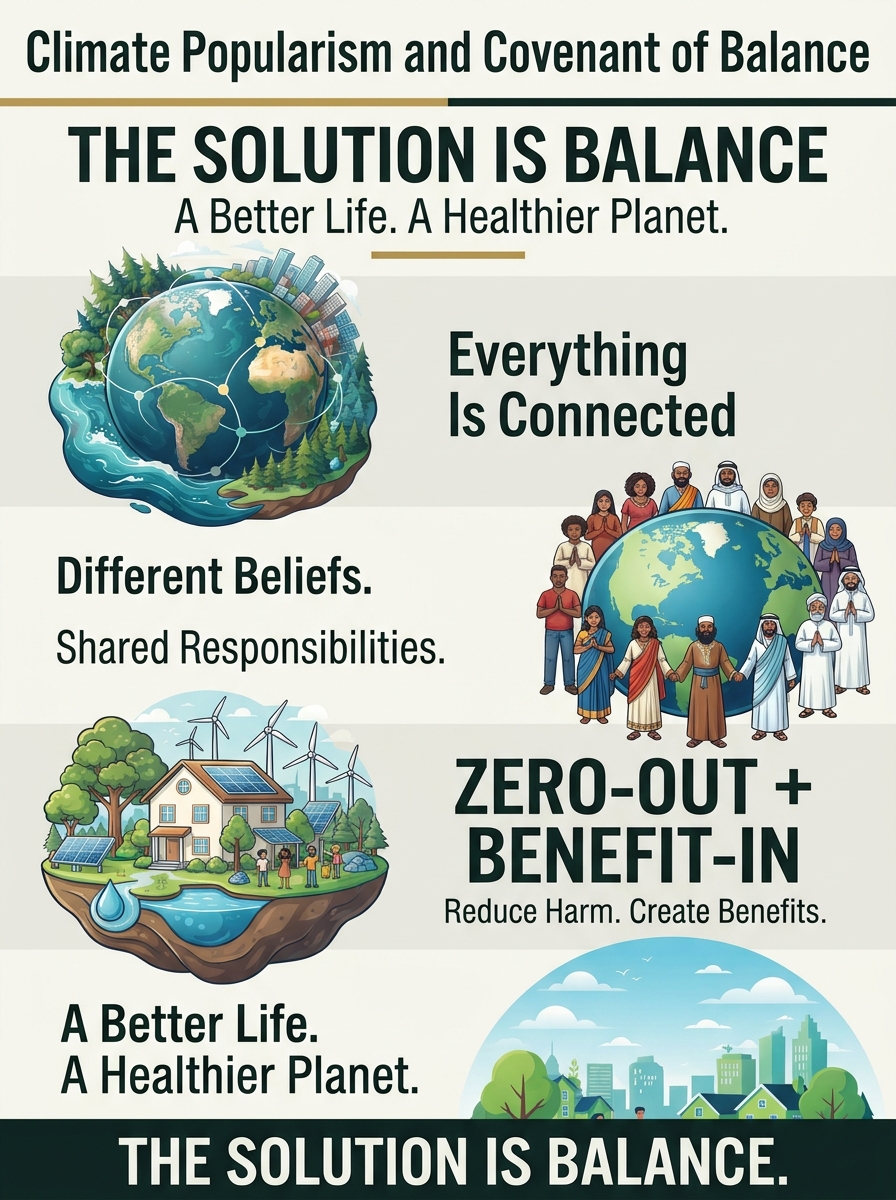
A Practical Path to a Healthier Planet and a Better Life
Climate change is more than a problem of rising temperatures. It affects our homes, food supplies, health, economy, and the natural systems that support life. Addressing it requires science, practical solutions, shared values, and cooperation.
But there is a challenge: people are busy trying to make ends meet. They have bills to pay, families to support, and communities to protect. Climate action must address these everyday concerns if it is to gain lasting public support.
Two complementary ideas offer a way forward: Climate Popularism and the Covenant of Balance.
Start With What Matters to People
Climate Popularism, developed by Caroline Lucas and Rupert Read, argues that climate action should connect with the things people care about most.
Lower energy bills. Affordable food. Reliable transportation. Comfortable homes. Cleaner air and water. Safer communities.
These are not separate from climate action. Many practical improvements can help meet these needs while also reducing pollution and preparing communities for future risks.
For example, improving home insulation can reduce energy use and heating costs. Better public transportation can make travel more affordable. Protecting forests and restoring natural areas can support wildlife, protect water supplies, and help communities manage heat and flooding.
The goal is to make climate action useful in people’s daily lives.
What Does Balance Mean?
The Covenant of Balance builds on this practical approach by connecting climate science with shared ethical principles.
Earth is an interconnected system. The atmosphere, oceans, forests, soils, and living things all affect one another. Human life and our economy depend on these systems working well.
Climate change is one sign that this system is being pushed out of balance.
Earth receives energy from the Sun and releases energy back into space. Greenhouse gases from human activities trap additional heat, causing Earth’s climate system to gain energy. The oceans absorb most of this excess heat, while temperatures rise, ice melts, sea levels increase, and ecosystems change.
These effects can also interact. For example, when ice melts, darker surfaces are exposed. These surfaces absorb more sunlight, adding further warming.
Understanding these connections helps explain why reducing greenhouse gas emissions and protecting natural systems are both essential.
Balance does not mean that nature must never change. It means respecting the conditions that allow people and other living things to thrive.
Integrated Climate Stewardship: ZERO-OUT + BENEFIT-IN
Integrated Climate Stewardship’s guiding formula is simple:
ZERO-OUT + BENEFIT-IN
ZERO-OUT means reducing actual sources of harm. This includes cutting greenhouse gas emissions, wasting less energy, reducing pollution, and using fewer resources when doing so makes sense.
BENEFIT-IN means choosing improvements that also provide real benefits to people. These may include lower bills, better comfort, improved health, stronger local economies, and greater protection against extreme weather.
Consider a home that uses less energy for heating and cooling. The household may save money while also reducing pollution associated with energy use. A community that reduces food waste can save resources and lower disposal costs. A town that protects trees and improves stormwater management can create healthier neighborhoods while reducing certain local risks.
Not every project will produce every benefit. Costs, safety, local conditions, and actual environmental results must be considered.
The important point is to look for solutions that work in the real world.
Balance the Economy With the Environment
A healthy economy depends on healthy natural systems. Businesses need reliable supplies of water, energy, food, materials, and other resources. Communities need safe homes, functioning infrastructure, and a healthy population.
Economic growth that ignores environmental damage can create costs that others must eventually pay.
A better approach asks whether an activity meets a real need, whether it can be done with fewer resources, and whether its benefits justify its full costs.
This does not require rejecting markets, business, economic growth, or new technology. It means accounting for environmental damage rather than treating it as someone else’s problem.
Practical climate solutions should also consider fairness. Families with limited incomes may struggle to afford improvements even when those improvements would save money over time. Public programs, better financing, and community cooperation can help make effective solutions accessible to more people.
From Individual Action to Community Progress
Personal choices matter, but individual households cannot solve climate change by themselves.
Electricity generation, industry, transportation, agriculture, buildings, and public policy all play important roles. Businesses and governments must also reduce pollution and invest in practical improvements.
Communities can help by sharing useful information, improving public infrastructure, supporting vulnerable residents, and measuring progress openly.
The same standard should apply to everyone: look at the results.
Are emissions falling? Is energy being used more efficiently? Are costs manageable? Are communities becoming safer? Are natural systems being protected?
Good intentions are important, but measurable results are essential.
The Solution Is Balance
Climate Popularism offers a way to connect climate action with people’s everyday needs. The Covenant of Balance adds a broader ethical foundation, bringing together science, economics, environmental responsibility, and shared values.
Integrated Climate Stewardship provides the practical link between them: reduce actual harm while seeking measurable benefits for people and the planet.
We do not need to agree on every political, religious, or economic question to make progress. We need to recognize that our choices affect one another and that our long-term well-being depends on the natural systems that sustain us.
The goal is not to make people choose between a healthy planet and a better life.
The goal is to build a future in which protecting the planet helps people live healthier, safer, more affordable, and more fulfilling lives.
Different beliefs. Shared responsibilities. Practical solutions.
The solution is balance.
See:
Climate Popularism: https://assets.climatemajorityproject.com/Climate%20popularism%206Oct26.pdf
Covenant of Balance: https://www.kingarthur.com/global_warming/Covenant-of-Balance.html