by Daniel Brouse and Sidd Mukherjee
Do you have homeowners insurance? If you answered yes, do you know what is actually covered when climate change and extreme weather damage your property?
Most homeowners insurance policies exclude major categories of extreme weather damage, including flooding, while coverage for wind, hurricanes, and other hazards may be subject to significant limitations and exclusions. These restrictions are becoming more prevalent, creating one of the most significant emerging systemic risks to the global financial system.
In the United States, roof coverage is a particularly important concern. Many homeowners policies restrict roof-damage compensation through exclusions, depreciation provisions, actual-cash-value settlements, deductibles, or other limitations. Depending on the policy, a homeowner may have little chance of receiving enough compensation for a completely new roof, even when the damage is covered. As wind-related risks and losses intensify, these restrictions can leave homeowners responsible for an increasing share of repair and replacement costs.
The same principle applies to automobile insurance. If a tree is blown onto your car during a severe storm, are you covered? The answer depends on your policy, including whether you carry comprehensive coverage and whether any exclusions or limitations apply.
Climate change is already disrupting insurance markets, and the consequences extend far beyond rising premiums. Insurers are increasing prices, restricting coverage, declining renewals, and withdrawing from markets. These developments are creating growing financial vulnerabilities for homeowners, mortgage lenders, investors, businesses, and governments.
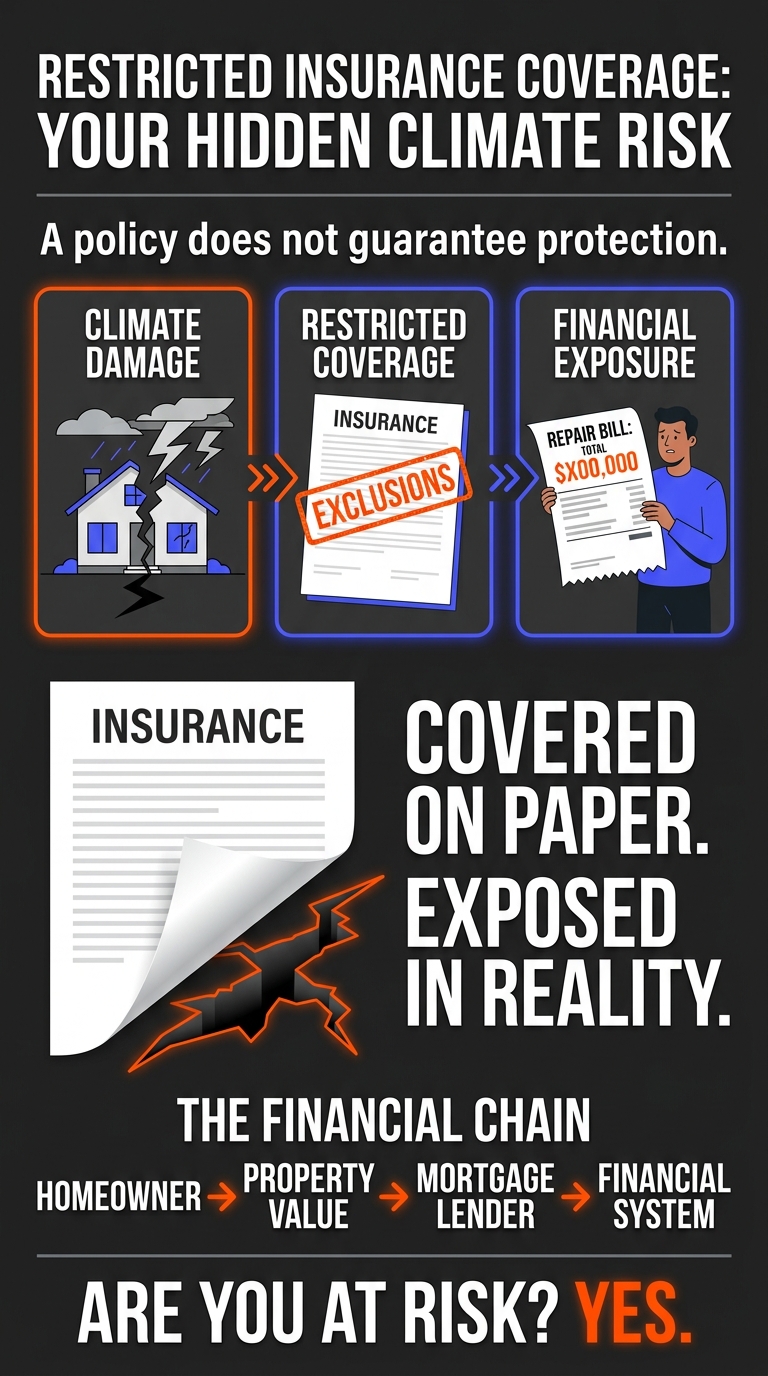
One of the most dangerous—and least understood—parts of this crisis is the expansion of restricted coverage. When an insurer refuses to cover a property, the problem is obvious. When a policy remains in force but excludes important risks, limits payouts, or imposes conditions that leave substantial losses uncovered, the danger is hidden. Homeowners may continue paying premiums believing they are protected, only to discover after a disaster that their policies do not cover the damage they suffered.
This is the delayed-disclosure trap: the financial vulnerability exists before the disaster, but its full consequences may not become apparent until a claim is denied or severely limited. By then, the homeowner may face repair costs, continuing mortgage obligations, and a damaged property without the insurance proceeds expected to cover the loss.
Restricted coverage can therefore undermine property values and mortgage security even when insurance remains available. A property may appear insured on paper while carrying substantial uninsured exposure. As these gaps widen, the distinction between having an insurance policy and having adequate financial protection has become increasingly important.
These developments are part of a larger system of interconnected feedbacks. Climate-related losses drive insurance costs higher and encourage insurers to limit their exposure. Higher costs and narrower protection weaken housing affordability and can depress property values. Declining property values and inadequate coverage increase financial risks for lenders and investors. When private insurance retreats, more costs shift to homeowners, businesses, and governments. These additional burdens can weaken the financial resources needed to prevent, withstand, and recover from future climate-related losses.
The central finding is that this feedback crisis is already underway. Rising premiums, insurance withdrawals, coverage restrictions, and growing exposure to uninsured losses are observable market developments. The interactions among these forces create additional risks that can reinforce one another, extending climate-related financial stress well beyond the locations directly affected by disasters.
The ultimate danger is not simply that insurance becomes more expensive. It is that insurance increasingly fails to provide the protection that households, lenders, and financial markets depend on. As this happens, climate risk has become a broader housing, credit, and economic crisis.
The Feedback Crisis Has Already Begun
The Whistleblower Warning: A Campaign to Expand Restricted Coverage
A memo by insurance-industry whistleblowers documents a disturbing development: the insurance industry is already well underway in what the whistleblowers characterize as a subversive campaign to expand restricted coverage, shifting financial risks onto homeowners without their full awareness.
The significance of this warning cannot be overstated. The expansion of restricted coverage changes the nature of the insurance crisis. The problem is no longer limited to rising premiums, canceled policies, or insurers refusing to cover high-risk properties. It also involves the erosion of protection within policies that homeowners continue to purchase and rely upon.
When insurers restrict coverage through exclusions, payout limitations, depreciation provisions, and other policy conditions, they can reduce their own exposure while transferring a greater share of potential losses to policyholders. When those restrictions are not adequately understood by homeowners, the transfer of risk can occur without a corresponding understanding of the financial consequences.
This creates a fundamental imbalance. Homeowners continue paying premiums and may reasonably believe they have protection against major property losses. Yet the actual terms of their policies may leave them responsible for substantial costs following a disaster. The gap between perceived protection and actual coverage can remain hidden until a claim is denied or the insurance payment falls far short of the amount needed to repair or replace damaged property.
The whistleblower warning therefore adds a critical dimension to the delayed-disclosure trap. Financial exposure is not simply increasing because climate-related disasters are becoming more costly. It is also increasing because the insurance protection intended to absorb those losses is being restricted, potentially without homeowners fully recognizing the changes.
The systemic consequences extend beyond individual households. Mortgage lenders may hold collateral whose owners cannot adequately insure or repair it. Investors may underestimate the uninsured exposure embedded in real estate portfolios. Communities may face declining property values and a growing burden of unrecoverable losses. When private insurance transfers more risk to homeowners, the resulting costs do not disappear. They are redistributed through household finances, mortgage markets, lending institutions, businesses, and ultimately, in some circumstances, governments and taxpayers.
This is the critical distinction: an insurance policy can remain active while the financial protection it provides deteriorates. Consequently, policy counts and insurance availability alone can understate the growth of climate-related financial risk.
The whistleblower allegations point to the need for scrutiny not only of insurance prices and market withdrawals, but also of how coverage restrictions are introduced, disclosed, and enforced. Regulators and policymakers must examine whether homeowners can readily understand the risks they are assuming, whether policy changes are adequately communicated, and whether the actual protection provided remains consistent with reasonable expectations.
If the documented practices are as extensive as the whistleblowers contend, the expansion of restricted coverage represents more than an insurance-market adjustment. It is a mechanism through which climate-related financial risk is being transferred to households while remaining largely concealed from homeowners, lenders, investors, and the broader financial system.
That makes restricted coverage a particularly dangerous link in the climate feedback crisis. The physical risk can increase, the financial protection can weaken, and the resulting vulnerability can remain hidden until a disaster exposes the full extent of the loss.
The Protection Gap Is a Critical Link in the Climate Feedback Crisis
The climate-insurance crisis is already unfolding. Rising premiums, restricted coverage, nonrenewals, and insurer withdrawals are changing the financial risks associated with property ownership. These are not merely forecasts of what might happen in a warmer future. They are observable developments whose economic consequences are already being felt.
Restricted coverage deserves particular attention because it can conceal financial exposure rather than eliminate it. When a policy excludes an increasingly important hazard, limits the amount payable, or imposes conditions that prevent a full recovery, the homeowner may remain exposed even while paying for insurance. The inadequacy of that protection may not become apparent until a disaster triggers a claim.
This delayed disclosure creates a dangerous mismatch between perceived security and actual financial resilience. Homeowners may believe their properties are protected. Mortgage lenders may assume that required insurance adequately safeguards their collateral. Investors may underestimate the exposure embedded in real estate portfolios. Yet a property with substantial uninsured risk can suffer serious financial damage even when an insurance policy remains active.
The consequences can reinforce one another. Climate-related damage increases insurance losses. Insurers respond through higher premiums, tighter policy terms, exclusions, and withdrawals. These changes increase ownership costs and expose homeowners to losses they cannot readily absorb. Property values and mortgage security can weaken, while financial distress, defaults, repair costs, and public financial obligations may rise. Governments and taxpayers can then inherit a larger share of the burden.
The feedback does not end there. When households, businesses, lenders, and governments must devote more resources to recovering from losses, fewer resources may remain available for risk reduction, resilience, and adaptation. If that shortfall leaves communities more vulnerable to subsequent disasters, future losses can grow, further intensifying insurance-market stress and financial instability.
This is the feedback mechanism at the heart of the crisis: climate risk increases financial vulnerability, and financial vulnerability is making society less capable of managing the next climate-related loss.
The appropriate response must therefore go beyond monitoring premiums and counting policy cancellations. Regulators, insurers, lenders, and policymakers need to examine what policies actually cover, how exclusions are changing, whether coverage limits remain adequate, and how much risk is being transferred to households and the public. Insurance availability alone is not a sufficient measure of financial protection.
The evidence establishes the need to take the observed disruption seriously and to investigate how its interacting effects are evolving. The precise scale and timing of future financial consequences remain uncertain, but the underlying feedback mechanisms are already visible. Waiting for the full consequences to emerge would mean waiting until hidden financial exposures become actual losses.
The critical question is no longer simply whether homeowners can obtain insurance. It is whether the insurance they can obtain will actually protect them when disaster strikes. As restricted coverage expands, the gap between insured property and adequately protected property has become one of the most consequential—and least visible—channels through which climate change destabilizes the economy.
Insurance can redistribute financial losses, but it cannot eliminate the physical risks that generate them. When those risks undermine the financial systems that support property ownership, lending, and investment, climate change becomes a systemic economic problem.
The insurance feedback crisis has already begun. Whether it remains manageable or develops into much broader financial instability depends on how quickly society recognizes these connections, exposes hidden coverage gaps, and acts to reduce the underlying risks.