bookmark_borderFeedback Loops: How They Accelerate Global Warming

By Daniel Brouse and Sidd Mukherjee

In the 1990s, the Membrane Domain initiated groundbreaking research on human-induced climate change, challenging the prevailing linear models of global warming. Our research introduced a nonlinear, exponential model—akin to the shape of a bathtub curve or hockey stick—which has since been repeatedly confirmed by real-world data.

At the heart of this acceleration are feedback loops, also known in climate science as positive feedback mechanisms. These are processes where an initial change in a system leads to additional changes that reinforce and amplify the original effect, setting off a self-reinforcing cycle. Though technically termed “positive,” their consequences for the planet are overwhelmingly negative.

Arctic Feedback Loops: The Ice-Albedo Crisis

One of the most well-documented feedback loops involves the melting of Arctic sea ice. Ice and snow reflect sunlight (a property called albedo), helping keep the planet cool. But as global temperatures rise and ice melts, darker ocean surfaces are exposed. These surfaces absorb more heat, further warming the oceans, accelerating ice loss, and releasing trapped greenhouse gases—especially methane, a gas more than 80 times more potent than CO₂ over a 20-year period.

A 2022 study published in Nature found the Arctic is warming nearly four times faster than the global average since 1979. That warming feeds into multiple simultaneous loops:

  • Ice-Albedo Loop: Loss of reflectivity speeds up warming.

  • Ocean Heating Loop: Warmer oceans melt more ice.

  • Methane Release Loop: Thawing permafrost and seafloor methane seeps intensify greenhouse effects.

Snow-Albedo and Greenland’s Darkening Ice Sheet

Another feedback loop is the snow-albedo loop. A warmer atmosphere leads to more rain and less snow. Less snowfall means less surface reflectivity, which leads to increased heat absorption and more warming.

In Greenland, NASA has tracked how the ice sheet has been darkening over the past two decades. During warmer summers, fresh snow disappears, exposing older, impurity-laden snow and larger snow grains that absorb more sunlight. The result: accelerated melt and rising sea levels.

Wildfires, Lightning, and Brown Carbon

A dangerous and expanding set of feedback loops involve wildfires, lightning, and brown carbon:

  • Warmer temperatures lead to more lightning, which sparks more forest fires.

  • Forest fires release vast amounts of CO₂ and brown carbon (a form of organic carbon with low albedo), further warming the atmosphere.

  • Brown carbon settles on ice and snow, darkening surfaces and accelerating melt.

According to Forests at Risk Due to Lightning Fires, 77% of forest fires in intact forest regions outside the tropics are now started by lightning. The number of strikes is expected to rise by 11–33% per degree of warming.

Prof. Sander Veraverbeke, Vrije Universiteit Amsterdam, warns:

“Thousands of lightning strikes in remote forests can spark hundreds of small fires. These merge into mega-fires—blazes the size of small countries. Once they reach this scale, they’re nearly impossible to stop.”

The Canadian wildfires of 2023 exemplify a crossed tipping point: they released more CO₂ than the annual emissions of all but three countries. In some places, permafrost is now burning year-round.

Permafrost Thaw and the Methane Bomb

Permafrost, long considered a stable carbon sink, is thawing rapidly, releasing methane and CO₂ into the atmosphere. This creates a powerful and terrifying loop:

  • Warming thaws permafrost.

  • Thawed permafrost emits methane and CO₂.

  • These emissions intensify warming.

  • Which thaws more permafrost.

This “methane bomb” effect could release hundreds of gigatons of carbon, pushing the climate system into uncharted territory.

Water Vapor: The Master Feedback Loop

The most dominant feedback loop is water vapor. As CO₂ warms the Earth, the atmosphere can hold more moisture. Water vapor itself is a potent greenhouse gas, amplifying the greenhouse effect. This leads to more warming, more evaporation, and thus, more water vapor.

This also intensifies precipitation events. Studies like A Harder Rain Is Falling and The Reign of Violent Rain show that storms are becoming more extreme, more sudden, and more destructive—another feedback loop fueled by warming.

Summary of Major Feedback Loops


Feedback Loop Mechanism Amplifying Effect
Ice-Albedo Melting ice exposes darker surfaces More heat absorption, more ice melt
Water Vapor Warmer air holds more moisture Increased greenhouse effect
Permafrost Thaw Thawing releases methane and CO₂ More warming, more thawing
Vegetation Loss Fewer plants absorb CO₂ More CO₂ in the atmosphere
Brown Carbon Deposits on snow reduce albedo Accelerated melt and warming
Forest Fires Fires release CO₂ and dark particles Warmer temps trigger more fires
Lightning More warming increases lightning More fire ignition events

Conclusion: The Dangerous Dance Between Feedback and Tipping Points

Feedback loops are not just theoretical—they are active, compounding, and interlinked. Many of them are already accelerating the breakdown of Earth’s climate systems.

When feedback loops interact with tipping points—critical thresholds beyond which irreversible change occurs—they can trigger cascading effects. These Domino Effects can cause widespread ecological collapse and rapid shifts in climate much faster than models predict.

Understanding these loops is not just an academic exercise. It’s a survival imperative. Stopping emissions is no longer enough—we must now act to halt the self-reinforcing feedbacks that threaten to run out of control.

URGENT CLIMATE WARNING
Our latest climate model — now incorporating complex social-ecological feedback loops within a dynamic, non-linear system — projects that global temperatures could rise by up to 9°C (16.2°F) within this century. This far exceeds earlier estimates, which predicted a 4°C rise over the next thousand years, and signals a dramatic acceleration of warming.

At this level of heating, large regions of the planet will become uninhabitable due to extreme heat, sea level rise, agricultural collapse, and mass migration. Critically, parts of the U.S. are already experiencing wet-bulb temperatures approaching or exceeding 31°C (87.8°F) — a physiological limit beyond which the human body can no longer regulate its internal temperature, even in the shade with ample water.

This is no longer a distant threat. The climate system is entering a phase of compound risk and cascading collapse — and we are already seeing the early signs.

Immediate, radical mitigation and adaptation efforts are now essential to preserve habitable zones, food systems, and public health.
Tipping points and feedback loops are parts of an equation that determine the rate of acceleration in climate change.

The Human Induced Climate Change Experiment

bookmark_borderThe Race Against Time: Climate Crisis vs. the United States

by Daniel Brouse
April 12, 2025

Abstract
Humanity stands at a historic crossroads where the accelerating pace of climate change threatens to overtake both our capacity for response and the viability of the global economic system itself. Recent models indicate that without immediate intervention, climate change could cause the collapse of capitalism as we know it—potentially as soon as 2050. At the same time, U.S. political developments—particularly Trump-era trade, fiscal, and environmental policies—may unintentionally hasten this collapse. The central question becomes: Will the U.S. economic system implode before climate change forces its hand, or has irreversible damage already been done?

I. Climate Change: From Hypothesis to Imminent Catastrophe

In the 1990s, we proposed a hypothesis: that climate change would not follow a linear trajectory but would instead accelerate non-linearly—driven by feedback loops such as polar ice melt, permafrost thaw, ocean acidification, and carbon release from soil and forests. Over the following decades, this hypothesis evolved into an established scientific theory, now widely accepted by the international scientific community.

Through collaboration with a physicist from Ohio State University, we observed a startling trend in the “doubling time” of climate impacts. Originally pegged at around 100 years, this timeframe has since shrunk to 10 years, and now—alarmingly—approaches just 2. That means climate-related damages could be 64 times worse a decade from now than they are today. These aren’t worst-case scenarios; they are conservative models assuming no further acceleration.

Our latest models integrate not only geophysical systems but also social, political, and economic feedback loops. The results are grim: we now forecast a potential 9°C rise in global temperatures within this century—a rate that would make much of the planet uninhabitable and render large-scale human migration and system failure unavoidable.

II. A New Threat Emerges: Trumpenomics and the War on Global Stability

Ironically, the Trump administration—through its aggressive trade, credit, and isolationist policies—has accelerated the very breakdown of capitalism that climate change is expected to cause.

The imposition of widespread tariffs, especially those based on falsified “reciprocal” trade deficits, has triggered not just a trade war, but a credit war. This combination has never before been tested in modern economic history. During Trump’s first term, the stage was set. Now, in his second term, the global economy is being subjected to a real-time, uncontrolled experiment.

The administration’s “drill, baby, drill” energy policy, paired with unprecedented regulatory rollbacks, has only deepened the climate crisis. Yet, from an economic systems perspective, it is the trade and credit dislocations that may deliver the first major blow.

III. Global Trade, Capital Flows, and the Liquidity Death Spiral

Most people think of tariffs as mere taxes on goods. But in today’s complex financial system, their impact extends far beyond the shipping yard.

When the U.S. imports less, foreign exporters earn fewer dollars. This reduces their ability to invest in U.S. Treasuries—the bedrock of the global financial system. As demand for Treasuries falls, yields rise, borrowing costs spike, and credit conditions tighten. This sets off a self-reinforcing liquidity crisis, undermining everything from consumer lending to corporate investment.

The risk is real and growing: a scenario where the U.S. dollar loses its global reserve status is no longer the stuff of academic theory. Should this occur, the fallout would include:

  • Exploding U.S. borrowing costs

  • A collapse in consumer purchasing power

  • Capital flight from U.S. markets

  • Severe contraction in both trade and credit

  • Domestic political and social unrest on a scale not seen in modern history

IV. The Tipping Point: Will Climate Collapse or Economic Collapse Win the Race?

The economic trajectory of the U.S. under Trump’s policies suggests that a post-capitalist transition may be triggered by domestic fiscal instability rather than climate catastrophe alone. In other words, the United States may be the first nation to economically implode under the dual weight of environmental and self-inflicted economic collapse.

Complicating matters, the U.S. is simultaneously dealing with aging infrastructure, mounting national debt, deteriorating public health, climate-related disasters, and rising political extremism—all of which erode resilience and reduce the chances of a coordinated national response.

This raises a chilling question: Will the collapse of the U.S. economy accelerate faster than climate change itself—or are we already too late to avoid either fate?

The U.S. dollar’s decline from global dominance — driven by unprecedented political dysfunction and fiscal recklessness — is unraveling the myth of American exceptionalism. Once the cornerstone of international finance, the United States now risks becoming a net liability to the world economy. Paradoxically, this economic unraveling may carry a sliver of hope. If Trump’s economic collapse marks the end of mass consumption, over-leveraged capitalism, and fossil fuel dependency, it could trigger a sharp drop in global emissions and slow the pace of climate change. Such a forced degrowth scenario–where contraction curbs carbon output–might buy humanity precious time to adapt, innovate, and survive. But this path would come at a steep cost: to livelihoods, political stability, and America’s standing in the world.

Conclusion: What Comes After?

Regardless of which crisis arrives first, one outcome is increasingly likely: the U.S. standard of living will fall sharply, and life expectancy may follow. Whether that post-collapse society can still be sustainable—or even enjoyable—will depend on the decisions we make in the next few years.

Our only hope is to treat this as a true “race against time” and respond with urgency, humility, and collective will. The future depends not just on science and economics, but on whether we can choose survival over ideology, cooperation over conflict, and truth over convenience.

The Human Induced Climate Change Experiment

bookmark_borderWhen Hypothesis Becomes Theory: Trump’s Trade War Has Triggered a Global Credit War

by Daniel Brouse
April 11, 2025

For decades, economists have quietly asked a disturbing hypothetical: What happens if the U.S. launches a trade war and a credit war at the same time? It was an academic curiosity — a thought experiment for textbooks, not real life. Until now.

Donald Trump has turned that hypothesis into reality.

During Trump’s first term (Trump 1.0), he laid the groundwork — tearing up trade agreements, undermining global institutions, and threatening America’s economic alliances. But now, in Trump 2.0, he’s gone from testing the waters to executing a full-scale economic experiment on a global stage.

What was once theory is now practice. And the world is starting to buckle under the strain.

Trade War Meets Credit War: A Dangerous Combination

Most people think of tariffs as isolated tools — a tax on imported goods here, a protectionist policy there. But in a global economy powered by complex capital flows, the consequences are far more sweeping. Tariffs don’t just hit goods — they hit trust, stability, and most importantly: liquidity.

By weaponizing trade, Trump has triggered a second, even more dangerous war: a global credit war.

Here’s why that matters.

The U.S. dollar has long been the world’s reserve currency because global trade flows through it. Countries that export goods to the U.S. accumulate dollars — and those dollars flow right back into U.S. assets like Treasury bonds. That system keeps interest rates low, funds U.S. debt, and stabilizes the global economy.

But what happens when that trade flow is deliberately choked off?

The Early Signs of System Failure

If foreign countries export less to the U.S., they earn fewer dollars. If they have fewer dollars, they buy fewer U.S. Treasuries. And if they buy fewer Treasuries, U.S. borrowing costs go up — triggering higher interest rates, tighter credit, and financial instability.

This is not just a theoretical concern anymore. We are seeing early evidence that this credit war is underway:

  • Bond market liquidity is evaporating.

  • Foreign demand for U.S. Treasuries is declining.

  • Global central banks are diversifying away from the dollar.

  • Gold, commodities, and non-dollar assets are surging.

  • Interest rates are rising — not because of growth, but because of risk.

Chaos Theory in Action

This is a classic example of a complex, non-linear dynamic system at work — the domain of chaos theory. The parts are all connected, but not in simple, linear ways. A shock in one area — tariffs — is now producing unpredictable disruptions in areas that may seem unrelated but are fundamentally tied together.

The variables in this system include:

  • The value of the U.S. dollar

  • U.S. debt and Treasury markets

  • Interest rates (both domestic and global)

  • Inflation and deflation pressures

  • Recession — or worse, depression

  • Foreign cash flows and investment patterns

  • Trade wars and their escalation

  • Climate disasters exacerbating supply shocks

  • Immigration pressures triggered by economic collapse

The Big Question: What If the Dollar Loses Its Reserve Status?

Ultimately, the darkest scenario is no longer unthinkable: What happens if the U.S. dollar loses its status as the world’s reserve currency?

This would unleash a profound economic reset, marked by:

  • Exploding U.S. borrowing costs

  • A collapse in consumer purchasing power

  • Global capital flight from U.S. assets

  • Severe contraction in both trade and credit

  • Domestic political and economic instability unlike anything in modern history

Conclusion: We Are In the Experiment Now

This is no longer just economic theory.

This is real.

Trump’s trade war has metastasized into a global credit war. The feedback loops are forming. The shocks are compounding. And the system is starting to behave exactly as economists long feared: chaotically, violently, and unpredictably.

Welcome to the experiment. We’re all in it now. The only question left is whether the damage is reversible — or if we’ve already crossed the tipping point.

Capital Preservation During Trumpenomics

The Inevitable Collapse: How Trump’s Policies and Climate Neglect Will Reshape the Economy

Trumpenomics: The Decline of the US

bookmark_borderThe Destructive Legacy of Trump’s Climate and Economic Policies: A Call for Urgent Action

by Daniel Brouse
April 9, 2025

Donald Trump’s dismissal of climate science and his aggressive promotion of fossil fuel extraction have resulted in a harmful and increasingly unsustainable energy policy. By labeling climate change as a “hoax” and referring to policies designed to combat it as “The Green New Scam,” Trump has ignored the overwhelming scientific consensus that climate change is real and accelerating. His catchphrase, “Drill, Baby, Drill,” is emblematic of an energy policy that favors short-term profits from fossil fuel extraction over the long-term health of the planet. This approach has not only worsened the climate crisis but has also contributed to growing economic instability. If left unchecked, the policies enacted during Trump’s administration will likely render the planet uninhabitable for future generations, causing irreversible damage to both the environment and the economy.

Trump’s Climate-Defying Actions: A Clear Threat to the U.S.

One of the most glaring examples of Trump’s failure to address climate change is his active support for policies that encourage fossil fuel extraction, even in the face of overwhelming evidence of its destructive impacts. While news broke about a major leak in the Keystone pipeline, causing widespread environmental damage, Trump was busy pandering to coal executives at a Republican fundraiser, celebrating the reopening of coal mining on public lands. At the same time, his Energy Secretary went on financial news outlets and falsely claimed that coal-fired power plants emit nothing but water vapor. This blatant ignorance and the spread of misinformation not only mislead the public but also accelerate the environmental degradation that is already threatening our future.

“Drill, Baby, Drill”: The Policy That Puts Us All at Risk

Perhaps no phrase better encapsulates Trump’s approach to energy policy than “Drill, Baby, Drill.” This mantra, which prioritizes fossil fuel extraction, is a cornerstone of an energy strategy that ignores the overwhelming evidence of climate change and its economic consequences. The immediate result of this policy is an increase in carbon emissions, which exacerbates the very climate crisis that threatens to destabilize both our environment and economy.

Climate change, driven by such policies, presents the most severe threat to not only our ecosystems but also to the global economy. The fallout from unchecked environmental destruction will have far-reaching effects, from agricultural disruptions to significant increases in healthcare costs and the destruction of vital infrastructure.

The Economic Consequences of Climate Change: A Perfect Storm of Inflation and Instability

Trump’s climate-denying energy policies are not just harmful to the planet—they have also created a volatile economic environment. The first inflationary shock tied to climate change occurred in 2019, when a devastating drought in Taiwan crippled the semiconductor industry. Taiwan, a global leader in microchip production, saw critical manufacturing facilities forced to shut down due to water shortages. This disruption, which impacted the global supply chain, marked the beginning of a series of economic challenges tied to climate-induced disasters.

In the years since, climate-related disasters have continued to escalate. From severe hurricanes and wildfires to prolonged droughts, each event has intensified the economic instability caused by climate change. These disasters have driven up insurance premiums, adding to the financial burden on homeowners and businesses alike. President Trump’s “Drill, Baby, Drill” approach has only fueled this instability by perpetuating fossil fuel dependency, accelerating climate change, and deepening the economic crisis.

The Price of Inaction: U.S. Faces Trillions in Economic Losses

In 2023, the United States experienced a record-breaking number of climate-related events, each causing damage exceeding one billion dollars. The cumulative impact of these events is staggering, with some individual disasters costing hundreds of billions of dollars. The frequency and severity of these events highlight the accelerating pace of climate change and the urgent need for intervention.

Projections suggest that the long-term economic costs of climate change could reach trillions of dollars for the U.S. alone. These costs stem from a range of factors, including the destruction of infrastructure, increased healthcare expenditures due to climate-related illnesses, and disruptions to agriculture and the food supply chain. Perhaps most concerning of all is the projected rise in homeowners’ insurance premiums, driven by the growing frequency of climate disasters. Short sellers predict that, within the next decade, up to 25% of U.S. properties could become uninsurable. Without significant policy changes, these costs will continue to rise, exacerbating the inflationary pressures already plaguing the U.S. economy.

A Future at Risk: The Need for Urgent Action

The economic effects of climate change go beyond financial losses—they have the potential to undermine future growth, reduce productivity, and deepen social inequalities. Proactive investments in renewable energy, climate resilience, and sustainable practices are not just necessary to protect the environment—they are also critical to safeguarding economic stability and future prosperity. Without a dramatic shift in policy direction, the U.S. risks a future where economic growth is stunted, natural disasters become the new normal, and entire communities are left to cope with the aftermath.

As a climate scientist with decades of experience developing climate models, I have seen firsthand the alarming projections of global warming. Our updated climate model, now integrating complex social-ecological factors as part of a dynamic and non-linear system, suggests that global temperatures could rise by as much as 9°C within this century. This is far beyond previous estimates of a 4°C increase over the next thousand years, and such an extreme rise in temperature would render much of the world uninhabitable within our lifetimes.

Without urgent intervention, the accelerating pace of climate change will surpass our ability to adapt, leading to widespread ecological collapse, economic destabilization, and loss of human life on a scale never before seen. The time to act is now. Climate change is not a distant threat—it is happening right now, and the choices we make today will determine whether or not future generations will inherit a livable planet.

Conclusion: A Call for Immediate Change

Donald Trump’s policies, which have ignored the science of climate change and prioritized fossil fuel extraction, have exacerbated the environmental and economic challenges facing the world. These policies, driven by ignorance and short-term profit motives, have intensified the climate crisis and undermined global efforts to transition to a more sustainable future. It is critical that we shift away from such destructive policies and invest in solutions that will not only protect our environment but also safeguard the future of the global economy. The window for action is closing, and the time for change is now.

The Persistence of Climate Change Denial: Impact and Consequences
Politicians Hinder Fight Against Climate Change
Insurance Cost and Availability

The Human Induced Climate Change Experiment

Trumpenomics: The Decline of the US

bookmark_borderChina Hits Back: 84% Tariff Targets U.S. Farmers First

by Daniel Brouse
April 9, 2025

In response to President Trump’s recent tariff increases on Chinese imports, China has retaliated by imposing an 84% tariff on U.S. goods. This escalation significantly impacts American farmers, as agricultural products are primary targets in China’s countermeasures.

Impact on U.S. Farmers:

  • Loss of Competitive Edge: The steep tariffs make U.S. agricultural products substantially more expensive in the Chinese market. Consequently, Chinese buyers are likely to turn to alternative suppliers from other countries, diminishing the market share for American farmers.

  • Financial Strain: The increased tariffs exacerbate existing financial pressures on U.S. farmers, who are already contending with high input costs and low commodity prices. The added burden threatens their profitability and overall financial stability. ​

  • Ripple Effect on Rural Economies: Agriculture plays a crucial role in the economic health of rural communities. Reduced exports due to tariffs can lead to decreased income for farmers, which in turn affects local businesses and services that rely on the agricultural sector.

This development underscores the escalating trade tensions between the U.S. and China, with American farmers bearing significant repercussions.

Trumpenomics: The Decline of the US

bookmark_borderIntegrating Chaos: New Climate Models Project Up to 9°C Warming This Century

by Daniel Brouse
April 6, 2025

How can the climate breakdown and collapse of the climate system be explained through chaos theory?

Great question — this is one of those rare cases where chaos theory isn’t just useful — it’s necessary to understand what’s happening with the climate system.

In a nutshell:

The climate system is a non-linear, complex, feedback-driven system — exactly the kind of system chaos theory was developed to describe.

Chaos Theory Basics (quick refresher)

Chaos theory studies how small changes in initial conditions can lead to wildly different outcomes in complex systems. This is often called sensitive dependence on initial conditions — or famously, the butterfly effect.

In chaotic systems:

  • Behavior looks random, but is deterministic underneath.

  • Predictability breaks down over time.

  • Feedback loops accelerate instability.

  • Thresholds or tipping points matter more than averages.

The Climate System is a Classic Chaotic System

Climate Feature Chaos Theory Concept Example in Climate Breakdown
Feedback Loops Positive/Negative Feedback Melting ice reduces reflectivity → warms faster. Dying forests release CO₂ → warms faster.
Sensitive Dependence Butterfly Effect Tiny changes in Arctic ice cover alter the jet stream → extreme weather thousands of miles away.
Non-linearity Disproportionate Outcomes +1°C doesn’t mean “a little worse” → it can mean entirely new weather patterns, droughts, floods, collapse.
Tipping Points Critical Thresholds Collapse of Greenland Ice Sheet or Amazon rainforest sets off irreversible global changes.
Attractors Shifting Stability Zones The climate might “prefer” certain stable states (ice age vs warm period) — human forcing could push us into a new, hostile attractor.

Chaos Theory Explains Why Climate Collapse Feels Sudden

  1.  Long period of relative stability (homeostasis in chaos theory terms).

  2.  Hidden stresses build slowly (greenhouse gases, deforestation, pollution).

  3.  System nears a critical threshold (edge of chaos).

  4.  Seemingly small trigger (like a bad El Niño year) causes cascading failures:

    • ocean currents stall

    • food systems fail

    • regional collapses emerge

    • global feedbacks accelerate

The Frightening Part (but also the scientific truth)

Climate breakdown isn’t a slow, smooth, linear decline.
It’s a chaotic, non-linear system heading for phase shifts, tipping points, and potential collapse.

That’s why decades of “x degrees = y impacts” models are failing.
Real-world climate disruption is jumping ahead faster than expected — because the system is moving into a chaotic regime.

A Final Visual Metaphor (from chaos theory)

Imagine Earth’s climate as a ball rolling in a valley:

  • Stable = ball stays in the valley bottom.

  • We’ve pushed the ball up the slope (burning fossil fuels).

  • The higher it goes, the more unstable.

  • At some point the ball tips over into another valley — a new stable state (but maybe hostile to life as we know it).

 This is what collapse looks like in chaos theory.

Bottom Line

Climate change isn’t just “getting hotter.”
It’s a chaotic transition, where:

  • Local events become global.

  • Predictability evaporates.

  • System stability breaks.

  • Collapse happens not slowly — but in lurches, jumps, and phase changes.

Our updated climate model, which integrates complex social-ecological dynamics with the non-linear, feedback-driven behavior of physical systems, indicates global temperatures could rise by as much as 9°C this century.

bookmark_borderLiberation (From Your Money) Day: Largest Tax Increase in History

April 2, 2025

On April 2, 2025, President Donald Trump announced a series of new tariffs under the “Liberation Day” initiative, targeting multiple countries and sectors. The key measures include:​

  • Universal Tariff: A minimum 10% tariff on all U.S. imports. ​

  • Country-Specific Tariff Examples:

    • China: 34% tariff on imports. Although challenging to calculate precisely, this appears to bring the total tax on imports from China to 165% (updated). It also remains unclear whether the tax on EVs will now rise to 265%.

    • Taiwan: 32% tariff on imports. Taiwan’s semiconductors are currently exempt; however, the U.S. administration is still evaluating the possibility of imposing tariffs of up to 100% on Taiwanese chips and related electronic devices.
    • European Union: 20% tariff on imports.

    • Japan: 24% tariff on imports. ​

    • Vietnam: 46% tariff on imports. ​

    • United Kingdom: 10% tariff on all goods. ​

    • Canada: 25% tariff on goods, with a 10% tariff specifically on energy products. ​

    • Mexico: 25% tariff on all products. ​

    • Australia: Tariffs imposed on beef exports to the U.S., citing Australia’s ban on American beef due to mad cow disease concerns.

There are at least 180 country-specific tariffs, in addition to sector-specific tariffs on industries such as automobiles, steel, and aluminum. Calculating the total sales tax impact requires complex assessments, factoring in tariffs on individual components, the country of origin for each part, and any additional sector-based levies. This layered tariff structure makes it difficult for businesses to accurately predict final costs and pricing for imported goods, especially since most products contain some imported materials. For example, 55% of fresh fruits and 32% of fresh vegetables consumed in the U.S. are imported, meaning the price of a salad could rise by 45%. In Pennsylvania, where there is a 6% sales tax, the new tariffs on a purchase from China could result in a total sales tax of 172%, including the state’s 6%. If it’s an electric vehicle (EV), the tax could reach 272%. Another estimate suggests that the cost of lumber for new construction could rise by $25,000. Most drywall comes from Mexico or China, so this would add a substantial tax burden. Metals, such as aluminum, steel, and copper, are also being taxed on a sector basis, adding to the overall cost. All of these factors are likely to double the cost of building a home.

Tariff Theater: Trump’s Economic War on the World — Including Penguins

Tariff Theater: Trump’s Economic War on the World — Including Penguins

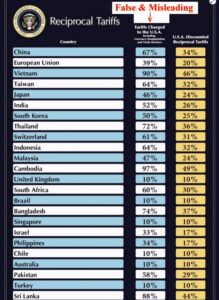
The tariffs announced on what Trump dubbed “Liberation Day” featured a chart titled Tariffs Charged to the U.S.A., purporting to show the crushing rates foreign countries supposedly impose on American goods. But these numbers were completely fabricated — not grounded in trade data or economic principles. Instead, Trump’s team appears to have confused tariffs with trade deficits, using the size of the U.S. trade deficit with each country to create a fictional “tariff rate.”

This fundamental misunderstanding is emblematic of much of Trump’s economic worldview — one that runs counter to decades of established economic theory.

In reality, U.S. trade deficits have long benefited American consumers by allowing access to cheaper foreign goods, while the strength of the dollar fuels domestic spending. The U.S. essentially trades inexpensive paper money for real goods — raw materials, finished products, and even luxury items — while foreign countries often recycle those dollars back into U.S. Treasuries, helping finance America’s debt.

Yet Trump continues to argue that trade deficits equal theft.

Trump’s Trade Narrative: Economic Victimhood

In speeches and social media posts in April 2025, Trump has claimed:

“For too long, corrupt foreign leaders — even from the poorest countries — have slapped massive tariffs on American products while flooding our markets with their goods, often duty-free. It’s been a one-sided scam — they’ve taken our jobs, stolen our industries, and destroyed entire American communities.”

Trump alleges that:

  • Foreign tariffs make U.S. farmers and manufacturers uncompetitive.

  • The U.S. has been the “piggy bank” of the world.

  • New tariffs will “level the playing field” and force “fair deals.”

Supporters call this economic justice. Critics call it economic vandalism.

Lesotho: Targeting One of the World’s Poorest Nations

Among the most striking examples of Trump’s tariff policy is Lesotho — a tiny, landlocked kingdom in southern Africa and one of the poorest nations in the world. The U.S. has imposed a staggering 50% tariff on its exports — the highest tariff applied to any sovereign country.

Lesotho’s economy depends heavily on textiles exported under the African Growth and Opportunity Act (AGOA), and diamond exports to the U.S. are another vital revenue source. In 2024, Lesotho exported about $237 million in goods to the U.S.

The 50% tariff threatens to devastate Lesotho’s fragile economy, potentially wiping out thousands of jobs in a country where nearly half the population already lives below the poverty line.

Tariffs on Penguins: Heard and McDonald Islands

In perhaps the most surreal example of Trump’s trade war, a 10% tariff was imposed on the Heard and McDonald Islands — an uninhabited Australian territory in the sub-Antarctic populated only by penguins and seals.

With no human population and no meaningful exports, the islands became a global punchline. Memes exploded online mocking Trump’s “penguin tariff” as the ultimate symbol of policy absurdity.

Economic Isolation — and Global Backlash

Trump’s tariff strategy has triggered a wave of retaliatory measures, trade disruptions, and diplomatic backlash. Analysts warn that the U.S. is rapidly isolating itself from global supply chains, allies, and markets.

The economic damage has been swift and severe — not just abroad but at home, as higher consumer prices, supply shortages, and market instability ripple through the U.S. economy.

As one critic put it:

“Trump didn’t just pick a trade war — he picked one with the entire planet.”

Full List of Countries Hit With Reciprocal Tariffs

Country Tariffs Charged to the U.S.A. (%) U.S.A. Discounted Reciprocal Tariffs (%)
China 67 34
European Union 39 20
Vietnam 90 46
Taiwan 64 32
Japan 46 24
India 52 26
South Korea 50 25
Thailand 72 36
Switzerland 61 31
Indonesia 64 32
Malaysia 47 24
Cambodia 97 49
United Kingdom 10 10
South Africa 60 30
Brazil 10 10
Bangladesh 74 37
Singapore 10 10
Israel 33 17
Philippines 34 17
Chile 10 10
Australia 10 10
Pakistan 58 29
Turkey 10 10
Sri Lanka 88 44
Colombia 10 10
Peru 10 10
Nicaragua 36 18
Norway 30 15
Costa Rica 17 10
Jordan 40 20
Dominican Republic 10 10
United Arab Emirates 10 10
New Zealand 20 10
Argentina 10 10
Ecuador 12 10
Guatemala 10 10
Honduras 10 10
Madagascar 93 47
Myanmar (Burma) 88 44
Tunisia 55 28
Kazakhstan 54 27
Serbia 74 37
Egypt 10 10
Saudi Arabia 10 10
El Salvador 10 10
Côte d’Ivoire 41 21
Laos 95 48
Botswana 74 37
Trinidad and Tobago 12 10
Morocco 10 10
Papua New Guinea 15 10
Malawi 34 17
Liberia 10 10
British Virgin Islands 10 10
Afghanistan 49 10
Zimbabwe 35 18
Benin 10 10
Barbados 10 10
Monaco 10 10
Syria 81 41
Uzbekistan 10 10
Republic of the Congo 10 10
Djibouti 10 10
French Polynesia 10 10
Cayman Islands 10 10
Kosovo 10 10
Curaçao 10 10
Vanuatu 44 22
Rwanda 10 10
Sierra Leone 10 10
Mongolia 10 10
San Marino 10 10
Antigua and Barbuda 10 10
Bermuda 10 10
Eswatini 10 10
Marshall Islands 10 10
Saint Pierre and Miquelon 99 50
Saint Kitts and Nevis 10 10
Turkmenistan 10 10
Grenada 10 10
Sudan 10 10
Turks and Caicos Islands 10 10
Aruba 10 10
Montenegro 10 10
Saint Helena 15 10
Kyrgyzstan 10 10
Yemen 10 10
Saint Vincent and the Grenadines 10 10
Niger 10 10
Saint Lucia 10 10
Nauru 59 30
Equatorial Guinea 25 13
Iran 10 10
Libya 61 31
Samoa 10 10
Guinea 10 10
Timor-Leste 10 10
Montserrat 10 10
Chad 26 13
Mali 10 10
Algeria 59 30
Oman 10 10
Uruguay 10 10
Bahamas 10 10
Lesotho 99 50
Ukraine 10 10
Bahrain 10 10
Qatar 10 10
Mauritius 80 40
Fiji 63 32
Iceland 10 10
Kenya 10 10
Liechtenstein 73 37
Guyana 76 38
Haiti 10 10
Bosnia and Herzegovina 70 35
Nigeria 27 14
Namibia 42 21
Brunei 47 24
Bolivia 20 10
Panama 10 10
Venezuela 29 15
North Macedonia 65 33
Ethiopia 10 10
Ghana 17 10
Moldova 61 31
Angola 63 32
Democratic Republic of the Congo 22 11
Jamaica 10 10
Mozambique 31 16
Paraguay 10 10
Zambia 33 17
Lebanon 10 10
Tanzania 10 10
Iraq 78 39
Georgia 10 10
Senegal 10 10
Azerbaijan 10 10
Cameroon 22 11
Uganda 20 10
Albania 10 10
Armenia 10 10
Nepal 10 10
Sint Maarten 10 10
Falkland Islands 82 41
Gabon 10 10
Kuwait 10 10
Togo 10 10
Suriname 10 10
Belize 10 10
Maldives 10 10
Tajikistan 10 10
Cabo Verde 10 10
Burundi 10 10
Guadeloupe 10 10
Bhutan 10 10
Martinique 10 10
Tonga 10 10
Mauritania 10 10
Dominica 10 10
Micronesia 10 10
Gambia 10 10
French Guiana 10 10
Christmas Island 10 10
Andorra 10 10
Central African Republic 10 10
Solomon Islands 10 10
Mayotte 10 10
Anguilla 10 10
Cocos (Keeling) Islands 10 10
Eritrea 10 10
Cook Islands 10 10
South Sudan 10 10
Comoros 10 10
Kiribati 10 10
Sao Tome and Principe 10 10
Norfolk Island 58 29
Gibraltar 10 10
Tuvalu 10 10
British Indian Ocean Territory 10 10
Tokelau 10 10
Guinea-Bissau 10 10
Svalbard and Jan Mayen 10 10
Heard and McDonald Islands 10 10
Reunion 73 37

Dumbfoundingly Dumb Tariffs

China Hits Back: 84% Tariff Targets U.S. Farmers First

EU’s Trade Counterattack: Tariffs Designed to Target U.S. Red States


On April 2, President Trump unilaterally declared a trade war against the rest of the world, imposing protectionist tariffs on 180 countries — calling it “Liberation Day.” This action was taken without congressional approval and in direct violation of the Constitution.

Trump’s Sector-Specific Tariffs

Trumpenomics: The Decline of the US

bookmark_borderUnderestimation of Climate Sensitivity and Feedback Processes

by Daniel Brouse
April 2, 2025

In the 1990s, we first hypothesized the non-linear acceleration of climate change. By the early 2000s, this hypothesis had evolved into established climate theory, now widely recognized as scientific fact. My lab partner, a Doctor of Physics from Ohio State, and I collaborated to provide key evidence supporting this theory. Over the years, we have observed a dramatic reduction in the doubling time of climate change impacts — the rate at which these effects intensify. Initially, the doubling time was approximately 100 years, but it has since decreased to 10 years and, more recently, to just 2 years. This trend implies that the damage caused by climate change today is double what it was two years ago. In two years, it could be four times worse; in four years, eight times worse; and within a decade, potentially 64 times worse. These projections are conservative, assuming the doubling period does not continue to shrink further. Alarmingly, this rapid acceleration does not appear to be an anomaly. If this trajectory persists, the consequences will likely be far more catastrophic than previously anticipated.

Dr. James E. Hansen’s paper Global Warming Acceleration: Impact on Sea Ice confirms our theory with an analysis of the acceleration of global warming and its impact on sea ice, ice sheets, and ocean circulation, with a particular focus on the Atlantic Meridional Overturning Circulation (AMOC). Climate sensitivity is higher than previously estimated (ECS = 4.5 ± 0.5°C for doubled CO₂), which fundamentally alters expectations for future climate change. IPCC models fail to account for freshwater effects on sea ice cover, leading to an underestimation of climate sensitivity and feedback processes.

AMOC Shutdown Risk: Hanson emphasizes that accelerated warming increases the likelihood of AMOC shutdown by reducing surface water density in deepwater formation regions. A shutdown would trigger severe long-term consequences, including rapid sea level rise.

An AMOC shutdown would have severe and far-reaching impacts worldwide. For instance, on the U.S. East Coast it would lead to rapid sea level rise, stronger storms, and extreme weather shifts. As the AMOC slows or stops, warm water would no longer be transported northward, causing ocean water to pile up along the East Coast, which could raise sea levels by 1-3 feet (30-90 cm) almost immediately, on top of global sea level rise. This would have particularly devastating effects on the Northeast U.S. (New York, Boston, DC, Miami), where flooding would be most severe.

The weakening or shutdown of the AMOC would also impact hurricane formation. With warmer waters off the East Coast, hurricanes would become more intense and slower-moving, leading to longer-lasting and more destructive storms, like Hurricane Sandy. As the Gulf Stream weakens, hurricanes could linger longer over coastal cities, causing catastrophic flooding. Additionally, the disruption of weather patterns would lead to a stark contrast: the Northeast and Europe could experience much colder winters while the Southeast U.S. (Florida, Georgia, Carolinas) would face more extreme heat and droughts.

Increased rainfall and flooding would also become more common. With the Gulf Stream weakened, storms could stall over cities, dumping massive amounts of rainfall, similar to what occurred during Hurricane Harvey in Texas but along the East Coast. Nor’easters and stronger winter storms would become more frequent, particularly in New England. The disruption of the AMOC would also have catastrophic consequences for marine ecosystems. The circulation helps distribute nutrients in the ocean, and its shutdown could disrupt fish migration patterns and collapse major fisheries, especially in the Northeast U.S., where industries like cod fishing and lobster harvesting would be devastated.

In a Climate Crisis

Since the Earth’s equilibrium climate sensitivity (ECS) is 4.5 ± 0.5°C for a doubling of CO₂, the likely temperature rise this century under current emission levels will be significantly higher than IPCC estimates. Here’s a breakdown of how that translates into global warming:

1. CO₂ Projections & Radiative Forcing

  • Pre-industrial CO₂ (~280 ppm) to Present (~420 ppm): We’ve already experienced a ~1.2°C rise in global temperature.

  • Business-as-Usual Scenario (High Emissions, ~800-1000 ppm CO₂ by 2100): If emissions continue at current levels, CO₂ could more than double from pre-industrial levels, reaching or exceeding 560 ppm (the doubling threshold for ECS calculations).

  • Additional non-CO₂ greenhouse gases (methane, nitrous oxide, etc.) also contribute to warming.

2. Temperature Increase by 2100

Using ECS = 4.5 ± 0.5°C, and considering:

  • Climate sensitivity refers to long-term equilibrium response (centuries), but transient warming occurs within this century.

  • The Transient Climate Response (TCR), which is lower than ECS, typically ranges ~60-70% of ECS, meaning near-term warming may be slightly less than equilibrium projections.

Projected Warming by 2100 Based on ECS = 4.5°C

  1. Lower-End Case (~550-600 ppm CO₂, with significant mitigation efforts)

    • Optimistic warming: ~3.5–4.5°C

    • Comparable to IPCC’s worst-case scenarios (RCP 6.0–7.0 range)

  2. High-Emissions Case (~800-1000 ppm CO₂, with some mitigation)

    • Potential warming: ~5–7°C

    • This is significantly worse than IPCC’s RCP 8.5 projection, which assumes ECS = 3°C.

  3. Business as Usual Case (Feedbacks Accelerate Warming: AMOC Shutdown, Ice-Albedo, Methane Releases, etc.)

    • Expected warming: 7-9°C or more

    • This would resemble past hyperthermal events like the Paleocene-Eocene Thermal Maximum (PETM).

3. Policy & Adaptation Implications

  • If ECS is higher than IPCC estimates, it means current climate policies are underestimating risk.

  • The IPCC’s mid-range scenarios (projecting ~3°C by 2100) may be too optimistic if ECS is truly ~4.5°C.

  • Higher ECS implies faster and more extreme tipping points, including AMOC collapse, rapid sea level rise, and uninhabitable regions.

4. Urgency for Rapid Emission Cuts

  • Even immediate aggressive action (net-zero by mid-century) would still result in ~2.5-3°C warming due to existing CO₂ levels and slow response time.

  • Avoiding catastrophic warming (>4°C) requires drastic reductions in fossil fuel use this decade.

Bottom Line: At Current Emissions, Warming by 2100 is Likely 6°C or Higher

This level of warming would lead to massive global disruptions, including widespread droughts, stronger hurricanes, agricultural collapse, and displacement of hundreds of millions due to rising sea levels. If ECS is truly 4.5°C, the window to prevent catastrophic warming is far smaller than most policymakers assume.

* Our climate model employs chaos theory to comprehensively consider human impacts and projects a potential global average temperature increase of 9℃ above pre-industrial levels.

bookmark_borderThe Impending Economic Impact of April 2 Tariff Announcement: A Global Crisis in the Making

by Daniel Brouse
April 1, 2025

The Washington Post has reported that sources indicate the April 2 tariff announcement is set to impose an across-the-board 20% tariff on a broad range of imports. Such a drastic move would have far-reaching implications for the global economy, potentially triggering the most significant worldwide economic downturn since the Great Depression.

Understanding the Scope of the 20% Tariff

Tariffs are taxes on imported goods, usually levied by governments to protect domestic industries or to encourage certain economic behaviors. A 20% across-the-board tariff means that the cost of many goods entering the U.S. from other countries will increase by 20%. This would apply to various sectors, from electronics and consumer goods to industrial materials and food products. As a result, the prices of everyday items could surge, straining consumers and businesses alike.

The immediate impact of such a policy would be felt in the U.S., as companies pass on the added costs to consumers. But the ramifications would not stop at U.S. borders. Trade is a two-way street, and countries affected by these tariffs are likely to retaliate. This could lead to a global trade war, where countries impose tariffs on each other’s exports, resulting in widespread disruptions to the global supply chain.

Potential Global Economic Consequences

  1. Rising Prices and Inflation
    A 20% tariff would lead to higher prices on a wide array of goods. Manufacturers and retailers would face increased costs for materials and products, which would, in turn, be passed on to consumers in the form of higher prices. For everyday consumers, this would result in reduced purchasing power, further exacerbating inflationary pressures already present in many economies. The cost of living would rise, leading to decreased consumer spending and potentially slowing down economic growth.

  2. Global Trade Disruption
    Global trade relies on the free flow of goods between nations. A sudden imposition of tariffs of this magnitude would disrupt supply chains, as businesses would need to find new suppliers or production methods to avoid the increased costs. Countries that rely heavily on exports to the U.S. could face severe economic hardships, while other nations may retaliate with tariffs of their own, creating a cycle of protectionist measures that harms all parties involved.

  3. Risk of Recession
    The last time the global economy faced a crisis of this magnitude was during the Great Depression. The widespread implementation of tariffs back in the 1930s triggered a global trade collapse, leading to massive economic contractions, rising unemployment, and a dramatic decrease in global output. Similarly, a modern-day trade war could push the world economy into recession, as countries become more isolated and less able to collaborate on international economic growth.

  4. Impact on Developing Economies
    Developing economies, which often rely on exports to wealthier nations, would be especially vulnerable to the effects of a 20% tariff. Countries like China, Mexico, and those in Southeast Asia could see their exports significantly reduced, hurting their GDP growth. This could lead to a rise in poverty and unemployment in these nations, which may also result in political instability and unrest.

  5. Financial Market Volatility
    The announcement of such a significant tariff could lead to considerable volatility in global financial markets. Investors would likely respond with caution, retreating from stocks and other risky assets in favor of safer investments like government bonds or gold. This could cause major declines in stock market indices worldwide and exacerbate economic instability. The uncertainty around trade relations could also harm long-term business planning and investment decisions.

Historical Precedents and the Global Economic Landscape

The Great Depression remains the most well-known example of how tariffs can spiral into a global economic collapse. The Smoot-Hawley Tariff Act of 1930, which raised U.S. tariffs on over 20,000 imported goods, is often cited as a contributing factor to the global depression. The resulting trade barriers reduced global trade by more than 60% and deepened the economic crisis. History has shown that protectionist policies, while sometimes aimed at shielding domestic industries, can often backfire, leading to a reduction in global trade, lower economic growth, and widespread hardship.

The global economy today is more interconnected than ever, with supply chains that stretch across borders and trade that plays a central role in most nations’ economic health. A tariff policy that disrupts this interconnectedness would likely have a ripple effect, leading to job losses, lower productivity, and declining standards of living for people around the world.

Conclusion

The April 2 tariff announcement, with its proposed 20% across-the-board levy, carries immense risks for the U.S. and the world. While the goal of such tariffs is often to protect domestic industries, the broader economic consequences could be catastrophic. With the potential to trigger a global trade war, increase inflation, and push the world into recession, the decision to impose such tariffs could very well be seen as a turning point in the global economic landscape. As businesses and consumers brace for these impacts, the world faces a future that is increasingly uncertain, with the specter of the Great Depression looming once more.

Trumpenomics: The Decline of the US

bookmark_borderClimate Change Fuels Devastating Floods in Australia: Record Rainfall and Economic Fallout

by Daniel Brouse
April 1, 2025

The devastating floods occurring in Australia today have been significantly influenced by climate change. As global temperatures rise, the atmosphere can hold more moisture, leading to more intense and prolonged rainfall events. This increase in heavy precipitation elevates the risk of severe flooding. ​

In Queensland, for instance, the recent deluge has resulted in unprecedented rainfall, with Townsville nearing its annual rainfall record within just three months. This excessive rainfall has caused rivers to overflow, inundating vast areas and leading to the loss of over 100,000 livestock.

Climate change not only intensifies rainfall but also contributes to more extreme weather patterns, including prolonged droughts followed by sudden, heavy downpours. This variability exacerbates the severity of flooding, as parched soils are less able to absorb water, increasing runoff into rivers and floodplains. ​

The economic and social impacts of these climate-induced floods are profound. Beyond the immediate damage to property and infrastructure, the agricultural sector faces significant losses, with livestock casualties and crop destruction leading to increased food prices and economic hardship for communities. ​

Addressing the root causes of climate change by reducing greenhouse gas emissions is crucial to mitigate the frequency and severity of such extreme weather events in the future.

The Human Induced Climate Change Experiment