bookmark_borderRealities of Climate Change

UNITED STATES — Sea level rise is accelerating. The number of large wildfires is growing. Dangerous heat waves are becoming more common. Extreme storm events are increasing in many areas. More severe droughts are occurring in others.

These are just some of the consequences of global warming, which are already having significant and harmful effects on our health, our environment, and our communities.

Unless we take immediate action to address global warming, these consequences will continue to intensify, grow ever more costly, and increasingly affect the entire planet — including you, your community, and your family.

Global warming is happening now.

The planet’s temperature is rising. The trend is clear and unmistakable.

Every one of the past 35 years has been warmer than the 20th century average. The 12 warmest years on record have all occurred since 1998. 2012 was the hottest year ever recorded for the contiguous United States.

Globally, the average surface temperature has increased more than one degree Fahrenheit since the late 1800s. Most of that increase has occurred over just the past three decades.
We are the cause.

We are overloading our atmosphere with carbon dioxide, which traps heat and steadily drives up the planet’s temperature. Where does all this carbon come from? The fossil fuels we burn for energy — coal, natural gas, and oil — plus the loss of forests due to deforestation, especially in the tropics.
The scientific evidence is clear.

Within the scientific community, there is no debate: An overwhelming majority of climate scientists agree that global warming is happening and that human activity is the primary cause.

This broad consensus — and the extensive scientific evidence that supports it — is often downplayed or distorted by a small but vocal minority of special interests that have a vested interest in delaying action on climate change.
We have a choice.

We can act now to reduce our carbon emissions, slow the pace of global warming, and pass on a safer, healthier world to our children. Or we can choose to do nothing, continue pumping massive amounts of carbon into an already overloaded atmosphere, and suffer the increasingly costly consequences.

At UCS, we believe the choice is clear: We must take steps now to reduce our global warming emissions.
Together we can tackle global warming.

We have the practical solutions and technologies at hand to substantially reduce our emissions, create a clean energy economy, and establish the United States as a global leader in innovation.

To accomplish it, we must:

Demand action from our elected leaders
Take simple, practical steps to reduce our personal carbon emissions
Aggressively fight misinformation about global warming
Prepare our cities and communities for the growing impacts of climate change

Working together, we can do it — and you can help make it happen. Take action today!
bookmark_borderArizona Wildfire

Extreme weather conditions in the Southwestern United States have resulted in several wildfires. Nineteen of the world’s best firefighters were killed in the Arizona wildfire.

The state of Arizona says: Yarnell Hill Fire Reported 45 Percent Contained
(Posted July 3, 2013, at 9:32 p.m.) The Yarnell Hill Fire burning southwest of Prescott, Ariz., is reported 45 percent contained.

Residents of Peeples Valley and Yarnell, evacuated by the Yavapai County Sheriff’s Office on Sunday, remain out of their homes. The Yarnell Fire Department and Yavapai County are assessing homes and structures around Glen Ilah and Yarnell.

Red Cross shelters are open at Yavapai Community College in Prescott at 928-717-8210 and at the Wickenburg High School in Wickenburg at 480-213-0706. People and small animals are welcome at both shelters while large livestock can be taken to Hidden Springs Ranch on Highway 89.

State Highway 89 remains closed between MP 270 and MP 238. The Yavapai County Sheriff’s Office has three different road blocks: the junctions of Highway 89 and Hays Ranch Road; Hays Ranch Road and Sickles Ranch Road; and at Buckhorn and Frontier Road.

Again, temperatures are expected to be in the low 90s, humidity 15-19 percent, and predicted winds out of the west at 4 to 6 miles per hour, gusting up to 12 miles per hour.

Locally, gusts up to 30 mph may occur near thunderstorms. The decreased relative humidity and increased wind speeds could cause more erratic fire behavior. No significant rain is expected in the next 7-10 days. However, overall fire behavior should continue to diminish due to fuels being consumed.

Tomorrow, firefighters will continue work on the eastern flank with a goal of connecting the contained areas on the northeast and southeast corners between Yarnell and Peeples Valley.

On the northern portion, hot shot crews will continue to build line towards a ridge above Peeples Valley. Scouting will take place along the western flank and contingency plans will continue to be refined in case the fire becomes active again. Firefighters will also support initial attack in the area as needed.

Creeping and smoldering are expected to continue around the structures, though sometimes not showing until the afternoon, and some areas around structures are still holding enough heat to be a concern. A plan is being developed to restore utilities and infrastructure to the affected communities.

Yarnell Hill Fire facts:
Fire Start Date: June 28, 2013 at 5:30 p.m.
Location: West of State 89 between Yarnell and Peeples Valley
Size: Estimated at 8,400 acres
Containment: 45 percent
Cause: Lightning
Personnel: 681 (includes 15 crews and 26 engines)
Aircraft: Thirteen helicopters are assigned to the incident and air tankers are available to support firefighters.

bookmark_borderColorado Wildfires

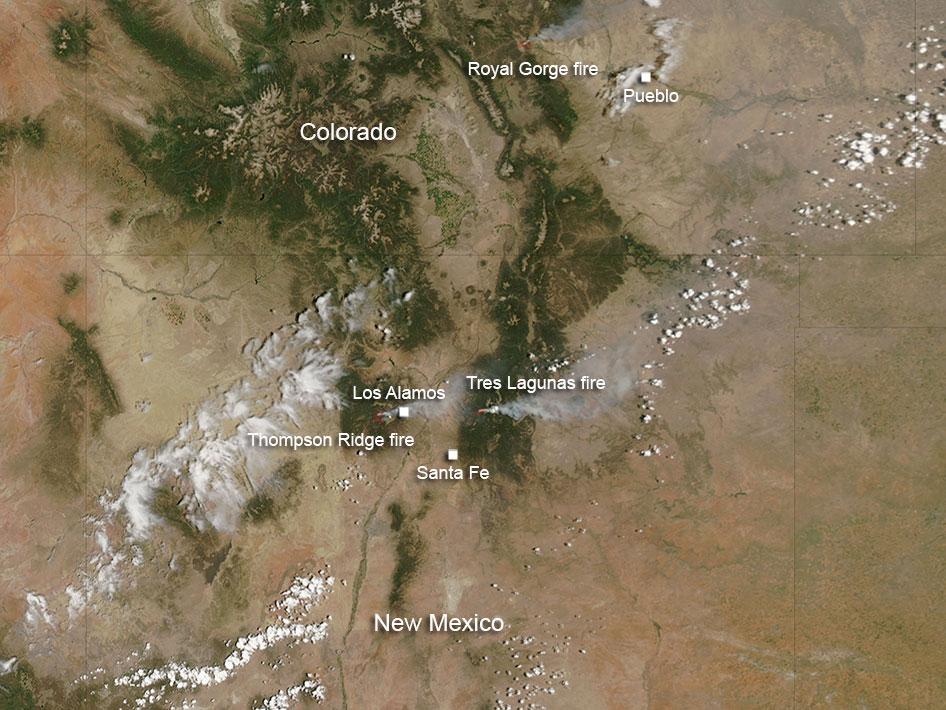
Over 500 homes have been destroyed in the Colorado wildfires. According to NASA: The Royal Gorge fire in Colorado was first reported at 1 p.m. Tuesday June 11, south of the Royal Gorge Bridge and Arkansas River. It is estimated at 3800 acres. At present the Arkansas River has been closed from Spike Buck through Canon City. The Royal Gorge Bridge and Park has been evacuated.

Resources on scene include: 150 firefighters and Law Enforcement officers from both federal and local departments. Resources ordered include: 2-Single Engine Airtanker and 1 Heavy Air Tanker.

The cause of the fire is under investigation.

The New Mexico fires include Thompson Ridge and Tres Lagunas fires. There is another fire in New Mexico south of the area where these fires are located, and that fire is known as the Silver fire. It is not visible in this image, although in the larger image that is included, it is visible.

The Thompson Ridge fire started on May 31, 2013. The cause was human in nature. It is located on the Valles Caldera National Preserve about two miles northeast of La Cueva, New Mexico. The fire is in steep rugged terrain and is burning mixed conifer and ponderosa pine. It has currently burned over 21,000 acres and is 50% contained. However, the growth potential for this fire is high due to rugged terrain, low humidity and dry conditions. Total personnel working this fire is 991.

The Tres Lagunas fire which started on May 30, 2013 was caused by human error and a downed power line. Currently it has burned over 10,000 acres. This fire is 10 miles north of Pecos, New Mexico.

There is a red flag warning for the area today which heralds hot, dry conditions with temperatures remaining well above normal. Stronger and gustier west/southwest winds are expected today with low humidity. All these conditions can contribute to fire growth. At this time the fire is 77% contained.

At present 14 Hand Crews, 5 Helicopters, 17 engines, 2 bulldozers, and 4 water tenders are fighting this fire.

This natural-color satellite image was collected by the Moderate Resolution Imaging Spectroradiometer (MODIS) on June 11, 2013. Actively burning areas, detected by MODIS’s thermal bands, are outlined in red.

NASA image courtesy Jeff Schmaltz, MODIS Rapid Response Team. Caption: NASA/Goddard, Lynn Jenner

colorado-wildfires-2013

bookmark_borderGlobal Warming And Climate Volatility

As part of the Human Induced Climate Change Experiment, we have been predicting the effects of global warming on climate volatility. Indeed, we have seen a marked severity in volatile weather systems.

2012 went down as the hottest year in recorded history. Though we are only several days into January, the year is already setting records. There has been snow in the deserts of China, record heat and wildfires in Australia… while record cold temperatures have killed hundreds in India.

bookmark_borderActs Of God

Natural Disasters in August, 2012

Tropical Storm IsaacAugust 29, 2012
Tropical Storm Isaac
 Hurricane IsaacAugust 28, 2012
Hurricane Isaac
Trinity Ridge FireAugust 28, 2012
Trinity Ridge Fire
Tropical Storm BolavenAugust 28, 2012
Tropical Storm Bolaven
Tropical Storm IsaacAugust 28, 2012
Tropical Storm Isaac
Wildfires in SiberiaAugust 28, 2012
Wildfires in Siberia
Tropical Storm IsaacAugust 27, 2012
Tropical Storm Isaac
Typhoon BolavenAugust 26, 2012
Typhoon Bolaven
Wildfires in AlgeriaAugust 25, 2012
Wildfires in Algeria
Typhoon BolavenAugust 24, 2012
Typhoon Bolaven
Tropical Storm IsaacAugust 23, 2012
Tropical Storm Isaac
Wildfires in CaliforniaAugust 23, 2012
Wildfires in California
Typhoon TembinAugust 20, 2012
Typhoon Tembin
Wildfires in CaliforniaAugust 19, 2012
Wildfires in California
 Wildfire on ChiosAugust 18, 2012
Wildfire on Chios
Typhoon Kai-takAugust 17, 2012
Typhoon Kai-tak
Typhoon Kai-takAugust 16, 2012
Typhoon Kai-tak
Plume from Batu TaraAugust 15, 2012
Plume from Batu Tara
Thick Smoke over WyomingAugust 14, 2012
Thick Smoke over Wyoming
Wildfires in IdahoAugust 14, 2012
Wildfires in Idaho
Tropical Storm Kai-takAugust 13, 2012
Tropical Storm Kai-tak
Western WildfiresAugust 13, 2012
Western Wildfires
Tropical Storm ErnestoAugust 8, 2012
Tropical Storm Ernesto
2012 Arctic CycloneAugust 7, 2012
2012 Arctic Cyclone
Hurricane ErnestoAugust 7, 2012
Hurricane Ernesto
 Mount Tongariro EruptsAugust 7, 2012
Mount Tongariro Erupts
Typhoon HaikuiAugust 7, 2012
Typhoon Haikui
Tropical Storm ErnestoAugust 6, 2012
Tropical Storm Ernesto
Typhoon HaikuiAugust 6, 2012
Typhoon Haikui
Halstead Fire, IdahoAugust 3, 2012
Halstead Fire, Idaho
 Typhoons Saola and DamreyAugust 1, 2012
Typhoons Saola and Damrey