bookmark_borderHow Is Climate Energy Hitting You? A: Like Wet Concrete

by Daniel Brouse

How Is Climate Energy Hitting You Nepal-Tibet?

A: Like Wet Concrete (Fluidize Physics)

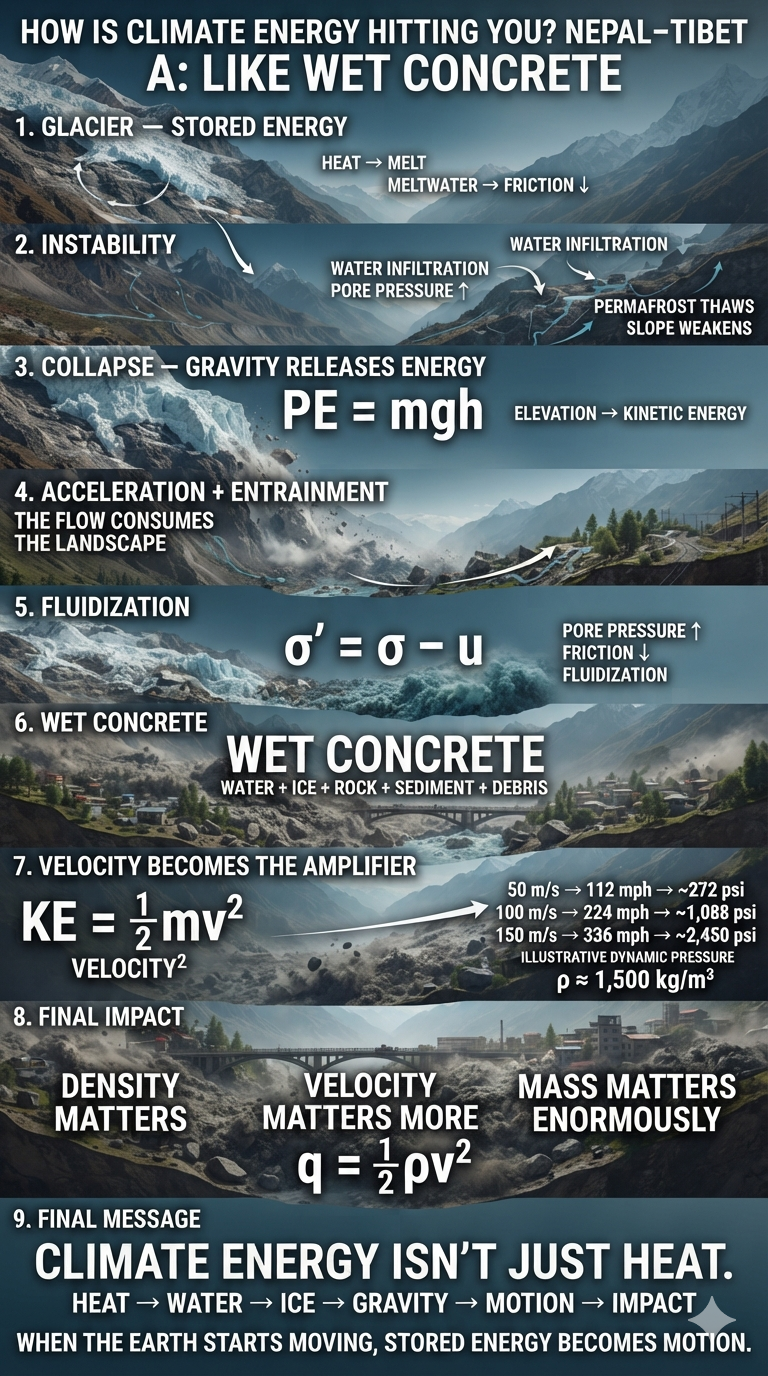
Heat melts ice. Meltwater changes friction. Water infiltrates soil. Pore pressure rises. Permafrost thaws. Slopes weaken. Glaciers destabilize. Gravity converts elevation into kinetic energy. Moving water entrains sediment. Sediment increases density. Increasing density increases the potential force of the flow. Velocity increases kinetic energy according to v². And then the landscape itself becomes part of the moving mass.

The Physics of the Langtang Lirung Glacier Collapse

The sequence is more accurately understood as a progression from glacier failure to gravitational acceleration, fragmentation, collision and deformation, water and sediment entrainment, increasing pore-water pressure, reduced effective friction, partial fluidization, and ultimately high-mobility debris-flow propagation.

There was a video of what appeared to be a large boulder rolling along the top of the entrained material, sometimes seeming to bob up and down as the flow moved beneath it. At first, I thought I was simply watching rock being carried by a flood. But the more I watched, the more complicated the physics appeared to be.

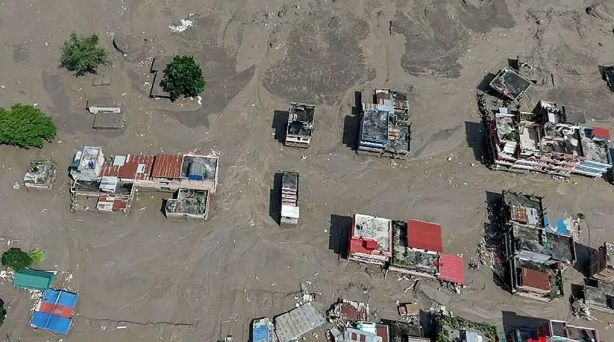
The bulk of the larger rock and ice appears to have come through first, driven by the initial collapse, gravity, and the rapidly moving water and debris. In doing so, it essentially carved and scoured a channel through the valley. Then came something very different: an enormous mass of mud, sediment, ice, rock, vegetation, and structural debris—apparently reaching several stories in depth—that overwhelmed and buried villages.

As for whether what we are seeing is rock or ice, it was probably a combination of both. One report described the material as being like “wet concrete,” which is actually a remarkably useful way to visualize what was happening. It captures something that ordinary words like “flood” or “mudslide” don’t fully convey. This wasn’t simply water carrying a little mud. It was a dense, multiphase mixture of water, sediment, rock, ice, vegetation, and everything else it encountered, moving together as a highly energetic mass.

The Bridge Experiment Nobody Intended to Conduct

I also saw video of a bridge collapse that really demonstrated the power of the flow. What amazed me was what initially looked almost like “buoyancy.” The entrainment was so dense and forceful that the bridge appeared to be lifted onto the surface of the moving material, carried downstream, and then used almost like another projectile when it encountered a second bridge. The second bridge appeared to do something similar.

Both structures were ultimately carried downstream, taking out virtually anything and everything in their path. Of course, this isn’t true buoyancy in the simple sense of a bridge floating in water. The physics is more complicated. A dense debris flow can exert enormous upward, lateral, and drag forces on an object. A structure can become partially supported, displaced, rotated, or entrained by the moving mass beneath and around it. Once a structure becomes part of the flow, it is no longer simply an obstacle. It becomes debris—and that debris becomes part of the destructive machinery of the flow.

That is the remarkable thing about these events. Water, sediment, rock, ice, trees, buildings, bridges, and pieces of the riverbank can become mechanically coupled into one enormous moving system. The density increases. The mass increases. The momentum increases. And the destruction compounds.

The Physics Begins With Gravity

The most important number in understanding this event may not be the one-kilometer distance over which the material traveled. It may be the approximately 1,200–1,300 meters of elevation that the collapsing mass lost between the glacier and the valley floor.

The lower section of the unnamed glacier was reportedly located at approximately 5,200 meters—about 17,000 feet—on the northern slopes of the Mount Langtang Lirung massif. The Lhende Khola valley floor lies roughly 3,900–4,000 meters above sea level. That means the system had approximately 1,200–1,300 meters of vertical gravitational head.

That is an enormous amount of stored gravitational energy.

The gravitational potential energy of a mass is:

PE = mgh

where m is mass, g is gravitational acceleration, and h is the vertical elevation difference.

For every kilogram of material, a 1,200–1,300 meter elevation loss represents approximately 11,800–12,800 joules of gravitational potential energy. If all of that energy could somehow be converted perfectly into kinetic energy, the corresponding free-fall-equivalent velocity would be:

v = √(2gh)

For a 1,200-meter drop, that produces approximately 153 m/s, or 343 mph. For a 1,300-meter drop, it produces approximately 160 m/s, or 357 mph.

Those numbers are startling, but they need to be understood correctly. They do not mean that the debris actually struck the valley floor at 343–357 mph. They represent an idealized upper-bound velocity scale—the speed a mass would acquire if gravitational potential energy were converted perfectly into kinetic energy without energy losses.

A real glacier collapse is nothing like free fall. Energy is consumed by fracturing ice and rock, deformation, friction, collisions, turbulence, air resistance, terrain geometry, erosion, entrainment, and the conversion of organized gravitational motion into chaotic motion within the debris mass. The actual velocity would therefore have been substantially lower and would have varied throughout the event.

But the calculation is still important because it tells us how much energy gravity made available to the system.

When Ice, Rock, Water, and Debris Become One Moving System

The original material at the top was probably heterogeneous. There could have been ice, snow, rock, sediment, water, and other material mixed together. As the mass accelerated, it was subjected to enormous stresses. Ice fractured. Rock fractured. Sediment was stripped from the landscape. Water was incorporated into the moving material. Trees and vegetation were uprooted. Structures and riverbank material were entrained.

Every collision changed the composition of the flow.

This is where the term “entrainment” becomes extremely important. The moving mass doesn’t simply travel over the landscape. It consumes the landscape. It picks up additional sediment, rock, water, vegetation, soil, and structures along the way. That increases the mass of the flow while simultaneously changing its physical properties.

Once the material becomes heavily saturated, another process becomes critically important: pore-water pressure.

Water Can Reduce Friction

This is one of the strangest aspects of the physics. We generally think of water as something that slows things down. But water under pressure between particles can reduce the friction holding those particles together.

In simplified form:

σ′ = σ − u

where σ′ is effective stress, σ is total stress, and u is pore-water pressure.

As pore-water pressure rises, effective stress falls. As effective stress falls, frictional resistance can decrease. That can make a slope or debris mass dramatically more mobile.

This is one reason why a wet, saturated mass can behave very differently from the dry rock, soil, and ice from which it originated. The material doesn’t literally turn into water. Instead, the water becomes part of a coupled solid-fluid system in which fluid pressure helps support and mobilize the solid particles. Under sufficiently energetic conditions, a granular mass can become partially liquefied or fluidized.

That is the “wet concrete” effect.

Another Lubrication Effect: Meltwater Beneath the Ice

There is also the possibility of basal lubrication beneath moving ice. Meltwater accumulating beneath a glacier can reduce basal friction and permit basal sliding, sometimes dramatically increasing the mobility of the ice.

That makes footage showing substantial water emerging from beneath the glacier particularly interesting. If meltwater was present beneath the ice, it could have contributed to the initial mechanical instability. If water was also available downstream, it could subsequently become incorporated into the collapsing ice-rock mass.

This creates the possibility of a coupled sequence: meltwater can reduce basal friction and increase glacier movement; movement can contribute to collapse; collapse releases gravitational potential energy; acceleration causes fragmentation and entrainment; and increasing water content and pore pressure can subsequently reduce internal friction and promote fluidization.

This is not one process. It is several physical processes interacting with one another.

The Ground Itself Can Become Part of the Flow

There is another important factor. Thawing permafrost and destabilized soil and peat can weaken the material that normally helps hold mountain slopes together. Add unusually warm conditions and significant precipitation preceding the event, and you potentially have several destabilizing mechanisms operating simultaneously: meltwater infiltration, increasing water pressure, reduced basal friction, thawing ground, weakened sediment and rock, and gravity acting on a huge mass of ice and rock.

That is why I am hesitant to characterize an event like this simply as an “ice collapse” or a “rockslide.” It appears more useful to think of it as a coupled ice-rock-water system in which one failure mechanism can trigger another.

What Happened to the Ice?

The ice-water mixture near the top of the fall may have been predominantly ice. But after a 1,200–1,300 meter descent, followed by rapid fragmentation, collision, deformation, mixing, and entrainment, the material at the bottom would have been physically very different from the material at the top.

That doesn’t mean all of the ice necessarily melted during the descent. There is not enough information to make that claim. But the ice could have been extensively fractured and broken apart, while meltwater and pre-existing water became mixed with rock, sediment, and debris.

The composition of the moving mass could therefore have changed rapidly as it descended. By the time it reached the valley floor, the system could contain a complex mixture of water, ice, fine sediment, sand, gravel, large rocks, trees, soil, and structural debris.

The result can look almost like a giant mass of wet concrete.

And that visual description isn’t merely poetic. It reflects the fact that the material can have a density much greater than water while simultaneously behaving as a highly mobile fluid-solid mixture.

An Estimate of the Force of the Flow: The Damage and the Impact

The simplest starting point for thinking about the destructive pressure of a moving mass is dynamic pressure:

q = ½ρv²

The density of the individual components varies enormously. Water has a density of approximately 1,000 kg/m³; ice about 917 kg/m³; wood roughly 400–700 kg/m³; wet sediment roughly 1,500–2,000 kg/m³; concrete and masonry roughly 2,200–2,400 kg/m³; and rock approximately 2,500–3,000 kg/m³.

But the flow is not one of these materials. It is a mixture.

For a water-rich ice/water/debris flow containing substantial sediment and rock, a reasonable illustrative bulk-density range might be approximately 1,200–2,000 kg/m³. For calculations, approximately 1,500 kg/m³ is a useful illustrative midpoint.

That is about 50 percent denser than water.

And density matters because:

q ∝ ρv²

Velocity is squared. That is the critical point.

If velocity doubles, dynamic pressure increases by approximately four times. The same principle applies to kinetic energy:

KE = ½mv²

If velocity doubles, kinetic energy also increases by a factor of four.

This is why velocity is such a powerful amplifier of destructive energy.

Using the illustrative bulk density of 1,500 kg/m³, a flow moving at 50 m/s—about 112 mph—would have a dynamic pressure of approximately 1.9 MPa, or roughly 272 psi. At 100 m/s, about 224 mph, the calculated dynamic pressure rises to approximately 7.5 MPa, or roughly 1,088 psi. At 150 m/s, about 336 mph, it reaches approximately 16.9 MPa, or roughly 2,450 psi.

At the same velocity, a 1,500 kg/m³ debris mixture has 1.5 times the dynamic pressure, momentum density, and kinetic energy density of water. But its destructive potential can be substantially greater because the flow also carries solid mass—boulders, trees, ice, vehicles, structures and sediment—that can strike, crush and penetrate objects rather than simply flow around them.

The underlying relationship: density matters, velocity matters even more, and mass matters enormously.

The Energy Doesn’t Disappear When the Flow Hits

When the moving mass reaches the valley floor, the kinetic energy has to go somewhere. It cannot simply vanish. It is transformed into crushing, fracturing, deformation, heating, melting, turbulence, particle collisions, pore-water pressure, erosion, lateral spreading, and the acceleration of additional material.

And that is where the destruction can become self-reinforcing.

A moving rock strikes the ground and fractures. The fragments become part of the flow. The flow picks up more sediment. Water pressure rises. The material becomes more mobile. More material is entrained. More mass is now moving.

Structures are struck. Structures break apart. Their components become additional debris. The flow becomes both the delivery mechanism and the source of new projectiles.

This is why the damage can propagate far beyond the location of the original glacier failure.

The Three-Story-Deep Problem

When you see villages buried beneath what appears to be an enormous layer of mud, it can look almost as though the ground itself has turned into solidifying concrete or quicksand.

That visual impression makes sense. A deep, water-saturated debris flow can behave nothing like ordinary soil. It can be dense enough to support and transport very large objects while simultaneously being fluid enough to flow around buildings, trees, vehicles, bridges, and terrain.

The surface can look deceptively solid. But underneath, the material may still be moving.

That creates an extraordinarily dangerous environment for rescuers. The footage of rescue teams moving carefully across the surface—sometimes crawling on their bellies—is a powerful illustration of this physical reality. The surface is not necessarily solid ground. It may be the upper surface of a dense, unstable, water-saturated debris mass.

A person standing on it is not necessarily standing on stable earth.

They may be standing on the moving aftermath of a mountain.

Climate Energy Is Not Just Heat

This is where the event gives me a completely different perspective on climate change physics.

When we talk about climate change, we often talk about temperature. But temperature is only one part of the energy story.

Climate energy can move through the Earth system as water, ice, air, sediment, and rock.

Heat melts ice. Meltwater changes friction. Water infiltrates soil. Pore pressure rises. Permafrost thaws. Slopes weaken. Glaciers destabilize. Gravity converts elevation into kinetic energy. Moving water entrains sediment. Sediment increases density. Increasing density increases the potential force of the flow. Velocity increases kinetic energy according to v². And then the landscape itself becomes part of the moving mass.

That is the larger lesson.

The climate system doesn’t have to “create” the energy of a landslide. Gravity already provides the energy. Climate change can alter the conditions that determine when, where, and how that gravitational energy is released.

A warmer atmosphere can increase the amount of water available to the system. Melt can add water. Rain can add water. Thawing ground can remove structural stability. Water pressure can reduce friction. And once a mountain begins moving, gravity takes over.

That is what I mean by:

How Is Climate Energy Hitting You?

Sometimes it arrives as heat.

Sometimes as water.

Sometimes as ice.

Sometimes as a flood.

And sometimes, after passing through enough interconnected physical processes, it arrives as something that looks like wet concrete moving down a mountain.

That is climate energy in motion.


Public Access Version

How Is Climate Energy Hitting You Nepal-Tibet?
A: Like Wet Concrete

My homework assignment for tonight was born from curiosity about the Nepal-Tibet glacial collapse.

What was in the mixture? How did it change as it moved? Did the enormous amount of energy involved cause it to fluidize?

The answer appears to be yes.

What began as a mixture of ice, rock, water, and sediment transformed into an extremely dense, rapidly moving mass—something remarkably like wet concrete.

This is where “entrainment” becomes critical.

The moving mass doesn’t simply travel over the landscape.

It consumes the landscape.

It picks up sediment, rock, water, vegetation, soil, trees, and structures along the way. That increases the mass of the flow while simultaneously changing its physical properties.

Water increases pore pressure. Pore pressure reduces friction. Reduced friction increases mobility. Increased mobility produces more entrainment.

It becomes a feedback loop: more water, more mobility, more mass, more destructive energy.

And that is what grabbed my attention.

Climate energy isn’t just heat.

Heat melts ice. Water changes friction. Gravity converts elevation into kinetic energy. And once the Earth starts moving, the landscape itself can become part of the moving mass.

That’s how climate energy can hit you:

Like wet concrete.
bookmark_borderHow Is Climate Energy Hitting You? The Domino Effect

by Daniel Brouse

Introduction

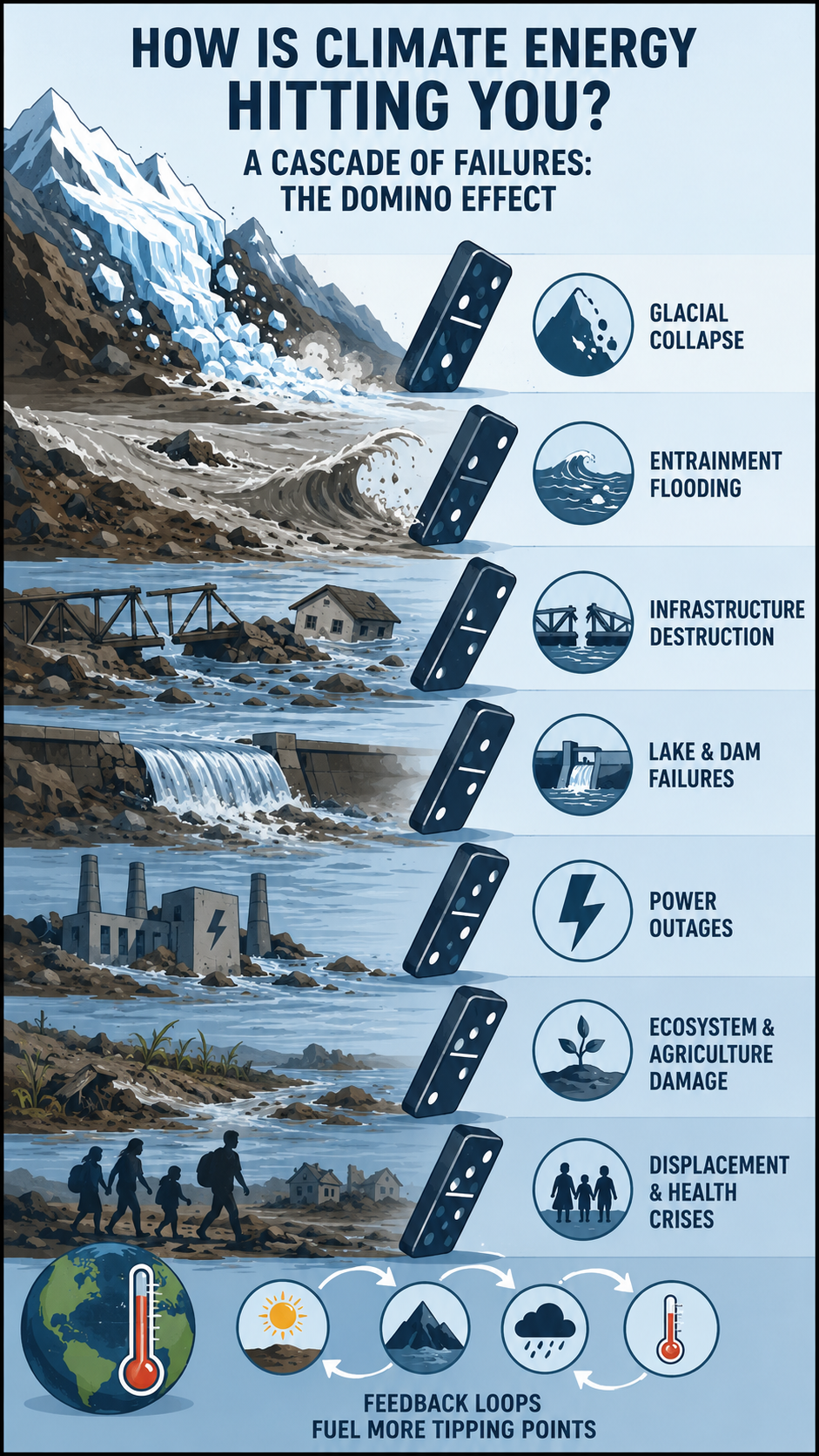
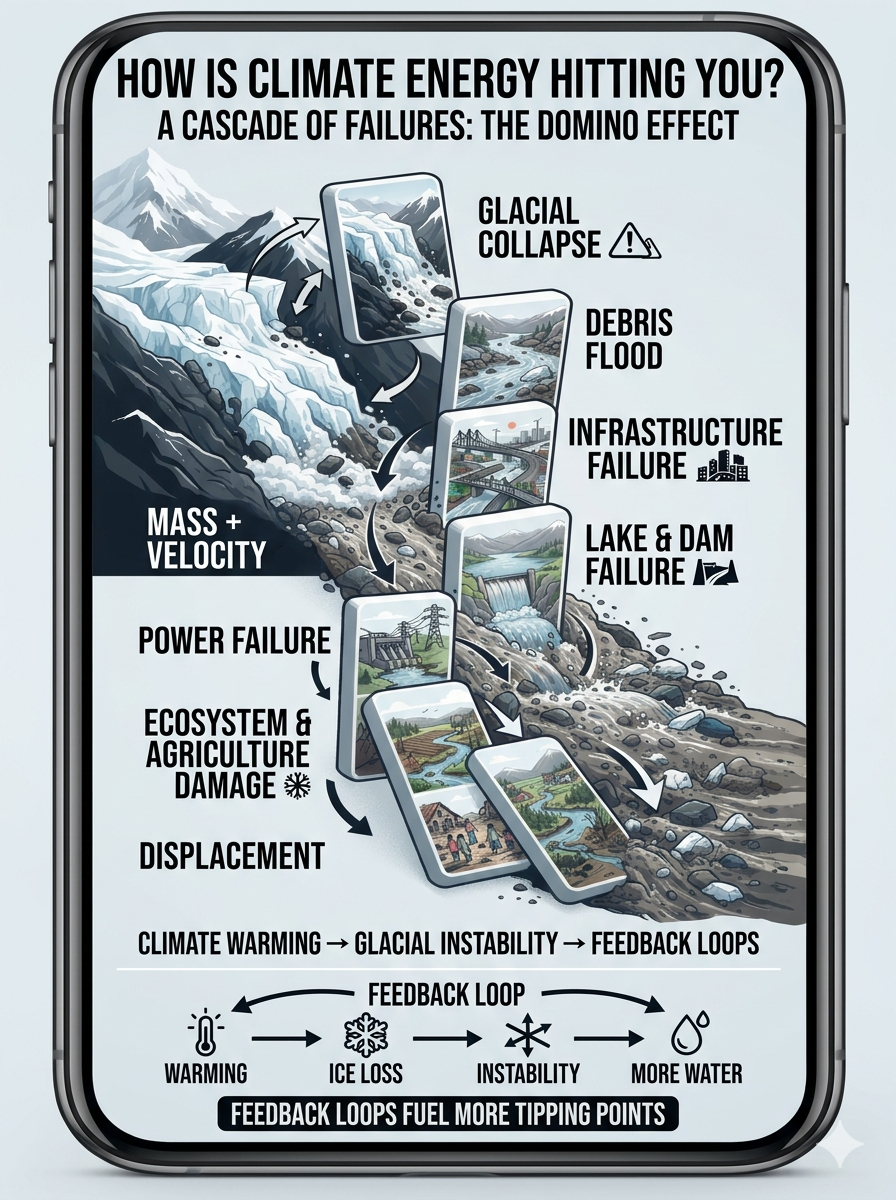
A glacial collapse is a powerful example of how climate change can turn one tipping point into a cascading chain of failures—the domino effect.

The first domino is literal: an enormous mass of ice, rock, snow, and sediment breaks loose and cascades down the mountainside in a massive avalanche or landslide. But the collapse does not end when the material reaches the valley floor. It can trigger the next domino: entrainment flooding.

As floodwater picks up soil, sediment, rocks, ice, trees, and other debris, it can transform into an extraordinarily dense, wet, cement-like slurry. This is no longer simply water flowing downstream. It is a moving mass with enormous mass, density, and velocity—and therefore enormous destructive energy.

As this debris-laden flow accelerates through steep mountain valleys, it can sweep away bridges, roads, buildings, power infrastructure, and entire sections of communities. But the dominoes still do not stop.

The flood can undermine riverbanks, destabilize slopes, overwhelm reservoirs, damage hydropower facilities, and compromise other natural or engineered barriers—including dams and glacial lakes. A single upstream failure can therefore create the conditions for multiple downstream failures.

And then comes the most dangerous part: the cascade can reinforce the very climate and physical feedbacks that made the system unstable in the first place.

The initial collapse can expose dark rock and soil, reducing surface albedo and increasing heat absorption. It can expose and destabilize permafrost. Meltwater and rainfall can infiltrate fractures and sediments, reducing friction and increasing lubrication. Additional water can enlarge glacial lakes and increase pressure against unstable moraine dams. Continued warming can accelerate glacier retreat and meltwater production, while changing precipitation patterns and more intense rainfall can add still more water and mechanical stress to an already destabilized landscape.

The chain becomes:

Glacier retreat → increased meltwater → glacial-lake expansion → permafrost thaw → ice and rock destabilization → landslide or glacial collapse → entrainment flooding → infrastructure failure → secondary lake and dam failures → additional flooding → further destabilization.

The energy does not simply disappear when the first domino falls.

It is transferred from ice to rock, from rock to water, from water to sediment, and from the moving flood into everything in its path.

This is the critical distinction between viewing climate change as a gradual change in temperature and understanding it as a dynamic physical system capable of cascading failures.

The question is no longer simply how much the planet is warming.

The question is:

How much energy is being loaded into the system—and what happens when the dominoes start falling?

A Continuous Cascade of Failures: The Nepal-Tibet Domino Effect

A mountain disaster rarely ends where it begins.

On Wednesday, August 26, 2026, a major glacial collapse in the Nepal–Tibet border region triggered devastating flash flooding. By Friday, August 28, the emergency had escalated again: an enormous new barrier lake, created when landslide debris choked a river confluence, was overflowing continuously under ongoing heavy rain.

The immediate danger is obvious—the potential failure of the unstable debris dam and the sudden release of millions of cubic meters of water downstream.

But the larger story is the cascade.

When ice collapses, rock moves. When rock blocks a river, water accumulates. When water overtops the blockage, the barrier can erode. When the barrier fails, a flood carries enormous quantities of sediment and boulders downstream. That surge can destabilize other slopes, erode riverbanks, damage infrastructure, and potentially trigger additional lake or moraine failures.

One failure can therefore become the next failure.

This is the domino effect of climate energy.

The First Domino: Ice, Rock, Water and Gravity

The massive debris generated by the initial landslide has choked the confluence of the Chhochen Khola and Purepu Tsangpo rivers on the Tibetan side, trapping an estimated 2.5 million cubic meters of water.

Ongoing heavy rainfall is adding even more water to an already unstable system.

The resulting barrier lake is not a conventional engineered dam. It is a temporary structure composed of landslide debris—rock, sediment, ice and soil—whose stability can change rapidly as water rises and begins eroding the barrier.

If the barrier breaches, the result would not simply be a larger river.

It could be a rapidly moving mixture of water, mud, sediment, boulders and debris, capable of scouring river channels, destroying bridges and roads, damaging hydropower facilities, and destabilizing additional natural barriers downstream.

The first domino would have fallen.

The Second Domino: A Network of Vulnerable Glacial Lakes

The danger does not end with the newly formed barrier lake.

The high mountains of the Nepal–Tibet region contain numerous glacial lakes held back by natural moraine and debris dams. Some have expanded dramatically as glaciers retreat and meltwater accumulates.

This creates a dangerous characteristic of mountain watersheds:

The hazards are connected.

A flood originating high in a watershed can travel rapidly downstream, carrying enough water and sediment to erode banks, undercut slopes, destabilize moraines, and overwhelm infrastructure.

That does not mean every lake will fail in sequence. It means that the failure of one component can increase stress on other components of an already unstable system.

Among the glacial lakes and hazard zones requiring close attention are:

Thulagi Glacial Lake — Marsyangdi River Basin

Located in the Manang District, Thulagi Glacial Lake has long been recognized as a significant glacial-lake hazard.

Its vulnerability is associated with the stability of its natural moraine dam and the potential for disturbances—including upstream ice or rock avalanches—to generate sudden waves or overtopping.

Lower Barun Glacial Lake — Sankhuwasabha District

Lower Barun lies in a rapidly changing high-altitude environment where glacier retreat and changing meltwater inputs can alter lake volume and moraine stability.

Its expansion illustrates a fundamental climate problem:

The landscape itself is changing faster than the infrastructure and hazard-management systems built around it.

Lumding Tsho — Solukhumbu District

Lumding Tsho represents another potential component of a connected high-mountain hazard system.

Rapid changes in surrounding glaciers, slopes and permafrost can alter the conditions controlling lake stability. A major avalanche, landslide or flood entering the lake could potentially produce dangerous waves or overtopping.

Hongu 2 — Solukhumbu District

Hongu 2 is another glacial-lake hazard requiring monitoring and risk reduction because of vulnerabilities associated with its natural damming structures.

The important point is not that every lake will suddenly fail.

It is that multiple unstable components exist within interconnected watersheds.

That changes the nature of the risk.

A Transboundary Domino Effect

The geography makes the situation even more dangerous.

The Himalaya is a connected hydraulic system. Water generated at extreme elevations can travel from the Tibetan Plateau into steep Nepalese valleys, where narrow channels concentrate enormous amounts of energy.

A flood does not recognize an international border.

A landslide in Tibet can therefore become an infrastructure emergency in Nepal.

A flood generated hundreds of kilometers upstream can destroy roads, bridges, hydropower facilities, agricultural land and communities downstream.

Past Himalayan GLOF events demonstrate how quickly an upstream disturbance can become a downstream catastrophe.

The July 2025 supraglacial lake outburst north of Langtang Himal is one example of the speed with which high-altitude water hazards can propagate into populated and economically important river corridors.

The critical issue is connectivity.

The mountains, glaciers, lakes and rivers are not independent hazards.

They are components of one interconnected system.

Climate Warming Loads the System With More Energy

This is where the story becomes larger than a single landslide or flood.

Climate change is altering the physical conditions that determine how much energy is stored in the mountain environment and how easily that energy can be released.

Warming contributes to:

  • Glacier retreat
  • Increasing meltwater production
  • Expansion of some glacial lakes
  • Thawing mountain permafrost
  • Destabilization of ice and rock
  • Changing precipitation patterns
  • More intense rainfall events in some regions
  • Increasing exposure of unstable slopes

The result is not simply more water.

It is a landscape containing more potential pathways for rapid energy release.

Water provides mass.

Gravity provides acceleration.

Steep terrain provides a pathway.

And when water interacts with loose sediment, ice and fractured rock, the resulting flow can become dramatically more destructive.

Permafrost: The Mountain’s Hidden Glue

High-altitude permafrost acts in part as a structural component of mountain slopes.

When permanently frozen ground warms and thaws, ice that previously helped bind rock and sediment together can disappear.

That can weaken slopes.

The consequences can include:

Rockfall → landslide → avalanche → river blockage → barrier lake → outburst flood.

Each stage creates the possibility of the next.

The initial failure can also expose previously frozen ground to warmer air, rain and meltwater, potentially accelerating local instability.

This is a critical climate feedback:

Warming destabilizes the mountain. Mountain collapse exposes more material. Exposed material absorbs heat and water. Instability increases.

Albedo Loss: From White Ice to Dark Rock

Ice and snow reflect a large proportion of incoming solar radiation.

Rock, soil, mud and exposed debris absorb considerably more.

When glaciers retreat or collapse, their reflective surfaces are replaced by darker terrain.

That creates a local energy imbalance:

Less reflection → more absorption → more warming → more melting and thawing.

Albedo loss is therefore another feedback mechanism operating alongside glacier retreat and permafrost thaw.

The mountain landscape is not simply losing ice.

It is changing the way it absorbs and stores energy.

Friction, Lubrication and the Release of Stored Energy

There is another physical mechanism that matters: friction.

Rock, ice and sediment can remain relatively stable when friction holds them in place.

But meltwater and rainfall can penetrate fractures and saturated sediments, reducing effective friction and increasing lubrication along some surfaces.

Under glaciers, meltwater can also act as a lubricant, allowing ice to move more rapidly across the bed.

The basic physical principle is straightforward:

When friction decreases, movement becomes easier.

That means climate-driven increases in meltwater can affect not only the amount of water entering a watershed, but also the mechanical stability and mobility of ice, sediment and rock.

The result is another pathway through which climate energy can become kinetic energy.

The Economic Domino Effect

The physical cascade rapidly becomes an economic cascade.

Hydropower

Himalayan hydropower facilities are particularly vulnerable because they are located directly within steep, confined river corridors.

Floods carrying enormous quantities of sediment, gravel and boulders can:

  • Damage intake structures
  • Fill reservoirs with sediment
  • Destroy transmission infrastructure
  • Erode turbines and mechanical equipment
  • Block access roads
  • Force prolonged shutdowns

The destruction of a single hydropower facility can therefore produce consequences far beyond the immediate flood zone.

Roads and Bridges

High mountain communities depend on relatively few transportation corridors.

When a bridge or highway is destroyed, there may be no practical alternative route.

A single failure can isolate entire communities and make emergency response and reconstruction substantially more difficult.

Transboundary infrastructure—including major crossings such as the Friendship Bridge—can become critical points of failure.

Agriculture

Floodwater does not simply deposit fertile soil.

A high-energy debris flood can bury agricultural land beneath layers of:

  • Rock
  • Gravel
  • Sand
  • Mud
  • Coarse sediment
  • Organic debris

Fields can become unusable for multiple growing seasons.

The agricultural domino effect becomes:

Flood → soil burial → crop loss → food insecurity → income loss → displacement.

The Ecological Domino Effect

The ecological consequences can be equally profound.

Rivers Become Sediment Conveyors

Extreme sediment loads can dramatically increase turbidity and reduce water quality.

Fine sediment can smother aquatic habitat while larger debris physically alters channels.

Fish populations can decline, disrupting food webs that extend from aquatic insects and fish to birds, mammals and human communities.

Protected Ecosystems Are Not Immune

Mountain ecosystems are among the most fragile environments on Earth.

Floods and landslides can destroy habitat within protected areas such as Langtang National Park.

Species adapted to narrow ecological zones have limited ability to escape rapidly changing landscapes.

The loss of habitat therefore becomes another domino:

Physical destruction → habitat fragmentation → population stress → biodiversity loss.

The Human Health Domino Effect

A major flood also creates an immediate public-health emergency.

Floodwaters can destroy sanitation systems and contaminate drinking-water supplies with sewage, animal waste, debris and other pollutants.

Where clean water becomes unavailable, the risk of waterborne disease increases.

But health consequences extend beyond infectious disease.

Survivors may lose:

  • Homes
  • Livelihoods
  • Schools
  • Transportation
  • Family members
  • Community networks

The psychological consequences of sudden disaster can persist long after the floodwaters recede.

Displacement Becomes the Final Domino

When communities are repeatedly exposed to catastrophic flooding, landslides and infrastructure failure, relocation can become unavoidable.

That produces a final cascade:

Climate disruption → disaster → infrastructure loss → economic collapse → displacement.

People displaced by climate-related disasters may face years of uncertainty rather than a temporary interruption.

And when multiple communities experience the same process simultaneously, the effects can spread well beyond the original disaster zone.

This Is What a Cascade Looks Like

The most important lesson from the Nepal–Tibet emergency is not simply that a glacier collapsed.

It is that the consequences of climate change increasingly emerge as connected chains of physical failure.

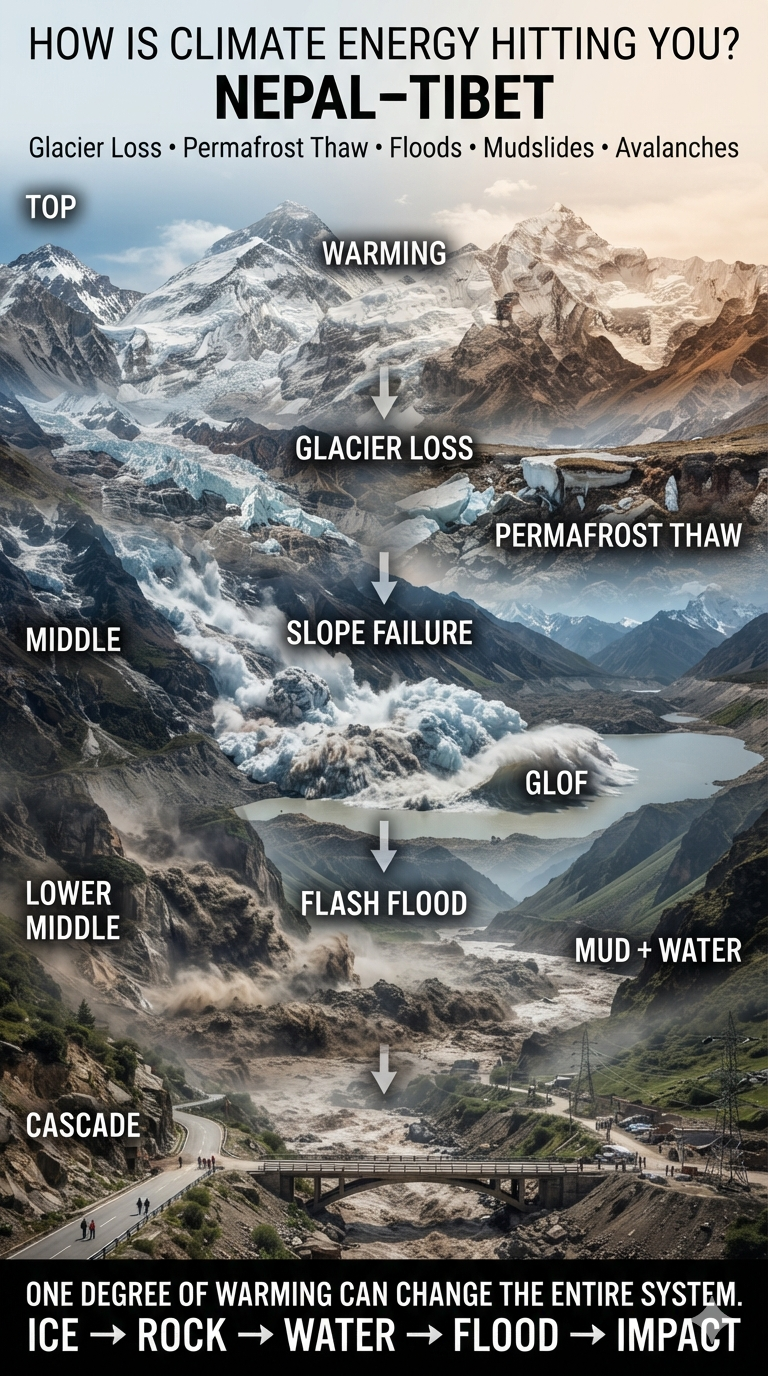
The sequence can look like this:

Warming

↓

Glacier retreat + permafrost thaw

↓

Ice and slope destabilization

↓

Landslide / avalanche / glacial collapse

↓

River blockage

↓

Barrier lake formation

↓

Lake expansion + overtopping

↓

Glacial Lake Outburst Flood

↓

Sediment + boulders + debris

↓

River-channel erosion

↓

Secondary landslides and infrastructure failures

↓

Hydropower disruption

↓

Road and bridge destruction

↓

Agricultural losses

↓

Water contamination

↓

Ecosystem collapse

↓

Economic disruption

↓

Displacement

The dominoes are connected.

And the energy driving them is not theoretical.

It is stored in ice, water, rock, gravity and the atmosphere.

Climate change is altering how much energy is available, where it is stored, and how quickly it can be released.

That is why the question is not simply:

How much is the planet warming?

The more important question is:

How Is Climate Energy Hitting You?

Because when the Earth starts moving, one failure can become another—and another—and another.

bookmark_borderHow Is Climate Energy Hitting You? The Physics of When the Earth Starts Moving

by Daniel Brouse

Density. Velocity. Gravity. Friction. Entrainment.

Climate change is often described in terms of temperature: another degree of warming, another heat record, another fraction of a degree above a historical baseline.

But temperature is only the beginning of the story.

The more consequential question is:

What happens when warming changes how much energy and mass are available to move—and how easily they can move?

The atmosphere, oceans, glaciers, snowpack, soils, mountains, and rivers are all components of a connected physical system. They store energy and mass. Under certain conditions, that stored energy can be released rapidly through wind, water, ice, avalanches, landslides, floods, and debris flows.

And once something starts moving, density, velocity, gravity, friction, and entrainment can interact to dramatically amplify the consequences.


The Physics: Density × Velocity²

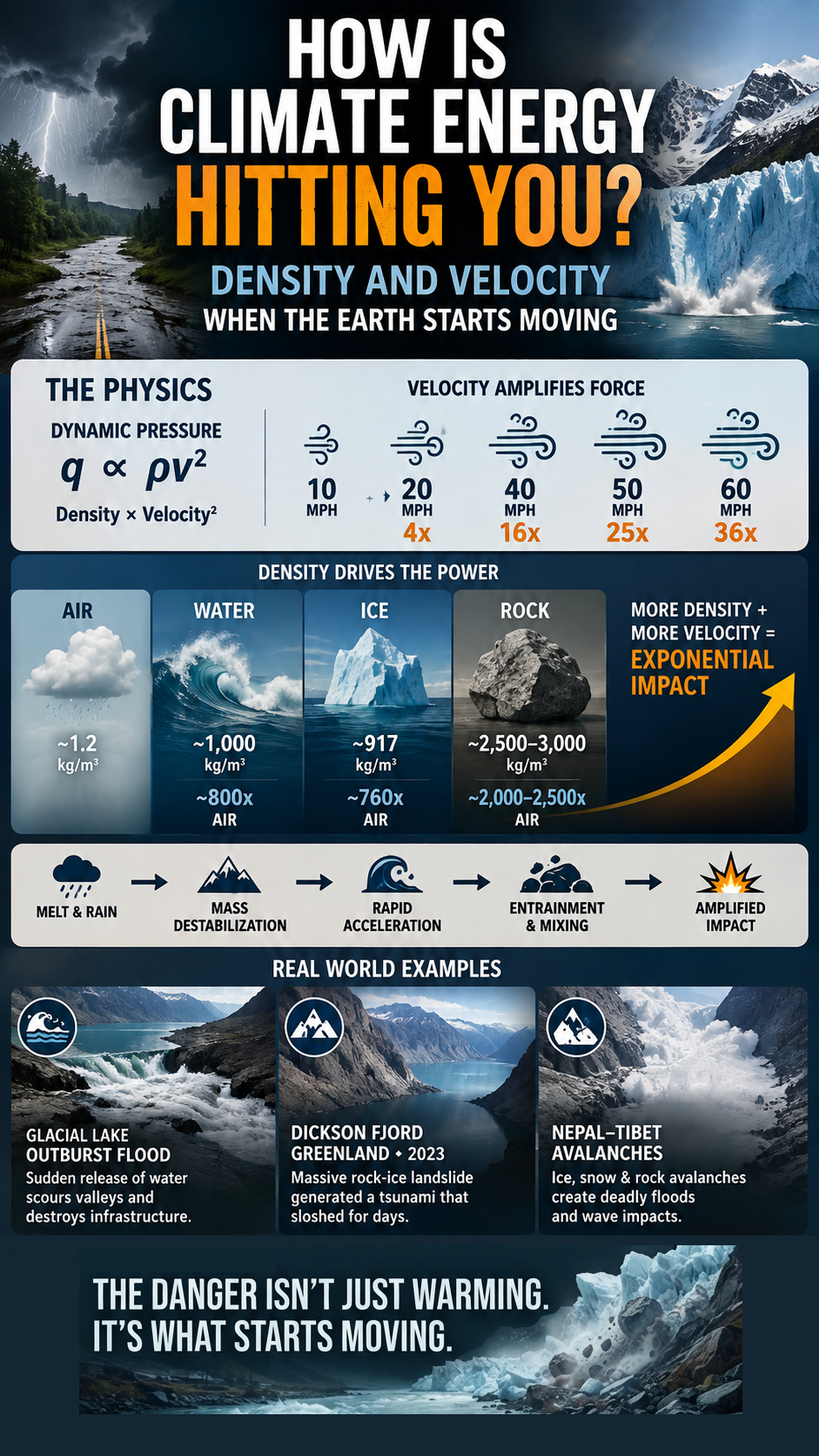
For fluid flow, dynamic pressure is proportional to density multiplied by the square of velocity:

q ∝ ρv²

More precisely, dynamic pressure is:

q = ½ρv²

This simple relationship explains why velocity is such a powerful amplifier.

For example:

  • A 20 mph wind produces 4× the dynamic-pressure scale of a 10 mph wind.
  • A 40 mph wind produces 16×.
  • A 50 mph wind produces 25×.
  • A 60 mph wind produces 36×.

Velocity is therefore not a linear amplifier.

Double the velocity → 4× the velocity-squared term.

Triple the velocity → 9×.

And this is before considering density.


Density: How Much Mass Is Moving?

Density determines how much mass is packed into a given volume.

Approximate densities illustrate the enormous difference:

  • Air: ~1.2 kg/m³
  • Water: ~1,000 kg/m³
  • Ice: ~917 kg/m³
  • Rock: ~2,500–3,000 kg/m³

Water is therefore roughly 800 times denser than air.

Ice is roughly 760 times denser than air.

Rock can be roughly 2,000–2,500 times denser than air.

At the same velocity, these differences matter enormously.

But there is an important distinction.

The simple ρv² relationship describes dynamic pressure in a moving fluid. It should not be applied mechanically as though a rock avalanche were simply “rock behaving like air or water.” Moving ice and rock involve additional physics—especially mass, momentum, gravitational potential energy, kinetic energy, friction, and collisions.

The underlying principle, however, remains powerful:

More mass moving faster carries more energy and momentum.


Gravity: The Energy Stored in Height

Gravity is one of the great energy reservoirs of the Earth system.

A glacier sitting high in a mountain valley contains enormous gravitational potential energy because of its mass and elevation.

So does a mountainside.

So does water stored behind a natural or artificial dam.

So does a glacial lake perched above a downstream valley.

Gravitational potential energy is commonly expressed as:

PE = mgh

where:

  • m = mass
  • g = gravitational acceleration
  • h = elevation

When that stored energy is released, it can become kinetic energy:

KE = ½mv²

This creates another important connection between mass and velocity.

A small object moving rapidly can be destructive.

An enormous mass moving rapidly can be catastrophic.

And when the moving mass begins picking up additional material, the system can become even more powerful.


Friction: The Brake on the System

But gravity does not automatically make everything move.

Friction is the brake.

Friction resists movement between surfaces. It helps keep glaciers attached to their beds, soil on hillsides, rocks on mountains, and sediment within channels.

In simplified terms:

Gravity drives movement.
Friction resists movement.

The balance between those forces can determine whether a system remains stable—or begins to move.

This is particularly important in glaciers and steep mountain environments.


Meltwater: When the Brake Gets Wet

Under a glacier, meltwater can travel through cracks, crevasses, channels, and conduits until it reaches the glacier bed.

There it can increase water pressure between the ice and underlying rock.

That matters because increased water pressure can reduce the effective normal force pressing the glacier against its bed, potentially reducing basal friction and allowing the ice to slide more easily.

In other words, meltwater can do more than add water to the system.

It can reduce resistance to movement.

The simplified conceptual chain becomes:

Warming → melting → more meltwater → increased basal water pressure → reduced friction → enhanced sliding

But the actual relationship is complex. More meltwater does not automatically mean faster glacier movement. The effect depends on how water is distributed and drained beneath the glacier. Efficient drainage can relieve pressure, while poorly drained or rapidly delivered water can increase basal pressure.

The important point is that lubrication can alter the balance between driving force and resistance.

The same broader principle applies to unstable slopes.

Water infiltrating soil, fractured rock, snow, and ice can change pore-water pressure and reduce effective resistance to failure. A slope that was stable under one set of conditions can become unstable when water changes the mechanical balance.

So another pathway emerges:

More water → less effective resistance → greater potential for movement.

And once movement begins:

greater movement → greater velocity → greater kinetic energy.

Climate change can therefore influence not only how much energy enters a system, but under some circumstances how easily that stored energy can be released.


Entrainment: When Moving Material Picks Up More Material

There is another amplifier:

Entrainment.

Moving water can pick up sediment.

Floods can carry gravel and boulders.

Avalanches can incorporate snow, ice, trees, and rock.

Landslides can transform into debris flows as they mix with water and incorporate additional material.

A moving glacier can transport enormous quantities of sediment and rock.

This creates a potentially powerful feedback:

Movement → entrainment → more mass → greater momentum → greater destructive potential

The flow is no longer carrying only the material that initially started moving.

It is gathering additional mass along the way.


When Water Becomes a Weapon

Consider extreme rainfall.

Rain falls onto a landscape.

Some infiltrates.

Some becomes runoff.

As rainfall intensity increases, runoff can become increasingly rapid. Gravity accelerates water downslope. The moving water begins eroding soil and sediment and can pick up increasingly large particles.

Now the flow is carrying:

water + soil + gravel + rocks + trees + debris

The physical character of the event has changed.

It is no longer simply a flood.

It can become a debris flow or sediment-laden flood, capable of enormous erosion and impact.

This is why the consequences of extreme rainfall can be disproportionately larger than the increase in rainfall itself.


Glacial Lake Outburst Floods

The same principles operate in high mountain environments.

Glaciers can dam lakes.

Meltwater can increase lake volume.

Ice or rock can destabilize the surrounding terrain.

A sudden collapse, avalanche, or breach can release enormous quantities of water.

A glacial lake outburst flood, or GLOF, can rapidly send a pulse of water downstream.

As that water accelerates under gravity, it can scour the valley and entrain sediment, boulders, trees, and infrastructure debris.

The result can become a cascading process:

Stored water → sudden release → acceleration → erosion → entrainment → greater mass → amplified destruction

The original trigger may be relatively localized.

The resulting moving mass may not be.


When Glaciers and Mountains Collapse

The same energy cascade can occur when ice and rock themselves become unstable.

A glacier, ice shelf, frozen slope, or mountain face can store enormous gravitational potential energy.

When structural stability is lost, that energy can be released rapidly.

Ice, snow, rock, and debris accelerate downslope.

Collisions generate additional energy transfer.

Material can fracture and fragment.

Snow and rock can be entrained.

Water can be displaced.

And if the moving mass enters a lake, fjord, river, or ocean, it can transfer energy into the water and generate powerful waves.

The system can therefore move through multiple physical states:

Ice → collapse → acceleration → impact → water displacement → wave → downstream damage

This is not simply “melting.”

It is a mass-and-energy transfer through a connected Earth system.


Dickson Fjord: Greenland, 2023

The September 2023 event at Dickson Fjord in Greenland provides a remarkable illustration.

A massive rock-and-ice landslide entered the narrow fjord, displacing water and generating a tsunami-like wave. The confined geometry of the fjord allowed the resulting water motion to oscillate for days.

The event demonstrates how changes affecting ice, permafrost, and mountain stability can interact with water and topography to produce consequences far beyond the original failure.

The important lesson is the chain:

Mass failure → gravity → acceleration → water displacement → wave energy

One component of the Earth system triggers another.


Nepal–Tibet and the Himalayas

The high mountains of the Nepal–Tibet/Himalayan region provide another setting where these interactions can become particularly dangerous.

Here, glaciers, snowpack, steep rock faces, permafrost, glacial lakes, and rapidly flowing rivers exist within an extraordinarily steep landscape.

Ice and snow avalanches can incorporate rock.

Rock avalanches can interact with glaciers and snow.

Failures can enter lakes and displace water.

Floods can then transport the resulting debris downstream.

The potential cascade becomes:

Ice + snow + rock → avalanche → acceleration → water displacement → flood → debris entrainment

Again, the initiating event is only one part of the story.

The pathway of energy matters.


The Nonlinear Cascade

Put all of these components together and the system begins to look very different.

Climate warming

↓

More heat and altered precipitation

↓

Melt + intense rainfall

↓

More water available to move

↓

Changes in pore pressure and basal lubrication

↓

Potential reduction in friction / resistance

↓

Destabilization

↓

Gravity releases stored potential energy

↓

Acceleration

↓

Velocity² amplification

↓

Ice + water + snow + rock + sediment

↓

Entrainment adds mass

↓

Momentum and kinetic energy increase

↓

Water displacement / waves / debris flows

↓

Amplified physical impact

This is the central concept:

The climate system does not have to increase every variable dramatically to produce a dramatically larger consequence.

Several smaller changes can interact.

More water.

Less resistance.

Greater instability.

More available mass.

Higher velocity.

More entrainment.

Each can alter the conditions experienced by the next part of the chain.


This Is Not “Exponential” by Default

It is important to be precise.

The underlying physics does not mean that every climate impact is mathematically exponential.

The velocity-squared relationship is nonlinear.

Kinetic energy also scales with v².

Gravitational potential energy scales with mass and elevation.

Friction determines resistance to motion.

Water pressure can alter effective stress and friction.

Entrainment can increase the moving mass.

These nonlinear processes can interact and produce disproportionately large impacts relative to the initiating change.

The result can sometimes look exponential in its consequences even when no single component follows a simple exponential equation.

That distinction matters.

The physics is powerful enough without exaggerating it.


The Earth Is a Connected Energy System

This changes how we should think about climate risk.

The danger is not simply:

“The temperature went up.”

The more important question is:

“What did that additional energy change?”

Did it increase atmospheric moisture?

Did it intensify rainfall?

Did it accelerate runoff?

Did it increase meltwater?

Did it alter water pressure beneath a glacier?

Did it reduce effective resistance to sliding?

Did it destabilize frozen ground?

Did it weaken a slope?

Did it increase the amount of material available to an avalanche or debris flow?

Did a moving flood begin carrying rocks and trees?

Did a landslide enter a fjord or lake and displace water?

The climate signal can therefore propagate through a chain of physical processes.

Heat can become water.

Water can become motion.

Motion can become erosion.

Erosion can become entrainment.

Entrainment can become mass.

Mass moving under gravity becomes momentum and kinetic energy.

And that energy eventually reaches something we care about:

a road, a bridge, a home, a community, an ecosystem, or a coastline.


The Physics

The physics can be summarized in five words:

Density. Velocity. Gravity. Friction. Entrainment.

Density determines how much mass is contained in a moving volume.

Velocity can amplify fluid dynamic pressure and kinetic energy through the v² relationship.

Gravity provides a pathway for converting elevation into motion.

Friction normally acts as a brake—but water can sometimes reduce effective resistance through lubrication and changes in water pressure.

Entrainment can add more mass to a moving system as it travels.

Together, these processes create the possibility of cascading amplification.

The danger of climate change is therefore not measured only by the number on a thermometer.

It is also measured by what begins moving when the Earth system is pushed beyond its previous conditions.

The atmosphere moves.
The oceans move.
Water moves.
Glaciers move.
Mountains move.
Rock moves.
And when those systems begin interacting, energy can move from one component to another with astonishing speed.

The critical question is no longer simply:

How much warmer is the planet?

It is:

How much stored energy and mass are being made available to move—and what happens when the brakes come off?

That is how climate energy can hit you.


Footnote:

There was a video of what appeared to be large boulder rolling along the top of the entrainment and sometimes appearing to be bobbing up and down.

The bulk of the rock appears to have come through first, driven by the entrainment and water flow. That process essentially carved out a channel, which was then followed by an enormous mass of mud—up to three stories deep—that completely buried villages.

As for whether what we’re seeing is rock or ice, it was probably a combination of both. I heard one report describe the flow as being like “wet concrete,” which is actually a pretty good way to visualize the density and behavior of the material.

I also saw a video of a bridge collapse that really demonstrated the power of the flow. I was amazed by what looked like the “buoyancy” of the bridge. The entrainment was so dense and forceful that the bridge essentially “floated” on top of the moving mass, continued downstream, and then took out another bridge—which also appeared to “float” on top of the flow.

Both structures were ultimately carried downstream, taking out virtually anything and everything in their path. That is the kind of energy and momentum you get when water, sediment, rock, ice, and debris become one extremely dense, moving mass.

q = ½ρv²

If you’re interested in the physics, I wrote it out in detail. I thought you might be particularly interested in the lubrication/friction component, especially since you’ve been describing what appears to be that process in some of your comments. Under the right conditions, meltwater can reduce friction beneath the ice, contributing to what is known as basal sliding (or basal slip).

I’ve also seen footage showing substantial water flowing out from beneath the glacier, which makes the basal-flow question particularly interesting. There was also a glacial lake at the bottom of the system and a hydroelectric plant downstream—well, there was one before the event—leading me to believe there is substantial glacial meltwater.

Another factor is the thawing permafrost and peat that had been helping stabilize the rock and sediment. Add the unseasonably warm conditions and significant precipitation in the preceding days, and you have multiple processes acting together: meltwater infiltration, increasing water pressure, reduced basal friction, thawing ground, and gravity-driven ice and rock movement.

That’s why I’m hesitant to characterize what happened as simply an “ice collapse” or a “rockslide.” It appears to have involved a coupled ice-rock-water system. The ice-water mixture at the top of the fall may have been predominantly ice, but by the time that mass traveled roughly a kilometer downhill under an acceleration of about 32 ft/s², much of the ice would likely have melted or fragmented. As it accelerated, it was also entraining water, rock, sediment, and debris, rapidly changing the composition and behavior of the flow. Once the material began moving, the entrainment produced an extremely dense and mobile flow like “wet concrete.” When you see these villages buried under that material, it almost looks like the ground has turned into solidifying concrete or quicksand—an incredibly dense, water-saturated mass that can engulf and bury structures… and people in minutes. The rescue teams are reaching for people almost like they’re conducting an ice rescue—crawling on their bellies across the surface because the material is so unstable. It gives me a whole new perspective on the physics of climate change.

bookmark_borderGlacial Collapse: Tipping Points in Real Time

by Daniel Brouse

We’re crossing 1.5°C in a hurry—and tipping points are beginning to topple.

This is where tipping points get your attention: you can actually observe them.

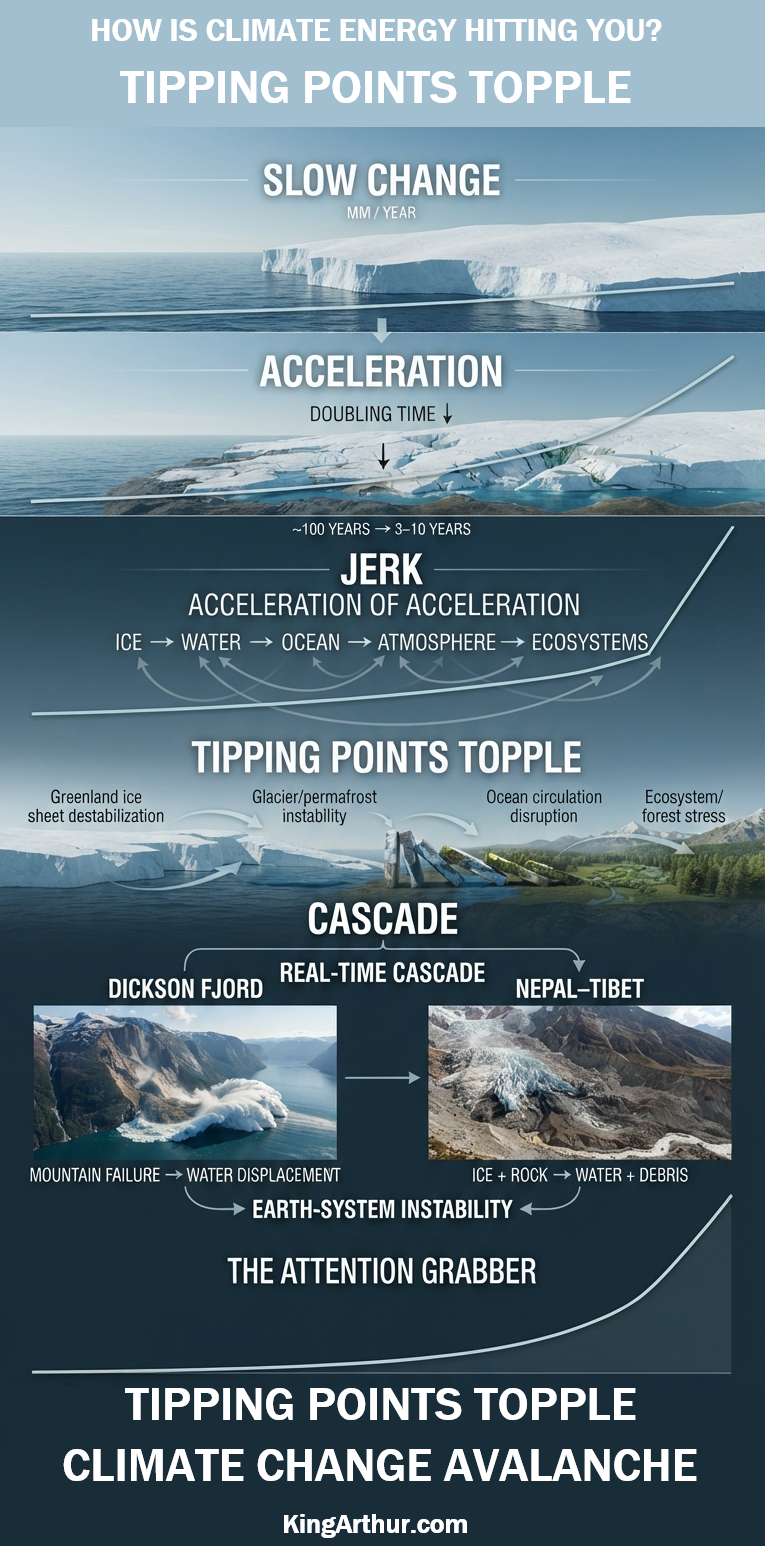
Climate change is not a smooth, linear progression. As thresholds are crossed, individual tipping elements can begin interacting with one another. Feedbacks can couple across the Earth system, changes can propagate faster, and the acceleration of change can itself increase.

What once looked like gradual change can suddenly become a rapidly evolving cascade.

HISTORICAL OBSERVATION

When the last Ice Age ended, Earth experienced “Meltwater Pulse 1A”—a dramatic period roughly 14,500 years ago when sea levels surged upward by about 66 feet over approximately 500 years. Geological evidence from Barbados, Tahiti, and Sunda indicates that sea-level rise reached astonishing rates, sometimes exceeding 40 mm per year.

The lesson from the paleoclimate record is not that history will repeat itself exactly, but that the Earth system is capable of producing rapid, nonlinear changes when large stores of ice and water cross critical thresholds.

OBSERVE CASCADING TIPPING POINTS TODAY

For the last 40 years, sea-level rise has increased from roughly a millimeter to several millimeters per year. People often respond, “So what? What difference does a few millimeters a year make?”

But a sudden-release event is fundamentally different from 40 years of gradually melting ice.

Large volumes of meltwater can be temporarily stored or dammed behind and beneath glaciers, creating the potential for abrupt releases when a critical threshold is crossed.

DICKSON FJORD — GREENLAND

In 2023, a massive rock-and-ice avalanche involving approximately 25 million cubic meters of material plunged into Dickson Fjord and generated a seiche that produced seismic signals detectable around the world for nine days.

This wasn’t simply ice melting.

It was a sudden gravitational release from a destabilized mountain system.

NEPAL–TIBET

A massive ice-and-rock avalanche generated its own seismic signature.

Seismic analysis indicates that the shaking was not an earthquake that triggered the landslide. Rather, the enormous mass movement itself generated seismic waves equivalent to those associated with a magnitude 4.4–5.2 earthquake.

A huge section of glacier reportedly detached from roughly 5,200 meters (17,000 feet) near Langtang Lirung, fragmented during its descent, and transformed into an extraordinarily mobile mixture of ice, water, rock, sediment, boulders, and trees.

This is the critical distinction.

We aren’t simply watching glaciers melt.

We are watching a destabilizing Earth system capable of producing sudden releases, massive gravitational failures, seismic energy, debris flows, river blockages, and catastrophic floods.

The concern is not that every tipping point suddenly collapses at once.

The concern is that tipping points can couple.

One failure can increase stress on another system.

Another threshold is crossed.

Another feedback activates.

The cascade accelerates.

THAT IS THE CLIMATE CHANGE AVALANCHE.

Slow → Accelerating → Tipping → Cascading → Rapidly Changing

Cascading tipping points are now observable in real time.

As we continue to race past 1.5°C, expect to see many more events like these as climate-driven changes increasingly interact with already destabilized Earth systems.

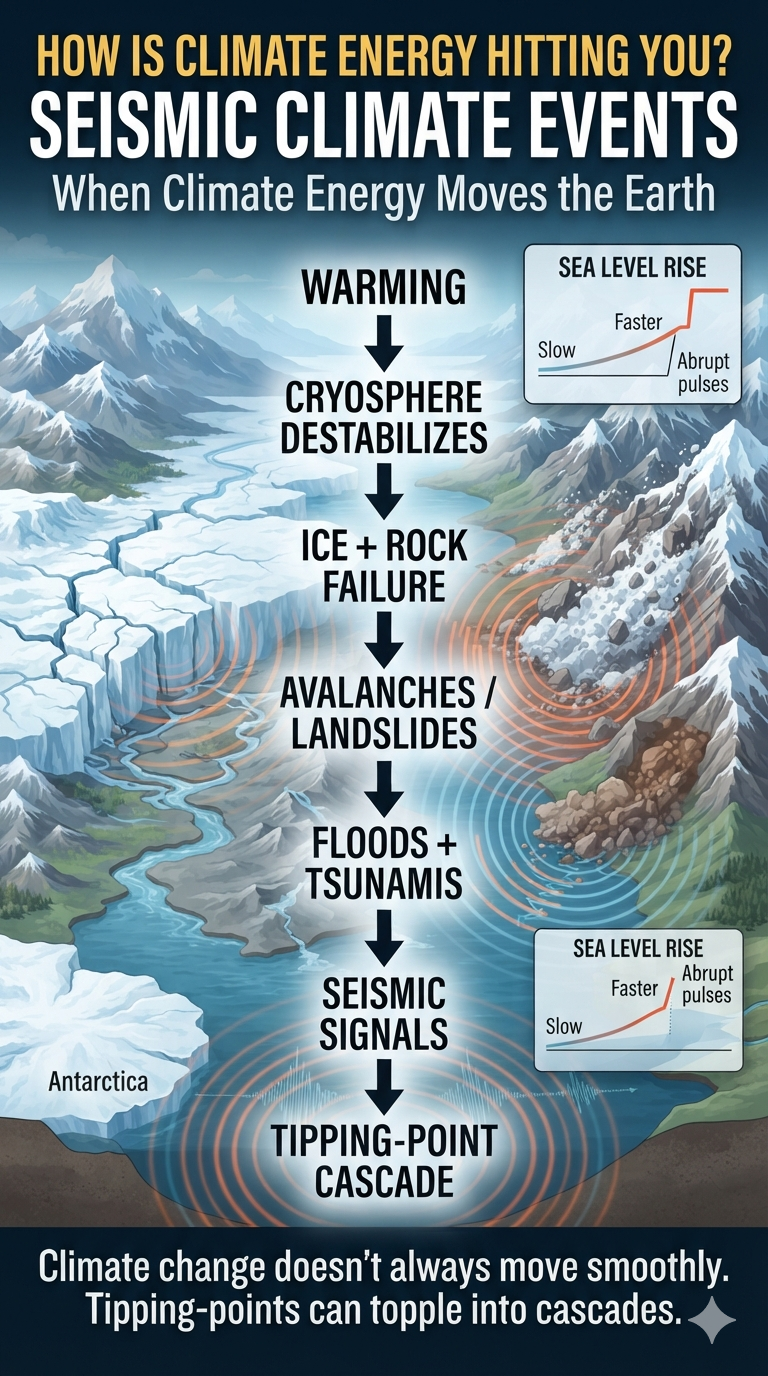
bookmark_borderHow Is Climate Energy Hitting You? Seismic Climate Events

by Daniel Brouse and Sidd Mukherjee

Seismic Climate Events: When Cryosphere Instability Becomes an Earth-System Hazard

I’ve written quite a bit about “Sudden Sea Level Pulses: How ‘Cork Release’ Events Could Rapidly Reshape Coastlines,” which you might find interesting. I expect we will see several feet of sea-level rise for several years in a row this century.

The big examples in Earth’s past occurred when proglacial lakes suddenly broke through ice dams during the last deglaciation.

When the last Ice Age ended, the Earth experienced “Meltwater Pulse 1A”—a dramatic period roughly 14,500 years ago when sea levels surged upward by about 66 feet in just 500 years. Data from Barbados, Tahiti, and Sunda confirm that the ocean rose at astonishing rates—sometimes more than 40 mm per year. We should expect similar patterns again.

I find sea-level rise very intriguing. However, the problem has always been that it is too “slow” for anybody to care. What’s a couple of millimeters a year?

It took us 10 years to confirm that sea-level rise was doubling every ~100 years—2²-fold on a centennial basis. Since the late 1990s, that doubling time has collapsed to 3–10 years. The collapsing doubling times indicate that SLR acceleration is accelerating at approximately 2⁶-fold on a decadal basis.

Though this jerk/third-derivative behavior is alarming to me, it still doesn’t seem to get people’s attention. This is just one set of climate-impact datasets. Many others show the same rate of acceleration.

Now, we’re crossing 1.5°C in a hurry.

This is where jerk behavior will get people’s attention.

We are fairly confident there are several feet or more of dammed-up meltwater. Jerk behavior puts a much higher probability on jerk-like reactions.

The result isn’t going to be a meter of sea-level rise overnight. It is much more likely to be a serious breach in Greenland that raises sea levels perhaps a foot the first year, two feet the next year, and another foot the following year. Then it may go back to millimeters or inches a year for a few years.

This is one of those feedbacks that is very difficult to comprehend.

Greenland has a lot of dammed-up meltwater. Greenland’s geology is shaped like a bowl. If the ice were to melt in place, most of it would likely stay in the bowl.

But hold on—not so fast.

Sudden-release events on Greenland are not the same thing as slowly melting ice over the last 40 years.

When the geology gives way, as it did in 2023’s Dickson Fjord seiche, the consequences can be extraordinary. That massive rock-and-ice avalanche, involving approximately 25 million cubic meters of material, created a tsunami that registered worldwide as an earthquake for nine days.

Recently, in Nepal–Tibet, a similar event demonstrated how a massive climate-sensitive mass movement can generate its own seismic signature. Seismic analysis indicates that the recorded shaking was not an earthquake that triggered the landslide. Instead, the enormous ice-and-rock avalanche generated seismic waves equivalent to those associated with a magnitude 4.4–5.2 earthquake.

A massive section of glacier—reported to have detached from an elevation of roughly 5,200 meters (17,000 feet) near Langtang Lirung—broke free and rapidly fragmented as it descended thousands of feet. The enormous mass of ice and rock transformed into a highly mobile mixture of ice, water, sediment, boulders, and trees.

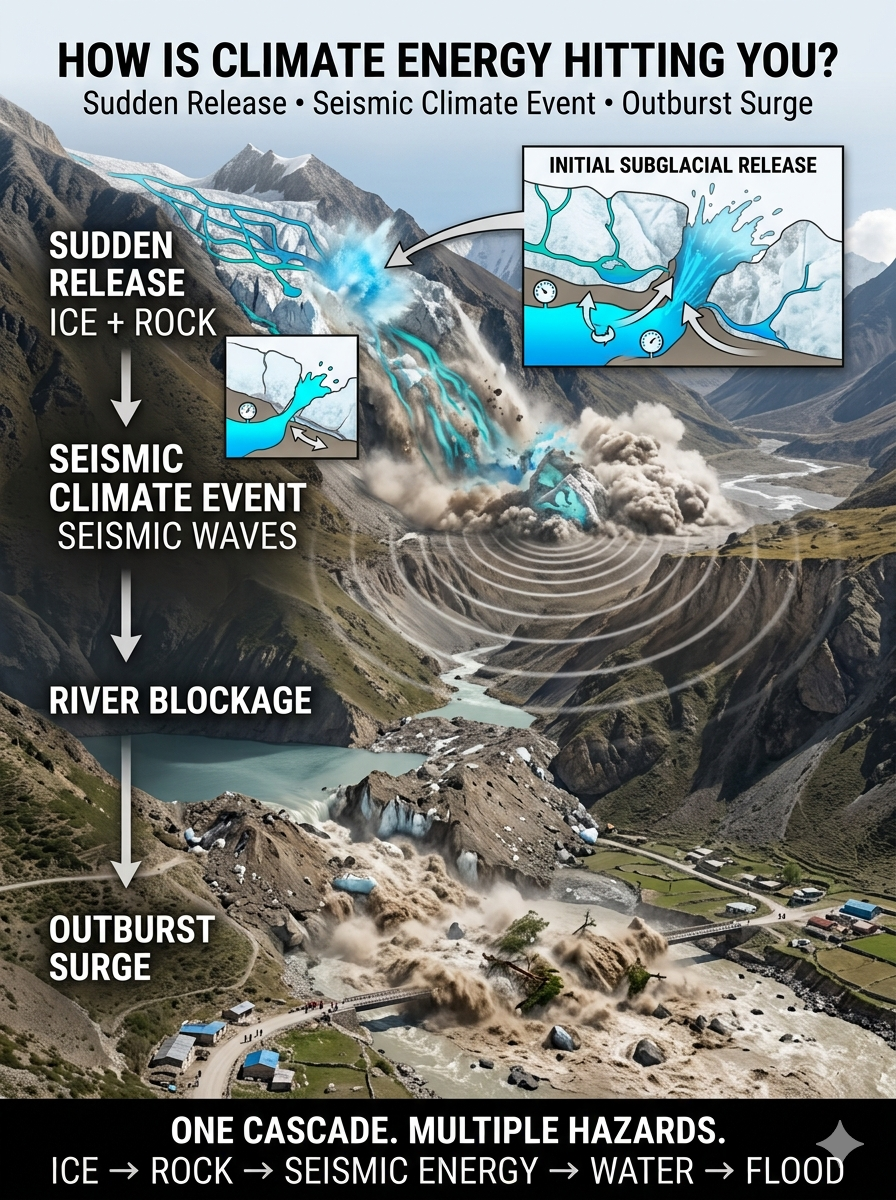
The most likely mechanism is the sudden release of water stored beneath or within the glacier. That water could have dramatically reduced friction beneath the moving mass, allowing the avalanche to accelerate and travel farther than a conventional rockfall or icefall. Rather than behaving like a simple avalanche, the mixture became a rapidly moving debris flow—a slurry of water, ice, sediment, and rock capable of behaving almost like liquid concrete.

The immense mass then crashed into the upper catchment of the Lhende Khola, a river valley along the Nepal–Tibet border. The debris temporarily choked the narrow valley, creating an unstable natural landslide dam.

The Outburst Surge

Summer glacier melt and seasonal monsoon rainfall continued feeding water into the blocked drainage. As water accumulated behind the debris barrier, pressure increased until the unstable dam failed.

The resulting outburst released a massive surge of water and sediment downstream, producing a destructive wall of water and debris through the connected Himalayan river system.

The significance extends beyond the immediate flood. A warming cryosphere can destabilize glaciers and mountain slopes, while extreme precipitation supplies additional water to an already unstable system. A single gravitational collapse can then trigger river blockage, dam failure, flash flooding, and a measurable seismic signal.

This is the kind of cascading interaction that makes seismic climate events fundamentally different from conventional earthquakes: the climate-sensitive Earth surface itself becomes the source of the seismic energy.

Seismic Climate Event

It is an example of what can be described as a seismic climate event: climate-driven changes in glaciers, permafrost, snow, and mountain stability can increase the potential for enormous mass movements, which in turn release sufficient mechanical energy to generate measurable seismic signals.

The broader danger is the cascade.

Warming can destabilize the cryosphere. Cryospheric destabilization can trigger massive avalanches and landslides. Those failures can block rivers, generate flash floods and debris flows, and even produce detectable seismic waves.

The resulting disaster is therefore not the product of a single hazard, but of multiple interconnected Earth-system processes interacting in rapid succession.

Greenland gets even more interesting.

That bowl-like shape was caused by the weight of the glacier. As the glacier and meltwater quake into the sea, there will be fairly rapid rebound, and the bowl bottom will rise back up. This rebound is already much faster than earlier predictions.

This all brings Antarctica into the picture, potentially coupling with Greenland. That could be really drastic compared with Greenland alone.

In particular, Sidd said:

“Yes, I saw that. Under-ice hydrology is hard to observe, but there have been efforts with maps made of Greenland and Antarctica—probably incomplete. I still think Greenland will melt largely in place; Antarctica is the big one.”

See: Greenland Melting Is Inevitable

So how much faster the new-normal sea-level rise will be after such an event is quite uncertain—as is how long it will be until the next sudden release.

The important point is that climate change does not necessarily operate as a smooth, linear progression.

Sometimes the Earth system stores energy and mass until a threshold is crossed. Then the response can become abrupt. This is an observable tipping-point cascade, where one threshold crossing can destabilize another system and trigger a rapid sequence of interconnected changes.

That is the fundamental concern with seismic climate events: the climate system is increasingly interacting with a destabilizing cryosphere and a mechanically active landscape, creating the potential for cascading events that are far faster than the gradual changes that initially caused them.

bookmark_borderHow Is Climate Energy Hitting You? Sweden

by Daniel Brouse

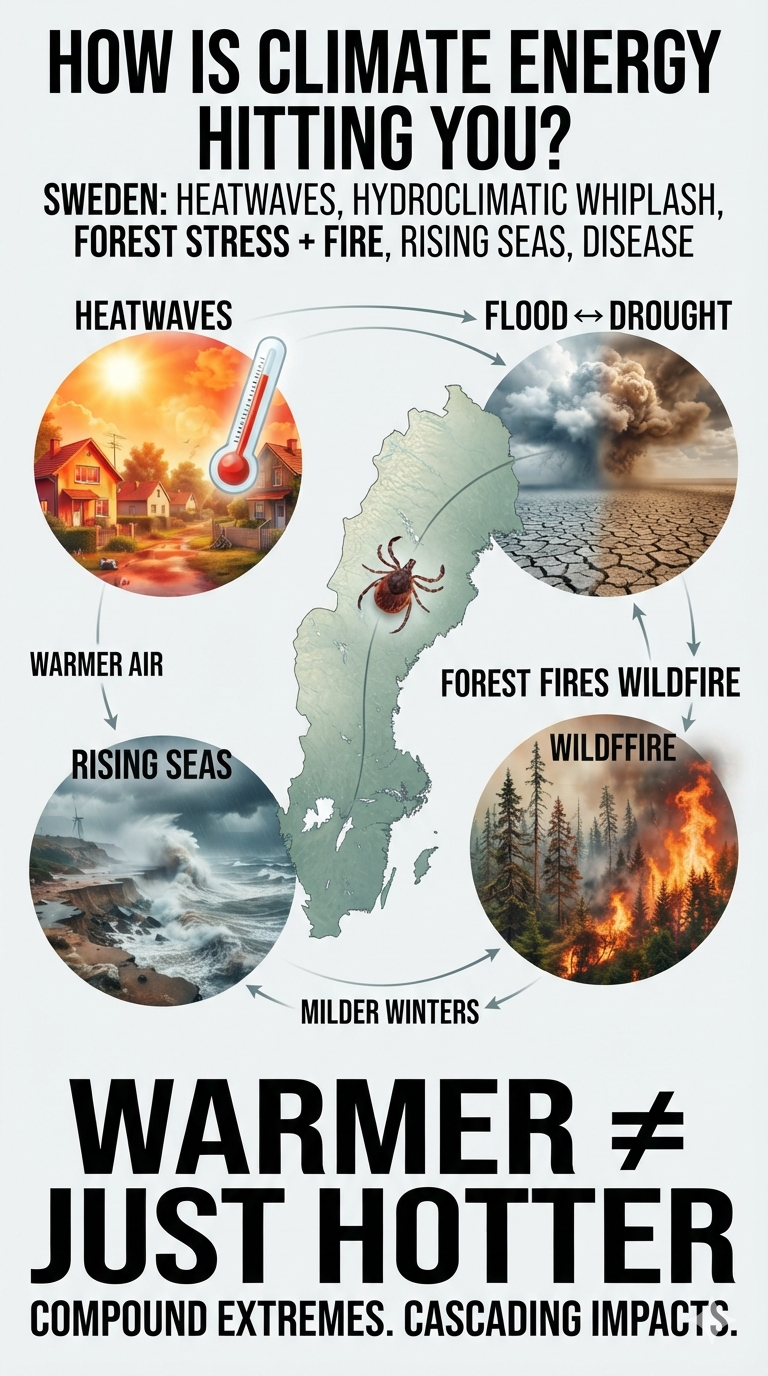
Sweden: Heatwaves, Hydroclimatic Whiplash, Forest Decline, Coastal Erosion and the Northward Spread of Disease

Sweden is warming rapidly, and the impacts of that warming are increasingly moving from long-term projections into everyday disruptions. A changing climate is reshaping Sweden’s risks across multiple interconnected systems—from heat and water to forests, coastlines, agriculture, and human health.

The Swedish Meteorological and Hydrological Institute (SMHI) and climate-impact assessments identify several major vulnerabilities that are becoming increasingly important.

1. Disruptive Heatwaves and the “Unprepared Housing” Crisis

More Frequent Extreme Heat: Sweden is experiencing increasingly frequent and intense heat events, including prolonged periods above 30°C (86°F) and, in extreme cases, 35°C (95°F) or higher. Although Sweden’s climate remains relatively cool compared with many parts of the world, its population and infrastructure are not designed for sustained extreme heat.

The Insulation Paradox: Much of Sweden’s housing stock was designed primarily to retain heat during long, cold winters. That efficiency can become a liability during prolonged summer heat, particularly in buildings without mechanical cooling or adequate passive ventilation.

Dangerous Warm Nights: Rising nighttime temperatures are especially important. When homes and buildings cannot cool overnight, people receive little physiological relief from daytime heat. Older adults, people with chronic conditions, outdoor workers, and other vulnerable populations face increased risks of heat exhaustion, cardiovascular stress, and premature death.

What was once considered an unusual summer inconvenience is increasingly becoming a public-health and infrastructure challenge.

2. Hydroclimatic Instability: Flash Floods vs. Drought

Climate change is intensifying Sweden’s water-cycle extremes, creating a dangerous contradiction: more intense rainfall can occur alongside longer periods of water scarcity.

Extreme Rainfall and Cloudbursts: A warmer atmosphere can hold more water vapor, increasing the potential for intense precipitation. Short-duration summer cloudbursts can overwhelm urban drainage systems, flooding streets, buildings, transportation networks, wastewater systems, and critical infrastructure.

Agricultural and Soil Drought: At the same time, prolonged periods without sufficient rainfall can rapidly dry soils. Higher temperatures increase evaporation and plant water demand, making drought conditions more severe even when annual precipitation does not decline dramatically.

Groundwater Stress: Extended dry periods can also reduce groundwater recharge and threaten local water supplies. Agriculture, forests, ecosystems, and municipalities can therefore experience water stress even during a year that produces damaging floods.

The result is increasingly hydroclimatic whiplash—rapid transitions between excessive water and insufficient water.

3. Forest Stress, Degradation and Wildfires

Sweden’s forests are both an economic resource and a major carbon store, making their increasing climate stress particularly consequential.

Heat and Drought Stress: Repeated heatwaves and prolonged drought reduce soil moisture and place trees under physiological stress. Weakened trees become more vulnerable to disease, insects, wind damage, and other disturbances.

Norway Spruce Vulnerability: Norway spruce, an important commercial species particularly in southern Sweden, is vulnerable to drought and heat stress. Water-stressed trees can become more susceptible to secondary pest outbreaks, accelerating forest decline.

A Longer Wildfire Window: Climate change does not necessarily create the ignition source for a wildfire, but it can make the landscape substantially more receptive to fire. Hotter temperatures, low humidity, dry vegetation, and prolonged drought can extend the period during which fires spread rapidly.

Large wildfires can destroy ecosystems and communities while releasing carbon stored in vegetation and soils—creating another feedback between climate change, forest health, and atmospheric carbon.

4. Coastal Erosion and Rising Sea Levels

Sweden’s coastline faces increasing pressure from rising sea levels, changing storm patterns, and coastal erosion.

Rising Baseline Water Levels: Global sea-level rise raises the starting point from which storm surges occur. Even where local land uplift moderates the rate of relative sea-level rise, some coastal areas remain increasingly exposed to flooding and erosion.

Storm-Surge Amplification: Strong autumn and winter storms can temporarily push water levels far above the average sea level. As the baseline rises, the same storm can produce greater coastal flooding and erosion.

Southern and Western Coastlines: Low-lying areas, particularly along parts of Skåne and Sweden’s western coast, face increasing long-term risks to beaches, wetlands, roads, buildings, and other infrastructure.

Cities and population centers including Malmö and Gothenburg face a particularly important challenge: protecting densely developed coastal areas while adapting to a coastline that is increasingly dynamic.

5. Vector-Borne Diseases Moving North

Climate change is also altering Sweden’s biological geography.

Expanding Tick Habitat: Warmer temperatures and milder winters can improve survival conditions for ticks and allow them to establish or remain active farther north and for longer portions of the year.

Tick-Borne Disease Risk: Diseases such as Lyme disease and tick-borne encephalitis (TBE) are therefore becoming increasingly important public-health concerns as environmental conditions change.

The northward expansion of vectors illustrates an important feature of climate change: the impacts are not limited to temperature. Warming can reorganize ecosystems and alter where infectious diseases can persist and spread.

Sweden’s Climate Risk Is Becoming a Systems Problem

These hazards do not occur independently.

Heat increases evaporation and worsens drought. Drought weakens forests and increases wildfire risk. Wildfires release stored carbon and damage ecosystems. Extreme rainfall can then produce flash floods after dry periods. Rising seas increase coastal exposure, while warmer conditions alter the distribution of disease-carrying organisms.

The emerging pattern is therefore not simply “Sweden is getting warmer.”

It is a more complicated transformation of the country’s water cycle, forests, coastlines, infrastructure, ecosystems, and public-health systems.

Climate energy is increasingly expressing itself through compound and cascading extremes—where one disruption increases the vulnerability to the next.

For Sweden, climate change is becoming less about a distant future and more about how quickly its existing systems can adapt to a rapidly changing physical environment.

bookmark_borderHow Is Climate Energy Hitting You? The I-95 Corridor

by Daniel Brouse

Philadelphia to Washington: Severe Storms, an Expanding “Tornado Alley,” Straight-Line Winds, and the Urban Heat Island

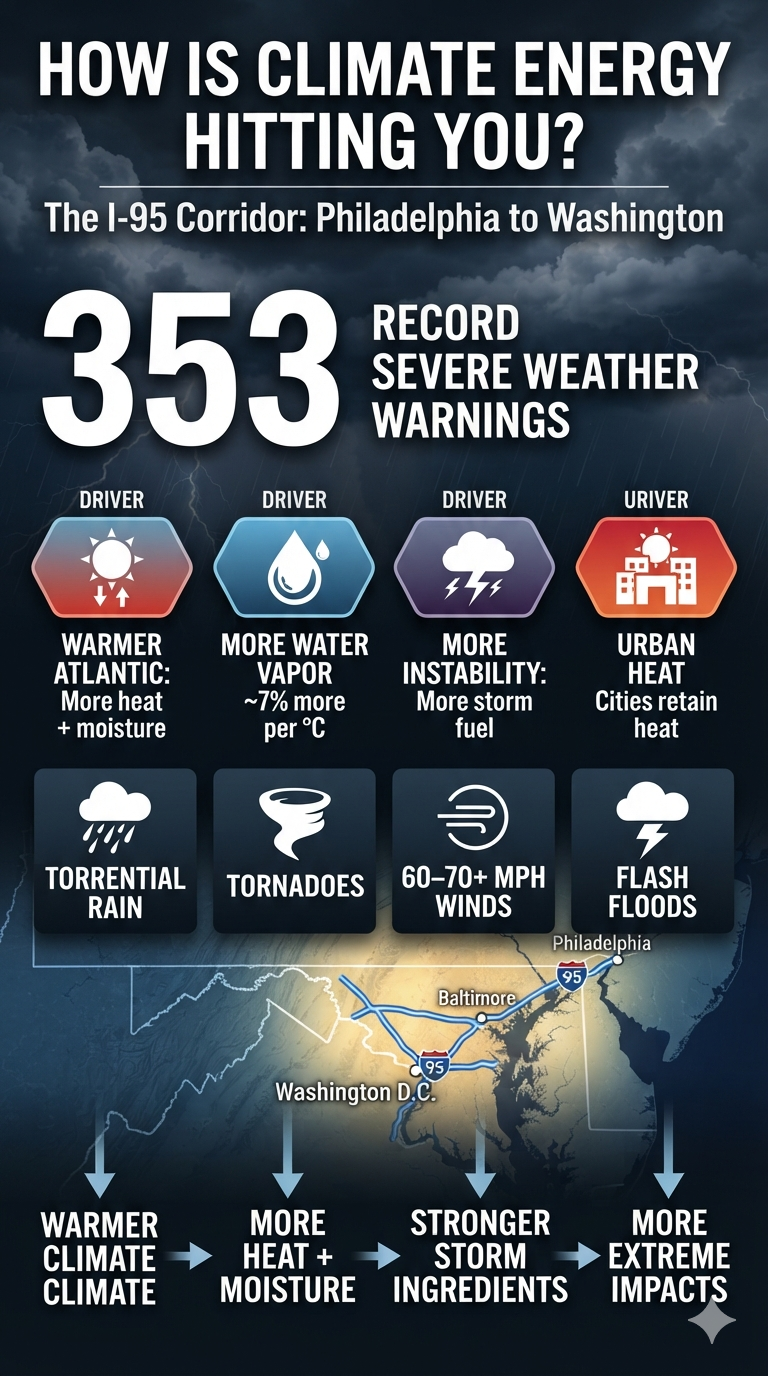
The Philadelphia-to-Washington corridor has experienced an extraordinary number of severe thunderstorm and tornado warnings this year. So far, 353 warnings have been issued across the region, putting the I-95 corridor from Washington, D.C., through Baltimore and Philadelphia at the center of an unusually active severe-weather season.

This concentration of warnings is not the result of a single cause. It reflects the interaction of a warming climate with the atmospheric conditions that generate severe thunderstorms: more available moisture, greater atmospheric instability, strong wind shear, warmer land and ocean surfaces, and increasingly favorable conditions for rapidly developing storms.

An Expanding “Tornado Alley”

The traditional image of “Tornado Alley” centers on the Great Plains. But severe-weather climatology is not static. Over recent decades, the eastern United States has experienced a growing share of tornado and severe-convective activity, with the Mid-Atlantic increasingly exposed to damaging storms.

The Washington-to-Philadelphia corridor is particularly vulnerable because of its geography. Warm, moisture-rich air from the Atlantic Ocean and the Gulf Stream can surge northward and collide with cooler, drier air and frontal boundaries moving eastward across the Appalachians.

When those ingredients overlap with sufficient wind shear and atmospheric instability, the result can be rapidly developing thunderstorms capable of producing tornadoes, damaging winds, large hail, and torrential rainfall.

A Warmer Atmosphere Means More Atmospheric Fuel

One of the most important climate connections is atmospheric moisture.

For every 1°C of warming, the atmosphere can hold approximately 7% more water vapor. A warmer atmosphere does not automatically produce severe weather, but when moisture is available and the other ingredients for convection are present, that additional moisture provides more energy and water for intense storms.

Along the heavily urbanized Northeast corridor, this can produce extremely high rainfall rates. Downpours capable of dropping several inches of rain in a short period can overwhelm drainage systems and produce flash flooding with little warning.

The same moisture-rich environment can also contribute to stronger thunderstorms by increasing the amount of latent heat released as water vapor condenses within developing storm clouds.

Microbursts and Damaging Straight-Line Winds

Not every destructive wind event is a tornado.

Many severe thunderstorm warnings along the I-95 corridor involve straight-line winds, downbursts, and microbursts. These winds can reach 60–70 mph or more and can cause damage comparable to that produced by weaker tornadoes.

A microburst occurs when a powerful column of descending air reaches the surface and spreads outward rapidly. The resulting winds can knock down trees and power lines, damage structures, overturn vehicles, and create dangerous conditions for aviation.

The distinction matters because the damage may look similar to tornado damage even when no tornado occurred.

The Urban Heat Island Adds Another Layer

Philadelphia, Baltimore, and Washington, D.C., are enormous concentrations of concrete, asphalt, buildings, vehicles, and other heat-absorbing surfaces.

These urban areas create a heat-island effect, in which temperatures remain higher than in surrounding rural areas, particularly after sunset. During the day, intense solar heating can further warm the surface and the air immediately above it.

When this heat interacts with an already warm, humid atmosphere, it can increase atmospheric instability. Boundaries created by differences between urban and rural heating can also help influence where thunderstorms develop or intensify.

That does not mean the urban heat island “causes” every severe storm. Rather, it is another component of an increasingly complex environment in which multiple sources of atmospheric energy can interact.

Climate Energy Meets Weather

The critical point is that climate change does not replace ordinary weather dynamics. It changes the background conditions in which those dynamics operate.

A warming Atlantic provides additional heat and moisture. A warmer atmosphere increases moisture capacity. Warmer urban surfaces add localized heat. Strong frontal boundaries and wind shear provide the structure needed for severe convection.

When these ingredients come together, the result can be a rapidly escalating sequence:

Warmer ocean → more atmospheric moisture → greater latent heat → greater instability → stronger convection → intense rainfall, downbursts, straight-line winds, and tornadoes.

The result is not simply “more storms.” It is an atmosphere increasingly capable of producing higher-impact extremes when the right ingredients align.

For the Philadelphia-to-Washington corridor, the extraordinary number of severe-weather warnings this year is another reminder that climate energy is not an abstract measurement on a graph. It is expressed through the atmosphere above our cities—and increasingly through the storms moving across them.

353 warnings is not just a number. It is a measure of how often the atmosphere has been reaching the threshold for potentially dangerous weather.

bookmark_borderHow Is Climate Energy Hitting You? Nepal–Tibet

by Daniel Brouse

Nepal–Tibet: Glacier Loss, Permafrost Collapse, Glacial Lake Outburst Floods, Flash Floods, Mudslides and Avalanches

Hundreds of people are missing—including hundreds of foreign tourists and pilgrims—after a deadly flash flood struck the Nepal–Tibet border. CCTV footage from Tibet shows a wall of water and mud sweeping into buildings at a border crossing, while images from Nepal show people scrambling to escape as floodwaters surge through the area.

Nepal is a major destination for mountaineers, trekkers, and Hindu and Buddhist pilgrims. Thousands of people travel through the Himalaya each year to visit sacred sites.

August is also a busy season for travelers heading toward Mount Kailash, located in Tibet’s Ngari Prefecture, which is administered by China. The journey from Kathmandu can take roughly 10 days, and thousands of pilgrims cross the Nepal–Tibet border to reach these sacred destinations.

Nepalese tourism officials say hundreds of pilgrims are missing, including more than 100 Indians. The Gyirong–Rasuwagadhi border crossing, a major route between Nepal and Tibet, was struck by a powerful surge of mud and water.

But this disaster is about more than one extreme event.

The Nepal–Tibet Himalayan region sits at the intersection of several climate-sensitive systems: glaciers, snowpack, permafrost, steep mountain slopes, monsoon rainfall, rivers, and glacial lakes. As the region warms, these systems can become increasingly unstable—and their failures can compound one another.

A Mountain System Under Increasing Stress

The Himalaya is warming rapidly, with high-elevation regions experiencing particularly significant changes. Rising temperatures are accelerating glacier loss, altering snow and ice dynamics, thawing permafrost, and increasing the potential for cascading hazards.

The important point is that these hazards do not operate independently.

A warming atmosphere can destabilize a glacier.

A collapsing glacier can trigger an avalanche.

An avalanche can strike a glacial lake.

The resulting displacement wave can breach a natural dam.

The flood can then pick up enormous quantities of rock, soil, and debris as it races downstream.

By the time it reaches a populated valley, what began as warming in the high mountains can become a wall of water, mud, ice, and rock.

Accelerating Avalanches and Permafrost Collapse

Glaciers across the Hindu Kush Himalaya are losing mass rapidly. Retreating glaciers expose unstable terrain while warming temperatures alter the physical structure of ice and frozen ground.

Hanging glaciers can become increasingly unstable. Warmer conditions can promote fracturing and destabilization of ice perched above steep slopes. When large sections collapse, they can generate enormous ice-and-rock avalanches.

Permafrost is another critical component. At high elevations, permanently frozen ground acts like a kind of natural cement holding fractured rock and mountain slopes together. As that frozen ground thaws, the strength of the mountain system can decline.

The result can be slope failures, rockfalls, landslides, and massive collapses into river valleys.

From Glacier Loss to Flash Floods

One of the most dangerous consequences is the increasing potential for glacial lake outburst floods, or GLOFs.

As glaciers retreat, they can leave behind lakes contained by unstable piles of glacial debris called moraines. These natural dams are considerably less predictable than engineered structures.

An avalanche, landslide, or large rockfall entering one of these lakes can displace enormous volumes of water. The resulting wave can overtop or breach the moraine, releasing a sudden flood downstream.

And the flood can become much larger as it moves.

A surge entering a narrow Himalayan valley can pick up boulders, trees, soil, ice, and other debris. What emerges downstream may no longer resemble a conventional flood. It becomes a rapidly moving mixture of water and sediment capable of destroying bridges, roads, buildings, power facilities, and entire communities.

Monsoon Extremes and Mudslides

The other half of the equation is rainfall.

Climate change is altering the hydrological cycle. A warmer atmosphere can hold more water vapor, increasing the potential for extremely intense precipitation when that moisture is released.

The danger is not simply more rain.

It is greater volatility.

Longer dry periods can be followed by exceptionally intense rainfall. When torrential precipitation falls onto already unstable slopes, landslides and mudflows can occur with little warning.

Mountain terrain makes the problem even more severe.

Steep slopes, fractured rock, thawing permafrost, retreating glaciers, and saturated soils create conditions in which enormous quantities of sediment can suddenly move downhill.

Critical transportation corridors are particularly vulnerable. Highways, bridges, tunnels, and hydropower facilities frequently occupy narrow valleys—the same pathways followed by floodwaters and debris flows.

The August 2026 Border Disaster

The current disaster along the Nepal–Tibet border illustrates how these hazards can interact.

Reports indicate that an ice-and-rock avalanche blocked the Lhende River, a tributary of the Bhotekoshi River. A localized magnitude-4.4 earthquake may also have contributed to destabilizing the terrain.

The resulting blockage and subsequent flooding generated a massive surge of water and debris, reportedly producing a mudflow roughly 33 feet high.

The flood destroyed or severely damaged border infrastructure, including the strategic Friendship Bridge, and caused major casualties around Tibet’s Gyirong port.

At least 22 people have been confirmed dead, while hundreds of international tourists and pilgrims remain missing according to reports.

The disaster also damaged Nepal’s electricity infrastructure, temporarily taking a substantial portion of the country’s hydropower capacity offline.

This is an important reminder that climate-driven disasters do not only kill people directly.

They can also disable the infrastructure societies depend upon for transportation, electricity, communications, food distribution, tourism, and emergency response.

The Cascade Is the Story

The most important climate signal here is not any single flood, avalanche, landslide, or rainfall event.

It is the coupling of hazards.

Warming

↓

Glacier loss + snow and ice instability

↓

Permafrost thaw

↓

Unstable mountain slopes

↓

Avalanches and landslides

↓

Glacial lake disruption and river blockages

↓

Extreme rainfall

↓

Flash floods + debris flows + mudslides

↓

Destroyed infrastructure

↓

Disrupted electricity, transportation and tourism

↓

Human casualties

This is what makes the Himalaya particularly vulnerable to a changing climate.

The mountains are not experiencing isolated changes. They are experiencing changes in a tightly connected system.

When one component moves, it can destabilize another.

And when several components move simultaneously, the result can be a cascade.

Climate Energy Is Moving Through the System

The Himalaya is a powerful example of what climate change actually means on the ground.

Climate change does not simply mean that the average temperature rises by a few degrees.

It means that additional energy enters the climate system and changes how water, ice, rock, soil, and atmospheric moisture interact.

In the high Himalaya, that additional energy is destabilizing parts of the cryosphere while increasing the atmosphere’s capacity to transport moisture.

The result is a dangerous combination:

More unstable ice + more unstable ground + more atmospheric moisture + extreme precipitation = greater potential for cascading disasters.

For people living in Himalayan valleys—and for the millions who depend upon these mountains for water, transportation, energy, agriculture, tourism, and cultural traditions—the consequences are becoming increasingly difficult to separate from everyday life.

The question is no longer simply whether climate change is occurring.

The question is:

How is the energy already entering the climate system moving through the landscape—and where will the next cascade begin?

bookmark_borderHow Is Climate Energy Hitting You? Death Valley

by Daniel Brouse

Death Valley: When the Desert’s Extremes Become More Extreme

Death Valley has always been one of the hottest, driest, and most inhospitable places on Earth. But human-caused climate change is pushing those natural extremes into increasingly dangerous territory. The valley’s unique topography—essentially a vast natural basin that traps heat—can amplify warming, while changing atmospheric conditions are producing longer heat waves, warmer nights, more intense rainfall, and increasing ecological stress.

Death Valley is not simply getting hotter. Its entire pattern of extremes is becoming more extreme.

Death Valley Lives Up to Its Name

The danger is not theoretical. Extreme heat, difficult terrain, vehicle accidents, and sudden medical emergencies make Death Valley one of the most hazardous environments in the National Park System.

August 2026: Extreme Heat and Fatalities

  • Pierre Michel Formosa — August 17, 2026: The 68-year-old French tourist died after his rental vehicle became stuck in mud on remote West Side Road. In temperatures reaching 116°F (46.6°C), Formosa and his companion attempted to walk across the open salt flats toward Badwater Road for help. Formosa collapsed and died roughly 1.3 miles into the trek. Park officials subsequently reminded visitors to remain with disabled vehicles, particularly where shade and visibility can improve the chances of rescue.
  • Unresponsive visitor south of Badwater — August 2026: Emergency responders located a deceased woman after receiving reports of an unresponsive visitor during a stretch of consecutive days in which temperatures exceeded 120°F.

Extreme heat can also contribute to mechanical failures and indirect deaths. When temperatures become extreme, vehicles, tires, batteries, cooling systems, electronics, and other mechanical components are pushed beyond the conditions for which they were designed. A breakdown in a remote or dangerously hot environment can quickly become a life-threatening event.

Death Valley provides a stark example. Some deaths there have been associated with vehicle failures that left people stranded in extreme heat. In such cases, the vehicle failure itself may not be the direct cause of death, but it can become a critical link in the chain of events that ultimately leads to fatal heat exposure.

This is an important dimension of climate risk that is easy to overlook. Extreme heat doesn’t only affect the human body directly; it can destabilize the systems people depend on to survive. A failed vehicle can mean the loss of transportation, air conditioning, communications, or access to water and medical assistance. As extreme temperatures become more frequent and intense, these indirect pathways to injury and death become increasingly important to consider.

1. Scorching Heat Waves Are Lasting Longer

Death Valley has always experienced extraordinary heat. Climate change, however, is increasing the baseline temperature on which these extremes occur, making prolonged heat events more dangerous.

Persistent high-pressure systems and heat domes can trap hot air over the region. Instead of experiencing a brief spike in temperature followed by meaningful relief, the valley can endure successive days of extraordinary heat.

Death Valley has repeatedly approached or exceeded 125°F (51.7°C) during major heat events, including extraordinarily long runs of extreme temperatures. The park’s record-setting summers increasingly cluster in the recent decades, illustrating how the climate baseline has shifted.

The significance is not simply another record high.

A hotter baseline makes extreme heat easier to reach—and harder to escape.

2. The Nights Are Getting Hotter

One of the most consequential changes associated with global warming is the rise in nighttime temperatures.

Historically, desert nights provided at least some relief from daytime heat. But as temperatures rise, that recovery period is becoming less reliable. During prolonged summer heat events, nighttime temperatures can remain extraordinarily high, sometimes failing to fall below 80°F and, during the most extreme events, remaining near or above 100°F (37.8°C).

That matters because the human body needs opportunities to shed accumulated heat.

When nights remain unusually warm, people, animals, vegetation, and infrastructure begin the next day without fully recovering from the previous one. The result is a form of cumulative heat stress:

Hot day → insufficient nighttime cooling → hotter starting point → greater heat stress → even greater vulnerability.

In Death Valley, where daytime temperatures can already exceed 120°F, the loss of nighttime relief is particularly dangerous.

3. “Once-in-a-Thousand-Year” Flash Floods

Death Valley presents a striking climate paradox: one of the driest places in North America can also experience devastating flash floods.

Warmer air can hold more atmospheric moisture. When that moisture is released in intense thunderstorms, rainfall can overwhelm the desert’s ability to absorb and channel the water.

The result can be catastrophic.

In August 2022, a historic storm dropped roughly 75% of Death Valley’s average annual rainfall in only about three hours. Floodwaters trapped hundreds of visitors, damaged or destroyed vehicles, and severely damaged park infrastructure.

The event demonstrated an important feature of a warming climate:

Extreme drought and extreme rainfall are not opposites. They can occur in the same place—and increasingly interact with one another.

Parched, hardened or poorly infiltrating desert surfaces can transform intense rainfall into rapidly moving floodwater. Canyons and steep terrain then concentrate that water into powerful torrents.

A place can therefore become simultaneously hotter, drier, and more vulnerable to extreme flooding.

4. Seasons Are Shifting

The climate signal is not confined to the middle of summer.

Extreme heat can arrive earlier in the year, rapidly drying winter and early-spring vegetation and shortening the period when conditions are relatively hospitable.

That matters because Death Valley’s plants and animals have evolved within a narrow set of environmental conditions. They are adapted to heat and drought—but adaptation has limits when environmental conditions change faster than biological systems can respond.

The park’s famous desert ecosystems are therefore being exposed to multiple pressures at once:

  • Earlier and more persistent heat
  • Greater evaporative demand
  • Reduced soil moisture
  • Longer periods of drought
  • More intense rainfall events
  • Greater wildfire and vegetation stress
  • Reduced opportunities for seasonal recovery

Species that depend on specific temperature and moisture conditions can be especially vulnerable. Joshua trees, for example, face increasing difficulty establishing new seedlings in portions of the Southwest as hotter and drier conditions alter the environments needed for successful reproduction.

Bird populations and other wildlife are also affected by changes in water availability, food resources, vegetation, and extreme heat.

Death Valley Is Becoming a Climate Stress Test

Death Valley has always been an extreme environment. That is precisely why it provides such a powerful illustration of climate change.

Climate change does not need to transform Death Valley into something completely different. It can amplify the characteristics that already define it.

The heat becomes hotter.

The heat lasts longer.

The nights provide less relief.

Rain falls less predictably and can arrive with greater intensity.

The seasons shift.

Ecological recovery becomes more difficult.

The result is not simply a warmer Death Valley. It is a more volatile and increasingly stressful climate system.

Death Valley has always lived up to its name.

The emerging question is whether the ecosystems—and the people who venture into them—can continue to live with the increasingly extreme conditions that made the valley famous in the first place.

bookmark_borderHow Is Climate Energy Hitting You? Extreme Extremes

by Daniel Brouse

Extreme Extremes: Walpeup and Hopetoun, Australia; Floridia, Italy; Miami, Florida; Joubertina, South Africa; Bridgeport, Connecticut; Philadelphia, Pennsylvania

Extreme Extremes: Record Heat, Rain, Snow, and Flooding Around the World

Several towns and cities across the globe have broken or approached major historical extreme-weather records so far in 2026. From record-setting heat in Australia and Florida to extraordinary rainfall in South Africa and Connecticut—and a historic blizzard in Philadelphia—the pattern is increasingly difficult to characterize as ordinary weather variability.

🌡️ Extreme Heat & Wildfires

Walpeup and Hopetoun, Australia: In late January 2026, these two towns in Victoria baked under a staggering 48.9°C (120°F) during a catastrophic wildfire season, setting potential all-time temperature records for the region.

Floridia, Italy: This Sicilian town has continued to experience intense summer heat, drawing international attention as one of Europe’s extreme heat zones.

Miami, Florida: In August 2026, Miami officially tied its all-time hottest day on record at 100°F, another indication of how extreme heat is becoming an increasingly familiar feature of the climate.

🌧️ Torrential Rain & Flooding

Joubertina, South Africa: Between May 5 and May 8, 2026, an intense low-pressure system dumped a historic 301.2 mm (11.86 inches) of rain on the town in just three days, triggering devastating flash floods.

Bridgeport, Connecticut: In August 2026, Bridgeport recorded its wettest meteorological summer on record, following a relentless series of heavy downpours.

❄️ Severe Snow & Blizzards

Philadelphia, Pennsylvania: In late February 2026, a massive historic blizzard blanketed the region with 13.7 inches of snow, accompanied by intense, gale-force winds. It was the city’s most severe single-day snowfall event in a decade.

The Bigger Picture

These events span three continents and multiple climate extremes: record heat, wildfire conditions, torrential rainfall, flash flooding, extreme wetness, and major winter storms.

Climate change does not mean that every extreme-weather event is caused by climate change. It does mean that a warmer atmosphere and warmer oceans can alter the conditions in which these events develop—loading the climate system with additional energy and moisture and increasing the potential for extremes.

The question is no longer simply whether extreme weather is occurring.

The question is how much more extreme the extremes are becoming—and how quickly.