By Daniel Brouse
Simplified Introduction
UK Climate Security: From Suppression to the Domino Effect
Climate change is increasingly moving from the category of environmental problem into the category of systemic risk.
A recently reported UK national-security assessment warned that climate and ecological disruption can cascade across borders—affecting food security, economies, migration, and political stability.
The problem is not simply the initial climate shock.
It is what happens afterward:
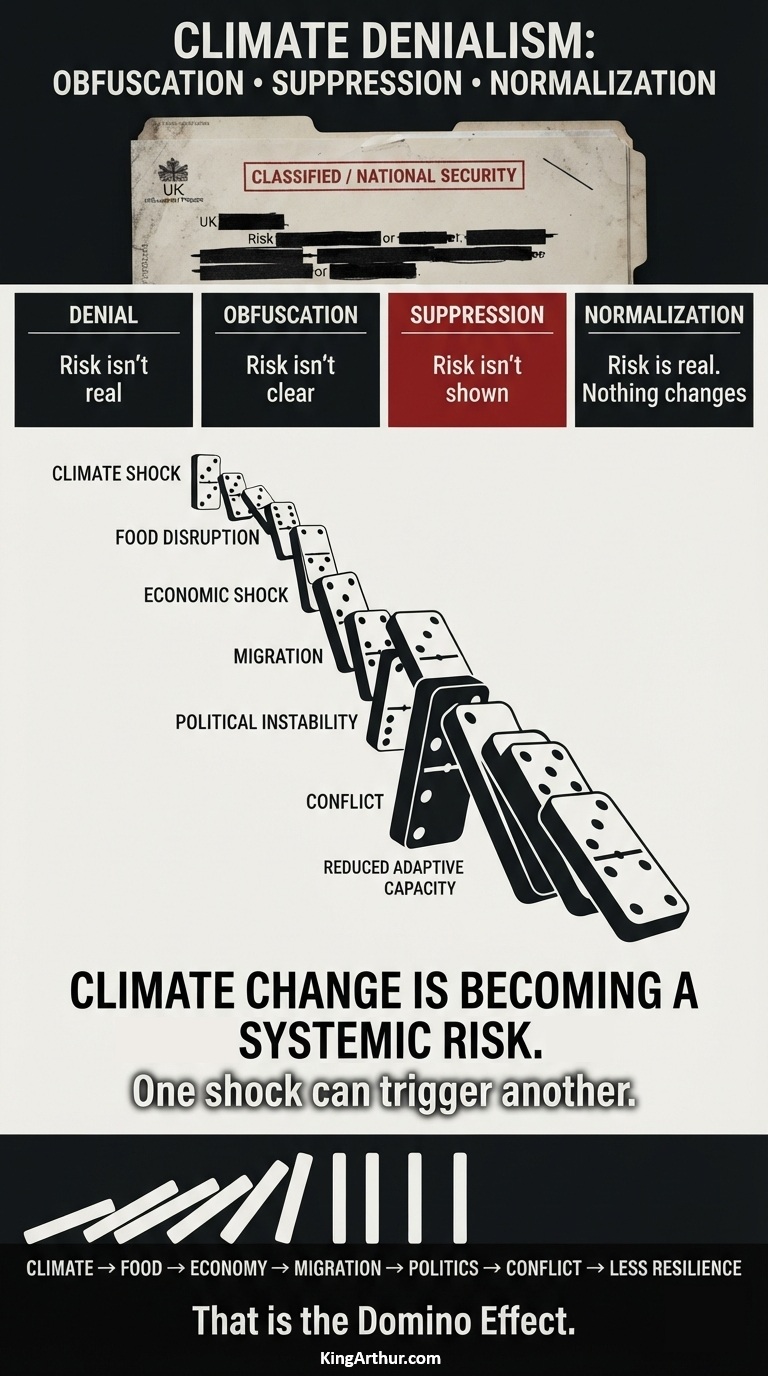
Climate shock → food disruption → economic shock → migration → political instability → conflict → reduced adaptive capacity
That is the Domino Effect. Denialism has become part of the feedback loop—delaying recognition, obstructing action, weakening resilience, and ultimately amplifying the consequences and accelerating the climate crisis.
The four stages of climate information failure are also important:
Denial — “The risk isn’t real.”
Obfuscation — “The risk isn’t clear.”
Suppression — “The evidence isn’t shown.”
Normalization — “The risk is real, but nothing fundamentally changes.”
When systemic risks are fragmented, delayed, or hidden from public discussion, society loses valuable time to prepare.
Climate risk is no longer just about what happens to the climate.
It is about what climate disruption does to everything connected to it.
🌎 Climate change → systemic risk → cascading consequences
Read the full report:
From Climate Shock to Food Disruption, Economic Shock, Migration, Political Instability, and Conflict
The climate crisis is increasingly being treated not simply as an environmental problem, but as a national-security and systemic-risk problem.
On September 23, 2026, UK Foreign Secretary Ed Miliband briefed foreign ministers from the European Union, Kenya, and other countries at the United Nations General Assembly on the findings of a UK intelligence assessment concerning climate change, nature loss, and national security. The assessment, prepared by the Joint Intelligence Committee, had reportedly been withheld from publication under the previous government and later released only in redacted form.
The assessment warned that the degradation of natural systems could cascade across borders through food shortages, migration, economic disruption, and conflict. Miliband specifically warned that the emerging El Niño could intensify these pressures, saying that climate shocks can “compound and cascade across borders,” threatening food and water security, displacing communities, putting pressure on markets, and damaging economies.
The significance of this assessment is not simply that climate change creates individual hazards. It is that climate shocks can propagate through interconnected physical, economic, and political systems.
That is the foundation of the Domino Effect:
Climate disruption
↓
Ecosystem degradation
↓
Crop losses and food disruption
↓
Food-price shocks
↓
Economic instability
↓
Migration
↓
Political instability
↓
Conflict
↓
Reduced adaptive capacity
The critical point is that none of these systems operates independently.
Denialism Depends on Fragmentation
Climate denialism often works by fragmenting a systemic problem into isolated questions.
Someone might argue:
“Climate change isn’t going to destroy my country.”
But that is not the relevant question.
A drought in one agricultural region can reduce global commodity supplies. A crop failure can increase prices in food-importing countries. Food-price inflation can destabilize governments. Migration can create political pressure far beyond the original climate impact. Conflict can disrupt energy, food, fertilizer, and commodity markets.
The original climate shock does not have to occur everywhere to produce consequences elsewhere.
That is precisely what the UK assessment is describing when it warns that climate and nature shocks can compound and cascade across borders.
The appropriate unit of analysis is therefore not simply the individual country—or even the individual climate hazard.
It is the coupled system.
The Domino Effect
The basic sequence is straightforward:
Drought
→ lower agricultural production
→ higher food prices
→ inflation
→ economic stress
→ political instability
→ migration
→ conflict
→ infrastructure destruction
→ reduced adaptive capacity
→ greater vulnerability to the next climate shock
Each stage can amplify the consequences of the previous one.
This creates a feedback loop between the physical Earth system and the socioeconomic system.
Climate disruption damages ecosystems and infrastructure. Economic disruption reduces the resources available for adaptation. Political instability makes coordinated adaptation more difficult. Conflict destroys infrastructure and institutional capacity. Those losses increase vulnerability to subsequent climate shocks.
The result is not simply:
climate change → damage
It can become:
climate shock → socioeconomic shock → reduced resilience → greater vulnerability → larger subsequent shock.
This is the essence of the Domino Effect.
The Weakness of the “Adaptation Only” Argument
If climate change were essentially linear and locally contained, adaptation could theoretically remain local:
warming → local impact → local adaptation
But a coupled system behaves differently:
warming
→ ecological disruption
→ economic disruption
→ geopolitical disruption
→ reduced adaptive capacity
→ greater vulnerability to subsequent climate disruption
At that point, adaptation is no longer simply a matter of building a seawall, installing air conditioning, changing crops, or relocating infrastructure.
The system’s capacity to adapt is itself being affected.
A country experiencing repeated crop failures, food inflation, infrastructure damage, capital losses, migration pressures, and political instability has fewer resources with which to prepare for the next shock.
Adaptation therefore has a socioeconomic limit.
Denial, Obfuscation, Suppression, and Normalization
Denialism does not always require an explicit rejection of climate science.
It can operate through several forms of information failure:
Denial:
“The risk isn’t real.”
Obfuscation:
“The evidence isn’t sufficiently important to discuss.”
Suppression:
“The evidence exists, but it should not receive public attention.”
Normalization:
“The evidence is real, but nothing fundamental needs to change.”
These mechanisms have different forms but can produce a similar result: society fails to recognize the systemic consequences of a known risk.
Climate denialism can therefore be understood broadly as systematic rhetorical, institutional, or informational behavior that prevents scientifically supported climate risks from being accurately recognized, communicated, or acted upon.
That definition shifts attention away from whether an individual literally believes climate change exists.
The more important question is whether society is capable of recognizing the consequences of climate change as an interconnected system.
The Irony of Climate Denialism
There is an important irony in the way climate risk is often framed.
Climate policy is frequently presented as a potential threat to:
- economic growth
- national sovereignty
- energy security
- food security
- employment
- military strength
- financial stability
But the emerging national-security analysis increasingly identifies climate disruption itself as a threat to those same systems.
The causal relationship is therefore reversed.
The question is no longer simply:
“Can we afford climate action?”
It becomes:
“What happens to the economic, social, and security systems we are trying to protect if climate disruption continues to intensify?”
That is the central problem exposed by the Domino Effect.
Climate change is not merely an environmental externality.
It is becoming a systemic economic, social, and security risk.
From Climate Shock to Conflict
The most important feature of the Domino Effect is that the final outcome does not have to resemble the original cause.
A climate shock may begin as a drought.
The drought becomes a crop failure.
The crop failure becomes a food-price shock.
The food-price shock becomes inflation and economic instability.
Economic instability can contribute to migration and political unrest.
Political instability can increase the risk of conflict.
Conflict then destroys infrastructure, institutions, and productive capacity—reducing the ability of affected populations to adapt to the next climate shock.
The original climate event has therefore propagated through the socioeconomic system and returned as greater vulnerability to future climate disruption.
This is why climate risk cannot be assessed solely by examining temperature, precipitation, sea level, or any other individual physical variable.
The relevant question is also:
How does the shock propagate through the systems connected to it?
Denialism and Ecofascism
Denialism attempts to preserve existing systems by denying, minimizing, delaying, or obscuring the consequences of climate disruption.
A more extreme response is ecofascism: accepting environmental or ecological crisis while responding through authoritarian, exclusionary, or coercive ideas about who should receive resources, security, or protection.
The distinction matters because the two responses can appear opposite while sharing a failure to address the underlying systems problem.
Denial says, in effect:
The crisis is not serious enough to require fundamental change.
Ecofascist responses say, in effect:
The crisis is unavoidable, so survival must be allocated unequally.
Neither addresses the central systemic challenge: climate disruption affects interconnected populations through interconnected systems.
Conclusion
Climate change is increasingly moving from the category of environmental problem into the category of systemic risk.
A climate shock can become a food shock.
A food shock can become an economic shock.
An economic shock can contribute to migration and political instability.
Political instability can contribute to conflict.
Conflict can destroy infrastructure and institutions, reducing adaptive capacity and increasing vulnerability to the next climate shock.
Climate shock → food disruption → economic shock → migration → political instability → conflict → reduced adaptive capacity.
That is the Domino Effect. Denialism has become part of the feedback loop—delaying recognition, obstructing action, weakening resilience, and ultimately amplifying the consequences and accelerating the climate crisis.
The emerging national-security response is significant because governments are beginning to recognize that climate and nature loss can propagate through the systems on which economic and political stability depend. The UK government’s September 2026 statement explicitly described climate and nature crises as security risks and emphasized the need to prevent shocks from feeding through to food prices, supply chains, and security.
The challenge for climate policy is therefore larger than reducing emissions or adapting to individual hazards.
It is preserving the capacity of interconnected human systems to absorb shocks without cascading into systemic failure.
Denialism delays recognition of that problem.
Exclusionary responses attempt to decide who survives it.
The alternative is to recognize the interconnectedness of the Earth and socioeconomic systems—and build resilience before individual shocks become cascading crises.