Tropospheric Ozone, Carbon-Sink Failure, Wildfire, Lightning, and the Coupled Acceleration of Climate Change
Daniel Brouse¹ and Sidd Mukherjee²
¹Independent Climate Researcher, Economist
²Physicist
Membrane Institute / Philadelphia Spirit Experiment Publishing Company
September 30, 2026
Overview
Ozone represents a rare intersection of climate, ecological, agricultural, and public-health science.
Core Formula
O₃ = Direct Warming + Plant Damage + Carbon-Sink Weakening + Climate Feedback + Atmospheric Coupling
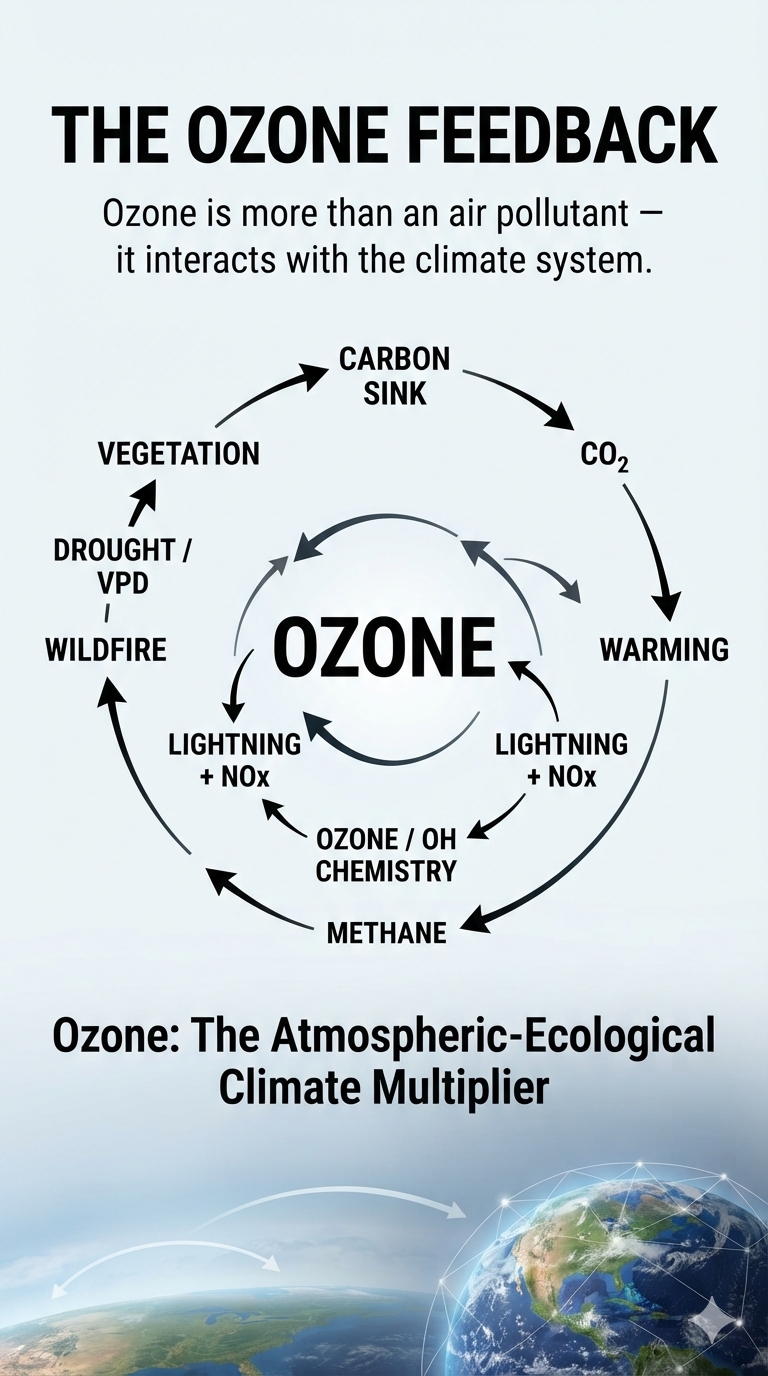
Proposed Central Figure
WARMING
↓
HEAT • DROUGHT • STAGNATION • WILDFIRE • LIGHTNING
↓
OZONE FORMATION
↙ ↘
ATMOSPHERIC ECOLOGICAL
FORCING FORCING
↓ ↓
WARMING VEGETATION DAMAGE
↓
PRODUCTIVITY ↓
↓
CARBON UPTAKE ↓
↓
ATMOSPHERIC CO₂ ↑
↓
WARMING
↺
OZONE = ATMOSPHERIC + ECOLOGICAL CLIMATE FORCING
The multiplier is the coupling.
Abstract
Tropospheric ozone (O₃) is commonly treated as an air pollutant and short-lived climate forcer. That description is scientifically correct but incomplete.
Ozone occupies an unusual position within the Earth system because it simultaneously functions as a greenhouse gas, atmospheric oxidant, phytotoxic pollutant, ecosystem stressor, and participant in multiple climate feedbacks. Unlike carbon dioxide, ozone is not primarily emitted directly. It is generated through atmospheric chemistry involving nitrogen oxides (NOₓ), volatile organic compounds (VOCs), carbon monoxide, methane, sunlight, temperature, atmospheric transport, and other chemical processes. Its concentration therefore responds not only to human emissions but also to changing climate conditions.
The central proposition of this paper is the Ozone Feedback Theory:
Tropospheric ozone is an atmospheric and ecological climate-forcing agent that can amplify warming by simultaneously contributing to radiative forcing and weakening biological systems that remove carbon from the atmosphere.
The direct greenhouse effect of ozone is well established. The IPCC Sixth Assessment Report estimates total ozone effective radiative forcing from 1750–2019 at approximately 0.47 W m⁻², with the forcing dominated by tropospheric ozone. This is substantially smaller than the forcing from CO₂, and ozone should not be described as the largest direct greenhouse forcing. Its significance lies elsewhere: ozone couples atmospheric chemistry to vegetation, carbon cycling, hydrology, wildfire, agriculture, human health, and other Earth-system processes.
Recent research strengthens this systems-level interpretation. A 2024 Nature Geoscience study estimated that anthropogenic ozone exposure has reduced tropical-forest net primary productivity and resulted in a loss of approximately 0.29 PgC of annual carbon drawdown since 2000, equivalent to about 17% of the contemporary tropical land carbon sink. A 2024 coupled climate–vegetation–chemistry study found that ozone–vegetation interactions can reduce productivity and stomatal conductance while producing regional warming and drying, particularly in the eastern United States and eastern China. A 2026 Science study found that increasing wildfire emissions reversed previously declining U.S. ozone trends during 2015–2024.
These findings support a broader hypothesis: ozone can function as a climate multiplier because warming can increase conditions favorable to ozone formation while ozone can simultaneously damage vegetation, weaken carbon uptake, increase ecosystem vulnerability, and contribute to further warming.
The resulting system is not a single feedback loop but a network:
Warming → heat/stagnation/fire/lightning → ozone formation → vegetation stress → reduced carbon uptake → atmospheric CO₂ → additional warming
Additional pathways involving methane, wildfire emissions, drought, hydrology, brown carbon, permafrost combustion, and ecosystem decline can couple to this network.
The scientific challenge is therefore not to establish that ozone is “the” dominant cause of climate change. CO₂ remains the dominant long-lived anthropogenic forcing. The challenge is to determine how much ozone-mediated amplification contributes to the observed trajectory of climate change and whether existing Earth-system models adequately represent these coupled biological and atmospheric processes.
1. Introduction
Climate change is often presented as a relatively simple relationship:
Fossil-fuel combustion → CO₂ → warming.
That relationship is fundamental, but it does not describe the complete atmospheric and biological response to combustion.
Combustion simultaneously changes atmospheric concentrations of CO₂, methane, NOₓ, VOCs, carbon monoxide, aerosols, black carbon, and other chemically reactive substances. Some of these compounds directly influence Earth’s energy balance. Others alter atmospheric chemistry. Still others affect the biological systems that regulate carbon, water, and energy exchange between the atmosphere and the land surface.
Tropospheric ozone is unusual because it intersects all three domains.
It is:
- a greenhouse gas;
- a short-lived climate forcer;
- a highly reactive atmospheric oxidant;
- a phytotoxic pollutant;
- a respiratory pollutant;
- a suppressor of plant productivity;
- a modifier of stomatal behavior;
- a contributor to agricultural losses;
- a participant in wildfire-related atmospheric chemistry; and
- a potential amplifier of climate feedbacks.
This paper synthesizes the ozone research developed through the Membrane Institute and related work from 2024–2026.
The objective is not simply to repeat the earlier papers. It is to combine them into a single framework and distinguish:
what is established,
what is strongly supported,
what is emerging,
and
what remains a hypothesis requiring further quantitative testing.
2. Ozone Must Be Divided by Altitude
The first distinction is essential.
Stratospheric ozone
Stratospheric ozone forms the protective ozone layer that absorbs biologically damaging ultraviolet radiation.
Tropospheric ozone
Tropospheric ozone occurs in the lower atmosphere, including at ground level.
It is harmful to human health, damages vegetation, participates in photochemical smog, and contributes directly to atmospheric warming.
The two should therefore never be treated as interchangeable.
This paper concerns tropospheric ozone.
3. Ozone Is a Secondary Pollutant and Climate Forcer
Unlike CO₂, ozone is not primarily emitted directly into the atmosphere.
It is produced through chemical reactions involving precursor gases.
A simplified representation is:
NOₓ + VOCs + sunlight + atmospheric chemistry → O₃
Methane and carbon monoxide also participate in the broader chemistry controlling tropospheric ozone.
The actual chemistry is substantially more complicated. Ozone production depends on the chemical regime, precursor concentrations, sunlight, temperature, humidity, atmospheric transport, aerosols, and oxidant chemistry.
This distinction matters because ozone can increase even when direct ozone emissions do not.
A region can therefore experience worsening ozone conditions because of:
- heat;
- atmospheric stagnation;
- wildfire emissions;
- methane oxidation;
- transported precursor pollution;
- changing vegetation emissions;
- lightning-generated NOₓ;
- or combinations of these factors.
Ozone is consequently a chemically generated climate pollutant rather than a conventional directly emitted greenhouse gas.
4. The Direct Climate Effect of Ozone
Ozone absorbs outgoing infrared radiation.
It therefore contributes directly to the Earth’s radiative energy imbalance.
The IPCC AR6 assessment estimates the effective radiative forcing associated with total ozone changes between 1750 and 2019 at approximately:
+0.47 W m⁻²
with an assessed range of approximately:
+0.24 to +0.70 W m⁻².
The forcing is dominated by changes in tropospheric ozone.
This establishes an important baseline:
Tropospheric ozone is unquestionably a climate-forcing gas.
The significance of ozone lies in what happens after the molecule interacts with the biosphere.
5. Ozone Is Also a Biological Toxin
Ozone enters plant leaves primarily through stomata. Once inside plant tissues, it participates in oxidative reactions that can damage cellular structures and interfere with photosynthesis.
The consequences include:
- oxidative stress;
- cellular damage;
- reduced photosynthetic efficiency;
- altered stomatal conductance;
- reduced carbon assimilation;
- impaired growth;
- reduced productivity;
- increased vulnerability to drought;
- increased vulnerability to heat;
- increased susceptibility to pests and disease;
- and increased mortality under sufficiently severe exposure.
This changes the climate significance of ozone. A conventional greenhouse gas adds radiative forcing.
Ozone can add radiative forcing while simultaneously damaging organisms that remove carbon from the atmosphere.
That dual role is the foundation of the Ozone Feedback Theory.
6. The Carbon-Sink Pathway
The basic biological pathway is:
O₃ ↑
↓
Plant injury
↓
Photosynthesis ↓
↓
Carbon assimilation ↓
↓
Net primary productivity ↓
↓
Carbon sequestration ↓
↓
More atmospheric CO₂
↓
Additional warming
The important distinction here is between gross primary productivity (GPP) and actual net carbon sequestration.
GPP is total photosynthetic carbon fixation. Net ecosystem carbon storage depends on photosynthesis minus plant respiration, decomposition, disturbance, mortality, fire, harvest, and other processes. Consequently, ozone-induced reductions in photosynthesis do not automatically translate one-for-one into atmospheric CO₂ increases. Nevertheless, reducing ecosystem productivity and carbon uptake can weaken an important component of Earth’s natural carbon sink.
This is the pathway that transforms ozone from a short-lived pollutant into a potential participant in long-term climate feedback.
7. The Tropical-Forest Evidence
The strongest recent evidence supporting this part of the theory comes from the 2024 Nature Geoscience study by Cheesman and colleagues. The study combined experimental measurements of ozone sensitivity in tropical tree species with a dynamic global vegetation model. Its central result was that anthropogenic ozone has produced substantial reductions in tropical-forest productivity.
The authors estimated:
- approximately 5.1% average reduction in tropical-forest NPP under their moderate ozone-sensitivity assumption;
- losses reaching approximately 10.9% in Asian tropical forests;
- approximately 0.29 PgC per year of lost carbon drawdown since 2000;
- approximately 17% of the contemporary tropical annual land carbon sink represented by that lost drawdown.
Anthropogenic ozone is measurably interfering with the productivity of tropical forests and therefore with terrestrial carbon cycling.
This is not merely a theoretical possibility.
It is a modeled estimate grounded in experimentally measured plant sensitivity.
8. Ozone–Vegetation–Climate Coupling
A second major development comes from coupled climate–vegetation–chemistry modeling. Zhou and colleagues (2024) used a climate–vegetation–chemistry model to examine ozone–vegetation interactions.
They found that ozone damage can:
- reduce GPP;
- suppress stomatal conductance;
- reduce transpiration;
- alter latent heat flux;
- increase sensible heat;
- produce warmer and drier conditions in important regions;
- and alter surface ozone itself.
The study estimated global GPP reduction of approximately:
1.80 ± 0.61 PgC yr⁻¹
or approximately:
4.69 ± 1.56%.
The modeled effects were considerably larger in certain regions.
In the eastern United States, the study estimated:
~20% GPP reduction under high ozone sensitivity
and approximately:
26% reduction in stomatal conductance.
The modeled ozone–vegetation interaction also produced approximately:
+0.33°C surface-air warming in the eastern United States
during the simulated boreal-summer conditions.
Their importance is mechanistic:
Ozone damage to vegetation can alter water and energy exchange in ways that feed back into climate.
9. A Second Ozone Feedback
The coupled model reveals an especially interesting mechanism.
Ozone damages stomatal function.
↓
Stomatal conductance declines.
↓
Transpiration declines.
↓
Latent heat flux declines.
↓
Sensible heat increases.
↓
Surface temperature increases.
The warmer and drier environment can then increase plant stress.
Thus:
Ozone → stomatal suppression → reduced evapotranspiration → warming/drying → additional plant stress
This is not simply a carbon-cycle feedback.
It is a land-surface energy and hydrology feedback.
That distinction is important to the larger Membrane climate framework because it demonstrates how one atmospheric pollutant can simultaneously influence:
carbon + water + energy + atmospheric chemistry.
10. The Ozone Feedback Theory
The central feedback proposed by this research can therefore be written:
Primary ozone feedback
Warming
↓
Heat + stagnation + photochemical activity
↓
Ozone formation ↑
↓
Vegetation injury
↓
Carbon uptake ↓
↓
Atmospheric CO₂ ↑
↓
Warming ↑
↓
Ozone formation ↑
This is a reinforcing feedback. Its strength depends upon:
- ozone precursor emissions;
- atmospheric chemistry;
- temperature;
- sunlight;
- moisture;
- ecosystem sensitivity;
- vegetation recovery;
- carbon-cycle dynamics;
- fire activity;
- and other feedbacks.
How strongly does ozone-mediated coupling amplify warming under different Earth-system conditions?
That is a measurable scientific question.
11. Wildfire Creates a Major Coupling Pathway
Wildfires connect climate warming to ozone formation. Fire emissions contain:
- NOₓ;
- VOCs;
- carbon monoxide;
- methane;
- particulate matter;
- black carbon;
- brown carbon;
- and other reactive compounds.
These emissions can generate ozone both near the fire and far downwind. The 2026 Science study by Deng and colleagues provides particularly important evidence for the United States. Using a 1-km-resolution daily ozone dataset covering 2003–2024, the researchers found that U.S. policy-relevant ozone trends reversed:
2003–2015: −0.65 ppb/year
versus
2015–2024: +0.13 ppb/year.
The authors attributed the reversal primarily to increasing wildfire emissions. They estimated that wildfire emissions offset approximately 3.9 years of progress in ozone mitigation.
This provides an important empirical connection:
Climate-driven wildfire pressure → ozone pollution
rather than merely:
fossil fuel combustion → ozone pollution.
12. The Fire–Ozone–Forest Feedback
Once vegetation is included, the system becomes:
Warming
↓
Drought + heat
↓
Wildfire risk ↑
↓
Fire emissions ↑
↓
Ozone precursors ↑
↓
Ozone ↑
↓
Vegetation damage ↑
↓
Forest resilience ↓
↓
Fire vulnerability ↑
↓
More wildfire
This creates a reinforcing fire–ozone–ecosystem pathway. The ozone component does not operate independently. It becomes coupled to the fire regime.
13. Lightning Adds Another Atmospheric Pathway
Lightning is a major natural source of atmospheric NOₓ. Lightning therefore provides a second potential climate–ozone connection:
Warming
↓
More atmospheric moisture
↓
Stronger convection
↓
More lightning
↓
NOₓ ↑
↓
Ozone production ↑
↓
Additional warming
The relationship is complicated and regionally variable. Lightning also produces hydroxyl radicals (OH), which can accelerate methane oxidation and therefore create a counteracting chemical pathway. Lightning provides an important mechanism through which changing atmospheric dynamics can alter ozone chemistry.
The broader significance is that ozone becomes a coupling molecule connecting atmospheric physics with atmospheric chemistry.
14. Methane Creates a Global Ozone Pathway
Methane represents another important connection. Methane is itself a powerful greenhouse gas. It also participates in atmospheric chemistry that produces tropospheric ozone.
Therefore:
Methane ↑
↓
Ozone production ↑
and
Methane ↑
↓
Direct greenhouse forcing ↑
The interaction does not stop there. Ozone chemistry and hydroxyl-radical chemistry influence methane’s atmospheric lifetime. Thus methane and ozone form part of a coupled atmospheric chemical system.
This means that evaluating a fuel or energy source solely by its CO₂ emissions can omit important atmospheric consequences.
15. Diesel, Natural Gas, and Combustion Pathways
Different combustion systems generate different atmospheric signatures. Diesel combustion tends to generate substantial NOₓ and can therefore contribute strongly to local ozone formation. It can also generate black carbon. Natural gas combustion generally produces less NOₓ than diesel under comparable conditions, but methane leakage and incomplete combustion create another pathway. Methane can persist in the atmosphere long enough to become globally distributed before participating in atmospheric chemistry that contributes to background ozone.
The result is not a simple:
diesel = bad
or
natural gas = good
comparison.
The correct systems analysis is:
Fuel → combustion → CO₂ + NOₓ + VOCs + methane leakage/slip + particles → atmospheric chemistry → ozone + radiative forcing + ecosystem effects
The same principle applies to biofuels.
16. The Biofuel Problem
The term “carbon neutral” can be misleading when applied to combustion-based biofuels without accounting for the complete atmospheric and ecological system. Biogenic carbon may be part of a short carbon cycle, but combustion can still produce:
- NOₓ;
- VOCs;
- carbon monoxide;
- particulate pollution;
- ozone precursors;
- and other climate-forcing compounds.
Land-use change, fertilizer use, transportation, processing, combustion efficiency, and ecosystem impacts also affect the overall balance.
Therefore:
carbon cycling ≠ climate neutrality.
A full assessment must include:
CO₂ + CH₄ + NOₓ + VOCs + ozone + aerosols + land use + ecosystem carbon uptake.
The ozone pathway is one reason a narrow CO₂-only accounting framework can miss important climate effects.
17. Pennsylvania Forests as a Long-Term Observation
The Membrane ozone research began partly from long-term observations of Pennsylvania forests.
The observations reported through this research include:
- substantial foliage loss;
- canopy thinning;
- declining canopy height;
- premature mortality;
- and increasing vulnerability to drought, heat, insects, and disease.
Some observations have been described as approximately:
40% multi-year foliage loss
and approximately:
33% reduction in canopy height
in certain monitored old-growth systems since approximately 2003.
Forest ecosystems are exposed simultaneously to:
- ozone;
- warming;
- drought;
- vapor-pressure deficit;
- hydrological extremes;
- insects;
- pathogens;
- competition;
- storms;
- land-use changes;
- and other pollutants.
Pennsylvania forest observations provide a long-term case study of compound ecological stress in which ozone is a plausible and independently documented contributor.
18. Ozone and the Amazon
The Amazon illustrates why ozone must be considered within a coupled Earth-system framework.
The Amazon is simultaneously:
- a major carbon reservoir;
- a biological carbon sink;
- a massive source of atmospheric moisture;
- a regulator of regional rainfall;
- and a fire-sensitive ecosystem.
Ozone damages vegetation.
↓
Carbon uptake declines.
↓
Vegetation becomes less resilient.
↓
Heat and drought produce greater stress.
↓
Fire vulnerability increases.
↓
Forest loss reduces carbon storage and moisture recycling.
↓
Regional drying can increase.
↓
Further forest stress occurs.
This is the type of coupled system in which ozone can act as one component of a larger tipping cascade.
Ozone can increase the stress load on an ecosystem already exposed to warming, drought, fire, deforestation, and hydrological disruption.
When multiple stressors interact, the combined effect can be nonlinear even if no individual stressor is sufficient to cause collapse.
19. Ozone and the Carbon-Sink Transition
The most consequential possibility raised by this research is not simply that ozone reduces plant productivity.
It is that chronic ecological stress could contribute to the weakening of Earth’s natural carbon sinks.
The general transition is:
Strong carbon sink
↓
Reduced productivity
↓
Reduced resilience
↓
Increased mortality
↓
Fire / decomposition / disturbance
↓
Reduced carbon storage
↓
Carbon neutrality
↓
Potential carbon source
This process is not caused by ozone alone. However, ozone can participate in the early stages by reducing productivity and physiological resilience.
That makes ozone potentially important as a precursor to ecosystem destabilization.
20. The Ozone Multiplier
The combined evidence suggests a useful conceptual distinction. A conventional greenhouse gas primarily changes the energy balance. Ozone does that too. But ozone also changes the biological system that helps regulate atmospheric carbon.
Therefore:
Atmospheric pathway
O₃ → infrared absorption → warming
Biological pathway
O₃ → plant injury → reduced productivity → weaker carbon uptake → more atmospheric CO₂ → warming
Hydrological pathway
O₃ → stomatal suppression → reduced transpiration → altered surface energy/water balance
Wildfire pathway
O₃ → vegetation stress → greater vulnerability → wildfire → ozone precursors → O₃
Methane pathway
CH₄ → ozone chemistry + direct greenhouse forcing
Lightning pathway
Warming → convection/lightning → NOₓ → O₃
Ecosystem pathway
O₃ + heat + drought + pests + disease → declining forest resilience
These pathways can overlap.
That overlap is what makes ozone a climate multiplier.
21. The Expanded Ozone Feedback Network
The entire system can be represented as:
FOSSIL-FUEL / COMBUSTION EMISSIONS
↓
CO₂ + CH₄ + NOₓ + VOCs + CO + PARTICULATES
↓
ATMOSPHERIC CHEMISTRY
Ozone ↑
↓
DIRECT CLIMATE FORCING
Radiative warming
↓
VEGETATION
Photosynthesis ↓
Stomatal conductance ↓
Productivity ↓
Carbon uptake ↓
↓
CARBON CYCLE
Atmospheric CO₂ ↑
↓
CLIMATE
Warming ↑
↓
EXTREME CONDITIONS
Heat + drought + stagnation + fire weather
↓
WILDFIRE
CO₂ + CH₄ + NOₓ + VOCs ↑
↓
Ozone ↑
↓
VEGETATION
Additional stress
↓
ECOSYSTEM RESILIENCE
Decline
↺
This is the central architecture of the Ozone Feedback Theory.
22. Ozone as an Earth-System Coupling Agent
The term climate multiplier is useful because it describes something more specific than simply saying ozone is “important.” Ozone does not need to dominate any individual component of the climate system to have systemic significance. Its importance arises from connectivity.
Ozone connects:
atmospheric chemistry
to
plant physiology
to
carbon cycling
to
hydrology
to
wildfire
to
human health
to
agriculture
to
climate forcing.
This makes ozone a potential Earth-system coupling agent.
That may ultimately be more scientifically useful than ranking ozone against CO₂, methane, or other individual climate agents.
23. The 2026 Copernicus Evidence
The Copernicus Atmosphere Watch 2026 assessment provides a striking contemporary observation.
During the first eight months of 2026, nearly 40% of the global population was exposed to harmful levels of ground-level ozone according to the CAMS analysis. Only approximately 5% of the world’s population experienced ozone conditions classified as “good” in the assessment. Asia experienced the greatest burden, followed by Europe and North America.
The CAMS analysis highlights the interaction of:
- extreme heat;
- anthropogenic emissions;
- wildfire pollution;
- transboundary atmospheric transport;
- and ozone chemistry.
CAMS has described this interaction as the “ozone-climate penalty.” This terminology is important because it captures a fundamental asymmetry:
warming can worsen ozone pollution,
while
ozone pollution contributes to warming and ecological damage.
The result is a bidirectional relationship rather than a one-way pollution problem.
24. Transboundary Ozone
Ozone also demonstrates that climate and pollution cannot always be managed within political boundaries. Wildfire smoke and ozone precursors can travel hundreds or thousands of kilometers. A wildfire in Canada can affect air quality in the northeastern United States. Methane emitted in one region can contribute to background ozone formation elsewhere. Industrial emissions can undergo atmospheric chemistry far from their source. The climate system therefore converts local emissions into regional and global consequences.
This is another reason ozone belongs in Earth-system analysis rather than being treated solely as a local air-quality issue.
25. Human Health Is Part of the Same System
The same ozone molecule that damages plant cells can damage human respiratory tissues. Ground-level ozone is associated with:
- respiratory inflammation;
- asthma exacerbation;
- reduced lung function;
- cardiovascular stress;
- hospitalization;
- and premature mortality.
This produces an unusual convergence. The same atmospheric chemistry can simultaneously:
damage forests,
reduce crop productivity,
weaken carbon sinks,
increase human health risks,
and
contribute to warming.
Ozone therefore represents a rare intersection of climate, ecological, agricultural, and public-health science.
26. What the Evidence Establishes
Several components of the ozone framework are already strongly established.
Established
1. Tropospheric ozone is a greenhouse gas.
2. Tropospheric ozone contributes positive radiative forcing.
3. Ozone damages vegetation.
4. Ozone reduces photosynthesis under damaging exposure.
5. Ozone can reduce plant productivity.
6. Ozone affects stomatal conductance and transpiration.
7. Wildfires produce ozone precursors.
8. Wildfire emissions can increase ozone far downwind.
9. Methane chemistry contributes to tropospheric ozone formation.
10. Ozone pollution causes significant human-health impacts.
27. What Is Strongly Supported but Still Quantitatively Uncertain
The evidence now supports a broader and more quantitatively developed picture of ozone as an atmospheric and ecological climate-forcing agent. Multiple studies and modeling frameworks identify measurable pathways through which tropospheric ozone can alter carbon uptake, land-surface energy exchange, wildfire vulnerability, atmospheric chemistry, and ecosystem resilience. The principal remaining uncertainty is not whether these mechanisms exist, but how large their combined effect is across regions, ecosystems, and timescales.
Ozone → Carbon-Sink Weakening
Tropospheric ozone damages photosynthetic tissues, reduces plant productivity, and alters stomatal function. Current estimates indicate that ozone exposure may reduce the global terrestrial carbon sink by approximately 10% to 25% relative to potential capacity, corresponding to roughly 0.4–0.8 PgC per year of carbon that remains in the atmosphere.
Over longer periods, this represents a potentially substantial additional atmospheric CO₂ burden. Some estimates indicate an additional 15–30 ppm of atmospheric CO₂ over a century attributable to ozone-related reductions in terrestrial carbon uptake.
The exact global magnitude remains uncertain because ozone sensitivity varies among species and ecosystems, while carbon-cycle responses also depend on drought, temperature, nutrient availability, mortality, decomposition, fire, and land-use change.
The mechanism itself, however, is increasingly well established:
O₃ exposure → plant injury → photosynthesis/productivity ↓ → carbon uptake ↓ → atmospheric CO₂ ↑
Ozone → Additional Warming
Ozone–vegetation interactions can produce warming through at least two distinct pathways.
The first is the carbon feedback:
O₃ damage → reduced carbon sequestration → additional atmospheric CO₂ → additional greenhouse warming.
Current estimates place the additional global warming associated with this indirect carbon-cycle pathway at approximately 0.05°C to 0.2°C by 2100, depending on assumptions about ozone exposure, vegetation response, and future emissions.
The second is the hydro-climate feedback.
Ozone damages stomatal function and can suppress plant transpiration. Reduced transpiration decreases the transfer of water from vegetation to the atmosphere and reduces evaporative cooling. The resulting redistribution of surface energy can increase sensible heating and alter atmospheric moisture and cloud processes.
In heavily polluted, vegetated regions, modeled ozone–vegetation interactions have produced surface-air-temperature increases of up to approximately 1.5°C under particular conditions.
These regional results should not be interpreted as a global ozone-attributable warming of 1.5°C. They demonstrate that the land-surface response to ozone can be climatically significant where ozone exposure, vegetation, and meteorological conditions interact strongly.
Ozone → Increased Ecosystem Vulnerability
Ozone does not act in isolation.
It interacts with heat, drought, vapor-pressure deficit, pests, disease, and other environmental stresses.
Chronic ozone exposure can damage cellular structures, accelerate foliar senescence, reduce photosynthesis, and impair the ability of plants to regulate water loss.
The result is a reduction in ecosystem resilience.
This creates an important distinction:
Ozone need not directly kill an ecosystem to contribute to ecosystem decline. It can reduce the physiological margin by which an ecosystem withstands other stresses.
This makes ozone particularly important during compound heat-and-drought events.
Ozone ↔ Drought and Vapor-Pressure Deficit
The ozone–drought relationship is not linear.
Under severe soil drought, plants normally close their stomata to conserve water. This can initially reduce ozone uptake and therefore reduce ozone injury.
However, chronic ozone exposure can damage the stomatal apparatus itself.
Under high vapor-pressure deficit (VPD), plants are already under pressure to restrict water loss. Ozone can exacerbate the physiological response, producing larger declines in productivity and vegetation greenness.
The resulting interaction can therefore shift from:
drought → stomatal closure → reduced ozone uptake
toward:
ozone damage → impaired stomatal regulation → greater water stress → additional vegetation damage.
This establishes drought and atmospheric dryness as important modifiers of ozone’s ecological effect.
Ozone → Wildfire Vulnerability
There is not currently a scientifically defensible single percentage describing how much wildfire activity is caused by ozone alone.
Ozone operates as a compounding stressor alongside heat and drought.
Chronic ozone exposure can accelerate foliar senescence, damage vegetation, and increase the availability of dry plant material. When severe ozone exposure coincides with compound heatwave-and-drought conditions, ecosystem vulnerability can increase substantially.
The appropriate formulation is therefore:
Ozone stress + heat + drought → vegetation vulnerability ↑ → available dry fuel ↑ → fire susceptibility ↑
Rather than claiming that ozone directly causes a specific percentage of wildfires, the evidence supports treating ozone as a potential amplifier of fire-season ecosystem stress.
Wildfire → Additional Ozone
The reverse pathway is much more directly measurable.
Wildfires emit large quantities of ozone precursors, including VOCs and NOₓ. When smoke plumes interact with sunlight and urban or industrial emissions, substantial photochemical ozone production can occur.
Observed wildfire smoke events have produced local and regional surface-ozone increases on the order of 20%–30%, with some studies reporting average increases of approximately 21 ppb.
Fire emissions can also make a major contribution to ozone in the remote free troposphere.
The resulting feedback is:
warming/drought → wildfire ↑ → VOCs + NOₓ ↑ → ozone formation ↑ → vegetation stress ↑
The 2026 U.S. evidence provides an important real-world example: increasing wildfire influence was identified as a major factor in reversing previously declining ozone trends.
Climate Change → Lightning NOₓ → Ozone
Lightning is responsible for approximately 10% of the global NOₓ budget, but its atmospheric location makes it particularly important for upper-tropospheric chemistry.
Model projections indicate that lightning-generated NOₓ could increase by approximately 33% under RCP4.5 to 78% under RCP8.5 by 2100.
Projected increases in lightning NOₓ have been associated with additional tropospheric ozone burdens of approximately 29–46 Tg in modeling studies.
This establishes another potential climate–ozone pathway:
warming → stronger convection → lightning ↑ → NOₓ ↑ → ozone ↑
The magnitude of this feedback remains sensitive to the response of convection and lightning to future warming and to the complex chemistry of the upper troposphere.
Ozone ↔ Methane and OH Chemistry
Ozone, hydroxyl radicals (OH), and methane form a tightly coupled atmospheric chemical system.
OH is the dominant atmospheric sink for methane and is responsible for removing the majority of atmospheric CH₄.
Ozone chemistry participates in OH production, meaning that changes in ozone can alter the atmosphere’s oxidative capacity and methane lifetime.
This creates an important chemical trade-off.
Changes in ozone pollution can alter OH availability, while wildfire smoke and other pollutants can suppress OH and temporarily slow methane removal.
Consequently:
O₃ ↔ OH ↔ CH₄
represents another atmospheric pathway through which ozone participates in climate forcing.
The direction and magnitude of the net feedback are chemically complex and cannot be reduced to the simple proposition that more ozone always means faster methane removal.
Ozone → Regional Climate Modification Through Vegetation
Ozone-induced changes in stomatal conductance and transpiration can modify:
- evapotranspiration;
- latent heat flux;
- sensible heat flux;
- surface temperature;
- boundary-layer moisture;
- and potentially cloud formation.
The result is a feedback between atmospheric chemistry and land-surface climate.
This is especially important in heavily vegetated regions where transpiration represents a significant component of the surface energy and water budget.
Thus ozone can affect climate not only by absorbing infrared radiation but also by changing how ecosystems exchange heat and water with the atmosphere.
Ozone → Nonlinear Ecosystem Stress
Evidence increasingly indicates that ozone effects become more consequential when exposure occurs simultaneously with other climate stresses.
The relevant system is therefore not:
O₃ → vegetation damage
but:
O₃ + heat + drought + high VPD + fire + biological stress → ecosystem response
This is particularly important because the response to multiple stresses does not necessarily equal the sum of their individual effects.
Once physiological repair capacity, stomatal regulation, or carbon reserves are exceeded, ecosystem responses can become increasingly nonlinear.
Ozone → Earth-System Model Complexity
Modern Earth-System Models increasingly incorporate coupled atmospheric chemistry, vegetation, and land-surface processes.
Frameworks such as DO3SE attempt to represent ozone damage through accumulated phytotoxic ozone dose and stomatal uptake rather than relying solely on ambient ozone concentration.
This represents an important improvement because plant injury depends on the ozone actually entering plant tissues rather than simply the concentration measured in the surrounding atmosphere.
Nevertheless, substantial uncertainty remains in representing:
- below-ground carbon cycling;
- root and mycorrhizal responses;
- species-specific ozone sensitivity;
- ecosystem adaptation;
- compound heat-and-drought stress;
- vegetation mortality;
- wildfire interactions;
- and long-term carbon-cycle feedbacks.
Therefore, the central uncertainty has shifted.
It is no longer simply:
Does ozone affect vegetation?
It is increasingly:
How much does ozone-mediated biological damage alter the trajectory of the coupled climate system?
28. What Remains a Research Hypothesis
The evidence now supports the individual components of the Ozone Feedback Theory sufficiently well that the central research question can be stated more precisely.
The remaining hypothesis is not whether ozone damages vegetation, contributes to radiative forcing, interacts with wildfire, or participates in atmospheric chemistry.
Those mechanisms have substantial observational, experimental, and modeling support.
The unresolved question is whether the combined interaction of these mechanisms produces a quantitatively significant contribution to climate acceleration and ecosystem destabilization at the global scale.
The Ozone Feedback Theory therefore proposes:
Tropospheric ozone can function as a climate multiplier when its direct radiative forcing interacts with carbon-sink weakening, altered land-surface energy and water exchange, wildfire feedbacks, methane chemistry, lightning-generated NOₓ, drought, and ecosystem stress. Under sufficiently strong compound stress, these interactions may become nonlinear and contribute to broader climate-feedback cascades.
The principal research questions are:
1. Carbon-Sink Feedback
How much additional atmospheric CO₂ results from ozone-induced reductions in terrestrial carbon uptake?
Current estimates suggest approximately 0.4–0.8 PgC per year of reduced carbon sequestration, but the global value remains sensitive to ecosystem sensitivity, ozone exposure, and interactions with drought, heat, fire, and nutrient limitation.
2. Global Temperature Feedback
How much additional global warming results from ozone–vegetation interactions?
Existing estimates suggest approximately 0.05°C–0.2°C of additional warming by 2100 through the carbon-cycle pathway, while regional land-surface effects can be substantially larger.
The global aggregate effect requires further constraint.
3. Fire-Feedback Attribution
How much wildfire activity is attributable to ozone-induced vegetation stress?
No single global percentage is currently justified.
The more tractable question is how much ozone contributes to fuel desiccation, foliar senescence, ecosystem vulnerability, and fire susceptibility under compound heat-and-drought conditions.
4. Wildfire-to-Ozone Feedback
How much additional ozone is produced by climate-driven increases in wildfire activity?
This pathway is directly measurable through atmospheric observations and chemical transport models.
The critical question is how this contribution changes as wildfire frequency, intensity, duration, and geographic distribution change under continued warming.
5. Lightning–Ozone Feedback
How important will increasing lightning-generated NOₓ become as anthropogenic surface NOₓ emissions decline?
Projected increases of approximately 33%–78% by 2100, depending on the emissions scenario, suggest that lightning could increasingly offset some surface-emission reductions.
The magnitude of the resulting ozone feedback remains uncertain because it depends on future convective behavior and upper-tropospheric chemistry.
6. Methane–OH–Ozone Coupling
How does changing ozone chemistry alter OH concentrations and methane lifetime under a changing climate?
This question is particularly important because ozone, OH, methane, wildfire smoke, and atmospheric oxidizing capacity are chemically coupled.
The net climate effect cannot be determined from ozone concentration alone.
7. Ozone–Drought–VPD Interaction
At what combinations of ozone exposure, soil moisture, temperature, and VPD does plant stress become strongly nonlinear?
This may prove more informative than defining a universal ozone threshold because plant response depends on both exposure and environmental conditions.
8. Earth-System Model Representation
Do current Earth-System Models adequately represent ozone’s effects on vegetation, carbon cycling, hydrology, and wildfire?
Particular attention should be given to:
- dynamic stomatal uptake;
- phytotoxic ozone dose;
- below-ground carbon processes;
- species-specific sensitivity;
- compound heat-and-drought stress;
- ecosystem mortality;
- wildfire coupling;
- and atmospheric chemistry.
9. Nonlinear Exposure Thresholds
At what cumulative ozone doses does plant damage transition from approximately linear physiological stress to nonlinear ecosystem degradation?
Critical ozone-dose thresholds may be more useful than ambient concentration alone because biological damage depends upon uptake, exposure duration, species sensitivity, and environmental conditions.
The frequently observed 40–50 ppb range should therefore be treated as an important exposure regime requiring investigation rather than as a universal tipping-point threshold applicable to every ecosystem.
10. Ecosystem Tipping Cascades
Can chronic ozone stress reduce ecosystem resilience sufficiently to contribute to tipping-point cascades?
The proposed pathway is:
Ozone exposure
↓
Stomatal dysfunction and physiological stress
↓
Reduced productivity and increased water stress
↓
Vegetation mortality / structural degradation
↓
Greater fire vulnerability
↓
Carbon release + ozone-precursor emissions
↓
Additional warming and ozone formation
The critical unresolved question is whether this feedback can become strong enough to shift an ecosystem from a stressed but recoverable state into a persistently degraded state.
The Central Research Problem
The next stage of Ozone Feedback Theory should therefore move beyond asking whether individual ozone mechanisms exist.
The more important question is:
Do the atmospheric, ecological, hydrological, carbon-cycle, wildfire, methane, and lightning pathways combine to produce a measurable nonlinear climate feedback?
If so, the magnitude of that feedback must be quantified.
The research objective is consequently to move from:
Ozone as pollutant
to
Ozone as greenhouse gas
to
Ozone as ecological stressor
to
Ozone as coupled climate feedback
to, ultimately,
Ozone as a potential climate-system multiplier.
The distinction is fundamental.
The existence of the mechanisms is increasingly supported.
Their combined magnitude and potential for nonlinear amplification remain the central research questions.
29. The Central Hypothesis
The research synthesized here leads to the following formal hypothesis:
The Ozone Feedback Hypothesis
Increasing tropospheric ozone contributes to climate-system acceleration through simultaneous direct radiative forcing and indirect ecological forcing, with ozone-induced vegetation stress reducing carbon uptake, altering land-surface energy and water exchange, increasing ecosystem vulnerability, and interacting with wildfire, drought, methane, lightning, and other climate feedbacks. These coupled interactions may amplify climate-system responses beyond the effect of ozone considered as an isolated atmospheric constituent.
The hypothesis predicts that the climate significance of ozone should be evaluated together with interacting Earth-system variables, including:
- vegetation productivity and mortality;
- terrestrial carbon uptake and carbon-sink strength;
- drought and vapor-pressure deficit;
- wildfire activity and fire emissions;
- temperature and heat stress;
- atmospheric stagnation;
- methane concentration and atmospheric lifetime;
- hydroxyl-radical (OH) chemistry;
- lightning and lightning-generated NOx;
- atmospheric ozone concentration and burden;
- and ecosystem-level physiological stress.
The hypothesis further predicts that ozone effects may operate through multiple interacting feedback pathways rather than through a single linear mechanism. These include:
ozone → vegetation damage → reduced carbon uptake → increased atmospheric CO₂ → additional warming
ozone + drought/VPD → impaired vegetation function → increased ecosystem vulnerability
heat/drought → wildfire → ozone precursors → increased ozone → additional vegetation stress
warming → increased lightning NOx → increased ozone formation → additional atmospheric and ecological forcing
ozone/OH chemistry ↔ methane lifetime → altered greenhouse forcing
The central research question is therefore not simply whether these individual mechanisms exist. Increasing evidence supports their physical and ecological basis. The more difficult question is how strongly these mechanisms interact, whether their combined effects are quantitatively significant at regional and global scales, and whether nonlinear interactions can produce climate-system acceleration or ecosystem destabilization.
Ozone should therefore not be analyzed as an isolated atmospheric variable. Its climate significance should be evaluated as part of the coupled atmosphere–vegetation–carbon–water–fire–chemistry system.
30. The Membrane Systems Model
The broader Membrane climate framework describes climate change as a nonlinear redistribution of energy through a coupled Earth system. Within that framework, ozone can be treated as an intermediary variable.
A simplified energy–biosphere pathway becomes:
Excess energy
↓
Warming
↓
Atmospheric instability / heat / drought / fire
↓
Ozone formation
↓
Atmospheric radiative forcing
Vegetation damage
↓
Carbon-sink weakening
↓
Additional greenhouse gases
↓
Additional energy retention
↓
Additional warming
The significance is not simply the magnitude of ozone’s direct forcing.
It is the number of feedback pathways that ozone can connect.
31. From Feedback to Domino Effect
A single feedback loop can remain relatively weak. Several coupled feedbacks can produce a different system behavior.
For example:
Ozone
↓
forest stress
↓
wildfire
↓
CO₂ + ozone precursors
↓
warming
↓
drought
↓
additional forest stress
At the same time:
warming
↓
lightning
↓
NOₓ
↓
ozone
And:
warming
↓
permafrost thaw/fire
↓
CO₂ + CH₄
↓
warming
These systems can interact.
That is the Domino Effect:
One feedback changes the conditions controlling another feedback.
Ozone may therefore function as one of the connecting molecules within a broader climate-feedback network.
32. A Climate Hierarchy
The synthesis suggests a useful hierarchy:
Level 1 — Primary forcing
CO₂ and other long-lived greenhouse gases
↓
Level 2 — Secondary atmospheric forcing
Ozone, methane chemistry, aerosols, black carbon and other short-lived climate forcers
↓
Level 3 — Biological feedback
Vegetation productivity and carbon-sink response
↓
Level 4 — Physical feedback
Heat, drought, hydrology, wildfire, ice, permafrost
↓
Level 5 — Coupled feedback
Multiple feedbacks interacting
↓
Level 6 — Potential tipping cascade
One destabilized system increases the probability of destabilizing another
Ozone occupies an unusual position because it participates across several levels.
33. Conclusions
Tropospheric ozone should no longer be considered solely an air-pollution problem.
It is a climate-forcing gas.
It is a biological toxin.
It is an ecosystem stressor.
It is a contributor to agricultural losses.
It is a public-health hazard.
It is produced through atmospheric chemistry involving human emissions and natural processes.
And increasingly, evidence indicates that it participates in coupled climate feedbacks.
The direct greenhouse effect is established.
The vegetation effect is established.
The carbon-cycle connection is increasingly quantified.
The wildfire connection is increasingly observable.
The ozone–vegetation climate interaction is demonstrated in coupled modeling.
The global-scale importance of the problem is illustrated by the 2026 Copernicus assessment showing widespread ozone exposure under conditions of extreme heat and pollution.
The remaining scientific challenge is quantitative:
How much does ozone amplify climate change beyond its direct radiative forcing?
That question cannot be answered by comparing ozone’s radiative forcing with CO₂ alone.
It requires evaluating the entire coupled system.
Ozone → atmosphere
Ozone → vegetation
Ozone → carbon cycle
Ozone → hydrology
Ozone → wildfire
Ozone → methane chemistry
Ozone → lightning/NOₓ chemistry
Ozone → human health
and ultimately:
Ozone → coupled Earth-system feedbacks
The central conclusion of this synthesis is therefore:
Tropospheric ozone is not the largest direct driver of anthropogenic warming. Its importance is that it can simultaneously add warming and weaken the biological systems that remove carbon from the atmosphere.
That combination makes ozone fundamentally different from a conventional greenhouse gas.
It is both:
an atmospheric forcing agent
and
an ecological forcing agent.
When those pathways interact with heat, drought, wildfire, methane, lightning, and declining ecosystem resilience, ozone becomes a plausible climate multiplier and Earth-system coupling agent.
References
Principal External Scientific Sources
Cheesman, A. W., Brown, F., Artaxo, P., et al. (2024). Reduced productivity and carbon drawdown of tropical forests from ground-level ozone exposure. Nature Geoscience, 17, 1003–1007. DOI: 10.1038/s41561-024-01530-1.
Deng, W., Wang, J., Zhou, M., et al. (2026). Fires reverse progress toward ozone air quality standards in the United States. Science, 392, 1088–1092. DOI: 10.1126/science.aed3197.
IPCC. (2021). Climate Change 2021: The Physical Science Basis. Chapter 7: The Earth’s Energy Budget, Climate Feedbacks, and Climate Sensitivity.
Zhou, X., Yue, X., Tian, C., & Lu, X. (2024). Global assessment of climatic responses to ozone–vegetation interactions. Atmospheric Chemistry and Physics, 24, 9923–9937.
Cao, J., Yue, X., & Ma, M. (2024). Simulation of ozone–vegetation coupling and feedback in China using multiple ozone damage schemes. Atmospheric Chemistry and Physics, 24, 3973–3987.
Sitch, S., Cox, P. M., Collins, W. J., & Huntingford, C. (2007). Indirect radiative forcing of climate change through ozone effects on the land-carbon sink. Nature, 448, 791–794.
Lombardozzi, D., Levis, S., Bonan, G., et al. (2015). The influence of chronic ozone exposure on global carbon cycling. Journal of Climate.
Mills, G., et al. (2018). Tropospheric ozone assessment report: Present-day ozone distribution and impacts on vegetation. Elementa: Science of the Anthropocene.
Copernicus / Atmospheric Evidence
Copernicus Atmosphere Monitoring Service. (2026). Atmosphere Watch 2026. Global analysis of atmospheric composition, ozone exposure, extreme heat, wildfire emissions, and transboundary pollution.
Membrane Institute Research
Brouse, D. (2024). The Dangers of Tropospheric Ozone: A Silent Threat to Health and the Environment.
Brouse, D. (2025). The Silent Unraveling of Pennsylvania’s Forests: Ozone Stress, Climate Change, and Resilient Tree Species.
Brouse, D. & Mukherjee, S. (2025). The Domino Collapse of Earth’s Climate Systems: Amazon Rainforest Dieback and the Ozone Feedback Loop.
Brouse, D. & Mukherjee, S. (2025). Runaway Feedbacks and the Collapse of Natural Carbon Sinks: Emerging Evidence From Forests, Permafrost, and Tropospheric Ozone.
Brouse, D. & Mukherjee, S. (2026). Ozone as a Climate Multiplier: Key Coupling Agent in Chemistry–Climate Feedbacks.
Brouse, D. & Mukherjee, S. (2026). The Ozone Climate Feedback: Fossil Fuel Combustion, Methane Emissions, Wildfires, and Ecosystem Degradation as Drivers of Self-Reinforcing Global Warming.
Brouse, D. & Mukherjee, S. (2026). Lightning-Generated Tropospheric Ozone and Earth-System Feedbacks.
Brouse, D. & Mukherjee, S. (2026). Ozone Feedbacks From Carbon Combustion: Tropospheric Ozone, Ecosystem Collapse, and the Failure of Biofuel Narratives.
Brouse, D. & Mukherjee, S. (2026). The Ozone Feedback Theory: Tropospheric Ozone as a Driver of Ecosystem Decline, Carbon Sink Failure, and Climate Acceleration.
Brouse, D. & Mukherjee, S. (2026). Known Ozone: The Climate Change Agent That Damages the Carbon Sink.
Brouse, D. (2026). Introduction to Tropospheric Ozone and Climate Change.
Brouse, D. (2026). Low-Level Ozone: The Invisible Climate Pollutant Threatening Human Health and Accelerating Global Warming.
- Introduction to the Ozone Feedback
- Low-Level Ozone: The Invisible Climate Pollutant Threatening Human Health and Accelerating Global Warming
- The Ozone Feedback Theory: Tropospheric Ozone as a Driver of Ecosystem Decline, Carbon Sink Failure, and Climate Acceleration
- The Ozone Climate Feedback: Fossil Fuel Combustion, Methane Emissions, Wildfires, and Ecosystem Degradation as Drivers of Self-Reinforcing Global Warming
- Lightning-Generated Tropospheric Ozone and Earth-System Feedbacks
- Ozone as a Climate Multiplier: Key Coupling Agent in Chemistry–Climate Feedbacks
- Ozone Feedbacks From Carbon Combustion: Tropospheric Ozone, Ecosystem Collapse, and the Failure of Biofuel Narratives
- Runaway Feedbacks and the Collapse of Natural Carbon Sinks: Emerging Evidence From Forests, Permafrost, and Tropospheric Ozone
- The Silent Unraveling of Forests: Ozone Stress, Climate Change, and Resilient Pennsylvania Tree Species
- The Domino Collapse: Amazon Rainforest Dieback and the Ozone Feedback Loop
- The Dangers of Tropospheric Ozone: A Silent Threat to Health and the Environment
- Known Ozone: The Climate Change Agent That Damages the Carbon Sink.