by Daniel Brouse
The loss of glacier ice therefore represents more than a change in scenery. It is a change in the physical infrastructure of the European water cycle.
Swiss glaciers are disappearing at an extraordinary rate.
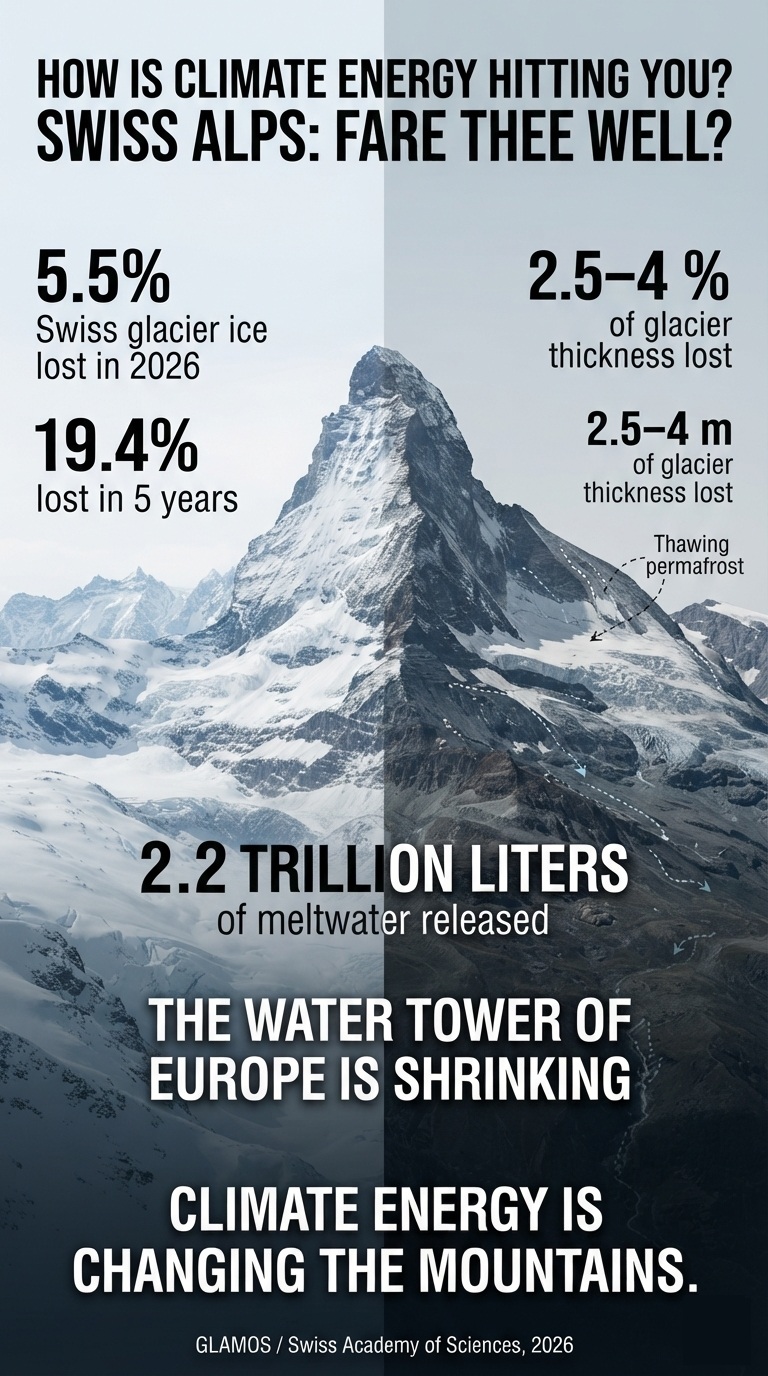
The Glacier Monitoring in Switzerland (GLAMOS) network and the Swiss Academy of Sciences report that Swiss glaciers lost approximately 5.5% of their total ice volume during the first eight months of 2026. That is the second-largest annual percentage loss on record, exceeded only by the exceptional melt of 2022.
The combination of exceptionally low winter snowfall and a record-hot summer has pushed Alpine glaciers into increasingly dangerous territory. Scientists warn that continued warming threatens the long-term survival of many Swiss glaciers.
A Five-Year Avalanche of Ice Loss
The latest measurements reveal how rapidly Switzerland’s frozen water reservoir is shrinking.
Nearly 20% Gone in Five Years
Swiss glaciers have lost approximately 19.4% of their ice mass in just five years.
Percentage Losses Are Accelerating
Although the absolute volume of ice lost in 2026 was lower than during the infamous 2003 heatwave, the percentage loss was substantially greater. The reason is straightforward: Switzerland’s remaining glacier ice reservoir is now dramatically smaller than it was two decades ago.
Meters of Ice Disappearing
Glacier thickness declined by roughly 2.5 to 4 meters (8 to 13 feet) in many areas during 2026, while some glacier tongues retreated by as much as 10 meters (33 feet). Major glaciers, including the Allalin, Clariden, Rhône and Aletsch, experienced severe melting.
The implication is important: as glaciers become smaller, a similar amount of atmospheric heat can produce an increasingly large percentage reduction in the remaining ice.
When the Mountains Begin to Crumble
The damage is not limited to the glaciers themselves.
Extreme warmth is also destabilizing the high Alpine environment by thawing permafrost—the permanently frozen ground and rock that helps stabilize steep mountain slopes.
Bare High Peaks
By late September 2026, the Matterhorn, rising 4,478 meters (14,692 feet), was photographed with exceptionally little snow cover. Persistent snow and ice at high elevations are becoming increasingly vulnerable during extreme warm periods.
Thawing Permafrost
As permafrost thaws, meltwater can penetrate cracks and fractures in mountain rock. The resulting changes in water pressure, ice bonding and rock strength can increase the risk of rockfalls, landslides and other slope failures.
In some locations, exceptionally rapid ground movement has already been observed. At sites such as Spitzerstein above Kandersteg, slopes have reportedly shifted by as much as 70 centimeters per day, demonstrating how quickly Alpine terrain can respond when its frozen foundations deteriorate.
The Water Tower of Europe Is Shrinking
Glaciers are more than spectacular scenery. They are part of Europe’s water infrastructure.
Between July and September 2026, Swiss glaciers released an estimated 2.2 trillion liters of meltwater. That is roughly four times the annual drinking-water consumption of Switzerland’s approximately 9.1 million residents.
But this enormous pulse of water is not necessarily good news.
Glaciers act as natural reservoirs, storing precipitation as ice and releasing water gradually. Extreme melting provides abundant runoff in the short term—but once the ice reservoir becomes sufficiently depleted, that stored-water contribution can decline dramatically.
The result is a fundamental change from a glacier-fed water system to a system increasingly dependent on rainfall and seasonal snow.
Hydropower Under Pressure
Switzerland obtains more than half of its domestic electricity generation from hydropower, making the timing and reliability of Alpine water flows economically important.
As glaciers shrink, their contribution to river flows will eventually decline. Earlier and more intense melting can also shift the timing of water availability.
That creates a difficult transition:
More meltwater today does not mean more water forever.
The disappearance of the ice reservoir ultimately removes one of Europe’s natural mechanisms for storing winter precipitation and releasing it during warmer, drier periods.
From Switzerland to Europe
The consequences extend far beyond Switzerland.
The Swiss Alps form part of Europe’s great mountain water system, feeding river basins associated with the Rhine, Rhône, Po and Danube.
Those rivers support:
- drinking-water supplies
- agriculture and irrigation
- hydropower
- industrial production
- ecosystems and wetlands
- inland navigation and transportation
As Alpine glaciers retreat, the timing and quantity of downstream water can change.
The loss of glacier ice therefore represents more than a change in scenery. It is a change in the physical infrastructure of the European water cycle.
Climate Energy at Work
Glacier loss provides one of the clearest visible examples of how excess climate energy is redistributed through the Earth system.
More atmospheric and oceanic energy → warmer air → reduced snowfall → accelerated glacier melt → exposed darker surfaces → greater solar absorption → further ice loss
At the same time:
Warming → permafrost thaw → weaker mountain structures → increased rockfall and landslide risk
These are not isolated events. They are interacting components of a changing climate system.
The Swiss Alps are effectively losing part of their natural infrastructure in real time.
Fare Thee Well?
Some small, low-elevation Alpine glaciers may already be committed to disappearance under present climate conditions. But the larger question extends far beyond Switzerland.
Every fraction of a degree of additional warming affects glaciers, snowpack, permafrost, water supplies and sea-level rise.
The loss of a glacier is therefore not simply the loss of ice.
It is the loss of a natural reservoir, a climate regulator, a water-storage system and part of the physical infrastructure on which human societies depend.
The Swiss Alps are telling us something important: climate change isn’t just happening around us. It is changing the systems we depend upon.
How Is Climate Energy Hitting You?