by Daniel Brouse
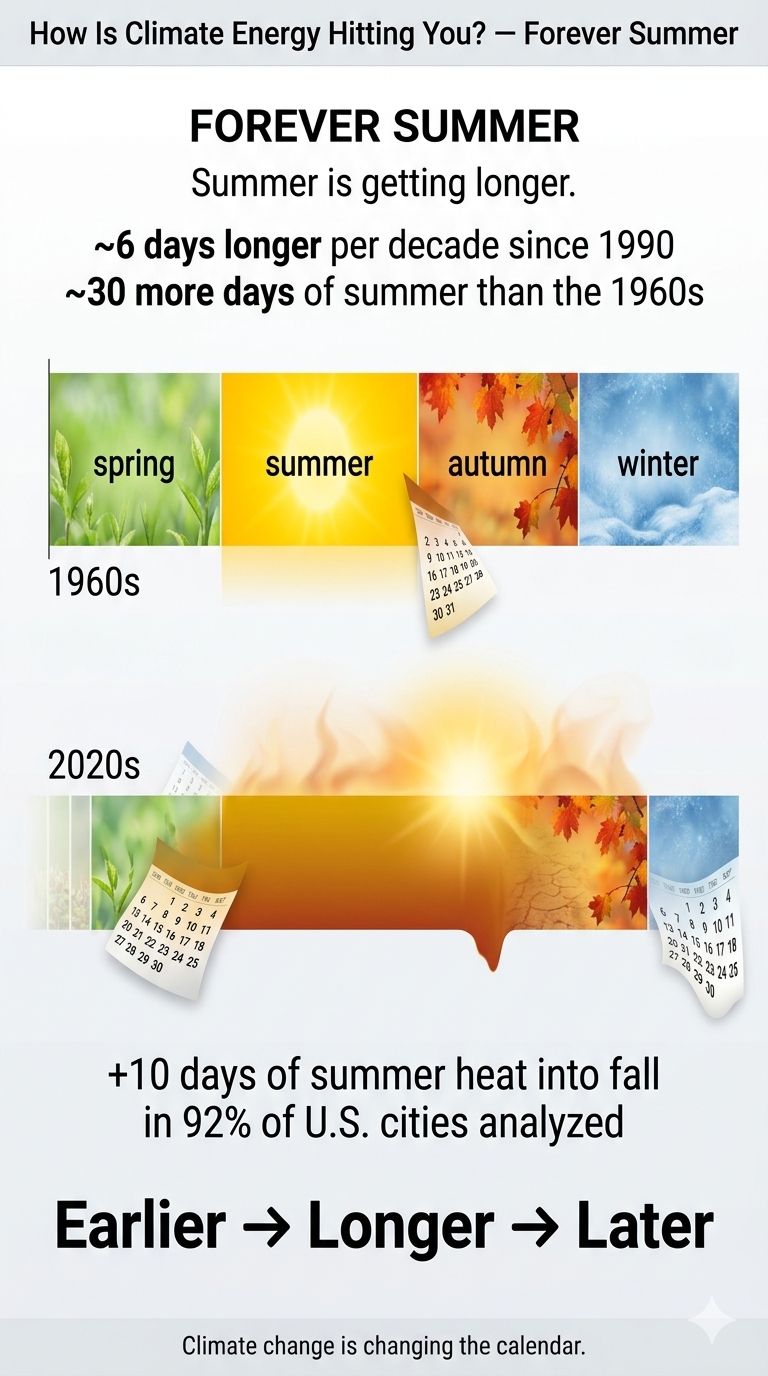
Summer is getting longer.
A study by researchers at the University of British Columbia found that, between 1990 and 2023, summer-like conditions across the regions between the tropics and the polar circles expanded by roughly six days per decade. That rate is substantially faster than earlier estimates.
The researchers did not define summer by the calendar. Instead, they identified summer as the period when temperatures rise above a location’s historically typical threshold for the warmest part of the year. Using this temperature-based definition, they found that summers across the midlatitudes now last roughly 30 days longer than they did in the 1960s.
The change is occurring at both ends of summer: warm conditions are arriving earlier in the year and lingering later into autumn. The result is not simply a longer calendar season, but a longer period of accumulated heat.
A Longer Summer
• Accelerating seasonal expansion — The UBC study, published in Environmental Research Letters, found that summer length increased by roughly six days per decade from 1990 to 2023. Across the midlatitudes, summer is now about 20 days longer than it was in 1990 and roughly 30 days longer than in the 1960s.
• Summer heat lingering into fall — Climate Central analyzed temperature records from 246 major U.S. cities and found that summer-like temperatures now extend an average of 10 days later into autumn in 227 cities—92% of those analyzed—compared with the early 1970s.
What Does a Longer Summer Mean?
A longer warm season can affect much more than the calendar.
More days of heat can mean:
- Longer periods of air-conditioning demand
- Greater heat-related health risks
- Longer wildfire seasons
- Extended allergy and mosquito seasons
- Earlier snowmelt and altered water supplies
- Greater stress on agriculture and ecosystems
Climate Central’s analysis notes that later-lasting summer heat can also increase cooling demand and household energy costs.
The seasons are not simply getting warmer. They are changing duration, timing, and intensity.
What once felt like a three-month summer is increasingly becoming something closer to a moving season of heat—arriving earlier, lasting longer, and accumulating more energy along the way.