by Daniel Brouse
Introdution
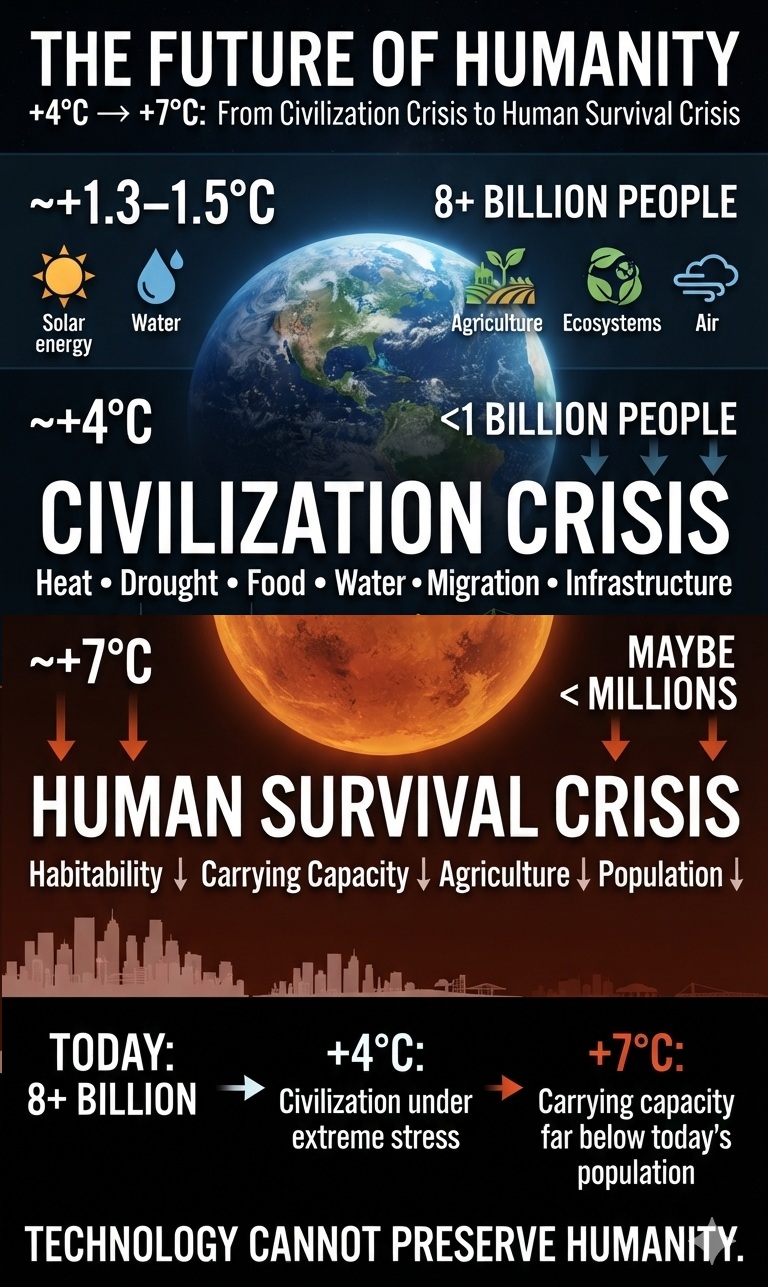
🌎 THE FUTURE OF HUMANITY
+4°C → +7°C: From Civilization Crisis to Human Survival Crisis
What happens to humanity if Earth doesn’t stop at +2°C or +3°C—but eventually reaches +4°C and then +7°C?
There is no scientifically established population number for a +7°C Earth.
But the physical constraints are becoming increasingly clear.
At approximately +4°C, humanity could face a civilization-scale crisis:
🔥 Extreme heat
💧 Water shortages
🌾 Agricultural disruption
🏙️ Infrastructure failures
🌍 Mass migration
⚡ Energy-system stress
Over the following centuries, continued warming toward +7°C could transform the question entirely.
The issue would no longer be simply:
How do we adapt civilization to a hotter planet?
It becomes:
How many humans can the planet physically support?
Technology could keep some people alive through underground facilities, controlled environments, hydroponic agriculture, protective equipment and advanced energy systems.
But there is an enormous difference between keeping thousands or millions of people alive in artificial environments and maintaining a civilization of 8+ billion people.
Today’s population depends upon the Earth providing enormous services essentially for free:
☀️ Solar energy
💧 Rainfall and freshwater
🌾 Productive soils
🌳 Ecosystems
🌬️ Breathable air
🌊 Functioning oceans
🌡️ Manageable temperatures
🌱 Outdoor agricultural space
At +7°C, humanity could increasingly have to manufacture artificially what the Earth currently provides naturally.
And that creates a fundamental problem:
Energy requires infrastructure.
Infrastructure requires materials.
Materials require mining and manufacturing.
Manufacturing requires energy and water.
Technology can extend human habitability.
But technology cannot be assumed to recreate the Earth for eight billion people.
The path from +4°C to +7°C could therefore represent a transition from:
Fighting to preserve civilization
to
Fighting to preserve humanity itself.
The Future of Humanity: +4°-7°C
The most likely scenario is for the planet to warm approximately 4°C by 2150, with the potential for +7°C over the longer term.
That raises an unavoidable question:
How many humans could survive on a planet that is +7°C warmer than the preindustrial Earth?
There are no official, peer-reviewed demographic consensus figures projecting an exact human population at +7°C of global warming. A +7°C scenario lies far beyond the temperature range of conventional climate projections for this century, so mainstream climate models do not provide a precise population forecast for such a world.
That does not mean the consequences are unknowable.
Scientists can examine the physical limits of human habitability, agricultural production, water availability, ecosystem function, infrastructure, energy requirements, and planetary carrying capacity. Taken together, these factors point toward a potentially catastrophic contraction of human population.
1. Planetary Carrying Capacity Could Fall Below One Billion
Climate scientists have previously addressed the question of Earth’s carrying capacity under extreme warming.
Hans Joachim Schellnhuber, former director of the Potsdam Institute for Climate Impact Research, has stated that at approximately +4°C, Earth’s sustainable carrying capacity could fall below one billion people.
At +7°C, the situation would be vastly more hostile.
The implied carrying capacity could therefore be a small fraction of today’s eight billion people. Under extreme-risk scenarios, humanity could potentially be reduced to a few million survivors concentrated in the remaining habitable regions, including high-latitude areas and highly protected technological environments.
There is no peer-reviewed demographic model establishing a precise population at +7°C. The absence of such a number should not be confused with evidence that the current population could be maintained.
The fundamental issue is carrying capacity.
A planet capable of supporting more than eight billion people under today’s climatic conditions does not necessarily retain that capacity after the climate system has been pushed several additional degrees beyond the historical range.
2. Physical Limits of Human Habitability
The most fundamental constraint is not economics.
It is thermodynamics.
Sherwood and Huber’s 2010 study examined the physiological limits imposed by extreme combinations of temperature and humidity. Their work established the importance of the 35°C wet-bulb temperature threshold as an approximate upper limit for human heat dissipation under extreme conditions.
At a wet-bulb temperature of 35°C, the human body can no longer effectively shed metabolic heat to the surrounding environment.
Even a healthy, hydrated, unclothed person resting in the shade with adequate air movement eventually becomes unable to maintain a safe core temperature.
A global warming level approaching +7°C would create regions in which these extreme combinations of heat and humidity become increasingly common.
The regions affected would include large portions of the tropics and subtropics, the Middle East, parts of Asia, and other heavily populated regions. This is not simply a matter of discomfort. At sufficiently high heat and humidity, the human body physically loses the ability to cool itself. Protective technology can delay the problem. It cannot eliminate the underlying thermodynamic limit.
3. Abrupt Carrying-Capacity Collapse
Population collapse does not require every human being to suddenly reach a temperature at which survival becomes impossible. It can occur when the systems supporting civilization cross critical thresholds. Mathematical population models have examined what happens when environmental carrying capacity suddenly declines because of severe environmental crises.
One such study published in Chaos, Solitons & Fractals modeled a hypothetical situation in which Earth’s sustainable carrying capacity abruptly fell to approximately two billion people. When carrying capacity suddenly becomes lower than the existing population, the model produces an extremely rapid population decline.
The population can fall by half within only a few decades. This is important because climate change does not operate as a single-variable problem. A collapse in agricultural production can cause food shortages. Food shortages can produce price shocks and famine. Famine can produce migration. Migration can produce political instability. Political instability can disrupt energy production and transportation. Energy shortages can further reduce agricultural production.
The resulting system is nonlinear.
Once multiple critical systems begin failing simultaneously, population decline can accelerate dramatically.
Earth Today vs. Earth at +7°C
| Metric | Current Era (~1.3–1.5°C) | Potential Earth at +7°C |
|---|---|---|
| Global population | ~8.3 billion | Unquantified, but potentially reduced to hundreds of millions or less |
| Human climate niche | Most humans live within a relatively narrow range of climatic conditions | Large regions experience temperatures and humidity increasingly hostile to human survival |
| Agriculture | Globalized and heavily dependent on predictable climate, water, fertilizers and energy | Severe disruption of traditional outdoor agriculture, particularly in the tropics and mid-latitudes |
| Food production | Primarily solar-powered outdoor agriculture | Increasing dependence on artificial environments and technologically controlled agriculture |
| Water | Large-scale freshwater systems support cities and agriculture | Increasing drought, heat, evaporation and competition for water |
| Outdoor labor | Possible across most populated regions | Increasingly restricted by dangerous heat and humidity |
| Infrastructure | Designed around the historical climate | Increasingly stressed by extreme heat, storms, drought, flooding and water shortages |
| Primary mortality risks | Aging, disease, accidents and conventional disasters | Heatstroke, famine, water shortages, disease, conflict and systemic infrastructure failure |
| Civilization | Natural ecosystems provide enormous life-support services | Increasing portions of the natural life-support system must be artificially replaced |
Ultimately, a +7°C world is not simply a difficult demographic scenario.
It represents an extreme threat to the carrying capacity of Earth and to the technological civilization that currently supports billions of people.
Why Couldn’t Humans Simply Adapt?
A reasonable question is:
Why couldn’t humans simply adapt?
Why not wear protective clothing or cooling suits?
Why not live underground?
Why not grow hydroponic food?
Why not build artificial environments and maintain the current population?
Humans are extraordinarily adaptable.
Technology already allows small populations to survive in environments that would otherwise be extremely hostile.
Humans live in Antarctica.
Humans operate submarines.
Humans live in deserts.
Astronauts survive in space.
The problem is not whether technology can keep some humans alive.
The problem is whether technology can sustain eight billion humans in artificial environments after the natural environment has become hostile to large-scale civilization.
That creates fundamental bottlenecks involving energy, materials, infrastructure, maintenance, food production and thermodynamics.
1. The Hydroponic Energy Paradox
To feed eight billion people entirely indoors, humanity would have to replace much of the free energy currently supplied by the Sun. Traditional agriculture obtains solar energy directly. Millions of square kilometers of agricultural land receive sunlight without humanity having to manufacture the photons.
Indoor agriculture changes the equation. Artificial lighting must be produced. Water must be pumped. Nutrients must be circulated. Temperature and humidity must be controlled. Carbon dioxide must be managed. Air must be circulated. Crops must be harvested. The systems must be maintained continuously.
The Scale
Feeding eight billion people entirely indoors would require an enormous quantity of electricity for lighting, climate control, pumping, ventilation, automation and food processing.
The energy requirement would be many times greater than the amount of energy currently available to the human race for ordinary food production and could approach or exceed the scale of the entire existing global energy system depending on the crops and technologies used.
And food is not merely calories.
Humanity requires carbohydrates, proteins, fats, vitamins, minerals, animal feed, oils and a tremendous diversity of agricultural products.
The Catch-22
If that additional energy comes from fossil fuels, the energy system accelerates climate warming.
If it comes from renewable energy, enormous quantities of solar panels, wind turbines, transmission lines, batteries and other infrastructure must be manufactured and maintained.
If it comes from nuclear energy, enormous quantities of reactors, fuel-cycle infrastructure, cooling systems, transmission systems and industrial capacity must be maintained.
In every case, the artificial food system becomes dependent upon an enormous industrial infrastructure.
And that infrastructure itself must survive a +7°C world.
2. Environmental Degradation of Critical Machinery
Humanity cannot run a global civilization strictly from underground. Resources must still be extracted from the surface. Minerals must be mined. Construction materials must be manufactured. Energy systems must be maintained. Transportation systems must operate. Food-production systems require machinery. Factories require workers. The coolant problem becomes increasingly important. Mechanical and industrial systems must ultimately reject waste heat. Power plants, industrial equipment, refrigeration systems, data centers and other large-scale machinery rely on heat-transfer systems.
As surrounding air and water become hotter, the temperature difference available for rejecting heat becomes smaller. Cooling therefore becomes increasingly difficult and energy intensive. The problem is not that every machine instantly stops working at +7°C.
The problem is that the amount of energy and infrastructure required to keep machines operating rises while the surrounding civilization is simultaneously being subjected to increasing environmental stress.
Protective Suits
Humans can wear cooled protective suits or specialized thermal equipment. Such equipment can allow people to work temporarily in environments that would otherwise be dangerous.
But the suits require:
- electricity
- cooling
- air filtration
- communications
- maintenance
- replacement parts
- charging
- trained personnel
A protective suit can keep an individual alive.
It cannot make the surface environment normal.
It cannot eliminate the need to mine resources, maintain roads, operate ports, manufacture machinery, repair electrical grids, produce food and maintain global supply chains.
A civilization in which workers can safely operate outdoors only for limited periods becomes fundamentally different from today’s civilization.
3. The Enormous Resource Footprint of Underground Civilization
Housing eight billion people underground would require the largest engineering project in human history. Thousands of subterranean cities would have to be constructed.
The required quantities of:
- concrete
- steel
- copper
- electrical equipment
- ventilation equipment
- pumps
- elevators
- water systems
- sewage systems
- air filtration
- cooling systems
- power generation
- energy storage
- communications
- transportation
- food-production equipment
would be enormous.
Excavating underground cities would itself require enormous quantities of energy and heavy machinery. Concrete production would add another major industrial burden. The systems would also require continuous maintenance.
Ventilation and Air
An underground population of billions would require enormous systems for:
- supplying breathable air
- removing carbon dioxide
- controlling humidity
- filtering pollutants
- managing waste
- maintaining pressure
- controlling temperature
A single systemic failure in an underground city’s ventilation or power system could produce immediate mass casualties.
The larger and more interconnected the system becomes, the greater the consequences of systemic failure.
4. Underground Civilization Still Depends on the Surface
Moving underground does not eliminate dependence on the natural world.
An underground civilization would still need:
Energy.
Energy requires power plants and transmission systems.
Minerals.
Minerals require mining.
Food.
Food requires agriculture or industrial food-production systems.
Water.
Water must be obtained, transported and treated.
Machinery.
Machines require factories, raw materials and replacement parts.
Human labor.
Workers must maintain the systems.
Waste disposal.
Waste must be processed and ultimately incorporated into material cycles.
Therefore, an underground civilization would not actually be independent of the surface.
It would be more dependent on a functioning industrial system.
5. The Psychological and Biological Reality
Human beings are not genetically adapted to live permanently inside completely artificial environments.
Humans evolved within complex natural ecosystems under natural cycles of sunlight, darkness, temperature, seasons, atmospheric conditions, microbial exposure and biological diversity.
A completely artificial environment would impose enormous psychological and biological stresses.
Long-term confinement, artificial lighting, restricted environments, isolation and separation from natural ecosystems create substantial physiological and psychological challenges.
The problem extends beyond human psychology.
Natural ecosystems provide services that artificial systems would have to replace:
- water purification
- decomposition
- nutrient cycling
- pollination
- soil formation
- carbon storage
- atmospheric regulation
- biological pest control
The more completely humans isolate themselves from the natural environment, the more of these services must be replaced technologically.
Every replacement system requires energy and maintenance.
6. The Fundamental Problem: Scale
This is the central issue.
Technology could undoubtedly allow a sliver of humanity to survive conditions that would otherwise be fatal.
A few million highly organized people living in underground facilities, protected environments or high-latitude regions could potentially survive conditions under which conventional civilization could not.
The problem is maintaining eight billion people.
There is an enormous difference between:
keeping a few thousand people alive in Antarctica
and
maintaining billions of people inside an artificial global biosphere.
The first has already been demonstrated.
The second has not.
The eight-billion-person civilization exists because the planet provides enormous quantities of environmental services essentially for free. The Sun provides energy. Rain provides water. Soils grow crops. Oceans regulate heat. Forests and wetlands process water and carbon. Natural ecosystems recycle nutrients. The atmosphere provides breathable air. Outdoor agriculture converts sunlight into food without humanity having to construct the entire system artificially.
A +7°C Earth would place increasing portions of those services under extreme stress.
Humanity could replace some of them.
Replacing all of them, for eight billion people, indefinitely is a completely different problem.
The Catch-22 of Technological Survival
The technological solution creates its own dependency chain:
Climate warming
↓
Natural systems become less reliable
↓
Artificial systems replace natural services
↓
Artificial systems require enormous amounts of energy
↓
Energy systems require enormous industrial infrastructure
↓
Industrial infrastructure requires mining, water, transportation and stable ecosystems
↓
Those systems are themselves damaged by climate change
↓
Maintenance becomes increasingly difficult
↓
Artificial life-support systems become increasingly vulnerable
This is the fundamental problem.
Technology does not eliminate environmental carrying capacity.
It extends it by using energy and resources.
But the energy and resources required to extend carrying capacity become increasingly difficult to obtain as the planetary environment deteriorates.
The Real Question
The real question is therefore not:
“Can a human being survive +7°C?”
A human can survive an extraordinary range of environments with sufficient technology.
The real question is:
“Can eight billion humans maintain a technologically advanced global civilization on a planet that is +7°C warmer?”
That is an entirely different question.
The answer depends on whether enough food, water, energy, materials, infrastructure and habitable space remain available to support the enormous interconnected system required to maintain billions of people.
At +7°C, every one of those requirements becomes more difficult.
And the problems interact. Food shortages affect political stability. Political instability affects energy production. Energy shortages affect water systems. Water shortages affect agriculture. Agricultural failures affect food supplies. Infrastructure failures affect everything.
The result is a coupled nonlinear system in which multiple simultaneous stresses can produce consequences far larger than any individual stress alone.
Summary of the Collapse
The path to a +7°C world does not require humanity to suddenly jump from today’s climate into an uninhabitable planet.
It can happen progressively.
The first major threshold is approximately +4°C of global warming over the next century.
At +4°C, humanity would still exist in enormous numbers. Civilization would still operate. Technology would still function. Many regions would remain habitable. But the environmental conditions supporting today’s eight-billion-person civilization would be profoundly degraded. Agriculture would face increasing heat and drought. Freshwater supplies would become increasingly stressed. Extreme heat would restrict outdoor labor across large regions. Coastal regions would face accelerating sea-level rise.
Ecosystems would be increasingly disrupted. Food production, water systems, energy infrastructure and transportation would become increasingly vulnerable to compound climate extremes.
The result would not necessarily be the immediate collapse of civilization.
It would be the beginning of a progressive contraction in Earth’s effective carrying capacity. And +4°C would not necessarily be the end of the warming process.
If greenhouse-gas emissions, climate feedbacks and Earth-system changes continue to push the planet beyond +4°C, warming could continue over the following centuries toward +7°C or more.
That changes the problem fundamentally.
At +7°C, the issue is no longer simply whether humanity can adapt its agriculture, infrastructure and cities to a warmer climate. The issue becomes whether the Earth can continue to provide the environmental foundation required to support billions of people at all.
Technology would undoubtedly allow some portion of humanity to survive a +7°C world. Highly protected underground facilities, high-latitude settlements, artificial environments, hydroponic agriculture, protective equipment and advanced energy systems could preserve human life under conditions that would otherwise be lethal. But that does not demonstrate that eight billion people could be sustained.
The current population of approximately eight billion is supported by a planetary system that provides enormous services essentially for free:
- solar energy
- rainfall
- productive soils
- natural ecosystems
- breathable air
- functioning oceans
- manageable temperatures
- outdoor agricultural space
- natural water cycles
- global biological productivity
At +4°C, humanity would increasingly struggle to maintain those services.
At +7°C, humanity could increasingly be forced to manufacture them.
Air would have to be conditioned.
Water would have to be increasingly purified and transported.
Food would increasingly require controlled environments.
Temperature would have to be artificially regulated.
Nutrients would have to be recycled.
Natural ecosystem services would increasingly have to be replaced by industrial systems.
The resource and energy requirements would become enormous. And every artificial replacement creates another dependency.
Energy requires infrastructure. Infrastructure requires materials. Materials require mining and manufacturing. Manufacturing requires energy and water. Energy and water systems depend upon functioning infrastructure and ecosystems.
The result is a civilization increasingly dependent upon an industrial system that is itself operating under increasingly hostile environmental conditions.
This creates a fundamental progression:
Today → +4°C → +7°C
Stable planetary support → severely degraded planetary support → radically reduced planetary carrying capacity
At approximately +4°C, the central problem becomes maintaining civilization under extreme environmental stress.
At approximately +7°C, the central problem becomes maintaining humanity itself at anything approaching today’s population.
The transition would not necessarily be smooth. Climate systems, ecosystems, food systems and human societies are nonlinear. Carrying capacity can decline gradually for a time and then fall rapidly when multiple thresholds are crossed.
A decline in agricultural productivity can trigger food shortages. Food shortages can trigger migration. Migration can destabilize political systems. Political instability can disrupt energy and transportation systems. Energy failures can disrupt water and food production. Those failures can further reduce carrying capacity.
The process can therefore become a positive feedback loop of environmental degradation and societal contraction.
A +7°C world could produce a catastrophic contraction in human carrying capacity, potentially reducing the population by billions.
The exact surviving population cannot be known in advance.
It could be hundreds of millions.
It could be far lower.
Under extreme technological survival scenarios, only a small fraction of today’s population could remain. The critical point is not the precise number.
The critical point is that the carrying capacity of a +7°C Earth could be radically below the population that exists today.
And that creates an important distinction between the next century and the centuries that follow.
The +4°C world is a civilization-scale crisis.
The +7°C world could become a human-survival crisis.
Humanity does not merely inhabit the planet.
Human civilization is a product of the planet’s environmental stability.
The civilization supporting eight billion people was built within a remarkably narrow range of climatic conditions. Push the planet several degrees beyond that range and humanity must increasingly substitute technology for the natural systems that made civilization possible in the first place.
Technology can preserve pockets of humanity. Technology can extend human habitability.
Technology cannot be assumed to reproduce the entire Earth system for eight billion people.
The path from +4°C to +7°C therefore represents more than another three degrees of warming.
It represents a potential transition from adapting civilization to a changing planet to attempting to manufacture an artificial planet capable of sustaining humanity.
That is the ultimate carrying-capacity problem.
At +4°C, humanity may be fighting to preserve civilization.
At +7°C, humanity may be fighting to preserve humanity itself.