by Daniel Brouse
Introdution
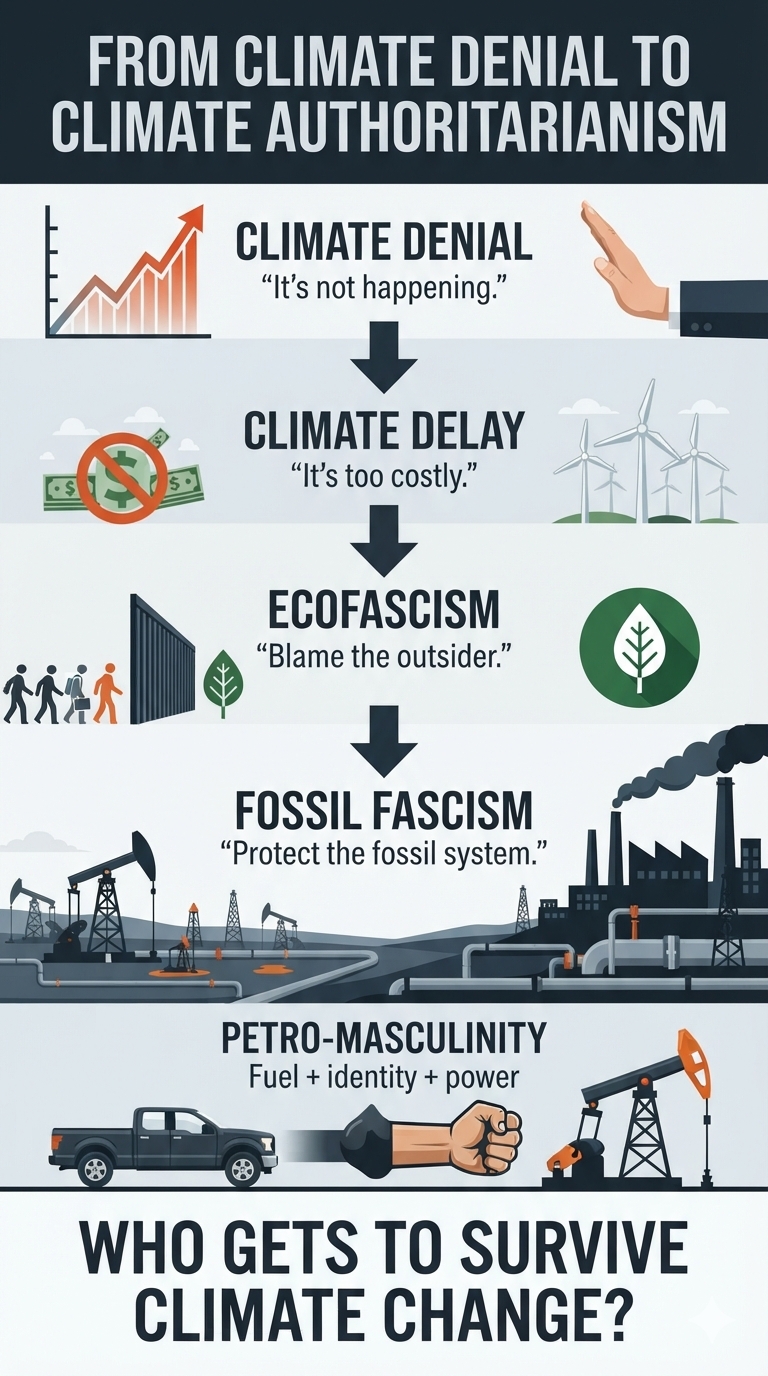
🌎 FROM CLIMATE DENIAL TO CLIMATE AUTHORITARIANISM
Climate politics is evolving.
As outright denial becomes harder to sustain, the narrative can shift from:
“Climate change isn’t happening.”
→ “Fixing it will cost too much.”
→ “Blame the outsiders.”
→ “Protect our resources.”
This article examines four related concepts:
🔹 Climate denial & climate delay
🔹 Ecofascism
🔹 Fossil fascism
🔹 Petro-masculinity
These aren’t interchangeable terms. Each describes a different way climate change, energy, identity, economics, and political power can become intertwined.
The central question is increasingly not simply whether the climate is changing—but how society explains the change, assigns responsibility, and responds to it.
Who gets to survive climate change?
Read the full report:
Fossil Fascism, Ecofascism, and Petro-Masculinity
Climate misinformation is no longer limited to simply denying that the planet is warming. As climate change becomes increasingly difficult to dismiss, the political narratives surrounding it have evolved—from outright denial, to attacks on climate science, to opposition to climate policy, and, in more extreme forms, to narratives that blame immigrants and other marginalized populations for environmental decline.
These narratives are not identical. They operate through different mechanisms and identify different enemies. But they can overlap, creating a broader political strategy in which climate science, energy policy, immigration, race, gender, and national identity become interconnected.
The International Panel on the Information Environment’s 2025 assessment concluded that powerful actors—including corporations, governments, and political parties—intentionally spread inaccurate or misleading narratives about anthropogenic climate change, contributing to declining public trust and political inaction.
Four concepts help describe different parts of this landscape: climate denial and delay, ecofascism, fossil fascism, and petro-masculinity.
1. Climate Denial and Climate Delay
The most familiar form of climate misinformation is outright denial: rejecting the existence, severity, or human cause of climate change.
Political rhetoric has also attacked renewable energy through claims that wind turbines, solar power, or other clean-energy technologies are inherently dangerous or economically destructive. Some of these claims have been challenged by scientific evidence, while others involve legitimate questions about environmental impacts that require quantitative comparison rather than political rhetoric.
As public acceptance of climate change has increased, however, the political emphasis has increasingly shifted from denying the problem to opposing proposed solutions. Researchers commonly describe this strategy as climate delay.
The basic argument changes from:
“Climate change isn’t happening.”
to:
“Climate change may be happening, but addressing it will cause even greater economic or social damage.”
This framing can emphasize immediate costs—higher energy prices, job losses, grid reliability, restrictions on vehicles or industrial activity—while giving less attention to the long-term economic costs of continued warming.
Government-sponsored challenges to climate science
A prominent recent example was the U.S. Department of Energy’s July 2025 publication of A Critical Review of Impacts of Greenhouse Gas Emissions on the U.S. Climate. The report was produced by five scientists assembled by Energy Secretary Chris Wright and argued, among other things, that the economic damages from CO₂-induced warming may be smaller than commonly believed and that aggressive mitigation policies could be more harmful than beneficial.
Carbon Brief subsequently conducted a detailed fact-check with climate scientists and reported more than 100 statements it characterized as false or misleading, including claims involving the economic consequences of climate change, extreme weather, and the interpretation of scientific literature.
The significance of such disputes is not simply whether individual claims are correct. It is also about which scientific evidence is selected, which uncertainties are emphasized, and how those choices are translated into public policy.
2. Ecofascism: Climate Change as a Scapegoating Narrative
Ecofascism represents a fundamentally different approach.
Rather than denying climate change, ecofascist narratives accept environmental collapse but attribute it to supposedly undesirable populations—particularly immigrants, refugees, or people in the Global South.
The “overpopulation” narrative
One recurring theme is the claim that environmental degradation is primarily caused by population growth among poorer or non-white populations.
This can obscure the enormous differences in consumption and greenhouse-gas emissions between populations. High-income populations have historically produced far greater per-capita emissions than the world’s poorest populations.
The political transformation occurs when legitimate concerns about ecological limits are converted into arguments about which people supposedly deserve access to resources.
Blaming immigrants for environmental degradation
A related narrative links immigration directly to pollution, resource depletion, or greenhouse-gas emissions.
This is sometimes described as eco-bordering: using environmental concerns to justify more restrictive borders.
The danger of this framing is not the discussion of the environmental consequences of population growth or migration itself. Those are legitimate subjects for analysis. The problem arises when immigrants are treated as the primary ecological threat while the much larger effects of industrial energy systems, fossil-fuel consumption, land use, and unequal resource consumption are displaced from the discussion.
“Lifeboat ethics”
At its most extreme, ecofascist thinking adopts a form of “lifeboat ethics”: the assumption that resources are becoming so scarce that societies must protect their own populations by excluding outsiders.
Climate disasters can intensify this mentality. As droughts, floods, heat waves, sea-level rise, and food insecurity increase displacement, refugees can be portrayed not as people affected by climate change but as the cause of further environmental decline.
In its most extreme forms, this worldview has intersected with white-supremacist and accelerationist movements. Researchers have documented cases in which perpetrators of mass violence invoked “Great Replacement” ideas alongside environmental or resource-based fears.
The resulting political question changes from:
How do we respond to climate change?
to:
Who gets to survive climate change?
That is a profound shift in the political meaning of climate change.
3. Fossil Fascism: Protecting Fossil Capital
Fossil fascism is related to, but distinct from, ecofascism.
The term has been used by scholars studying the intersection of fossil-fuel dependence, authoritarian politics, nationalism, racism, and opposition to climate action. Recent scholarship defines fossil fascism as a political, legal, and cultural system centered on an ultra-nationalist defense of fossil-fuel extraction while suppressing opposition to it.
In simplified terms:
Ecofascism accepts ecological crisis but blames the “outsider.”
Fossil fascism protects the fossil-fuel system and attacks those who seek to change it.
From “Blood and Soil” to “Black Fuel”
The historical roots of ecofascist thought are often connected to European romantic nationalism and the “Blood and Soil” tradition, in which land, national identity, and racial identity became intertwined.
Fossil fascism has a different historical lineage.
Political scientist Cara Daggett and other scholars have used the concept to examine the relationship between fossil fuels, authoritarian politics, nationalism, and racialized power. Andreas Malm and the Zetkin Collective further developed the concept in White Skin, Black Fuel, connecting fossil-fuel development to the history of European imperialism, colonialism, and racial hierarchy.
The underlying argument is that fossil fuels are not simply an energy source. They can also become embedded in political institutions, economic power, national identity, and cultural ideas about social hierarchy.
Two different responses to ecological crisis
| Feature | Fossil Fascism | Ecofascism |
|---|---|---|
| Climate position | Often characterized by denial, obstruction, or minimization | Accepts the reality of ecological crisis |
| Primary target | Climate scientists, activists, regulators, and opponents of fossil extraction | Immigrants, refugees, minorities, and supposedly “overpopulated” populations |
| Economic orientation | Defends fossil-fuel production and associated economic power | Often hostile to aspects of industrial globalization |
| Environmental vision | Nature treated primarily as a resource for economic and national power | Nature portrayed as a homeland requiring protection from perceived outsiders |
| Political expression | Deregulation, fossil-fuel expansion, political obstruction, and suppression of opposition | Anti-immigration politics, exclusionary nationalism, and, at its extreme, violent white-supremacist movements |
These categories are analytical concepts, not descriptions that apply automatically to every politician, government, or person who opposes a particular climate policy.
4. The Dangerous Crossover
Although fossil fascism and ecofascism can be distinguished conceptually, they can also overlap.
A political movement can simultaneously defend fossil-fuel extraction, oppose climate regulation, promote authoritarian nationalism, and blame immigrants or minorities for environmental problems.
As climate impacts become increasingly difficult to deny, the political narrative can therefore move through several stages:
Denial → Delay → Scapegoating → Authoritarian Protection
The first stage says the problem does not exist.
The second says the problem exists but solving it is too expensive.
The third says the problem exists because of particular groups of people.
The fourth argues that extraordinary political power is necessary to protect the nation and its resources.
This does not mean every instance of climate skepticism follows this progression. Rather, it illustrates how different narratives can reinforce one another.
5. Petro-Masculinity: The Cultural Engine
A related concept helps explain the cultural dimension of fossil-fuel politics: petro-masculinity.
Political scientist Cara Daggett introduced the term in her 2018 paper Petro-Masculinity: Fossil Fuels and Authoritarian Desire. Daggett argues that fossil-fuel systems can become connected not only to economic interests but also to identity, masculinity, authority, and resistance to social change.
The central idea is that fossil fuels can represent more than energy.
They can represent:
- independence
- personal freedom
- economic security
- traditional gender roles
- national power
- resistance to perceived cultural change
Fossil-fuel identity
During the twentieth century, American masculinity became closely associated with breadwinning, industrial employment, suburban development, automobile ownership, and inexpensive gasoline.
As a result, challenges to fossil-fuel consumption can sometimes be interpreted culturally rather than simply economically.
An electric vehicle, public transportation, reduced meat consumption, or restrictions on fossil-fuel use can be portrayed not merely as policy choices but as attacks on traditional identity.
This helps explain the cultural significance of behaviors such as “rolling coal,” in which modified diesel vehicles deliberately produce large quantities of exhaust smoke. The behavior can function as a form of political or cultural expression rather than transportation alone.
Petro-masculinity and authoritarianism
Daggett’s framework connects fossil-fuel dependence with authoritarian desire, particularly where climate action is interpreted as a threat to established gender roles, economic autonomy, or social status.
The connection to fossil fascism can therefore be understood at two levels:
Petro-masculinity is the cultural and identity dimension.
Fossil fascism is the political and institutional dimension.
The former can help create emotional resistance to changes in the energy system; the latter describes political structures and movements that defend fossil-fuel power.
6. Putting the Concepts Together
The four concepts describe different mechanisms rather than four interchangeable labels.
Climate denial rejects or minimizes the underlying science.
Climate delay accepts some degree of climate change while arguing against effective or rapid responses.
Ecofascism accepts ecological crisis but redirects blame toward immigrants, minorities, or other supposedly threatening populations.
Fossil fascism describes the fusion of fossil-fuel interests with authoritarian, nationalist, racialized, and anti-climate-action politics.
Petro-masculinity describes one cultural mechanism through which fossil-fuel dependence can become tied to identity, masculinity, autonomy, and authoritarian desire.
The concepts can overlap, but they should not be treated as synonyms.
The broader pattern is important because climate change is not merely a scientific problem. It is also a struggle over how societies interpret risk, distribute responsibility, allocate resources, and respond to disruption.
The critical question is therefore not only whether people acknowledge that the climate is changing.
It is also how they explain why it is changing, who they hold responsible, and what solutions they believe are legitimate.
That is where climate science, economics, energy policy, nationalism, race, gender, and political power increasingly intersect.