bookmark_borderWalk the Poop Before You Talk the Transition

By Daniel Brouse

July 18, 2025

Now that many people are finally waking up to the collapse of the climate and social systems, I hope my background as an economist focused on risk management can help illuminate the path forward. Ideally, we would have followed sound risk management decades ago to avoid reaching this crisis point. But here we are, and so we must shift to Plan B: A New Economy.

The Real Sustainability Test

Everyone talks about sustainability, but few understand what it requires at the most basic level: the ability to feed yourself and manage your waste without destroying your ecosystem.

Before we can credibly debate carbon markets, degrowth, or circular economies, we need to prove we can survive a single day in a truly self-sustaining way:

✅ Feed yourself for a day using methods that do not degrade soil, water, or biodiversity and that could scale for years.
✅ Secure clean water in a way that is sustainable long-term, without polluting the source or requiring massive energy inputs.
✅ Dispose of your own waste safely, ensuring you do not contaminate soil or water, or create disease vectors that harm your community or yourself.

The single most important thing you can do: go the distance.
Bury your waste far away from where you live, eat, drink, and grow your food. This simple action protects your water, your soil, and your health—more effectively than any untested high-tech solution.

Sustaining yourself for a day sounds simple until you try it. So, first do it. Once you can do it for a day, you need to scale it to weeks, months, and years—and then to your family, friends, and community.

The Hardest Part: Human Waste

Here’s the hard truth: the most important part of transitioning to a new economy is how you handle your poop.

Everyone wants to talk about electrification, AI, and green jobs, but no one wants to talk about the sanitation systems that prevent us from killing ourselves and our environment. Yet if we cannot manage our waste sustainably, any talk of a “sustainable economy” is hollow.

Before you join debates about transitioning to a post-carbon world, demonstrate you can literally walk the poop before you talk the transition.

Why Indigenous Practices Matter

This is not a new challenge. Indigenous communities across North America managed to live sustainably for millennia, disposing of human waste in ways that protected water sources, preserved soil health, and maintained community health.

They:

  • Buried waste away from water sources and habitation areas.

  • Moved camps periodically to prevent overloading any one location.

  • Used natural cover materials (soil, ash, plant matter) to accelerate decomposition and reduce contamination risks.

These practices were not merely cultural—they were effective, practical risk management strategies rooted in a deep understanding of land stewardship.

A Thought Experiment (That Should Become Reality)

If you think your solutions will save the world, start by proving you can:

  • Feed yourself for one day, sustainably.

  • Manage your waste for one day, sustainably.

  • Scale it to your family and community.

If your solutions fail at this basic level, they will fail at the societal level too. Conversely, if you can solve these fundamental challenges, you will be equipped with the grounded knowledge and humility needed to help design a real transition strategy for a collapsing climate and society.

Indigenous American Indians

Here is a clear, evidence-based overview on how many Indigenous American Indian communities traditionally managed human waste to avoid contaminating soil and water:

1️⃣ General Principles

  • Burial at a distance
    Waste was typically buried away from camps and water sources, using small personal latrines or digging cat holes, ensuring pathogens did not enter water supplies.

  • Site rotation
    Camps and waste sites were moved periodically, preventing concentration of waste in one location.

  • Choice of location
    Latrines were placed:

    • Downwind from camps

    • Far from streams, springs, or rivers (commonly 100+ feet)

    • On higher or well-drained ground to reduce runoff risk.


2️⃣ Region-Specific Practices

  • Plains & Nomadic Tribes (e.g., Lakota, Comanche)

    • Dug shallow pits when staying in one place.

    • Covered waste with soil and natural materials.

    • Moved frequently, allowing the environment to naturally decompose waste.

  • Southwest (e.g., Hopi, Pueblo)

    • In permanent villages, used designated latrine areas outside the living quarters.

    • Some used ash or sand to cover waste, aiding desiccation and reducing odors and flies.

  • Pacific Northwest & Woodlands

    • Waste was buried away from water sources, critical in forested or riparian zones.

    • Camps were often near water, but latrines were carefully sited at a safe distance and covered.

  • Arctic & Subarctic (e.g., Inuit)

    • In frozen conditions, waste was sometimes frozen and disposed of in designated snow areas.

    • In summer, waste was placed far from freshwater sources.


3️⃣ Why This Protected Soil and Water

✅ Burial with soil isolated pathogens from insects and animals.

✅ Distance from water reduced fecal contamination, protecting drinking and fishing sources.

✅ Organic decomposition in small, distributed quantities allowed soil microbes and sunlight to neutralize pathogens naturally.

✅ Rotation and mobility prevented soil overload and nutrient leaching in a single location.


4️⃣ Important Context

  • While Indigenous practices varied widely across regions and tribes, their relationship with land emphasized maintaining the health of water and soil.

  • There was no single universal method, but core principles of burial, distance, and rotation were nearly universal.

  • The single most important thing you can do: go the distance.
    Bury your waste far away from where you live, eat, drink, and grow your food. This simple action protects your water, your soil, and your health—more effectively than any high-tech solution you don’t actually use.

Trumpenomics: The Decline of the US

The Human Induced Climate Change Experiment

bookmark_borderFiscal Policy in the Chaos: How America’s Current Path Accelerates Economic Collapse

by Daniel Brouse
July 17, 2025

I’ve been getting a lot of great questions about two nonlinear, dynamic systems: climate collapse and economic collapse. Just as the climate system consists of interconnected subsystems, so too does the world economy. This chapter examines how current U.S. fiscal policy is a critical driver within this chaotic system, accelerating the collapse of the American and, by extension, the global economy.

The Three Subsystems Driving Collapse

The current fiscal policy can be viewed as three interacting subsystems, each contributing to an exponential acceleration of collapse:

1️⃣ Anti-Immigration and Mass Deportation

Capitalism depends on population growth. The U.S. has an aging population and declining birth rates, making mass immigration essential for economic stability. Without it, the economy faces a death spiral: fewer workers, reduced consumer demand, lower tax revenues, and collapsing support for programs like Medicare and Social Security.

For the past five years, immigration has accounted for 80% of U.S. GDP growth. Ending immigration and pursuing mass deportation will likely be the first domino to fall, triggering lower demand, labor shortages, and the unraveling of America’s fragile social safety net. It will also accelerate the adoption of AI and robotics, ensuring these jobs never return.

2️⃣ Tariffs: The Hidden Consumption Tax

Tariffs are regressive consumption taxes that fall hardest on the poor and middle class. Consumer spending drives the U.S. economy, and rising prices from tariffs reduce purchasing power, creating a feedback loop of lower demand, declining business revenues, layoffs, and economic contraction.

Tariffs marketed as “protecting American jobs” are, in practice, a stealth tax on every consumer, funding unrelated policy goals while weakening the core engine of economic growth.

3️⃣ The Big Ugly Bill: A Bomb Under the Economy

Trump’s “One Big Beautiful Bill (Act)” is not a strategy for energy independence or economic growth; it is a reckless gamble trading long-term planetary and economic stability for a mirage of short-term gains.

Key impacts of the bill include:

  • Gutting science and promoting climate collapse, starting with the destabilization of the insurance industry as climate disasters become uninsurable.

  • Slashing Medicaid, pushing the cost of health care back onto the private sector and individuals, straining household finances, and increasing medical bankruptcies.

  • Spending billions on anti-immigration enforcement and mass deportations, resulting in a net economic loss while worsening demographic decline.

  • Creating unsustainable debt: The bill will add trillions to the deficit, creating a positive feedback loop:

    • Massive government borrowing drives up interest rates.

    • Rising rates increase the cost of borrowing.

    • Higher interest payments balloon the deficit further.

    • In addition, the Big Ugly Act quietly raised the debt ceiling by trillions, removing near-term borrowing constraints. Almost immediately after the bill’s passage, the U.S. Treasury announced it would issue $1 trillion in new debt to replenish its cash reserves and finance the growing deficit. This surge of Treasury issuance will flood the market with short-term bills and long-term bonds, further driving up interest rates as the government competes for scarce capital. Higher rates, in turn, increase the cost of servicing the debt, creating a self-reinforcing cycle of borrowing and rising interest expenses that threaten the long-term sustainability of the U.S. economy.

Is it really trillions of dollars billions?

The debt ceiling was increased by $5 trillion, raising the limit from around $36 trillion to approximately $41 trillion under the “One Big Beautiful Bill” reconciliation package.

Following the legislation’s passage, the Treasury immediately began issuing new debt. Recent projections estimate between $900 billion and $1.6 trillion in short-term T‑bill issuances over the next 18 months—as part of a total issuance effort likely exceeding $1 trillion.

So yes, it’s literally trillions—a $5 trillion increase in borrowing authority, with over $1 trillion already entering the market to fund current operations and replenish Treasury balances.

Already in 2025, the U.S. is spending $1 trillion annually on interest payments, surpassing the entire military budget and many key domestic spending programs. This rising interest burden crowds out critical investments, hollowing out the nation’s capacity to address infrastructure, education, and climate resilience.

A Cascade of Self-Destruction: How Protectionism, Corruption, and Extremism Are Undermining America
This disastrous fiscal policy, rooted in protectionism and white nationalism, is compounded by a cascade of other self-destructive actions. Among these are the covert funding of a proxy war in Gaza by the notorious GHF—a private militia corporation established under Trump in Delaware—which uses U.S. citizens in combat roles actively participating in acts of genocide. It also includes the systematic undermining of the Federal Reserve’s independence, attacks on the rule of law and the justice system, rampant conflicts of interest, nepotism, and entrenched corruption. Pathological lying, racism, and bigotry further erode America’s credibility, while the administration’s pattern of acting as an unreliable trading partner and military ally weakens longstanding alliances and global stability.

A System Destabilizing Itself

The combined effect of anti-immigration policies, regressive tariffs, and unsustainable debt expansion is creating a self-reinforcing system of instability. Each subsystem interacts with the others, amplifying the risk of a systemic collapse of the U.S. economy, which as a major subsystem of the global economy, could trigger a worldwide crisis.

As with the climate system, feedback loops in the economic system accelerate collapse once tipping points are crossed. Without fundamental policy changes, these current fiscal choices may mark the end of U.S. exceptionalism and push the world into a prolonged period of instability and decline.

The Big Beautiful Bill Shell Game: Funding Deportation While Killing Growth

Trumpenomics: The Decline of the US

The Human Induced Climate Change Experiment

bookmark_borderTipping Points, Feedback Loops, and the Accelerating Collapse of Earth’s Climate Systems

By Daniel Brouse and Sidd Mukherjee
July 16, 2025

Introduction

Research and development incorporating complex social-ecological feedback loops within a dynamic, non-linear system is profoundly challenging. A small window into this complexity can be seen in the interactions among the Albedo Feedback Loop, Brown Carbon Feedback Loop, Freshwater–AMOC Disruption Loop, Permafrost–Methane Feedback Loop, Amazon Rainforest Dieback Feedback Loop, Sudden Sea Level Rise Pulses (“Cork Release” Events), Hydroclimate Whiplash, and Arctic Sea Ice Feedback.

Combined Consequences

These interlinked, reinforcing feedbacks can:

  • Drive non-linear, abrupt climate shifts.

  • Cause sudden sea level rise pulses (feet per year for consecutive years).

  • Collapse the AMOC, disrupting weather, food systems, and rainfall patterns.

  • Trigger Amazon dieback, increasing global CO₂.

  • Result in mass displacement, famine, and water crises.

Tipping Points Igniting a Domino Effect

We knew tipping points would eventually trigger self-sustaining feedback loops in the climate system—and now, they have arrived. I was prepared for that part.

What I could not fully envision was how rapidly the interplay among these tipping points would ignite a domino effect—so, so fast.

Now, I see it clearly: the nonlinear, dynamic dance of economic, physical, and ecological systems unfolding in real time. Abstract models are transforming into undeniable, measurable reality before our eyes.

Cascading System Failures

The breakdown of climate subsystems will not follow a smooth, linear decline. Instead, as one subsystem fails, it accelerates the failure of others, creating cascading, compounding effects across the entire climate system.

There are too many interconnected subsystems to list exhaustively, but consider one example:
The collapse of the AMOC slows ocean circulation, leading to hotter tropics and a warmer Arctic. This accelerates polar ice melt, causing sea levels to rise more rapidly while injecting large volumes of freshwater into the North Atlantic, further destabilizing the AMOC in a reinforcing loop.

At the same time, a disrupted climate system increases droughts in the Amazon, pushing the rainforest toward dieback and desertification. As the Amazon loses its ability to recycle rainfall and sequester carbon, it further amplifies global warming, which then accelerates ice melt, sea level rise, and AMOC collapse.

This example is just one piece of a much larger mosaic of cascading feedback loops already unfolding, shifting the climate system from a stable state to a chaotic, accelerating collapse.:

Albedo Feedback and Ice Melt

As ice melts, darker surfaces are exposed, absorbing more heat and causing further melt. Sea ice melt increases ocean heat but does not directly raise sea levels, whereas land ice melt in Greenland and Antarctica not only raises sea levels but alters ocean salinity and temperature, destabilizing the AMOC.

Greenland and Antarctica contain “corks” holding vast meltwater reservoirs. Once these corks break, sudden sea level pulses of 1–3 feet per year for multiple years could occur, with unpredictable impacts on the AMOC and global climate systems.

East Antarctic Ice Sheet: The Giant Unknown

The East Antarctic Ice Sheet (EAIS) holds enough ice to raise global sea levels by 170 feet if fully destabilized. Will it collapse slowly over centuries or could warming oceans and ice cliff instabilities trigger rapid collapse, displacing massive water volumes and causing tsunamis? We do not know, but early destabilization within the next 100 years is increasingly likely.

Sidd Mukherjee’s Perspective: Context and Probabilities

Sidd Mukherjee frames it this way:

“Mmmm… how long is ‘ever’? I don’t think there is enough ice globally to do more than ~200 feet of sea level rise total.”

He estimates:

  • Greenland: Effectively lost, 100–300 years, +20 feet.

  • West Antarctica: Likely to collapse within decades to a century, +10 feet.

This implies ~20–30 feet over the next century (~2 inches/year, 10x today’s rate), with potential for “pulse” events:

“We could dawdle along at half an inch a year, then see a few years at a foot per year.”

The wildcard remains the EAIS: stable under <500 ppm CO₂ equivalents, but if destabilized, catastrophic sea level rise would follow.

What is the AMOC?

The Atlantic Meridional Overturning Circulation (AMOC), including the Gulf Stream, transports warm surface water northward and cold, dense water southward at depth, regulating regional climates, distributing heat, and driving the global nutrient cycle.

How Melting Greenland Ice Affects the AMOC

  • Freshwater Injection reduces salinity and density, inhibiting North Atlantic sinking.

  • Sea Level Rise alters pressure gradients and stratifies waters, weakening the AMOC.

  • Cooling Surface Waters from meltwater can inhibit sinking even if cooled.

  • Gravitational Redistribution from Greenland’s mass loss pulls water away toward the equator, subtly impacting current patterns.

How Antarctic Melt Impacts the AMOC Indirectly

  • Freshwater input reduces Southern Ocean salinity, altering deep water formation.

  • Global sea level rise shifts ocean stratification.

  • Gravitational effects from Antarctic melt redistribute water toward the equator.

Combined, these impacts weaken the AMOC, alter heat distribution, shift weather patterns, and create feedback loops affecting ice melt and rainfall.

How Polar Melting Accelerates Amazon Dieback

Feedback Loops in Motion

  • Albedo Effect & Ice Melt accelerate warming, leading to further ice loss.

  • AMOC Slowing disrupts rainfall patterns in the tropics, increasing Amazon drought.

  • Reduced Rainfall & Higher Temperatures stress Amazon trees, reducing transpiration and rainfall recycling.

  • Storm Pattern Changes damage forests and increase vulnerability.

  • Hydroclimate Whiplash—rapid swings between drought and heavy rain—erode soils, reduce regrowth, and increase mortality, leading to more CO₂ emissions.

The Rio Negro Case Study

The Rio Negro’s black waters, rich in dissolved organic carbon (DOC), typically aid long-term carbon sequestration as DOC is flushed to the ocean. Record-low river levels in 2023 reduced this export while exposing DOC to sunlight, increasing CO₂ emissions. The Rio Negro and Amazon Rivers now serve as a live case study for how hydroclimate whiplash, Amazon dieback, and carbon cycle disruptions interact with AMOC slowdown.

Drought → Fire → Dieback → Carbon Feedback

Drought stresses trees, increasing flammability and reducing CO₂ uptake. Fires release stored carbon, turning the Amazon from a carbon sink into a carbon source. Brown carbon from wildfires darkens snow and ice globally, accelerating melt and AMOC slowdown, feeding back into the system.

Why It Matters

The Amazon dieback is not an isolated crisis; it is tied to polar processes through atmospheric and oceanic feedback loops. Without rapid fossil fuel reduction, the interconnected:

  • Albedo feedback,

  • Ice melt and sea level rise,

  • AMOC slowdown,

  • Amazon drought-fire-carbon feedback,

will accelerate the collapse of Earth’s climate regulators, threatening global food systems, weather stability, and habitability.

The Human Induced Climate Change Experiment

bookmark_borderRethinking Collapse: Cascading Feedbacks

by Daniel Brouse and Sidd Mukherjee
July 16, 2025

Introduction

The Interaction of: Albedo Feedback Loop, Brown Carbon Feedback Loop, Freshwater–AMOC Disruption Loop, Permafrost–Methane Feedback Loop, Amazon Rainforest Dieback Feedback Loop, Sudden Sea Level Rise Pulses (“Cork Release” Events), Hydroclimate Whiplash, and Arctic Sea Ice Feedback

Combined Consequences

These interlinked, reinforcing feedbacks can:
* Drive non-linear, abrupt climate shifts.
* Cause sudden sea level pulses (feet/year for consecutive years).
* Collapse AMOC and disrupt weather, food systems, and rainfall patterns.
* Trigger Amazon dieback, increasing global CO₂.
* Result in mass displacement, famine, and water crises.

Research and Development Incorporating Complex Social-Ecological Feedback Loops Within a Dynamic, Non-Linear System is an extremely complex subject. A small example of this complexity can be seen in the interaction of the Albedo Feedback Loop, Brown Carbon Feedback Loop, Freshwater–AMOC Disruption Loop, Permafrost–Methane Feedback Loop, Amazon Rainforest Dieback Feedback Loop, Sudden Sea Level Rise Pulses (“Cork Release” Events), Hydroclimate Whiplash, and Arctic Sea Ice Feedback.

Lately, my deep reflection has centered on how tipping points have triggered self-sustaining feedback loops within the climate system. We knew this was coming—and now it is here. I was prepared for that part.

What I could not fully envision was how quickly the interplay of these tipping points would ignite a domino effect—so, so fast.

Now, I can see it clearly: the nonlinear, dynamic dance of economic, physical, and ecological systems in real time. This is pure math and science visibly unfolding, transforming abstract models into undeniable, measurable reality.

I’ve been reflecting further on the collapse of Atlantic currents and want to share another angle. The breakdown of these subsystems will not follow a smooth, linear decline. As one subsystem fails, it accelerates the failure of others, creating cascading, compounding effects within the climate system. There are too many interconnected subsystems to count, but let’s consider one example involving AMOC collapse and sea level rise.

We can start with the “albedo” feedback loop: as ice melts, it exposes darker surfaces, which absorb more heat, warming the surface further, and causing even more ice to melt. When this happens with sea ice, it increases ocean temperatures, which can affect the AMOC, but it doesn’t directly raise sea levels.

Land ice, however, is far more concerning. The albedo feedback loop accelerates glacier melt in Greenland and Antarctica, which not only raises sea levels but also changes the temperature and salinity of the ocean, having a much more direct and significant impact on the AMOC’s stability.

Many people don’t realize that Greenland and Antarctica contain giant “corks” holding back enormous quantities of fresh water in the form of ice and meltwater lakes. These corks, created by the underlying topography and ice dams, are precarious. For example, Greenland is shaped like a bowl, with meltwater pooling inside it. Once these corks break, we could see sudden pulses of sea level rise—potentially 1–3 feet per year for several consecutive years.

At that point, we truly do not know what will happen to the AMOC and other climate systems, as nothing like this has occurred within human history. What is clear is that as these cascading, nonlinear feedback loops accelerate, the climate system will become increasingly unstable, with each tipping point amplifying the next. We could likely see this within the next 50 years.

East Antarctic Ice Sheet Collapse: The Largest Unknown

An even larger, deeply unsettling unknown is the potential collapse of the East Antarctic Ice Sheet (EAIS)—a colossal risk with consequences we can barely begin to model. The EAIS holds the largest single store of ice on the planet, containing enough to raise global sea levels by over 170 feet if fully destabilized.

But what happens when it begins to go? Will it gradually slide off over centuries, or could destabilization occur much faster, driven by warming oceans, ice cliff instabilities, and subglacial melt? Could sections of the ice sheet collapse abruptly, displacing massive volumes of water and triggering tsunamis? How quickly would sea levels rise simply from displacement alone, before the ice even begins to melt in the ocean?

We do not yet know exactly how this will unfold, but it is likely we will witness the early stages within the next 100 years, if not sooner. Could this result in the fastest sea level rise in human history? It is not out of the question.


Sidd Mukherjee’s Perspective: Context and Probabilities

Sidd Mukherjee replied with his characteristically precise perspective:

“Mmmm… how long is ‘ever’? I don’t think there is enough ice globally to do more than ~200 feet of sea level rise total.”

He estimates:

  • Greenland: Effectively lost, will melt in place over 100–300 years, raising sea levels by ~20 feet.

  • West Antarctica: Also lost, could collapse rapidly—within decades to a century—adding ~10 feet.

  • Combined, this suggests ~20–30 feet of sea level rise over the next century, translating to an average of ~2 inches per year (10x the current rate).

However, Sidd highlights the pulse nature of collapse:

“We could dawdle along at half an inch a year, then see a few years at a foot per year.”

The wildcard is the East Antarctic Ice Sheet. If we manage to hold atmospheric CO₂ equivalents to ~500 ppm, it may remain largely stable. But if destabilized, it could eventually contribute another 170–200 feet of sea level rise, with catastrophic consequences for coastal cities, food systems, and global infrastructure.

What is the AMOC?

The Atlantic Meridional Overturning Circulation (AMOC) is a system of ocean currents, including the Gulf Stream, that transports warm, salty surface water northward and cold, dense water southward at depth. It is critical for:

  • Regulating regional climates (e.g., warming Europe)

  • Distributing heat across the planet

  • Driving the global nutrient cycle.

How melting Greenland land ice affects the AMOC

Freshwater Injection Reduces Salinity

  • Greenland’s glaciers and ice sheet are land ice, so when they melt, they add freshwater directly into the North Atlantic.

  • This reduces the salinity and density of surface waters, making them less likely to sink in the North Atlantic (the “engine” of the AMOC).

 Sea Level Rise and Pressure Changes

  • Melting ice increases local sea level in the North Atlantic, which can reduce vertical mixing and stratify the water column, further weakening the sinking mechanism.

  • It also changes pressure gradients across the Atlantic, potentially altering current speeds.

Cooling of Surface Waters

  • Melting ice cools local sea surface temperatures near Greenland, which can at first counteract warming, but if the surface water is too fresh, it still won’t sink even if cooled.

Gravitational Redistribution (“Water Pull”)

  • Greenland’s ice mass exerts gravitational pull on surrounding water. As Greenland loses mass, water is pulled away toward the equator, which raises sea levels in the Southern Hemisphere and equatorial regions while initially lowering local sea level near Greenland. This redistribution can alter ocean current patterns and the AMOC’s stability.

How Antarctica’s melt impacts the AMOC indirectly

 Southern Freshwater Input

  • Antarctic land ice melt primarily affects the Southern Ocean, reducing salinity and potentially impacting the formation of Antarctic Bottom Water, which feeds into global deep ocean currents.

Global Sea Level Rise

  • As Antarctic land ice melts, global sea levels rise, subtly changing pressure balances and stratification patterns across ocean basins, including the Atlantic.

Equatorial Water Pull

  • Like Greenland, Antarctica’s mass loss reduces its gravitational pull on water, causing water to redistribute away from Antarctica toward the equator, raising sea levels in equatorial regions.

Combined Impact on the AMOC

  • Stratification & Reduced Sinking: Freshwater from Greenland (and eventually Antarctica’s indirect influence) leads to less dense surface waters in the North Atlantic, preventing sinking and weakening the AMOC.

  • Altered Heat Distribution: A weakened AMOC means less warm water is transported north, leading to regional cooling in Europe but potential warming of tropical Atlantic waters.

  • Feedback Loops: Weakened AMOC can affect precipitation patterns, Arctic sea ice melt, and storm tracks, which can further influence ice melt, creating feedback loops.

Why it matters

If the AMOC weakens significantly or collapses:

  • Europe may face extreme cold spells despite global warming.

  • Tropical regions may see intensified storms and heatwaves.

  • Global weather patterns could shift abruptly.

  • Marine ecosystems would be disrupted by changes in nutrient and heat distribution.

The melting of Greenland and Antarctica’s land ice is thus not only a driver of sea level rise but a key destabilizer of Earth’s climate regulation systems like the AMOC, with cascading impacts on global habitability.

How Arctic and Antarctic Melting Accelerate Amazon Rainforest Dieback

The Feedback Loops In Motion

Albedo Effect & Ice Melt

  • As Arctic and Antarctic ice melts, darker ocean/land surfaces are exposed, absorbing more solar energy.

  • This accelerates local and global warming, leading to faster ice melt in Greenland and Antarctica.

  • Ice melt increases sea level rise and changes ocean salinity, contributing to AMOC weakening.

AMOC Slowing

  • The AMOC distributes heat globally; when it slows due to freshwater from melting ice, it disrupts weather patterns:

    • Alters rainfall distribution in the tropics.

    • Contributes to regional drying in the Amazon basin.

    • Shifts the Intertropical Convergence Zone (ITCZ), which impacts the Amazon’s rainfall cycles.

Impacts on the Amazon Rainforest

Reduced Rainfall & Longer Droughts

  • The Amazon depends on consistent rainfall, much of which it recycles itself.

  • AMOC weakening and altered tropical rainfall patterns reduce moisture transport into the basin, increasing the frequency and severity of droughts.

Higher Temperatures

  • Global and regional warming driven by greenhouse gases and the albedo feedback increase surface temperatures in the Amazon.

  • Higher temperatures increase evaporation and plant stress, compounding drought impacts.

Storm Pattern Changes

  • Shifting storm tracks can:

    • Decrease rainfall in the Amazon.

    • Increase extreme weather events, leading to tree damage and forest vulnerability.

Hydroclimate Whiplash

Hydroclimate whiplash—the rapid swings between extreme drought and intense rainfall—creates a destructive feedback loop accelerating Amazon dieback. Droughts stress trees, leading to increased mortality, while intense rains after droughts can erode nutrient-poor soils and wash away organic matter before it can contribute to healthy regrowth. In the Amazon, these rapid shifts weaken the forest’s resilience, leading to more vegetation death, less transpiration, and therefore less rainfall, perpetuating the cycle. As trees die and decompose during prolonged droughts, they release more carbon into the atmosphere, intensifying global warming and further drying conditions that continue to reduce rainfall across the basin. This dynamic is critical in the context of the Rio Negro, whose black waters are rich in dissolved organic carbon (DOC) sourced from forest soils and decaying vegetation. Under normal rainfall conditions, much of this DOC is flushed toward the ocean, aiding in long-term carbon sequestration as the carbon sinks to the seafloor. However, record-low river levels in 2023 due to drought reduced this export, while exposing more DOC to photo-oxidation under intense sunlight, leading to additional CO₂ emissions. As the Rio Negro and Amazon Rivers continue to experience these unprecedented drought conditions, they serve as a case study for how hydroclimate whiplash, Amazon dieback, and disruptions in the carbon cycle may interact with broader climate systems, including the slowing or collapse of the AMOC, underscoring the interconnected risks we now face.

Positive Feedback: Drought → Fire → Dieback

Drought & Heat Stress:

  • Stressed trees close stomata, reducing CO₂ uptake and weakening forest resilience.

  • Warmer, drier conditions make forests more flammable.

Fire & Mortality:

  • Drought conditions lead to more frequent and intense forest fires.

  • Fires release stored carbon, turning the Amazon from a carbon sink to a carbon source.

 Ozone Poisoning:

  • Ozone pollution, driven by fossil fuel combustion, further reduces plant CO₂ uptake, compounding forest decline.

Brown Carbon from Wildfires

  • As climate change and droughts increase wildfires globally (including in the Amazon, boreal forests, and other regions), they produce “brown carbon” (light-absorbing organic particles) that travel via wind currents.

  • When this brown carbon settles on snow and ice in Greenland, Antarctica, and mountain glaciers, it darkens the ice surface, reducing reflectivity (albedo), causing faster melting

Carbon Feedback Loop:

  • Dying and burning forests release CO₂, further warming the planet, which accelerates polar ice melt and deepens the AMOC slowdown, feeding back into the cycle.

Why It Matters

The Amazon dieback is not an isolated crisis:

  • It is tied to polar processes through atmospheric and oceanic feedback loops.

  • It represents a tipping point where global systems interact, pushing each other toward collapse.

Without rapid fossil fuel reduction, the interconnected:

  • Albedo feedback,

  • Ice melt and sea level rise,

  • AMOC slowdown,

  • and Amazon drought-fire-carbon feedback

will accelerate the collapse of one of Earth’s most critical climate regulators, impacting global food systems, weather stability, and habitability.
The Human Induced Climate Change Experiment

bookmark_borderWhere Will Be Safe? The Future of Human Habitation on a Rapidly Collapsing Earth

by Daniel Brouse and Sidd Mukherjee
July 15, 2025


Q: Where will be safe to live in the coming years as climate change accelerates?

Great question.

The simple answer is: “Underground.”

The habitability of Earth’s surface will become increasingly complicated as tipping points and cascading system failures accelerate. For the next 30 years, it will likely still be possible to live above ground if you remain nomadic with enough money and power—but keep in mind, the value of money will rapidly erode, and what counts as “wealth” will change, becoming increasingly difficult to protect and secure.

In this part of the world, the Appalachian Trail will likely become a primary trade and migration route, but it will be extremely dangerous due to raping, pillaging, and collapse of social structures. If cannibalism becomes widespread, you will need to ensure you do not become livestock.

Sea Level “Surges” Will Accelerate Collapse

We are going to start seeing “surges” in sea level rise where, instead of millimeters of rise per year, some years will suddenly see feet of rise in a single year, likely 2–3 feet per year for several consecutive years. When this happens, places like Philadelphia and Camden will become uninhabitable overnight. Infrastructure, sewer systems, water treatment, and energy grids will fail in these low-lying regions, forcing mass migration and amplifying societal collapse.

These surges will not only drown infrastructure but will contaminate freshwater systems, disable transport routes, and spread disease. Expect these rapid shifts to happen episodically and without much warning, making it impossible for most people to adapt in place.

Underground: The Last Option

Within 30 years, much of Earth’s surface will likely become uninhabitable due to deadly wet-bulb heat, violent storms, flooding, and societal collapse. At that point, finding a secure underground living space will become the objective.

However, underground living brings its own challenges:

  • Food production without sunlight.

  • Water access and purification.

  • Sanitation: The hardest part will be sewage removal and flood control.

  • Flash floods will increase, contaminating underground spaces with sewage and disease.

  • Underground dwellings will be at risk of collapse or drowning during extreme weather.

  • People living in below-grade housing already have the highest mortality during flash floods, a risk that will only increase.

The Short Window of Nomadism

In the coming decades, if you have the means, nomadic relocation may temporarily work as you chase the last habitable microclimates. However, this window is closing quickly as tipping points and system failures compound.

Local community resilience, underground flood-resistant infrastructure, and developing off-grid water and food systems will matter far more than money in the world we are heading toward.

Conclusion

Where will it be safe? Nowhere for long. The collapse will come in waves:

  • Economic collapse,

  • Infrastructure collapse,

  • Social collapse,

  • Environmental collapse.

The final wave will be surface uninhabitability, forcing humanity underground if it wishes to survive. This will be a harsh, disease-ridden, and resource-constrained existence requiring preparation far beyond bug-out bags and solar panels.

If you want to survive, think beyond climate denial and political distraction. Think engineering, hydrology, sanitation, and nutrition, not just “location.” The sooner we face this reality, the better we can prepare.

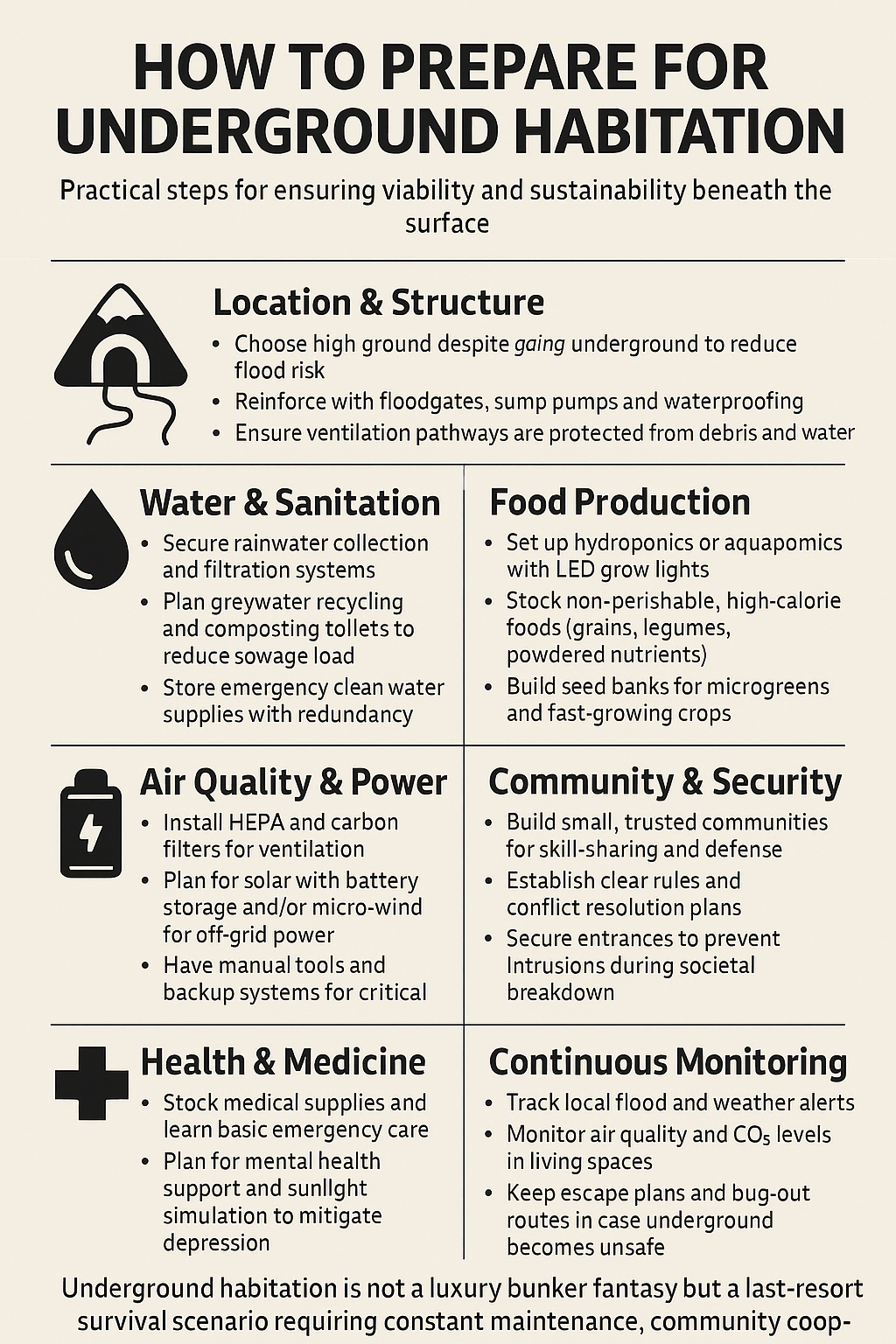
How to Prepare for Underground Habitation

 Location & Structure

  • Choose high ground despite going underground to reduce flood risk.

  • Reinforce with floodgates, sump pumps, and waterproofing.

  • Ensure ventilation pathways are protected from debris and water.

Water & Sanitation

  • Secure rainwater collection and filtration systems.

  • Plan greywater recycling and composting toilets to reduce sewage load.

  • Store emergency clean water supplies with redundancy.

Food Production

  • Set up hydroponics or aquaponics with LED grow lights.

  • Stock non-perishable, high-calorie foods (grains, legumes, powdered nutrients).

  • Build seed banks for microgreens and fast-growing crops.

Air Quality & Power

  • Install HEPA and carbon filters for ventilation.

  • Plan for solar with battery storage and/or micro-wind for off-grid power.

  • Have manual tools and backup systems for critical needs.

 Community & Security

  • Build small, trusted communities for skill-sharing and defense.

  • Establish clear rules and conflict resolution plans.

  • Secure entrances to prevent intrusions during societal breakdown.

Health & Medicine

  • Stock medical supplies and learn basic emergency care.

  • Plan for mental health support and sunlight simulation to mitigate depression.

  • Maintain physical fitness to handle manual labor and emergencies.

Continuous Monitoring

  • Track local flood and weather alerts.

  • Monitor air quality and CO2 levels in living spaces.

  • Keep escape plans and bug-out routes in case underground becomes unsafe.

Remember:
Underground habitation is not a luxury bunker fantasy; it is a last-resort survival scenario requiring constant maintenance, community cooperation, and adaptability in a rapidly collapsing climate system.


Underground Living Guide

Underground Living Guide

The Human Induced Climate Change Experiment

bookmark_borderTrump’s “Big and Brutally Ugly Bill” Triggers Fossil Fuel Expansion, Ends Solar and Wind Support, and Risks Climate, Economic, and Infrastructure Collapse

by Daniel Brouse
July 4, 2025

President Donald Trump’s One Big Beautiful Bill Act marks a seismic shift in U.S. energy, climate, and economic policy, ending decades of federal support for solar and wind while unleashing a massive expansion of oil, gas, and coal production.

The House passed the megabill on Thursday following a narrow Senate approval on Tuesday, after Trump set a hard deadline to clear the bill before the July recess. It is set to be signed into law today, July 4, 2025.

Fossil Fuels Win, Renewable Energy Loses

Trump’s priorities are clear: the U.S. will double down on fossil fuels to meet its energy needs while dismantling renewable energy progress. In a Fox News interview on June 29, Trump stated:

“I don’t want windmills destroying our place. I don’t want these solar things where they go for miles and they cover up a half a mountain that are ugly as hell.”

The law delivers nearly every wish of the oil and gas sector, as noted by Mike Sommers, president of the American Petroleum Institute:

“This bill will be the most transformational legislation that we’ve seen in decades in terms of access to both federal lands and federal waters. It includes almost all of our priorities.”

The act:

  • Ends tax credits and subsidies for solar and wind that fueled their exponential growth.

  • Mandates 30 offshore oil and gas lease sales in the Gulf of Mexico over 15 years.

  • Requires over 30 lease sales annually on public lands across nine states, expanding into Alaska.

  • Slashes royalties paid by fossil fuel producers for drilling on federal lands, incentivizing increased extraction.

Climate Consequences: A System in Nonlinear Collapse

The timing of this fossil fuel expansion could not be worse. As a climate scientist and economist, I can confirm the climate system is in a state of nonlinear acceleration:

  • The shrinking climate doubling period means climate impacts are arriving exponentially faster than models previously predicted.

  • The collapse of the Atlantic Meridional Overturning Circulation (AMOC) is weakening the jet stream, fueling persistent deadly heatwaves, floods, and tornadoes across North America.

  • Sudden Stratospheric Warming (SSW) and Rossby wave disruptions are destabilizing weather systems, making extreme weather the norm.

  • The expansion of fossil fuel burning increases atmospheric CO₂, while low-level ozone pollution reduces plants’ ability to capture CO₂ by up to 30%, worsening the crisis.

Meanwhile, stratospheric ozone depletion from reentering low orbit satellites threatens to further destabilize the polar vortex, increasing the frequency and severity of extreme weather events.

Economic and Infrastructure Backfire

This fossil fuel push aligns with fiscal policies that are already backfiring:

  • The dollar has experienced its worst performance in 40 years, undermining U.S. global economic stability.

  • PMI data reveals contracting U.S. manufacturing and the slowest services growth in a year, indicating a weakening economic foundation.

  • U.S. infrastructure is collapsing under the weight of climate-fueled extreme weather, with roads, bridges, and grids failing amid rising repair costs and insurance market collapse.

Trump’s policies risk accelerating fiscal collapse before climate collapse, or vice versa—either outcome will dismantle the illusion of U.S. exceptionalism.

Ignoring the Warning Signs

By prioritizing short-term fossil fuel profits over systemic risk management, the “One Big Beautiful Bill” ignores overwhelming evidence:

  • More fossil fuel burning will increase deadly wet-bulb temperatures, leading to mass mortality during humid heatwaves.

  • Expanding extraction accelerates feedback loops between brown carbon, wildfires, lightning, and permafrost melt, creating uncontrollable global warming.

  • Climate extremes are already causing uninsurable zip codes in Florida, California, and coastal states, with entire property markets on the verge of collapse.

Conclusion: A Short-Sighted Gamble

Trump’s “One Big Beautiful Bill” is not a strategy for energy independence; it is a short-sighted gamble that trades long-term planetary and economic stability for the illusion of short-term gains.

If the U.S. wants to remain globally competitive while safeguarding human life, it must align energy, fiscal, and infrastructure policies with climate-integrated risk management, as leaders like NOAA’s Sarah Kapnick advocate. Anything less will accelerate the collapse of both the climate system and the economy, leaving future generations to pay the ultimate price for the fossil-fueled delusion of today.

The Great Race Against Time: Trump vs. Mother Nature

Trumpenomics: The Decline of the US

The Human Induced Climate Change Experiment

bookmark_borderThe Math Behind Sequential Tariffs

by Daniel Brouse
June 11, 2025

The math of sequential tariffs is both interesting and economically significant. The complexity adds to business uncertainty. For instance, to calculate the total duties on Chinese steel imports — subject to a combined 132.5% tariff rate — you can break it down like this:

Starting Point: A $100 shipment of Chinese steel
Step 1: Apply Section 301 Tariff (55%)
55% of $100 = $55

New subtotal: $100 + $55 = $155

Step 2: Apply Section 232 Steel Tariff (50%)
50% of $155 = $77.50

New subtotal: $155 + $77.50 = $232.50

Final Import Cost: $232.50

Summary:
Description Amount
Original Invoice Value $100.00
Total Tariffs Paid $132.50
Effective Tariff Rate 132.5%

Would the sequential tariffs on steel and aluminum apply to washers and dryers made in China?

Washers and dryers made in China do face stacked tariffs, but not all of the same ones that apply to steel and aluminum. Instead, they’re subject to a specific tariff framework that includes:

1. Section 201 Safeguard Tariff
Specifically targets large residential washers (like top-load/front-load machines).

Originally 20% tariff in 2018, phased down over time — but was reimposed and increased in 2025 under Trump’s new trade policy.

Current estimate: 20%–30% depending on category.

2. Section 301 Tariff (China-specific)
As of June 2025: 55% total (25% original + 20% fentanyl-related + 10% universal tariff).

Applies to most appliances and electronics imported from China.

3. Section 232 (Steel & Aluminum) Tariff
Only applies to raw materials or unfinished parts, not finished consumer goods like assembled washers/dryers.

However, if imported as parts or unfinished assemblies, Section 232 may apply.

4. Universal 10% Tariff
Included in the 55% Section 301 total, not double-counted.

Applies to all imports, including appliances.

Example Calculation: Chinese Washer ($100 FOB value)
Let’s assume:
It qualifies as a large residential washer
No exclusions or exemptions apply

Step 1: Apply Section 201 Tariff (25%)
25% of $100 = $25

Subtotal = $125

Step 2: Apply Section 301 Tariff (55%)
55% of $125 = $68.75

Subtotal = $193.75

Final Import Cost = $193.75
Result Summary
Description Amount
Original Value $100.00
Section 201 Tariff $25.00
Section 301 Tariff $68.75
Total Tariffs Paid $93.75
Effective Tariff Rate 93.75%

Additional Notes
Dryers (not washers) may not fall under Section 201 but still face the full 55% Section 301 tariff.

Steel/aluminum content inside these appliances does not trigger Section 232 if the item is fully assembled.

The HS classification code used by U.S. Customs determines which tariff layers apply.

What would the sequential tariff be on a BYD electric vehicle?

Section 301 (China-specific, EV-focused)
Initially 27.5% (Trump era) and raised to 100% under Biden on May 14, 2024

Section 232 (Auto Tariff)
A 25% steel/aluminum tariff also applies to vehicles and parts imported from China, enacted April 3, 2025 under Section 232

Universal 10% Tariff
Part of the broader Section 301 package or standalone under “reciprocal” policy. Likely factored, but could stack separately

Sequential Tariff Calculation – Hypothetical $30,000 BYD EV
Step 1: Section 301 – 100%
$30,000 × 100% = +$30,000 → Subtotal: $60,000

Step 2: Section 232 – 25% on New Subtotal
$60,000 × 25% = +$15,000 → Subtotal: $75,000

Step 3: Universal 10% Tariff
$75,000 × 10% = +$7,500 → Final Cost: $82,500

Final Tallies
Tariff Component Rate Amount
Original Vehicle Price – $30,000
Section 301 Duty 100% $30,000
Section 232 Duty 25% $15,000
Universal Tariff (est.) 10% $7,500
Total Duties Paid – $52,500
Effective Tariff Rate – 175%

Conclusion
The examples above demonstrate how sequential tariffs can significantly inflate the final cost of imported goods—sometimes more than doubling or tripling the original price. While these tariffs are often justified as tools for protecting national industries or pressuring foreign governments, their economic consequences are far-reaching. Tariffs act as a regressive tax, disproportionately impacting lower-income consumers who spend a higher share of their income on goods affected by price hikes. They also introduce business uncertainty, discourage investment, and strain global supply chains. Perhaps most damaging in the long term, the increasing use of unilateral and stacked tariffs undermines the United States’ credibility as a reliable trading partner, encouraging allies and rivals alike to pursue trade relationships elsewhere. As trade policy becomes more complex and politically charged, understanding the math—and the unintended consequences—of sequential tariffs is more important than ever.

Trumpenomics: The Decline of the US

bookmark_borderThe Race Against Time: Climate Crisis vs. the United States

by Daniel Brouse
April 12, 2025

Abstract
Humanity stands at a historic crossroads where the accelerating pace of climate change threatens to overtake both our capacity for response and the viability of the global economic system itself. Recent models indicate that without immediate intervention, climate change could cause the collapse of capitalism as we know it—potentially as soon as 2050. At the same time, U.S. political developments—particularly Trump-era trade, fiscal, and environmental policies—may unintentionally hasten this collapse. The central question becomes: Will the U.S. economic system implode before climate change forces its hand, or has irreversible damage already been done?

I. Climate Change: From Hypothesis to Imminent Catastrophe

In the 1990s, we proposed a hypothesis: that climate change would not follow a linear trajectory but would instead accelerate non-linearly—driven by feedback loops such as polar ice melt, permafrost thaw, ocean acidification, and carbon release from soil and forests. Over the following decades, this hypothesis evolved into an established scientific theory, now widely accepted by the international scientific community.

Through collaboration with a physicist from Ohio State University, we observed a startling trend in the “doubling time” of climate impacts. Originally pegged at around 100 years, this timeframe has since shrunk to 10 years, and now—alarmingly—approaches just 2. That means climate-related damages could be 64 times worse a decade from now than they are today. These aren’t worst-case scenarios; they are conservative models assuming no further acceleration.

Our latest models integrate not only geophysical systems but also social, political, and economic feedback loops. The results are grim: we now forecast a potential 9°C rise in global temperatures within this century—a rate that would make much of the planet uninhabitable and render large-scale human migration and system failure unavoidable.

II. A New Threat Emerges: Trumpenomics and the War on Global Stability

Ironically, the Trump administration—through its aggressive trade, credit, and isolationist policies—has accelerated the very breakdown of capitalism that climate change is expected to cause.

The imposition of widespread tariffs, especially those based on falsified “reciprocal” trade deficits, has triggered not just a trade war, but a credit war. This combination has never before been tested in modern economic history. During Trump’s first term, the stage was set. Now, in his second term, the global economy is being subjected to a real-time, uncontrolled experiment.

The administration’s “drill, baby, drill” energy policy, paired with unprecedented regulatory rollbacks, has only deepened the climate crisis. Yet, from an economic systems perspective, it is the trade and credit dislocations that may deliver the first major blow.

III. Global Trade, Capital Flows, and the Liquidity Death Spiral

Most people think of tariffs as mere taxes on goods. But in today’s complex financial system, their impact extends far beyond the shipping yard.

When the U.S. imports less, foreign exporters earn fewer dollars. This reduces their ability to invest in U.S. Treasuries—the bedrock of the global financial system. As demand for Treasuries falls, yields rise, borrowing costs spike, and credit conditions tighten. This sets off a self-reinforcing liquidity crisis, undermining everything from consumer lending to corporate investment.

The risk is real and growing: a scenario where the U.S. dollar loses its global reserve status is no longer the stuff of academic theory. Should this occur, the fallout would include:

  • Exploding U.S. borrowing costs

  • A collapse in consumer purchasing power

  • Capital flight from U.S. markets

  • Severe contraction in both trade and credit

  • Domestic political and social unrest on a scale not seen in modern history

IV. The Tipping Point: Will Climate Collapse or Economic Collapse Win the Race?

The economic trajectory of the U.S. under Trump’s policies suggests that a post-capitalist transition may be triggered by domestic fiscal instability rather than climate catastrophe alone. In other words, the United States may be the first nation to economically implode under the dual weight of environmental and self-inflicted economic collapse.

Complicating matters, the U.S. is simultaneously dealing with aging infrastructure, mounting national debt, deteriorating public health, climate-related disasters, and rising political extremism—all of which erode resilience and reduce the chances of a coordinated national response.

This raises a chilling question: Will the collapse of the U.S. economy accelerate faster than climate change itself—or are we already too late to avoid either fate?

The U.S. dollar’s decline from global dominance — driven by unprecedented political dysfunction and fiscal recklessness — is unraveling the myth of American exceptionalism. Once the cornerstone of international finance, the United States now risks becoming a net liability to the world economy. Paradoxically, this economic unraveling may carry a sliver of hope. If Trump’s economic collapse marks the end of mass consumption, over-leveraged capitalism, and fossil fuel dependency, it could trigger a sharp drop in global emissions and slow the pace of climate change. Such a forced degrowth scenario–where contraction curbs carbon output–might buy humanity precious time to adapt, innovate, and survive. But this path would come at a steep cost: to livelihoods, political stability, and America’s standing in the world.

Conclusion: What Comes After?

Regardless of which crisis arrives first, one outcome is increasingly likely: the U.S. standard of living will fall sharply, and life expectancy may follow. Whether that post-collapse society can still be sustainable—or even enjoyable—will depend on the decisions we make in the next few years.

Our only hope is to treat this as a true “race against time” and respond with urgency, humility, and collective will. The future depends not just on science and economics, but on whether we can choose survival over ideology, cooperation over conflict, and truth over convenience.

The Human Induced Climate Change Experiment

bookmark_borderHow Tariffs on Guitars and Pianos Could Impact the Next Generation of Musicians

by Daniel Brouse
April 3, 2025

An economist just referenced Little Richard to illustrate how tariffs might impact young musicians. Little Richard, known for his energetic vocals and piano playing, also had a band called “The Upsetters,” and while he wasn’t primarily a guitarist, he had notable guitarists in his band, including Jimi Hendrix. Due to tariffs on guitars, the next “Little Richard Band” may not be able to afford a starter instrument, potentially depriving future generations of groundbreaking artists.

The new tariffs will significantly impact the price of pianos, depending on their country of origin and the materials used in their construction. Many pianos, especially more affordable models, are imported from China, and if tariffs are imposed on Chinese-made pianos or parts, the price for consumers could rise. With the proposed tariffs on China totaling up to 114%, the cost of Chinese-made pianos could increase substantially. Additionally, pianos from countries like Japan, South Korea, and Indonesia face substantial tariff increases. Additionally, labor shortages and increased shipping costs resulting from tariffs on freight could further drive up piano prices. Retaliatory tariffs from other countries could disrupt the supply chain for piano parts or finished products, potentially making American-made pianos more expensive. It’s likely that both imported and domestically produced pianos could become much more expensive due to these tariffs.

The imposition of tariffs on countries that supply musical instruments and their components—particularly China, Canada, Mexico, and the EU—along with tariffs on wood, metal, and electronics, raises production costs for manufacturers, resulting in higher retail prices for consumers, including for starter guitars and other musical instruments. The combined taxes could exceed 100%, potentially leading to a halt in imports of more affordable instruments. This, in turn, would make it harder for young musicians to access the tools they need to start their musical journey, potentially limiting the next generation of groundbreaking artists.


Trump’s Sector-Specific Tariffs

Trumpenomics: The Decline of the US

bookmark_borderTrump Economic Facts

Amazingly, some still suffer from Trump Delusionment Syndrome, defending his economic policies while claiming Biden ‘destroyed the economy’ or insisting that Trump needs to ‘break some eggs’ to bake a cake—meaning we need to endure pain. No, we don’t need pain. The economy performed the best in history during Biden’s term, in sharp contrast to both Trump 1.0 and the early signs of Trump 2.0.

Let’s look at the numbers: During Trump’s first term (2017–2021), the national debt increased by about $7.8 trillion, mainly due to tax cuts that didn’t pay for themselves and pandemic-related spending. Under Biden (2021–2025), the debt rose by about $6.3 trillion—but a significant portion of that came from legislation and tax policies enacted under Trump.

Now, three months into Trump’s second term (2025–2029), debt projections are looking even worse. Estimates suggest Trump 2.0 will add an additional $10 trillion, driven by an extension of his tax cuts and increasing deficits. By the end of Trump 2.0, Trump will have added more to the national debt than all Democratic presidents combined.

So if debt is your concern, you might want to rethink which administration is actually running up the tab. On the other hand, if you’re talking about GDP, we are currently experiencing the sharpest decline since Trump’s last term—when he oversaw the fastest economic contraction in U.S. history.

Protectionism is one of the worst economic policies. Tariffs are regressive taxes that disproportionately harm marginalized communities while failing to boost the economy or reduce the deficit. The last time a president imposed broad tariffs, it contributed to the Great Depression—a global economic catastrophe that took decades to recover from and provided no lasting benefits to society.

Trumpenomics: The Decline of the US