Climate change is often discussed as a problem of emissions, but emissions are the result of two interconnected forces: consumption and production.
Q: What are the greatest drivers of climate change? A: Consumption and production.
At present, I would rank our addiction to consumption and ecofascism as the two most significant drivers of the climate crisis. While they operate in different ways, both reinforce the systems that accelerate environmental degradation.
The Consumption Problem
The United States, Western Europe, Canada, and Australia represent some of the world’s most consumption-driven economies. When self-interest, materialism, and short-term economic incentives dominate decision-making, consumer demand becomes one of the primary drivers of climate change, influencing not only greenhouse gas emissions but also land-use change, deforestation, habitat destruction, water consumption, resource depletion, and biodiversity loss.
This is why consumption-based accounting provides a more accurate picture of climate responsibility than production-based accounting alone.
For example, if a smartphone is manufactured in Asia using coal-generated electricity and then shipped across the Pacific to a consumer in Los Angeles, the emissions from mining, manufacturing, transportation, and delivery are ultimately driven by the purchasing decision. Under consumption-based accounting, those emissions are attributed to the American consumer rather than solely to the country where the phone was manufactured.
Read the full explanation and view the rankings here:
The production side of the equation is likewise influenced by self-interest and economic incentives, but it is also shaped by ideological movements that obstruct effective climate action.
Two distinct, though sometimes overlapping, ideologies are particularly important:
Denialism is characterized by the rejection of scientific evidence, refusal to engage with empirical data, and reliance on misinformation or rhetorical distraction. Its primary objective is often the protection of political, ideological, or economic interests by undermining the scientific consensus.
Ecofascism combines elements of denialism with authoritarian, exclusionary, or extremist beliefs. In its most extreme forms, it portrays environmental collapse as acceptable—or even desirable—because it is viewed as reducing populations or preserving resources for groups considered more deserving than others. This ideology has historically been associated with racist, xenophobic, or eugenicist beliefs and rejects principles of equality and shared human responsibility.
The distinction is important. Traditional denialism primarily seeks to delay or prevent climate policy. Ecofascism goes further by framing unequal human survival as an acceptable or even desirable outcome — eliminationist logic.
Why This Matters
Climate change is not simply a technological or economic challenge. It is also a question of values.
On one side, excessive consumption drives demand for fossil fuels, resource extraction, and emissions. On the other, ideologies that reject science or rationalize unequal human suffering weaken society’s ability to respond effectively to the crisis.
Both sides must be addressed if meaningful progress is to be made.
Further Reading
While investigating climate change denialism, I examined material that I believe illustrates the intersection between denialist narratives and extremist environmental ideologies. A summary of that research is available here:
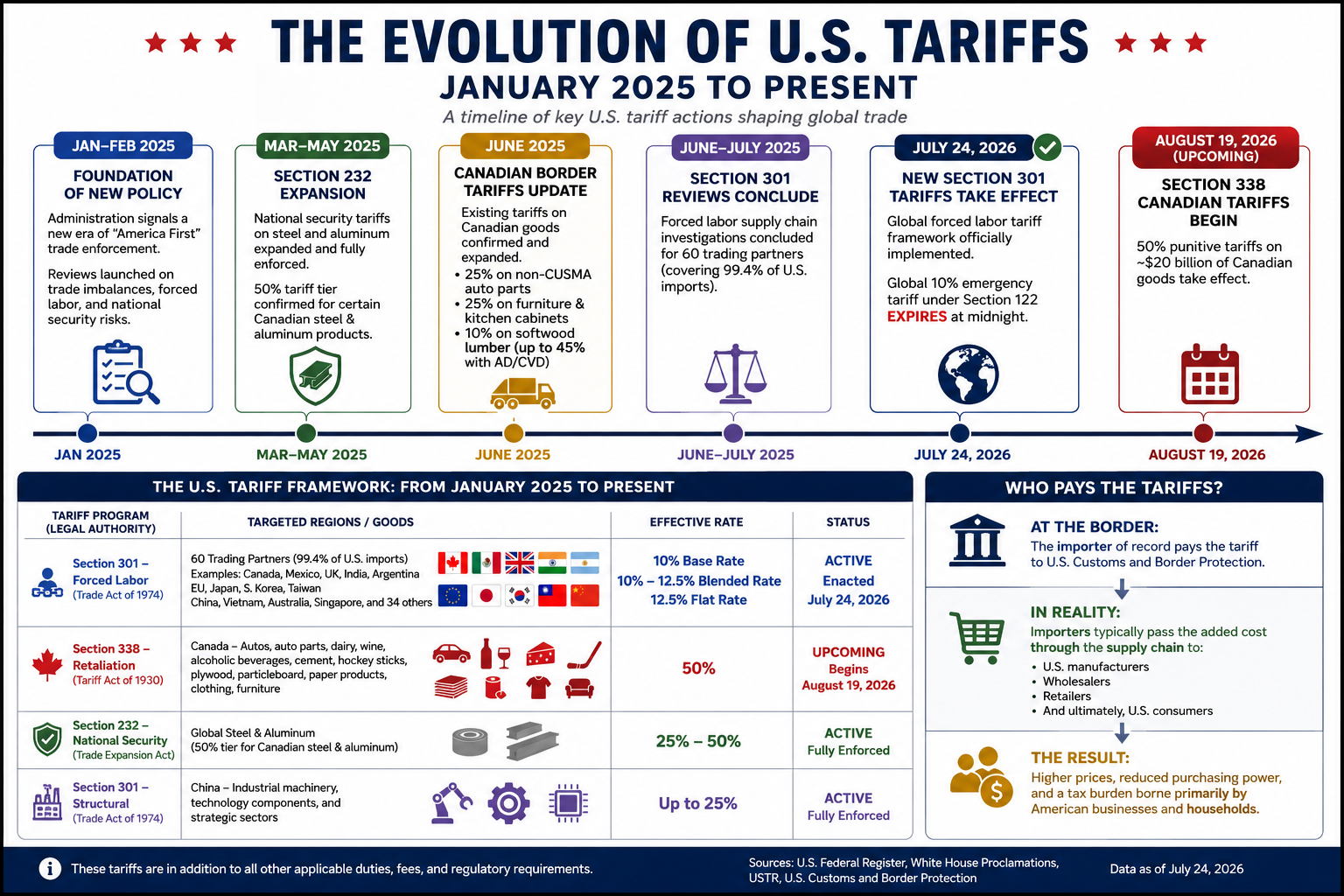
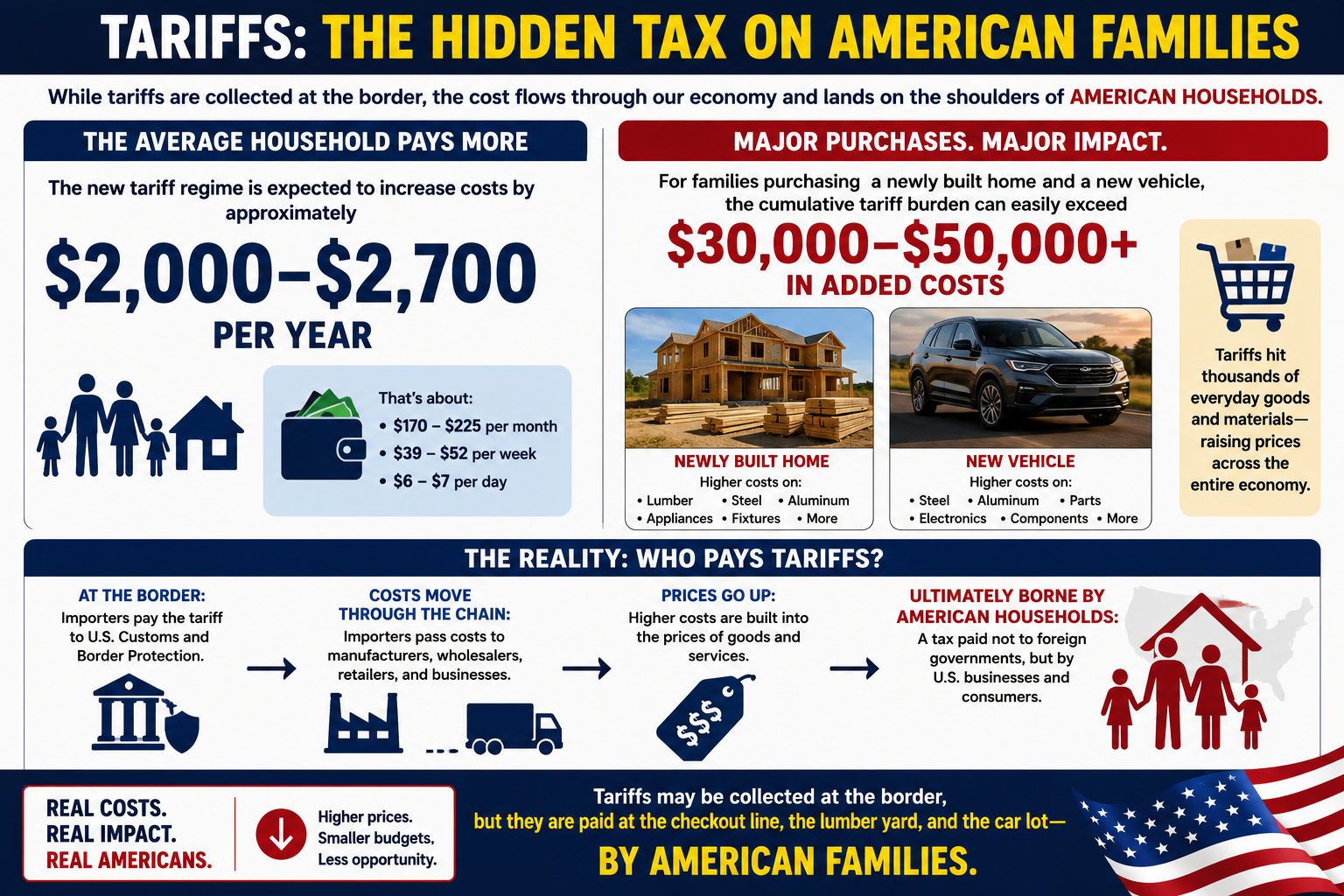
The latest U.S. tariff framework is now in place, and while tariffs are collected at the border, it’s American families who ultimately pay most of the bill.
📊 Highlights: • Average household: +$2,000–$2,700 per year • Buying a new home and a new car? The added cost from tariffs on steel, aluminum, lumber, vehicles, appliances, and other goods could exceed $30,000–$50,000. • New tariffs now cover nearly 99.4% of U.S. imports from 60 trading partners, while additional 50% tariffs on many Canadian products are scheduled to begin in August.
The article explains what changed, which goods are affected, who legally pays the tariff, and who ultimately bears the economic burden.
Read the full analysis and decide for yourself: Are tariffs protecting American industry, or are they becoming one of the largest hidden taxes on American consumers?
Effective July 24, 2026, the United States implemented a new tariff regime targeting imports from approximately 60 trading partners, representing 99.4% of all U.S. imports. The tariffs are based on supply-chain forced labor investigations.
Tariff Rates
10% Base Rate
Canada
Mexico
United Kingdom
India
Argentina
10%–12.5% Blended Rate
European Union
Japan
South Korea
Taiwan
12.5% Flat Rate
China
Vietnam
Australia
Singapore
34 additional economies under investigation
Exemptions
Several strategically important commodities remain exempt, including:
Crude oil
Natural gas
Fertilizer
Selected primary food products
These tariffs also do not stack with existing Section 232 national security duties.
2. Upcoming Canadian Tariffs: Section 338
Beginning August 19, 2026, the United States is scheduled to impose 50% retaliatory tariffs on approximately $20 billion of Canadian imports under Section 338 of the Tariff Act of 1930.
Products Subject to the 50% Tariff
Dairy products
Wine and other alcoholic beverages
Automobiles
Auto parts
Cement
Hockey equipment
Plywood
Particleboard
Paper products
Clothing
Furniture
These tariffs bypass normal CUSMA (USMCA) preferential treatment.
Exemptions
The following Canadian exports are excluded:
Energy products
Potash
Fish
Critical minerals
3. Existing Tariffs That Remain in Effect
Several major tariff programs adopted during 2025 and 2026 continue unchanged.
Section 232 National Security Tariffs
These duties continue to apply to steel and aluminum imports, including tariffs reaching 50% on certain Canadian steel and aluminum products.
Existing Canadian Import Tariffs
Additional tariffs remain in place on:
25% on non-CUSMA-compliant auto parts
25% on upholstered furniture and kitchen cabinets
10% tariff on Canadian softwood lumber, with combined anti-dumping and countervailing duties pushing the effective rate to approximately 45%
Section 301 China Tariffs
Long-standing tariffs on Chinese imports also remain active, with rates reaching 25% on numerous products, including:
Industrial machinery
Technology equipment
Electronic components
Strategic manufacturing inputs
Current U.S. Tariff Framework
Tariff Program
Primary Target
Rate
Status
Section 301 – Forced Labor
60 trading partners
10%–12.5%
Active (July 24, 2026)
Section 338 – Canada
Autos, dairy, wine, cement, consumer goods
50%
Begins August 19, 2026
Section 232 – National Security
Steel & aluminum
25%–50%
Active
Section 301 – China
Industrial & technology products
Up to 25%
Active
Who Really Pays Tariffs?
Legally, tariffs are paid by the U.S. importer when goods enter the country through Customs and Border Protection.
Economically, however, that is only the beginning of the story.
Importers generally recover those additional costs by increasing the prices they charge wholesalers, retailers, manufacturers, and ultimately consumers. Numerous economic studies of recent U.S. tariffs have found that most of the cost is passed through to American businesses and households rather than absorbed by foreign exporters.
In some industries, foreign suppliers may reduce prices to remain competitive, meaning they share part of the burden. But the overall trade data and pricing evidence show that the majority of tariff costs are ultimately borne within the United States through higher prices, reduced business margins, or both.
In other words, while tariffs are collected at the border from importers, they function much like a domestic consumption tax. The final bill is usually paid by American businesses and consumers—not by foreign governments.
Conclusion
For the average American household, the new tariff regime is expected to increase costs by approximately $2,000–$2,700 per year. For families purchasing a newly built home and a new vehicle, the cumulative tariff burden can easily exceed $30,000–$50,000 through higher prices on construction materials, automobiles, appliances, and other imported goods. While tariffs are collected at the border from importers, they are ultimately borne by American businesses and consumers in the form of higher prices—a tax paid not to foreign governments, but by U.S. households.
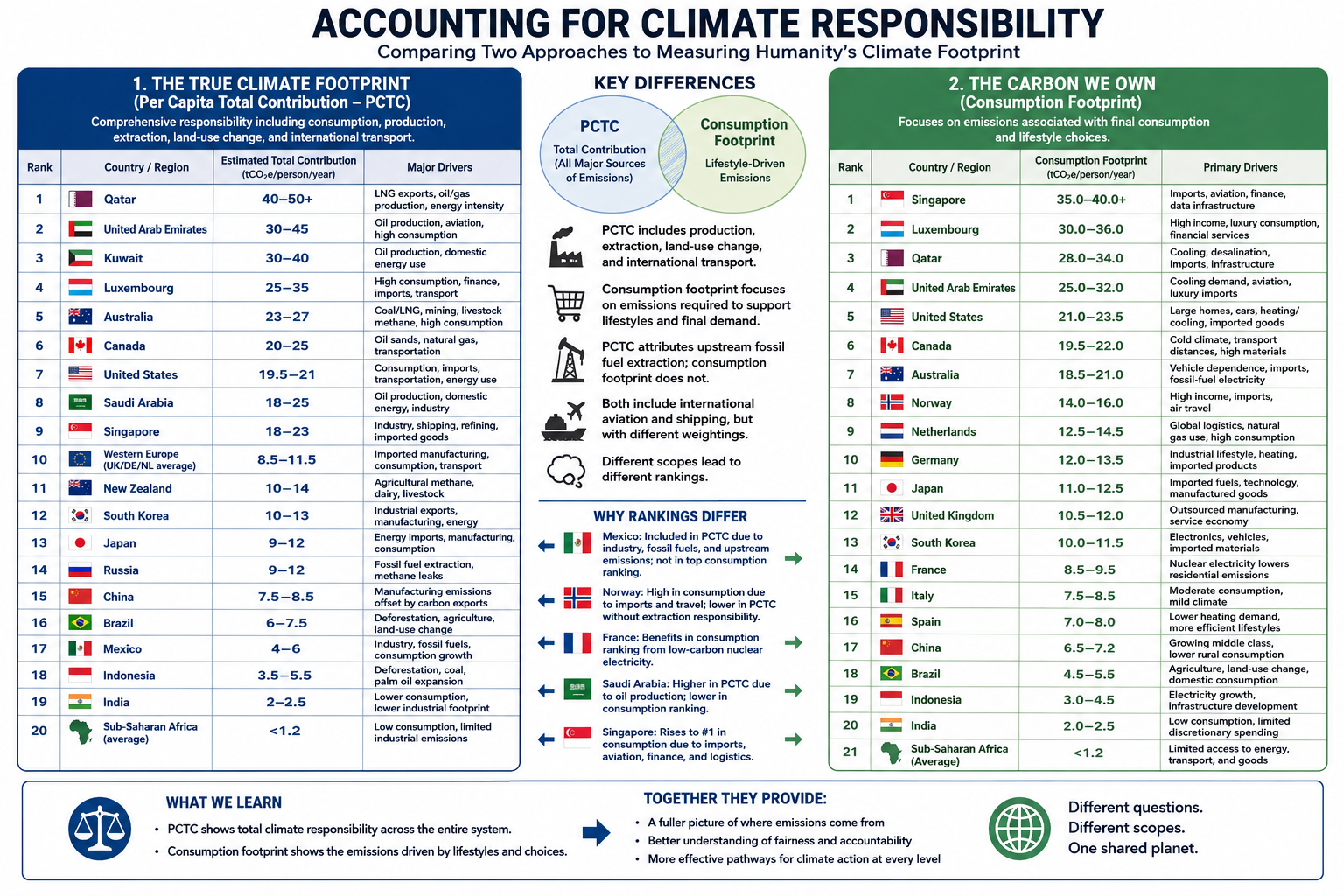
Comparing Two Approaches to Measuring Humanity’s Climate Footprint
Climate responsibility depends on how emissions are assigned. Traditional territorial accounting attributes emissions to the country where they occur, but globalization has made that approach increasingly incomplete. Modern supply chains, international trade, and service-based economies often separate where emissions are produced from who ultimately benefits from them.
To explore this problem from two different perspectives, I developed two complementary accounting frameworks.
The first paper, The True Climate Footprint: Measuring Per Capita Total Contribution Beyond Territorial Emissions, introduces the Per Capita Total Contribution (PCTC) framework. PCTC seeks to estimate an individual’s or nation’s complete climate responsibility by incorporating not only consumption, but also several major sources of emissions that are frequently omitted from conventional carbon accounting.
All major greenhouse gases (CO₂, CH₄, N₂O, and others expressed as CO₂-equivalent)
Responsibility associated with fossil fuel production where appropriate
The second paper, The Carbon We Own: Why Consumption Matters More, examines climate responsibility from a different perspective. Rather than estimating total climate contribution, it focuses specifically on the carbon footprint required to support modern lifestyles using a consumption-based accounting approach.
Unlike PCTC, this framework intentionally places less emphasis on fossil fuel extraction and producer responsibility in order to better isolate the climate impacts associated with everyday consumption.
After completing the first paper, I wanted to examine the climate footprint from the perspective of the consumer rather than the entire climate system. The PCTC framework provides a comprehensive measure of total responsibility, but it does not distinguish as clearly between emissions driven by individual lifestyle choices and those associated with resource extraction or national production.
A consumption-based framework highlights decisions that individuals and societies can influence more directly. Choices such as lowering a home’s thermostat, improving insulation, selecting public transportation or electric vehicles instead of internal combustion vehicles, reducing air travel, or purchasing fewer carbon-intensive goods become more visible within the accounting. It also better captures the increasingly important role of service-based economies. While services may appear less energy-intensive than manufacturing, sectors such as healthcare, finance, telecommunications, cloud computing, and artificial intelligence rely on extensive digital infrastructure—including energy-hungry data centers—that can be substantially underrepresented in traditional emissions inventories.
Finally, I wanted a more detailed comparison among developed economies, particularly within Europe. Countries such as Norway and France illustrate why accounting methodology matters. Norway has one of the world’s cleanest domestic electricity systems, powered primarily by hydropower, yet it is also a major exporter of oil and natural gas. France, by contrast, derives much of its electricity from nuclear power, resulting in comparatively low-carbon domestic energy while maintaining a high standard of living. Comparing these countries under both frameworks reveals how different accounting methods assign responsibility and helps illustrate the strengths and limitations of each approach.
Taken together, these two papers do not compete—they answer different questions. Per Capita Total Contribution (PCTC) asks, What is humanity’s full climate responsibility?Consumption-based accounting asks, What emissions are required to sustain the lifestyle of the average resident? Used together, they provide a more complete understanding of climate responsibility than either framework alone.
Conclusion
Although The True Climate Footprint and The Carbon We Own both seek to improve upon traditional territorial emissions accounting, they answer different questions because they are built on different accounting frameworks.
The True Climate Footprint uses the Per Capita Total Contribution (PCTC) framework to estimate an individual’s or nation’s complete contribution to climate change. It extends beyond consumption to include land-use change, upstream fossil fuel extraction, international shipping and aviation, and the full spectrum of greenhouse gases. In some cases, it also attributes responsibility associated with fossil-fuel production, providing a broad measure of humanity’s total climate impact.
By contrast, The Carbon We Own focuses specifically on consumption-based climate responsibility. Using Multi-Regional Input-Output (MRIO) accounting, it assigns emissions to the final consumer by emphasizing direct household energy use, embedded emissions in imported goods, services, and lifestyle choices. It intentionally deemphasizes extraction and producer responsibility in order to better represent the carbon footprint required to sustain modern patterns of consumption.
Because these frameworks measure different aspects of climate responsibility, their rankings are not expected to be identical.
Mexico provides a useful illustration. Under the PCTC framework, Mexico’s estimated footprint includes domestic industry, fossil fuel production, growing consumption, and upstream emissions, resulting in an estimated contribution of approximately 4–6 tonnes of CO₂-equivalent per person per year. In the consumption-based analysis, however, Mexico does not appear among the highest-ranking countries because the focus is limited to end-user consumption, and the published rankings emphasize the world’s largest per-capita consumption footprints.
Similar differences appear elsewhere. Norway’s position changes substantially because one framework incorporates the climate responsibility associated with fossil fuel production, while the other emphasizes domestic consumption. France benefits in the consumption-based analysis because its low-carbon nuclear electricity reduces household emissions despite maintaining a high standard of living. Saudi Arabia ranks differently depending on whether responsibility is assigned to oil production or to energy consumption. Singapore rises dramatically under consumption accounting because imported goods, international aviation, finance, logistics, and digital infrastructure contribute heavily to its consumption footprint despite relatively limited domestic manufacturing.
These examples demonstrate that accounting methodology influences how climate responsibility is distributed. Production-based, consumption-based, and total-contribution frameworks each illuminate different dimensions of the global climate system.
Rather than viewing these approaches as competing methodologies, they should be regarded as complementary analytical tools. The Per Capita Total Contribution (PCTC) framework asks, What is a nation’s or individual’s total contribution to climate change? The consumption-based framework asks, What emissions are required to sustain the average resident’s lifestyle? Together, they provide a more complete understanding of climate responsibility than either approach can achieve alone, revealing both the systemic impacts of resource production and the powerful role of consumer demand in shaping the global climate.
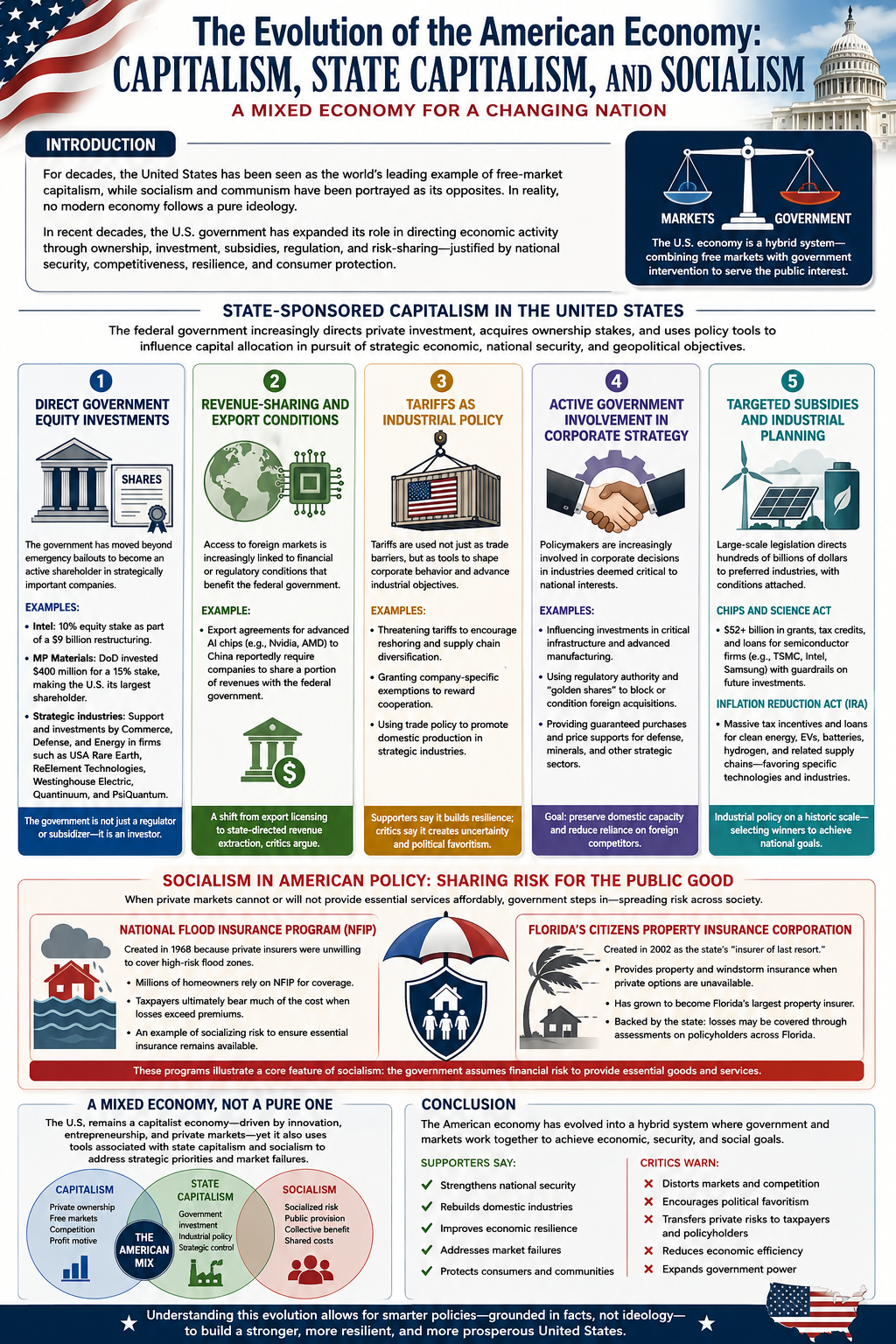
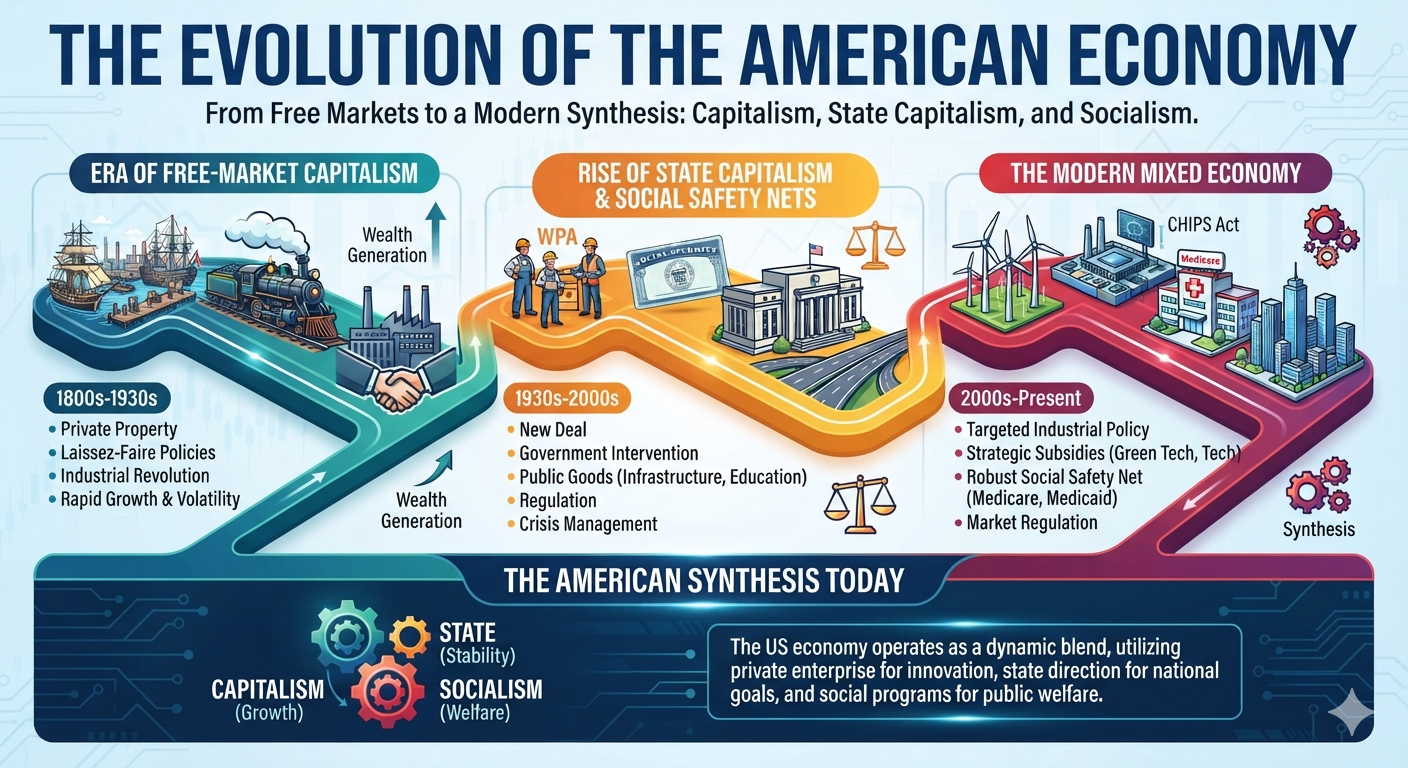
For much of its history, the United States has been portrayed as the world’s leading example of free-market capitalism, while socialism and communism have often been presented as fundamentally incompatible with American economic principles. In reality, no modern economy operates as a pure ideological model. Instead, governments continually adapt their economic policies in response to war, financial crises, technological competition, natural disasters, and changing national priorities.
Over the past several decades—and especially in recent years—the United States has significantly expanded the role of government in directing economic activity. Federal and state governments now provide targeted subsidies, acquire ownership stakes in private companies, shape investment decisions, guarantee markets for strategic industries, and assume financial risks that private markets are unwilling to bear. These policies are generally justified on the grounds of national security, economic competitiveness, supply-chain resilience, disaster recovery, or consumer protection.
This paper examines how these policies reflect characteristics traditionally associated with state-sponsored capitalism and socialism. Rather than arguing that the United States has abandoned capitalism, it demonstrates how the American economy has evolved into a hybrid system that combines free markets with substantial government intervention. Understanding this evolution provides important context for evaluating current economic policy and the changing relationship between government and private enterprise.
State-Sponsored Capitalism in the United States
State-sponsored capitalism (also called state capitalism) refers to an economic system in which the government plays an increasingly active role in directing private investment, acquiring ownership stakes in companies, or using public policy to influence capital allocation in pursuit of strategic economic, national security, or geopolitical objectives.
In recent years, the United States has moved further toward this model. While market mechanisms remain the foundation of the U.S. economy, successive administrations have expanded the federal government’s role through direct investments, industrial policy, subsidies, export controls, tariffs, and other forms of intervention designed to strengthen domestic manufacturing, secure critical supply chains, and enhance national competitiveness.
The principal mechanisms through which the federal government has pursued state-sponsored capitalism include the following:
1. Direct Government Equity Investments
Historically, federal ownership of private corporations was generally limited to temporary emergency bailouts. More recently, however, the government has begun acquiring direct equity positions in strategically important companies.
Examples include:
Intel: The federal government obtained a 10% equity stake in Intel as part of a restructuring package that included approximately $9 billion in federal support.
MP Materials: The Department of Defense invested approximately $400 million to acquire a 15% ownership stake in MP Materials, making the federal government its largest shareholder while supporting domestic rare-earth mineral production.
Strategic Industries: Federal agencies, including the Departments of Commerce, Defense, and Energy, have supported or invested in companies involved in critical technologies and infrastructure, including USA Rare Earth, ReElement Technologies, Westinghouse Electric Corporation, Quantinuum, and PsiQuantum.
These investments represent a notable departure from traditional industrial policy by making the government not only a regulator and subsidizer, but also an investor.
2. Revenue-Sharing and Export Conditions
The federal government has increasingly linked access to export markets with financial or regulatory conditions.
One example is the export framework governing advanced artificial intelligence chips. Agreements allowing companies such as Nvidia and AMD to export certain AI processors to China have reportedly included provisions requiring companies to share a portion of the resulting revenues with the federal government. Critics, including analysts at the Cato Institute, argue that this approach resembles state-directed revenue extraction rather than conventional export licensing.
3. Tariffs as Industrial Policy
Tariffs have become an increasingly important instrument of industrial strategy.
Rather than functioning solely as broad trade barriers, tariffs have also been used to influence corporate behavior.
Examples include:
Threatening tariffs to encourage companies to relocate manufacturing or diversify supply chains.
Granting company-specific exemptions or adjustments that reward firms aligning with national industrial objectives.
Using trade policy to encourage domestic production in strategically important industries.
Supporters argue these measures strengthen national resilience, while critics contend they increase uncertainty and allow greater political influence over private investment decisions.
4. Active Government Involvement in Corporate Strategy
Federal policymakers have become increasingly involved in major corporate decisions affecting industries considered strategically important.
Examples include:
Influencing investment decisions involving critical infrastructure and advanced manufacturing.
Exercising regulatory authority to discourage foreign acquisitions of strategically important companies.
Employing “golden share” mechanisms or comparable government veto powers in selected transactions involving national security interests.
Providing guaranteed purchase agreements or price supports for defense-related technologies, critical minerals, and other strategic industries.
These policies seek to preserve domestic industrial capacity while reducing dependence on foreign suppliers.
5. Targeted Subsidies and Industrial Planning
The expansion of state involvement did not begin with direct government ownership. Earlier legislation established a broad framework for government-directed industrial policy through grants, tax incentives, loans, and regulatory requirements.
The CHIPS and Science Act
The CHIPS and Science Act committed more than $52 billion in grants, tax credits, and loan guarantees to expand domestic semiconductor manufacturing. Major beneficiaries include Intel, TSMC, Samsung, and other semiconductor producers.
Recipients were also subject to “guardrail” provisions limiting certain future investments in countries considered strategic competitors.
The Inflation Reduction Act (IRA)
The Inflation Reduction Act created extensive tax credits, grants, and financing mechanisms supporting renewable energy, electric vehicles, battery manufacturing, hydrogen production, and related supply chains.
The legislation represents one of the largest industrial policy initiatives in U.S. history, directing hundreds of billions of dollars toward technologies identified by policymakers as priorities for the energy transition.
A New Economic Model?
Taken together, these policies illustrate a significant evolution in the relationship between the federal government and private enterprise. Rather than relying primarily on market incentives and regulatory oversight, the government has increasingly acted as investor, financier, customer, shareholder, trade negotiator, and strategic planner.
Supporters argue that these interventions are necessary to compete with state-directed economies such as China, strengthen national security, rebuild domestic manufacturing, and secure critical supply chains.
Critics counter that expanding government ownership, selective subsidies, preferential treatment, and direct intervention in private markets blur the traditional distinction between free-market capitalism and state-sponsored capitalism. They warn that such policies may distort competition, encourage political favoritism, and reduce market efficiency.
Whether viewed as a pragmatic response to global competition or a fundamental shift in American economic philosophy, the growing role of the federal government in directing private capital represents one of the most consequential developments in U.S. economic policy in decades.
Socialism
One characteristic commonly associated with socialism is the government assuming responsibility for providing goods or services that private markets are unable or unwilling to provide. In these cases, financial risks and costs are shared across society through taxes, mandatory assessments, or publicly backed insurance programs.
The U.S. insurance industry provides several examples of this approach.
The National Flood Insurance Program (NFIP)
The National Flood Insurance Program (NFIP), administered by the Federal Emergency Management Agency (FEMA), was established in 1968 because private insurers were largely unwilling to provide affordable flood insurance in many high-risk areas.
Rather than leaving homeowners without coverage, the federal government assumed much of the financial risk. Today, millions of property owners purchase flood insurance through the NFIP, with taxpayers ultimately bearing a substantial portion of catastrophic losses when claims exceed collected premiums. The program illustrates how the government has socialized a specific category of insurance risk that the private market has historically struggled to insure profitably.
Florida’s Citizens Property Insurance Corporation
Florida provides one of the clearest state-level examples of government intervention in insurance markets.
The Citizens Property Insurance Corporation was created by the Florida Legislature in 2002 as a government-established, not-for-profit insurer intended to serve as the state’s “insurer of last resort.” Its purpose is to provide property and windstorm insurance for homeowners, condominium owners, renters, and businesses that cannot obtain comparable coverage from private insurers.
As hurricanes have become more destructive, litigation costs have risen, and many private insurers have reduced their exposure or exited the Florida market altogether, Citizens has expanded dramatically. What began as a safety net has evolved into Florida’s largest property insurer, covering well over one million policies.
Unlike a private insurance company operating solely for profit, Citizens is backed by the state. If claims substantially exceed its financial reserves, Florida law allows Citizens to levy assessments on many insurance policies throughout the state to help cover losses. In effect, the financial risk is spread broadly among policyholders rather than borne exclusively by the individual customers who file claims.
A Mixed Economic Model
Programs such as the National Flood Insurance Program and Citizens Property Insurance Corporation illustrate how the United States operates as a mixed economy rather than a purely laissez-faire capitalist system. When private markets fail to provide essential services at affordable prices, governments have often stepped in to provide financing, insurance, or direct support.
Supporters argue that these programs protect homeowners, stabilize housing markets, and ensure that essential insurance remains available despite increasing climate and catastrophe risks.
Critics contend that publicly backed insurance can distort market signals, encourage development in high-risk areas, and shift financial burdens from individual property owners to taxpayers or other policyholders.
Regardless of one’s perspective, these programs demonstrate that government assumption of economic risk—one characteristic often associated with socialist policies—has become an established component of the American insurance system while coexisting with a predominantly private-market economy.
Conclusion
The American economy has never been completely free of government intervention, but the scope and nature of that intervention have changed substantially over time. Today, federal and state governments influence private markets through direct ownership, industrial policy, targeted subsidies, publicly backed insurance programs, trade policy, regulatory oversight, and strategic investments. These policies increasingly resemble characteristics associated with state-sponsored capitalism, while programs such as federally backed flood insurance and state-run insurers illustrate elements commonly associated with socialized risk.
Supporters argue that these interventions strengthen national security, rebuild domestic manufacturing, improve economic resilience, and address market failures that private enterprise alone cannot solve. Critics contend that expanding government involvement can reduce market efficiency, distort competition, encourage political favoritism, and transfer private risks to taxpayers.
The United States remains a capitalist economy, but it is no longer accurately described as a purely laissez-faire one. Instead, it has evolved into a mixed economic system in which free markets coexist with significant government participation. Recognizing this reality allows for a more informed discussion of public policy—one based not on political labels, but on the practical ways governments and markets increasingly work together to shape economic outcomes.
Introduction: Climate Change as an Economic and Human Security Crisis
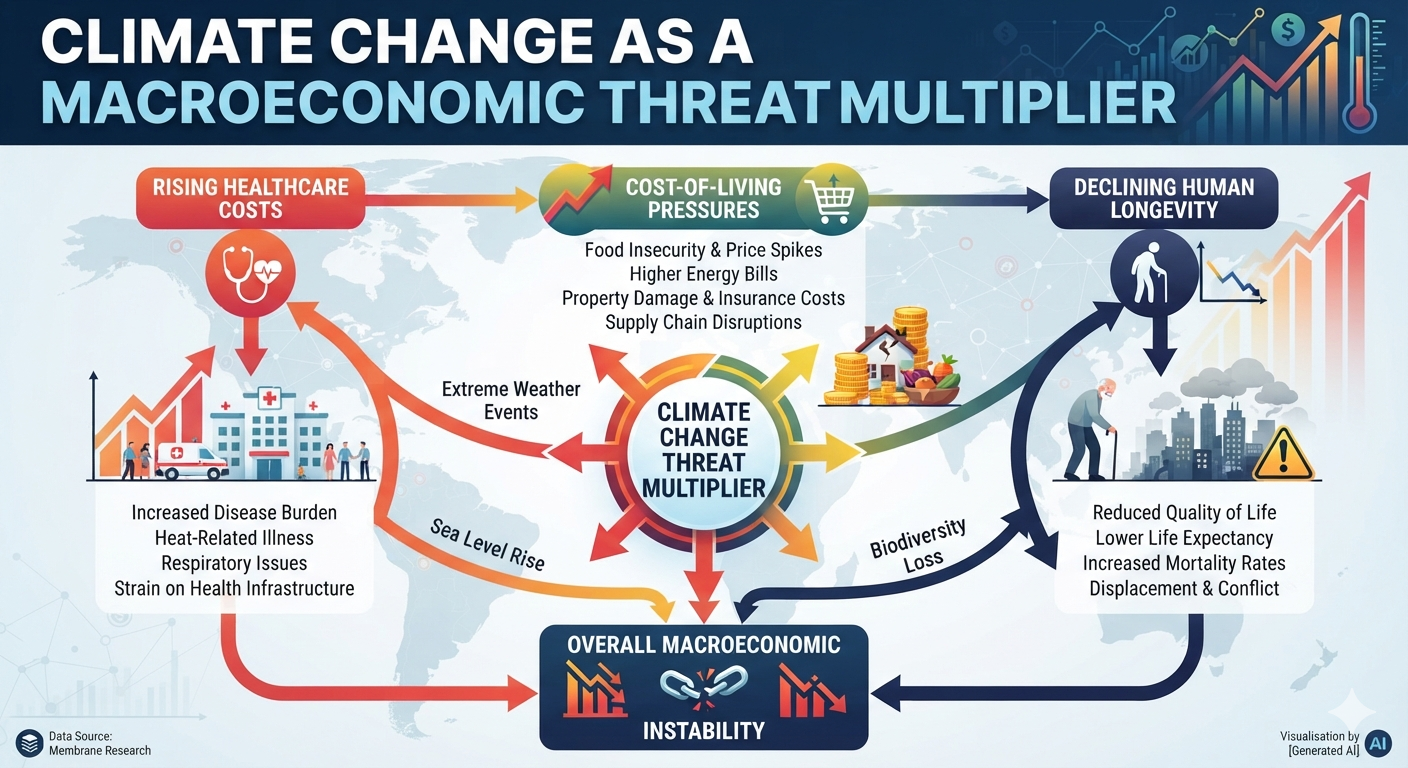
Climate change is no longer only an environmental challenge; it has become a powerful macroeconomic threat multiplier that amplifies existing social, economic, and public health vulnerabilities. Rising temperatures, increasingly extreme weather events, deteriorating air quality, and destabilized ecosystems are creating cascading financial pressures that extend from governments and businesses to individual households.
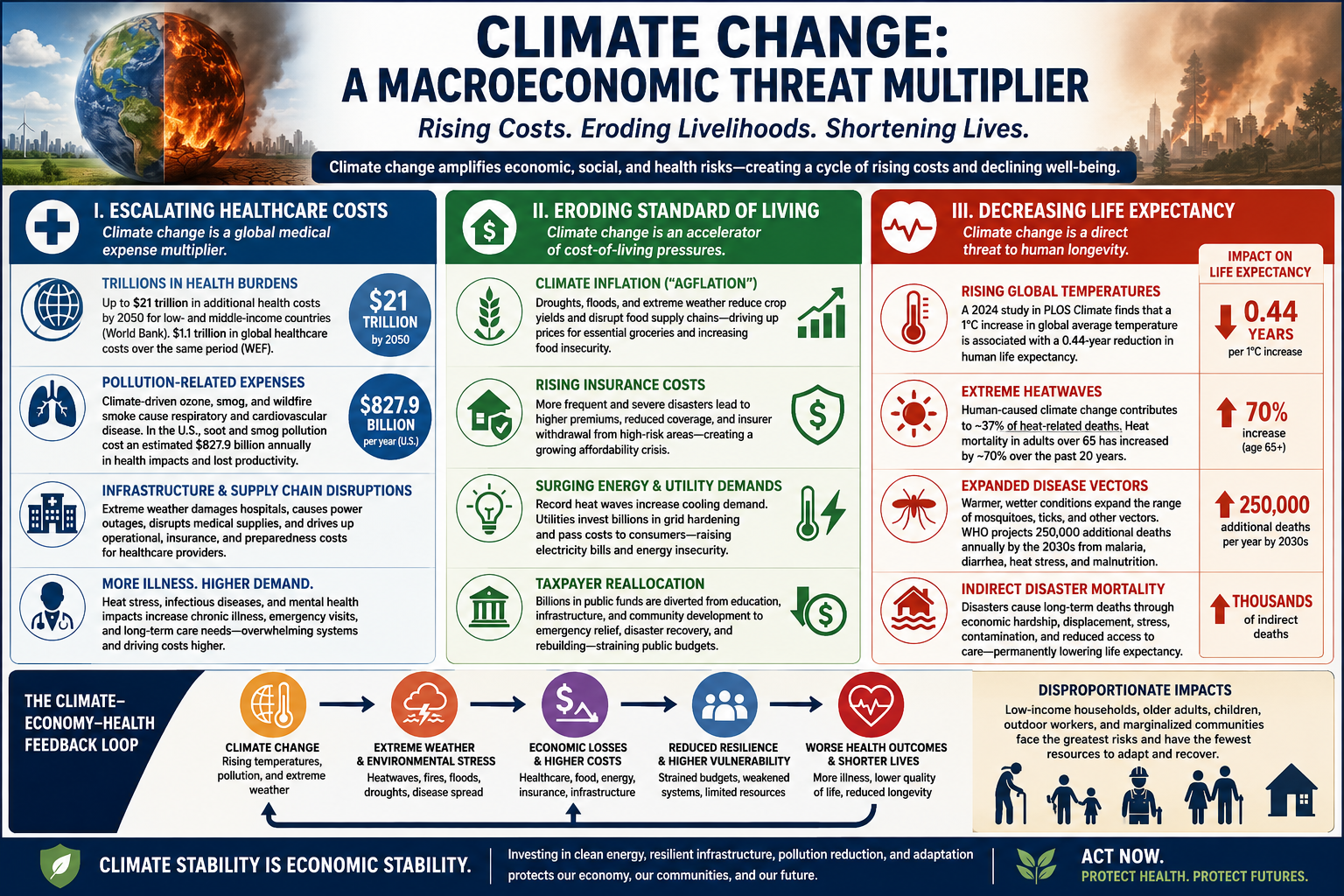
The economic consequences of climate change are increasingly visible through three interconnected pathways:
Escalating healthcare costs caused by heat exposure, air pollution, infectious diseases, and climate-related disasters.
Erosion of living standards through inflationary pressures on food, energy, insurance, housing, and public infrastructure.
Declining human longevity as environmental stressors undermine physical health, increase mortality, and reverse decades of progress in life expectancy.
These impacts are not distributed equally. Low-income households, elderly populations, outdoor workers, and marginalized communities often face the greatest exposure while having the fewest resources to adapt. Climate change therefore transforms environmental instability into a localized economic and human health crisis.
I. Escalating Healthcare Costs: Climate Change as a Global Medical Expense Multiplier
Climate change is placing unprecedented strain on healthcare systems by increasing both the frequency and severity of climate-related illnesses while simultaneously disrupting healthcare infrastructure.
1. Trillions of Dollars in Climate-Driven Health Burdens
The financial consequences of climate-related health impacts are expected to reach historic levels.
The World Bank estimates that climate-related health crises could impose approximately $21 trillion in additional costs by 2050 across low- and middle-income countries, reflecting increased disease burdens, reduced productivity, and expanding healthcare needs.
The World Economic Forum estimates that climate change could create approximately $1.1 trillion in additional global healthcare costs over the same period.
These costs represent more than direct medical expenses. They include lost productivity, reduced workforce participation, premature mortality, emergency response requirements, and infrastructure adaptation.
2. Pollution-Related Healthcare Expenses
Climate change and fossil fuel combustion are closely linked. Rising temperatures accelerate atmospheric chemical reactions that increase ground-level ozone formation, intensifying smog episodes and worsening respiratory and cardiovascular disease.
Fine particulate matter (PM2.5), ozone, wildfire smoke, and other pollutants contribute to:
Asthma and chronic respiratory illness
Heart attacks and strokes
Lung disease
Premature deaths
Increased emergency room visits
In the United States alone, soot and smog pollution are estimated to generate hundreds of billions of dollars annually in health-related costs, including medical expenses and lost economic productivity.
The growing frequency of wildfire smoke events demonstrates how climate impacts can transform regional air pollution into a national health emergency. Smoke from distant wildfires can travel thousands of miles, exposing millions of people far from the original source.
3. Healthcare Infrastructure and Supply Chain Disruptions
Extreme weather events increasingly threaten the operational stability of healthcare systems.
Climate-related disruptions include:
Hospitals losing electrical power during heat waves, hurricanes, and wildfires
Flooding damaging medical facilities
Disruptions in pharmaceutical and medical equipment supply chains
Increased emergency response costs
Higher insurance and operational expenses for healthcare providers
Hospitals are being forced to spend billions on climate resilience measures, including backup power systems, flood protection, cooling infrastructure, and emergency preparedness.
II. Eroding Standard of Living: Climate Change as a Cost-of-Living Accelerator
Climate change is increasingly becoming an economic reality experienced directly through household budgets. The same forces increasing healthcare costs are also driving inflationary pressures throughout the economy.
1. Climate Inflation and Agricultural Instability (“Agflation”)
Food systems are among the most climate-sensitive sectors of the global economy.
Rising temperatures, droughts, flooding, changing precipitation patterns, and extreme storms reduce agricultural productivity by damaging:
Crop yields
Livestock health
Fisheries
Agricultural infrastructure
Transportation networks
These disruptions create supply-side inflation, increasing prices for essential goods including:
Grains
Fruits and vegetables
Meat and dairy products
Transportation-dependent food products
Climate-driven food inflation disproportionately harms lower-income households because food represents a larger percentage of their monthly expenses.
2. Rising Insurance Costs and the Retreat From High-Risk Regions
The insurance industry has become one of the clearest economic indicators of accelerating climate risk.
As hurricanes, wildfires, floods, and severe storms become more frequent and destructive:
Insurance premiums increase dramatically.
Coverage becomes more restricted.
Insurers withdraw from vulnerable markets.
Property values decline in high-risk regions.
Homeowners increasingly face a difficult choice: pay rapidly increasing premiums or assume greater financial risk without adequate coverage.
This creates a growing climate affordability crisis, particularly for homeowners living in areas exposed to wildfire, coastal flooding, extreme storms, and severe weather.
3. Rising Energy Demand and Utility Costs
Climate change increases energy demand while simultaneously placing stress on energy infrastructure.
During extreme heat events:
Electricity consumption rises sharply due to increased air conditioning demand.
Utilities must invest billions in grid upgrades.
Transmission systems require additional protection against storms and wildfires.
Energy insecurity becomes a growing concern as vulnerable households struggle to afford cooling during dangerous heat events.
4. Taxpayer Costs and Public Financial Burdens
Climate disasters increasingly redirect public resources away from long-term investments toward emergency response and recovery.
Government spending is increasingly allocated toward:
Disaster relief
Infrastructure repairs
Emergency housing assistance
Flood recovery
Wildfire response
Agricultural assistance
These expenditures compete directly with funding for:
Education
Transportation improvements
Community development
Public health programs
Climate change therefore functions as a long-term fiscal drain, increasing government expenditures while reducing resources available for economic development.
III. Declining Human Longevity: Climate Change as a Biological Stressor
Beyond economic impacts, climate change increasingly affects the fundamental measure of human well-being: life expectancy.
The cumulative effects of extreme heat, pollution exposure, disease expansion, food insecurity, and climate disasters are slowing—and in some regions reversing—historical gains in longevity.
Climate Driver
Impact on Human Health and Longevity
Rising Global Temperatures
A 2024 study published in PLOS Climate found that a 1°C increase in global average temperature is associated with approximately a 0.44-year reduction in life expectancy.
Extreme Heatwaves
Human-caused climate change is estimated to contribute to approximately 37% of heat-related deaths. Heat-related mortality among adults over age 65 has increased substantially over recent decades.
Expanded Disease Vector Ranges
Warmer and wetter conditions allow mosquitoes, ticks, and other disease vectors to expand into new regions, increasing risks from malaria, dengue fever, Lyme disease, and other infections.
Food and Water Stress
Climate disruption increases risks of malnutrition, dehydration, agricultural failure, and water insecurity, particularly in vulnerable populations.
Indirect Disaster Mortality
Floods, hurricanes, wildfires, and other disasters create long-term health impacts through displacement, economic hardship, psychological stress, and environmental contamination.
This feedback loop means climate impacts are not isolated events. A wildfire, flood, or heat wave can simultaneously damage infrastructure, increase healthcare expenses, reduce productivity, raise insurance costs, and shorten human lives.
The poorest communities often experience the strongest effects because they have fewer resources to prepare, recover, and relocate.
Conclusion: Climate Stability Is Economic Stability
Climate change represents one of the largest economic and public health challenges of the modern era. Its consequences extend far beyond environmental degradation, affecting national budgets, household finances, healthcare systems, and human survival.
Addressing climate change is therefore not simply an environmental investment—it is an economic resilience strategy and a public health imperative. Investments in clean energy, resilient infrastructure, pollution reduction, efficient buildings, and climate adaptation can reduce future costs while protecting both human health and economic stability.
The cost of inaction is no longer measured only in degrees of warming. It is measured in rising medical bills, shrinking household budgets, damaged communities, and lost years of human life.
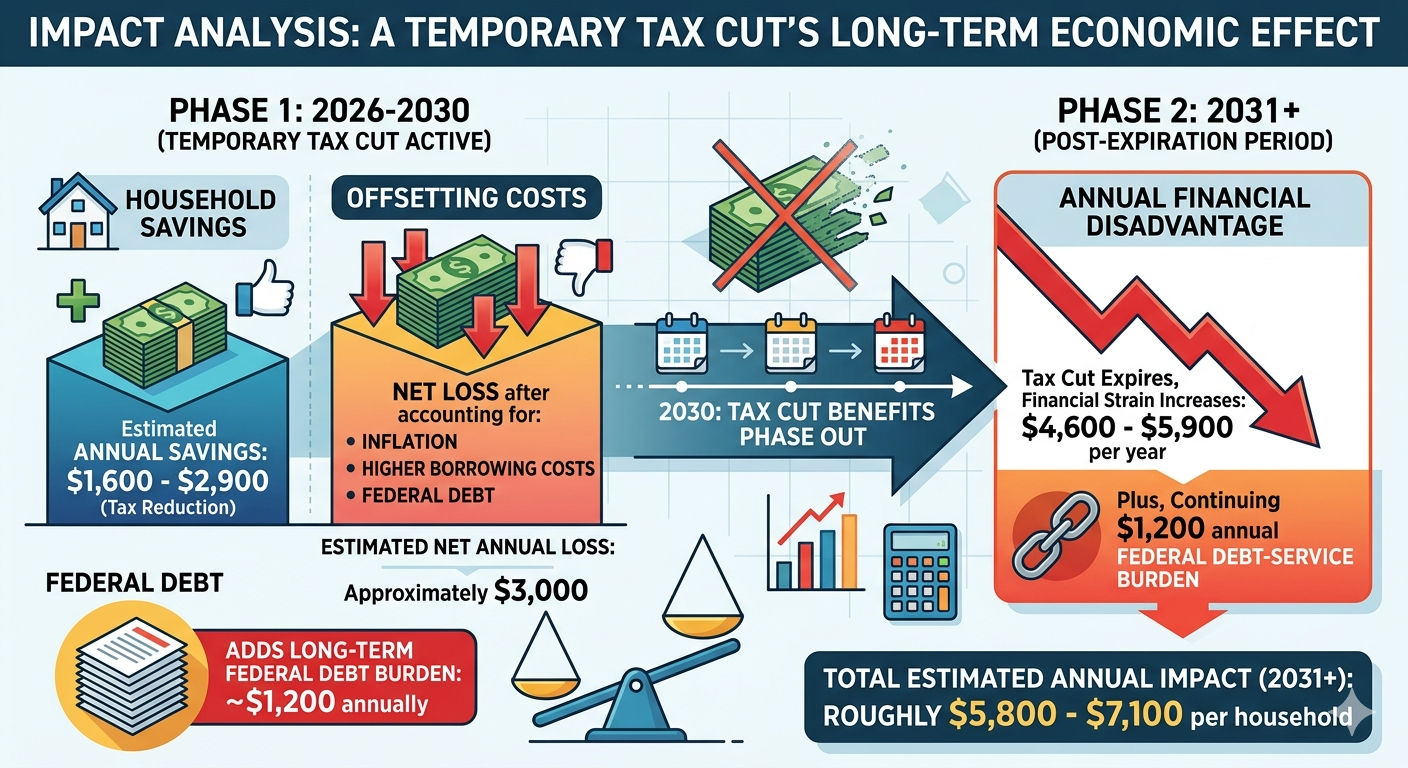
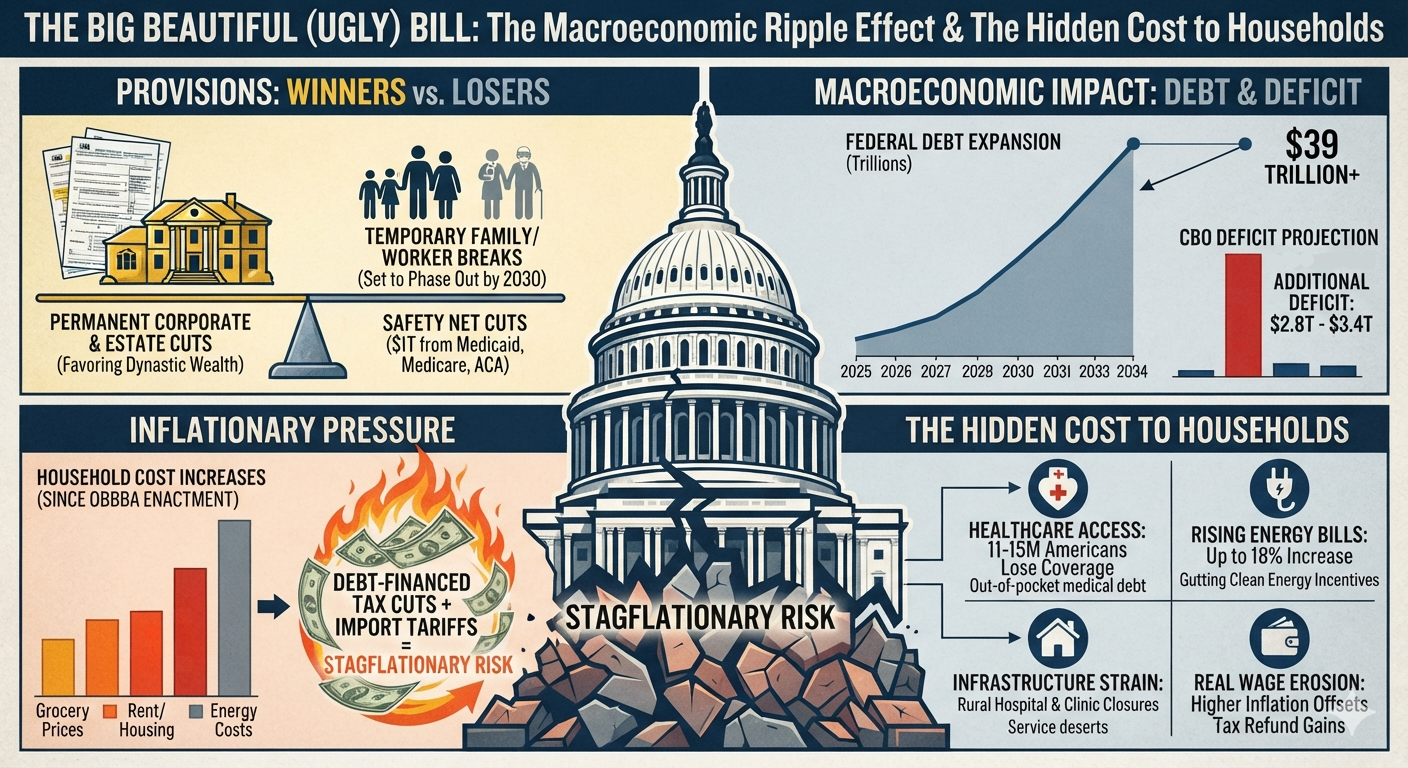
A tax cut that appeared to provide the average household with $1,600–$2,900 in annual savings was more than offset by the broader economic effects of inflation, higher borrowing costs, and increased federal debt. After accounting for these costs, the average household experienced an estimated net loss of approximately $3,000 per year, along with an additional long-term federal debt burden equivalent to roughly $1,200 annually.
However, the tax cut benefits are scheduled to phase out by 2030, meaning households will eventually lose the temporary savings while many of the costs associated with higher debt, interest payments, and elevated borrowing rates remain. Beginning in 2031, when the tax reduction expires, the average household’s annual financial disadvantage could increase to approximately $4,600–$5,900 per year, plus the continuing $1,200 annual federal debt-service burden. This would place the total estimated impact at roughly $5,800–$7,100 per household annually, while the accumulated federal debt continues to shift additional costs onto future taxpayers.
Tax Cuts vs. Inflation: The Hidden Battle Over Household Purchasing Power
Tax cuts are often promoted as a direct way to improve household finances, but for the average American family, inflation can have a much larger and more immediate impact on financial well-being. A tax cut may provide a noticeable boost to income, but a sustained period of elevated inflation can quietly reduce purchasing power by thousands of dollars each year.
For a typical middle-income household, a broad tax reduction might save several hundred to a few thousand dollars annually. However, inflation affects the entire household budget—including housing, groceries, utilities, transportation, healthcare, and services. A 4%–5% annual inflation rate can easily increase household expenses by $3,500–$5,000 per year, effectively overwhelming the benefit of many tax cuts.
The result is a simple economic reality: a dollar gained through tax cuts can be offset—or even erased—by dollars lost through higher prices.
The Mathematical Mismatch: Tax Savings vs. Inflation Costs
Tax Cuts Provide Limited Annual Gains
For most middle-class households, federal tax cuts typically produce moderate savings rather than dramatic changes in disposable income. Historical analyses of broad tax packages, including evaluations by organizations such as the Tax Policy Center, have shown that middle-income families often receive annual tax reductions in the range of roughly $1,600 to $2,900, depending on the structure of the legislation. The most recent tax cuts saved the average household $1,600 and $2,900.
While meaningful, these savings represent only a fraction of a household’s total annual expenses.
Inflation Acts Like a Hidden Tax
Inflation operates differently from taxes. Rather than reducing a paycheck directly, it increases the cost of nearly everything a household buys.
A family spending $80,000 annually on goods and services would experience approximately:
4% inflation: about $3,200 in additional annual costs
5% inflation: about $4,000 in additional annual costs
6% inflation: about $4,800 in additional annual costs
Unlike a tax cut, which may provide a one-time or annual benefit, inflation compounds year after year. Even if wages rise, households can still lose purchasing power if prices increase faster than incomes.
Distribution of Benefits vs. Distribution of Burdens
Tax Cuts Often Deliver Larger Dollar Benefits to Higher-Income Households
Income tax reductions generally scale with taxable income. Higher-income households typically pay more in taxes, so percentage-based tax cuts often produce larger dollar savings at the top.
Analyses from organizations such as the Congressional Budget Office have repeatedly shown that broad tax changes frequently provide the largest absolute benefits to higher-income groups, while middle- and lower-income households receive smaller dollar amounts.
Inflation Disproportionately Hurts Lower- and Middle-Income Families
Inflation is often described as a regressive economic force because it affects essential spending categories that consume a larger share of lower-income household budgets.
A wealthy household can often absorb higher prices by reducing discretionary spending or shifting purchases. A working-class family has fewer options when facing increases in:
Food prices
Rent or mortgage payments
Electricity and heating costs
Gasoline and transportation
Healthcare expenses
For families living close to their monthly budget limits, inflation functions like a pay cut.
The Inflation Feedback Loop
Tax cuts can stimulate economic activity by increasing disposable income. However, if tax reductions are not matched by spending reductions or productivity gains, they can increase demand in an economy already operating near capacity.
The mechanism is straightforward:
Tax cuts increase household disposable income.
Increased income boosts consumer demand.
If supply cannot expand quickly enough, businesses raise prices.
Higher prices reduce the purchasing power of the original tax cut.
In this scenario, households may receive additional money in their paycheck while simultaneously paying more at the grocery store, gas station, and utility bill.
The economic benefit becomes partially or completely offset by rising prices.
The Federal Debt Effect: How Tax Cuts Can Increase Long-Term Costs
Tax cuts also have a broader economic impact beyond the immediate benefit to taxpayers. When tax reductions are not accompanied by equivalent spending reductions or stronger economic growth, they increase the federal budget deficit and add to the national debt. The government must finance that additional debt by issuing more Treasury securities, increasing the supply of government borrowing.
As federal debt rises, the government competes with households and businesses for available capital. This increased demand for borrowed money can place upward pressure on interest rates, raising the cost of mortgages, auto loans, credit cards, business financing, and other forms of credit.
The effect is often indirect but significant. A household may receive a $2,000 annual tax reduction, but if higher federal borrowing contributes to even a modest increase in interest rates, that same family may pay thousands of dollars more over time through:
Higher mortgage rates when purchasing or refinancing a home
Increased interest on auto loans
Higher credit card balances
More expensive consumer financing
Higher costs passed through by businesses borrowing at elevated rates
For example, a 1% increase in mortgage rates on a $300,000 home loan can add roughly $200 per month to a typical 30-year mortgage payment—more than $2,000 annually. Across the economy, higher interest rates also increase the federal government’s own debt-service costs, requiring more taxpayer dollars to pay interest rather than fund public services or reduce future deficits.
This creates a potential feedback loop:
Tax cuts reduce federal revenue.
Larger deficits increase government borrowing.
Higher debt levels put upward pressure on interest rates.
Higher rates increase borrowing costs for households, businesses, and the government.
Additional interest expenses reduce the long-term economic benefit of the original tax cut.
The ultimate measure of a tax policy is therefore not only the size of the immediate tax reduction, but its effect on total household purchasing power after accounting for inflation, interest rates, and the long-term cost of increased federal debt.
The Role of Bracket Creep
Inflation also affects taxation through a process known as bracket creep.
As wages rise due to inflation, taxpayers can unintentionally move into higher tax brackets even though their real purchasing power has not increased. To address this, the Internal Revenue Service adjusts federal income tax brackets, standard deductions, and other thresholds annually for inflation.
These adjustments prevent inflation from automatically increasing a household’s tax burden. However, they do not compensate for the broader loss of purchasing power caused by rising prices.
Inflation indexing protects taxpayers from paying higher taxes simply because of inflation—it does not make groceries, housing, or energy affordable again.
Conclusion: The True Measure Is Total Economic Impact
Tax cuts can provide meaningful benefits to households, but their true economic value cannot be measured by the size of the immediate reduction in a tax bill alone. A complete evaluation must consider the broader effects on purchasing power, inflation, interest rates, and the long-term federal debt burden.
A tax cut may increase disposable income in the short term, but those gains can be diminished or even erased when inflation raises the cost of everyday necessities such as housing, food, energy, and transportation. Unlike a one-time tax reduction, inflation affects the entire household budget and compounds over time, reducing what each dollar can actually buy.
The impact also depends on how tax cuts are financed. When reductions in federal revenue are not matched by spending cuts or sufficient economic growth, they increase budget deficits and add to the national debt. Higher federal borrowing can place upward pressure on interest rates, increasing costs for mortgages, auto loans, credit cards, and business financing. Households may receive additional money through lower taxes while simultaneously paying more through higher borrowing costs and rising prices.
This creates a broader economic equation:
The benefit of a tax cut is not simply the dollars returned to taxpayers—it is the change in real purchasing power after accounting for inflation, interest rates, and future debt obligations.
For some households, especially higher-income taxpayers, tax reductions may provide substantial direct benefits. However, for many middle- and lower-income families, the effects of inflation and higher interest rates can outweigh those gains because they spend a larger share of their income on necessities and borrowing costs.
The ultimate question is therefore not:
“How much did taxpayers save in taxes?”
The more important question is:
“Did households become financially better off after accounting for the full economic consequences?”
A sustainable economic policy must balance tax relief with fiscal responsibility, price stability, and long-term economic growth. Without that balance, a tax cut can create the appearance of increased prosperity while shifting costs into higher prices, higher interest payments, and a larger debt burden for future generations.
ADDENDUM
The exact “net cost” depends on the household’s income, debt exposure, and whether the tax cuts are financed by borrowing. A reasonable estimate can be made by separating immediate annual effects from long-term debt effects.
Estimated Annual Impact on an Average Household
Item
Annual Impact
Tax cut benefit
+$1,600 to +$2,900
4% inflation increase in household expenses
−$3,200
Higher mortgage costs (if buying/refinancing)
−$2,000+
Higher auto loan, credit card, and consumer financing costs
−$500 to −$2,000+
Higher business borrowing costs passed through in prices
−$300 to −$1,000+
Additional federal debt interest burden
−$900 to −$1,500+ annually (estimated)
Short-Term Net Effect (First-Year Estimate)
Lower-cost scenario:
Tax savings: +$2,900
Inflation cost: −$3,200
Consumer borrowing/business costs: −$800
Debt interest effect: −$900
Net impact: approximately −$2,000 per household per year
Higher-cost scenario:
Tax savings: +$1,600
Inflation cost: −$3,200
Mortgage/borrowing costs: −$3,000
Debt interest effect: −$1,500
Net impact: approximately −$6,100 per household per year
Long-Term Federal Debt Effect
If tax cuts add $3–$5 trillion to federal debt:
There are roughly 130 million U.S. households.
The added debt equals approximately:
130 million households$3 trillion≈$23,000 per household130 million households$5 trillion≈$38,000 per household
That does not mean each household receives a bill, but it represents the additional federal liability ultimately supported by taxpayers.
If the government pays roughly 4% interest on that additional debt:
$3 trillion × 4% = $120 billion/year
$5 trillion × 4% = $200 billion/year
Spread across households:
$900–$1,500 per household annually in additional federal interest costs
Over decades, if the debt is refinanced and interest compounds, the total burden can become substantially larger.
Other Potential Costs Associated With Large Tax Cuts
1. Reduced fiscal flexibility
Higher debt can limit the government’s ability to respond to:
recessions
natural disasters
pandemics
military emergencies
infrastructure needs
Future taxpayers may face higher taxes or spending cuts to service the debt.
2. Higher interest rates
Large deficits can increase demand for borrowed funds, putting upward pressure on interest rates. This affects:
mortgages
business loans
student loans
auto loans
government borrowing costs
3. Crowding out private investment
When the government absorbs more available capital:
businesses may invest less
productivity growth can slow
wage growth may weaken over time
4. Inflation risk
If tax cuts increase demand without increasing supply, they can contribute to inflationary pressure, especially when the economy is already near capacity.
Estimated Net Household Effect
Time Frame
Estimated Impact
Immediate annual effect
−$2,000 to −$6,000 per household
Added federal debt liability
+$23,000 to +$38,000 per household
Annual debt-service burden
−$900 to −$1,500 per household/year
Bottom Line
A tax cut that appeared to provide an average household with $1,600–$2,900 in annual savings was far outweighed by the broader economic effects of inflation, higher borrowing costs, and increased federal debt. The average household had a net loss of $3,000 and an additional debt burden of $1,200/year. For many households, the combined impact may represent a net financial loss of several thousand dollars per year, while the long-term debt burden shifts additional costs onto future taxpayers.
A child’s financial future can be strengthened by using multiple savings vehicles, each designed for a different purpose. Rather than choosing only one account, families can combine them strategically to maximize government benefits, tax advantages, and long-term wealth creation.
Step 1: Capture the Free Government Contribution
For children born between 2025 and 2028, families should consider opening a Trump Account through Trump Accounts.gov as soon as possible to qualify for the initial $1,000 government contribution and any eligible corporate matching contributions.
The key advantage is that this initial deposit provides a foundation of invested capital that can compound for decades. When started early, even a relatively small contribution can grow substantially through the power of long-term investment returns.
Step 2: Use a 529 Plan for Education Savings
After securing available government contributions, families can direct additional college savings into a 529 education savings plan.
A 529 plan offers:
Tax-free growth on qualified education expenses
Tax-free withdrawals for eligible college, vocational, and educational costs
The ability for family members to contribute over time
For parents and grandparents specifically saving for education, a 529 plan remains one of the most efficient tools for building a dedicated education fund.
Step 3: Transition to a Custodial Roth IRA for Long-Term Wealth
Once a child has earned income from a legitimate job—such as babysitting, lawn care, summer employment, or other documented work—a Custodial Roth IRA can become a powerful wealth-building tool.
A Roth IRA allows:
Tax-free investment growth
Tax-free qualified withdrawals in retirement
The potential to use contributions (not earnings) later for certain purposes, such as a first-home purchase
Starting a Roth IRA during childhood gives decades of compounding potential and can help transform early earnings into a future home down payment or retirement asset.
The Three-Account Strategy: A Lifetime Financial Roadmap
The most powerful approach is not choosing between accounts—it is using each account for its intended purpose:
Trump Account → Capture free government and matching contributions
529 Plan → Build a tax-advantaged education fund
Custodial Roth IRA → Create lifelong tax-free wealth
By combining these tools, families can provide children with a financial foundation that supports education, home ownership, and long-term financial independence. The earlier the process begins, the greater the benefit of decades of compound growth.
The unexpectedly rapid release of more than $100 billion in tariff refunds is likely amplifying an already sharp increase in U.S. imports, contributing to a much wider trade deficit reported today by the Bureau of Economic Analysis.
According to the U.S. Bureau of Economic Analysis (BEA), the international trade deficit jumped 42.2% to $77.6 billion in May, up from a revised $54.6 billion in April. Imports climbed 3.3% to $395.3 billion, while exports fell 3.2% to $317.7 billion.
While businesses also accelerated purchases ahead of potential new tariffs and supply chain disruptions, the rapid release of tariff refunds appears to have become a major source of liquidity that enabled importers to dramatically increase orders from overseas.
Tariff Refunds Are Moving Much Faster Than Expected
The current refund program stems from the February 2026 U.S. Supreme Court ruling that invalidated many emergency tariffs imposed under the International Emergency Economic Powers Act (IEEPA). Since then, U.S. Customs and Border Protection (CBP) has been processing one of the largest customs refund programs in U.S. history.
The pace of payments has exceeded many expectations:
Approximately $166 billion in refund claims have been filed.
More than $104.3 billion has already been accepted.
Roughly $71 billion has been finalized and paid.
On June 29, CBP launched Phase 2 of its automated CAPE refund portal to process an additional 2.8 million older and more complex import entries.
The unexpectedly rapid return of more than $100 billion to importers has significantly improved corporate cash flow, allowing companies to replenish inventories and increase imports almost immediately.
Refund Liquidity Is Expanding the Trade Deficit
The refund process has created a powerful economic chain reaction:
More than $104 billion in accepted refund claims → Increased importer liquidity → Accelerated foreign purchasing → Larger U.S. trade deficit
Instead of remaining tied up in government accounts, tariff revenue is now flowing back into corporate balance sheets, enabling businesses to front-load imports while attempting to stay ahead of replacement tariff policies.
Tariff Revenue Has Effectively Disappeared
The refund program is also dramatically reducing federal customs revenue.
In May 2026, the U.S. Treasury paid out $21.97 billion in tariff refunds while collecting $21.93 billion in gross customs duties. The result was a net customs outflow of approximately $42 million, effectively eliminating tariff revenue for the month.
Growing Pressure on the Federal Budget
The reversal from collecting tariffs to issuing massive refunds is widening the federal fiscal deficit.
Because tariffs had become a significant source of government revenue, refunding those collections represents both a loss of expected receipts and a substantial increase in federal expenditures.
Moody’s Analytics estimates the immediate fiscal impact could exceed $133 billion.
The Congressional Budget Office (CBO) projects that related policy changes could increase federal deficits by roughly $2 trillion over the next decade.
Consumers See Little Benefit
Although corporations are receiving billions in refund payments, consumers are unlikely to see corresponding price reductions.
Several major retailers—including Nike, Amazon, and Costco—are facing class-action lawsuits alleging they retained tariff-related price increases while also receiving refund payments, allowing them to benefit from both higher prices and government reimbursements.
New Tariffs Could Offset the Windfall
Following the Supreme Court decision, the U.S. Trade Representative introduced new tariffs under alternative statutory authorities, including Section 122 and Section 301.
Many importers warn that these replacement tariffs could quickly erode the financial gains created by the current refund program. In the meantime, however, the rapid pace of tariff refunds is injecting substantial liquidity into import markets, contributing to a wider trade deficit and placing additional pressure on the federal budget.
The U.S. labor force participation rate now stands at 61.5%, according to the latest Bureau of Labor Statistics (BLS) June 2026 report. This metric measures the share of the civilian population aged 16 and older that is either employed or actively seeking work, and it declined from 61.8% in the prior reading.
Within the broader non-participating population, only a small segment is considered even loosely attached to the labor market. Approximately 1.76 million people are classified as “marginally attached” to the labor force—individuals who want a job and have looked for work within the past 12 months, but have not searched in the past four weeks. Of these, about 477,000 are “discouraged workers,” meaning they believe no jobs are available for them or that they lack the skills required to obtain employment.
The latest BLS June 2026 employment report highlights a notable shift in labor force dynamics. Roughly 720,000 people left the labor force, contributing to the decline in the participation rate from 61.8% to 61.5%.
This decline helps explain the apparent contradiction in the headline employment figures. The economy added a modest 57,000 jobs, and the official unemployment rate edged down from 4.3% to 4.2%. However, this improvement is partly driven by a smaller labor force rather than a surge in hiring, as fewer people were actively seeking work during the reporting period.
An Ensemble-Based Probabilistic Framework for Estimating the Full Economic Burden of Climate Change in the United States
Daniel Brouse and Sidd Mukherjee
Abstract
Traditional estimates of climate damages generally report single-value estimates or narrow ranges that fail to capture the cascading uncertainty inherent in coupled human-natural systems. Climate change is not a single hazard but a network of interacting physical, ecological, epidemiological, economic, and social feedbacks.
This paper proposes an ensemble-based probabilistic accounting framework that estimates the true annual economic burden of climate change in the United States as a distribution rather than a point estimate.
Using 2025 as the baseline year, we define a conservative lower bound of $2.06 trillion annually (approximately $6,050 per American) consisting only of directly attributable and well-quantified damages.
Additional categories—including infectious disease emergence, ecosystem collapse, climate migration, geopolitical instability, financial contagion, biodiversity loss, fossil-fuel subsidies, and other partially attributable systemic risks—are represented probabilistically through an ensemble framework.
Rather than producing one “correct” number, the framework generates prediction intervals describing the likely range of the true climate burden.
1. Introduction
Climate damages are fundamentally nonlinear.
Traditional integrated assessment models generally estimate expected damages using equilibrium assumptions and relatively independent variables.
Real-world climate systems behave differently.
Climate interacts simultaneously with
ecosystems
economics
epidemiology
infrastructure
migration
finance
agriculture
conflict
public health
Each contains reinforcing feedback loops.
The objective is therefore not prediction of a single value but estimation of a probability distribution.
2. The Climate Damage Ensemble
Define total damages as: Dₜₒₜₐₗ = Dₒᵦₛₑᵣᵥₑd + ∑ Dᵢ
Wildfire → Smoke → Respiratory disease → Lost labor → Lower GDP → Reduced adaptation capacity → Greater vulnerability
The ensemble models these interactions through conditional dependence rather than assuming independence.
6. Prediction Intervals
Instead of a single estimate, the framework produces confidence bands.
Illustrative example
Percentile
Annual Cost
5th
$2.06T
25th
$2.7T
Median
~$4T
75th
~$6T
90th
~$8T
95th
~$10T+
These values would ultimately emerge from the Monte Carlo simulation rather than being fixed assumptions.
7. Fan Charts
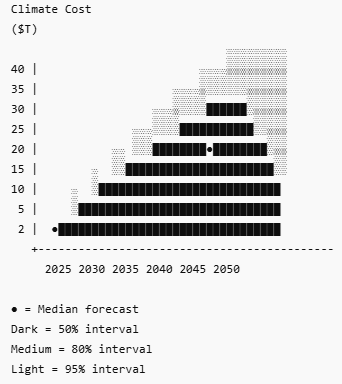
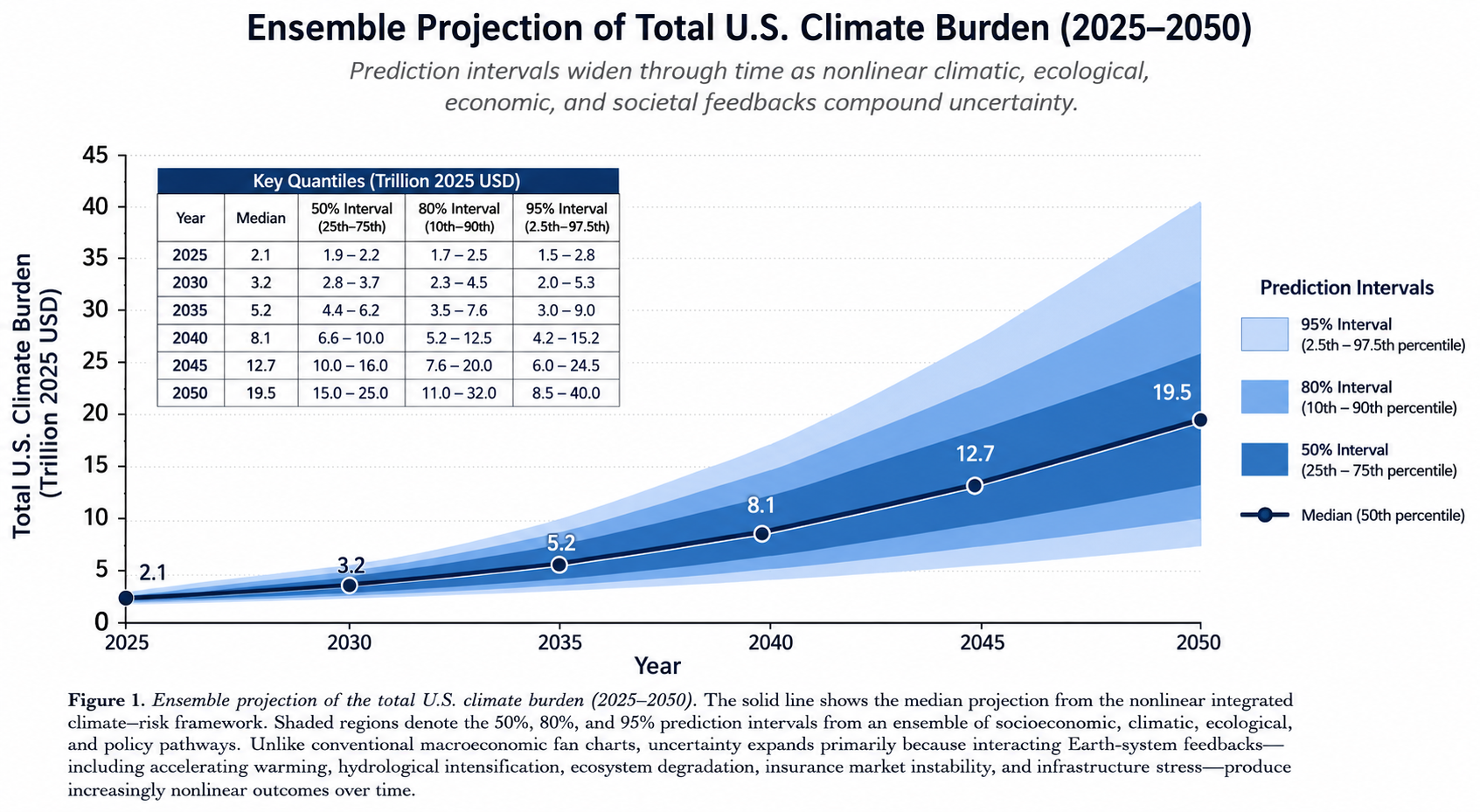
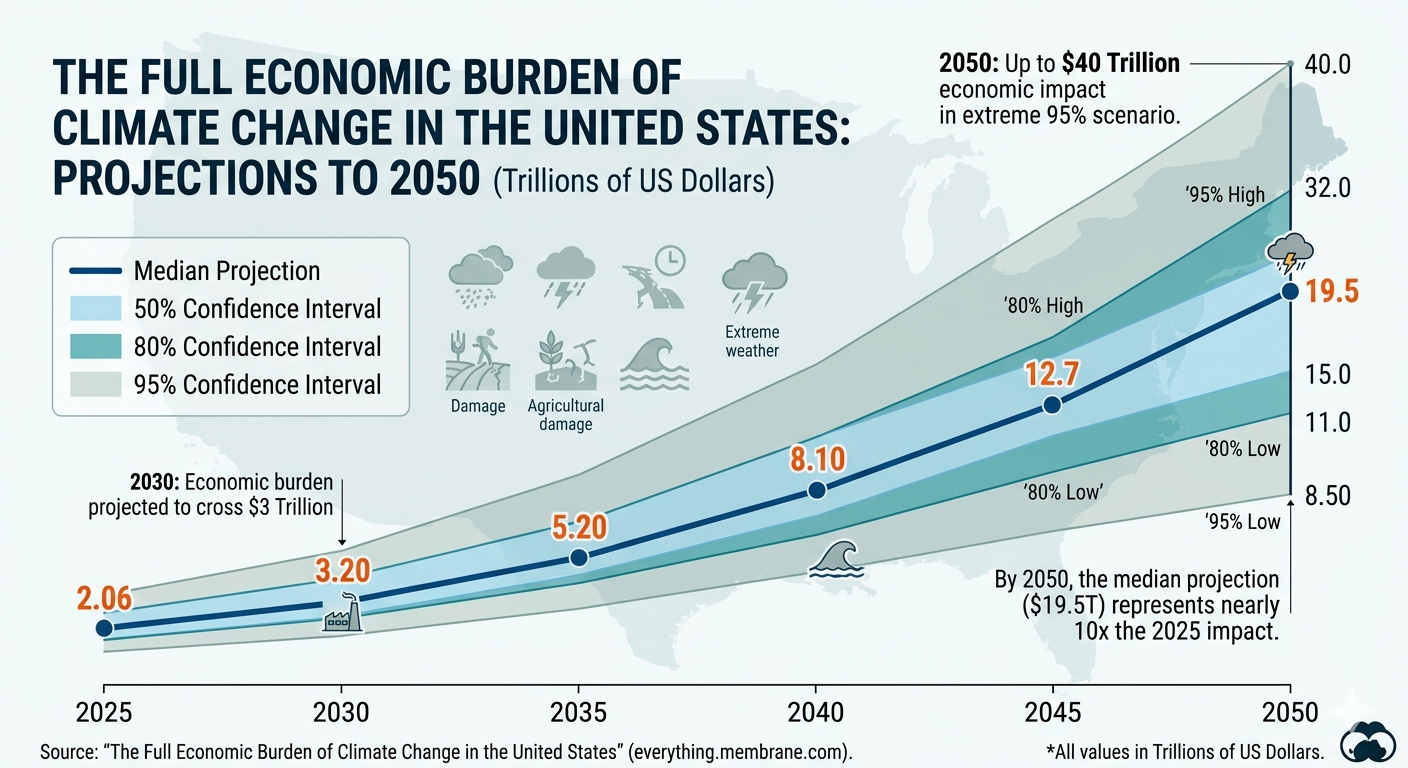
The preferred visualization is not a line graph. Instead, it is to plot 2025 through 2050 with widening prediction bands.
The widening fan reflects increasing uncertainty produced by nonlinear climate feedbacks.
Unlike economic forecasting, these intervals widen primarily because interacting Earth-system feedbacks amplify uncertainty over time.
Year
Median
50% Low
50% High
80% Low
80% High
95% Low
95% High
2025
2.06
1.90
2.20
1.70
2.50
1.50
2.80
2030
3.20
2.80
3.70
2.30
4.50
2.00
5.30
2035
5.20
4.40
6.20
3.50
7.60
3.00
9.00
2040
8.10
6.60
10.00
5.20
12.50
4.20
15.20
2045
12.7
10.0
16.0
7.60
20.0
6.00
24.5
2050
19.5
15.0
25.0
11.0
32.0
8.50
40.0
* In trillions of US dollars.
Figure X. Ensemble projection of the total U.S. climate burden (2025–2050). The solid center line represents the median projection from the nonlinear integrated climate-risk framework. Shaded regions denote the 50%, 80%, and 95% prediction intervals derived from an ensemble of socioeconomic, climatic, ecological, and policy pathways. Unlike conventional macroeconomic fan charts, uncertainty expands primarily because interacting Earth-system feedbacks—including accelerating warming, hydrological intensification, ecosystem degradation, insurance market instability, and infrastructure stress—produce increasingly nonlinear outcomes over time. Consequently, the widening fan reflects structural uncertainty arising from feedback amplification rather than simple forecast error accumulation.
This style closely matches the fan charts used by central banks, but adapts them to nonlinear climate-risk modeling, making it appropriate for a publication on ensemble climate-economic projections.
8. Interpretation
The conservative estimate of $2.06 trillion should not be interpreted as the expected value.
Rather, it is the lower bound supported by presently attributable damages.
The ensemble median is expected to exceed this value substantially as additional climate-sensitive costs become attributable.
Conversely, the upper tail represents systemic risks whose probabilities remain uncertain but whose consequences could dominate future economic losses.
9. Conclusion
Climate damages are not deterministic.
Neither are they adequately represented by point estimates.
A probabilistic ensemble framework better reflects the state of climate science, economics, epidemiology, ecology, and complex systems theory.
Instead of asking
“What does climate change cost?”
the scientifically appropriate question becomes
“What is the probability distribution of the total societal cost once all interacting climate feedbacks are considered?”
This framework shifts climate economics from deterministic bookkeeping toward full systemic risk analysis, consistent with modern catastrophe modeling, insurance science, and Earth-system dynamics.
We develop a probabilistic ensemble framework to estimate the annual economic burden of climate change in the United States.
The approach decomposes total damages into observed, directly attributable components and a set of latent, partially observable,
or structurally uncertain damage channels. These are combined within a stochastic simulation framework to generate a full probability distribution of annual climate damages.
Total damages are defined as:
DTotal = DObs + Σ Di
where DObs represents empirically observed and directly attributable damages, and Di represents uncertain damage channels modeled as stochastic processes.
2. Baseline Observed Damages (2025)
The baseline estimate DObs is constructed from sectorally disaggregated empirical loss data for the United States in 2025.
All included components meet a conservative attribution threshold requiring strong empirical linkage to climate-related hazards.
Table 1. Baseline Observed Damages (2025)
Sector
Damage Category
Estimated Annual Loss (USD)
Data Basis
Extreme events
Hurricanes, floods, droughts, wildfire direct losses
0.78T
NOAA, FEMA loss estimates
Insurance & infrastructure
Uninsured losses, premium escalation, rebuilding
0.32T
Industry loss reports
Health impacts
Heat mortality, air quality, morbidity, productivity loss
0.41T
CDC, EPA burden estimates
Agriculture
Yield losses, supply disruption, input volatility
0.27T
USDA crop loss models
Energy system impacts
Cooling demand, grid stress, peak pricing effects
0.18T
EIA demand elasticity
Macro-financial impacts
GDP losses, capital disruption, adaptation expenditure
0.10T
IMF-style macro damage estimates
Total observed baseline:
DObs = 2.06 trillion USD (2025)
Per capita estimate:
2.06T / 340M ≈ 6,050 USD/person
3. Latent and Partially Attributable Damage Channels
We define a second class of damages Di, representing climate-linked risks that are supported by physical or epidemiological mechanisms but remain incompletely attributable in aggregate economic terms.
Each Di is modeled as a stochastic variable:
Di ~ 𝒟(θi, σi)
4. Infectious Disease and Pandemic Risk Module
Climate change may influence infectious disease dynamics via:
Shifts in vector ecology
Habitat fragmentation
Zoonotic spillover risk
Altered pathogen persistence environments
COVID-19-related impacts are excluded from DObs due to attribution uncertainty but included in ensemble tail-risk modeling.
5. Climate-Sensitive Disease Expansion Model
Following Mora et al. (Nature Climate Change), evidence indicates:
58% of known human pathogenic diseases are climate-sensitive
Disease risk is modeled as:
Dhealth,i = f(Ei, Vi, Ci)
Ei: exposure expansion
Vi: vector suitability change
Ci: climate hazard intensity
6. Fossil Fuel Subsidy Module
Subsidies are excluded from baseline accounting due to definitional heterogeneity.
We define a bounded distribution:
S ~ Triangular(10¹⁰, 10¹¹, 7×10¹¹)
7. Stochastic Ensemble Construction
Total damages are computed using Monte Carlo simulation:
D(k)Total = DObs + Σ Xi(k)
Where k = 1…100,000 simulations.
Distribution types include:
Lognormal (health, infrastructure)
Gamma (agriculture, extreme events)
Pareto (tail risk)
Mixture distributions (financial system risk)
8. Dependence Structure
We impose a dependency structure using a copula-based framework:
DObs represents a lower-bound empirical estimate.
DTotal represents the full probabilistic damage distribution including latent and tail-risk components.
DObs ≤ E[DTotal]
11. Data Sources
NOAA climate disaster loss datasets
FEMA disaster expenditure reports
CDC morbidity and mortality statistics
USDA agricultural loss data
EIA energy demand data
IMF macroeconomic climate damage frameworks
IPCC AR6 assessment reports
12. Limitations
Partial observability of latent damage channels
Structural uncertainty in tail-risk distributions
Simplified correlation structure
Attribution uncertainty in health and ecological modules
Non-stationarity of climate–economy relationships
Results should be interpreted as probabilistic risk estimates rather than point forecasts.