bookmark_borderThe U.S. Economy into 2026: Tariffs, Immigration, and the AI Paradox

by Daniel Brouse
December 13, 2025

Introduction

The U.S. economy in 2025 is shaped by three powerful and interacting forces: tariff implementation, restrictive immigration policies, and the rapid adoption of artificial intelligence (AI). Each has distinct economic effects, but taken together they create a complex macroeconomic picture with both upside and risk.

1. Tariffs: A Drag on Growth

Tariffs function effectively as taxes on imported goods and inputs. Higher tariffs increase costs for U.S. producers and consumers, reduce trade volumes, and create uncertainty in supply chains. Empirical research shows that higher tariff rates tend to be negatively correlated with real GDP growth over time, with lagged effects that can take months or years to fully materialize.

Recent macroeconomic forecasts attribute part of the slowdown in U.S. GDP growth to tariff effects. The Organisation for Economic Co-operation and Development (OECD) notes that rising tariff rates and lower net immigration have weakened growth momentum, even as other sectors contribute positively.

Tariffs also distort reported GDP through accounting effects. When imports fall sharply—as has happened recently—net exports (exports minus imports) mechanically add to GDP growth even when underlying domestic demand remains weak.

Taken together, tariffs are acting as a drag on growth, raising costs and undermining business and consumer demand, even as headline numbers may temporarily mask underlying weakness.

2. Immigration Policy: Labor Market Constraints

Restrictive immigration policies reduce labor supply directly and indirectly. While precise impacts are difficult to quantify in real time, recent scholarly and policy analysis suggests immigration contributes significantly to labor force growth, especially in sectors such as technology, construction, and services.

For example, forecasts indicate that both tariff hikes and lower net immigration contributed to a slower labor market, reducing payroll growth and increasing unemployment rates.

Immigrants accounted for an estimated 80% of U.S. GDP growth from 2020–2025, underscoring their outsized contribution to labor supply and overall economic expansion. A sharp reduction or elimination of immigration therefore constrains the labor force, lowers potential output, and slows GDP growth. While official estimates vary, the underlying mechanism is well established in macroeconomic models and supported by recent forecasts: reduced immigration leads directly to weaker economic growth.

Equally important is the spending behavior of immigrant households. A large share of earned income is spent quickly on goods and services, providing an immediate boost to aggregate demand. In recent months, multiple consumer-facing industries have reported noticeable declines in sales following reductions in immigrant participation in the economy, including beer brands, food producers, and businesses tied to cultural and community celebrations.

3. AI Adoption and Capital Spending: A Temporary Boon?

AI-related investment—particularly in data centers, hardware, and information technology—has become a dominant driver of U.S. GDP growth. Multiple analyses find that AI infrastructure spending alone explained an exceptionally high share of reported GDP growth in 2025. Some estimates show AI-related data center investment accounted for as much as 92% of total GDP growth in the first half of 2025, despite representing a much smaller share of overall GDP.

Capital spending in AI is substantial: hyperscale firms like Microsoft, Google, Meta, Amazon, and Nvidia are expanding data center capacity and hardware investment by the hundreds of billions of dollars annually. These investments act like short-term stimulus, lifting real GDP growth above what it would have been otherwise.

However, long-term returns on all that AI investment remain uncertain from the standpoint of actual productivity realized in final goods and services. Goldman Sachs analysts note that significant portions of AI investment aren’t fully reflected in official GDP statistics because of how intermediate inputs are treated, making accurate measurement difficult.

Moreover, traditional economic models suggest that capital spending without commensurate returns can lead to misallocation, just as excessive leverage did before past financial crashes. If AI capital expenditures do not generate sustainable earnings and broader productivity gains, the long-term macro impact may be weaker than headline growth suggests.

Perhaps most concerning is the emergence of circular financing among hyperscalers. Companies such as NVIDIA are effectively extending credit—directly or indirectly—to other large technology firms so they can purchase NVIDIA’s chips and related infrastructure. With no proven, scalable business model yet established for monetizing many AI applications, this financing structure carries significant risk and could result in losses measured in the hundreds of billions, if not trillions, of dollars. Reflecting these concerns, industry analysts now estimate that at least one-third of all announced data center projects are unlikely to ever be completed.

4. What It All Means

Taken together, these three forces create a fragile economic structure:

  • Tariffs slow trade, raise prices, and dampen business investment.
  • Immigration restrictions weaken labor supply and potential output.
  • AI spending is boosting GDP figures in the short term, but its sustainability and true economic impact remain heavily debated. The industry’s highly leveraged structure raises the risk of a bubble bursting, potentially triggering sharp declines in stock prices. Recent weeks of heightened market volatility suggest that investors are beginning to recognize and price in these risks.

The Organization for Economic Co-operation and Development now projects modest GDP growth in 2025 and 2026, in part because of strong AI-related investment, but also warns that tariff and immigration effects will continue to weigh on growth.

Without AI investment, the economy would likely be much weaker and possibly in contraction, as private domestic demand outside technology sectors has struggled to expand.

5. Risks on the Horizon

There are several risks:

  • Investment sustainability: If hyperscale investments fail to deliver strong returns, both corporate profits and stock valuations could suffer.
  • Leverage and risk: Much of the market’s valuation of AI-linked firms depends on optimistic long-term returns on borrowed capital.
  • Labor displacement: AI-driven automation could reduce employment opportunities without corresponding growth in new job categories.
  • Collapse of circular financing: If one hyperscaler defaults on obligations to another, the interconnected debt structure could trigger a cascading, domino-style failure across the sector.

These risks could amplify the negative effects of tariff-induced cost pressures and labor shortages, creating headwinds for long-term economic resilience.

Conclusion

In 2025, the U.S. economy appears to be a highly concentrated growth story: dependent on AI-related capital spending to offset structural headwinds caused by tariffs and restrictive immigration policies. While headline GDP growth persists, underlying fundamentals point to slowing labor markets, rising costs, and a high degree of reliance on a narrow set of technology investments. The sustainability of this model remains uncertain and will depend critically on whether AI investments translate into broad-based productivity gains and meaningful returns in the years ahead.

Trumpenomics

bookmark_borderTipped Tipping Points: The Non-Linearity of Climate Collapse

By Daniel Brouse and Sidd Mukherjee
December 12, 2025

Introduction

The non-linearity of collapse describes how complex systems can appear stable for long periods before experiencing a sudden, rapid, and often unexpected breakdown. Instead of declining gradually, systems absorb stress quietly until they cross a critical threshold—after which deterioration becomes abrupt, exponential, and irreversible.

This dynamic applies across climate, ecological, infrastructural, and socio-economic systems. Understanding it is essential to recognizing why global stability is now unraveling faster than most projections anticipated.

The Dynamics of Non-Linear Collapse

1. Accumulation of Stress

Systems absorb increasing stress—pollution, inequality, biodiversity loss, deferred maintenance—while appearing stable. This creates a false sense of resilience.

2. Hidden Thresholds (Tipping Points)

Every system has limits. Once a critical boundary is crossed, stabilizing mechanisms fail, and the system’s condition changes abruptly.

3. Rapid Breakdown

After tipping, feedback loops accelerate the collapse. Decline becomes exponential, not linear, and happens far faster than the stress buildup.

Examples of Non-Linearity in Climate Collapse

1. Arctic Sea Ice Collapse

Gradual decline for decades → sudden record-shattering drops in 2007 and 2012.
Once thinning breached a threshold, albedo feedback caused nonlinear, runaway melt.

2. Greenland & West Antarctic Ice Sheet Disintegration

Ice sheets remain stable until basal melt or grounding-line retreat passes a ridge.
After that, collapse becomes self-sustaining—even if warming stopped today.

3. AMOC (Atlantic Meridional Overturning Circulation)

A slow weakening over decades now signals proximity to a rapid shutdown.
When AMOC collapses, it will likely shift within years—not centuries.

4. Permafrost Thaw & Methane Bursts

Frozen ground remains stable until a thermal threshold is crossed.
Collapse into thermokarst landscapes releases methane in nonlinear spikes.

5. Amazon Rainforest Dieback

Appears stable until deforestation exceeds ~20–25%.
Then rapid savannification triggers massive carbon release.

6. Coral Reef Bleaching

Warm 1°C above normal → reefs shift from healthy to 80–90% dead in weeks.

7. Monsoon System Destabilization

A disrupted heat gradient can trigger rapid monsoon failure, collapsing food systems suddenly.

8. Boreal Forest Die-Off

Years of subtle stress → explosive multi-million-acre mortality once thresholds are crossed.

9. Global Food Supply Shock

Small yield declines → sudden global famine risk when multiple breadbaskets fail at once.

10. Extreme Weather Frequency Surge

“Stored” ocean heat enables sudden leaps in storm intensity and flood frequency.

11. Fisheries & Ocean Food Web Collapse

Ocean conditions shift past survivability limits → abrupt die-offs and trophic collapse.

12. Wildfire Regime Shifts

Forests tolerate warming until vapor-pressure thresholds trigger continent-scale megafires.

Summary: What Nonlinear Collapse Means

A system experiencing nonlinear collapse:

  • Absorbs stress invisibly
  • Appears stable
  • Crosses hidden thresholds
  • Then collapses abruptly and irreversibly

Multiple Earth systems are simultaneously approaching these thresholds—an unprecedented situation.


Compound, Cascading Collapse: The New Phase of Global Destabilization

We are no longer dealing with isolated climate impacts. The world has entered a phase of compound, cascading collapse, where failures in one system destabilize others. These collapses occur simultaneously and accelerate each other through interconnected feedback loops.

1. Climate Tipping Points Trigger Other Tipping Points

Examples of tipping cascades:

  • Arctic warming → sea ice loss → jet stream disruption → persistent heat domes and rainfall extremes
  • Warming oceans → weakened AMOC → shifting rainfall → Amazon dieback
  • Amazon dieback → carbon release → more warming → more Arctic ice loss

Each tipping point pushes others toward collapse.

2. Physical Hazards Now Stack and Multiply

Recent disasters increasingly involve multiple extremes at once:

  • Heatwave + drought + wildfire + crop failure
  • Storm surge + extreme rain + soil saturation + infrastructure collapse
  • Marine heatwave + coral mortality + fishery collapse + famine risk

These don’t simply add—they multiply one another’s impacts.

3. Infrastructure Failures Cascade

Modern systems were built for a stable climate:

  • Flood → power failure → water treatment failure → health crisis
  • Heat wave → grid overload → blackout → hospital failure
  • River flooding → sewage overflow → contamination → compounding damage

One failure weakens all connected sectors.

4. Ecological Collapses Reinforce Each Other

Examples:

  • Coral death → fishery decline → food insecurity
  • Insect loss → reduced pollination → crop losses → increased deforestation
  • Permafrost thaw → carbon release → biodiversity loss → ecosystem destabilization

Collapsed ecosystems heighten the risk of human system failure.

5. Economic and Social Systems Amplify Collapse

Climate shocks now interact with global fragility:

  • Crop failures → price spikes → political unrest → supply disruptions → more spikes
  • Insurance withdrawal → property market instability → municipal insolvency
  • Repeated disasters → displacement → extremism → policy paralysis

Social instability becomes both cause and effect.

6. Feedback Loops Across All Domains

Climate → ecology → infrastructure → economy → governance → climate.

Each domain amplifies the others, forming a global cascade.

This is why collapse is no longer linear—it is self-reinforcing acceleration.


Model-Based Assessment

Our probabilistic, ensemble-based climate model—integrating socio-economic and ecological feedbacks within a nonlinear system—indicates that global temperatures are accelerating toward conditions incompatible with modern civilization. Earlier estimates projected ~4°C warming over a millennium. Current projections show similar or higher warming this century.

We now face a world where multiple tipping elements destabilize at once.

Human activities—deforestation, fossil fuel combustion, urbanization, industrial agriculture—interact with ecological processes like carbon cycling, thermal redistribution, hydrology, and species decline. These are not linear cause-and-effect relationships. They are emergent, interlocking feedback loops capable of sudden, irreversible transformation.

Understanding these dynamics is essential for assessing global risk and planning human survival in the 21st century.

bookmark_borderComplex Social-Ecological Feedback Loops and You

by Daniel Brouse
December 11, 2025

Complex social-ecological feedback loops arise when human systems and natural systems react to climate change in ways that amplify one another. Because the Earth’s climate operates as a nonlinear, chaotic system, these interactions don’t unfold gradually—they can accelerate suddenly, compound unpredictably, and push the system toward irreversible shifts.

1. Ecological Feedbacks That Intensify Climate Forcing

As ecosystems are stressed, they begin amplifying the very forces that destabilize them.
Examples include:

  • Drought → wildfire → CO₂ release → more warming
    Forests that once absorbed carbon burn or die back, turning into major carbon sources.
  • Warming → permafrost thaw → methane release → more warming
    Methane spikes accelerate heat faster than CO₂, deepening the cycle.
  • Ocean warming → ice melt → reduced albedo → more ocean heat absorption
    Each stage magnifies the next, speeding polar destabilization.

These loops accelerate themselves: warming causes ecosystem loss, which causes further warming, which accelerates ecosystem loss even faster.

2. Social Feedbacks That Magnify Ecological Stress

Human systems also respond in ways that reinforce the crisis:

  • Heatwaves → crop failures → food price spikes → land conversion and deforestation
    Emergency agricultural expansion destroys carbon sinks, increasing emissions.
  • Extreme weather → infrastructure damage → increased fossil-fuel rebuilding
    Disasters force societies back into carbon-intensive solutions, deepening the root problem.
  • Climate migration → political instability → delays in mitigation and adaptation
    Political polarization slows climate action, allowing impacts to intensify and trigger more migration.

These are self-reinforcing: stress triggers human responses that generate more stress.

3. Coupled Social-Ecological Feedbacks: Acceleration Through Interaction

When ecological loops and social loops interact, their effects compound:

  • Water scarcity drives conflict and unsustainable groundwater extraction, which collapses ecosystems, worsening scarcity.
  • Heat-related crop loss drives fertilizer overuse, which degrades soils and increases nitrous oxide emissions, further accelerating warming.
  • Economic disruptions prompt short-term fossil expansion (“energy security”), raising emissions that amplify the disruptions.

Each of these interactions is nonlinear—meaning small increases in stress can cause enormous increases in impact. They also shorten the doubling time of climate damages.

4. The Nonlinear System: Why Everything Speeds Up

Because climate, ecological, and social systems are tightly coupled:

  • A shift in one system (ice loss, jet-stream distortion, coral collapse, crop failure) changes boundary conditions for every connected system.
  • These new conditions accelerate the next shift.
  • That shift accelerates the next.

This produces runaway co-acceleration, where loops reinforce not just each other but their own prior states, driving the compound collapse we now observe.

* Our probabilistic, ensemble-based climate model — which incorporates complex socio-economic and ecological feedback loops within a dynamic, nonlinear system — projects that global temperatures are becoming unsustainable this century. This far exceeds earlier estimates of a 4°C rise over the next thousand years, highlighting a dramatic acceleration in global warming. We are now entering a phase of compound, cascading collapse, where climate, ecological, and societal systems destabilize through interlinked, self-reinforcing feedback loops.

What Can I Do?
The single most important action you can take to help address the climate crisis is simple: stop burning fossil fuels.

Tipping points and feedback loops drive the acceleration of climate change. When one tipping point is breached and triggers others, the cascading collapse is known as the Domino Effect.

The Climate Crisis: Violent Rain | Deadly Humid Heat | Health Collapse | Extreme Weather Events | Insurance | Trees and Deforestation | Soil | Rising Sea Level | Food and Water | Updates

The Human Induced Climate Change Experiment

bookmark_borderThe Real Cost of Fossil Fuels: How Trump’s Policies Accelerate Economic Collapse

by Daniel Brouse
December 10, 2025

Fossil-fuel combustion isn’t just environmentally destructive — it is the single most expensive human activity in the global economy. The illusion of “affordable energy” collapses the moment you account for the actual economic costs: healthcare burdens, lost productivity, infrastructure damage, climate-driven disasters, agricultural losses, ecosystem collapse, and trillions in government subsidies that mask the true market price of oil, gas, and coal.

When you add these direct and indirect costs together, the losses outweigh the benefits by trillions of dollars every single year.

Yet Donald Trump continues to weaponize disinformation, promoting anti-economic, white-nationalist energy policies built entirely on propaganda—not reality. And the data proves it.

Energy Prices: What Actually Happened

Trump repeatedly claims he “made energy cheap” and “brought prices down.”
That is a lie.

Here are the actual numbers:

Gasoline

  • January 2016: $1.70/gallon
  • December 2025: ~$2.99/gallon
    ➡️ ↑ 76% increase

Natural Gas (Henry Hub Spot)

  • January 2016: ~$1.60 per MMBtu
  • December 2025: ~$5.08 per MMBtu
    ➡️ ↑ 217% increase

The truth is blunt:
Fuel prices are dramatically higher today than when Trump first took office—and that volatility is a direct consequence of policy choices, not some inevitable market swing. The biggest financial hit isn’t just at the gas pump, but on every electric bill in the country. Natural gas is still the backbone of U.S. power generation, so when its price spikes, electricity costs rise right along with it.

Trump made the situation dramatically worse by opening U.S. natural gas to heightened global demand, driving domestic prices even higher. And instead of strengthening the most affordable, stable, and sustainable energy sources—solar and wind—he’s actively undermined them. The result is a manufactured energy crisis that harms households, businesses, and the long-term health of the U.S. economy.

Trump’s Economic Agenda: A Blueprint for Collapse

Modern economic debates have been hijacked by emotional rhetoric and short-term political wins. But basic economics tells us:

  • Protectionism and tariffs shrink economies.
  • Nationalism and anti-immigration policies reduce labor supply, innovation, and GDP growth.
  • Populist attacks on institutions increase risk, weaken currency stability, and scare away investment.
  • Deregulation of fossil fuels amplifies long-term costs while accelerating climate-driven economic shocks.

These are not theoretical risks.
They are happening right now.

Capitalism Is Becoming Uninsurable

Perhaps the most alarming warning comes from Gunther Thallinger of Allianz SE, one of the world’s largest global insurers:

The pace and scale of climate-related destruction is beginning to exceed the insurance industry’s ability to function.

Insurance is the keystone stabilizer of capitalism.
If insurers can no longer price risk:

  • mortgages fail
  • banks collapse
  • property markets implode
  • businesses cannot operate
  • governments cannot finance disaster recovery
  • investment markets unravel

This is how capitalism collapses from within — not through ideology, but through mathematical certainty.

Climate Change: A Cascading, Nonlinear Health Crisis

Climate change is not just melting ice sheets.
It is unraveling the biological, ecological, and medical systems humans depend on.

Warming temperatures trigger reinforcing health feedback loops:

  • extreme heat → cardiovascular deaths → weakened population resilience
  • air pollution → chronic disease → higher mortality + healthcare costs
  • food system instability → malnutrition → reduced cognitive development
  • ecosystem collapse → infectious disease spread → rising pandemics
  • infrastructure failures → water contamination → chronic illness

These loops interact, amplify, and accelerate one another.
They are nonlinear, meaning each degree of warming creates exponentially greater harm.

This translates directly into:

  • shorter life expectancy
  • declining quality of life
  • skyrocketing healthcare costs
  • reduced labor productivity
  • shrinking economic output
  • destabilized communities
  • massive, permanent losses in human capital

The Bottom Line

Trump’s fossil-fuel agenda isn’t just anti-science.
It is anti-economic, anti-health, and anti-American.

By clinging to the most expensive and destructive energy system ever created, we are:

  • sabotaging our economy
  • accelerating financial collapse
  • undermining national security
  • destabilizing global markets
  • shortening human life
  • destroying the conditions necessary for civilization to function

A livable future — and a stable economy — requires recognizing that clean energy is not a cost.
It is the only economic path that ensures survival.

* Our probabilistic, ensemble-based climate model — which incorporates complex socio-economic and ecological feedback loops within a dynamic, nonlinear system — projects that global temperatures are becoming unsustainable this century. This far exceeds earlier estimates of a 4°C rise over the next thousand years, highlighting a dramatic acceleration in global warming. We are now entering a phase of compound, cascading collapse, where climate, ecological, and societal systems destabilize through interlinked, self-reinforcing feedback loops.

What Can I Do?
The single most important action you can take to help address the climate crisis is simple: stop burning fossil fuels. There are numerous actions you can take to contribute to saving the planet. Each person bears the responsibility to minimize pollution, discontinue the use of fossil fuels, reduce consumption, and foster a culture of love and care. The Butterfly Effect illustrates that a small change in one area can lead to significant alterations in conditions anywhere on the globe. Hence, the frequently heard statement that a fluttering butterfly in China can cause a hurricane in the Atlantic. Be a butterfly and affect the world.

→ “Solutions to the Fossil Fuel Economy and the Myths Accelerating Climate and Economic Collapse.“

The Climate Crisis: Violent Rain | Deadly Humid Heat | Health Collapse | Extreme Weather Events | Insurance | Trees and Deforestation | Soil | Rising Sea Level | Food and Water | Updates

Tipping points and feedback loops drive the acceleration of climate change. When one tipping point is toppled and triggers others, the cascading collapse is known as the Domino Effect.

The Human Induced Climate Change Experiment

Gasoline and Gas Prices 2016 to 2026

Trumpenomics

bookmark_borderThe New Era of Economic Uncertainty: How Trump’s Tariff Shock Is Breaking America’s Forecasting Models

Economic forecasting has always carried uncertainty, but under Trump’s current fiscal and trade agenda, that uncertainty has exploded to levels not seen in a century. Policies that economists—left, right, and center—have avoided for 100 years are suddenly being deployed at massive scale. Chief among them: unprecedented import taxation and the largest tariff regime in modern U.S. history.

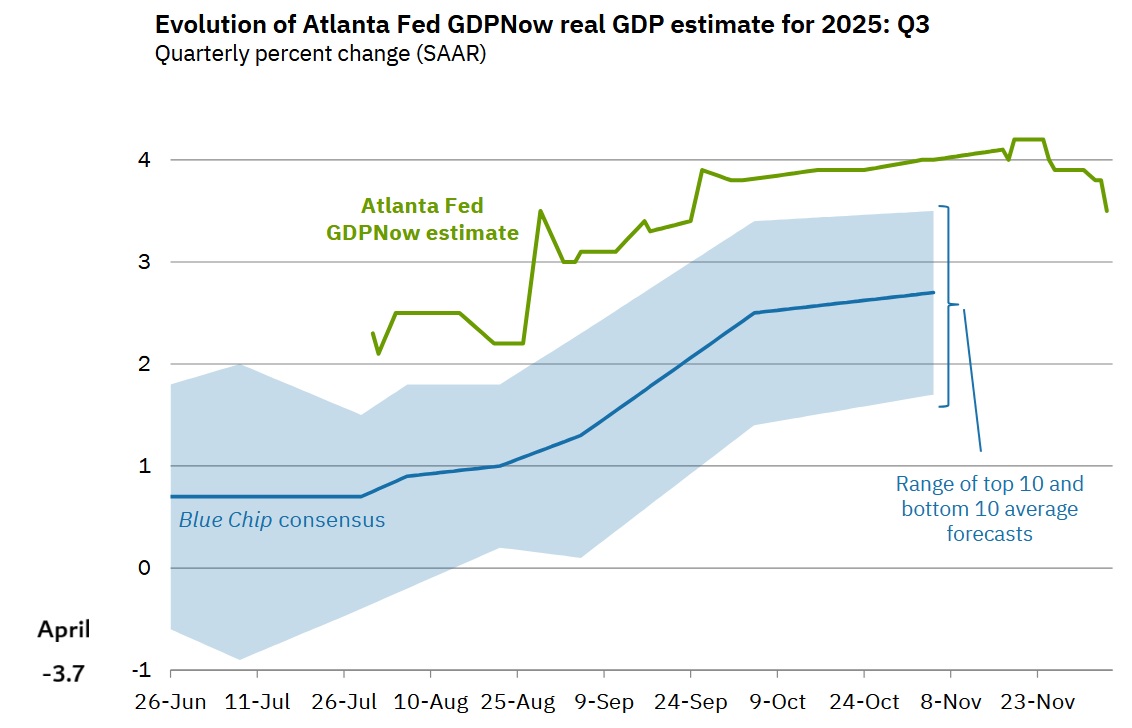
These policies are not just economically risky—they’re actively destabilizing the tools we rely on to understand the economy. Even the Atlanta Fed’s GDPNow model, one of the most respected real-time forecasting systems, has struggled to capture the resulting volatility.

The First Shockwave: GDP Collapses in Early 2025

During the first quarter of 2025, the GDPNow model projected real GDP growth (seasonally adjusted annual rate) at –3.7%. The contraction was so sharp that it fell off the scale of standard graph displays.

Crucially, this collapse wasn’t caused by consumer demand or business investment falling apart—it was almost entirely due to the way imports and exports are measured in GDP accounting. With Trump’s tariff schedule looming, businesses launched a massive, front-loaded rush to import goods before the tax hikes hit, causing an artificial spike in imports that mechanically pushed GDP downward.

This is not normal economic behavior. It’s panic behavior—created by policy.

The Tariff Whiplash Effect: Forecasts Go Wild

Once the early-year import surge ended, import levels cratered. Because imports are subtracted in GDP calculations, this plunge created the opposite effect: a predicted surge in GDP growth for late 2025.

Initial projections showed GDPNow spiking to around 5% in Q3 and Q4.

But those optimistic spikes never fully materialized.

The tariffs had a far more damaging, persistent effect on supply chains than anticipated. Import volumes fell harder and for longer than models historically assume possible.

As a result, GDP appears to have briefly peaked at about 4% in November 2025, followed by a rapid decline.

Where the Economy Is Heading Now

Current forecasts show GDP falling sharply again, with projections targeting near 0% growth in the first two quarters of 2026.

And this time, the uncertainty is extreme. Economists describe today’s forecast bands as “cone-of-uncertainty levels wider than during COVID,” because:

  • Tariff effects are non-linear and historically unprecedented
  • Supply chains are behaving unpredictably
  • Consumer prices are destabilizing
  • Business investment is freezing due to policy confusion

In short: upside potential is tiny, but downside risk is enormous.

The Supreme Court Wildcard

One of the biggest unknowns is the upcoming Supreme Court ruling on whether Trump’s “retaliatory tariffs” are even legal.

If the Court invalidates them abruptly:

  • Imports could surge again
  • Supply chains would be thrown into chaos
  • Businesses would need to reprice and reorder instantly
  • GDP models would again be blindsided

If the Court upholds them, the U.S. remains locked into a historically high-tariff regime that suppresses imports, raises prices, and slows growth.

Either outcome carries major economic shock potential.

Additional Policy Risks on the Horizon

Forecasting also remains clouded by several other Trump-era policy disruptions, each of which could individually affect GDP growth but collectively pose massive systemic risk:

  • Immigration restrictions, which could worsen labor shortages and reduce potential GDP
  • Healthcare policy uncertainty, especially around ACA destabilization
  • Expansion of fossil fuel subsidies, which distort investment flows and long-term energy costs
  • Budgetary unpredictability due to inconsistent fiscal priorities

All of these factors compound the difficulty of projecting the next 12–18 months.

Conclusion: The U.S. Is Entering an Economically Uncharted Era

The combination of unprecedented tariffs, volatile trade behavior, unstable supply chains, and sweeping policy changes has pushed the U.S. economy into a state where traditional forecasting tools are struggling to keep up.

This is not just “normal economic noise.”
This is a result of anti-economic policy design, implemented at a scale large enough to break the models themselves.

Until the policy environment stabilizes—and until the Supreme Court resolves key legal uncertainties—the U.S. economy is likely to remain on a knife’s edge, with enormous downside risk and extremely limited upside potential.

2025 GDP
2025 GDP

Trumpenomics

bookmark_borderFlorida at the Front Line: How Accelerating Sea-Level Rise Is Reshaping the State in Real Time

by Daniel Brouse
December 5, 2025

Florida faces a long list of climate-driven threats — extreme heat, stronger hurricanes, toxic algal blooms, and collapsing insurance markets — but accelerating sea-level rise (SLR) sits at the center of nearly all of them. Although the current rise of a few millimeters per year may sound trivial, the reality is anything but. Sea-level rise is no longer linear; it is entering a phase of nonlinear, exponential acceleration, and Florida is already experiencing the consequences.

1. Sea-Level Acceleration: From Millimeters to Centimeters

Sea level has been rising for a century, but what matters most is the rate of change. Historically, it took roughly a century for the rate to jump from ~3 mm/year to ~6 mm/year. Now, that doubling has happened in just eight years.

This exponential acceleration is driven by:

  • Rapid ice-sheet melt in Greenland and Antarctica
  • Thermal expansion of superheated oceans
  • Slowing ocean circulation (including the AMOC)
  • Increased land subsidence in coastal regions

If current trends hold — and most projections underestimate nonlinear behavior — Florida could see centimeters per year within the next decade and experience multiple surge-years this century where sea levels jump over a foot in a single year due to ice-sheet pulses and ocean heat anomalies.

This is not a distant scenario. It is unfolding now.

2. Everyday Flooding: Surge Without a Storm

Storm surge is no longer just a hurricane problem. Florida now experiences regular tidal flooding with no storms at all, as “sunny-day floods” push seawater into streets, yards, and infrastructure simply because the baseline sea level is higher.

Consequences include:

• Infrastructure decay

Saltwater corrodes electrical systems, sewer lines, bridges, roads, pumps, and underground cables. Critical infrastructure in Miami-Dade, Tampa Bay, the Keys, and Jacksonville is suffering chronic damage.

• Soil and ecosystem collapse

Saltwater intrusion destroys soil structure, kills vegetation, and converts freshwater wetlands into ghost forests.

• Drinking-water contamination

Saltwater is infiltrating freshwater aquifers — especially the Biscayne Aquifer — which supply millions of Floridians with drinking water.

One striking example of the water crisis:

“VERY RARE”: Tampa is currently purchasing about 10 million gallons of water per day — something officials say almost never happens this early in the year.
Saltwater intrusion and low river flows are driving emergency purchases months ahead of schedule.

3. Insurance Market Collapse: Climate as an Economic Wrecking Ball

Extreme saltwater events, chronic flooding, stronger hurricanes, and skyrocketing property risk have triggered a full-scale insurance meltdown in Florida.

The results:

  • Dozens of private insurers have left the state
  • Those remaining have raised premiums by 50–200%
  • Auto insurance rates are rising due to saltwater-related electronics failures and flood losses
  • Citizens Property Insurance — the taxpayer-funded state insurer of last resort — is now the largest insurer in Florida

This means the financial burden is shifting directly onto Florida taxpayers, even if they live nowhere near the coast.

4. The Bottom Line

Florida’s sea-level rise is not “millimeters that don’t matter.”
It is:

  • Accelerating at a historically unprecedented rate
  • Flooding infrastructure even on sunny days
  • Salting soils and destroying ecosystems
  • Contaminating drinking water
  • Collapsing the private insurance market
  • Forcing taxpayers to absorb billions in risk

Florida is already living in the future the rest of the country is headed toward. The question is no longer if sea-level rise will reshape the state, but how fast and how prepared communities will be for what’s coming next.

* Our probabilistic, ensemble-based climate model — which incorporates complex socio-economic and ecological feedback loops within a dynamic, nonlinear system — projects that global temperatures are becoming unsustainable this century. This far exceeds earlier estimates of a 4°C rise over the next thousand years, highlighting a dramatic acceleration in global warming. We are now entering a phase of compound, cascading collapse, where climate, ecological, and societal systems destabilize through interlinked, self-reinforcing feedback loops.

What Can I Do?
The single most important action you can take to help address the climate crisis is simple: stop burning fossil fuels. There are numerous actions you can take to contribute to saving the planet. Each person bears the responsibility to minimize pollution, discontinue the use of fossil fuels, reduce consumption, and foster a culture of love and care. The Butterfly Effect illustrates that a small change in one area can lead to significant alterations in conditions anywhere on the globe. Hence, the frequently heard statement that a fluttering butterfly in China can cause a hurricane in the Atlantic. Be a butterfly and affect the world.

Tipping points and feedback loops drive the acceleration of climate change. When one tipping point is breached and triggers others, the cascading collapse is known as the Domino Effect.

The Human Induced Climate Change Experiment

bookmark_borderSmall Businesses Are the First Casualties of Trump’s Tariff Economy — And the Jobs Data Proves It

The latest employment numbers reveal exactly why small businesses are suing President Trump over his tariff policies: tariffs hit small firms and lower-income consumers the hardest, functioning as a stealth tax that now adds anywhere from 20% to over 50% to the cost of many goods compared with last year.

And the results are now undeniable.

Record Small Business Bankruptcies and a Collapse in Hiring

Small business bankruptcies have surged to record highs, and the newest job numbers show the situation is accelerating.

According to the November 2025 ADP National Employment Report, the private sector saw a net loss of 32,000 jobs. That decline was driven entirely by small businesses, which shed an alarming 120,000 workers in just one month.

ADP’s chief economist, Dr. Nela Richardson, called small firms “a canary in the coal mine” — the first to suffer when consumer demand weakens and operating costs spike. Pay growth for small-firm workers also fell far behind that of larger companies, underscoring how badly the sector is being squeezed.

This isn’t a blip. It’s a structural failure created by policy.

Tariffs Are Functioning as a Massive, Regressive Tax

Unlike large corporations, small businesses don’t have the financial cushion, global supply chains, or pricing power to absorb sudden spikes in import costs. They pay tariffs up front, while their customers — mostly working- and middle-class households — face higher prices at checkout.

That’s why small businesses are paying the equivalent of 20% to over 50% more in real taxes compared with last year. U.S. import prices (excluding the tariff) show that foreign exporters have been raising their prices in dollars. This indicates they are not absorbing much, if any, of the tariff cost.


Tariffs are taxes. And these taxes are crippling the very businesses that drive local economies and job creation.

The Administration Blames… Democrats?

In stark contrast to economic reality, U.S. Secretary of Commerce Howard Lutnick declared that the weak job numbers were not caused by tariffs, but instead blamed:

  • the recent government shutdown, and
  • mass deportations,
    as if those weren’t also direct consequences of Trump’s own policies.

Tariffs raised business costs.
The shutdown weakened demand.
Mass deportations removed workers and consumers.
Every explanation points back to the same place.

The Lawsuit Before the Supreme Court

The reason small businesses are currently suing the administration — in a case now before the U.S. Supreme Court — is precisely because Trump’s tariff actions have caused severe, measurable financial harm.

If the Court rules the tariffs illegal (as multiple lower courts already have), businesses want the right to recover the money they were forced to pay. Without that ruling, many of them won’t survive.


Small businesses are not just numbers on a spreadsheet — they’re the backbone of the U.S. economy. And right now, Trump’s tariff regime is breaking that backbone.

Trumpenomics

bookmark_borderTariffs, Protectionism, and Economic Self-Harm: Why Costco’s Lawsuit Exposes a Bigger National Problem

Costco Has Sued the U.S. Government — and It Highlights the Bigger Failure of Trump’s Tariff Policy

Costco has filed suit against the U.S. government — specifically U.S. Customs and Border Protection — to preserve its ability to receive a full refund on tariffs it has already paid, should the Supreme Court ultimately rule that President Trump’s tariffs were illegal.

This case is not just about Costco. It is a symptom of the deeper economic damage caused by tariffs and protectionism.

Key Details of the Lawsuit

1. Purpose of the Suit

Filed on November 28, 2025, in the U.S. Court of International Trade, Costco’s lawsuit is not intended to strike down the tariffs directly. Instead, it aims to protect Costco’s right to reclaim the money it paid in tariffs — money that may have been unlawfully collected.

2. The “Liquidation” Deadline

Costco faces a crucial December 15, 2025 deadline for certain import entries to be liquidated (finalized by Customs). Once an entry is liquidated, an importer can permanently lose the right to challenge those charges or receive a refund.

Costco says Customs refused to extend the deadline, leaving the company no choice but to sue immediately to avoid losing millions.

3. Legal Foundation of the Challenge

The lawsuit cites earlier rulings by the Court of International Trade and the Federal Circuit, both of which determined that Trump misused the International Emergency Economic Powers Act (IEEPA).
Those courts concluded the law did not give him the authority to impose the tariffs he enacted.

This core legal issue is now before the Supreme Court.

4. The Supreme Court’s Role

The Supreme Court heard arguments last month and is expected to rule soon on whether the tariffs were illegal. Costco’s lawsuit ensures that if the Court rules against Trump’s authority, Costco will be positioned to receive a refund — potentially tens or hundreds of millions of dollars.

5. Part of a Larger Corporate Pushback

Costco is not alone. Major companies including Revlon, Bumble Bee Foods, and Kawasaki Motors have filed similar suits to preserve their rights to reimbursement. Collectively, these legal actions highlight the widespread financial harm caused by the tariffs.

How Tariffs and Protectionism Damage the Economy

Tariffs Are Taxes on Americans — Not on Foreign Countries

Politicians promote tariffs as “making other countries pay,” but that is unequivocally false.
U.S. businesses pay the tariffs. U.S. consumers pay the higher prices. Tariffs are simply a hidden sales tax.

Tariffs Raise Inflation

Economists across the political spectrum agree: tariffs raise the cost of imported goods, and those costs ripple through supply chains, forcing companies to raise prices.
Trump’s tariffs have contributed significantly to higher costs for:

  • food
  • electronics
  • vehicles
  • building materials
  • clothing
  • household goods

The Costco lawsuit underscores how much corporate America has been forced to absorb — or pass on to consumers.

Protectionism Destroys Jobs Rather Than Creating Them

Tariffs are often sold as “protecting American jobs,” but the historical and empirical record shows:

  • Far more jobs rely on inexpensive imported inputs
  • Retaliatory tariffs reduce U.S. exports
  • Supply chains become strained
  • Manufacturing declines instead of growing

Every time the U.S. has leaned into protectionism (Smoot-Hawley in the 1930s, steel tariffs in the 2000s, Trump’s first-term tariffs), jobs were lost and recessions worsened.

Tariffs Undermine Global Confidence in the U.S. Economy

The Costco lawsuit points to a growing crisis:
If companies believe U.S. policy is arbitrary, unpredictable, or politically motivated, they lose confidence in the U.S. market.

This raises borrowing costs, increases volatility, and weakens the dollar — the exact opposite of what a healthy global reserve currency requires.

Protectionism Hurts Small Businesses the Most

Large companies like Costco can file lawsuits and hedge against risk.
Small businesses cannot. They simply face:

  • higher costs
  • lower profits
  • reduced competitiveness
  • bankruptcy risk

Protectionism is a tax on the middle class and a subsidy for the politically connected.

Conclusion: Costco’s Case Is a Warning Sign

The Costco lawsuit illustrates a much broader economic truth:

Tariffs and protectionism are not “America First.”
They are inflationary, economically destructive, and legally unstable.

If the Supreme Court rules the tariffs illegal, the U.S. will be forced to face an even harder reality:
The economic damage was unnecessary, self-inflicted, and entirely avoidable.

Trumpenomics

bookmark_borderTrump’s Fiscal Volatility and the Rising Global Risk: How Political Interference Is Destabilizing the Dollar and the World Economy

There are several interlocking elements of Donald Trump’s fiscal and political strategy that are increasingly destabilizing the global economy. As international markets grow more risk-averse, the persistent uncertainty surrounding U.S. institutions — particularly the financial and judicial systems — is eroding confidence in the dollar. The global economy still relies on the dollar as its primary reserve currency, so even subtle shifts in trust can have outsized effects.

That erosion is now visible. Eurozone lenders with substantial dollar-denominated operations are being warned to bulk up their liquidity and capital buffers in anticipation of potential volatility triggered by Trump’s actions. On Wednesday, the European Central Bank issued a pointed warning: the growing instability around U.S. fiscal policy, political pressure on independent institutions, and tariff-driven disruptions could expose the global financial system to a dangerous squeeze.

The ECB has been quietly sounding the alarm since Trump’s tariff escalations and his public pressure campaign on the Federal Reserve rattled confidence in the spring. The issue is not who chairs the Fed — the chair does not unilaterally set interest rates. What matters is the perception of political influence. When a president attempts (or even appears) to steer central bank decisions, the credibility of the institution erodes. For a reserve-currency nation, credibility is not just a virtue — it is the foundation of global financial stability.

In its latest Financial Stability Review, the ECB sharpened its language. It emphasized that the handful of major eurozone banks heavily exposed to the dollar must prepare for the possibility of sudden, Trump-induced volatility.

“Capital headroom could be needed to absorb … higher currency volatility and counterparty credit risk,” the ECB wrote in its twice-yearly report. “Banks should hold liquid U.S. dollar assets to counterbalance outflows and act as a stabilising intermediary.”

The ECB also reiterated broader concerns: inflated stock market valuations, historically high global debt, trade tariffs that undermine supply chains, and the unpredictable growth of stablecoins — all factors that amplify systemic fragility.

The pattern is unmistakable. Trump’s fiscal destabilization is not confined to the United States — it radiates outward, magnifying global risk, weakening trust in the dollar, and forcing foreign institutions to brace for shocks they did not create.

The world is preparing for turbulence. The question is whether the United States is.

Trumpenomics

bookmark_borderA Treasury Secretary Out of His Depth: Bessent’s Bungled Defense of Rising Prices and Tariff Failures

The Treasury Secretary offered up a last-ditch, visibly strained defense on NBC’s Meet the Press while discussing the administration’s sudden decision to roll back tariffs on a range of food products. What followed was one of the most awkward and revealing interviews of the administration’s economic team to date.

When journalist Kristen Welker pressed Bessent, 63, with the obvious question — “Isn’t the fact that you’re rolling back tariffs an admission that they ultimately do drive up prices?” — he interrupted abruptly with a bizarre deflection:

“Kristen, how much does your arm weigh?”

Welker, understandably taken aback, tried to steer the conversation back to the facts. But Bessent doubled down:

“You know how much you weigh, and you get on the scale every morning. Inflation is a composite number and we look at everything, so we are trying to push down the things we can control.”

Instead of answering the straightforward economic question, the Treasury Secretary offered a metaphor that made no economic sense and evaded the issue entirely. He then launched into a broad — and equally unconvincing — defense of the administration’s economic record, insisting that energy prices were “flattening” and that “other prices will follow,” despite consumer data showing the opposite trend.

This exchange came immediately after Bessent visibly stumbled while attempting to explain a contradiction now central to Trump’s economic policy. Months ago, he enthusiastically claimed that tariffs were good for consumers. Today, Trump is being forced to roll back tariffs on essential consumer goods because prices for everyday items — including staples like bananas and coffee — have surged under the tariff regime.

The contradiction is not subtle. It is not complicated. And Bessent was unable to reconcile it.

A Treasury Secretary Without the Basics

Many observers are now openly questioning why Bessent is Treasury Secretary at all. His résumé only deepens the concern:

  • No prior experience in government finance or macroeconomic policy
  • Previously a hedge fund manager, not an economist
  • Before that, a history teacher, with no discernible background in fiscal or monetary analysis
  • No published economic work, no record of policy scholarship, and no demonstrated expertise in inflation mechanics, taxation, or global trade

In short, nothing in his background suggests even a foundational understanding of the economic tools he is now attempting — unsuccessfully — to defend on national television.

The administration’s tariff policies have been widely criticized by economists across the political spectrum for raising prices, dampening consumer demand, and contributing to a broader economic slowdown. Sunday’s interview only underscored what many feared: the nation’s chief economic policymaker cannot explain the consequences of his own policies and appears unfamiliar with basic economic principles.

What should have been a straightforward discussion about tariffs and consumer prices instead became an uncomfortable display of confusion, deflection, and economic incoherence — raising even deeper concerns about who is steering the country’s financial policy at one of the most volatile moments in modern economic history.

Trumpenomics