bookmark_borderHow the “Global Average” Is Hiding the Real Climate Emergency

by Daniel Brouse
December 16, 2025

Q3 2025: Extreme Global Temperature Anomalies

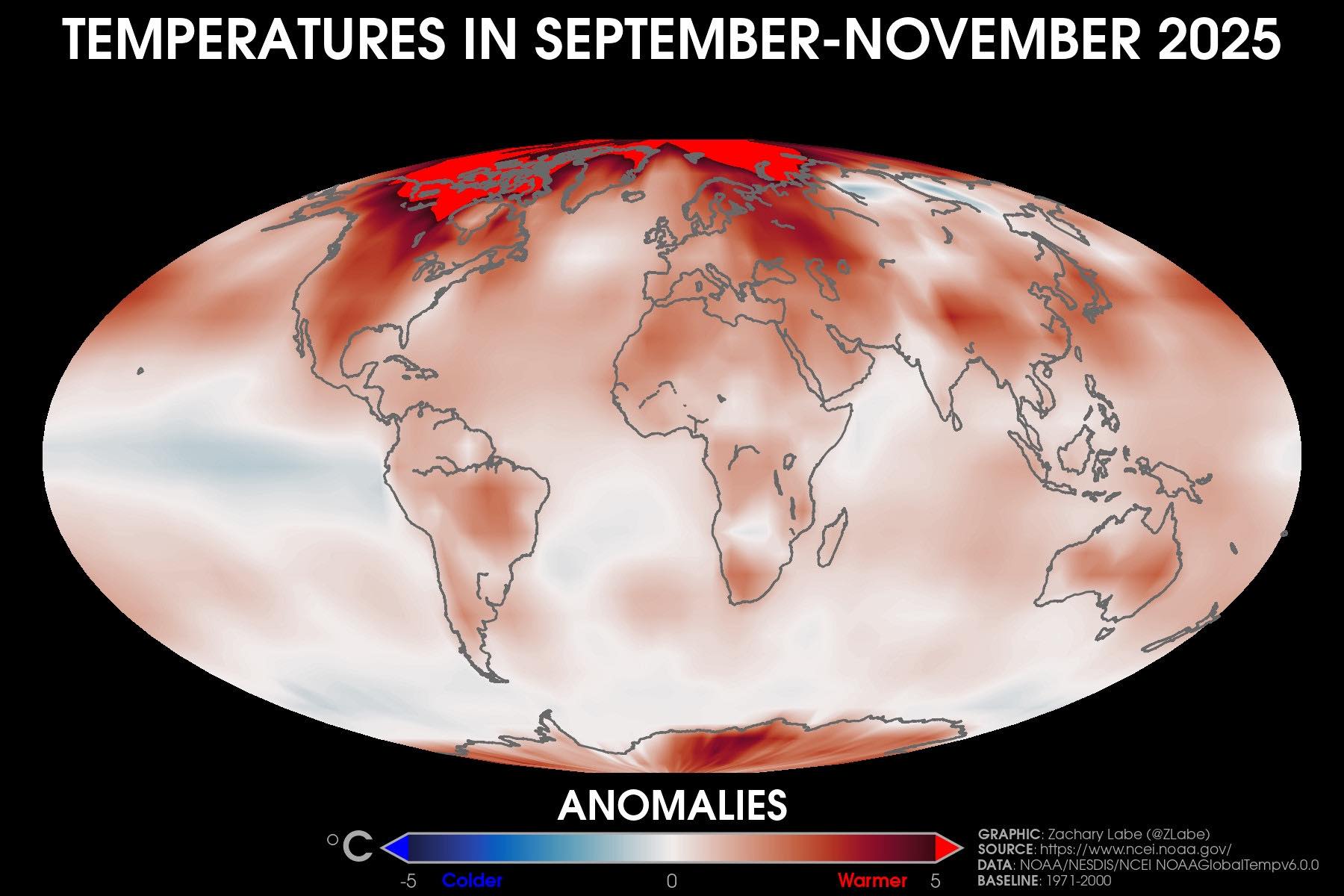
Autumn (September–November) climate data reveal two features that matter far more than the global average: what is happening at the poles and what is happening at the equator.

Both the Arctic and Antarctic are experiencing record-breaking temperatures—warming at rates up to 20 times faster than much of the rest of the planet, visible as deep red anomalies on global maps. This extreme polar amplification is not a regional curiosity; it is destabilizing the foundational circulation systems that regulate Earth’s climate, including the jet stream, the Atlantic Meridional Overturning Circulation (AMOC), and the Pacific Meridional Overturning Circulation (PMOC).

As a direct consequence, the Northeastern United States is now experiencing sharp climate whiplash: record cold conditions this week, followed by unseasonably warm temperatures days later. These are not random swings—they are signatures of a circulation system that is losing coherence.

The Poles: Where Climate Change Is Accelerating Fastest

The polar regions act as the planet’s thermal anchors. Normally, the large temperature contrast between the equator and the poles powers a fast, stable jet stream and robust ocean circulation. But as the Arctic warms nearly four times faster than the global average, and Antarctic ice loss accelerates, that temperature gradient is collapsing.

With less contrast to drive it, the jet stream weakens and becomes increasingly wavy and prone to stalling. This allows weather patterns to linger—producing prolonged heatwaves, extended cold outbreaks, persistent flooding, and flash droughts. At the same time, freshwater from polar melt is disrupting deep-water formation in the North Atlantic, weakening the AMOC and altering global heat transport.

The Equator: The Illusion of Cooling

The other key feature in the data is a small blue patch along the equatorial Pacific—a weak La Niña signal. This localized cooling will likely prevent 2025 from being recorded as the single hottest year on record by slightly suppressing the global mean temperature.

But this is precisely where the global average becomes misleading.

Oceans absorb the vast majority of excess heat and require far more energy to warm than air or land. A small cooling anomaly in the tropical Pacific can therefore offset massive heating elsewhere in the global average—especially at the poles—without reducing actual climate risk.

In other words, the planet can appear “less hot” on paper while becoming far more dangerous in reality.

Why “Global Average Temperature” Misleads

A 3 °C increase in the global average temperature sounds abstract and manageable. In reality, it masks extreme regional outcomes that determine human survivability.

  • The Arctic is already warming more than four times faster than the global mean, with localized increases exceeding 10 °C. In 2025, parts of the Arctic are running as much as 20 °C above normal.

  • Land and air temperatures rise far faster than ocean averages.

  • Human limits are governed not by global means, but by regional extremes and wet-bulb temperatures—the point at which heat and humidity overwhelm the body’s ability to cool itself.

When policymakers talk about “holding warming below 1.5 °C,” they are referring to a blended average across oceans, land, and atmosphere. But oceans absorb over 90% of the excess heat trapped by greenhouse gases, heavily damping the apparent rise in the global mean.

This creates a dangerous illusion of control.

The Ocean Heat Mask

Recent deep-ocean studies show that even the deepest layers of the ocean are warming. A change of just 0.1 °C in ocean temperature represents an enormous amount of stored energy. If that heat were redistributed over land, it would be equivalent to roughly a 35 °C increase—a level incompatible with large-scale human survival.

The oceans are acting as a temporary buffer, hiding the true magnitude of warming while simultaneously destabilizing themselves through:

  • Increased stratification

  • Slowing circulation

  • Oxygen loss

  • Ecosystem collapse

During 2025, the Pacific Ocean has been running approximately 1.6 °C above its long-term average—a deviation of six standard deviations above the mean. In climate science, values this far from normal variability are essentially off the charts.

The Thresholds That Matter

Two temperature thresholds now demand urgent attention:

  • ~1.5 °C global average warming
    This marks the widespread activation of major climate tipping points—ice sheet instability, circulation slowdown, ecosystem collapse.

  • ~9 °C land and air warming
    This represents the upper boundary of human physiological survivability across much of the planet.

These are not distant, theoretical limits. They are rapidly approaching—and in some regions, already being exceeded.

The climate crisis is no longer about slow, linear warming. It is about where the heat is accumulating, how it is destabilizing Earth’s life-support systems, and how misleading averages are masking the speed and severity of the transformation now underway.

* Our probabilistic, ensemble-based climate model — which incorporates complex socio-economic and ecological feedback loops within a dynamic, nonlinear system — projects that global temperatures are becoming unsustainable this century. This far exceeds earlier estimates of a 4°C rise over the next thousand years, highlighting a dramatic acceleration in global warming. We are now entering a phase of compound, cascading collapse, where climate, ecological, and societal systems destabilize through interlinked, self-reinforcing feedback loops.

We examine how human activities — such as deforestation, fossil fuel combustion, mass consumption, industrial agriculture, and land development — interact with ecological processes like thermal energy redistribution, carbon cycling, hydrological flow, biodiversity loss, and the spread of disease vectors. These interactions do not follow linear cause-and-effect patterns. Instead, they form complex, self-reinforcing feedback loops that can trigger rapid, system-wide transformations — often abruptly and without warning. Grasping these dynamics is crucial for accurately assessing global risks and developing effective strategies for long-term survival.

Tipping points and feedback loops drive the acceleration of climate change. When one tipping point is breached and triggers others, the cascading collapse is known as the Domino Effect.

The Climate Crisis: Violent Rain | Deadly Humid Heat | Health Collapse | Extreme Weather Events | Insurance | Trees and Deforestation | Rising Sea Level | Food and Water

The Human Induced Climate Change Experiment

Runaway Feedbacks: Can Earth Warm 9°C This Century?
bookmark_borderPolar Bear Plunge: Will Humans Follow? (Adaptation Part II)

Polar Bear Plunge: Will Humans Follow?

Adaptation Part II

Daniel Brouse
December 14, 2025

Abstract

In The Plight of the Penguin: Will Humans Follow? (Adaptation Part I), I examined how multiple penguin species—despite short-term behavioral flexibility—are failing to adapt to the pace and scale of anthropogenic climate change. This second paper extends that analysis to the Arctic, focusing on polar bears as a living stress test for biological adaptation under rapid warming. Together, penguins and polar bears frame the planetary poles as early-warning systems for human survivability. While limited genetic and epigenetic responses are emerging in some species, the evidence suggests that nonlinear climate dynamics and cascading feedback loops are outpacing adaptive capacity—first in wildlife, and increasingly in humans.

I. From Penguins to Polar Bears: A Shared Signal

Penguin populations across the Southern Hemisphere are undergoing rapid collapse as climate change, ocean warming, disrupted food webs, and direct human exploitation destabilize their ecosystems. While a handful of species show limited, short-term adaptability, the majority are now projected to decline irreversibly within this century.

The Emperor Penguin, African Penguin, Yellow-eyed Penguin, Erect-crested Penguin, Galápagos Penguin, Macaroni Penguin, and Southern Rockhopper Penguin have all failed to adapt to accelerating environmental change. Current projections place several of these species on extinction trajectories within decades—some potentially much sooner.

These collapses are not isolated ecological tragedies. They are biological signals. Penguins evolved for cold, stable systems; when those systems destabilize beyond critical thresholds, even highly specialized and once-resilient species fail. This same pattern—rapid environmental change overwhelming adaptive capacity—now appears in the Arctic.

II. Polar Bears: The Arctic’s Canary

Polar bears (Ursus maritimus) provide one of the clearest real-time examples of how climate change drives species toward physiological and ecological limits. The Arctic is warming between three and twenty times faster than the global average, making it an early indicator of future conditions elsewhere.

Sea ice loss is the single most important driver of polar bear decline. Bears depend on stable ice platforms to hunt seals; as these platforms vanish, bears are forced into longer swims, nutritional stress, isolation, and reproductive failure. This season alone, polar bears have been documented swimming up to 80 miles in search of ice and prey. Many juveniles do not survive these journeys.

As a result, polar bear populations across most regions are declining rapidly, with increasing mortality among cubs and subadults.

III. A Glimmer of Adaptation — and Its Limits

There is, however, a narrow and sobering glimmer of hope: genetic response under extreme stress.

Recent research led by Alice Godden, building on earlier University of Washington work, examined blood samples from polar bear populations in northeastern and southeastern Greenland. The southeastern group inhabits a significantly warmer climate zone—conditions similar to what much of the Arctic is expected to experience later this century.

In this southern population, researchers identified differences in gene activity related to:

  • Heat stress response
  • Aging
  • Metabolism and digestion

These findings suggest that climate stress is actively influencing gene regulation. As Godden noted, this may represent the first documented case of rising temperatures driving genomic change in a mammal.

In the Springer Nature paper “Diverging transposon activity among polar bear sub-populations inhabiting different climate zones,” the authors describe how transposable elements (TEs)—mobile sections of DNA—are behaving differently across subpopulations. These elements can accelerate genetic change under environmental stress.

In essence, different groups of polar bears are experiencing different sections of their DNA being activated or altered at different rates, closely linked to their local climate conditions. Godden described this as a form of the species being forced to “rewrite its own DNA”—a desperate survival mechanism in response to melting sea ice.

IV. Why This Does Not Mean Polar Bears Are Safe

Despite this remarkable finding, the implications are grim. The same research estimates that two-thirds of the global polar bear population could be gone by 2050, with total extinction likely by the end of the century if current warming trends continue.

The Arctic Ocean has repeatedly recorded record-high temperatures in recent years. Reduced sea ice has:

  • Eliminated hunting platforms
  • Increased fasting duration
  • Forced dietary shifts toward low-fat, plant-based or scavenged food sources

These changes are driving physiological stress and may be altering body composition and morphology. Adaptation, in this context, does not mean recovery—it means buying time.

As Godden emphasized, these findings do not reduce extinction risk. At best, they offer a narrow genetic blueprint for how adaptation might occur—if warming slows enough to allow it.

V. Humans and the Myth of Superior Adaptation

A common assumption is that humans, by virtue of intelligence and technology, will adapt where other species fail. This belief is not supported by the bulk of current scientific evidence.

Unlike polar bears, whose genetic shifts may offer limited resilience, human biological changes under climate stress are increasingly maladaptive. Even more troubling, many of these changes are epigenetic and transgenerational—meaning they can be passed on to future generations.

Adaptation, in humans, is beginning to resemble degradation.

VI. Climate Extremes and Cellular Breakdown

The health impacts of climate change are no longer abstract projections; they are measurable and accelerating.

  • One death per minute: Heat-related mortality now averages roughly one fatality per minute worldwide.
  • Rising exposure: Over the past four years, the average person has experienced 19 days per year of life-threatening heat, nearly all attributable to human-caused warming.
  • Severe health impacts: Extreme heat causes heatstroke, dehydration, kidney injury, and exacerbates cardiovascular and respiratory disease.

Prolonged heat exposure accelerates biological aging, damages tissues, and shortens telomeres at the cellular level. These processes increase the risk of:

  • Cancer
  • Dementia
  • Diabetes
  • Cardiovascular disease

Mental health is also affected. Heat stress correlates with increased rates of depression, anxiety, aggression, and suicide.

VII. Epigenetics: The Molecular Convergence of Climate Stressors

A critical mechanism linking these outcomes is epigenetic change—chemical modifications that regulate gene expression without altering DNA sequences. These changes act like dimmer switches, activating or silencing genes in response to environmental conditions.

Climate-related stressors that drive epigenetic change include:

  • Extreme heat
  • Ozone and air pollution exposure
  • Infectious disease, including COVID-19

All three are directly connected to fossil fuel combustion and climate destabilization.

When multiple stressors act simultaneously, epigenetic effects compound rather than add, increasing vulnerability across multiple organ systems. Genes associated with cancer, metabolic disease, cardiovascular dysfunction, and neurological disorders become more likely to activate.

Of particular concern is evidence that some epigenetic changes are heritable, raising the specter of transgenerational decline—where reduced health, shortened lifespan, and heightened disease risk are passed forward even if environmental conditions later stabilize.

VIII. Conclusion: A Narrowing Window

Penguins and polar bears are not merely victims of climate change; they are indicators. Their struggles reveal the limits of biological adaptation under rapid, nonlinear environmental change.

Polar bears show that even when genetic flexibility exists, it may only delay extinction—not prevent it. Humans, meanwhile, appear to be accumulating biological damage faster than beneficial adaptation.

The lesson is stark: adaptation without mitigation is failure postponed. The window for preserving both human health and planetary biodiversity is closing, and no species—no matter how intelligent—can out-evolve a collapsing climate system.

The choice is no longer whether change is coming, but whether we act quickly enough to remain biologically capable of surviving it.

* Our climate model — which incorporates complex social-ecological feedback loops within a dynamic, non-linear system — projects that global temperatures could rise by up to 9°C (16.2°F) within this century. This far exceeds earlier estimates of a 4°C rise over the next thousand years, signaling a dramatic acceleration of warming.

We analyze how human activities (such as deforestation, fossil fuel use, and land development) interact with ecological processes (including carbon cycling, water availability, and biodiversity loss) in ways that amplify one another. These interactions do not follow simple cause-and-effect patterns; instead, they create cascading, interconnected impacts that can rapidly accelerate system-wide change, sometimes abruptly. Understanding these dynamics is essential for assessing risks and designing effective climate adaptation and mitigation strategies.

The Climate Crisis: Violent Rain | Deadly Humid Heat | Health Collapse | Extreme Weather Events | Insurance | Trees and Deforestation | Soil | Rising Sea Level | Food and Water | Updates

Tipping points and feedback loops drive the acceleration of climate change. When one tipping point is breached and triggers others, the cascading collapse is known as the Domino Effect.

The Human Induced Climate Change Experiment

bookmark_borderTipped Tipping Points: The Non-Linearity of Climate Collapse

By Daniel Brouse and Sidd Mukherjee
December 12, 2025

Introduction

The non-linearity of collapse describes how complex systems can appear stable for long periods before experiencing a sudden, rapid, and often unexpected breakdown. Instead of declining gradually, systems absorb stress quietly until they cross a critical threshold—after which deterioration becomes abrupt, exponential, and irreversible.

This dynamic applies across climate, ecological, infrastructural, and socio-economic systems. Understanding it is essential to recognizing why global stability is now unraveling faster than most projections anticipated.

The Dynamics of Non-Linear Collapse

1. Accumulation of Stress

Systems absorb increasing stress—pollution, inequality, biodiversity loss, deferred maintenance—while appearing stable. This creates a false sense of resilience.

2. Hidden Thresholds (Tipping Points)

Every system has limits. Once a critical boundary is crossed, stabilizing mechanisms fail, and the system’s condition changes abruptly.

3. Rapid Breakdown

After tipping, feedback loops accelerate the collapse. Decline becomes exponential, not linear, and happens far faster than the stress buildup.

Examples of Non-Linearity in Climate Collapse

1. Arctic Sea Ice Collapse

Gradual decline for decades → sudden record-shattering drops in 2007 and 2012.
Once thinning breached a threshold, albedo feedback caused nonlinear, runaway melt.

2. Greenland & West Antarctic Ice Sheet Disintegration

Ice sheets remain stable until basal melt or grounding-line retreat passes a ridge.
After that, collapse becomes self-sustaining—even if warming stopped today.

3. AMOC (Atlantic Meridional Overturning Circulation)

A slow weakening over decades now signals proximity to a rapid shutdown.
When AMOC collapses, it will likely shift within years—not centuries.

4. Permafrost Thaw & Methane Bursts

Frozen ground remains stable until a thermal threshold is crossed.
Collapse into thermokarst landscapes releases methane in nonlinear spikes.

5. Amazon Rainforest Dieback

Appears stable until deforestation exceeds ~20–25%.
Then rapid savannification triggers massive carbon release.

6. Coral Reef Bleaching

Warm 1°C above normal → reefs shift from healthy to 80–90% dead in weeks.

7. Monsoon System Destabilization

A disrupted heat gradient can trigger rapid monsoon failure, collapsing food systems suddenly.

8. Boreal Forest Die-Off

Years of subtle stress → explosive multi-million-acre mortality once thresholds are crossed.

9. Global Food Supply Shock

Small yield declines → sudden global famine risk when multiple breadbaskets fail at once.

10. Extreme Weather Frequency Surge

“Stored” ocean heat enables sudden leaps in storm intensity and flood frequency.

11. Fisheries & Ocean Food Web Collapse

Ocean conditions shift past survivability limits → abrupt die-offs and trophic collapse.

12. Wildfire Regime Shifts

Forests tolerate warming until vapor-pressure thresholds trigger continent-scale megafires.

Summary: What Nonlinear Collapse Means

A system experiencing nonlinear collapse:

  • Absorbs stress invisibly
  • Appears stable
  • Crosses hidden thresholds
  • Then collapses abruptly and irreversibly

Multiple Earth systems are simultaneously approaching these thresholds—an unprecedented situation.


Compound, Cascading Collapse: The New Phase of Global Destabilization

We are no longer dealing with isolated climate impacts. The world has entered a phase of compound, cascading collapse, where failures in one system destabilize others. These collapses occur simultaneously and accelerate each other through interconnected feedback loops.

1. Climate Tipping Points Trigger Other Tipping Points

Examples of tipping cascades:

  • Arctic warming → sea ice loss → jet stream disruption → persistent heat domes and rainfall extremes
  • Warming oceans → weakened AMOC → shifting rainfall → Amazon dieback
  • Amazon dieback → carbon release → more warming → more Arctic ice loss

Each tipping point pushes others toward collapse.

2. Physical Hazards Now Stack and Multiply

Recent disasters increasingly involve multiple extremes at once:

  • Heatwave + drought + wildfire + crop failure
  • Storm surge + extreme rain + soil saturation + infrastructure collapse
  • Marine heatwave + coral mortality + fishery collapse + famine risk

These don’t simply add—they multiply one another’s impacts.

3. Infrastructure Failures Cascade

Modern systems were built for a stable climate:

  • Flood → power failure → water treatment failure → health crisis
  • Heat wave → grid overload → blackout → hospital failure
  • River flooding → sewage overflow → contamination → compounding damage

One failure weakens all connected sectors.

4. Ecological Collapses Reinforce Each Other

Examples:

  • Coral death → fishery decline → food insecurity
  • Insect loss → reduced pollination → crop losses → increased deforestation
  • Permafrost thaw → carbon release → biodiversity loss → ecosystem destabilization

Collapsed ecosystems heighten the risk of human system failure.

5. Economic and Social Systems Amplify Collapse

Climate shocks now interact with global fragility:

  • Crop failures → price spikes → political unrest → supply disruptions → more spikes
  • Insurance withdrawal → property market instability → municipal insolvency
  • Repeated disasters → displacement → extremism → policy paralysis

Social instability becomes both cause and effect.

6. Feedback Loops Across All Domains

Climate → ecology → infrastructure → economy → governance → climate.

Each domain amplifies the others, forming a global cascade.

This is why collapse is no longer linear—it is self-reinforcing acceleration.


Model-Based Assessment

Our probabilistic, ensemble-based climate model—integrating socio-economic and ecological feedbacks within a nonlinear system—indicates that global temperatures are accelerating toward conditions incompatible with modern civilization. Earlier estimates projected ~4°C warming over a millennium. Current projections show similar or higher warming this century.

We now face a world where multiple tipping elements destabilize at once.

Human activities—deforestation, fossil fuel combustion, urbanization, industrial agriculture—interact with ecological processes like carbon cycling, thermal redistribution, hydrology, and species decline. These are not linear cause-and-effect relationships. They are emergent, interlocking feedback loops capable of sudden, irreversible transformation.

Understanding these dynamics is essential for assessing global risk and planning human survival in the 21st century.

bookmark_borderAtmospheric Rivers, Jet Stream Instability, and America’s New Era of Climate Extremes

By Daniel Brouse — December 12, 2025

Atmospheric rivers are rapidly increasing in intensity, duration, and frequency as a direct consequence of human-driven climate change. Their behavior is now tightly linked to profound disruptions in the jet stream, the Atlantic Meridional Overturning Circulation (AMOC), and the Pacific Meridional Overturning Circulation (PMOC). These interacting systems are reshaping weather patterns across the United States, particularly in the Pacific Northwest — where an historic atmospheric river has once again revealed the fragility of our climate-altered world.

A Week of Catastrophic Flooding in Washington State

A powerful atmospheric river has drenched Washington state this week, delivering destructive and, in several locations, record-breaking flooding. Emergency declarations, mass evacuations, infrastructure failures, and paralyzed transportation systems underscore how climate-charged storms are overwhelming communities.

Key Impacts

• Record River Levels
Multiple rivers exceeded historical flood crests.
– The Snohomish River set a new all-time flood record.
– The Nooksack River at North Cedarville broke its all-time high.
– The Skagit River is projected to crest at a potentially record height near Mount Vernon.

• Widespread Evacuations
Mandatory evacuations affected an estimated 100,000 residents, including all of Burlington and parts of Mount Vernon.

• Infrastructure Failures
Landslides and rising water forced closures of major highways, including portions of I-90 and U.S. Route 2 over the Cascades.
The Lummi Nation declared a state of emergency as rising waters threatened to isolate the reservation.

• Meteorological Cause
A massive 7,000-mile-long atmospheric river, tapping deep tropical moisture, stalled over the Pacific Northwest. Mountain temperatures were warm enough that precipitation fell as rain — not snow — dramatically increasing runoff.

• Ongoing Threat
Even with rainfall easing, rivers remain dangerously swollen, levees are strained, and recovery will take weeks.

Washington Governor Bob Ferguson has declared a statewide emergency and requested federal assistance.

How Climate Change Is Supercharging Atmospheric Rivers

Atmospheric rivers have always been part of Earth’s climate system, but human-induced warming is amplifying them. A warmer atmosphere holds more moisture — roughly 7% more for every 1°C of warming (Clausius-Clapeyron relation) — which directly increases the intensity of these storms.

1. Increased Moisture and Stronger Storms

• Warmer Pacific waters and higher evaporation rates supply atmospheric rivers with unprecedented moisture loads.
• These enhanced rivers produce far heavier rainfall, greatly increasing flood risk.

2. Changing Trajectories

• As the jet stream becomes more unstable, atmospheric rivers take new and unpredictable paths.
• Regions historically unaffected — including parts of the U.S. East Coast — now face rising risk.

3. More Frequent Events

• Once-rare high-intensity atmospheric rivers are becoming commonplace.
• 100-year flood events are occurring every decade or less in some regions.

Jet Stream Destabilization: A Critical Driver

Climate change is profoundly weakening and destabilizing the jet stream — the fast, high-altitude wind current that governs global weather. This destabilization is driven primarily by Arctic amplification, where the Arctic warms 3–4 times faster than the global average.

What’s Happening to the Jet Stream

• Amplification and Slowing

The reduced temperature gradient between the Arctic and mid-latitudes weakens the jet stream, creating larger, slower-moving north–south waves.

• More Stalled Weather Patterns

A weakened jet stream locks weather systems in place:
– heatwaves linger
– cold spells deepen
– storms stall
– atmospheric rivers sit over one region for days

• Increased Blocking Patterns

Persistent high- or low-pressure “blocks” intensify extreme events — including the kind of prolonged flooding seen this week.

• Disrupted Zonal Flow

The jet’s typical west-to-east flow becomes wavier and erratic, redirecting storms into regions unprepared for extreme precipitation.

AMOC, PMOC, and the Wider Climate System

Atmospheric rivers and jet stream disruptions do not occur in isolation. They are part of a rapidly destabilizing climate system where oceanic overturning circulations play a central role.

AMOC Slowdown

The AMOC is weakening as Greenland meltwater reduces salinity in the North Atlantic. Consequences include:
• wetter, stormier winters in the Northeast U.S.
• increased hurricane intensity
• altered jet stream behavior
• higher sea levels along the East Coast

PMOC Changes

The Pacific overturning circulation is also shifting due to warming and altered wind patterns, influencing:
• atmospheric river formation
• heat distribution across the Pacific Basin
• long-term storm tracks

Climate Change and Atmospheric Chaos

Human-induced climate change is not a linear process. It is a nonlinear, dynamic, and chaotic system, governed by interacting subsystems — atmosphere, ocean, land, and biosphere.

As these subsystems destabilize, they reinforce one another through feedback loops:

• Arctic warming → jet stream weakening
• Jet stream weakening → more stalled atmospheric rivers
• More atmospheric rivers → intensified flooding, erosion, ecological damage
• Ecosystem losses → reduced carbon uptake
• Reduced carbon uptake → faster warming

This is climate amplification — a positive-feedback cycle.

Modeling the Future: A Chaotic System in Acceleration

Our climate model incorporates chaos theory to account for human impacts within a nonlinear system. The findings are stark:

The most probable global temperature outcome this century is ~3–7°C above pre-industrial levels.

• 3°C → catastrophic flooding, megafires, agricultural destabilization
• 4°C → systemwide collapse of global ecosystems
• 5°C → collapse of food systems and human society
• 6–7°C → entry into long-term Hothouse Earth conditions

These projections align with the accelerating pace of observed change: record heat, record fossil-fuel emissions, record atmospheric CO₂, record ice loss — all occurring simultaneously.

Conclusion: America’s Climate Has Already Changed

The Washington disaster is not “bad weather.”
It is a preview of an increasingly unstable climate governed by altered jet streams, warming oceans, and atmosphere-saturated moisture transport pathways.

Atmospheric rivers will continue to intensify.

Floods will become more destructive.

And the interacting breakdown of Earth’s systems — jet stream, AMOC, PMOC, cryosphere, biosphere — is accelerating in ways that now require both emergency adaptation and immediate, large-scale emission reductions.

This is the new era of climate extremes.
And without rapid global action, it will define the century.

* Our probabilistic, ensemble-based climate model — which incorporates complex socio-economic and ecological feedback loops within a dynamic, nonlinear system — projects that global temperatures are becoming unsustainable this century. This far exceeds earlier estimates of a 4°C rise over the next thousand years, highlighting a dramatic acceleration in global warming. We are now entering a phase of compound, cascading collapse, where climate, ecological, and societal systems destabilize through interlinked, self-reinforcing feedback loops.

We examine how human activities — such as deforestation, fossil fuel combustion, mass consumption, industrial agriculture, and land development — interact with ecological processes like thermal energy redistribution, carbon cycling, hydrological flow, biodiversity loss, and the spread of disease vectors. These interactions do not follow linear cause-and-effect patterns. Instead, they form complex, self-reinforcing feedback loops that can trigger rapid, system-wide transformations — often abruptly and without warning. Grasping these dynamics is crucial for accurately assessing global risks and developing effective strategies for long-term survival.

What Can I Do?
The single most important action you can take to help address the climate crisis is simple: stop burning fossil fuels. There are numerous actions you can take to contribute to saving the planet. Each person bears the responsibility to minimize pollution, discontinue the use of fossil fuels, reduce consumption, and foster a culture of love and care. The Butterfly Effect illustrates that a small change in one area can lead to significant alterations in conditions anywhere on the globe. Hence, the frequently heard statement that a fluttering butterfly in China can cause a hurricane in the Atlantic. Be a butterfly and affect the world.

→ “Solutions to the Fossil Fuel Economy and the Myths Accelerating Climate and Economic Collapse.“

Tipping points and feedback loops drive the acceleration of climate change. When one tipping point is toppled and triggers others, the cascading collapse is known as the Domino Effect.

The Human Induced Climate Change Experiment

bookmark_borderComplex Social-Ecological Feedback Loops and You

by Daniel Brouse
December 11, 2025

Complex social-ecological feedback loops arise when human systems and natural systems react to climate change in ways that amplify one another. Because the Earth’s climate operates as a nonlinear, chaotic system, these interactions don’t unfold gradually—they can accelerate suddenly, compound unpredictably, and push the system toward irreversible shifts.

1. Ecological Feedbacks That Intensify Climate Forcing

As ecosystems are stressed, they begin amplifying the very forces that destabilize them.
Examples include:

  • Drought → wildfire → CO₂ release → more warming
    Forests that once absorbed carbon burn or die back, turning into major carbon sources.
  • Warming → permafrost thaw → methane release → more warming
    Methane spikes accelerate heat faster than CO₂, deepening the cycle.
  • Ocean warming → ice melt → reduced albedo → more ocean heat absorption
    Each stage magnifies the next, speeding polar destabilization.

These loops accelerate themselves: warming causes ecosystem loss, which causes further warming, which accelerates ecosystem loss even faster.

2. Social Feedbacks That Magnify Ecological Stress

Human systems also respond in ways that reinforce the crisis:

  • Heatwaves → crop failures → food price spikes → land conversion and deforestation
    Emergency agricultural expansion destroys carbon sinks, increasing emissions.
  • Extreme weather → infrastructure damage → increased fossil-fuel rebuilding
    Disasters force societies back into carbon-intensive solutions, deepening the root problem.
  • Climate migration → political instability → delays in mitigation and adaptation
    Political polarization slows climate action, allowing impacts to intensify and trigger more migration.

These are self-reinforcing: stress triggers human responses that generate more stress.

3. Coupled Social-Ecological Feedbacks: Acceleration Through Interaction

When ecological loops and social loops interact, their effects compound:

  • Water scarcity drives conflict and unsustainable groundwater extraction, which collapses ecosystems, worsening scarcity.
  • Heat-related crop loss drives fertilizer overuse, which degrades soils and increases nitrous oxide emissions, further accelerating warming.
  • Economic disruptions prompt short-term fossil expansion (“energy security”), raising emissions that amplify the disruptions.

Each of these interactions is nonlinear—meaning small increases in stress can cause enormous increases in impact. They also shorten the doubling time of climate damages.

4. The Nonlinear System: Why Everything Speeds Up

Because climate, ecological, and social systems are tightly coupled:

  • A shift in one system (ice loss, jet-stream distortion, coral collapse, crop failure) changes boundary conditions for every connected system.
  • These new conditions accelerate the next shift.
  • That shift accelerates the next.

This produces runaway co-acceleration, where loops reinforce not just each other but their own prior states, driving the compound collapse we now observe.

* Our probabilistic, ensemble-based climate model — which incorporates complex socio-economic and ecological feedback loops within a dynamic, nonlinear system — projects that global temperatures are becoming unsustainable this century. This far exceeds earlier estimates of a 4°C rise over the next thousand years, highlighting a dramatic acceleration in global warming. We are now entering a phase of compound, cascading collapse, where climate, ecological, and societal systems destabilize through interlinked, self-reinforcing feedback loops.

What Can I Do?
The single most important action you can take to help address the climate crisis is simple: stop burning fossil fuels.

Tipping points and feedback loops drive the acceleration of climate change. When one tipping point is breached and triggers others, the cascading collapse is known as the Domino Effect.

The Climate Crisis: Violent Rain | Deadly Humid Heat | Health Collapse | Extreme Weather Events | Insurance | Trees and Deforestation | Soil | Rising Sea Level | Food and Water | Updates

The Human Induced Climate Change Experiment

bookmark_borderThe Real Cost of Fossil Fuels: How Trump’s Policies Accelerate Economic Collapse

by Daniel Brouse
December 10, 2025

Fossil-fuel combustion isn’t just environmentally destructive — it is the single most expensive human activity in the global economy. The illusion of “affordable energy” collapses the moment you account for the actual economic costs: healthcare burdens, lost productivity, infrastructure damage, climate-driven disasters, agricultural losses, ecosystem collapse, and trillions in government subsidies that mask the true market price of oil, gas, and coal.

When you add these direct and indirect costs together, the losses outweigh the benefits by trillions of dollars every single year.

Yet Donald Trump continues to weaponize disinformation, promoting anti-economic, white-nationalist energy policies built entirely on propaganda—not reality. And the data proves it.

Energy Prices: What Actually Happened

Trump repeatedly claims he “made energy cheap” and “brought prices down.”
That is a lie.

Here are the actual numbers:

Gasoline

  • January 2016: $1.70/gallon
  • December 2025: ~$2.99/gallon
    ➡️ ↑ 76% increase

Natural Gas (Henry Hub Spot)

  • January 2016: ~$1.60 per MMBtu
  • December 2025: ~$5.08 per MMBtu
    ➡️ ↑ 217% increase

The truth is blunt:
Fuel prices are dramatically higher today than when Trump first took office—and that volatility is a direct consequence of policy choices, not some inevitable market swing. The biggest financial hit isn’t just at the gas pump, but on every electric bill in the country. Natural gas is still the backbone of U.S. power generation, so when its price spikes, electricity costs rise right along with it.

Trump made the situation dramatically worse by opening U.S. natural gas to heightened global demand, driving domestic prices even higher. And instead of strengthening the most affordable, stable, and sustainable energy sources—solar and wind—he’s actively undermined them. The result is a manufactured energy crisis that harms households, businesses, and the long-term health of the U.S. economy.

Trump’s Economic Agenda: A Blueprint for Collapse

Modern economic debates have been hijacked by emotional rhetoric and short-term political wins. But basic economics tells us:

  • Protectionism and tariffs shrink economies.
  • Nationalism and anti-immigration policies reduce labor supply, innovation, and GDP growth.
  • Populist attacks on institutions increase risk, weaken currency stability, and scare away investment.
  • Deregulation of fossil fuels amplifies long-term costs while accelerating climate-driven economic shocks.

These are not theoretical risks.
They are happening right now.

Capitalism Is Becoming Uninsurable

Perhaps the most alarming warning comes from Gunther Thallinger of Allianz SE, one of the world’s largest global insurers:

The pace and scale of climate-related destruction is beginning to exceed the insurance industry’s ability to function.

Insurance is the keystone stabilizer of capitalism.
If insurers can no longer price risk:

  • mortgages fail
  • banks collapse
  • property markets implode
  • businesses cannot operate
  • governments cannot finance disaster recovery
  • investment markets unravel

This is how capitalism collapses from within — not through ideology, but through mathematical certainty.

Climate Change: A Cascading, Nonlinear Health Crisis

Climate change is not just melting ice sheets.
It is unraveling the biological, ecological, and medical systems humans depend on.

Warming temperatures trigger reinforcing health feedback loops:

  • extreme heat → cardiovascular deaths → weakened population resilience
  • air pollution → chronic disease → higher mortality + healthcare costs
  • food system instability → malnutrition → reduced cognitive development
  • ecosystem collapse → infectious disease spread → rising pandemics
  • infrastructure failures → water contamination → chronic illness

These loops interact, amplify, and accelerate one another.
They are nonlinear, meaning each degree of warming creates exponentially greater harm.

This translates directly into:

  • shorter life expectancy
  • declining quality of life
  • skyrocketing healthcare costs
  • reduced labor productivity
  • shrinking economic output
  • destabilized communities
  • massive, permanent losses in human capital

The Bottom Line

Trump’s fossil-fuel agenda isn’t just anti-science.
It is anti-economic, anti-health, and anti-American.

By clinging to the most expensive and destructive energy system ever created, we are:

  • sabotaging our economy
  • accelerating financial collapse
  • undermining national security
  • destabilizing global markets
  • shortening human life
  • destroying the conditions necessary for civilization to function

A livable future — and a stable economy — requires recognizing that clean energy is not a cost.
It is the only economic path that ensures survival.

* Our probabilistic, ensemble-based climate model — which incorporates complex socio-economic and ecological feedback loops within a dynamic, nonlinear system — projects that global temperatures are becoming unsustainable this century. This far exceeds earlier estimates of a 4°C rise over the next thousand years, highlighting a dramatic acceleration in global warming. We are now entering a phase of compound, cascading collapse, where climate, ecological, and societal systems destabilize through interlinked, self-reinforcing feedback loops.

What Can I Do?
The single most important action you can take to help address the climate crisis is simple: stop burning fossil fuels. There are numerous actions you can take to contribute to saving the planet. Each person bears the responsibility to minimize pollution, discontinue the use of fossil fuels, reduce consumption, and foster a culture of love and care. The Butterfly Effect illustrates that a small change in one area can lead to significant alterations in conditions anywhere on the globe. Hence, the frequently heard statement that a fluttering butterfly in China can cause a hurricane in the Atlantic. Be a butterfly and affect the world.

→ “Solutions to the Fossil Fuel Economy and the Myths Accelerating Climate and Economic Collapse.“

The Climate Crisis: Violent Rain | Deadly Humid Heat | Health Collapse | Extreme Weather Events | Insurance | Trees and Deforestation | Soil | Rising Sea Level | Food and Water | Updates

Tipping points and feedback loops drive the acceleration of climate change. When one tipping point is toppled and triggers others, the cascading collapse is known as the Domino Effect.

The Human Induced Climate Change Experiment

Gasoline and Gas Prices 2016 to 2026

Trumpenomics

bookmark_borderThe Plight of the Penguin: Will Humans Follow?

by Daniel Brouse and Sidd Mukherjee
December 7, 2025

The Plight of the Penguin: Will Humans Follow?

Adaptation Part I

Abstract

Penguin populations across the Southern Hemisphere are undergoing rapid collapse as climate change, ocean warming, disrupted food webs, and human exploitation destabilize their ecosystems. This paper synthesizes new evidence from Antarctic system destabilization, emerging penguin population studies, and interlinked climate tipping points to examine the existential crisis facing both penguin species and humanity. While some penguin species exhibit short-term adaptability, the majority face extinction within the century. Likewise, accelerating nonlinear climate dynamics and cascading feedback loops threaten to exceed human adaptive capacity. Understanding the penguin’s collapse offers a preview of humanity’s own trajectory under unchecked climate destabilization.

1. Introduction

Over the past year, the severity of global penguin declines has become unmistakably clear. These declines are not isolated events: they are symptoms of a rapidly destabilizing Earth system. From Antarctica to South Africa to the Galápagos, penguins serve as indicator species—sentinels signaling the collapse of marine and cryospheric ecosystems.

At the same time, new climate science—particularly the August 2025 paper Emerging Evidence of Abrupt Changes in the Antarctic Environment—confirms that Antarctica is destabilizing far faster than previously modeled. Processes once thought to unfold over millennia are now accelerating on decadal or even annual scales.

What is happening to the penguins is not separate from humanity’s fate. It is a preview.

2. The Emperor Penguin and the Antarctic System Collapse

2.1 Antarctica: The Fastest-Moving Existential Threat

Antarctica represents the single greatest existential threat to human civilization. The collapse of the West Antarctic Ice Sheet alone commits the planet to ~3.3 meters (11 feet) of sea-level rise; full destabilization of East Antarctica commits humanity to more than 50 meters (164 feet).

The August 2025 Antarctic study revealed several accelerated processes:

  • Ice shelf disintegration occurring a century ahead of projections

  • Runaway marine ice sheet instability along the Amundsen sector

  • Rapid weakening of the Antarctic overturning circulation (AOC)

  • Record-low sea-ice extent for consecutive years

  • Nonlinear acceleration of glacial outflow

These are tipping points, and evidence indicates many have already been crossed.

2.2 Biological Collapse: The Emperor Penguin

The Emperor Penguin (Aptenodytes forsteri), entirely dependent on stable, land-fast sea ice, has become the symbol of Antarctic ecological collapse.

Key Impacts

  • Breeding failures
    Early sea-ice breakup plunges downy chicks into freezing water; they drown or die of hypothermia. Entire colonies experience total reproductive collapse.

  • Colony declines
    Between 2018 and 2022, 30% of all known colonies experienced major or total sea-ice loss.

  • Population crash
    Some regions show a 22% decline, nearly 50% worse than previous worst-case predictions.

  • Extinction risk
    Under current emissions scenarios, >90% of colonies may reach quasi-extinction by 2100.
    The species was listed as Threatened under the U.S. Endangered Species Act in 2022.

The Emperor Penguin is not merely “at risk.” It is on a countdown to extinction.

3. African Penguins: A Parallel Collapse

A newly published analysis from the University of Exeter and South Africa’s Department of Forestry, Fisheries, and the Environment (Ostrich: Journal of African Ornithology) reveals staggering losses in African penguin (Spheniscus demersus) populations.

3.1 Catastrophic Findings

  • 62,000 breeding adults died between 2004–2011

  • 95% colony collapse at Dassen and Robben Islands

  • 80% global decline over 30 years

  • Species now classified as Critically Endangered

3.2 Drivers of Collapse

  1. Commercial overfishing
    Exploitation of sardines and anchovies reached ~80%, leaving insufficient forage.

  2. Climate-driven ecosystem shift
    Warming and changing salinity pushed prey far offshore.
    Penguins cannot forage more than ~40 km from the nest—beyond that, they starve.

This is not a natural fluctuation. It is a human-driven collapse.

4. The Broader Penguin Crisis

A snapshot of current conservation status:

4.1 Endangered or Declining Species

  • Yellow-eyed Penguin (Hoiho) – <3,000 mature individuals

  • Erect-crested Penguin – declining, restricted to sub-Antarctic islands

  • Galápagos Penguin – threatened by El Niño amplification

  • Macaroni & Southern Rockhopper Penguins – food scarcity, climate extremes

These declines highlight the fragility of polar and marine ecosystems under rapid warming.

5. Species Showing Short-Term Adaptation

A few penguin species—temporarily—appear stable or increasing:

  • Gentoo Penguins
    Thrive with reduced ice; flexible diet and foraging range.

  • Adélie Penguins (regional)
    Declining in the warming Peninsula but increasing in the Ross Sea and East Antarctica.

  • King Penguins
    Overall stable and increasing, though some colonies show sharp declines.

  • Little Penguins
    Generally stable; primary threats are human disturbance rather than climate.

These species are not “safe.” They are simply not yet in freefall.

6. Can Humans Adapt?

The question is no longer theoretical.

Humanity has triggered:

  • Antarctic and Arctic permafrost thaw

  • Carbon-sink collapse in mature forests

  • Nonlinear amplification of feedback loops

  • Accelerating sea-level rise

  • Disrupted global heat and moisture transport

  • Destabilized agriculture, fisheries, and water systems

As of 2020–2025, most of Earth’s major carbon sinks—including Amazonia, boreal forests, and thawing permafrost—have shifted from net absorbers to net sources of greenhouse gases. This marks the onset of an accelerating planetary cascade.

Migration? Limited.
Geoengineering? Unproven and high-risk.
Adaptation? Insufficient.
Restoring lost ice? Impossible on human timescales.

Without unprecedented global action—and likely without breakthroughs in AI-accelerated climate solutions—human adaptive capacity will be exceeded within decades.

Penguins are simply ahead of us in the timeline.

7. Conclusion

Penguin collapse is not just a biodiversity tragedy—it is a systems-level warning of Earth’s destabilization. The same forces driving penguin extinction are driving humanity toward an adaptation threshold we are unlikely to surpass.

The question is not whether the penguins can adapt.
It is whether we can.

And the window to answer that question is rapidly closing.

* Our probabilistic, ensemble-based climate model — which incorporates complex socio-economic and ecological feedback loops within a dynamic, nonlinear system — projects that global temperatures are becoming unsustainable this century. This far exceeds earlier estimates of a 4°C rise over the next thousand years, highlighting a dramatic acceleration in global warming. We are now entering a phase of compound, cascading collapse, where climate, ecological, and societal systems destabilize through interlinked, self-reinforcing feedback loops.

What Can I Do?
The single most important action you can take to help address the climate crisis is simple: stop burning fossil fuels.

Tipping points and feedback loops drive the acceleration of climate change. When one tipping point is breached and triggers others, the cascading collapse is known as the Domino Effect.

The Climate Crisis: Violent Rain | Deadly Humid Heat | Health Collapse | Extreme Weather Events | Insurance | Trees and Deforestation | Soil | Rising Sea Level | Food and Water | Updates

The Human Induced Climate Change Experiment

bookmark_borderAmerica’s Water Crisis: Climate Change Is Reshaping Freshwater Security in the U.S.

by Daniel Brouse / December 5, 2025

Much of the United States is already experiencing severe, measurable impacts of climate change on freshwater availability. These changes are not abstract predictions — they are unfolding in real time, impacting drinking water supplies, agriculture, ecosystems, and energy production. From the rapidly drying West to the saltwater-intruded aquifers of Florida and New Jersey, the nation’s water security is under unprecedented strain.

The Western U.S.: From Drought to Permanent Aridification

For decades, the Western United States has cycled through droughts, but the current crisis is fundamentally different. Scientists increasingly refer to the region’s condition not as a drought — which implies a temporary deviation — but aridification, a long-term drying driven by rising temperatures.

Record Lows in Major Reservoirs

The Colorado River Basin, which serves 40 million people across seven states and Mexico, is the clearest example of how climate change is reshaping water security.

Lake Mead

Lake Mead, the country’s largest reservoir, has dropped to the lowest levels since it was filled in the 1930s. The enormous white “bathtub ring” etched into its canyon walls is visible proof of its historic decline.

In 2021, the federal government declared the first-ever Tier 1 water shortage, triggering mandatory cuts — most notably for Arizona and Nevada. Mead’s decline has grown so severe that it threatens hydroelectric generation at the Hoover Dam.

Lake Powell

Upstream, Lake Powell has fared no better. Water levels have approached the minimum power pool, the threshold below which the Glen Canyon Dam’s turbines can no longer operate. Federal officials have had to take emergency actions, including releasing water from upstream reservoirs and withholding water traditionally sent downstream.

Unprecedented Federal Mandates and Local Water Restrictions

The worsening crisis has forced all levels of government to intervene:

1. Federal Water Reductions

The Bureau of Reclamation has required massive cuts — 2 to 4 million acre-feet annually across the basin.

  • Arizona lost 18% of its entire Colorado River allocation in a single year.

2. Urban Water Conservation

Cities dependent on the river — including Las Vegas, Phoenix, and Los Angeles — have introduced aggressive conservation programs and, in some cases, mandatory rationing. Despite efforts to diversify water portfolios, long-term water security remains precarious.

3. Agricultural Fallout

Agriculture, which consumes roughly 70–80% of Colorado River water, is being forced into drastic measures. Farmers are:

  • shifting away from water-intensive crops,
  • adopting new irrigation technologies, or
  • fallowing land entirely.

The economic implications reach far beyond the farm gate.

How Climate Change Is Driving the Collapse

The Colorado River Compact, signed in 1922, dramatically overestimated the river’s annual flow. Climate change has transformed a historically strained system into an outright failing one.

Reduced Snowpack and Early Melt

Warmer winters mean less snowfall in the Rockies and Sierra Nevada. What snow does fall melts too early, disrupting the timing of spring runoff — the pulse that has always sustained the river through summer.

Increased Evaporation and Soil Moisture Loss

Higher temperatures accelerate evaporation from reservoirs and rivers. Meanwhile, parched soils absorb more water before it reaches tributaries and main stems.

A 2023 study found that human-caused warming has removed the equivalent of an entire Lake Mead from the basin since 2000.

This is not natural variability — it is climate-driven hydrological destabilization.

The Pacific Northwest: Myths and Realities of the Lower Snake River Dams

Some political voices claim the lower Snake River dams are essential for regional energy security. The data says otherwise:

  • They contribute less than 4% of the Northwest’s electricity.
  • They operate at a small fraction of theoretical capacity.
  • As run-of-river dams, they offer minimal storage — unlike major storage systems such as Grand Coulee.
  • They require tens of millions in taxpayer subsidies to remain operational.
  • They are a leading driver of salmon population collapse, threatening tribal treaty rights and devastating ecosystems and fisheries.

Labeling dam removal as “climate craziness” ignores hydrology, ecology, economics, and modern grid modeling.

Florida: Freshwater on the Brink

While the West grapples with aridification, Florida faces a different climate-driven threat: saltwater intrusion.

Saltwater Invading Drinking Water Aquifers

South Florida’s primary freshwater source, the Biscayne Aquifer, is becoming increasingly contaminated as rising sea levels push saltwater inland. This process accelerates when rainfall declines, river flows weaken, and groundwater pumping intensifies.

Emergency Water Purchases in Tampa

A stark illustration of the crisis:

  • Tampa is currently buying 10 million gallons of water per day,
  • an action officials describe as “very rare” — especially this early in the year.

Saltwater intrusion and diminished river flows are forcing utilities into emergency measures far earlier than in previous decades. And this isn’t just a Florida problem — it’s unfolding across the Eastern U.S.

Along the Delaware River, saltwater has been pushing farther upstream than ever recorded, killing cedar forests in New Jersey and threatening Philadelphia’s drinking water supply. Large stretches of the East Coast and Gulf Coast are experiencing the same accelerating pattern.

Louisiana’s coastline remains deeply damaged and largely infertile even decades after Hurricane Katrina, and successive storms have further degraded ecosystems and freshwater systems across Louisiana, Alabama, Texas, and the Florida Panhandle.

Climate-driven hydrological collapse is no longer a regional issue — it’s a national one.

A National Crisis: Different Regions, Same Driver

From the drying reservoirs of the West to the compromised aquifers of the Southeast, America’s water systems are being reshaped by the same underlying force: climate-driven hydrological disruption.

The consequences are already visible:

  • collapsing reservoirs
  • failing aquifers
  • disappearing snowpack
  • rising salinity
  • ecological devastation
  • increased water costs
  • declining hydroelectric capacity
  • agricultural instability
  • regional economic stress

This is not a future scenario — it is the present, and it is accelerating.

* Our probabilistic, ensemble-based climate model — which incorporates complex socio-economic and ecological feedback loops within a dynamic, nonlinear system — projects that global temperatures are becoming unsustainable this century. This far exceeds earlier estimates of a 4°C rise over the next thousand years, highlighting a dramatic acceleration in global warming. We are now entering a phase of compound, cascading collapse, where climate, ecological, and societal systems destabilize through interlinked, self-reinforcing feedback loops.

What Can I Do?
The single most important action you can take to help address the climate crisis is simple: stop burning fossil fuels. There are numerous actions you can take to contribute to saving the planet. Each person bears the responsibility to minimize pollution, discontinue the use of fossil fuels, reduce consumption, and foster a culture of love and care. The Butterfly Effect illustrates that a small change in one area can lead to significant alterations in conditions anywhere on the globe. Hence, the frequently heard statement that a fluttering butterfly in China can cause a hurricane in the Atlantic. Be a butterfly and affect the world.

Tipping points and feedback loops drive the acceleration of climate change. When one tipping point is breached and triggers others, the cascading collapse is known as the Domino Effect.

The Human Induced Climate Change Experiment

bookmark_borderFlorida at the Front Line: How Accelerating Sea-Level Rise Is Reshaping the State in Real Time

by Daniel Brouse
December 5, 2025

Florida faces a long list of climate-driven threats — extreme heat, stronger hurricanes, toxic algal blooms, and collapsing insurance markets — but accelerating sea-level rise (SLR) sits at the center of nearly all of them. Although the current rise of a few millimeters per year may sound trivial, the reality is anything but. Sea-level rise is no longer linear; it is entering a phase of nonlinear, exponential acceleration, and Florida is already experiencing the consequences.

1. Sea-Level Acceleration: From Millimeters to Centimeters

Sea level has been rising for a century, but what matters most is the rate of change. Historically, it took roughly a century for the rate to jump from ~3 mm/year to ~6 mm/year. Now, that doubling has happened in just eight years.

This exponential acceleration is driven by:

  • Rapid ice-sheet melt in Greenland and Antarctica
  • Thermal expansion of superheated oceans
  • Slowing ocean circulation (including the AMOC)
  • Increased land subsidence in coastal regions

If current trends hold — and most projections underestimate nonlinear behavior — Florida could see centimeters per year within the next decade and experience multiple surge-years this century where sea levels jump over a foot in a single year due to ice-sheet pulses and ocean heat anomalies.

This is not a distant scenario. It is unfolding now.

2. Everyday Flooding: Surge Without a Storm

Storm surge is no longer just a hurricane problem. Florida now experiences regular tidal flooding with no storms at all, as “sunny-day floods” push seawater into streets, yards, and infrastructure simply because the baseline sea level is higher.

Consequences include:

• Infrastructure decay

Saltwater corrodes electrical systems, sewer lines, bridges, roads, pumps, and underground cables. Critical infrastructure in Miami-Dade, Tampa Bay, the Keys, and Jacksonville is suffering chronic damage.

• Soil and ecosystem collapse

Saltwater intrusion destroys soil structure, kills vegetation, and converts freshwater wetlands into ghost forests.

• Drinking-water contamination

Saltwater is infiltrating freshwater aquifers — especially the Biscayne Aquifer — which supply millions of Floridians with drinking water.

One striking example of the water crisis:

“VERY RARE”: Tampa is currently purchasing about 10 million gallons of water per day — something officials say almost never happens this early in the year.
Saltwater intrusion and low river flows are driving emergency purchases months ahead of schedule.

3. Insurance Market Collapse: Climate as an Economic Wrecking Ball

Extreme saltwater events, chronic flooding, stronger hurricanes, and skyrocketing property risk have triggered a full-scale insurance meltdown in Florida.

The results:

  • Dozens of private insurers have left the state
  • Those remaining have raised premiums by 50–200%
  • Auto insurance rates are rising due to saltwater-related electronics failures and flood losses
  • Citizens Property Insurance — the taxpayer-funded state insurer of last resort — is now the largest insurer in Florida

This means the financial burden is shifting directly onto Florida taxpayers, even if they live nowhere near the coast.

4. The Bottom Line

Florida’s sea-level rise is not “millimeters that don’t matter.”
It is:

  • Accelerating at a historically unprecedented rate
  • Flooding infrastructure even on sunny days
  • Salting soils and destroying ecosystems
  • Contaminating drinking water
  • Collapsing the private insurance market
  • Forcing taxpayers to absorb billions in risk

Florida is already living in the future the rest of the country is headed toward. The question is no longer if sea-level rise will reshape the state, but how fast and how prepared communities will be for what’s coming next.

* Our probabilistic, ensemble-based climate model — which incorporates complex socio-economic and ecological feedback loops within a dynamic, nonlinear system — projects that global temperatures are becoming unsustainable this century. This far exceeds earlier estimates of a 4°C rise over the next thousand years, highlighting a dramatic acceleration in global warming. We are now entering a phase of compound, cascading collapse, where climate, ecological, and societal systems destabilize through interlinked, self-reinforcing feedback loops.

What Can I Do?
The single most important action you can take to help address the climate crisis is simple: stop burning fossil fuels. There are numerous actions you can take to contribute to saving the planet. Each person bears the responsibility to minimize pollution, discontinue the use of fossil fuels, reduce consumption, and foster a culture of love and care. The Butterfly Effect illustrates that a small change in one area can lead to significant alterations in conditions anywhere on the globe. Hence, the frequently heard statement that a fluttering butterfly in China can cause a hurricane in the Atlantic. Be a butterfly and affect the world.

Tipping points and feedback loops drive the acceleration of climate change. When one tipping point is breached and triggers others, the cascading collapse is known as the Domino Effect.

The Human Induced Climate Change Experiment

bookmark_borderWhy the Deep Freeze Is a Warning Sign: How Global Warming Is Driving the Siberian Express

by Daniel Brouse
December 4, 2025

Cold weather brought to you by global warming.

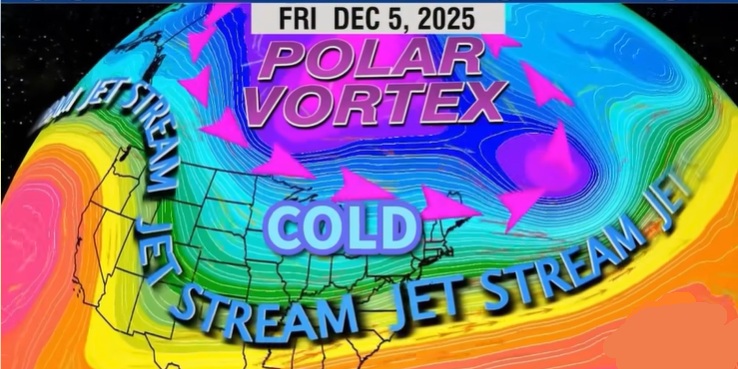
Over the next several days, the Northeastern United States will experience unusually cold temperatures delivered by what meteorologists call the Siberian Express — a mass of frigid Arctic air plunging southward into North America. While this may feel like a contradiction to global warming, it is in fact one of the clearest signatures of a destabilizing climate system. The very forces warming the planet overall are also helping unleash more extreme cold spells in the mid-latitudes.

At the heart of this counterintuitive pattern are two major disruptions: the weakening of the AMOC (Atlantic Meridional Overturning Circulation) and the increasing waviness and instability of the jet stream. These changes are direct consequences of unprecedented ocean heating and rapid Arctic amplification.

What Is the “Siberian Express”?

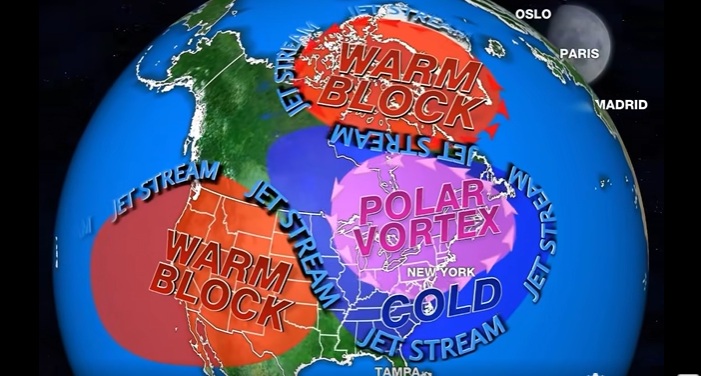
The “Siberian Express” refers to a weather pattern in which extremely cold, dense Arctic air is displaced from its usual position near the pole and funneled southward into North America. Despite the name, this air mass often forms in the Canadian Arctic, where strong high-pressure systems develop over extensive snow and ice. In this case, however, the cold air does originate in Russia and is being held north by a blocking high positioned between Russia and Canada. After sweeping over the Northwestern United States, the jet stream then dips sharply, steering the frigid air directly over Pennsylvania.

This displacement comes from:

  • A weakened or disrupted polar vortex
  • A deeply dipping jet stream
  • A “cross-polar flow” pattern that bridges Asia, the Arctic, and North America

The jet stream acts like an atmospheric conveyor belt. When it becomes wavier and slower, it can scoop up Arctic air and drive it far south into the continental United States, delivering the kind of bitter cold typically confined to the high latitudes.

The blue and purple regions commonly shown on temperature anomaly maps reflect areas experiencing temperatures far below average during these events.

Why Global Warming Is Causing More Extreme Cold Bursts

At first glance, “global warming causes cold” seems paradoxical. But in a nonlinear climate system, warming does not simply raise all temperatures evenly—it disrupts circulation patterns that have stabilized Earth’s climate for thousands of years.

1. The Arctic Is Warming 3–4 Times Faster Than the Global Average

This process, called polar amplification, reduces the temperature contrast between the Arctic and the mid-latitudes — the very contrast that powers a strong, stable jet stream.

2. A Weaker Temperature Gradient Means a Weaker Jet Stream

With less difference between Arctic cold and mid-latitude warmth, the jet stream slows, becomes wavier, and meanders. These waves can dip deeply southward, dragging Arctic air with them.

3. A Disrupted Polar Vortex Spills Cold Air South

When the stratospheric polar vortex weakens or splits, cold air that was once confined to the Arctic is free to plunge into regions unaccustomed to such extremes.

Ocean Heating, AMOC Slowdown, and the Breakdown of Planetary Circulation

More than 90% of the excess heat trapped by greenhouse gases is absorbed by the oceans. This enormous thermal load is now reshaping planetary circulation systems, setting the stage for weather extremes of all kinds — including sudden, intense cold outbreaks.

Key destabilizing impacts of ocean warming:

  • Weakening of the AMOC, which normally helps distribute heat from the tropics to the North Atlantic
  • Slowing, stretching, and increased waviness of the jet stream, allowing Arctic air to spill south
  • Persistent heat domes and atmospheric blocking patterns, which can trap cold air in place for days or weeks
  • Amplification of storms, including more powerful nor’easters fueled by warm Atlantic waters

These shifts introduce chaotic behavior into global weather patterns—creating an atmosphere that oscillates between extremes: historic droughts one season, record floods the next, blistering heat followed by abnormal cold.

Cold Is Not a Contradiction — It’s a Symptom

The same climate forces that bring deadly heat waves, supercharged rainfall, intensifying hurricanes, and historic wildfires are also responsible for destabilizing winter.

Extreme cold events in a warming world are not only possible; they are increasingly expected.

The Siberian Express hitting the Northeast is not a sign that global warming has paused. It is evidence that the planetary circulation systems that once regulated our seasons are breaking down — and extremes of all kinds are becoming the new normal.

* Our probabilistic, ensemble-based climate model — which incorporates complex socio-economic and ecological feedback loops within a dynamic, nonlinear system — projects that global temperatures are becoming unsustainable this century. This far exceeds earlier estimates of a 4°C rise over the next thousand years, highlighting a dramatic acceleration in global warming. We are now entering a phase of compound, cascading collapse, where climate, ecological, and societal systems destabilize through interlinked, self-reinforcing feedback loops.

What Can I Do?
The single most important action you can take to help address the climate crisis is simple: stop burning fossil fuels. There are numerous actions you can take to contribute to saving the planet. Each person bears the responsibility to minimize pollution, discontinue the use of fossil fuels, reduce consumption, and foster a culture of love and care. The Butterfly Effect illustrates that a small change in one area can lead to significant alterations in conditions anywhere on the globe. Hence, the frequently heard statement that a fluttering butterfly in China can cause a hurricane in the Atlantic. Be a butterfly and affect the world.

Tipping points and feedback loops drive the acceleration of climate change. When one tipping point is breached and triggers others, the cascading collapse is known as the Domino Effect.

The Human Induced Climate Change Experiment

Siberian Express and the  Jet Stream Collapse
Siberian Express and the Jet Stream Collapse
Polar Blocks
Polar Blocks