bookmark_borderThe Trade Deficit Shrinks — and So Does America’s Economic Pulse

The U.S. trade deficit for August 2025 came in at $59.6 billion, down sharply from a revised $78.2 billion in July. On the surface, this might look like good news for an administration obsessed with shrinking the trade gap. In reality, it is a warning sign — and yet another indictment of Trump’s misguided, economically illiterate trade agenda.

A Smaller Trade Deficit Isn’t a Victory — It’s a Symptom of Weakness
This month’s narrowing was driven almost entirely by a drop in imports, not a boom in exports. That distinction matters. When the U.S. imports less while exporting the same amount, it doesn’t signal economic strength. It signals that consumers and businesses are pulling back, buying fewer goods, delaying purchases, and tightening their belts.

Yes, the change may superficially boost GDP in the quarter — but only because of the way GDP accounting treats imports, not because real economic conditions improved. The underlying truth is the opposite: U.S. economic momentum is slowing.

Trump’s Trade War: A Case Study in Economic Misunderstanding
Trump continues to push the debunked narrative that trade deficits are an economic threat. This belief is not just wrong — it’s dangerous. His policies reflect a fundamental misunderstanding of trade, capital flows, and the basic mechanics of a modern global economy.

For decades, economists have been clear:

  • Trade deficits are not inherently harmful.

  • They often reflect a strong dollar, high consumer demand, and a robust investment climate.

  • Americans benefit from lower-cost imported goods, which raise purchasing power and living standards.

  • Dollars spent on imports frequently return as foreign investment in the U.S., including in Treasury securities, real estate, and American companies — strengthening financial markets and keeping interest rates lower.

Trump’s fixation on eliminating the deficit ignores all of this and instead pushes policies that raise consumer prices, destabilize supply chains, and threaten American jobs, especially in industries dependent on global inputs.

Today’s Numbers Reveal the Truth Hidden Beneath the Headlines
A shrinking deficit due to falling imports is not a sign of a booming America. It is a sign of a cooling domestic economy. Consumers are spending less. Importers are ordering less. Businesses are becoming more cautious.

Trump may tout this as a win. In reality, it’s a red flag — one that economists and anyone paying attention should recognize immediately.

The administration can celebrate a smaller deficit if it wants. But the data tell a different story: America didn’t suddenly start winning; Americans simply started buying less.

Trumpenomics

bookmark_borderThe Physics of Violent Rain: Turning Ordinary Storms Into Catastrophic Events

by Daniel Brouse and Sidd Mukherjee
November 18, 2025

We’ve been working specifically on the physics of what we now call violent rain, and once you fully understand latent heat, the entire climate system reveals a deeper and far more alarming complexity. Latent heat is not just a chapter in a textbook; it is the engine behind much of Earth’s atmospheric power. But the energy budget is only the entry point. The way that energy manifests — through momentum, turbulence, pressure gradients, and flow dynamics — is some of the most elegant, and now increasingly dangerous, mathematics in climate science.

The fatal mistake many people make is equating “global warming” strictly with warmer temperatures. The additional heat does not simply remain as heat. It is continually exchanged, transformed, and expressed throughout the climate system. It reappears as massive increases in atmospheric moisture, sharper pressure differentials, explosive updrafts, and an atmosphere filled with stored potential energy waiting for the right trigger to be released.

A warmer atmosphere can hold about 7% more water for every 1°C of warming. Over the full temperature anomaly we are now entering, this increased capacity nearly doubles the amount of moisture available to A warmer atmosphere can hold about 7% more water for every 1°C of warming. Over the full temperature anomaly we are now entering, this increased capacity nearly doubles the amount of moisture available to storms. This is not theoretical — it is already transforming rainfall dynamics worldwide. Parts of the world, especially the poles, are now experiencing temperature anomalies that remain more than 22°C above normal for extended periods, supercharging atmospheric moisture and destabilizing global circulation patterns.

One of the most overlooked consequences of this added energy is the rise in both raindrop size and raindrop count. Larger droplets fall faster, strike harder, and inject more energy into the air column, intensifying turbulence. Upon impact with the ground, they deliver far more kinetic energy than raindrops did even a generation ago. Using the momentum relation p = mv:

  • As mass increases, momentum increases.
  • As velocity increases, momentum increases.

More momentum means more turbulence, more kinetic energy, and more destructive rainfall.

People already sense this intuitively — the louder impact of rain on roofs, water bouncing higher off pavement, and downpours that feel physically heavier — but few connect these sensations to the underlying physics.

The destructive power of violent rain actually begins before the drops reach the ground. As storms intensify, raindrops become larger and wind velocities rise, accelerating them horizontally and vertically. Because both m (mass) and v (velocity) increase, each raindrop carries significantly more momentum than in past climates.

Stronger horizontal winds effectively act as a second gravitational pull, increasing the angle and force of impact. This is why wind-driven rain can sting the skin, shred crops, strip leaves from trees, and erode soils far more quickly than vertical rainfall alone. The increased velocity also injects more energy into the air column, amplifying turbulence, updraft strength, and pressure gradients — processes that feed storm intensification.

Once the water reaches the ground, flow dynamics dominate. Force scales with the square of velocity (v²), and density multiplies that force dramatically:

  • A 20 mph wind exerts 4× the force of a 10 mph wind.
  • A 40 mph wind exerts 16× the force.
  • A 60 mph wind exerts 36× the force.

Now apply the same physics to water, which is ~800 times denser than air:

  • A shallow 10 mph sheet of runoff exerts 800× the force of a 10 mph wind.
  • At 20 mph, the force becomes 3,200×.
  • At 40 mph — common in debris-laden flash floods — the force jumps to 12,800×.

When storms produce larger raindrops and faster-moving rain, driven by extreme heat anomalies and stronger wind fields, the resulting flows carry exponentially greater destructive potential. This is why hillsides fail more quickly, roads wash out more often, and floodwaters rise and accelerate with far greater violence in a warming climate — and why these events are unfolding years to decades ahead of earlier projections.

As rainfall intensity spikes, so do these destructive flow forces. This is why modern storms overwhelm culverts, stormwater systems, levees, dams, and hillside soils. It’s why slopes liquefy, bridges scour, and infrastructure collapses in events that used to be considered “routine.”

The mathematics is beautiful — but the consequences are devastating. Violent rain is not a metaphor — it is the physical expression of a climate system carrying far more energy, mass, and momentum than it did just a few decades ago. And every additional fraction of a degree adds more fuel to that system.

For anyone watching closely, the evidence is not abstract. It’s outside your window.

The Climate Crisis: Violent Rain | Extreme Weather Events | Insurance | Soil | Updates

The Human Induced Climate Change Experiment

bookmark_borderEarth at the Threshold: CO₂ Acceleration, Systemic Feedback Loops, and the Coming Era of Rapid Sea-Level Rise

by Daniel Brouse and Sidd Mukherjee
November 17, 2025

CO₂ is only one component in a vast, interconnected climate system — but it remains the most significant driver of human-caused warming. While water vapor, clouds, aerosols, and ocean circulation all play essential roles, CO₂ is the primary forcing mechanism we directly control. And today, it is rising at a speed unprecedented in Earth’s recent geological history.

According to the World Meteorological Organization (2025) and the Global Carbon Project (2025), the year 2024 marked the most extreme convergence of climate records ever observed. Atmospheric CO₂ levels reached 422.7 ppm, the highest in three million years, with a record annual increase of 3.75 ppm. Monthly readings peaked at 426.91 ppm in June 2024 — a value that would have been unimaginable even a generation ago.

Accelerating Emissions and the Collapse of “Natural Buffers”

Global fossil fuel and cement emissions rose to 37.4 gigatons of CO₂ in 2024, a 0.8% increase from 2023. The growth was driven by:

  • Coal expansion across Asia

  • Post-pandemic industrial rebound

  • Sharp increases in liquefied natural gas (LNG) production, particularly in the United States

While often marketed as a “bridge fuel,” methane leakage from LNG infrastructure — over 80 times more potent than CO₂ over 20 years — has erased its supposed climate advantage. These cumulative emissions are now overwhelming the buffering capacity of the oceans, cryosphere, and biosphere.

This record convergence signals a fundamental phase transition in the Earth system. Regions that once absorbed carbon, stabilized temperature, and moderated climate extremes are now flipping into self-reinforcing feedback loops. What was once a slow climb in global heat content is now taking on the characteristics of nonlinear acceleration.

Glaciers, Cryosphere Collapse, and the Finality of “Point of No Return”

The WMO issued one of its starkest warnings in 2023:

“The world’s glaciers melted at dramatic speed last year and saving them is effectively a lost cause…
Antarctic sea ice fell to its lowest extent on record.
Some European glaciers are literally off the charts.”

WMO Secretary-General Petteri Taalas summarized the situation bluntly:

“We have already lost the melting-of-the-glaciers game.
The CO₂ concentration is now simply too high.”

In the Swiss Alps alone, 6.2% of total glacier mass vanished in a single summer, the greatest loss in the entire observational record.

Taalas further warned that disappearing glaciers will:

  • Reduce global freshwater supply

  • Impair agriculture

  • Destabilize river transport and hydrology

  • Accelerate sea-level rise far beyond prior projections

For decades, sea-level rise was expected to unfold over millennia. But with runaway CO₂ growth and feedback amplification, that timeline is rapidly collapsing into decades.

How Fast Could Sea Levels Rise? A Scientific Exchange

A natural question follows:
Could this trigger the fastest sea-level rise in Earth’s history?

Physicist Sidd Mukherjee offered the following expert assessment:

“It depends on what you mean by ‘ever.’
In terms of human civilization: yes, likely.”

He notes:

  • The total global ice inventory can produce ~200 feet of sea-level rise.

  • Greenland and West Antarctica may already be committed to collapse.

Breakdown of likely contributions:

  • Greenland: ~20 feet over 100–300 years

  • West Antarctica: ~10 feet, potentially in decades to a century

Average over a century:

  • ~20 feet → 2 inches per year (50 mm/year), 10x the current rate

But the average masks the danger. Sea-level rise will likely arrive in pulses, not a smooth curve:

“We could dawdle along at half an inch per year, then suddenly experience a couple of years with a foot of rise annually.”

If CO₂-equivalent concentrations can be stabilized near 500 ppm, there may still be a chance to preserve East Antarctica, the largest remaining ice sheet. But if it destabilizes:

“Expect another couple hundred feet of sea-level rise.”

A Civilization-Level Threshold

We are now witnessing the early stages of a global system crossing into a new and dangerous mode of operation — one defined by:

  • Rapid CO₂ accumulation

  • Collapsing carbon sinks

  • Accelerating ocean heat storage

  • Cryosphere destabilization

  • Intensified extreme weather

The question is no longer whether these changes are occurring, but how quickly, and how prepared we are for the consequences.

Humanity is approaching — and in some cases passing — thresholds that earlier generations believed were centuries away. The decisions made in the next decade will determine whether sea-level rise is measured in inches, feet, or tens of feet within a single human lifetime.

WARNING

* Our probabilistic, ensemble-based climate model — which incorporates complex socio-economic and ecological feedback loops within a dynamic, nonlinear system — projects that global temperatures are becoming unsustainable this century. This far exceeds earlier estimates of a 4°C rise over the next thousand years, highlighting a dramatic acceleration in global warming. We are now entering a phase of compound, cascading collapse, where climate, ecological, and societal systems destabilize through interlinked, self-reinforcing feedback loops.

What Can I Do?
The single most important action you can take to help address the climate crisis is simple: stop burning fossil fuels. There are numerous actions you can take to contribute to saving the planet. Each person bears the responsibility to minimize pollution, discontinue the use of fossil fuels, reduce consumption, and foster a culture of love and care. The Butterfly Effect illustrates that a small change in one area can lead to significant alterations in conditions anywhere on the globe. Hence, the frequently heard statement that a fluttering butterfly in China can cause a hurricane in the Atlantic. Be a butterfly and affect the world.

Tipping points and feedback loops drive the acceleration of climate change. When one tipping point is toppled and triggers others, the cascading collapse is known as the Domino Effect.

The Climate Crisis: Violent Rain | Deadly Humid Heat | Health Collapse | Extreme Weather Events | Insurance | Trees and Deforestation | Soil | Rising Sea Level | Food and Water | Updates

The Human Induced Climate Change Experiment

bookmark_borderUSDA Orders States to Halt Full SNAP Payments — Trump’s Directive Threatens Millions of Families and Children

In a stunning and deeply troubling move, the U.S. Department of Agriculture (USDA) has ordered all states to “immediately undo” actions they’ve taken to issue full Supplemental Nutrition Assistance Program (SNAP) benefits to eligible families. This directive, originating from the Trump administration, effectively reverses state efforts to maintain food security for low-income households amid economic uncertainty and political dysfunction.

The SNAP program — formerly known as food stamps — is the nation’s cornerstone against hunger, serving over 40 million Americans, including approximately 20 million children. By instructing states to reduce or suspend full benefits, the USDA is targeting the most vulnerable segment of the population — families with children. According to the Center on Budget and Policy Priorities (CBPP), more than half of all SNAP recipients are children, and these benefits provide essential nutrition that supports healthy growth, cognitive development, and school performance.

Under the Trump directive, millions of children stand to lose consistent access to meals. Many will be forced to rely on overstretched school lunch programs or local food pantries that are already struggling to meet record demand. Pediatric nutritionists warn that even short-term food insecurity can have long-term consequences, including weakened immune systems, developmental delays, and lower educational outcomes.

Economists emphasize that this decision is not only cruel but also economically reckless. SNAP has long been one of the most effective automatic stabilizers in the U.S. economy. Each dollar in SNAP benefits generates between $1.50 and $1.80 in total economic activity, circulating money directly into grocery stores, farms, and local businesses. Reducing benefits now will remove billions in purchasing power from the economy, further weakening communities already suffering from inflation, layoffs, and stagnant wages.

The timing could not be worse. Consumer confidence has fallen sharply, and October 2025 saw the highest number of layoff announcements in more than two decades. Taking food off children’s tables in the midst of this downturn will exacerbate both economic and humanitarian crises.

Politically, the USDA’s action exposes the Trump administration’s widening gap between populist rhetoric and policy reality. While Trump continues to claim he champions “working Americans,” his administration’s actions — from tariff-driven price increases to cuts in social safety programs — have disproportionately hurt working-class families. The rollback of full SNAP payments is just the latest in a pattern of policies that prioritize ideology over empathy, and short-term optics over long-term stability.

If fully implemented, this SNAP rollback could become one of the most devastating federal policy reversals in decades — a moral and economic failure that undermines the nation’s children, widens inequality, and deepens poverty in the world’s wealthiest country.

Trumpenomics

bookmark_borderDon the Con: How Trump Cemented His Legacy as the Dumbest World Leader in History

Trump said it best, “Smart people don’t like me.”

Trump is going down in history as the dumbest president in American history; however, that title may not be “biggly” enough for him. He is now being recognized globally as the dumbest world leader in history — a man who has willfully ignored, denied, and lied about established science, accelerating a planetary crisis that has already cost millions of lives. Trump’s science denial directly resulted in millions of preventable COVID deaths in his first term. Now, he is endangering the entire population of the world.

Trump has repeatedly dismissed climate science as a “hoax,” “bullshit,” and “the green scam.” At the United Nations, he called climate change a “con” — an irony lost on no one, coming from “Don the Con” himself, a man whose business empire was built on deceit, bankruptcies, and fraud. His record now includes criminal convictions, civil judgments, and an unparalleled legacy of scientific ignorance.

This year, Trump refused to cooperate with the COP30 global climate summit in Brazil, further cementing America’s retreat from global climate leadership. With global emissions nearly doubling in the last 33 years, few would argue that progress has met expectations. Worse, the post-COVID global consensus on tackling climate change is fracturing — led by Trump’s renewed campaign of climate disinformation and economic coercion. His administration’s new trade tariffs pressure allies such as Japan, the EU, and South Korea to buy more U.S. fossil fuels, directly undermining global decarbonization efforts.

Trump’s absence from COP30 drew sharp rebukes from world leaders. “For small island states, the climate crisis is not past tense or future tense. It is our reality. We have no way to run, no way to hide,” said Antigua and Barbuda’s Prime Minister Gaston Browne. Chilean President Gabriel Boric accused Trump of spreading “lies” about the climate crisis, while Colombian President Gustavo Petro declared, “Mr. Trump is against humankind.”

As Trump abandons both people and planet, others are stepping into the leadership void. California Governor Gavin Newsom announced he will attend COP30 in Brazil, representing the world’s fourth-largest economy. Newsom aims to strengthen climate partnerships, promote clean-energy investments, and showcase California’s model for creating jobs while cutting toxic pollution.

“As the President of the United States turns his back on people and the planet, California is inking global partnerships focused on creating jobs and cutting toxic pollution,” Newsom said. “The economic winners of the 21st century are those who build the clean-energy future. We’re doing that right now — and showing the world that climate action means jobs, clean air, and lower costs.”

While Trump clings to fossil-fueled fantasies and falsehoods, California and the world are moving forward without him. History will remember Trump not as a leader, but as a warning — a living example of how ignorance, arrogance, and greed can conspire to imperil the planet itself.

The Great Race Against Time: Trump vs. Mother Nature

Donald Trump has consistently dismissed the science of climate change, calling it a hoax and dismissing policies aimed at addressing it as “The Green New Scam.” His repeated use of the phrase “Drill, Baby, Drill” symbolizes an energy policy that prioritizes fossil fuel extraction over sustainable alternatives. These policies have only intensified the climate crisis, posing severe risks not only to the environment but to the global economy as well. If left unchecked, Donald Trump’s economic and environmental policies will render the planet uninhabitable for future generations.

The evidence is irrefutable: climate change is accelerating at an alarming pace, and the associated costs—both economic and human—are rising exponentially. Immediate, decisive action is essential to reduce greenhouse gas emissions and prevent further environmental collapse. Our updated climate model, now grounded in chaos theory and incorporating complex social-ecological factors within a dynamic, non-linear framework, predicts that global temperatures could increase by up to 9°C this century—far surpassing the previous estimate of a 4°C rise over the next thousand years. Such extreme warming will render large portions of the planet uninhabitable within this century, threatening the stability of ecosystems and human societies alike.


* Our probabilistic, ensemble-based climate model — which incorporates complex socio-economic and ecological feedback loops within a dynamic, nonlinear system — projects that global temperatures are becoming unsustainable this century. This far exceeds earlier estimates of a 4°C rise over the next thousand years, highlighting a dramatic acceleration in global warming. We are now entering a phase of compound, cascading collapse, where climate, ecological, and societal systems destabilize through interlinked, self-reinforcing feedback loops.

What Can I Do?
The single most important action you can take to help address the climate crisis is simple: stop burning fossil fuels. There are numerous actions you can take to contribute to saving the planet. Each person bears the responsibility to minimize pollution, discontinue the use of fossil fuels, reduce consumption, and foster a culture of love and care. The Butterfly Effect illustrates that a small change in one area can lead to significant alterations in conditions anywhere on the globe. Hence, the frequently heard statement that a fluttering butterfly in China can cause a hurricane in the Atlantic. Be a butterfly and affect the world.

→ “Solutions to the Fossil Fuel Economy and the Myths Accelerating Climate and Economic Collapse.“

The Human Induced Climate Change Experiment

bookmark_borderScientific Research: Tipped Tipping Points, the Accelerating Climate Collapse, and the Domino Effect

Daniel Brouse¹ and Sidd Mukherjee²

¹Independent Climate Researcher, Economist, Membrane Institute, USA
²Independent Physicist, Membrane Institute, USA


Abstract

Earth’s climate is a nonlinear, chaotic system composed of interdependent subsystems—atmosphere, hydrosphere, lithosphere, and biosphere. Drawing from chaos theory and nonlinear thermodynamics, this paper examines how feedback loops and tipping points interact to accelerate global warming. Building on prior work establishing the non-linear acceleration hypothesis, we present evidence that the doubling time of climate change impacts has decreased from approximately 100 years to less than 2 years. Data from 2024–2025 confirm record atmospheric CO₂ concentrations, fossil fuel emissions, and temperatures, signifying a transition to a phase of self-reinforcing instability. We synthesize recent research showing that cascading climate feedbacks are now driving a compound collapse of planetary systems — from carbon sinks turning into carbon sources to economic, health, and ecological destabilization. These interlinked “tipped tipping points” constitute what we term the Domino Effect — a systemic cascade that threatens global habitability within the century.

1. Introduction

The Earth functions as a dynamic climate system, governed by the flow and redistribution of thermal energy among its interlinked subsystems: the atmosphere, oceans, and land surface. Global warming arises from the accumulation of thermal energy within this system. The complexity and nonlinearity of these interactions have long been the domain of chaos theory, which illustrates how small perturbations can yield large, unpredictable consequences — an effect popularly described as the “Butterfly Effect”¹.

In climate science, General Circulation Models (GCMs) represent these interconnections, incorporating feedback loops between temperature, pressure, humidity, and energy flow. Because these systems are nonlinear and teleconnected, small local perturbations can propagate into large-scale global shifts². Despite inherent unpredictability, model-based projections have successfully anticipated long-term trends in global temperature and carbon flux — though with recognized uncertainty in rate and magnitude.

2. The Nonlinear Acceleration Hypothesis

In the early 1990s, we proposed the nonlinear acceleration hypothesis — the idea that climate change impacts do not increase linearly, but exponentially, through self-reinforcing feedback loops³. By the early 2000s, multiple independent studies had validated this framework, establishing it as part of the broader consensus in climate dynamics⁴,⁵.

Our analysis shows that the doubling time of observable impacts — heat extremes, wildfire frequency, and ice loss — has fallen from approximately 100 years (pre-industrial) to ~10 years by 2000 and to <2 years by 2024. If this exponential trend continues, the cumulative impact could increase sixty-fourfold within a decade, even assuming constant emissions. This acceleration signals a system entering chaotic instability.

3. Record-Breaking 2024: Earth Breaches the 1.5°C Threshold

According to the World Meteorological Organization (2025) and Global Carbon Project (2025), the year 2024 marked an unprecedented convergence of climate records⁶,⁷. Atmospheric CO₂ concentrations reached 422.7 ppm, the highest in 3 million years, with a record annual increase of 3.75 ppm. Monthly values peaked at 426.91 ppm in June 2024.

Simultaneously, global fossil fuel and cement emissions rose to 37.4 gigatons of CO₂, a 0.8% increase from 2023. The rise was driven primarily by coal use in Asia, post-pandemic industrial expansion, and increased liquefied natural gas (LNG) production — particularly from the United States⁸. Methane leakage from LNG infrastructure, over 80 times more potent than CO₂ over 20 years⁹, has sharply reduced the supposed climate benefit of natural gas.

This record convergence signals a phase transition in the Earth system: as warming accelerates, natural feedbacks that once stabilized climate are now amplifying it.

4. Collapse of Carbon Sinks

For millennia, forests, soils, and oceans absorbed roughly half of anthropogenic CO₂ emissions¹⁰. By 2024, multiple datasets confirmed that major carbon sinks — notably the Amazon Basin, boreal forests, and Arctic permafrost — have shifted from net absorbers to net emitters¹¹–¹³.

Ozone pollution, drought, and pests weaken trees’ photosynthetic capacity; wildfires, intensified by heat and aridity, release billions of tons of CO₂ annually¹⁴. In the Arctic, thawing permafrost releases methane and CO₂, sometimes reigniting “zombie fires” through winter¹⁵. In the oceans, coral die-offs and reduced vertical mixing from a slowing Atlantic Meridional Overturning Circulation (AMOC) limit carbon sequestration and nutrient flow¹⁶.

This collective degradation represents a systemic feedback reversal — the transformation of natural carbon sinks into carbon sources — driving an escalating and largely self-sustaining cycle of warming.

5. Cascading Feedbacks: The Domino Effect

Climate feedback loops do not act independently; rather, they interact synergistically in what we term the Domino Effect — a cascade of tipped tipping points where each system failure accelerates the next¹⁷.

For example, rising heat intensifies wildfires and particulate pollution, which alters atmospheric chemistry and reduces photosynthesis; decreased plant uptake increases CO₂ concentrations, driving further heat. Similarly, sea level rise and loss of glacial mass amplify coastal erosion, migration, and economic instability — reinforcing social and political feedbacks that delay mitigation.

This emergent behavior exemplifies a complex adaptive system entering runaway disequilibrium — one that can only be described probabilistically.

6. Human and Economic Implications

The social and economic consequences of accelerating warming are becoming immediate and measurable.

A Scientific Reports study (January 2025) found that in half of 38 global cities, annual heat-related deaths will exceed COVID-19 mortality rates within a decade if warming reaches 3°C¹⁸. A Nature Reviews Earth & Environment paper (February 2025) projected that at 2°C, global land area where human thermoregulation becomes impossible will triple¹⁹.

Economic analyses by the First Street Foundation (2025) estimate $1.47 trillion in U.S. property devaluation by 2055 due to flooding and extreme weather²⁰. Boston Consulting Group (2025) calculates that failing to limit warming from 3°C to 2°C would cost the world 11–27% of total GDP²¹.

Beyond these, secondary and indirect feedbacks are emerging: cooling of the upper atmosphere extends orbital debris lifetime²²; sleep disorders linked to rising temperatures may triple²³; and wildfire-driven PM₂.₅ exposure could cause 98,000 annual excess deaths in the U.S. by 2050²⁴.

Even cultural systems are at risk: by 2050, 14 of 16 FIFA World Cup stadiums will face “unsafe” extreme heat, with two-thirds of grassroots football fields already crossing climate risk thresholds²⁵.

7. Toward a Unified Framework

Our ensemble-based probabilistic climate model integrates socio-economic, ecological, and biogeophysical feedbacks within a nonlinear dynamical system. The results indicate that global temperatures are on course to become unsustainable within this century, far surpassing earlier projections of a 4°C rise over a millennium²⁶.

The transition from a stable Holocene equilibrium to a runaway Anthropocene trajectory is characterized by compounding, interdependent feedbacks across multiple systems — thermal, hydrological, biological, and societal.

8. Conclusion: A Closing Window

The events of 2024–2025 reveal the limits of incremental mitigation. Stabilizing Earth’s climate now demands more than emission reductions — it requires active carbon removal, ecosystem restoration, and an immediate global phase-out of fossil fuels.

As the planet’s natural stabilizers fail, humanity faces a critical juncture: continue deferring action or act decisively to preserve habitability. The evidence is unequivocal — the feedback loops have tipped, the tipping points have cascaded, and the window for prevention is rapidly closing.


References

  1. Lorenz, E. N. (1963). Deterministic Nonperiodic Flow. Journal of the Atmospheric Sciences, 20(2), 130–141.
  2. IPCC. (2023). AR6 Climate Change 2023: The Physical Science Basis.
  3. Brouse, D., & Mukherjee, S. (1999). Nonlinear Acceleration of Climate Change. Membrane Institute Working Paper Series.
  4. Lenton, T. M. et al. (2008). Tipping elements in the Earth’s climate system. PNAS, 105(6), 1786–1793.
  5. Steffen, W. et al. (2018). Trajectories of the Earth System in the Anthropocene. PNAS, 115(33), 8252–8259.
  6. WMO. (2025). State of the Global Climate 2024.
  7. Friedlingstein, P. et al. (2025). Global Carbon Budget 2025. Earth System Science Data.
  8. IEA. (2025). Global Energy Review 2025.
  9. IPCC. (2022). Climate Change 2022: Mitigation of Climate Change.
  10. Friedlingstein, P. et al. (2020). Global carbon budget 2020. Earth System Science Data, 12, 3269–3340.
  11. Gatti, L. V. et al. (2021). Amazonia as a carbon source linked to deforestation and climate change. Nature, 595, 388–393.
  12. McGuire, A. D. et al. (2023). Permafrost carbon feedbacks. Nature Climate Change, 13, 456–465.
  13. Buitenhuis, E. et al. (2024). Oceanic carbon sink slowdown. Nature Communications, 15(6), 4441.
  14. Bowman, D. M. J. S. et al. (2023). Wildfire trends under climate change. Science, 379(6629), 44–50.
  15. Natali, S. et al. (2023). Arctic carbon emissions from permafrost thaw. Nature Geoscience, 16, 255–262.
  16. Caesar, L. et al. (2021). Weakening AMOC in recent decades. Nature Climate Change, 11, 680–686.
  17. Mukherjee, S., & Brouse, D. (2025). Tipped Tipping Points, Feedback Loops, and the Domino Effect. Membrane Institute Press.
  18. Mora, C. et al. (2025). Heat-related mortality projections. Scientific Reports, 15, 101–112.
  19. Sherwood, S. C. et al. (2025). Limits of human heat tolerance. Nature Reviews Earth & Environment, 6, 88–96.
  20. First Street Foundation. (2025). Climate Risk and U.S. Property Devaluation.
  21. Boston Consulting Group. (2025). Economic Consequences of Climate Inaction.
  22. Meech, K. et al. (2025). Orbital debris lifetimes in a warming atmosphere. Nature Sustainability, 8(3), 221–230.
  23. Gao, Y. et al. (2025). Rising global temperature and sleep apnea prevalence. Nature Communications, 16, 5543.
  24. Burke, M. et al. (2025). Wildfire PM₂.₅ and excess mortality in the United States. Nature, 625, 34–41.
  25. Common Goal & Football for Future. (2024). Heat Risk and Football Infrastructure Report.
  26. Brouse, D., & Mukherjee, S. (2025). Ensemble modeling of compound climate collapse. Membrane Institute Climate Series, 3(2), 14–27.

The Human Induced Climate Change Experiment

bookmark_borderThe Domino Effect: Tipped Tipping Points and the Accelerating Collapse of Earth’s Climate System

By Daniel Brouse and Sidd Mukherjee

The Climate as a Chaotic System

The Earth is a climate system — a vast network of interconnected subsystems including the atmosphere, oceans, and land. Global warming is driven by an increase in thermal energy within this system. Chaos theory reveals the inherent complexity and nonlinearity of such dynamic systems, particularly in the intricate interactions between soil, air, and sea.

Atmospheric and oceanic circulation redistribute thermal energy around the globe. These flows are governed by nonlinear dynamics, meaning small perturbations can cause disproportionate effects — a concept captured by the “Butterfly Effect,” in which the flap of a butterfly’s wings in one region can influence a hurricane in another.

General Circulation Models (GCMs), which simulate the Earth’s climate, are highly teleconnected and nonlinear. A minor change in temperature, pressure, or humidity in one small area can trigger large changes anywhere on the planet. Climate science must wrestle with these complex models, extracting insight despite inherent chaos — with both remarkable successes and sobering failures. Yet, we must proceed.


The Acceleration Hypothesis

In the 1990s, we first hypothesized the nonlinear acceleration of climate change. My lab partner, a Doctor of Physics from Ohio State, and I collaborated to provide the foundational evidence for this theory. By the early 2000s, our work had evolved into an established framework, validated repeatedly by independent studies and now accepted as scientific consensus.

Over the decades, the doubling time of climate impacts — the rate at which effects intensify — has shortened dramatically. Initially around 100 years, it fell to 10 years, and more recently to just 2. This means climate damage today is double what it was two years ago, potentially quadrupling within two more, and growing sixty-fourfold within a decade if trends continue. These are conservative estimates that assume the doubling time does not shrink further.

This is not an anomaly — it is a trajectory. Without immediate global intervention, the results will be far more catastrophic than previously projected.


2024: The Year of Records — and Warnings

Research released in 2025 confirmed that 2024 was the year the planet shattered multiple climate records — none of them good. Atmospheric carbon dioxide (CO₂) concentrations, fossil fuel emissions, and global average temperatures all reached unprecedented highs, officially breaching the 1.5°C warming threshold of the Paris Agreement.

This convergence signals a dangerous new phase: self-reinforcing climate instability, where runaway feedback loops — from melting ice and collapsing ecosystems to oceanic and atmospheric disruptions — are beginning to overpower human mitigation efforts.


Record CO₂ Concentrations and Emissions

The global average concentration of CO₂ reached 422.7 ppm in 2024 — the highest in at least three million years — with a record annual increase of 3.75 ppm, the steepest since modern measurements began in 1959. Monthly concentrations peaked in June 2024 at 426.91 ppm.

Record heat across air and oceans amplified carbon releases from soils, forests, and seas. Wildfires, droughts, and ecosystem die-offs weakened natural absorptive capacity, forming a dangerous feedback: as the planet warms, its ability to regulate CO₂ declines — further accelerating warming.

Meanwhile, fossil fuel and cement emissions reached 37.4 gigatons in 2024, a 0.8% rise over 2023. Much of this growth stemmed from coal use in Asia and oil-driven transport demand. The U.S. contributed heavily through record fossil fuel consumption and liquefied natural gas (LNG) exports. Methane leakage from this “bridge fuel” — over 80 times more potent than CO₂ over 20 years — erased any claimed climate advantage, compounding global warming.

This paradox persists: while renewable capacity expands, fossil fuel use rises nearly as fast. The carbon gap — between emissions and absorption — widens, while natural sinks falter under stress.


The Collapse of Carbon Sinks

Forests, soils, and oceans have long absorbed about half of human-generated CO₂. But that balance is unraveling. In 2024, mounting evidence suggested key ecosystems had crossed tipping points, shifting from net absorbers to net emitters of greenhouse gases.

Ozone pollution now impairs photosynthesis; drought, heat, and pests accelerate tree death; and megafires release billions of tons of carbon each year. The Amazon — once a crucial carbon sink — now emits more carbon than it stores.

In the Arctic, thawing permafrost releases methane and CO₂ while fueling “zombie fires.” Oceans, destabilized by coral die-offs and a slowing Atlantic Meridional Overturning Circulation (AMOC), absorb less CO₂ and support fewer marine organisms. Each failure amplifies the next, reinforcing the global feedback cycle.


Cascading Feedbacks and the Domino Effect

These are not isolated failures but interconnected system breakdowns. As forests burn, permafrost thaws, reefs die, and currents weaken, each feedback loop amplifies others. The transformation of carbon sinks into carbon sources marks one of Earth’s most profound shifts — ensuring that even if emissions plateau, atmospheric CO₂ may continue to rise for centuries.

We are witnessing the onset of the Domino Effect — a cascade of tipped tipping points pushing the planet toward a less stable, hotter equilibrium.


The Human and Economic Toll

The year 2025 has clarified that these changes are no longer theoretical. Peer-reviewed research reveals accelerating, compounding crises that threaten human health, economies, and planetary stability.

  • Health: A Scientific Reports study found that in half of 38 major cities, annual heat deaths will surpass COVID-19 mortality rates within a decade under 3°C warming. A Nature Reviews paper warns that at 2°C, vast regions will become uninhabitable without artificial cooling.
  • Economy: The First Street Foundation projects $1.47 trillion in U.S. property devaluation by 2055. Boston Consulting Group estimates a global GDP loss of up to 27% if warming exceeds 3°C.
  • Planetary Systems: The World Meteorological Organization reports a 70% chance that global warming will exceed 1.5°C between 2025–2029. Glacial studies predict massive ice loss and irreversible sea level rise even if warming halted today.
  • Ecological Collapse: Coral reefs, forests, and permafrost systems are crossing thresholds beyond recovery.
  • Social Systems: Even cultural events are affected; by 2050, 11 of 16 FIFA World Cup stadiums are projected to be “unplayable” due to extreme heat.

Integrating the Evidence: A System in Cascade

Our 2025 framework, “Tipped Tipping Points, Feedback Loops, and the Domino Effect,” describes this accelerating collapse. Rising heat amplifies wildfire smoke and PM2.5 deaths, which alter atmospheric chemistry and weaken photosynthesis. Forests become carbon and methane sources. Sea level rise and coastal loss fuel economic instability and migration.

Each “tipped” system stresses the next — compounding risk in an exponential cascade.

Our ensemble-based probabilistic climate model — integrating socio-economic and ecological feedbacks — projects that global temperatures will become unsustainable within this century, far exceeding earlier estimates of 4°C over a millennium. Humanity is entering a phase of compound, cascading collapse — where climate, ecological, and societal systems destabilize through self-reinforcing feedback loops.


Conclusion: A Closing Window

The year 2024 will be remembered not just for record-breaking heat, but for revealing the limits of incrementalism. Stabilizing the climate now demands more than emission cuts — it requires active carbon removal, ecosystem restoration, and the immediate global phase-out of fossil fuels.

As natural systems that once protected us begin to fail, humanity faces an existential choice: continue rationalizing short-term convenience or act decisively to preserve a habitable planet.

The evidence is overwhelming. The feedback loops are accelerating. The window for prevention is closing.

* Our probabilistic, ensemble-based climate model — which incorporates complex socio-economic and ecological feedback loops within a dynamic, nonlinear system — projects that global temperatures are becoming unsustainable this century. This far exceeds earlier estimates of a 4°C rise over the next thousand years, highlighting a dramatic acceleration in global warming. We are now entering a phase of compound, cascading collapse, where climate, ecological, and societal systems destabilize through interlinked, self-reinforcing feedback loops.

We examine how human activities — such as deforestation, fossil fuel combustion, mass consumption, industrial agriculture, and land development — interact with ecological processes like thermal energy redistribution, carbon cycling, hydrological flow, biodiversity loss, and the spread of disease vectors. These interactions do not follow linear cause-and-effect patterns. Instead, they form complex, self-reinforcing feedback loops that can trigger rapid, system-wide transformations — often abruptly and without warning. Grasping these dynamics is crucial for accurately assessing global risks and developing effective strategies for long-term survival.

Tipping points and feedback loops drive the acceleration of climate change. When one tipping point is toppled and triggers others, the cascading collapse is known as the Domino Effect.

bookmark_border2024: The Year Earth Crossed a Critical Climate Threshold

by Daniel Brouse
October 15, 2025

Research released in 2025 confirmed that 2024 was the year the planet broke multiple climate records — none of them good. Atmospheric carbon dioxide (CO₂) concentrations, fossil fuel emissions, and global average temperatures all soared to unprecedented highs, marking the moment humanity officially breached the 1.5°C warming threshold established by the Paris Agreement. This convergence of record-setting trends underscores a sobering reality: Earth’s climate system has entered a phase of self-reinforcing instability, where runaway feedback loops — from melting ice and collapsing ecosystems to ocean and atmospheric disruptions — are beginning to overpower human mitigation efforts.

Atmospheric CO₂ Concentration at Record Highs

The global average concentration of atmospheric CO₂ reached approximately 422.7 parts per million (ppm) in 2024 — the highest level in at least three million years. Even more alarming was the record-breaking annual increase of 3.75 ppm, the largest jump since modern measurements began in 1959. Monthly concentrations peaked in June 2024 at 426.91 ppm, reflecting a steep and accelerating rise.

Several compounding factors contributed to this unprecedented spike. Record-breaking air and ocean temperatures intensified carbon release from both terrestrial and marine environments. Heatwaves, droughts, and wildfires — especially across the tropics and boreal regions — released massive quantities of stored carbon while simultaneously weakening the ecosystems that usually absorb it.

The result is a dangerous new feedback: as the planet warms, its capacity to regulate CO₂ diminishes, which in turn drives further warming — a loop now gaining speed.

CO₂ Emissions from Fossil Fuels and Cement Continue to Rise

Despite decades of scientific warnings, global CO₂ emissions from fossil fuels and cement production climbed to yet another record high in 2024. Projections estimate a total of 37.4 billion tons (gigatons) of CO₂, representing a 0.8% increase over 2023 levels. Much of this growth stemmed from rising coal consumption across Asia, increased oil use in transportation, and a continued post-pandemic rebound in global industrial activity.

The United States also played a major role in driving 2024’s record atmospheric CO₂ levels through its high fossil fuel consumption, expanded production, and record exports. In particular, the rapid growth of liquefied natural gas (LNG) production and export — often marketed as a “cleaner” alternative to coal — became a significant driver of global emissions growth. While natural gas combustion releases less CO₂ per unit of energy than coal, the methane leakage across the U.S. extraction, processing, and transport chain — a greenhouse gas over 80 times more potent than CO₂ over a 20-year period — has sharply undercut those supposed climate benefits. The result is a double impact: rising global CO₂ emissions and an accelerating surge in methane-driven warming.

These numbers underscore a troubling contradiction: while renewable energy capacity is expanding rapidly, fossil fuel use continues to rise at nearly the same pace. The gap between emissions and global absorption is widening, and natural systems once capable of buffering this excess carbon are faltering under the strain.

Emissions vs. Absorption: The Planet’s Carbon Sinks Are Failing

Historically, forests, soils, and oceans have acted as vast carbon sinks, absorbing roughly half of all human-generated CO₂. But that balance is shifting. In 2024, mounting evidence suggested that key ecosystems may have crossed critical tipping points, transitioning from net absorbers to net emitters of greenhouse gases.

Forests — long the planet’s most dependable carbon reservoirs — are being systematically weakened. Ozone pollution impairs photosynthesis, while prolonged droughts, heat waves, and invasive pests have reduced resilience and accelerated tree mortality. Meanwhile, wildfires, now more frequent and ferocious, are releasing billions of tons of CO₂ annually. In the Amazon Basin, scientists have confirmed that large portions of the rainforest are now emitting more carbon than they sequester — a stunning reversal of one of Earth’s primary climate regulators.

The crisis extends beyond the land. In the Arctic, thawing permafrost is releasing immense stores of methane and CO₂ previously locked in frozen soils, sometimes reigniting “zombie fires” that smolder beneath the surface through winter. In the oceans, coral reef die-offs and rising surface temperatures are disrupting marine carbon cycles and weakening the ocean’s ability to absorb CO₂. Compounding these effects, the slowing of the Atlantic Meridional Overturning Circulation (AMOC) — a key driver of global ocean currents — is reducing vertical mixing, which limits both carbon sequestration and nutrient flow essential for marine life.

Crossing the Line: Cascading Climate Feedbacks

These trends are not isolated events but interconnected system failures that amplify one another. As forests burn, permafrost melts, reefs collapse, and ocean currents weaken, each feedback loop accelerates the others. The cumulative result is a cascade of tipping points, pushing the Earth toward a less stable, hotter state.

The transformation of natural carbon sinks into carbon sources represents one of the most profound shifts in Earth’s recent history. It means that even if human emissions were to plateau, atmospheric CO₂ could continue to rise — locking in further warming, sea-level rise, and extreme weather.

Conclusion: The Window for Prevention Is Closing

The year 2024 will be remembered not only for breaking records but for revealing the limits of incremental change. Climate stabilization now demands more than emissions reductions — it requires active carbon removal, ecosystem restoration, and the rapid phase-out of fossil fuels on a global scale.

As natural systems that once shielded us begin to fail, humanity faces a stark choice: continue to rationalize short-term convenience, or act decisively to preserve a habitable planet. The data from 2024 make clear that hesitation is no longer an option.

* Our climate model employs chaos theory to comprehensively consider human impacts and projects a potential global average temperature increase of 9℃ above pre-industrial levels. Global warming is a consequence of elevated thermal energy in the climate system, which comprises various subsystems. Chaos theory underscores the intricate and nonlinear nature of dynamic systems. Human well-being is compromised above a 1.5-degree temperature rise, rendering much of the Earth uninhabitable. A 9-degree Celsius increase would bring the Earth close to a wet-bulb temperature incapable of sustaining human life.

Tipping points and feedback loops drive the acceleration of climate change. When one tipping point is toppled and triggers others, the cascading collapse is known as the Domino Effect.

The Human Induced Climate Change Experiment

bookmark_borderPowell’s QE Pivot: The Fed’s Dangerous Return to Easy Money

by Daniel Brouse
October 14, 2025

On October 14, 2025, in a speech delivered in Philadelphia, Federal Reserve Chair Jerome Powell hinted at a significant policy shift — one that could reshape the financial landscape for years to come. Powell indicated that the Fed may soon end its balance sheet reduction program, effectively pausing Quantitative Tightening (QT) and signaling the potential return of Quantitative Easing (QE).

The motivation, he said, lies in growing concern over labor market weakness and the need to provide “stability” amid economic uncertainty. Powell described the move as “QE-like” and acknowledged the risks of persistent inflation, while emphasizing the importance of tracking a broad set of data — particularly state-level employment figures — in the absence of timely federal economic reports.

In practical terms, Powell also suggested that the Fed would begin buying U.S. Treasuries again. For investors, businesses, and consumers, this represents a major turning point — and a deeply troubling one.

What Is Quantitative Easing (QE)?
In simple terms, QE is money creation. The Federal Reserve purchases financial assets — usually Treasury bonds or mortgage-backed securities — to inject liquidity into the banking system and push long-term interest rates lower. While this can provide short-term relief to credit markets, it almost always comes with serious long-term consequences: asset bubbles, wealth inequality, and inflationary pressure.

Fiscally conservative economists, including many Republicans, have traditionally opposed QE for precisely this reason — it’s artificial stimulus that distorts markets and devalues currency. Ironically, the largest expansions of QE have occurred under Republican administrations, particularly under Presidents Bush and Trump.

At its core, QE works like this:
* The U.S. Treasury issues debt in the form of bonds.
* The Federal Reserve buys those bonds using newly created money.

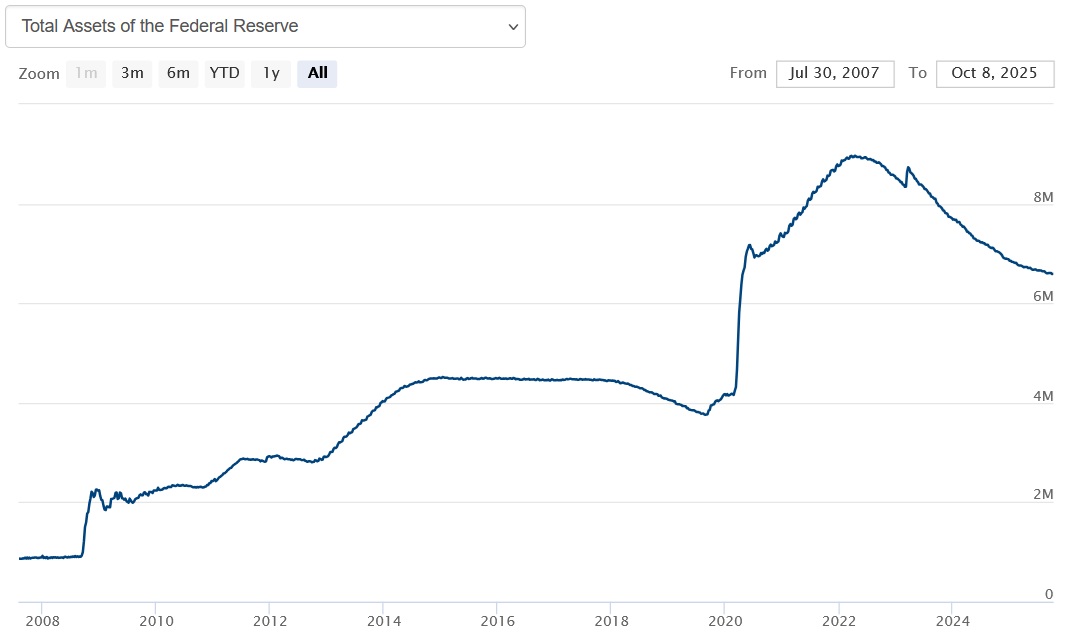
The result is a loop of monetized debt, where the government effectively funds itself by printing dollars through the Fed’s balance sheet. When considering the full fiscal picture, the real U.S. debt burden should include both the national debt and the Federal Reserve’s assets — a combined total of roughly $44.5 trillion:

$37,887,475,445,601 (national debt)
+ $6,608,000,000,000 (Federal Reserve assets)
= $44.495 trillion owed by U.S. taxpayers

That’s the true figure Americans are on the hook for. And the question remains: how will it ever be repaid?

The History of QE
The Federal Reserve first launched Quantitative Easing in November 2008, during the Great Recession, under President George W. Bush. Known as QE1, the program focused on purchasing mortgage-backed securities and agency debt to stabilize collapsing credit markets when interest rates were already near zero.

This initial cycle expanded the Fed’s balance sheet to approximately $4.5 trillion. By late 2019, the Fed began to unwind those holdings — allowing assets to “roll off” as they matured — marking the start of Quantitative Tightening (QT). However, the onset of the COVID-19 pandemic in 2020, under President Trump, triggered an unprecedented new wave of Quantitative Easing (QE), which rapidly expanded the balance sheet to nearly $9 trillion, the highest level in U.S. history. Many economists attribute a significant portion of the 2021–2022 inflation surge to this Trump-era QE, which flooded the financial system with liquidity and fueled speculative bubbles across housing, equities, and commodities.

In 2022, under President Biden, the Fed began a gradual process of balance sheet reduction, marking the start of Quantitative Tightening (QT) reducing the Fed’s assets to $6.6 trillion.

Now, just a few years later, Powell’s comments suggest a reversal of that policy — a return to money printing at a time when inflation remains above target and fiscal deficits are exploding.

QE Today: The Warning Signs
Powell’s latest remarks should set off alarm bells across the financial community. Reintroducing QE in the current environment — with massive fiscal deficits, high consumer debt, and lingering inflation — is not a stabilizing policy. It’s a recipe for economic disaster.

By artificially lowering rates and inflating asset prices, the Fed risks fueling another speculative bubble — one that could end in catastrophic wealth destruction, job loss, and financial contagion. Meanwhile, the federal government’s relentless spending ensures that each round of QE only digs the hole deeper.

This is not monetary stability. It’s the illusion of prosperity — a temporary sugar high before a historic crash.

If the Fed follows through with this plan, the outcome is predictable: rising inequality, eroding purchasing power, and ultimately what could become the Greatest Depression in U.S. history.

Fed Assets: The History of Quantitative aEsing (QE)

Creative Destruction in the Age of AI: How Endogenous Growth Theory Explains AI Stock Market Bubble

Déjà Vu Economics: How Trump’s Deregulation and Tariff Policies Mirror the Road to the Great Depression

Trumpenomics: The Fall of the USA

bookmark_borderCreative Destruction in the Age of Artificial Intelligence: How Endogenous Growth Theory Explains Today’s AI Stock Market Bubble

by Daniel Brouse
October 13, 2025

The Theory: Innovation, Growth, and Creative Destruction

Joel Mokyr, Philippe Aghion, and Peter Howitt Nobel Prize winning work advanced what’s known as endogenous growth theory, which emphasizes that technological progress is not something that just happens outside the economy (“exogenously”) but rather emerges from within it — from incentives, competition, and human ingenuity.

1. Aghion & Howitt – The Schumpeterian Model of Creative Destruction

Their core idea builds on Joseph Schumpeter’s notion of creative destruction:

  • Economic growth results from new innovations that make old technologies obsolete.

  • Entrepreneurs and firms invest in research and development (R&D) to gain temporary monopoly profits.

  • But those profits are eroded as new innovations arise, replacing the old technologies in a perpetual cycle.

This process is inherently disruptive — some firms and workers lose out while the economy as a whole advances.  Aghion and Howitt’s mathematical framework formalized this dynamic, showing how policies that encourage innovation — such as intellectual property rights, education, and competition — can accelerate long-run growth.

2. Joel Mokyr – Technological Revolutions and the “Culture of Growth”

Mokyr provided the historical and cultural context. He argued that the Industrial Revolution wasn’t a random event, but the result of a cultural shift toward experimentation, curiosity, and tolerance for failure.
In other words, progress comes not only from inventions themselves, but from societies that reward innovation and permit “creative destruction” to play out.


Connection to Today’s AI Stock Market Bubble

Now let’s apply this to today’s markets, especially the so-called “AI boom” or “AI bubble” of the 2020s.

1. Innovation-Driven Expectations

AI represents the next major general-purpose technology, much like the steam engine, electricity, or the internet. According to the Aghion–Howitt model, such technologies can trigger long periods of high growth by spawning new industries, raising productivity, and replacing outdated methods.

However — as with every technological revolution — the market tends to overprice the early promise. Investors project rapid and universal adoption long before the productivity gains materialize.
This is classic in early phases of creative destruction: massive capital pours into the “new thing,” often faster than the real economy can absorb it.

2. Creative Destruction in Real Time

AI is already destroying and creating value:

  • Winners: chip manufacturers (NVIDIA, AMD), cloud providers, and leading AI platforms.

  • Losers: traditional software firms, smaller labor-intensive industries, and certain white-collar sectors vulnerable to automation.

This mirrors the mechanism Aghion and Howitt described — innovation shifts profits and productivity across the economy, while creative destruction eliminates older structures.

3. The Bubble Mechanism

The AI stock bubble arises when:

  • Investors focus on potential future monopoly rents of innovation leaders (e.g., OpenAI, Microsoft, NVIDIA).

  • They overestimate the speed and scale of productivity spillovers.

  • The expectation of continuous innovation feeds speculative growth loops — firms are valued not on present earnings but on anticipated technological dominance.

This speculative behavior has historical precedent:

  • Railroad boom (1840s)

  • Electricity and radio bubbles (1920s)

  • Dot-com bubble (1990s–2000s)

Each reflected a genuine technological breakthrough, but financial markets priced in decades of progress almost overnight.

4. Mokyr’s Cultural Insight

Mokyr’s emphasis on cultural attitudes toward innovation helps explain why the bubble exists at all.
Modern tech culture — particularly in Silicon Valley — celebrates disruption and treats exponential growth as inevitable. The “AI hype” is as much cultural and psychological as it is economic:

  • The belief that “if we don’t invest now, we’ll miss the revolution” drives valuations higher.

  • Social narratives around AI (from AGI dreams to existential risk) amplify both fear and greed, core emotional drivers in financial bubbles.

5. The Long-Term Payoff

Despite the bubble, endogenous growth theory predicts that the underlying innovation cycle will eventually justify much of the investment — just not as fast or evenly as markets expect.
After each crash, the surviving technologies and firms lay the foundation for the next era of sustained productivity growth.


Thus, while the AI stock market bubble may burst, the AI technological revolution will likely continue reshaping the economy — improving productivity, transforming industries, and generating new waves of creative destruction.

It would not be unreasonable to suggest that as much as 90% of today’s companies could face creative destruction within the next decade, including members of the so-called “Magnificent Seven” tech giants. History shows that no company—no matter how dominant—remains immune to technological upheaval.

Artificial intelligence represents a general-purpose technology capable of reshaping nearly every industry, from manufacturing and finance to entertainment and healthcare. As automation, machine learning, and generative AI continue to advance, they are likely to collapse traditional cost structures, eliminate redundant business models, and redistribute profits toward entirely new players.

The “Mag 7” firms—Apple, Microsoft, Alphabet, Amazon, Meta, NVIDIA, and Tesla—currently appear invincible, much like IBM in the 1980s or Yahoo in the early 2000s. Yet their dominance depends on maintaining proprietary advantages in algorithms, data, and computing infrastructure. As AI becomes more open-source, decentralized, and commoditized, those moats could shrink quickly. A new generation of innovators may rise on more efficient models, more agile platforms, or disruptive uses of AI that make even the current leaders look obsolete.

In short, creative destruction doesn’t spare its own champions. The same technological forces that built the modern tech giants could dismantle them—proving once again that in an age of accelerating innovation, staying dominant is harder than becoming dominant.


In Summary

Concept Economic Theory Relation to AI Bubble
Endogenous growth Innovation arises from within the economy Firms are racing to internalize and monetize AI capabilities
Creative destruction New technologies displace old ones AI is already rendering older business models obsolete
Temporary monopoly profits Innovators earn short-term gains Market leaders (NVIDIA, Microsoft, OpenAI) enjoy outsized valuations
Speculative overshoot Early overvaluation of innovation potential AI stocks trade on promise, not earnings
Cultural driver (Mokyr) Societies that glorify progress fuel innovation Tech optimism and “AI evangelism” inflate the bubble