bookmark_borderFlood-Risk Disclosure Is Financial Risk Management: Pennsylvania’s New Law and the Growing Climate Liability of Real Estate

By Daniel Brouse and Sidd Mukherjee

Insurance and Real Estate | Financial Analysis | Independent Climate Research | Physics and Climate Systems

Overview

🏠 PENNSYLVANIA’S NEW FLOOD-RISK DISCLOSURE LAW: WHAT HOME BUYERS NEED TO KNOW

A home may be your biggest investment. Do you know its flood risk—and whether your insurance will cover the damage?

Pennsylvania’s new flood-risk disclosure law brings an important issue into focus: flood risk is not just an environmental problem. It is an insurance, real estate, financial planning, and consumer protection issue.

The paper, Flood-Risk Disclosure Is Financial Risk Management: Pennsylvania’s New Law and the Growing Climate Liability of Real Estate, Daniel Brouse and Sidd Mukherjee, examine the implications of this legislation and why informed property decisions matter.

Drawing on previous work in insurance, real estate, financial analysis, physics, and climate research, the paper explores:

• What Pennsylvania’s new law means for home buyers and sellers.

• Why standard homeowners insurance generally does not cover flood damage.

• How flood exposure can affect property values, insurance costs, and household finances.

• Why historical flood records alone cannot fully establish future risk.

• How climate change, better disclosure, insurance planning, and practical mitigation fit together.

• Why renters, existing homeowners, and taxpayers also have a stake in flood-risk awareness.

The bottom line: A property’s purchase price tells only part of the story. Buyers need to understand the risks, insurance limitations, and potential future expenses associated with owning it.

The conclusion is simple: Know the risks. Protect your investment. Build more resilient communities.

#FloodRisk #Pennsylvania #RealEstate #Insurance #ClimateChange #ConsumerProtection #ClimateAdaptation

Introduction

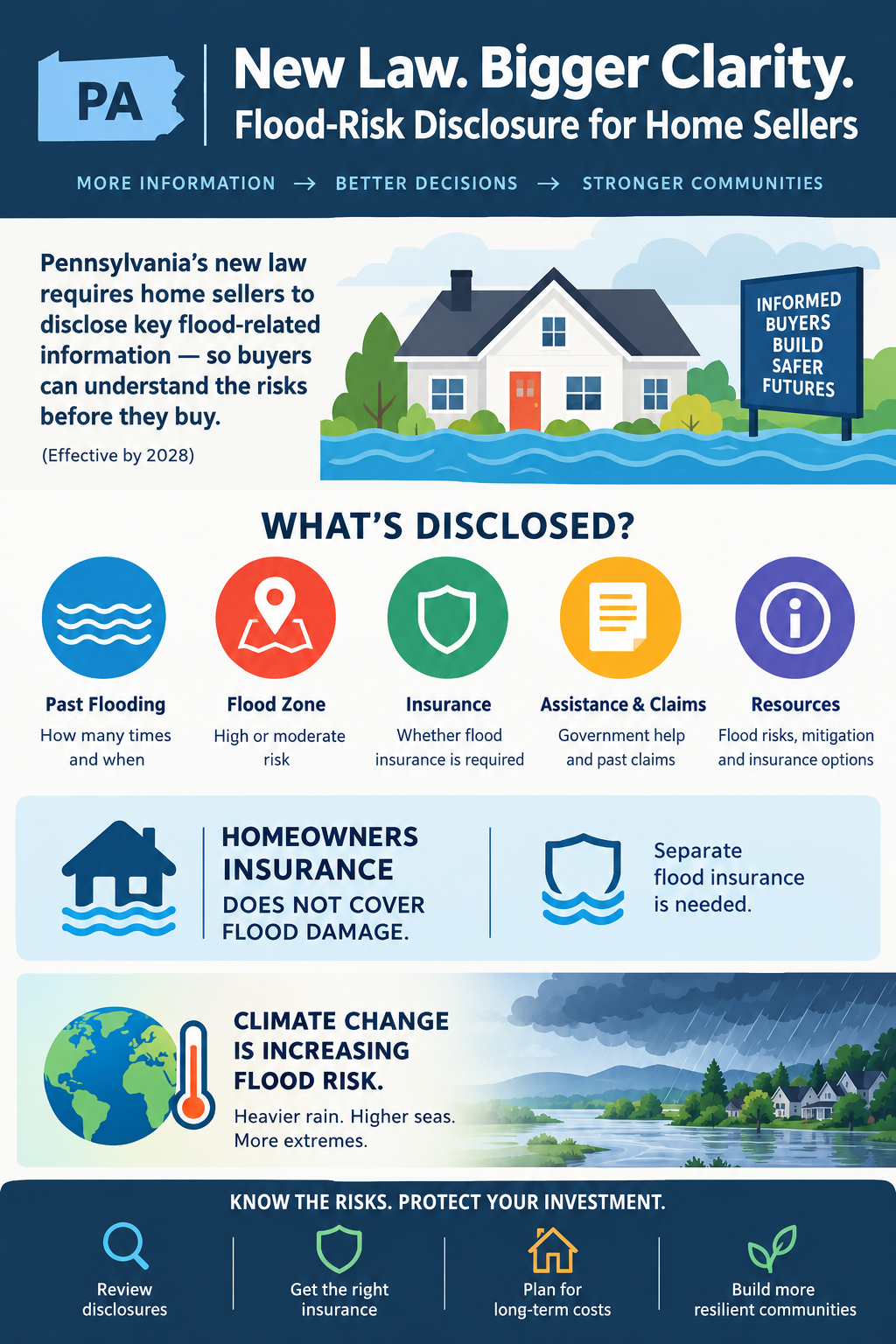
Pennsylvania’s new flood-risk disclosure law recognizes a fundamental principle of responsible financial decision-making: people cannot adequately evaluate a property’s financial risks when material information about those risks is unavailable or undisclosed. Signed into law on October 22, 2026, House Bill 1704 strengthens residential real estate disclosures concerning flood history, flood insurance, and related risk factors. The law also directs the Pennsylvania Insurance Department to provide public information about flood risks, mitigation, and insurance options.

This legislation has implications extending well beyond real estate transactions. Flood risk affects property valuation, mortgage lending, insurance adequacy, household financial security, municipal budgets, and taxpayer exposure. Climate change adds another dimension by altering the conditions under which property risks must be evaluated. Historical flood records and existing hazard maps are important, but they cannot, by themselves, establish the full range of future risks.

Drawing on decades of experience in insurance, real estate, financial analysis, and independent climate research, this paper argues that Pennsylvania’s legislation is an important step toward more informed property transactions. It also identifies the limitations of disclosure alone and the need for integrated climate-risk assessment, transparent insurance information, forward-looking property valuation, and financially responsible adaptation.

1. Introduction: The Financial Consequences of Undisclosed Risk

Pennsylvania has taken an important step toward protecting homebuyers from financial losses they may not anticipate when purchasing residential property.

On October 22, 2026, Governor Josh Shapiro signed House Bill 1704 into law. As reported by WHYY on October 27, the legislation expands the information residential property sellers must disclose about flooding and related risks. Compliance with the revised disclosure requirements is scheduled for the summer of 2028. WHYY’s report on the new law.

The underlying issue is straightforward: purchasing a home is one of the largest financial commitments most households make. Buyers need accurate information about the property’s condition, operating expenses, insurability, and exposure to foreseeable losses. When important risks are not adequately communicated, buyers can make decisions based on an incomplete assessment of the property’s true financial cost.

My professional experience spans real estate, mortgage banking, financial planning, accounting, and financial analysis. My independent climate research, which began in 1992, has focused on the physical processes driving climate change and the implications of a changing climate for human systems.

These fields converge on a common principle: risk that is omitted from a financial decision does not disappear. It remains a potential liability.

Flood-risk disclosure is therefore not simply a paperwork requirement. It is part of the larger responsibility to ensure that property buyers, lenders, insurers, and communities can make informed decisions about the assets and liabilities they assume.

2. What Pennsylvania’s New Law Requires

House Bill 1704 amends Pennsylvania’s residential real estate disclosure provisions under Title 68 of the Pennsylvania Consolidated Statutes.

The legislation strengthens the information buyers receive about flood-related risks. Among the provisions described in the enacted legislation and WHYY’s reporting are requirements concerning:

  • The number of times a property has experienced flooding and the estimated dates of those incidents.
  • Whether a property is located in a Federal Emergency Management Agency-designated high- or moderate-risk flood zone.
  • Whether flood insurance is required for the property.
  • Whether the seller has received government assistance for flood damage.
  • Whether the seller has filed a flood insurance claim.

The law also directs the Pennsylvania Insurance Department to publish information about flood-risk factors, mitigation measures, insurance coverage, and resources for identifying properties in flood-hazard areas.

The revised disclosure process will include a written notice advising prospective buyers that many Pennsylvania properties face flood risks and that standard homeowners insurance typically does not cover flood damage. Buyers are encouraged to consult insurance professionals and investigate separate flood coverage.

These requirements are significant because they connect property disclosures with practical financial decisions. Buyers need to know not only whether a property has flooded but also whether the insurance they expect to protect their investment will actually cover the loss.

The important distinction is between knowing that a risk exists and understanding the financial consequences of that risk. Effective disclosure should help buyers investigate both.

Sources: Pennsylvania House Bill 1704 and the Pennsylvania Insurance Department’s announcement.

3. The Insurance Problem: Homeowners Coverage Is Not Flood Coverage

One of the most consequential misconceptions in residential property ownership is that a standard homeowners insurance policy covers every major source of property damage.

It does not.

Standard homeowners policies generally exclude flood damage. Flood insurance is typically purchased separately, either through the National Flood Insurance Program or an eligible private insurer. Coverage terms, exclusions, limits, deductibles, and eligibility vary by policy.

This distinction can have severe financial consequences.

A buyer may purchase a home, obtain a mortgage, and maintain homeowners insurance while remaining exposed to substantial flood losses. The existence of an insurance policy does not establish that the property is adequately insured against every material hazard.

From an insurance and financial-planning perspective, this is a problem of incomplete risk transfer. The homeowner retains a potentially substantial uninsured liability.

A flood can damage structural components, electrical systems, heating and cooling equipment, appliances, flooring, furnishings, and personal possessions. Recovery may involve temporary housing, repairs, reconstruction, and expenses that continue while a property is uninhabitable. Actual coverage depends on the applicable policies and circumstances.

The financial consequences extend beyond the initial repair bill. Flood damage may affect resale value, future insurance costs, mortgage affordability, and the amount of money a household can preserve for retirement or other needs.

This is why the insurance question must be addressed before a transaction closes.

Buyers should determine:

  1. What hazards the homeowners policy covers and excludes.
  2. Whether separate flood insurance is available and appropriate.
  3. What the policy limits, deductibles, exclusions, and waiting periods are.
  4. Whether the coverage is sufficient to address the property’s actual replacement and recovery costs.
  5. How premiums and other carrying costs affect the household’s long-term budget.

Pennsylvania’s new law directs attention to these questions. Its broader value will depend on whether buyers use the information to evaluate their actual exposure rather than treating disclosure as another form to sign.

4. Real Estate Valuation Must Account for Risk

Real estate valuation is not simply a matter of comparing square footage, location, amenities, and recent sales.

A property’s economic value also depends on the costs and risks associated with owning it.

Flood exposure can affect insurance premiums, repair and maintenance expenses, financing conditions, marketability, and the potential for future losses. Two otherwise comparable properties may therefore have materially different economic profiles.

A waterfront home, for example, may offer exceptional recreational value, scenic views, and personal enjoyment. Those benefits may justify a higher purchase price for a particular buyer. However, the same property may carry additional insurance expenses, mitigation costs, and exposure to flooding.

There is no universal answer to whether a property with elevated flood risk is a good investment. That determination depends on the buyer’s objectives, financial resources, risk tolerance, insurance options, and the property’s specific characteristics.

The essential requirement is informed consent to the financial risk.

My experience in real estate and mortgage banking reinforces the importance of distinguishing a property’s purchase price from its total cost of ownership. A transaction can appear affordable at closing while creating substantial future expenses that were not incorporated into the buyer’s original budget.

A more complete financial assessment should consider:

  • Purchase price and financing costs.
  • Property taxes and ordinary maintenance.
  • Homeowners and flood insurance premiums.
  • Expected mitigation and resilience investments.
  • Potential deductibles and uninsured losses.
  • The implications of future hazard changes for resale and financing.

Not every risk can be expressed as a precise dollar amount. Nevertheless, acknowledging uncertainty is better financial practice than treating an incomplete estimate as a comprehensive valuation.

A property’s market price does not automatically reflect its full climate-related financial risk.

Improved disclosures can help correct that information gap, although disclosure alone cannot guarantee that prices, insurance premiums, or lending decisions will fully reflect future exposure.

5. Climate Change Changes the Risk-Assessment Problem

Flood risk is not determined by property history alone. It also depends on precipitation, drainage, topography, river conditions, coastal processes, land development, infrastructure, and the changing physical environment.

Climate change adds an important consideration: historical conditions are not necessarily a complete guide to future conditions.

Warmer air can hold more water vapor, increasing the potential for heavier precipitation under suitable atmospheric conditions. Changes in precipitation patterns can affect runoff, streamflow, drainage systems, and flood hazards. The resulting effects vary by location and depend on local geography, infrastructure, and other factors.

At the same time, flooding can occur outside formally designated high-risk zones. Localized rainfall, overwhelmed drainage systems, changing waterways, and other conditions can produce losses that a buyer might not anticipate from a single map or a property’s previous history.

This does not mean every property will experience increasing flood risk at the same rate. Nor does climate change eliminate the value of historical flood records or FEMA flood maps. Both remain important sources of information.

It means that risk assessment should consider multiple sources of evidence and distinguish present conditions from future possibilities.

My climate research has focused on the interaction of climate processes, feedbacks, and changes in the Earth’s energy system. That work informs a broader concern about financial risk: physical systems can change, and risk assessments that assume past conditions will continue indefinitely can become inadequate.

The appropriate response is not to disregard established flood maps. It is to use them alongside other relevant information, including local flood histories, drainage conditions, infrastructure assessments, updated hazard analyses, and credible forward-looking projections.

For real estate, the distinction is critical. A disclosure based on what a seller knows about past flooding serves a different purpose from a scientific assessment of what could happen to the property over the coming decades.

Historical disclosure documents the past. Climate-informed risk assessment helps evaluate the future. Both are necessary for sound decisions.

6. Disclosure Is Consumer Protection and Fiscal Responsibility

The economic benefits of better disclosure extend beyond individual buyers.

When a homeowner experiences a major uninsured loss, the consequences may include depleted savings, additional borrowing, delayed repairs, mortgage distress, or the loss of accumulated household wealth.

Public assistance may help some affected households, but disaster assistance is not a substitute for comprehensive insurance and does not guarantee full compensation for losses.

Flood damage can also affect local governments through emergency response expenses, infrastructure repairs, drainage improvements, and other recovery costs. Public insurance programs and disaster assistance may expose taxpayers to additional financial obligations.

These consequences connect private property decisions to public fiscal responsibility.

Better disclosure can help buyers make more informed choices about whether to purchase a property, obtain insurance, invest in mitigation, or reconsider the transaction. It can also encourage earlier investments in measures that reduce potential losses.

Depending on the property and hazard, mitigation may include improving drainage, protecting critical equipment, installing appropriate flood-resistant materials, elevating vulnerable components, or undertaking professionally designed structural improvements.

Not every mitigation measure is appropriate for every property, and its cost-effectiveness should be evaluated individually.

Nevertheless, identifying a risk before a loss occurs generally provides more opportunities to plan than discovering it after the damage is done.

Pennsylvania’s legislation addresses one part of this problem by strengthening the flow of information between sellers and buyers. The next challenge is to ensure that the information supports practical decisions rather than merely satisfying a disclosure requirement.

7. The Remaining Gap: Renters and Existing Property Owners

The new law primarily addresses residential property sales. It does not establish a comparable general flood-risk disclosure requirement for landlords and renters.

That distinction matters.

Renters can face serious financial consequences from flooding, including damage to personal belongings, displacement, temporary housing expenses, and interruptions to employment or daily life. A landlord’s building insurance does not necessarily cover a tenant’s personal possessions or additional living expenses.

Tenants may also have limited control over building-level mitigation measures and may not know whether a property has flooded previously.

The absence of equivalent disclosure requirements for renters leaves an important consumer-information gap. WHYY reports that a separate proposal concerning flood disclosures for rental properties had not advanced beyond committee referral as of its October 27, 2026, report.

A comprehensive approach to flood-risk communication should consider both owners and tenants, while distinguishing the respective responsibilities of property owners, insurers, and occupants.

Existing homeowners also need access to understandable information about their current exposure. They should not have to wait until they sell their homes to discover that their insurance coverage is inadequate or that local flood conditions warrant further investigation.

The public information resources required by House Bill 1704 can help address this broader need, provided they remain accessible, useful, and responsive to changing information.

8. Recommendations for a More Comprehensive Approach

Pennsylvania’s new law creates an opportunity to strengthen the relationship between real estate transactions, insurance decisions, climate adaptation, and financial planning.

Several additional measures would build on its foundation.

A. Make flood-risk information accessible before an offer is made

Buyers should be encouraged to investigate flood history, mapped hazards, insurance requirements, and available coverage early in the purchasing process. Discovering significant costs after making a binding commitment can leave buyers with fewer practical options.

B. Distinguish historical records from forward-looking risk

Disclosure forms should communicate what is known about past flooding without implying that a property with no documented history is free from risk. Public resources should help buyers understand the limitations of historical records and hazard maps.

C. Encourage insurance review before closing

Buyers should obtain quotes and review relevant policy terms before finalizing a purchase. This allows insurance costs, deductibles, exclusions, and coverage availability to inform the household budget and purchase decision.

D. Incorporate climate risk into property and infrastructure planning

Local governments, lenders, insurers, and property owners should evaluate relevant forward-looking hazard information when making long-term decisions. The appropriate analysis will differ between inland river flooding, localized stormwater flooding, and coastal exposure.

E. Expand consumer education

Disclosure is most effective when people understand what the information means. Public education should explain the difference between homeowners insurance and flood insurance, how to investigate risk, what mitigation can accomplish, and where to obtain qualified advice.

F. Evaluate affordability and financial feasibility

Some households have limited alternatives when searching for affordable housing. Better information cannot, by itself, resolve that constraint. Policy responses should recognize the need to balance risk awareness with practical access to housing and the cost of mitigation and insurance.

G. Improve transparency across the property lifecycle

Risk information should not be viewed solely as a requirement at the point of sale. Property owners, renters, insurers, lenders, and local officials all benefit from accessible information that supports ongoing risk management.

These recommendations are consistent with a basic principle of financial analysis: identify material risks, estimate their potential consequences, evaluate the available responses, and make decisions with a clear understanding of the remaining uncertainty.

9. Integrated Climate Stewardship and Property Risk

My broader approach to climate solutions is called Integrated Climate Stewardship. It emphasizes reducing avoidable resource consumption and climate impacts while directing resources toward practical benefits and resilience.

Applied to real estate, this framework supports a comprehensive approach to property risk rather than treating flood disclosure, insurance, energy use, infrastructure, and climate adaptation as unrelated issues.

A property is part of a larger system. Its financial performance depends not only on the building itself but also on the surrounding environment, public infrastructure, insurance market, utilities, and community resilience.

The same principle applies to climate risk. Effective management requires attention to both the physical hazard and the economic systems that determine who bears the losses.

For an individual homeowner, that may mean evaluating insurance coverage, reducing avoidable exposure, and making cost-effective improvements. For a community, it may mean improving drainage, maintaining infrastructure, updating hazard assessments, and evaluating development decisions against long-term risks.

For lenders and insurers, it means recognizing that reliable risk information is essential to assessing potential losses. For policymakers, it means considering the distribution of costs among property owners, private insurers, public programs, and taxpayers.

This is not an argument that every climate-related risk can be eliminated. It is an argument that avoidable financial exposure should not be ignored simply because the relevant costs may occur years after a transaction.

10. Conclusion: Disclosure Is the Beginning, Not the End

Pennsylvania’s new flood-risk disclosure law establishes an important principle for residential real estate: prospective buyers deserve more complete information about a property’s flood history and related insurance considerations.

That principle aligns with longstanding practices in responsible insurance, real estate, and financial analysis. A major financial commitment should be based on an informed assessment of material risks, not merely on the purchase price or the assumption that existing insurance covers every foreseeable loss.

The legislation is a meaningful step, but its limits must be understood. Disclosure does not prevent flooding, guarantee affordable insurance, eliminate uninsured losses, or ensure that property values accurately reflect future climate conditions. Its effectiveness will depend on implementation, public understanding, and the decisions that buyers and other stakeholders make with the information provided.

Climate change adds urgency to the broader question of how society evaluates long-lived assets. Homes, mortgages, infrastructure, and insurance arrangements often extend across decades. Risk assessments that rely exclusively on past conditions can leave households and institutions exposed when relevant conditions change.

My experience in insurance, real estate, mortgage banking, financial analysis, and climate research leads to one central conclusion:

Sound property ownership requires more than knowing what a home costs today. It requires understanding the risks, liabilities, and future expenses that come with owning it.

Pennsylvania’s new law moves the state toward that objective. The next step is to connect better disclosure with informed insurance decisions, climate-aware valuation, practical mitigation, and financially responsible planning.

The goal should be straightforward: fewer preventable losses, better-informed buyers, more resilient communities, and less avoidable financial risk for homeowners and taxpayers alike.


Sources and Further Reading

  1. Sophia Schmidt, “Gov. Shapiro signs law requiring home sellers to disclose more about a home’s flood risk,” WHYY, October 27, 2026.
  2. Pennsylvania General Assembly, House Bill 1704, 2025–2026 Regular Session.
  3. Pennsylvania Insurance Department, “Governor Shapiro Signs New Law to Improve Transparency for Homeowners and Protect Pennsylvanians from Unexpected Flood Losses,” October 23, 2026.
  4. Commonwealth of Pennsylvania, Do I Need Flood Insurance?.

This paper presents professional and analytical commentary on flood-risk disclosure, insurance, real estate, and climate adaptation. It is not legal, insurance, investment, or property-specific advice.
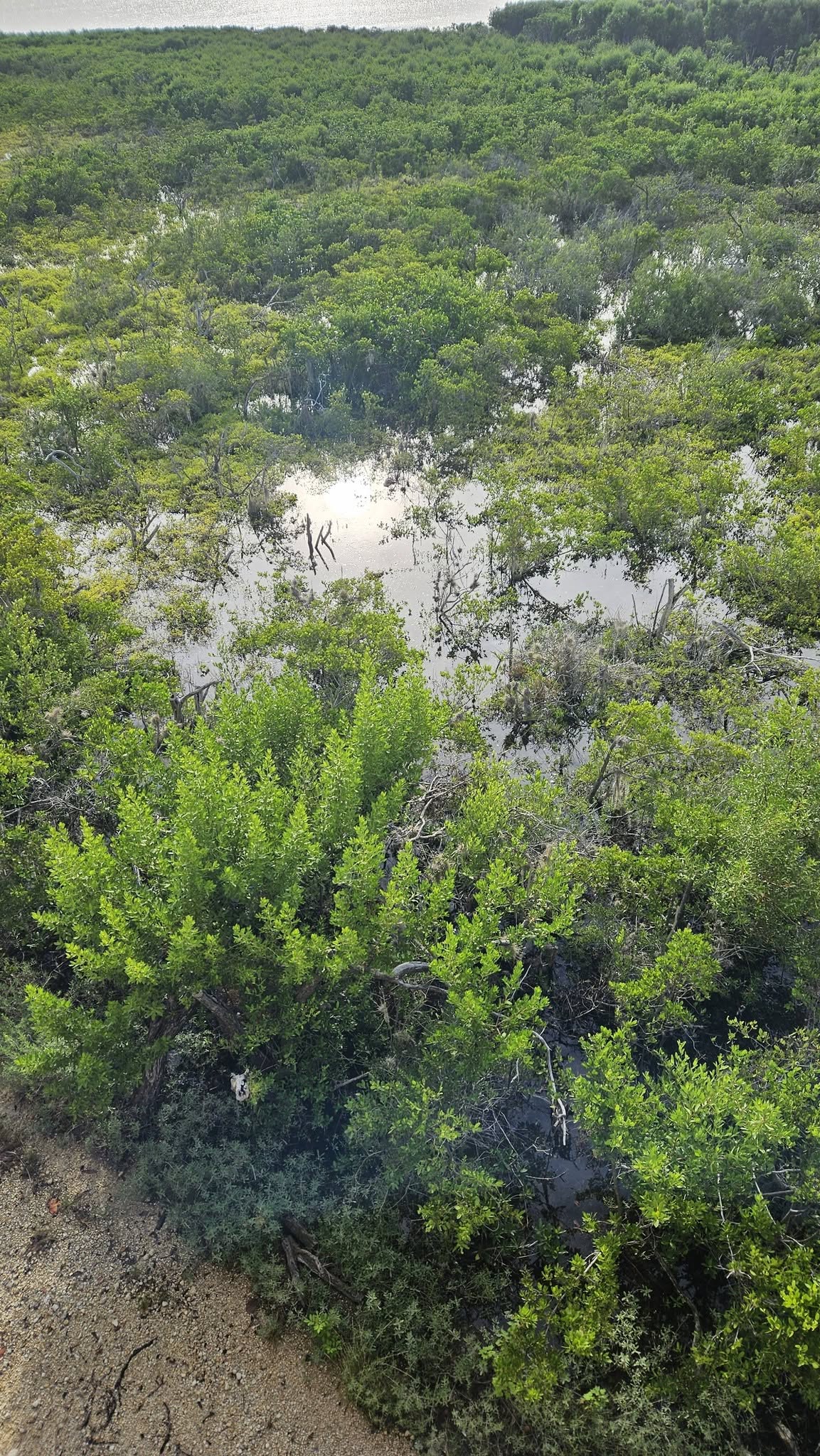
bookmark_borderHow Is Climate Energy Hitting You? Florida Keys: Going Under

by Daniel Brouse

Much of the public discussion of climate change still focuses on historical trends and older climate models. Since 2023–2024, however, our understanding of the climate system has advanced significantly as scientists increasingly examine real-time observations, accelerating changes, feedback loops, and complex Earth system behavior.

Understanding climate acceleration no longer requires multiple advanced degrees or an extensive background in nonlinear chaos theory. The evidence is increasingly visible in the world around us. In many ways, you can begin by simply looking out your window.

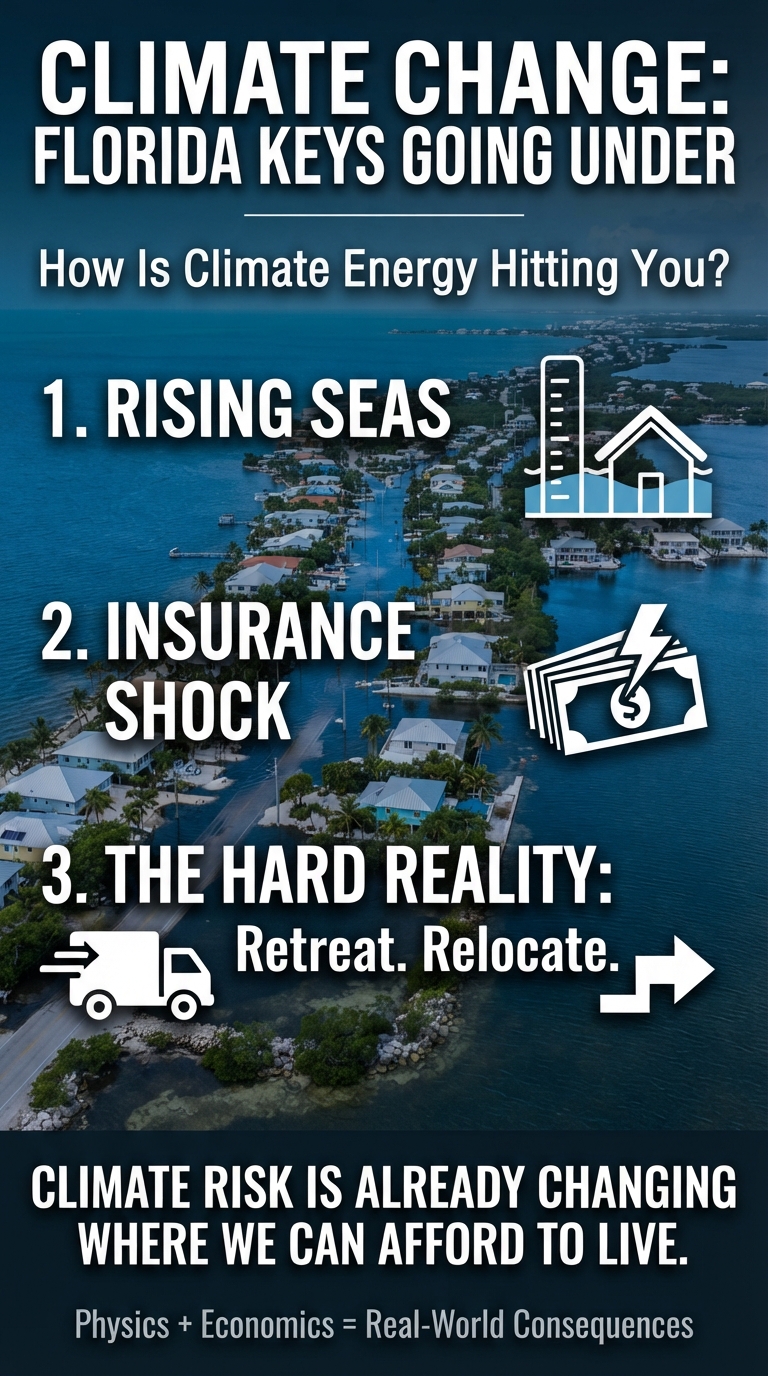
Florida Keys: Going Under

Dave Darlington Sr. shared this observation from Tavernier, Florida:

“Our last morning here in Tavernier, I wanted to speak to climate change. Some say it’s a hoax, but as the planet warms, glaciers and ice melt and salt water rises. Change is needed or future generations won’t enjoy what we have. Fran and I have come to this area since 1986 and seen profound change here. I wanted to share it with you. Until this administration cast off the ecologic safeguards there was hope. Will everyone do something? Now we are at a crucial point, vote carefully. Or throw it all away.”

Going Under

The photograph captures the ongoing threats of coastal flooding, tidal inundation, and saltwater intrusion driven by sea-level rise in this low-lying Florida Keys community.

Because these islands sit on highly porous limestone, rising seas threaten them from two directions: seawater can inundate the shoreline and push inland through the ground beneath it. These growing risks have prompted multimillion-dollar infrastructure projects in Tavernier and surrounding communities to protect homes, roads, and other critical infrastructure.

Unfortunately, much of this investment risks becoming a losing battle against accelerating sea-level rise. Over the next decade, protecting the most vulnerable areas will become increasingly difficult and expensive as rising seas intensify the threats facing coastal infrastructure. Managed retreat—planning for the relocation of people, homes, and infrastructure away from areas that can no longer be defended—is the only realistic long-term solution in the most vulnerable locations.

The underlying problem is physical: infrastructure can be elevated, drainage improved, and seawalls strengthened, but these measures cannot permanently overcome rising seas.

Insurance: When the Economics No Longer Work

Given the extent of climate damage already locked into the system, insurance prices serve a purpose beyond determining the cost of coverage. They increasingly reveal where the risks of homeownership are becoming economically unsustainable.

When homeowners insurance becomes unaffordable, it signals that the financial risks of owning property in that location may no longer justify the investment. Premiums, deductibles, coverage restrictions, and the growing difficulty of obtaining insurance all reveal the economic consequences of physical climate risks.

This is the interaction of physics and economics: as climate hazards intensify, the costs of protecting property rise. Eventually, the expense of maintaining and insuring a home can exceed what the property is worth owning.

Ironically, Florida became a prime example of how government intervention can subsidize homeowners insurance and delay the financial recognition of growing climate risks. Such subsidies may temporarily reduce costs for property owners, but they do not eliminate the underlying physical hazards. They shift the financial burden to taxpayers.

Dave responded: “Makes sense to me, that is one reason we left south Florida after Hurricane Andrew.”

His experience illustrates a difficult reality: people who recognize escalating risks and leave vulnerable areas may make their decisions long before the broader housing and insurance markets fully reflect those risks.

The bottom line: Climate change is not just a distant environmental problem. It is reshaping coastlines, threatening infrastructure, increasing insurance costs, and changing the economics of where people can safely and affordably live. The evidence is already visible. The challenge is recognizing what it means—and acting before the costs become overwhelming.

bookmark_borderFire Without Precedent: The Wildfire Escalation Reshaping the Pacific Northwest and Alaska

by Daniel Brouse

The 2026 wildfire season is rewriting the history of wildfire in Oregon, Washington, and Alaska. Record-setting megafires, increasingly unusual Arctic fires, overwintering “zombie fires,” and growing insurance losses reveal a wildfire regime that is expanding in both intensity and geographic reach.

From Oregon’s record-breaking Big Grass Fire to destructive fires around Spokane and unprecedented burning across Alaska’s tundra and boreal forests, the scale of change is becoming increasingly difficult to dismiss as simply another bad fire season.

Oregon’s Worst Wildfires

Oregon’s wildfire history is being rewritten by back-to-back extreme fire years, particularly in 2024 and 2026.

The Big Grass Fire (2026)

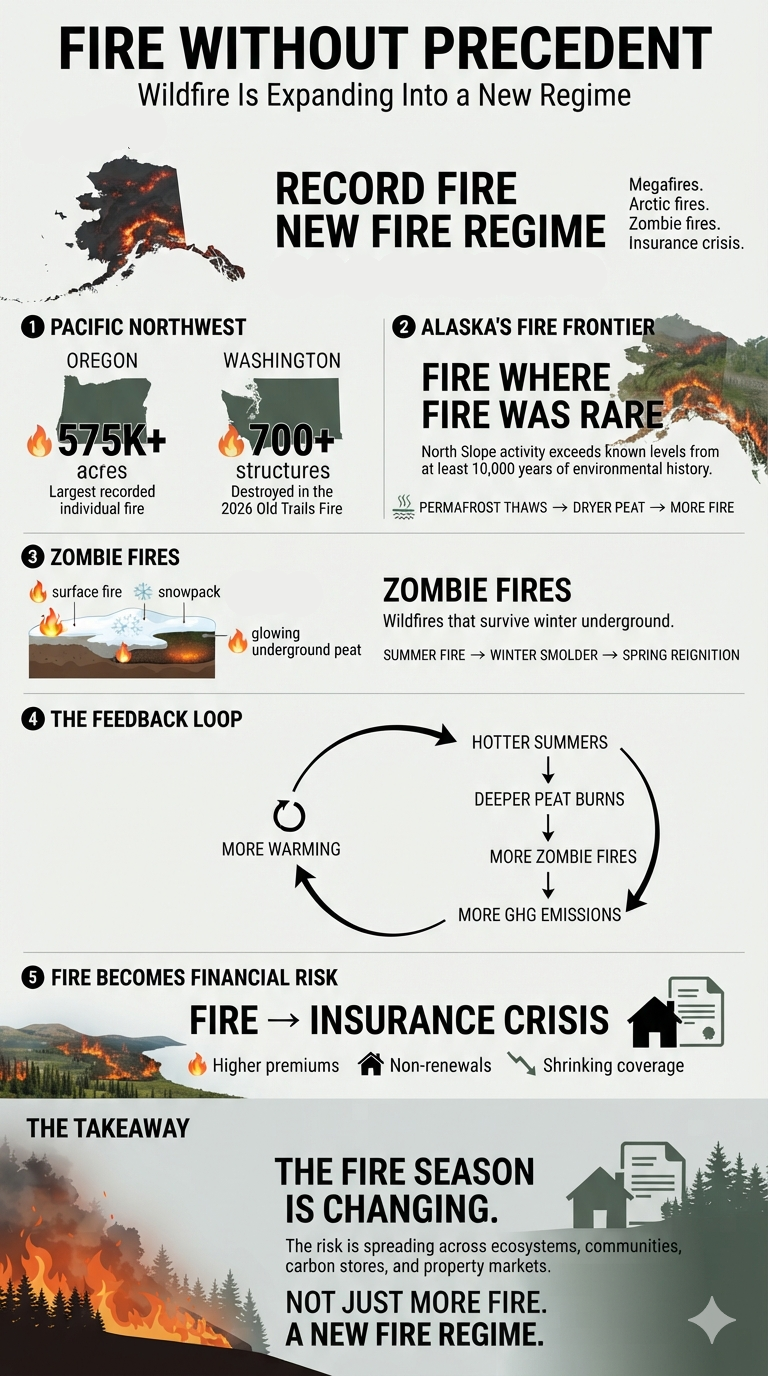
Burning 575,341 acres, the active Big Grass Fire has become the largest individual wildfire in recorded Oregon history by acreage.

The Long Draw Fire (2012)

The Long Draw Fire consumed 557,028 acres of rangeland in southeastern Oregon and previously held the modern state record.

The Biscuit Fire (2002)

The Biscuit Fire burned approximately 500,000 acres through southwestern Oregon’s Siskiyou National Forest, requiring a massive national firefighting response.

The Rowe Creek and Coleman Creek Fires (2026)

These two major fire complexes have burned approximately 372,971 and 308,721 acres, respectively, adding to an extraordinary season of large-scale burning.

The Labor Day Fires (2020)

Although not the largest Oregon fires by individual acreage, the 2020 Labor Day fires demonstrated how rapidly extreme weather can transform multiple fires into a statewide disaster. Severe winds drove simultaneous fires—including the Santiam and Almeda fires—that collectively burned more than 1 million acres, destroyed thousands of homes, and caused multiple fatalities.

Washington’s Worst Wildfires

Washington’s most intense historical fires have generally occurred in the state’s drier eastern regions. More recently, however, extreme fires have increasingly demonstrated their destructive potential at the wildland-urban interface.

The Okanogan Complex (2015)

The Okanogan Complex burned more than 304,000 acres, making it the largest wildfire complex in modern Washington history. Three wildland firefighters lost their lives.

The Carlton Complex (2014)

The Carlton Complex burned approximately 256,000 acres in the Methow Valley and destroyed about 300 homes, making it the state’s most destructive fire in terms of property loss at that time.

The Old Trails Fire (2026)

The catastrophic, human-caused Old Trails Fire near Spokane has consumed more than 700 structures, contributing to what is being described as Washington’s most destructive wildfire season on record.

The Sinlahekin Fire (2026)

This ongoing megafire has scorched more than 115,514 acres in Okanogan County.

The Gray and Oregon Fires (2023)

These two fast-moving fires in Spokane County destroyed a combined 710 structures, including 366 homes, and caused two deaths.

Cross-Border Blazes

Wildfires do not recognize state boundaries. The shared Columbia River border between Oregon and Washington can allow fire impacts to cross from one state to the other.

In 2017, the human-caused Eagle Creek Fire ignited in Oregon’s Columbia River Gorge, burned approximately 50,000 acres, and sent airborne embers across the river, igniting secondary fires in Washington.

Alaska’s New Wildfire Frontier

Alaska is experiencing another dimension of the wildfire transformation: fire is expanding into landscapes where large, persistent wildfires were historically exceptionally rare.

The North Slope tundra and portions of southwestern Alaska are experiencing wildfire activity that paleofire research suggests has no close parallel in the region’s known environmental history.

The North Slope Tundra

Historically, the Arctic tundra north of the Brooks Range was too cold, wet, and sparsely vegetated to sustain frequent large fires. Recent research indicates that North Slope wildfire activity during the past century has risen beyond anything observed in at least 3,000 years.

The drivers: Thawing permafrost is lowering local water tables and drying ancient peat layers that once acted as natural fire barriers. At the same time, warmer conditions are allowing woody shrubs to expand, creating additional fuel across the tundra.

The precedent: Modern megafires in this region—including the historic Anaktuvuk River Fire, which burned more than 400 square miles of tundra—represent a fundamentally different fire regime from what prevailed during much of the previous several millennia.

Southwestern Alaska: Yukon-Kuskokwim Delta and Bristol Bay

Southwestern Alaska has also historically experienced very little wildfire because of maritime moisture and tundra conditions.

That pattern is changing.

Millions of acres have burned across the region during recent consecutive fire seasons, including major events such as the Lime Complex and East Fork Fire.

Fires are now occurring as early as April and can burn deeply into organic-rich soils that have stored carbon for thousands of years.

The Yukon Flats

Farther south, in Alaska’s Interior boreal forest, the Yukon Flats ecoregion has experienced a dramatic increase in fire frequency and severity. Research indicates that recent fire activity has reached levels exceeding those seen at any point in approximately 10,000 years.

The ecological consequences extend beyond individual fires. Repeated severe burning can help convert ancient conifer-dominated spruce forests into more fire-adapted deciduous woodlands, potentially altering the region’s ecosystem for generations.

Zombie Fires: Wildfires That Survive the Winter

One of the most unusual consequences of Arctic and sub-Arctic warming is the rise of “zombie fires,” scientifically known as overwintering or holdover fires.

These fires can continue burning underground through the freezing winter and then reemerge at the surface the following spring. Instead of being extinguished by rain and heavy snow, they remain hidden beneath the surface until conditions become favorable for renewed combustion.

How a Fire Survives Under Ice and Snow

Zombie fires depend heavily on the unique composition of Arctic and sub-Arctic soils.

The fuel layer: Boreal and tundra ecosystems contain thick layers of peat and decomposing organic material. Peat is highly compacted, carbon-rich, and capable of sustaining slow, persistent combustion.

Low-oxygen smoldering: When a summer wildfire penetrates deeply into peat, it can transition from an open flame to underground smoldering. The winter snowpack restricts oxygen availability without necessarily extinguishing the fire, allowing it to move slowly through roots and organic matter even while surface temperatures plunge far below freezing.

Spontaneous combustion: Research has also identified another potential mechanism. Rapid spring warming can accelerate microbial decomposition within peat, producing heat that may contribute to spontaneous ignition under certain conditions.

Why Zombie Fires Challenge Fire Management

Fire managers once viewed overwintering fires as rare anomalies. Increasing observations suggest they may be becoming a more important source of new wildfire ignitions across Alaska, northern Canada, and Siberia.

An early start to fire season: Zombie fires can reemerge in April or May, weeks before the traditional summer lightning season. This can place additional demands on firefighting resources before seasonal crews are fully deployed.

An invisible threat: While buried, these fires can produce little visible flame and relatively little surface heat, making detection difficult. Firefighters may not discover them until they emerge along the edges of previous burn scars.

Booby-trapped landscapes: As underground fires consume roots and peat, they can hollow out sections of the ground. The resulting landscape can contain extensive areas of fallen trees and unstable soil, creating dangerous conditions for helicopters and ground crews.

The Climate Feedback Loop

The most consequential concern may be what these fires release into the atmosphere.

Peatlands store enormous quantities of carbon. When zombie fires smolder through peat for months, they can release carbon dioxide (CO₂), carbon monoxide (CO), and potentially methane (CH₄), adding greenhouse gases to the atmosphere.

That creates the potential for a reinforcing feedback loop:

Hotter summers → deeper peat fires → more overwintering fires → greater greenhouse-gas emissions → additional warming.

The concern is not simply that the Arctic is burning more. It is that warming can alter the underlying conditions that determine where, when, and how fire can persist.

Wildfire Is Becoming an Insurance Crisis

The intensifying wildfire seasons across the Western United States are also triggering a severe property-insurance crisis, characterized by soaring premiums, policy non-renewals, and increasingly stringent requirements for homes in fire-prone areas.

Major nationwide insurers, including State Farm and Allstate, have been pulling back from or reducing exposure to some high-risk Western markets as they attempt to limit catastrophic wildfire losses.

The effects differ considerably among Oregon, Washington, and Alaska because of differences in fire activity, population exposure, and state regulation.

Oregon: Pushed Toward the Brink

Oregon’s insurance market is under increasing pressure following consecutive years of severe wildfire activity.

Premium surges: Homeowners in Central Oregon, along the Oregon Coast, and on rural acreage properties are facing renewal increases ranging from 50% to more than 100%.

Statewide non-renewals: Some carriers are dropping entire ZIP codes, leaving rural homeowners increasingly dependent on high-cost, bare-bones “last-resort” insurance pools.

Regulatory intervention: Under S.B. 82, insurers must provide clear and detailed notices explaining the wildfire risk factors contributing to a cancellation or premium increase.

During the active 2026 fire season, the Oregon Division of Financial Regulation issued an emergency order pausing home-insurance cancellations and non-renewals through August 2026 in affected areas.

Local governments are also responding. Deschutes County, for example, has adopted the R327 building code, which requires newly constructed or remodeled homes to incorporate features such as ember-resistant vents and Class A roofing to improve wildfire resilience and eligibility for specialty insurance markets.

Washington: Post-Spokane Instability

Before August 2026, Washington’s property-insurance market had been showing signs of stabilization. The devastating Old Trails Fire near Spokane, however, has injected new volatility into the market.

The Spokane drop-off: Data indicate that after severe fire seasons, Washington insurers have dropped or canceled policies on more than a third of fire-impacted properties, while Spokane County has experienced a 65% increase in non-renewals.

Risk-score friction: Insurers increasingly use wildfire-risk scores to price policies. A 2026 legislative effort backed by the Washington Office of the Insurance Commissioner sought greater transparency and an appeals process for consumers. The bill passed the Senate 48–1 but ultimately stalled in the House.

Mandated baseline coverage: Washington law requires standard homeowners policies to cover basic fire, smoke, and soot damage under terms that meet or exceed the state’s official model policy. Yet obtaining new coverage in a high-risk area has become increasingly difficult.

Alaska: The Emerging Insurance Frontier

Alaska has not yet experienced the widespread homeowner-insurance collapse seen in some other high-risk Western markets. But the underlying risk profile is changing.

Lagging actuarial models: Many legacy underwriting maps continue to assess Alaska through a historical lens—one that assumes an Arctic environment with relatively low structural wildfire risk.

The tundra shift: Much of Alaska’s recent extreme fire activity has occurred in remote wilderness rather than heavily populated residential areas. As a result, structural losses remain comparatively limited.

Future vulnerability: The situation could change as tundra and Interior fires move closer to isolated communities and population centers such as Fairbanks. Insurance brokers anticipate that carriers could respond with tighter underwriting standards and higher deductibles for smoke and fire damage in vulnerable wildland-urban interface areas.

From Wildfire Season to a New Fire Regime

The story unfolding across Oregon, Washington, and Alaska is larger than a collection of record-breaking fires.

It is a shift in the conditions under which fire operates.

Oregon is experiencing record-scale megafires. Washington is confronting increasing destruction at the wildland-urban interface. Alaska is seeing fire penetrate ecosystems where large fires were historically rare. And beneath the surface, overwintering fires are extending the wildfire season beyond the traditional summer window.

The consequences do not stop when the flames disappear. They reach into forests, soils, carbon stores, communities, property markets, and the insurance system itself.

The question is no longer simply how bad the next wildfire season will be.

It is whether the wildfire regime itself is changing faster than our ecosystems, infrastructure, insurers, and communities can adapt.

bookmark_borderClimate Change and the Global Insurance Crisis: Rising Losses, Retreating Insurers, and the Growing Protection Gap

by Daniel Brouse

Climate change is fundamentally destabilizing insurance markets by driving increasingly severe financial losses, pushing premiums sharply higher, and causing insurers to reduce or withdraw coverage in some high-risk regions. As extreme weather events become more frequent and, in many cases, more intense, traditional underwriting models are being challenged by rapidly changing risk. The result is a growing transfer of financial risk from private insurers to consumers, businesses, lenders, and governments.

The Protection Gap Crisis

One of the clearest signs of growing insurance instability is the widening protection gap—the difference between total economic losses from disasters and the portion covered by insurance.

In many climate-vulnerable regions, the majority of disaster losses remain uninsured. The gap can be particularly severe in developing economies, where insurance penetration is low and households, businesses, and governments may lack the financial resources to recover from catastrophic events.

This creates a dangerous feedback loop:

More extreme losses → higher insurance costs → reduced coverage → greater uninsured losses → greater financial vulnerability

The protection gap is therefore not simply an insurance problem. It is increasingly a problem of household financial security, economic resilience, infrastructure recovery, and public finance.

Corporate Pullbacks From High-Risk Regions

Insurers are increasingly reassessing their exposure to regions where climate-related risks are becoming more difficult to price and manage.

In some high-risk markets, major insurers have stopped writing certain types of new business, declined to renew policies, restricted coverage, increased deductibles, or imposed substantially higher premiums. These trends have been especially visible in wildfire-prone areas of California and hurricane- and flood-exposed coastal regions.

When private carriers retreat, governments and state-sponsored insurance programs often become insurers of last resort. This can concentrate risk in public or quasi-public systems while leaving taxpayers increasingly exposed to catastrophic losses.

Systemic Financial Risks

Mortgage Market Threats

Property insurance is closely connected to the housing and banking systems because mortgage lenders generally require borrowers to maintain adequate insurance on the underlying property.

As premiums rise and coverage becomes more difficult to obtain, homeowners can face rapidly increasing housing costs even when their mortgage payment remains unchanged. In the most exposed markets, some properties may become effectively uninsurable or prohibitively expensive to insure.

This creates a potential chain reaction:

Climate risk → higher insurance costs → declining property affordability → falling property values → mortgage stress → increased financial-system risk

The burden can fall disproportionately on lower-income homeowners, who have less capacity to absorb sudden increases in insurance and other climate-related costs.

Macroeconomic Volatility

Rising insurance premiums can also contribute to broader economic volatility. Insurance is an input into housing, transportation, agriculture, construction, business operations, and investment.

When insurers raise premiums to reflect increased catastrophe risk, those costs can eventually be passed through to consumers in the form of higher rents, housing costs, food prices, transportation costs, and prices for other goods and services.

In particularly vulnerable areas, insurance costs can also influence where people are willing and able to live. If housing becomes prohibitively expensive to insure—or insurance becomes unavailable altogether—households and businesses may begin relocating toward less exposed regions.

Climate change can therefore contribute to climate-driven migration within countries and across regions, even before an area becomes physically uninhabitable.

Global Climate Insurance Disruption Ranking

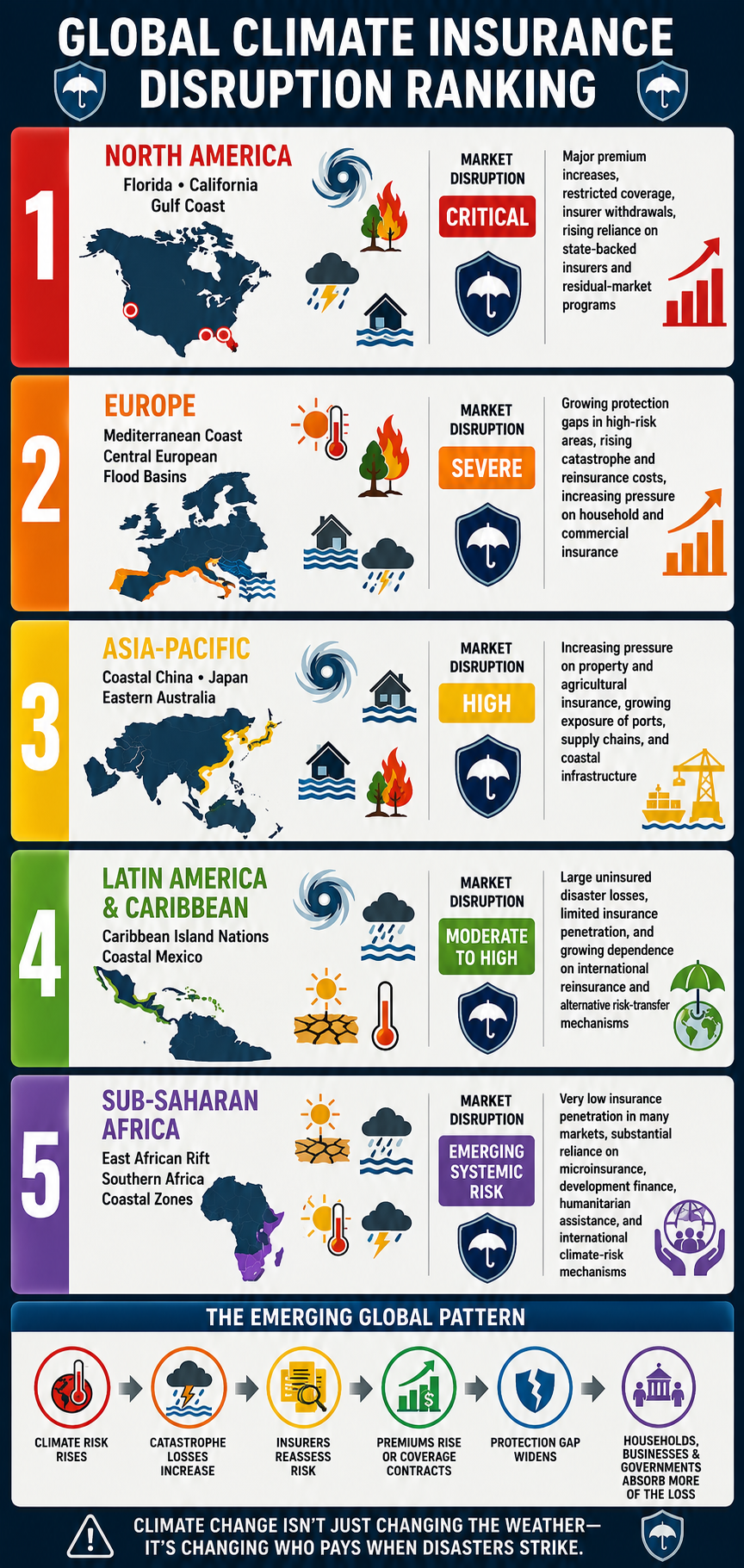
The global property and casualty (P&C) insurance market is experiencing very different levels of stress depending on regional climate hazards, catastrophe exposure, insurance penetration, regulatory frameworks, and the capacity of governments to absorb residual risk.

The following ranking identifies major regions experiencing significant climate-driven insurance disruption, moving from the most acute and visible market stress toward regions where systemic pressures are emerging or are likely to intensify.

Global RankVulnerable RegionKey Impacted AreasPrimary Climate PerilsMarket Disruption LevelKey Insurance Market Impact
1North AmericaFlorida; California; Gulf CoastHurricanes, wildfires, severe convective storms, floodingCriticalMajor premium increases, restricted coverage, insurer withdrawals from selected markets, rising reliance on state-backed insurers and residual-market programs
2EuropeMediterranean coast; Central European flood basinsExtreme heat, wildfires, flooding, severe stormsSevereGrowing protection gaps in high-risk areas, rising catastrophe and reinsurance costs, increasing pressure on household and commercial insurance
3Asia-PacificCoastal China; Japan; eastern AustraliaTyphoons, sea-level rise, flooding, bushfiresHighIncreasing pressure on property and agricultural insurance, growing exposure of ports, supply chains, and coastal infrastructure
4Latin America & CaribbeanCaribbean island nations; coastal MexicoHurricanes, flooding, drought, extreme heatModerate to HighLarge uninsured disaster losses, limited insurance penetration, and growing dependence on international reinsurance and alternative risk-transfer mechanisms
5Sub-Saharan AfricaEast African Rift; southern African coastal zonesMulti-year droughts, flooding, extreme heat, severe stormsEmerging Systemic RiskVery low insurance penetration in many markets, substantial reliance on microinsurance, development finance, humanitarian assistance, and international climate-risk mechanisms

The Emerging Global Pattern

The geographic details differ, but the underlying pattern is increasingly similar:

Climate risk rises → catastrophe losses increase → insurers reassess risk → premiums rise or coverage contracts → the protection gap widens → households, businesses, and governments absorb more of the loss.

This represents a fundamental challenge to the traditional concept of insurability.

Insurance works most effectively when risks are sufficiently predictable, geographically diversified, and economically manageable. Climate change can undermine all three conditions simultaneously. When catastrophic risks become correlated across large geographic areas, historical loss data become less reliable as a guide to future exposure, and the cost of transferring risk through reinsurance increases.

The consequences extend well beyond the insurance industry.

A property that cannot be affordably insured can become difficult to finance. A home that cannot be financed can lose market value. A business that cannot obtain affordable coverage can become less competitive or relocate. A community facing repeated disasters can experience declining tax revenues while public recovery costs rise.

The insurance market is therefore becoming an increasingly important early-warning indicator of climate-driven financial stress.

What begins as a change in weather risk can ultimately become a problem involving housing, banking, inflation, public budgets, infrastructure, migration, and regional economic stability.

The question is no longer simply whether climate change is generating larger physical losses.

It is whether the global financial system can continue to price, distribute, and absorb those losses at a sustainable cost.

bookmark_borderPolar Bear Plunge: Will Humans Follow? (Adaptation Part II)

Polar Bear Plunge: Will Humans Follow?

Adaptation Part II

Daniel Brouse
December 14, 2025

Abstract

In The Plight of the Penguin: Will Humans Follow? (Adaptation Part I), I examined how multiple penguin species—despite short-term behavioral flexibility—are failing to adapt to the pace and scale of anthropogenic climate change. This second paper extends that analysis to the Arctic, focusing on polar bears as a living stress test for biological adaptation under rapid warming. Together, penguins and polar bears frame the planetary poles as early-warning systems for human survivability. While limited genetic and epigenetic responses are emerging in some species, the evidence suggests that nonlinear climate dynamics and cascading feedback loops are outpacing adaptive capacity—first in wildlife, and increasingly in humans.

I. From Penguins to Polar Bears: A Shared Signal

Penguin populations across the Southern Hemisphere are undergoing rapid collapse as climate change, ocean warming, disrupted food webs, and direct human exploitation destabilize their ecosystems. While a handful of species show limited, short-term adaptability, the majority are now projected to decline irreversibly within this century.

The Emperor Penguin, African Penguin, Yellow-eyed Penguin, Erect-crested Penguin, Galápagos Penguin, Macaroni Penguin, and Southern Rockhopper Penguin have all failed to adapt to accelerating environmental change. Current projections place several of these species on extinction trajectories within decades—some potentially much sooner.

These collapses are not isolated ecological tragedies. They are biological signals. Penguins evolved for cold, stable systems; when those systems destabilize beyond critical thresholds, even highly specialized and once-resilient species fail. This same pattern—rapid environmental change overwhelming adaptive capacity—now appears in the Arctic.

II. Polar Bears: The Arctic’s Canary

Polar bears (Ursus maritimus) provide one of the clearest real-time examples of how climate change drives species toward physiological and ecological limits. The Arctic is warming between three and twenty times faster than the global average, making it an early indicator of future conditions elsewhere.

Sea ice loss is the single most important driver of polar bear decline. Bears depend on stable ice platforms to hunt seals; as these platforms vanish, bears are forced into longer swims, nutritional stress, isolation, and reproductive failure. This season alone, polar bears have been documented swimming up to 80 miles in search of ice and prey. Many juveniles do not survive these journeys.

As a result, polar bear populations across most regions are declining rapidly, with increasing mortality among cubs and subadults.

III. A Glimmer of Adaptation — and Its Limits

There is, however, a narrow and sobering glimmer of hope: genetic response under extreme stress.

Recent research led by Alice Godden, building on earlier University of Washington work, examined blood samples from polar bear populations in northeastern and southeastern Greenland. The southeastern group inhabits a significantly warmer climate zone—conditions similar to what much of the Arctic is expected to experience later this century.

In this southern population, researchers identified differences in gene activity related to:

  • Heat stress response
  • Aging
  • Metabolism and digestion

These findings suggest that climate stress is actively influencing gene regulation. As Godden noted, this may represent the first documented case of rising temperatures driving genomic change in a mammal.

In the Springer Nature paper “Diverging transposon activity among polar bear sub-populations inhabiting different climate zones,” the authors describe how transposable elements (TEs)—mobile sections of DNA—are behaving differently across subpopulations. These elements can accelerate genetic change under environmental stress.

In essence, different groups of polar bears are experiencing different sections of their DNA being activated or altered at different rates, closely linked to their local climate conditions. Godden described this as a form of the species being forced to “rewrite its own DNA”—a desperate survival mechanism in response to melting sea ice.

IV. Why This Does Not Mean Polar Bears Are Safe

Despite this remarkable finding, the implications are grim. The same research estimates that two-thirds of the global polar bear population could be gone by 2050, with total extinction likely by the end of the century if current warming trends continue.

The Arctic Ocean has repeatedly recorded record-high temperatures in recent years. Reduced sea ice has:

  • Eliminated hunting platforms
  • Increased fasting duration
  • Forced dietary shifts toward low-fat, plant-based or scavenged food sources

These changes are driving physiological stress and may be altering body composition and morphology. Adaptation, in this context, does not mean recovery—it means buying time.

As Godden emphasized, these findings do not reduce extinction risk. At best, they offer a narrow genetic blueprint for how adaptation might occur—if warming slows enough to allow it.

V. Humans and the Myth of Superior Adaptation

A common assumption is that humans, by virtue of intelligence and technology, will adapt where other species fail. This belief is not supported by the bulk of current scientific evidence.

Unlike polar bears, whose genetic shifts may offer limited resilience, human biological changes under climate stress are increasingly maladaptive. Even more troubling, many of these changes are epigenetic and transgenerational—meaning they can be passed on to future generations.

Adaptation, in humans, is beginning to resemble degradation.

VI. Climate Extremes and Cellular Breakdown

The health impacts of climate change are no longer abstract projections; they are measurable and accelerating.

  • One death per minute: Heat-related mortality now averages roughly one fatality per minute worldwide.
  • Rising exposure: Over the past four years, the average person has experienced 19 days per year of life-threatening heat, nearly all attributable to human-caused warming.
  • Severe health impacts: Extreme heat causes heatstroke, dehydration, kidney injury, and exacerbates cardiovascular and respiratory disease.

Prolonged heat exposure accelerates biological aging, damages tissues, and shortens telomeres at the cellular level. These processes increase the risk of:

  • Cancer
  • Dementia
  • Diabetes
  • Cardiovascular disease

Mental health is also affected. Heat stress correlates with increased rates of depression, anxiety, aggression, and suicide.

VII. Epigenetics: The Molecular Convergence of Climate Stressors

A critical mechanism linking these outcomes is epigenetic change—chemical modifications that regulate gene expression without altering DNA sequences. These changes act like dimmer switches, activating or silencing genes in response to environmental conditions.

Climate-related stressors that drive epigenetic change include:

  • Extreme heat
  • Ozone and air pollution exposure
  • Infectious disease, including COVID-19

All three are directly connected to fossil fuel combustion and climate destabilization.

When multiple stressors act simultaneously, epigenetic effects compound rather than add, increasing vulnerability across multiple organ systems. Genes associated with cancer, metabolic disease, cardiovascular dysfunction, and neurological disorders become more likely to activate.

Of particular concern is evidence that some epigenetic changes are heritable, raising the specter of transgenerational decline—where reduced health, shortened lifespan, and heightened disease risk are passed forward even if environmental conditions later stabilize.

VIII. Conclusion: A Narrowing Window

Penguins and polar bears are not merely victims of climate change; they are indicators. Their struggles reveal the limits of biological adaptation under rapid, nonlinear environmental change.

Polar bears show that even when genetic flexibility exists, it may only delay extinction—not prevent it. Humans, meanwhile, appear to be accumulating biological damage faster than beneficial adaptation.

The lesson is stark: adaptation without mitigation is failure postponed. The window for preserving both human health and planetary biodiversity is closing, and no species—no matter how intelligent—can out-evolve a collapsing climate system.

The choice is no longer whether change is coming, but whether we act quickly enough to remain biologically capable of surviving it.

* Our climate model — which incorporates complex social-ecological feedback loops within a dynamic, non-linear system — projects that global temperatures could rise by up to 9°C (16.2°F) within this century. This far exceeds earlier estimates of a 4°C rise over the next thousand years, signaling a dramatic acceleration of warming.

We analyze how human activities (such as deforestation, fossil fuel use, and land development) interact with ecological processes (including carbon cycling, water availability, and biodiversity loss) in ways that amplify one another. These interactions do not follow simple cause-and-effect patterns; instead, they create cascading, interconnected impacts that can rapidly accelerate system-wide change, sometimes abruptly. Understanding these dynamics is essential for assessing risks and designing effective climate adaptation and mitigation strategies.

The Climate Crisis: Violent Rain | Deadly Humid Heat | Health Collapse | Extreme Weather Events | Insurance | Trees and Deforestation | Soil | Rising Sea Level | Food and Water | Updates

Tipping points and feedback loops drive the acceleration of climate change. When one tipping point is breached and triggers others, the cascading collapse is known as the Domino Effect.

The Human Induced Climate Change Experiment

bookmark_borderTipped Tipping Points: The Non-Linearity of Climate Collapse

By Daniel Brouse and Sidd Mukherjee
December 12, 2025

Introduction

The non-linearity of collapse describes how complex systems can appear stable for long periods before experiencing a sudden, rapid, and often unexpected breakdown. Instead of declining gradually, systems absorb stress quietly until they cross a critical threshold—after which deterioration becomes abrupt, exponential, and irreversible.

This dynamic applies across climate, ecological, infrastructural, and socio-economic systems. Understanding it is essential to recognizing why global stability is now unraveling faster than most projections anticipated.

The Dynamics of Non-Linear Collapse

1. Accumulation of Stress

Systems absorb increasing stress—pollution, inequality, biodiversity loss, deferred maintenance—while appearing stable. This creates a false sense of resilience.

2. Hidden Thresholds (Tipping Points)

Every system has limits. Once a critical boundary is crossed, stabilizing mechanisms fail, and the system’s condition changes abruptly.

3. Rapid Breakdown

After tipping, feedback loops accelerate the collapse. Decline becomes exponential, not linear, and happens far faster than the stress buildup.

Examples of Non-Linearity in Climate Collapse

1. Arctic Sea Ice Collapse

Gradual decline for decades → sudden record-shattering drops in 2007 and 2012.
Once thinning breached a threshold, albedo feedback caused nonlinear, runaway melt.

2. Greenland & West Antarctic Ice Sheet Disintegration

Ice sheets remain stable until basal melt or grounding-line retreat passes a ridge.
After that, collapse becomes self-sustaining—even if warming stopped today.

3. AMOC (Atlantic Meridional Overturning Circulation)

A slow weakening over decades now signals proximity to a rapid shutdown.
When AMOC collapses, it will likely shift within years—not centuries.

4. Permafrost Thaw & Methane Bursts

Frozen ground remains stable until a thermal threshold is crossed.
Collapse into thermokarst landscapes releases methane in nonlinear spikes.

5. Amazon Rainforest Dieback

Appears stable until deforestation exceeds ~20–25%.
Then rapid savannification triggers massive carbon release.

6. Coral Reef Bleaching

Warm 1°C above normal → reefs shift from healthy to 80–90% dead in weeks.

7. Monsoon System Destabilization

A disrupted heat gradient can trigger rapid monsoon failure, collapsing food systems suddenly.

8. Boreal Forest Die-Off

Years of subtle stress → explosive multi-million-acre mortality once thresholds are crossed.

9. Global Food Supply Shock

Small yield declines → sudden global famine risk when multiple breadbaskets fail at once.

10. Extreme Weather Frequency Surge

“Stored” ocean heat enables sudden leaps in storm intensity and flood frequency.

11. Fisheries & Ocean Food Web Collapse

Ocean conditions shift past survivability limits → abrupt die-offs and trophic collapse.

12. Wildfire Regime Shifts

Forests tolerate warming until vapor-pressure thresholds trigger continent-scale megafires.

Summary: What Nonlinear Collapse Means

A system experiencing nonlinear collapse:

  • Absorbs stress invisibly
  • Appears stable
  • Crosses hidden thresholds
  • Then collapses abruptly and irreversibly

Multiple Earth systems are simultaneously approaching these thresholds—an unprecedented situation.


Compound, Cascading Collapse: The New Phase of Global Destabilization

We are no longer dealing with isolated climate impacts. The world has entered a phase of compound, cascading collapse, where failures in one system destabilize others. These collapses occur simultaneously and accelerate each other through interconnected feedback loops.

1. Climate Tipping Points Trigger Other Tipping Points

Examples of tipping cascades:

  • Arctic warming → sea ice loss → jet stream disruption → persistent heat domes and rainfall extremes
  • Warming oceans → weakened AMOC → shifting rainfall → Amazon dieback
  • Amazon dieback → carbon release → more warming → more Arctic ice loss

Each tipping point pushes others toward collapse.

2. Physical Hazards Now Stack and Multiply

Recent disasters increasingly involve multiple extremes at once:

  • Heatwave + drought + wildfire + crop failure
  • Storm surge + extreme rain + soil saturation + infrastructure collapse
  • Marine heatwave + coral mortality + fishery collapse + famine risk

These don’t simply add—they multiply one another’s impacts.

3. Infrastructure Failures Cascade

Modern systems were built for a stable climate:

  • Flood → power failure → water treatment failure → health crisis
  • Heat wave → grid overload → blackout → hospital failure
  • River flooding → sewage overflow → contamination → compounding damage

One failure weakens all connected sectors.

4. Ecological Collapses Reinforce Each Other

Examples:

  • Coral death → fishery decline → food insecurity
  • Insect loss → reduced pollination → crop losses → increased deforestation
  • Permafrost thaw → carbon release → biodiversity loss → ecosystem destabilization

Collapsed ecosystems heighten the risk of human system failure.

5. Economic and Social Systems Amplify Collapse

Climate shocks now interact with global fragility:

  • Crop failures → price spikes → political unrest → supply disruptions → more spikes
  • Insurance withdrawal → property market instability → municipal insolvency
  • Repeated disasters → displacement → extremism → policy paralysis

Social instability becomes both cause and effect.

6. Feedback Loops Across All Domains

Climate → ecology → infrastructure → economy → governance → climate.

Each domain amplifies the others, forming a global cascade.

This is why collapse is no longer linear—it is self-reinforcing acceleration.


Model-Based Assessment

Our probabilistic, ensemble-based climate model—integrating socio-economic and ecological feedbacks within a nonlinear system—indicates that global temperatures are accelerating toward conditions incompatible with modern civilization. Earlier estimates projected ~4°C warming over a millennium. Current projections show similar or higher warming this century.

We now face a world where multiple tipping elements destabilize at once.

Human activities—deforestation, fossil fuel combustion, urbanization, industrial agriculture—interact with ecological processes like carbon cycling, thermal redistribution, hydrology, and species decline. These are not linear cause-and-effect relationships. They are emergent, interlocking feedback loops capable of sudden, irreversible transformation.

Understanding these dynamics is essential for assessing global risk and planning human survival in the 21st century.

bookmark_borderComplex Social-Ecological Feedback Loops and You

by Daniel Brouse
December 11, 2025

Complex social-ecological feedback loops arise when human systems and natural systems react to climate change in ways that amplify one another. Because the Earth’s climate operates as a nonlinear, chaotic system, these interactions don’t unfold gradually—they can accelerate suddenly, compound unpredictably, and push the system toward irreversible shifts.

1. Ecological Feedbacks That Intensify Climate Forcing

As ecosystems are stressed, they begin amplifying the very forces that destabilize them.
Examples include:

  • Drought → wildfire → CO₂ release → more warming
    Forests that once absorbed carbon burn or die back, turning into major carbon sources.
  • Warming → permafrost thaw → methane release → more warming
    Methane spikes accelerate heat faster than CO₂, deepening the cycle.
  • Ocean warming → ice melt → reduced albedo → more ocean heat absorption
    Each stage magnifies the next, speeding polar destabilization.

These loops accelerate themselves: warming causes ecosystem loss, which causes further warming, which accelerates ecosystem loss even faster.

2. Social Feedbacks That Magnify Ecological Stress

Human systems also respond in ways that reinforce the crisis:

  • Heatwaves → crop failures → food price spikes → land conversion and deforestation
    Emergency agricultural expansion destroys carbon sinks, increasing emissions.
  • Extreme weather → infrastructure damage → increased fossil-fuel rebuilding
    Disasters force societies back into carbon-intensive solutions, deepening the root problem.
  • Climate migration → political instability → delays in mitigation and adaptation
    Political polarization slows climate action, allowing impacts to intensify and trigger more migration.

These are self-reinforcing: stress triggers human responses that generate more stress.

3. Coupled Social-Ecological Feedbacks: Acceleration Through Interaction

When ecological loops and social loops interact, their effects compound:

  • Water scarcity drives conflict and unsustainable groundwater extraction, which collapses ecosystems, worsening scarcity.
  • Heat-related crop loss drives fertilizer overuse, which degrades soils and increases nitrous oxide emissions, further accelerating warming.
  • Economic disruptions prompt short-term fossil expansion (“energy security”), raising emissions that amplify the disruptions.

Each of these interactions is nonlinear—meaning small increases in stress can cause enormous increases in impact. They also shorten the doubling time of climate damages.

4. The Nonlinear System: Why Everything Speeds Up

Because climate, ecological, and social systems are tightly coupled:

  • A shift in one system (ice loss, jet-stream distortion, coral collapse, crop failure) changes boundary conditions for every connected system.
  • These new conditions accelerate the next shift.
  • That shift accelerates the next.

This produces runaway co-acceleration, where loops reinforce not just each other but their own prior states, driving the compound collapse we now observe.

* Our probabilistic, ensemble-based climate model — which incorporates complex socio-economic and ecological feedback loops within a dynamic, nonlinear system — projects that global temperatures are becoming unsustainable this century. This far exceeds earlier estimates of a 4°C rise over the next thousand years, highlighting a dramatic acceleration in global warming. We are now entering a phase of compound, cascading collapse, where climate, ecological, and societal systems destabilize through interlinked, self-reinforcing feedback loops.

What Can I Do?
The single most important action you can take to help address the climate crisis is simple: stop burning fossil fuels.

Tipping points and feedback loops drive the acceleration of climate change. When one tipping point is breached and triggers others, the cascading collapse is known as the Domino Effect.

The Climate Crisis: Violent Rain | Deadly Humid Heat | Health Collapse | Extreme Weather Events | Insurance | Trees and Deforestation | Soil | Rising Sea Level | Food and Water | Updates

The Human Induced Climate Change Experiment

bookmark_borderThe Real Cost of Fossil Fuels: How Trump’s Policies Accelerate Economic Collapse

by Daniel Brouse
December 10, 2025

Fossil-fuel combustion isn’t just environmentally destructive — it is the single most expensive human activity in the global economy. The illusion of “affordable energy” collapses the moment you account for the actual economic costs: healthcare burdens, lost productivity, infrastructure damage, climate-driven disasters, agricultural losses, ecosystem collapse, and trillions in government subsidies that mask the true market price of oil, gas, and coal.

When you add these direct and indirect costs together, the losses outweigh the benefits by trillions of dollars every single year.

Yet Donald Trump continues to weaponize disinformation, promoting anti-economic, white-nationalist energy policies built entirely on propaganda—not reality. And the data proves it.

Energy Prices: What Actually Happened

Trump repeatedly claims he “made energy cheap” and “brought prices down.”
That is a lie.

Here are the actual numbers:

Gasoline

  • January 2016: $1.70/gallon
  • December 2025: ~$2.99/gallon
    ➡️ ↑ 76% increase

Natural Gas (Henry Hub Spot)

  • January 2016: ~$1.60 per MMBtu
  • December 2025: ~$5.08 per MMBtu
    ➡️ ↑ 217% increase

The truth is blunt:
Fuel prices are dramatically higher today than when Trump first took office—and that volatility is a direct consequence of policy choices, not some inevitable market swing. The biggest financial hit isn’t just at the gas pump, but on every electric bill in the country. Natural gas is still the backbone of U.S. power generation, so when its price spikes, electricity costs rise right along with it.

Trump made the situation dramatically worse by opening U.S. natural gas to heightened global demand, driving domestic prices even higher. And instead of strengthening the most affordable, stable, and sustainable energy sources—solar and wind—he’s actively undermined them. The result is a manufactured energy crisis that harms households, businesses, and the long-term health of the U.S. economy.

Trump’s Economic Agenda: A Blueprint for Collapse

Modern economic debates have been hijacked by emotional rhetoric and short-term political wins. But basic economics tells us:

  • Protectionism and tariffs shrink economies.
  • Nationalism and anti-immigration policies reduce labor supply, innovation, and GDP growth.
  • Populist attacks on institutions increase risk, weaken currency stability, and scare away investment.
  • Deregulation of fossil fuels amplifies long-term costs while accelerating climate-driven economic shocks.

These are not theoretical risks.
They are happening right now.

Capitalism Is Becoming Uninsurable

Perhaps the most alarming warning comes from Gunther Thallinger of Allianz SE, one of the world’s largest global insurers:

The pace and scale of climate-related destruction is beginning to exceed the insurance industry’s ability to function.

Insurance is the keystone stabilizer of capitalism.
If insurers can no longer price risk:

  • mortgages fail
  • banks collapse
  • property markets implode
  • businesses cannot operate
  • governments cannot finance disaster recovery
  • investment markets unravel

This is how capitalism collapses from within — not through ideology, but through mathematical certainty.

Climate Change: A Cascading, Nonlinear Health Crisis

Climate change is not just melting ice sheets.
It is unraveling the biological, ecological, and medical systems humans depend on.

Warming temperatures trigger reinforcing health feedback loops:

  • extreme heat → cardiovascular deaths → weakened population resilience
  • air pollution → chronic disease → higher mortality + healthcare costs
  • food system instability → malnutrition → reduced cognitive development
  • ecosystem collapse → infectious disease spread → rising pandemics
  • infrastructure failures → water contamination → chronic illness

These loops interact, amplify, and accelerate one another.
They are nonlinear, meaning each degree of warming creates exponentially greater harm.

This translates directly into:

  • shorter life expectancy
  • declining quality of life
  • skyrocketing healthcare costs
  • reduced labor productivity
  • shrinking economic output
  • destabilized communities
  • massive, permanent losses in human capital

The Bottom Line

Trump’s fossil-fuel agenda isn’t just anti-science.
It is anti-economic, anti-health, and anti-American.

By clinging to the most expensive and destructive energy system ever created, we are:

  • sabotaging our economy
  • accelerating financial collapse
  • undermining national security
  • destabilizing global markets
  • shortening human life
  • destroying the conditions necessary for civilization to function

A livable future — and a stable economy — requires recognizing that clean energy is not a cost.
It is the only economic path that ensures survival.

* Our probabilistic, ensemble-based climate model — which incorporates complex socio-economic and ecological feedback loops within a dynamic, nonlinear system — projects that global temperatures are becoming unsustainable this century. This far exceeds earlier estimates of a 4°C rise over the next thousand years, highlighting a dramatic acceleration in global warming. We are now entering a phase of compound, cascading collapse, where climate, ecological, and societal systems destabilize through interlinked, self-reinforcing feedback loops.

What Can I Do?
The single most important action you can take to help address the climate crisis is simple: stop burning fossil fuels. There are numerous actions you can take to contribute to saving the planet. Each person bears the responsibility to minimize pollution, discontinue the use of fossil fuels, reduce consumption, and foster a culture of love and care. The Butterfly Effect illustrates that a small change in one area can lead to significant alterations in conditions anywhere on the globe. Hence, the frequently heard statement that a fluttering butterfly in China can cause a hurricane in the Atlantic. Be a butterfly and affect the world.

→ “Solutions to the Fossil Fuel Economy and the Myths Accelerating Climate and Economic Collapse.“

The Climate Crisis: Violent Rain | Deadly Humid Heat | Health Collapse | Extreme Weather Events | Insurance | Trees and Deforestation | Soil | Rising Sea Level | Food and Water | Updates

Tipping points and feedback loops drive the acceleration of climate change. When one tipping point is toppled and triggers others, the cascading collapse is known as the Domino Effect.

The Human Induced Climate Change Experiment

Gasoline and Gas Prices 2016 to 2026

Trumpenomics

bookmark_borderFlorida at the Front Line: How Accelerating Sea-Level Rise Is Reshaping the State in Real Time

by Daniel Brouse
December 5, 2025

Florida faces a long list of climate-driven threats — extreme heat, stronger hurricanes, toxic algal blooms, and collapsing insurance markets — but accelerating sea-level rise (SLR) sits at the center of nearly all of them. Although the current rise of a few millimeters per year may sound trivial, the reality is anything but. Sea-level rise is no longer linear; it is entering a phase of nonlinear, exponential acceleration, and Florida is already experiencing the consequences.

1. Sea-Level Acceleration: From Millimeters to Centimeters

Sea level has been rising for a century, but what matters most is the rate of change. Historically, it took roughly a century for the rate to jump from ~3 mm/year to ~6 mm/year. Now, that doubling has happened in just eight years.

This exponential acceleration is driven by:

  • Rapid ice-sheet melt in Greenland and Antarctica
  • Thermal expansion of superheated oceans
  • Slowing ocean circulation (including the AMOC)
  • Increased land subsidence in coastal regions

If current trends hold — and most projections underestimate nonlinear behavior — Florida could see centimeters per year within the next decade and experience multiple surge-years this century where sea levels jump over a foot in a single year due to ice-sheet pulses and ocean heat anomalies.

This is not a distant scenario. It is unfolding now.

2. Everyday Flooding: Surge Without a Storm

Storm surge is no longer just a hurricane problem. Florida now experiences regular tidal flooding with no storms at all, as “sunny-day floods” push seawater into streets, yards, and infrastructure simply because the baseline sea level is higher.

Consequences include:

• Infrastructure decay

Saltwater corrodes electrical systems, sewer lines, bridges, roads, pumps, and underground cables. Critical infrastructure in Miami-Dade, Tampa Bay, the Keys, and Jacksonville is suffering chronic damage.

• Soil and ecosystem collapse

Saltwater intrusion destroys soil structure, kills vegetation, and converts freshwater wetlands into ghost forests.

• Drinking-water contamination

Saltwater is infiltrating freshwater aquifers — especially the Biscayne Aquifer — which supply millions of Floridians with drinking water.

One striking example of the water crisis:

“VERY RARE”: Tampa is currently purchasing about 10 million gallons of water per day — something officials say almost never happens this early in the year.
Saltwater intrusion and low river flows are driving emergency purchases months ahead of schedule.

3. Insurance Market Collapse: Climate as an Economic Wrecking Ball

Extreme saltwater events, chronic flooding, stronger hurricanes, and skyrocketing property risk have triggered a full-scale insurance meltdown in Florida.

The results:

  • Dozens of private insurers have left the state
  • Those remaining have raised premiums by 50–200%
  • Auto insurance rates are rising due to saltwater-related electronics failures and flood losses
  • Citizens Property Insurance — the taxpayer-funded state insurer of last resort — is now the largest insurer in Florida

This means the financial burden is shifting directly onto Florida taxpayers, even if they live nowhere near the coast.

4. The Bottom Line

Florida’s sea-level rise is not “millimeters that don’t matter.”
It is:

  • Accelerating at a historically unprecedented rate
  • Flooding infrastructure even on sunny days
  • Salting soils and destroying ecosystems
  • Contaminating drinking water
  • Collapsing the private insurance market
  • Forcing taxpayers to absorb billions in risk

Florida is already living in the future the rest of the country is headed toward. The question is no longer if sea-level rise will reshape the state, but how fast and how prepared communities will be for what’s coming next.

* Our probabilistic, ensemble-based climate model — which incorporates complex socio-economic and ecological feedback loops within a dynamic, nonlinear system — projects that global temperatures are becoming unsustainable this century. This far exceeds earlier estimates of a 4°C rise over the next thousand years, highlighting a dramatic acceleration in global warming. We are now entering a phase of compound, cascading collapse, where climate, ecological, and societal systems destabilize through interlinked, self-reinforcing feedback loops.

What Can I Do?
The single most important action you can take to help address the climate crisis is simple: stop burning fossil fuels. There are numerous actions you can take to contribute to saving the planet. Each person bears the responsibility to minimize pollution, discontinue the use of fossil fuels, reduce consumption, and foster a culture of love and care. The Butterfly Effect illustrates that a small change in one area can lead to significant alterations in conditions anywhere on the globe. Hence, the frequently heard statement that a fluttering butterfly in China can cause a hurricane in the Atlantic. Be a butterfly and affect the world.

Tipping points and feedback loops drive the acceleration of climate change. When one tipping point is breached and triggers others, the cascading collapse is known as the Domino Effect.

The Human Induced Climate Change Experiment

bookmark_borderThe Collapse Point: How Climate Change Is Breaking Insurance — and Capitalism With It

by Daniel Breouse / November 26, 2025

As extreme weather accelerates, humanity is nearing a tipping point where insurance — and the economic system built upon it — may no longer function. One of the world’s largest insurers, Allianz SE, has issued an unusually blunt warning: the climate crisis is destabilizing global capitalism from within, and the breakdown has already begun.

Allianz board member Gunther Thallinger, who also chairs the company’s investment board, argues that rising temperatures and worsening climate disasters are pushing many risks past the limits of insurability. And when insurance fails, everything built on top of it — mortgages, real estate markets, infrastructure investment, business lending, and even municipal budgets — begins to unravel.

His message is simple and grim:
“Heat and water destroy capital.”

Flooded homes lose value. Overheated cities become uninhabitable. Billion-dollar infrastructure corrodes, warps, or burns. Entire asset classes are degrading in real time.

The consequences ripple far beyond insurance claims. They threaten the foundational assumptions of modern capitalism itself.

A Financial System on the Brink

The planet is currently on track for 2.2°C to 3.4°C of warming — well beyond the thresholds that insurers, governments, and markets are designed to withstand. Global temperatures have already surpassed 1.5°C and are projected to blow past 3°C within a decade.

At that level of heating:

  • The number and severity of disasters become too frequent to price.
  • Extreme losses arrive faster than insurers can rebuild capital.
  • Governments cannot bail out the private sector at the required scale.
  • Entire regions become economically nonviable.

The numbers already paint the picture of an economy under siege:

  • $2 trillion in climate-related damages from 2013–2023 (Aviva).
  • $400 billion in 2024 alone (Gallagher RE).
  • A fivefold increase in annual weather-related losses in Europe since the 1980s.

Insurers like Zurich now openly state that achieving net-zero emissions by 2050 is essential to prevent systemic collapse.

Thallinger’s warning:
We may not have until 2050.

In California, major carriers have already stopped writing home insurance in fire-prone regions. In Florida, companies are fleeing as storm intensities shred actuarial models. These are not hypotheticals — they are the first cracks in the global financial foundation.

When the Math Breaks Down

Insurance only works when the risks are measurable and the premiums remain affordable. Climate change destroys both conditions.

Thallinger is explicit:

“As temperatures rise to 1.5°C, 2°C, 3°C, insurers will no longer be able to offer coverage. The premiums required exceed what people or companies can pay. This is already happening.”

If insurance fails:

  • Banks cannot issue mortgages.
  • Developers cannot secure financing.
  • Cities cannot bond infrastructure.
  • Home values collapse.
  • Industries become stranded.
  • Governments face spiraling bailout demands they cannot meet.

This is the hidden climate tipping point — a systemic failure that happens quietly, through spreadsheets and canceled policies, before it erupts into a full-blown economic crisis.

What the Industry Says Must Happen (and Why It Isn’t Happening)

Klaus-Peter Röhler, another Allianz board member, outlines what is required to keep insurance viable:

1. Massive prevention and adaptation

Climate-resilient building codes, flood defenses, and infrastructure upgrades.
Europe has completed only 5% of its planned flood protection projects.
At the current pace, it will take 100 years to finish.

2. Risk-based pricing

Political pressure often forces insurers to keep premiums artificially low — a recipe for insolvency. Without prices that reflect real risk, insurers collapse sooner.

3. Government stop-loss support for extreme events

Governments should backstop only the rarest, most catastrophic disasters — not routine damage that should be prevented through better planning.

No country has successfully implemented this triad.
Some, notably the United States, demonstrate what happens when policymakers block these measures:

  • California: Wildfire risk makes coverage unavailable at any price.
  • Florida: Storm losses and dysfunctional regulation have triggered an insurance exodus.
  • State-run bailout insurers are failing under the load.

The lesson is clear: Insurability is not guaranteed.
It must be preserved — and it is being lost region by region.

What Happens Next

Allianz emphasizes that policyholders, governments, and insurers all have roles to play — but adaptation can only delay collapse if emissions continue rising.

Without rapid decarbonization:

  • More regions will become uninsurable.
  • Financial shocks will cascade into housing, banking, and municipal finance.
  • Capitalism, which relies on pricing risk, will have no mechanism to allocate it.
  • Entire coastal and heat-exposed regions could lose economic viability.

We are approaching a world in which the question will not be whether people can afford insurance — but whether insurance can afford people.

The Real Tipping Point Isn’t Just Environmental — It’s Economic

Climate change is often framed as a humanitarian crisis or an environmental challenge. It is far more than that.

It is a capital destruction engine operating on a planetary scale.

Insurance is simply the first part of the system to falter, because it is the first to directly feel the mathematical impossibility of infinite losses on a finite balance sheet. But what follows is not limited to insurers:

  • Mortgage markets fail.
  • Municipal bond markets seize up.
  • Infrastructure investment dries out.
  • Property values collapse.
  • Supply chains face continuous disruption.
  • Governments pick up costs they cannot bear.
  • Capitalism enters an unmanageable risk spiral.

Unless warming is rapidly halted, we will cross a line where risk can no longer be transferred, financed, or recovered.

That is the collapse point.

* Our probabilistic, ensemble-based climate model — which incorporates complex socio-economic and ecological feedback loops within a dynamic, nonlinear system — projects that global temperatures are becoming unsustainable this century. This far exceeds earlier estimates of a 4°C rise over the next thousand years, highlighting a dramatic acceleration in global warming. We are now entering a phase of compound, cascading collapse, where climate, ecological, and societal systems destabilize through interlinked, self-reinforcing feedback loops.

What Can I Do?
The single most important action you can take to help address the climate crisis is simple: stop burning fossil fuels.

Tipping points and feedback loops drive the acceleration of climate change. When one tipping point is toppled and triggers others, the cascading collapse is known as the Domino Effect.

The Human Induced Climate Change Experiment