by Daniel Brouse
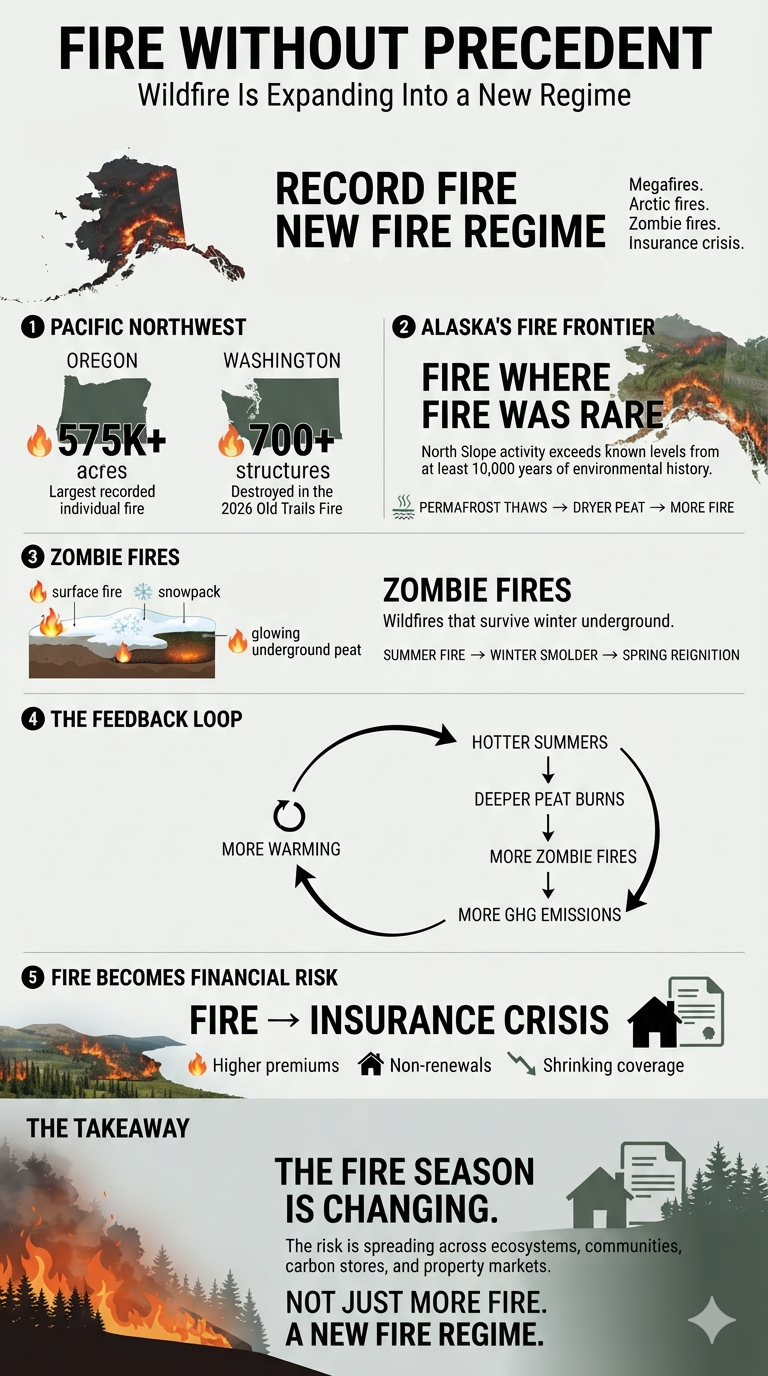
The 2026 wildfire season is rewriting the history of wildfire in Oregon, Washington, and Alaska. Record-setting megafires, increasingly unusual Arctic fires, overwintering “zombie fires,” and growing insurance losses reveal a wildfire regime that is expanding in both intensity and geographic reach.
From Oregon’s record-breaking Big Grass Fire to destructive fires around Spokane and unprecedented burning across Alaska’s tundra and boreal forests, the scale of change is becoming increasingly difficult to dismiss as simply another bad fire season.
Oregon’s Worst Wildfires
Oregon’s wildfire history is being rewritten by back-to-back extreme fire years, particularly in 2024 and 2026.
The Big Grass Fire (2026)
Burning 575,341 acres, the active Big Grass Fire has become the largest individual wildfire in recorded Oregon history by acreage.
The Long Draw Fire (2012)
The Long Draw Fire consumed 557,028 acres of rangeland in southeastern Oregon and previously held the modern state record.
The Biscuit Fire (2002)
The Biscuit Fire burned approximately 500,000 acres through southwestern Oregon’s Siskiyou National Forest, requiring a massive national firefighting response.
The Rowe Creek and Coleman Creek Fires (2026)
These two major fire complexes have burned approximately 372,971 and 308,721 acres, respectively, adding to an extraordinary season of large-scale burning.
The Labor Day Fires (2020)
Although not the largest Oregon fires by individual acreage, the 2020 Labor Day fires demonstrated how rapidly extreme weather can transform multiple fires into a statewide disaster. Severe winds drove simultaneous fires—including the Santiam and Almeda fires—that collectively burned more than 1 million acres, destroyed thousands of homes, and caused multiple fatalities.
Washington’s Worst Wildfires
Washington’s most intense historical fires have generally occurred in the state’s drier eastern regions. More recently, however, extreme fires have increasingly demonstrated their destructive potential at the wildland-urban interface.
The Okanogan Complex (2015)
The Okanogan Complex burned more than 304,000 acres, making it the largest wildfire complex in modern Washington history. Three wildland firefighters lost their lives.
The Carlton Complex (2014)
The Carlton Complex burned approximately 256,000 acres in the Methow Valley and destroyed about 300 homes, making it the state’s most destructive fire in terms of property loss at that time.
The Old Trails Fire (2026)
The catastrophic, human-caused Old Trails Fire near Spokane has consumed more than 700 structures, contributing to what is being described as Washington’s most destructive wildfire season on record.
The Sinlahekin Fire (2026)
This ongoing megafire has scorched more than 115,514 acres in Okanogan County.
The Gray and Oregon Fires (2023)
These two fast-moving fires in Spokane County destroyed a combined 710 structures, including 366 homes, and caused two deaths.
Cross-Border Blazes
Wildfires do not recognize state boundaries. The shared Columbia River border between Oregon and Washington can allow fire impacts to cross from one state to the other.
In 2017, the human-caused Eagle Creek Fire ignited in Oregon’s Columbia River Gorge, burned approximately 50,000 acres, and sent airborne embers across the river, igniting secondary fires in Washington.
Alaska’s New Wildfire Frontier
Alaska is experiencing another dimension of the wildfire transformation: fire is expanding into landscapes where large, persistent wildfires were historically exceptionally rare.
The North Slope tundra and portions of southwestern Alaska are experiencing wildfire activity that paleofire research suggests has no close parallel in the region’s known environmental history.
The North Slope Tundra
Historically, the Arctic tundra north of the Brooks Range was too cold, wet, and sparsely vegetated to sustain frequent large fires. Recent research indicates that North Slope wildfire activity during the past century has risen beyond anything observed in at least 3,000 years.
The drivers: Thawing permafrost is lowering local water tables and drying ancient peat layers that once acted as natural fire barriers. At the same time, warmer conditions are allowing woody shrubs to expand, creating additional fuel across the tundra.
The precedent: Modern megafires in this region—including the historic Anaktuvuk River Fire, which burned more than 400 square miles of tundra—represent a fundamentally different fire regime from what prevailed during much of the previous several millennia.
Southwestern Alaska: Yukon-Kuskokwim Delta and Bristol Bay
Southwestern Alaska has also historically experienced very little wildfire because of maritime moisture and tundra conditions.
That pattern is changing.
Millions of acres have burned across the region during recent consecutive fire seasons, including major events such as the Lime Complex and East Fork Fire.
Fires are now occurring as early as April and can burn deeply into organic-rich soils that have stored carbon for thousands of years.
The Yukon Flats
Farther south, in Alaska’s Interior boreal forest, the Yukon Flats ecoregion has experienced a dramatic increase in fire frequency and severity. Research indicates that recent fire activity has reached levels exceeding those seen at any point in approximately 10,000 years.
The ecological consequences extend beyond individual fires. Repeated severe burning can help convert ancient conifer-dominated spruce forests into more fire-adapted deciduous woodlands, potentially altering the region’s ecosystem for generations.
Zombie Fires: Wildfires That Survive the Winter
One of the most unusual consequences of Arctic and sub-Arctic warming is the rise of “zombie fires,” scientifically known as overwintering or holdover fires.
These fires can continue burning underground through the freezing winter and then reemerge at the surface the following spring. Instead of being extinguished by rain and heavy snow, they remain hidden beneath the surface until conditions become favorable for renewed combustion.
How a Fire Survives Under Ice and Snow
Zombie fires depend heavily on the unique composition of Arctic and sub-Arctic soils.
The fuel layer: Boreal and tundra ecosystems contain thick layers of peat and decomposing organic material. Peat is highly compacted, carbon-rich, and capable of sustaining slow, persistent combustion.
Low-oxygen smoldering: When a summer wildfire penetrates deeply into peat, it can transition from an open flame to underground smoldering. The winter snowpack restricts oxygen availability without necessarily extinguishing the fire, allowing it to move slowly through roots and organic matter even while surface temperatures plunge far below freezing.
Spontaneous combustion: Research has also identified another potential mechanism. Rapid spring warming can accelerate microbial decomposition within peat, producing heat that may contribute to spontaneous ignition under certain conditions.
Why Zombie Fires Challenge Fire Management
Fire managers once viewed overwintering fires as rare anomalies. Increasing observations suggest they may be becoming a more important source of new wildfire ignitions across Alaska, northern Canada, and Siberia.
An early start to fire season: Zombie fires can reemerge in April or May, weeks before the traditional summer lightning season. This can place additional demands on firefighting resources before seasonal crews are fully deployed.
An invisible threat: While buried, these fires can produce little visible flame and relatively little surface heat, making detection difficult. Firefighters may not discover them until they emerge along the edges of previous burn scars.
Booby-trapped landscapes: As underground fires consume roots and peat, they can hollow out sections of the ground. The resulting landscape can contain extensive areas of fallen trees and unstable soil, creating dangerous conditions for helicopters and ground crews.
The Climate Feedback Loop
The most consequential concern may be what these fires release into the atmosphere.
Peatlands store enormous quantities of carbon. When zombie fires smolder through peat for months, they can release carbon dioxide (CO₂), carbon monoxide (CO), and potentially methane (CH₄), adding greenhouse gases to the atmosphere.
That creates the potential for a reinforcing feedback loop:
Hotter summers → deeper peat fires → more overwintering fires → greater greenhouse-gas emissions → additional warming.
The concern is not simply that the Arctic is burning more. It is that warming can alter the underlying conditions that determine where, when, and how fire can persist.
Wildfire Is Becoming an Insurance Crisis
The intensifying wildfire seasons across the Western United States are also triggering a severe property-insurance crisis, characterized by soaring premiums, policy non-renewals, and increasingly stringent requirements for homes in fire-prone areas.
Major nationwide insurers, including State Farm and Allstate, have been pulling back from or reducing exposure to some high-risk Western markets as they attempt to limit catastrophic wildfire losses.
The effects differ considerably among Oregon, Washington, and Alaska because of differences in fire activity, population exposure, and state regulation.
Oregon: Pushed Toward the Brink
Oregon’s insurance market is under increasing pressure following consecutive years of severe wildfire activity.
Premium surges: Homeowners in Central Oregon, along the Oregon Coast, and on rural acreage properties are facing renewal increases ranging from 50% to more than 100%.
Statewide non-renewals: Some carriers are dropping entire ZIP codes, leaving rural homeowners increasingly dependent on high-cost, bare-bones “last-resort” insurance pools.
Regulatory intervention: Under S.B. 82, insurers must provide clear and detailed notices explaining the wildfire risk factors contributing to a cancellation or premium increase.
During the active 2026 fire season, the Oregon Division of Financial Regulation issued an emergency order pausing home-insurance cancellations and non-renewals through August 2026 in affected areas.
Local governments are also responding. Deschutes County, for example, has adopted the R327 building code, which requires newly constructed or remodeled homes to incorporate features such as ember-resistant vents and Class A roofing to improve wildfire resilience and eligibility for specialty insurance markets.
Washington: Post-Spokane Instability
Before August 2026, Washington’s property-insurance market had been showing signs of stabilization. The devastating Old Trails Fire near Spokane, however, has injected new volatility into the market.
The Spokane drop-off: Data indicate that after severe fire seasons, Washington insurers have dropped or canceled policies on more than a third of fire-impacted properties, while Spokane County has experienced a 65% increase in non-renewals.
Risk-score friction: Insurers increasingly use wildfire-risk scores to price policies. A 2026 legislative effort backed by the Washington Office of the Insurance Commissioner sought greater transparency and an appeals process for consumers. The bill passed the Senate 48–1 but ultimately stalled in the House.
Mandated baseline coverage: Washington law requires standard homeowners policies to cover basic fire, smoke, and soot damage under terms that meet or exceed the state’s official model policy. Yet obtaining new coverage in a high-risk area has become increasingly difficult.
Alaska: The Emerging Insurance Frontier
Alaska has not yet experienced the widespread homeowner-insurance collapse seen in some other high-risk Western markets. But the underlying risk profile is changing.
Lagging actuarial models: Many legacy underwriting maps continue to assess Alaska through a historical lens—one that assumes an Arctic environment with relatively low structural wildfire risk.
The tundra shift: Much of Alaska’s recent extreme fire activity has occurred in remote wilderness rather than heavily populated residential areas. As a result, structural losses remain comparatively limited.
Future vulnerability: The situation could change as tundra and Interior fires move closer to isolated communities and population centers such as Fairbanks. Insurance brokers anticipate that carriers could respond with tighter underwriting standards and higher deductibles for smoke and fire damage in vulnerable wildland-urban interface areas.
From Wildfire Season to a New Fire Regime
The story unfolding across Oregon, Washington, and Alaska is larger than a collection of record-breaking fires.
It is a shift in the conditions under which fire operates.
Oregon is experiencing record-scale megafires. Washington is confronting increasing destruction at the wildland-urban interface. Alaska is seeing fire penetrate ecosystems where large fires were historically rare. And beneath the surface, overwintering fires are extending the wildfire season beyond the traditional summer window.
The consequences do not stop when the flames disappear. They reach into forests, soils, carbon stores, communities, property markets, and the insurance system itself.
The question is no longer simply how bad the next wildfire season will be.
It is whether the wildfire regime itself is changing faster than our ecosystems, infrastructure, insurers, and communities can adapt.