by Daniel Brouse
The rule to drink six to eight glasses of water a day is a myth.
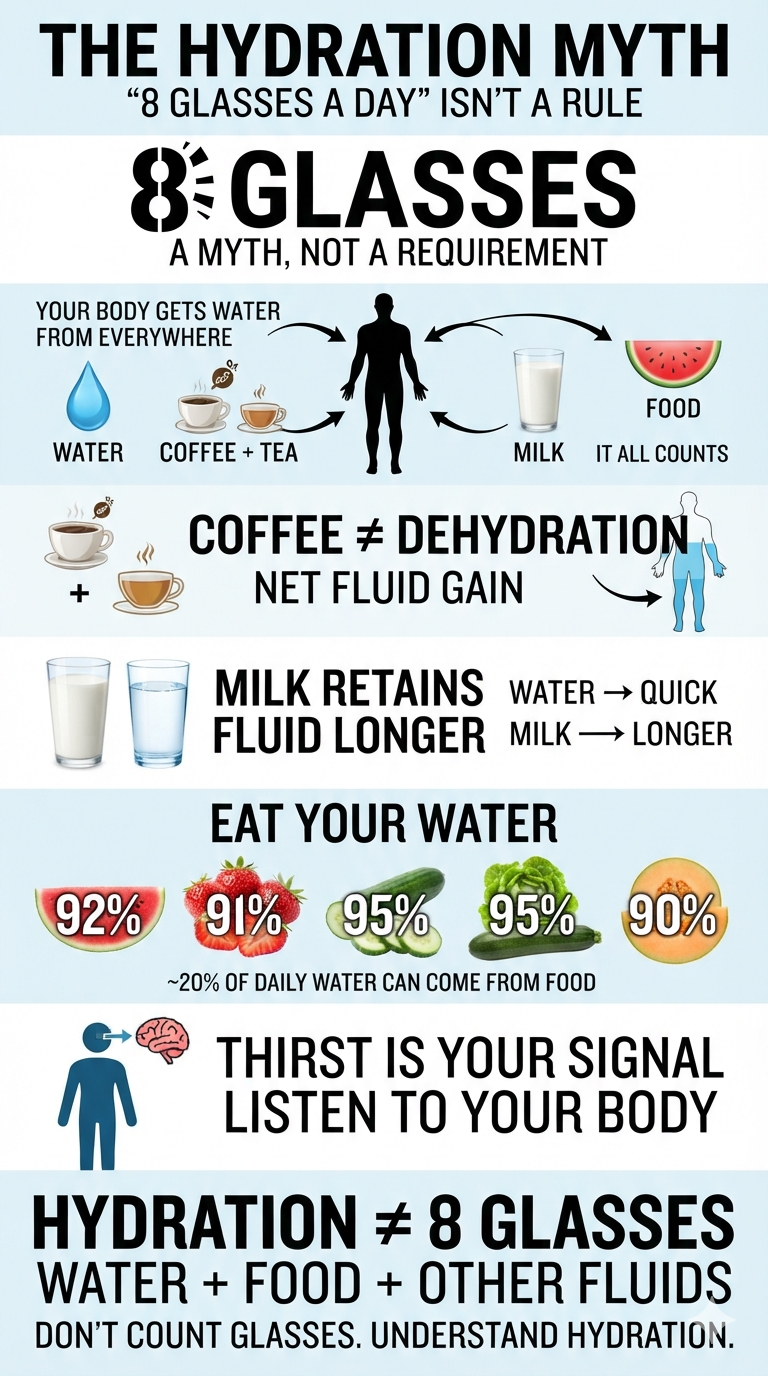
The standard recommendation to drink six to eight glasses of water every day is a popular health myth that is not supported by scientific evidence. While it may serve as a convenient baseline, there is no universal requirement for everyone to drink a fixed number of glasses of water each day.
Your actual hydration needs depend heavily on your body size, health, activity level, diet, and local weather conditions.
Why the “Eight Glasses” Rule Is Flawed
It Omits Food Sources
You get roughly 20% of your daily water from food. Fruits and vegetables can contain extraordinarily high amounts of water, meaning hydration doesn’t come exclusively from what you drink.
It Counts Only Water
Coffee, tea, milk, juice, and other beverages all contribute directly to your daily fluid intake. Your body doesn’t somehow exclude the water in those beverages simply because it isn’t plain water.
Another persistent hydration myth is that coffee and tea are so diuretic that drinking them causes you to lose more fluid than you consume.
That’s not true.
It Ignores Your Body
For most healthy adults, your natural thirst mechanism is an incredibly precise indicator of when you need to drink. When you’re thirsty, drink. When you’re not thirsty, there is no scientific reason to force yourself to consume an arbitrary number of glasses simply because a popular rule says you should.
Milk Is More Hydrating Than Plain Water
Milk is actually more hydrating than plain water and keeps you hydrated for a longer period of time.
Plain water is excellent for rapid hydration, but it moves through the digestive system quickly and can result in faster fluid loss through urination. Milk contains water along with electrolytes, carbohydrates, protein, and other nutrients that slow fluid movement and help the body retain the water longer. Studies have found that milk produces less fluid loss than plain water.
This makes milk an especially effective hydrating beverage when longer-lasting fluid retention matters.
Eat Your Water
Some of the most hydrating foods on the planet are also among the most nutritious.
Melons and Berries
Watermelon: Composed of 92% water and packed with the antioxidant lycopene and potassium.
Strawberries: Contain 91% water alongside high amounts of vitamin C and inflammation-fighting fiber.
Cantaloupe: Made of 90% water and provides more than half your daily vitamin A needs per cup.
Crunchy and Leafy Vegetables
Cucumbers: Boast the highest water content of any solid food at 95% water, plus vitamin K.
Celery: Contains 95% water and provides a natural source of hydrating potassium and sodium.
Zucchini: Made of 94% water and delivers gut-friendly fiber that slows nutrient absorption.
Lettuce: Iceberg and romaine are approximately 95% water, providing an easy, volume-based hydration boost.
Liquids and Soups
Plain Yogurt or Kefir: Approximately 85% water while also providing calcium, protein, and gut-healthy probiotics.
Broths and Bouillons: Provide a high-moisture base loaded with electrolytes such as sodium, which helps the body retain fluids and prevents rapid fluid loss.
The Bottom Line
Hydration is not about hitting an arbitrary number of glasses.
Your body gets water from food and beverages—not just from plain water. Your hydration needs change with your size, activity, health, diet, temperature, and humidity.
So forget the eight-glass rule.
Drink when you’re thirsty. Eat water-rich foods. Drink more when you’re sweating or exposed to heat. And stop treating plain water as the only source of hydration.
Your body already has a sophisticated hydration system.
Listen to it.