by Daniel Brouse
Climate change is fundamentally destabilizing insurance markets by driving increasingly severe financial losses, pushing premiums sharply higher, and causing insurers to reduce or withdraw coverage in some high-risk regions. As extreme weather events become more frequent and, in many cases, more intense, traditional underwriting models are being challenged by rapidly changing risk. The result is a growing transfer of financial risk from private insurers to consumers, businesses, lenders, and governments.
The Protection Gap Crisis
One of the clearest signs of growing insurance instability is the widening protection gap—the difference between total economic losses from disasters and the portion covered by insurance.
In many climate-vulnerable regions, the majority of disaster losses remain uninsured. The gap can be particularly severe in developing economies, where insurance penetration is low and households, businesses, and governments may lack the financial resources to recover from catastrophic events.
This creates a dangerous feedback loop:
More extreme losses → higher insurance costs → reduced coverage → greater uninsured losses → greater financial vulnerability
The protection gap is therefore not simply an insurance problem. It is increasingly a problem of household financial security, economic resilience, infrastructure recovery, and public finance.
Corporate Pullbacks From High-Risk Regions
Insurers are increasingly reassessing their exposure to regions where climate-related risks are becoming more difficult to price and manage.
In some high-risk markets, major insurers have stopped writing certain types of new business, declined to renew policies, restricted coverage, increased deductibles, or imposed substantially higher premiums. These trends have been especially visible in wildfire-prone areas of California and hurricane- and flood-exposed coastal regions.
When private carriers retreat, governments and state-sponsored insurance programs often become insurers of last resort. This can concentrate risk in public or quasi-public systems while leaving taxpayers increasingly exposed to catastrophic losses.
Systemic Financial Risks
Mortgage Market Threats
Property insurance is closely connected to the housing and banking systems because mortgage lenders generally require borrowers to maintain adequate insurance on the underlying property.
As premiums rise and coverage becomes more difficult to obtain, homeowners can face rapidly increasing housing costs even when their mortgage payment remains unchanged. In the most exposed markets, some properties may become effectively uninsurable or prohibitively expensive to insure.
This creates a potential chain reaction:
Climate risk → higher insurance costs → declining property affordability → falling property values → mortgage stress → increased financial-system risk
The burden can fall disproportionately on lower-income homeowners, who have less capacity to absorb sudden increases in insurance and other climate-related costs.
Macroeconomic Volatility
Rising insurance premiums can also contribute to broader economic volatility. Insurance is an input into housing, transportation, agriculture, construction, business operations, and investment.
When insurers raise premiums to reflect increased catastrophe risk, those costs can eventually be passed through to consumers in the form of higher rents, housing costs, food prices, transportation costs, and prices for other goods and services.
In particularly vulnerable areas, insurance costs can also influence where people are willing and able to live. If housing becomes prohibitively expensive to insure—or insurance becomes unavailable altogether—households and businesses may begin relocating toward less exposed regions.
Climate change can therefore contribute to climate-driven migration within countries and across regions, even before an area becomes physically uninhabitable.
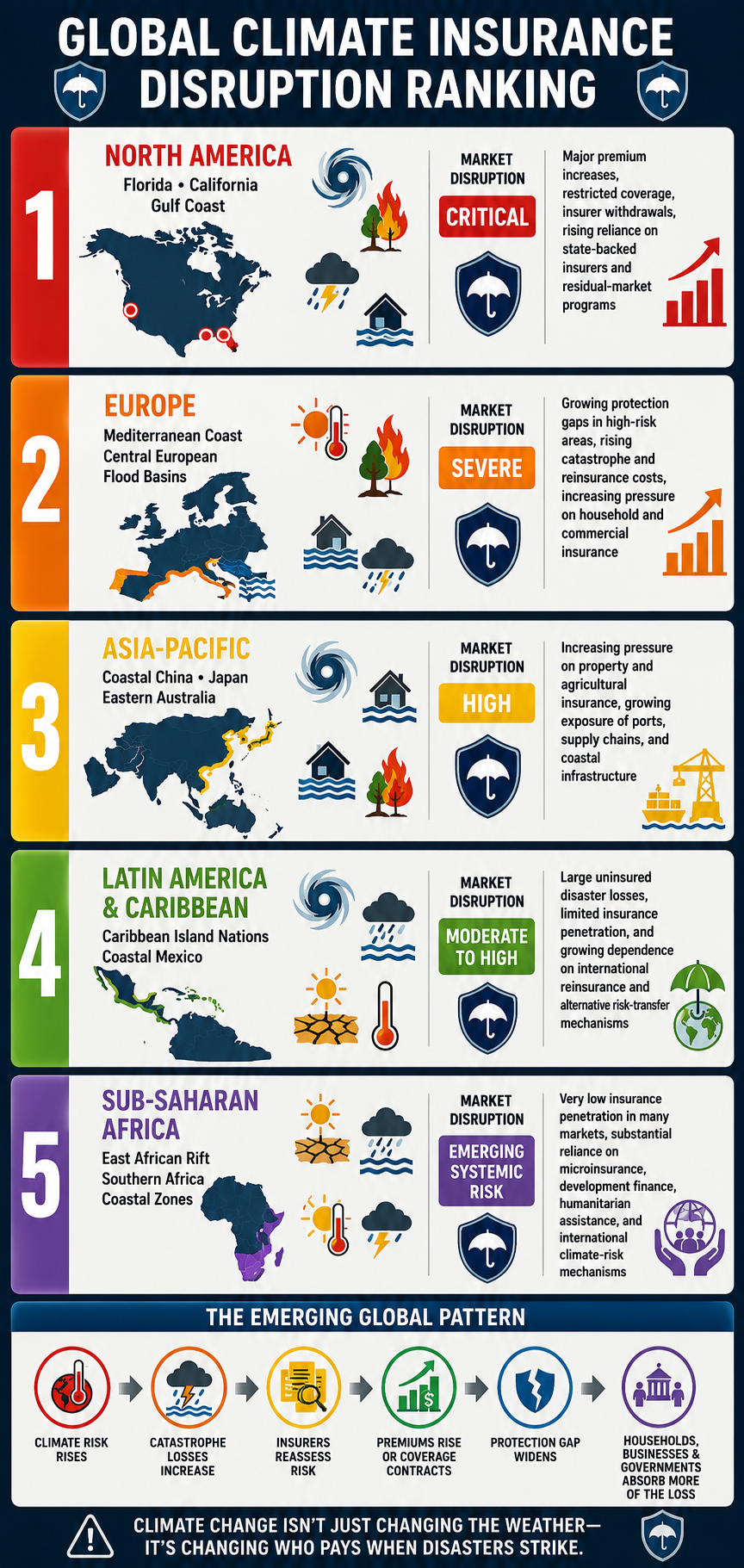
Global Climate Insurance Disruption Ranking
The global property and casualty (P&C) insurance market is experiencing very different levels of stress depending on regional climate hazards, catastrophe exposure, insurance penetration, regulatory frameworks, and the capacity of governments to absorb residual risk.
The following ranking identifies major regions experiencing significant climate-driven insurance disruption, moving from the most acute and visible market stress toward regions where systemic pressures are emerging or are likely to intensify.
| Global Rank | Vulnerable Region | Key Impacted Areas | Primary Climate Perils | Market Disruption Level | Key Insurance Market Impact |
|---|---|---|---|---|---|
| 1 | North America | Florida; California; Gulf Coast | Hurricanes, wildfires, severe convective storms, flooding | Critical | Major premium increases, restricted coverage, insurer withdrawals from selected markets, rising reliance on state-backed insurers and residual-market programs |
| 2 | Europe | Mediterranean coast; Central European flood basins | Extreme heat, wildfires, flooding, severe storms | Severe | Growing protection gaps in high-risk areas, rising catastrophe and reinsurance costs, increasing pressure on household and commercial insurance |
| 3 | Asia-Pacific | Coastal China; Japan; eastern Australia | Typhoons, sea-level rise, flooding, bushfires | High | Increasing pressure on property and agricultural insurance, growing exposure of ports, supply chains, and coastal infrastructure |
| 4 | Latin America & Caribbean | Caribbean island nations; coastal Mexico | Hurricanes, flooding, drought, extreme heat | Moderate to High | Large uninsured disaster losses, limited insurance penetration, and growing dependence on international reinsurance and alternative risk-transfer mechanisms |
| 5 | Sub-Saharan Africa | East African Rift; southern African coastal zones | Multi-year droughts, flooding, extreme heat, severe storms | Emerging Systemic Risk | Very low insurance penetration in many markets, substantial reliance on microinsurance, development finance, humanitarian assistance, and international climate-risk mechanisms |
The Emerging Global Pattern
The geographic details differ, but the underlying pattern is increasingly similar:
Climate risk rises → catastrophe losses increase → insurers reassess risk → premiums rise or coverage contracts → the protection gap widens → households, businesses, and governments absorb more of the loss.
This represents a fundamental challenge to the traditional concept of insurability.
Insurance works most effectively when risks are sufficiently predictable, geographically diversified, and economically manageable. Climate change can undermine all three conditions simultaneously. When catastrophic risks become correlated across large geographic areas, historical loss data become less reliable as a guide to future exposure, and the cost of transferring risk through reinsurance increases.
The consequences extend well beyond the insurance industry.
A property that cannot be affordably insured can become difficult to finance. A home that cannot be financed can lose market value. A business that cannot obtain affordable coverage can become less competitive or relocate. A community facing repeated disasters can experience declining tax revenues while public recovery costs rise.
The insurance market is therefore becoming an increasingly important early-warning indicator of climate-driven financial stress.
What begins as a change in weather risk can ultimately become a problem involving housing, banking, inflation, public budgets, infrastructure, migration, and regional economic stability.
The question is no longer simply whether climate change is generating larger physical losses.
It is whether the global financial system can continue to price, distribute, and absorb those losses at a sustainable cost.