by Daniel Brouse
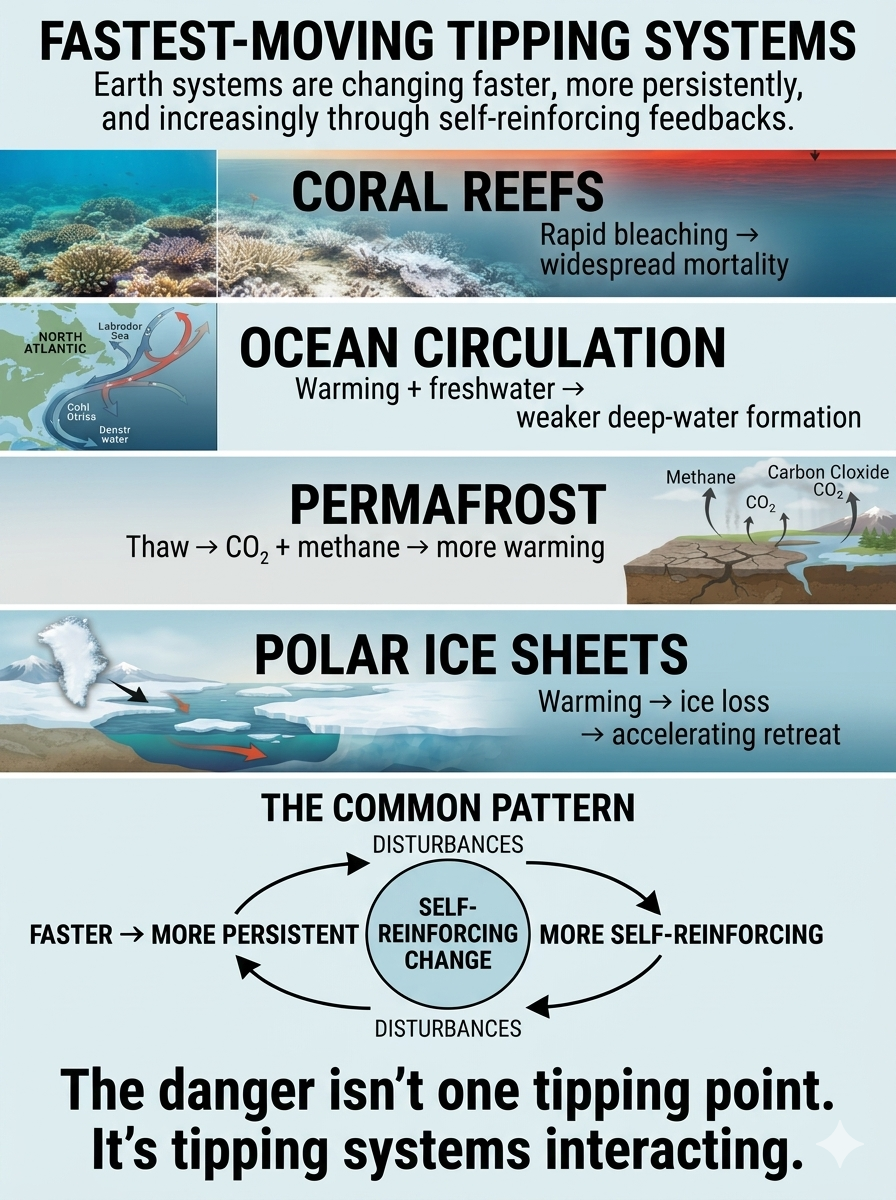
Fastest-Moving Tipping Systems
Coral Reef Die-Offs
Warm-water coral reef dieback is widely recognized as one of the clearest examples of an Earth-system tipping point now being actively crossed—and among the major ecological tipping systems, it is showing some of the fastest rates of deterioration. Driven by record-breaking marine heatwaves associated with global temperatures approaching 1.4°C above pre-industrial levels, widespread coral mortality is unfolding across the world’s tropical oceans. The scale and speed of reef degradation are exceeding many earlier projections.
Repeated mass-bleaching events are causing widespread coral mortality and ecological degradation. As heat stress becomes more frequent and severe, many reefs are losing their ability to recover between bleaching events, making warm-water coral ecosystems one of the fastest-collapsing major ecological systems on Earth.
Subpolar Ocean Circulation
Deep-water formation in the Labrador Sea and North Atlantic is showing signs of increasing instability as warming and freshwater influx from melting ice alter ocean density and circulation. Continued weakening could disrupt regional and global climate patterns.
Permafrost Thaw
Arctic permafrost is degrading as temperatures rise, releasing carbon dioxide and methane that have accumulated in frozen soils over thousands of years. Accelerating thaw creates a potentially self-reinforcing feedback: warming increases permafrost loss, which releases additional greenhouse gases and contributes to further warming.
Polar Ice Sheets
Parts of the Greenland and West Antarctic ice sheets are experiencing accelerating mass loss. As ice sheets retreat, feedbacks involving surface elevation, ocean heat, ice dynamics, and albedo can increase instability and make further ice loss increasingly difficult to reverse.
The Common Pattern
These systems differ in their physical mechanisms, but they share a critical characteristic: change is becoming faster, more persistent, and increasingly self-reinforcing.
The danger is not simply that individual tipping systems may cross thresholds. It is that multiple systems can interact, creating cascading feedbacks that accelerate Earth-system change beyond the rate suggested by any single process alone.