bookmark_borderClimate Denial at the Helm: How Trump’s Legacy Endangers Public Safety and Freedom

by Daniel Brouse
June 5, 2025

The Trump administration’s ongoing denial of climate science and persistent spread of misinformation continues to pose a grave threat to public safety, national preparedness, and democratic freedoms. This threat is vividly illustrated by a recent incident involving David Richardson, the newly appointed head of the Federal Emergency Management Agency (FEMA), who reportedly tells staff during a Monday morning briefing that he was previously unaware the United States has a hurricane season—despite the 2025 season officially beginning on Sunday.

Richardson, appointed by President Trump in May, is expected to lead the nation’s emergency response as extreme weather events grow more frequent and destructive. Yet his lack of even the most basic understanding of the seasonal climate cycle reflects a deeper, systemic failure within the administration—one rooted in contempt for science and expertise.

Under Trump’s leadership, scientific consensus on climate change is dismissed as a political inconvenience. Federal agencies that once relied on climate data and risk models are now steered by loyalists who often lack relevant experience or actively reject environmental realities. Trump continues to dismantle regulations meant to address the climate crisis, suppresses climate research within government agencies, and attacks scientists who raise alarms about worsening environmental threats.

This willful ignorance is not just incompetent—it’s dangerous. When those in charge of disaster response do not understand the threats they are supposed to manage, the consequences are deadly. Hurricanes, wildfires, floods, and heatwaves are increasing in both frequency and intensity due to global warming, yet the federal government under Trump appears more committed to preserving a narrative of denial than to protecting lives.

The broader implications go beyond emergency management. When scientific truth is undermined at the highest levels of government, public trust in institutions erodes. Disinformation fills the void. Citizens are left confused, divided, and vulnerable—not just to climate disasters, but to the decay of democratic norms that depend on transparency, accountability, and fact-based governance.

President Trump’s pattern of appointing unqualified individuals to critical agencies reflects a broader strategy: control the narrative, ignore the data, and punish dissent. But the climate does not wait for politics. Nature operates on physical laws, not political spin.

The revelation about Richardson should alarm every American. It’s not merely a bureaucratic blunder—it’s a symptom of an administration that is deliberately sidelining science in favor of ideology. And in the era of climate crisis, that kind of leadership is not just negligent. It’s catastrophic.
Trumpenomics: The Decline of the US

The Human Induced Climate Change Experiment

bookmark_borderToxic Skies: Ozone, Wildfires, and Saharan Dust Collide Across the U.S.

by Daniel Brouse
June 4, 2025

Air Quality Today: A Triple Threat

Across the United States today, millions are facing a dangerous cocktail of air pollution events driven by both human activity and climate disruption. From Canadian wildfires and Saharan dust storms to toxic ground-level ozone, Americans are increasingly breathing air that threatens their health, safety, and long-term well-being.

Wildfire Smoke: A Growing Hazard from the North

In the Midwest, massive wildfires burning across Canada are triggering air quality alerts, making outdoor activity risky for vulnerable populations. While the jet stream is currently carrying much of the smoke high in the atmosphere and sparing the U.S. East Coast—for now—this circulation pattern can shift quickly. The fires remain out of control, fueled by rising temperatures and prolonged drought conditions. As the wildfire season grows longer and more intense, no part of the U.S. is safe from the haze and health effects that follow.

Saharan Dust: A Transatlantic Health Crisis

At the same time, unusually severe Saharan dust storms are sweeping across the Atlantic, blanketing the Caribbean and southeastern United States in fine particulate matter. Florida, in particular, is experiencing air quality alerts as dust-laden air raises the risk of respiratory distress, especially for those with asthma, COPD, or other pre-existing health conditions. These dust plumes, once rare or moderate in strength, are becoming stronger and more frequent as climate conditions intensify desertification across North Africa.

Ozone Pollution: A Silent Killer in U.S. Cities

In urban areas like the Philadelphia region, ground-level ozone is adding to the danger. Unlike the protective ozone layer high above the Earth, low-level ozone is a toxic byproduct of fossil fuel combustion—emitted by vehicles, power plants, and industrial processes. It forms when pollutants react in sunlight, especially during hot, stagnant weather.

Not only does ozone damage human lungs and cardiovascular systems—ranking as one of the leading causes of air pollution-related deaths—it also harms plant life. By impairing the ability of plants to absorb carbon dioxide, ozone pollution creates a feedback loop that further accelerates climate change.

Climate Change: The Unifying Force Behind the Crisis

Each of these events—wildfire smoke, transcontinental dust, and ground-level ozone—might once have been considered separate environmental issues. But today, they are all symptoms of the same underlying crisis: a rapidly destabilizing climate. Human-induced global warming is not only intensifying these phenomena but also increasing their frequency and geographic spread.

Pollutants are no longer just local problems. The air in your lungs may carry particles from a fire hundreds of miles away, or dust that traveled thousands of miles across the ocean. And with every passing year, the boundaries that once separated natural disasters are eroding, replaced by a continuous global threat to air quality, public health, and ecological balance.

Looking Ahead

Until aggressive action is taken to reduce greenhouse gas emissions and transition away from fossil fuels, Americans can expect these dangerous air quality events to become more common, more severe, and more interconnected. The skies may be hazy, but the message is clear: climate change is already here—and we are breathing it.

The Human Induced Climate Change Experiment

bookmark_borderThe War on Science and Education: How Conspiracy Politics Are Undermining America’s Future

by Daniel Brouse
June 4, 2025

For years, the Republican Party wages a systematic campaign to undermine science and dismantle the foundations of public education. This effort is most prominently led by Donald Trump, whose presidency marks a dramatic escalation in anti-scientific rhetoric and policy.

Trump’s denial of climate science is blatant and persistent. In 2012, he tweets: “The concept of global warming was created by and for the Chinese in order to make U.S. manufacturing non-competitive.” In 2015, he tells the press, “I’m not a big believer in man-made climate change.” By 2016, he goes further, calling climate science “bullshit.” These aren’t just offhand comments—they translate directly into federal policy. As president, Trump withdraws the U.S. from the Paris Climate Agreement, guts the Environmental Protection Agency, and rolls back more than 100 environmental protections. His administration actively censors scientific findings, buries federal climate assessments, and elevates fossil fuel expansion as a central economic strategy, regardless of long-term environmental costs.

But Trump isn’t the only figure promoting science denial. Robert F. Kennedy Jr., despite his environmental roots, becomes a leading voice in spreading misinformation about vaccines and public health. His misleading and often debunked claims about vaccine safety fuel vaccine hesitancy and undermine trust in medical institutions.

Meanwhile, former WWE executive Linda McMahon—an influential Republican donor and Trump administration official—aligns with broader GOP efforts to weaken the Department of Education. These moves reflect a long-term strategy to defund public education, delegitimize academic expertise, and promote private and religious schooling over secular, science-based curricula.

Perhaps most emblematic of the broader problem is a bill recently passed by the Louisiana House of Representatives. The bill seeks to outlaw “chemtrails”—a conspiracy theory that falsely claims the government or secret organizations are dispersing chemicals or metals into the atmosphere using aircraft. Proponents of this myth suggest these so-called “chemtrails” are part of covert operations for mind control, population control, or weather manipulation. In reality, the white streaks seen behind planes are contrails—harmless trails of condensed water vapor formed at high altitudes, often appearing as cirrus clouds.

That such a bill can pass a state legislature underscores the growing influence of conspiracy theories and pseudoscience in mainstream politics. Instead of addressing real, evidence-based challenges like climate change, air pollution, and the collapse of biodiversity, lawmakers chase fantasies fueled by internet disinformation and distrust of expertise.

The consequences of this war on science and education are profound. As the planet warms, storms intensify, and ecosystems unravel, the U.S. faces mounting climate threats. Ignoring or denying these problems doesn’t make them go away—it only delays action, deepens inequality, and increases human suffering.

Science is not a partisan issue. It is a foundation of progress, resilience, and public well-being. Undermining it for short-term political gain isn’t just reckless—it is a betrayal of future generations.

Trumpenomics: The Decline of the US

The Human Induced Climate Change Experiment

bookmark_borderUnseen Borders: How Climate Change, Wildfires, and Saharan Dust Are Choking U.S. Skies

by Daniel Brouse
June 3, 2025

Climate change is rapidly transforming the quality of the air we breathe—and its effects are neither local nor contained. As global temperatures rise, so too do the intensity and frequency of wildfires, droughts, and dust storms, with far-reaching consequences that extend across continents and oceans. Air pollution has become one of the most visible and harmful symptoms of our changing climate, and it increasingly ignores the boundaries we rely on to manage environmental threats.

This week, the United States faces a convergence of atmospheric threats that underscore the global nature of the crisis. A massive plume of Saharan dust is sweeping across the Atlantic and is expected to reach Florida, bringing hazy skies and worsening air quality across the southeastern U.S. Though common during the summer months, this year’s dust cloud is especially large and could have broad effects on respiratory health, especially for children, the elderly, and people with asthma or other preexisting conditions.

At the same time, smoke from ongoing Canadian wildfires is drifting southward toward the U.S. East Coast. Satellite maps and air quality forecasts show large swaths of smoke making their way into the Mid-Atlantic and Northeast, threatening to trigger another wave of “code orange” or worse air quality alerts. Cities from Washington D.C. to New York and Boston may experience hazy skies, reduced visibility, and increased pollution levels.

The dual impact of transcontinental dust and wildfire smoke reveals a grim truth: climate change-induced air hazards are now a regular part of the atmospheric system. Wildfires in boreal forests and desertification in North Africa—once considered remote or seasonal events—are now directly impacting millions of Americans on a near-constant basis.

Air quality maps now resemble climate change threat maps: dynamic, unpredictable, and dangerously expansive. And while mitigation efforts often focus on emissions from vehicles or industry, these transboundary air events show that we are also facing a feedback loop. Hotter temperatures dry out landscapes, which fuel more fires and increase dust activity. In turn, these pollutants contribute to even more warming and exacerbate human health risks.

There is no local fix for a global problem. From the deserts of the Sahara to the forests of Alberta, climate change is linking ecosystems and weather patterns in new, often dangerous ways. It’s no longer just a matter of local environmental management—it’s a matter of international coordination, climate adaptation, and rapid decarbonization.

Until we act comprehensively and globally, the air we breathe will continue to deteriorate, crossing borders and boundaries just as fast as the climate crisis accelerates.

The Human Induced Climate Change Experiment

bookmark_borderTrump’s Steel Tariff Déjà Vu: Doubling Down on Economic Damage

by Daniel Brouse
June 1, 2025

On May 30, 2025, Donald Trump announced that he would raise tariffs on imported steel and aluminum from 25% to 50%. The announcement took place in Pittsburgh, Pennsylvania—ironically, at the headquarters of U.S. Steel, a company now under foreign ownership after being acquired by Japan-based Nippon Steel.

Despite Trump’s attempts to frame the acquisition as something other than a foreign takeover, his administration supported the deal—effectively relinquishing one of the last iconic symbols of American industrial independence. The political optics of standing in front of a foreign-owned U.S. Steel to promote tariffs supposedly aimed at protecting American manufacturing highlight the contradictions at the core of Trump’s economic strategy.

Trump’s Tariff Folly: Round One

Trump’s earlier imposition of steel tariffs in 2018 under his “America First” policy was marketed as a way to revive domestic industry. But in reality, it delivered a net blow to the broader U.S. economy. Here’s what happened:

  • Net Loss of 75,000 U.S. Manufacturing Jobs
    While a small number of domestic steel jobs were created, the broader manufacturing sector was hit hard. Industries like automotive, construction, and appliances faced soaring input costs, resulting in layoffs, reduced investment, and production slowdowns.

  • $900,000 Cost Per Job Saved
    According to independent economic analyses, each job preserved by the steel tariffs cost American taxpayers nearly $900,000, making it one of the least cost-effective job protection strategies in recent memory.

  • Higher Prices Across the Economy
    U.S. firms paid 15–20% more for steel and aluminum than their international competitors. These increased costs rippled across industries, raising prices on everything from cars to washing machines to public infrastructure projects.

  • Retaliatory Tariffs and Export Declines
    Countries like Canada, China, and the EU responded with their own tariffs, particularly targeting U.S. agricultural exports. Farmers, already struggling from shifting global markets, saw billions in lost revenue.

  • Increased Market Volatility and Business Uncertainty
    The erratic nature of Trump’s trade policies created uncertainty that dampened business investment and contributed to increased market instability.

Why Trump’s 2025 Tariffs Could Be Even More Destructive

Trump’s new 50% tariff—double the rate from 2018—comes at a time when the global economy is more interconnected than ever and inflationary pressures remain sensitive to supply chain disruptions. The risks are even greater now:

  • More Global Retaliation: Other countries may once again hit back with tariffs of their own—this time potentially broader and more aggressive. The U.S. could face compounded export losses, especially in tech, energy, and agriculture.

  • Greater Downstream Harm: U.S. manufacturers are already competing on thin margins and globalized supply chains. A 50% tariff will push many over the edge, leading to offshoring, layoffs, and consolidation.

  • Foreign Ownership Undermines the Premise: Supporting a foreign takeover of U.S. Steel while implementing protectionist tariffs is not just contradictory—it’s economically incoherent. Tariffs that raise domestic prices now benefit a Japanese-owned firm at the expense of U.S. manufacturers and consumers.

  • Inflationary Effects at the Worst Possible Time: Adding significant cost pressures to critical materials like steel and aluminum may worsen inflation at a time when the Federal Reserve is trying to stabilize prices.

Conclusion: America Last, Not First

Rather than revitalizing American industry, Trump’s steel tariffs have proven to be an expensive exercise in economic nationalism. They harm the very sectors they aim to protect, misallocate resources, and isolate the U.S. from global trade benefits.

Trump’s doubling down on tariffs in 2025—combined with a tacit approval of foreign acquisitions—only magnifies the disconnect between his rhetoric and reality. In doing so, he’s not making America great again—he’s making it less competitive, more isolated, and economically unstable.

Trumpenomics: The Decline of the US

bookmark_borderAir Quality Warnings Stretch from Midwest to East Coast as Canadian Wildfires Trigger Mass Evacuations

FLIN FLON, Manitoba – May 31, 2025 — Massive wildfires sweeping across Canada’s prairie province of Manitoba have forced the evacuation of thousands, with the city of Flin Flon nearly emptied as dangerous fire conditions persist. The smoke from these wildfires has drifted far beyond Canada’s borders, triggering widespread air quality alerts across the U.S. — from the Midwest to the East Coast and as far south as Washington, D.C.

Manitoba Premier Wab Kinew announced Friday that the situation in Flin Flon, a city of approximately 5,000 residents, had become critical. The city’s mayor, municipal councilors, healthcare personnel, and essential staff were forced to evacuate as the flames advanced.

“The only people left in Flin Flon are front-line emergency responders — firefighters, the Office of the Fire Commissioner, and the Royal Canadian Mounted Police,” Kinew said during a press briefing. “We expect extremely challenging conditions to continue in Flin Flon and the surrounding region over the next several days.”

Thick smoke from the fires has already degraded air quality across much of the U.S. Upper Midwest, including Minnesota, Wisconsin, Michigan, and parts of Illinois. Meteorologists now predict that winds will carry the smoke plume even farther — blanketing large parts of the Northeast and reaching as far south as the Mid-Atlantic, including major population centers like Philadelphia, New York City, and Washington, D.C.

State and local health officials are issuing air quality alerts urging residents — especially children, the elderly, and those with asthma or other respiratory issues — to remain indoors and limit outdoor activity. School districts in several areas are monitoring the situation closely and may modify outdoor schedules as conditions worsen.

Experts warn that the 2025 wildfire season is shaping up to be the worst in Canadian history. Climate scientists point to human-induced global warming as a key driver, with rising temperatures, prolonged droughts, and earlier snowmelts creating ideal conditions for megafires across North America.

“This isn’t just a Canadian problem — it’s a North American crisis fueled by climate change,” said Dr. Lena Hoffman, a climate and wildfire expert at the University of Toronto. “What’s happening in Manitoba today is part of a much larger and increasingly dangerous pattern.”

As the fires continue to burn out of control, emergency officials are urging residents across affected areas to heed evacuation orders and public health advisories. Meteorologists warn that dry conditions and high winds could continue to fan the flames for days or even weeks to come, with smoke likely to remain a widespread hazard.

The Human Induced Climate Change Experiment

bookmark_borderFederal Court Rebukes Trump’s Tariff Plan as an “Unprecedented” Executive Overreach

by Daniel Brouse
May 29, 2025

In a landmark decision, a three-judge panel of the U.S. Court of International Trade has struck down President Donald Trump’s sweeping 2025 tariffs, ruling that he unilaterally overstepped his authority by imposing blanket tariffs on all imported goods under a disputed claim of national security. The court called the move “legally untenable” and a violation of the constitutional separation of powers.

A First in Modern History: Blanket Tariffs on All Imports

On April 2, 2025, the Trump administration began enforcing unilateral tariffs on all imported goods, with rates starting at 10% and rising to 50%. This marked the most extensive use of presidential trade power in U.S. history, applying broadly to all imports from every trading partner, including NATO allies.

President Trump invoked Section 232 of the Trade Expansion Act of 1962, a statute that allows limited import restrictions if national security is genuinely at risk. He argued that decades of deindustrialization and overreliance on foreign suppliers had left the U.S. vulnerable in times of crisis.

Critics said the move was a gross distortion of the law’s intent—using a narrow national defense exemption to pursue full-scale economic nationalism without congressional approval.

The Court’s Ruling: “No Statutory Basis”

In a unanimous decision, the U.S. Court of International Trade ruled that Trump’s action exceeded the authority granted by Congress.

Judge Jane Restani, writing for the panel, stated:

“Section 232 provides targeted authority to address real threats to national security. It does not authorize the president to impose tariffs on all imports in pursuit of broader policy goals. To do so is to legislate without Congress.”

The court faulted the administration for:

  • Lack of Evidence: It found no clear connection between many of the affected imports and actual threats to national security.

  • Violation of Constitutional Structure: By imposing universal tariffs, the administration had assumed powers explicitly delegated to Congress under the Commerce Clause.

Reaction from Legal Experts and Industry

Legal Scholars:
Trade and constitutional law scholars applauded the decision as a critical defense of legislative authority. Professor Eli Mendelsohn of Columbia Law School called it “the strongest signal yet that courts will not rubber-stamp national security justifications for sweeping economic actions.”

Business Groups:
Retailers, manufacturers, and agricultural importers expressed relief. The American Apparel & Footwear Association said the ruling would “prevent a cost shock that would have rippled through every household in the country.”

The White House:
A spokesperson for the Trump administration denounced the ruling, saying:

“President Trump acted to defend American sovereignty, jobs, and strength. This ruling undermines national security and invites economic sabotage.”

They confirmed the White House will appeal the decision to the U.S. Court of Appeals for the Federal Circuit.

Broader Implications for Trade and Governance

This ruling carries significant weight for the future of U.S. trade policy:

  • Reins in Presidential Power: Courts are no longer willing to allow open-ended executive authority on trade under vague legal provisions.

  • Reaffirms Congressional Role: The decision reasserts that only Congress can overhaul tariff policy—especially on such a sweeping scale.

  • Raises Legal Bar for Section 232: Future administrations must show clear, product-specific, and defensible links to national security threats.

Conclusion:
Futures markets responded with cautious optimism to the court’s ruling. While investors welcomed the reaffirmation of constitutional limits on presidential power—and the prospect of a more restrained executive—they remain concerned about the lasting economic fallout. Significant damage has already been inflicted: global supply chains are disrupted, long-standing trade agreements with allies have been unilaterally nullified, and international trust in U.S. trade reliability has been eroded. Additionally, tariffs on key sectors such as automobiles, steel, and aluminum remain firmly in place. Substantial and economically impactful tariffs on China continue to persist, including product-specific Section 301 tariffs ranging from 25% to 100%, 25% Section 232 tariffs on steel, aluminum, and automobiles, and the closure of the de minimis exemption on all retail shipments from China. The court ordered the Trump administration to issue revised directives reflecting the permanent injunction within 10 days. However, minutes later, the administration filed a notice of appeal and publicly challenged the court’s authority, framing the intervention as a matter of national sovereignty.

Bond markets reacted negatively, with interest rates rising amid concerns that the Trump administration’s “Big Beautiful Bill” will further increase the deficit and exacerbate the already unsustainable national debt.

Trumpenomics: The Decline of the US

bookmark_borderThe Lingering Toll: How Long-COVID Continues to Reshape American Lives

by Daniel Brouse
May 27, 2025

Five Years Later, COVID’s Chronic Shadow Persists

Five years after the COVID-19 pandemic began, millions of Americans continue to battle lingering and often debilitating symptoms that have upended their lives. Among the most distressing and widespread of these are cognitive impairments — memory loss, mental fatigue, and difficulty concentrating — symptoms that strike people of all ages and backgrounds.

These neurological effects are not just inconvenient; they’re life-altering. In many cases, they mimic early signs of dementia or other neurodegenerative conditions. For some, they have ended careers and reshaped identities.

When the Brain Fog Never Lifts

Ken Todd, a 56-year-old former Showtime executive living in New York City, is one of these patients. Once a high-performing professional, Todd was forced to stop working in 2023 after struggling with persistent symptoms. “When I tried to go back and apply for jobs, I just didn’t have the stamina — mentally or physically,” he says. “It just exacerbated my symptoms.” Eventually, he was diagnosed with a form of mild cognitive impairment, a condition previously rare in middle-aged adults with no history of neurological disease.

Todd’s story is increasingly common. COVID-19, caused by the SARS-CoV-2 virus, has proven to be more than an acute respiratory illness. Its lasting damage now stands as a major public health crisis — one that may endure for decades.

A Disease That Doesn’t Let Go

Recent studies show that the virus often triggers a cascade of chronic complications that significantly reduce both quality of life and life expectancy. One shocking estimate suggests that up to 10% of the excess deaths since the pandemic’s onset can be directly attributed to the virus itself. But the remaining 90% are linked to what experts are calling COVID’s “silent killers”: the conditions it leaves behind.

Patients are reporting not only cognitive issues but also cardiovascular problems, chronic fatigue, respiratory decline, and new-onset diabetes and autoimmune disorders. “There is something inside the body going wrong with the disease,” says Dr. Rob Wüst, a researcher studying the long-term effects of COVID on muscle tissue and metabolism. The damage, he says, often continues even after the virus has cleared from the body.

Long-COVID: From Rare Concern to Routine Diagnosis

What was once considered a rare or controversial diagnosis is now a regular part of medical practice. Long-COVID, also known as post-acute sequelae of SARS-CoV-2 infection (PASC), refers to the collection of symptoms that persist for weeks or months — sometimes years — after the initial illness. And according to emerging data, the chances of experiencing some form of long-term effect after infection may be as high as 99%.

While the severity and duration of symptoms vary, the risk of long-term complications rises with reinfection. This makes prevention and public health measures still vitally important, even as public attention has shifted elsewhere.

A Public Health Reckoning Still to Come

COVID-19 has rewritten the rules of public health and chronic disease. As the world attempts to move on, the growing population of long-COVID patients represents a slow-burning crisis. These individuals require sustained medical support, workplace accommodations, and mental health care — needs that far outlast the acute phase of the pandemic.

And for those like Ken Todd, the consequences are deeply personal. “You lose your sense of self,” he says. “It’s like your mind used to be a sharp tool — and now it’s rusting.”

The pandemic may no longer dominate headlines, but for millions of Americans, its effects are anything but over. The long shadow of COVID-19 continues to fall over daily life — reshaping our understanding of what it means to survive a virus that never truly leaves.

COVID Science Updates

bookmark_borderClimate Risk: The Sixth ‘C’ Transforming Credit and Mortgage Markets

The First Street Foundation’s report, “Climate, the Sixth ‘C’ of Credit,” introduces climate risk as a critical factor in credit assessments, alongside the traditional five Cs: character, capacity, capital, conditions, and collateral. This addition reflects the growing impact of climate-related events on mortgage markets and financial stability.

Key Findings

1. Climate Risk as a Credit Factor

The report emphasizes that climate-related hazards—such as floods, wildfires, and hurricanes—are increasingly influencing mortgage defaults and loan viability. This necessitates the inclusion of climate risk in credit evaluations to accurately assess potential losses.

2. Rising Financial Losses

Projections indicate that climate-driven foreclosures could result in $1.21 billion in bank losses by 2025, escalating to $5.36 billion by 2035 during severe weather years. These figures represent a significant portion of total foreclosure losses, highlighting the financial risks posed by climate change.

3. Insurance Market Strain

The increasing frequency and severity of natural disasters have led to higher insurance premiums and reduced availability of coverage in high-risk areas. This shift places a greater financial burden on homeowners, increasing the likelihood of mortgage defaults.

4. Flooding as a Primary Driver

Flood events, particularly in areas outside FEMA’s Special Flood Hazard Areas (SFHAs), are identified as the leading cause of climate-related foreclosures. Properties in these regions often lack mandatory flood insurance, exacerbating financial vulnerabilities.

5. Historical Precedents

The aftermath of Hurricane Sandy in 2012 serves as a case study, where unaccounted flood risks led to unexpected credit losses of approximately $68 million. This example underscores the need for incorporating climate risk into credit models.

Implications for Stakeholders

  • Lenders and Financial Institutions: Integrating climate risk assessments can enhance the accuracy of credit evaluations and mitigate potential losses.

  • Homeowners and Buyers: Awareness of climate risks can inform property decisions and preparedness measures.

  • Policymakers and Regulators: Developing policies that address climate-related financial risks can strengthen economic resilience.


For a comprehensive understanding, you can access the full report here: Climate, the Sixth “C” of Credit.

The Human Induced Climate Change Experiment

bookmark_borderWhen AI Attacks Itself: The Strange New World of Automated Copyright Warfare

by Daniel Brouse
May 25, 2025

In our last R&D and A&R deep dive, “AI, Copyrights, and the Music Industry: A Glimpse into the Future of Intellectual Property,” we explored the growing legal and ethical complexities facing artists who use artificial intelligence in their creative workflows. But as complicated as things were then, the latest development pushes us even further into absurdity: welcome to the era of automated and self-inflicted copyright enforcement.

In that previous case, my digital music distributor had flagged one of my own AI-generated releases, questioning whether I owned the rights. That was odd enough—essentially, my distribution partner was getting into a dispute with my AI assistant over something I had created. But now, the situation has taken a new turn.

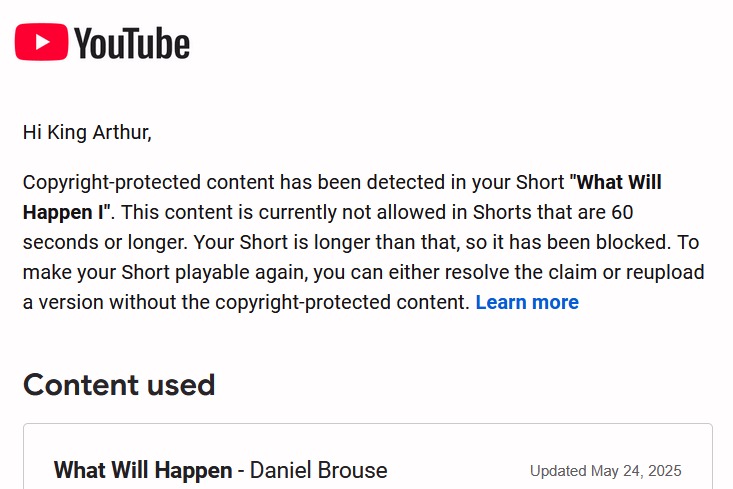
This week, I was notified that my YouTube channel removed one of my own videos—because the background music in the video was “owned” by me through my digital distributor. Yes, you read that correctly: my distributor triggered a Content ID claim against me, on behalf of me.

To restore the video, YouTube now requires that I “submit a dispute to the content owner if you have the rights to the content.” The process continues: “When you dispute a Content ID claim, the person that claimed your video (the claimant) is notified. The claimant has 30 days to respond.”

So now I must formally dispute myself to restore a song that I composed, performed, and uploaded.

The track in question, “What Will Happen Pt. 1,” was created with the help of my AI assistant, trained with my own musical data over the course of a year. That means I now have three virtual agents—my AI assistant, my distributor’s AI system, and YouTube’s Content ID—all fighting each other over a song that I indisputably own.

This is no longer a legal or technical nuance. It’s an existential glitch in the new digital music ecosystem. None of these systems were designed to resolve ownership at this level of nuance or context—and certainly not to understand when they are attacking their own creator.

I never instructed any of these tools to act against me. But the automation is now operating independently, enforcing policies that treat creators as potential infringers, even when there is no infringement. This is more than inconvenient; it’s reputational damage, business disruption, and the beginning of a deeply flawed feedback loop.

What we’re seeing is the early chaos of a system that’s automating enforcement faster than it’s developing the intelligence to understand context. As AI becomes more entrenched in content creation, content distribution, and content policing, the potential for misfires like this will only grow.

It raises urgent questions:

  • Who is ultimately responsible when automated systems attack legitimate creators?

  • What recourse do independent artists have when the enforcement tools are in conflict with each other—and themselves?

  • And most fundamentally, how can we create digital ecosystems where creators aren’t penalized by their own tools?

One thing is clear: we need new protocols for authorship, ownership, and automated enforcement—before the machines get too far ahead of the musicians.

When AI Attacks Itself

KingArthur.com