bookmark_borderNeptune Flood IPO: Riding the Rising Tide of Climate Risk

by Daniel Brouse
October 1, 2025

Neptune Flood, the largest private flood insurance company in the U.S., went public today, October 1, 2025, with its initial public offering (IPO) on the New York Stock Exchange under the ticker symbol “NP.” The St. Petersburg, Florida-based company raised $368 million by selling over 18 million shares at $20 per share, pricing at the top of its marketed range.

The IPO underscores the growing intersection between climate change, financial markets, and technological disruption. For decades, the flood insurance sector in the United States has been dominated by the National Flood Insurance Program (NFIP), a government-run system long criticized for outdated risk maps, cross-subsidized premiums, and mounting losses as extreme weather intensifies.

Neptune Flood is positioning itself as a market-based alternative. By leveraging artificial intelligence, machine learning, and big data, the company provides instant, risk-adjusted quotes—a major departure from the slow, bureaucratic processes of traditional insurance systems. Its model appeals to homeowners and businesses seeking coverage in areas where climate-driven flooding has rendered NFIP or private insurers either too slow, too expensive, or unwilling to underwrite risk.

But the company’s growth also highlights a troubling trend: vast regions of the U.S. are becoming increasingly uninsurable due to climate change. Rising sea levels, heavier rainfall, and stronger hurricanes are driving up both the frequency and severity of flood events. Where government-backed programs once absorbed much of the cost, private insurers like Neptune are stepping in with higher-cost policies tailored to high-risk consumers willing to pay for coverage.

While investors are attracted to Neptune’s profitability and data-driven underwriting, critics argue that its model may accelerate inequality in climate resilience. Wealthier homeowners and businesses may be able to afford Neptune’s “climate risk premium,” while middle- and lower-income households are left exposed or priced out of protection entirely. This could widen the gap between those who can adapt financially to climate change and those who cannot.
As Neptune Flood begins its life as a publicly traded company, its trajectory will serve as a bellwether for how private capital navigates the growing risks of climate change. Whether it represents a genuine solution or simply a profitable adaptation to a failing system remains to be seen—but one thing is clear: the tide of climate risk is rising, and financial markets are now deeply invested in who sinks and who swims.

Is this a good stock to short?

Actually, it’s not that simple. Neptune’s AI model incorporates climate risk directly into its premium setting, which gives it a built-in hedge—if people are willing (or forced) to pay the extraordinary premiums, Neptune stays profitable. As FEMA gradually steps back from subsidized coverage and shifts toward managed retreat, the private flood insurance market is only going to grow.

That said, there’s a real wild card here: states like Florida are already socializing homeowners’ insurance with taxpayer money. That creates a distorted market where Neptune may find itself competing not just with other insurers, but with its own state government’s artificially underpriced coverage.

So, shorting them might not be as obvious as it looks. This is one of those stocks where climate, policy, and economics will collide in unpredictable ways. Definitely worth watching.

* Our climate model employs chaos theory to comprehensively consider human impacts and projects a potential global average temperature increase of 9℃ above pre-industrial levels.
Tipping points and feedback loops drive the acceleration of climate change. When one tipping point is breached and triggers others, the cascading collapse is known as the Domino Effect.

The Human Induced Climate Change Experiment

bookmark_borderTrump’s FBI Cuts Ties with Anti-Defamation League in Latest Nod to White Nationalism

In a stunning move on Wednesday, the FBI announced it has severed ties with the Anti-Defamation League (ADL), a Jewish civil rights organization that has tracked antisemitism and extremism for more than a century. The decision comes after sustained pressure from right-wing activists, who attacked the ADL for flagging Turning Point USA—founded by the late Charlie Kirk—in its glossary of extremist groups and narratives.

This break represents more than bureaucratic housekeeping. It is the latest sign of the Trump administration’s increasingly open alignment with white nationalist and extremist rhetoric. By abandoning cooperation with one of the nation’s most respected watchdogs on hate, the FBI is sending a chilling message: political loyalty and appeasement of extremist groups take precedence over safeguarding communities from hate-fueled violence.

The hypocrisy is glaring. Trump and his allies routinely rail against antisemitism when it suits their narrative, yet they are now actively undermining the very organization tasked with monitoring and exposing antisemitic threats. Severing ties with the ADL does not merely weaken efforts to combat antisemitism—it emboldens those who perpetuate it.

The decision underscores a broader pattern of the Trump administration: normalizing extremism, discrediting institutions of accountability, and dismantling safeguards designed to protect pluralism and democracy. With antisemitic incidents at record highs in the United States, this move leaves Jewish communities and other vulnerable groups increasingly isolated.

Once again, the administration has proven itself not just indifferent to hate, but complicit in its spread.

Trumpenomics: The Decline of the USA

bookmark_borderTrump’s Bailouts: Socialism for Farmers, Handouts Abroad, and a Wrecking Ball for U.S. Taxpayers

Donald Trump has once again taken to social media to tout a taxpayer-funded “solution” to problems of his own making. After launching destructive tariff wars and pushing through regressive tax policies, he is now bailing out U.S. soy farmers left devastated by his economic blunders. The irony is glaring: a president who endlessly denounces “socialism” has engineered one of the largest socialized farm bailout schemes in modern U.S. history.

But Trump didn’t stop there. In a stunning twist, he also pledged a $20 billion bailout to Argentina—an economy already shattered by its own radical president, Javier Milei, whose wrecking-ball style of governance mirrors Trump’s. The justification? None offered, beyond Trump’s apparent admiration for Milei’s theatrics. The irony deepens as China, once the biggest buyer of U.S. soybeans, now sources much of its supply from Argentina. In essence, Trump is bailing out a competitor that has directly benefited from his failed trade war.

What emerges is a system of economic feedback loops where taxpayer money props up failed policies but provides no lasting benefits. Soy farmers are trapped in a cycle of dependency created by tariffs that cut them off from global markets. Meanwhile, billions flow overseas to countries like Argentina, whose gain comes at America’s loss. These are not investments in growth or competitiveness; they are subsidies for failure.

The larger picture is clear: Trump has redefined “America First” into “America Pays.” Trade wars have gutted U.S. exports, protectionism has isolated American industries, and fiscal recklessness has ballooned deficits. Instead of fostering resilience, his policies have created dependency at home and strategic giveaways abroad.

In the end, Trump’s bailouts are not acts of strength but confessions of failure—an admission that his economic vision is collapsing under its own weight, leaving taxpayers to foot the bill while competitors reap the rewards.

Trumpenomics: The Decline of the US

bookmark_borderImelda and Humberto: Climate Chaos, the Fujiwhara Effect, and the Web of Feedback Loops

by Daniel Brouse
September 30, 2025

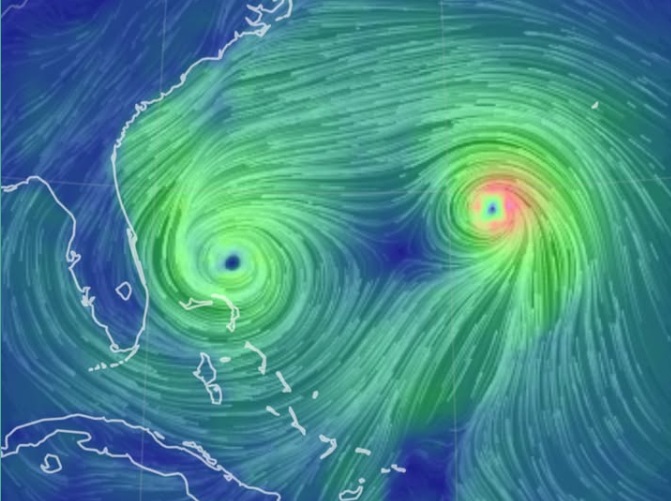
It is rare enough to see two hurricanes simultaneously spinning in the Mid-Atlantic. Even rarer still when those storms interact with a sagging jet stream and the disruption of the polar vortex. Yet this is precisely the kind of increasingly bizarre atmospheric alignment we are witnessing in the age of climate change. As human-driven warming accelerates, the complexity of interactions between climate systems grows—and so does the risk of compounding disasters.

Both Hurricane Imelda and Hurricane Humberto drew strength from the same underlying driver: climate change. Rising ocean temperatures provide hurricanes with more latent heat, acting as high-octane fuel that allows storms to intensify rapidly. Meanwhile, higher sea levels amplify the destructive power of storm surge. But the story does not end with simple cause and effect. Instead, these storms highlight a web of feedback loops that are making Earth’s climate system more volatile.

The Web of Feedback Loops

  1. Ocean Warming → Stronger Storms → More Heat Released
    Hurricanes act as massive heat engines, pulling energy from the ocean and releasing it into the atmosphere. Stronger storms churn up deeper warm water and transfer even more heat into the air, which in turn influences atmospheric circulation patterns, creating a self-reinforcing cycle.

  2. Jet Stream Disruption and Polar Vortex Instability
    The warming of the Arctic is reducing the temperature gradient between the poles and the tropics. This weakens and destabilizes the jet stream, causing it to meander and sometimes stall. A sluggish jet stream allows storms to linger, dumping catastrophic amounts of rain in one place, or, in this case, to align with other anomalies like a displaced polar vortex. The interactions multiply, making storm tracks less predictable and more destructive.

  3. Storm Interactions – The Fujiwhara Effect
    The Fujiwhara effect occurs when two cyclones rotate around a common center, sometimes merging, sometimes slingshotting one another into unexpected paths. While this phenomenon has long been known, climate change is increasing the probability of such interactions by raising the baseline frequency and intensity of storms. What was once an outlier may become a recurring feature of a warmer planet.

  4. Moisture Feedbacks
    Warmer air holds more water vapor, itself a potent greenhouse gas. As hurricanes intensify, they release enormous amounts of moisture into the atmosphere, which not only fuels heavier rainfall but also reinforces global warming by amplifying the greenhouse effect.

The Complexity Problem

Each of these processes alone would be troubling. Together, they weave a feedback network where one climate anomaly feeds into another, raising the odds of compound events. Instead of single, isolated extremes, we are entering an era defined by overlapping crises: two hurricanes colliding while the jet stream buckles and the polar vortex slumps southward. The result is not linear change but exponential escalation in intensity, frequency, and absurdity.

Strange Times, Stranger Storms

The case of Imelda and Humberto illustrates how climate change is no longer about gradual warming alone—it’s about destabilization. As feedback loops interact, they amplify chaos in ways our models struggle to fully capture. The Fujiwhara effect may be the headline here, but the deeper story is the tangled web of reinforcing climate feedbacks now shaping the 21st century.

We have entered a strange new climate era, where storms no longer follow familiar rules and extremes overlap in ways that strain our infrastructure, economies, and imagination. If Imelda and Humberto are any indication, the future will not only bring more powerful storms but increasingly bizarre interactions that defy precedent.

Hurricanes Imelda and Humberto Wind Pattern

Tipping points and feedback loops drive the acceleration of climate change. When one tipping point is toppled and triggers others, the cascading collapse is known as the Domino Effect.

The Human Induced Climate Change Experiment

bookmark_borderTrump Faces Over 300 Lawsuits for Executive Overreach and Harm to U.S. Citizens

Donald Trump is now facing more than 300 lawsuits challenging his executive overreach, authoritarian policies, and actions that have caused widespread harm to American citizens. The sheer volume of litigation is unprecedented in modern U.S. history and reflects the growing backlash against his administration’s unchecked power and disregard for constitutional limits.

A large portion of these lawsuits stem from Trump’s implementation of the largest regressive tax policies in U.S. history, which disproportionately burden working families, individuals, and small businesses while offering sweeping benefits to billionaires and multinational corporations. Small businesses across the country argue that Trump’s tax structure and tariffs have left them at a competitive disadvantage, forcing layoffs, closures, and in some cases, permanent shutdowns.

The tariff wars have also crushed American farmers, driving up input costs, cutting off access to foreign markets, and leaving crops unsold. Instead of addressing the damage caused by his own policies, Trump has announced that he will use billions in taxpayer money for bailouts—a form of economic intervention he derides as “socialism” when practiced by other countries. Critics point out that this hypocrisy not only undercuts U.S. credibility on trade policy but also exposes farmers to greater long-term instability as markets realign away from American agriculture.

Other lawsuits target Trump’s executive actions undermining democratic norms, including restrictions on immigration, the use of federal agents without identification in domestic operations, and policies that have weaponized federal agencies for political gain. Civil rights groups, state attorneys general, and advocacy organizations have joined the litigation, arguing that these actions not only violate the Constitution but also set dangerous precedents that erode the rule of law.

Additionally, several cases allege that Trump’s decisions have resulted in direct violations of individual rights—including denial of due process, infringement on free speech and assembly, and discriminatory practices rooted in racism and bigotry. Plaintiffs point to travel bans, detention practices, and the rollback of environmental and labor protections as examples of executive overreach that harm both people and the planet.

Legal experts note that while many of these cases will take years to wind through the courts, the sheer number and diversity of lawsuits illustrate a nation in deep conflict with its own leadership. If successful, these challenges could redefine limits on executive authority and reshape the balance of power between the presidency, the judiciary, and the people.

Trumpenomics: The Decline of the USA

bookmark_borderTrump’s Crimes, Illegal Activities, and Immorality: A Record of Corruption

Donald Trump’s public record is one of corruption, cruelty, and contempt for truth, law, and democracy. His actions—documented in court rulings, congressional reports, and his own words—paint a picture of a man unfit for power.

Trump’s Record:

  1. Been implicated in pedophilia and sexual misconduct allegations. The Epstein files are being withheld by Donald Trump—that’s not an accusation, it’s a fact. Trump himself admitted that Epstein “stole” his underaged massage girl from Mar-a-Lago, and his relationship with Epstein is well documented.
  2. Repeatedly denied science—on climate change, on public health, and on issues with life-or-death consequences.
  3. Lied pathologically about everything from crowd sizes to election results.
  4. Promoted white supremacy and emboldened racially charged violence.
  5. Been found liable for sexual assault in civil court.
  6. Stoked division through bigotry, bullying, and fear-based politics.
  7. Stood by as the U.S. Capitol was attacked, later praising or pardoning those responsible.
  8. Attempted to overturn a lawful election, undermining democracy itself.
  9. Engaged in financial fraud, including a judgment for falsifying business records.
  10. Misused charity funds, leading to a lifetime ban from operating a charitable foundation in New York.
  11. Implemented family separation policies at the border, losing track of children in the process.
  12. Attacked the independence of the Federal Reserve, destabilizing global markets.
  13. Attacked the First Amendment going so far as to threaten any television network critical of him.
  14. Exploded the national debt by trillions while handing tax cuts to billionaires, worsening inequality.
  15. Tried to weaponize the Justice Department as his personal shield and sword.
  16. Floated the idea of “suspending” the Constitution to stay in power.
  17. Been convicted of falsifying business records to hide damaging information from voters before an election.
  18. The real question is: who, knowing all of this, still chooses to support or defend such behavior?

The Bottom Line

Trump’s record is not a string of mistakes or misjudgments—it is a sustained pattern of lies, lawbreaking, and immorality. The real question is not whether Trump is guilty of corruption. The evidence is overwhelming. The real question is: who, knowing all of this, still chooses to support or defend such behavior—and why?

Trumpenomics: The Decline of America

bookmark_borderTrump, Epstein, and the Unanswered Questions: What the Records Reveal

Trump, Epstein, and the Unanswered Questions: What the Records Reveal

Donald Trump has been repeatedly linked to Jeffrey Epstein through a series of well-documented social, business, and personal interactions. Epstein, the convicted sex offender whose high-profile connections have drawn intense scrutiny, maintained extensive records of his relationships with wealthy and powerful individuals—including Trump.

While many of the Epstein files remain sealed or partially redacted, congressional investigators have subpoenaed documents from the Epstein estate that reference multiple high-profile figures. Among those named are Donald Trump and Elon Musk. According to these records, Epstein planned for Musk to visit his private island in 2014, and Trump appears in numerous entries related to Epstein’s activities.

Trump’s relationship with Epstein stretches back decades. Publicly available evidence—including Epstein’s 2003 birthday book, photographs, and past flight records—places Trump in Epstein’s circle on multiple occasions. Trump himself once remarked that Epstein had “stolen” a young massage worker from Mar-a-Lago, a statement that not only underscored their close association but also drew attention to the disturbing context in which both men operated. References to Trump also appear in communications tied to Epstein’s convicted associate, Ghislaine Maxwell.

While no criminal charges have been brought against Trump in connection with Epstein’s crimes, the ongoing withholding of the full Epstein files has intensified speculation about the extent of Trump’s—and other prominent figures’—ties to Epstein’s network. Congressional efforts to obtain and release these records highlight how much remains hidden from the public about the full scope of Epstein’s activities and connections.

Beyond Epstein, Trump has faced numerous allegations of sexual misconduct and assault over the years, including accusations involving inappropriate behavior toward minors. These claims, combined with his long-documented association with Epstein, continue to fuel public concern and demand for greater transparency.

The unanswered question is not whether Trump knew Epstein—he undeniably did—but what exactly Trump’s role or knowledge was in Epstein’s operation, and why so much information remains sealed.

A Breakdown of the Facts

Trump is the only one who publicly said he was going to release the Epstein files—and he lied. Since then, documents subpoenaed from the Epstein estate have revealed a far more extensive involvement by Trump, and even references to Musk. Regardless of political affiliation, anyone who raped underage girls or employed them as personal masseuses should be in jail.

The big difference with Trump is this:

  1. He is implicated in multiple allegations of sexual assault and misconduct involving minors—both connected to Epstein and unrelated cases.

  2. He personally admitted that Epstein “stole” his underage masseuse from Mar-a-Lago—his own words, not hearsay.

  3. He has repeatedly lied about releasing the files, as well as about the nature and depth of his involvement with Epstein and other sexual misconduct (“grab them by the pussy” being only one example of a documented pattern).

  4. He is not just another public figure—he is the President of the United States.

  5. Trump’s own Attorney General acknowledged that Trump’s name appears multiple times in the Epstein materials.

Trump has also faced decades of sexual assault and harassment claims, including being found liable for sexual abuse and defamation in civil court (the E. Jean Carroll case being the most recent, with a judgment of $83 million in damages). These are not isolated accusations—they form a consistent, well-documented pattern of predatory behavior.

Trumpenomics: The Decline of America

bookmark_border100% TACO: Trump’s Reckless Tariff on Life-Saving Medicines

Protectionism, White Nationalism, and the Collapse of U.S. Economic Credibility

Donald Trump has just announced one of the most dangerous and reckless policies of his presidency: a 100% tariff on all branded or patented pharmaceutical products, unless the manufacturer is currently building a plant in the United States.

“Starting October 1st, 2025, we will be imposing a 100% Tariff on any branded or patented Pharmaceutical Product, unless a Company IS BUILDING their Pharmaceutical Manufacturing Plant in America,” Trump declared on Truth Social. The tariff exemption would only apply if a company had already broken ground on U.S. facilities.

While generic drugs—representing the majority of U.S. imports—are excluded, the real impact falls on life-saving branded medicines, including cancer treatments, biologics, vaccines, and advanced therapies. Nathalie Moll, director-general of the European pharma lobby EFPIA, warned bluntly: “Tariffs on medicines, however excessive, will create the worst of all worlds. Patients will be denied access to life-saving treatments.”

The pharmaceutical industry had previously been spared from Trump’s earlier “reciprocal tariff” packages, but this announcement breaks with prior commitments made to the EU and other trading partners. The EU’s 15% tariff ceiling deal, which included a “no stacking” clause, now appears to be in jeopardy. Switzerland, despite agreeing to steep tariffs in August, had exempted pharmaceuticals—until now. The UK, lacking any pharma-specific trade agreement, is scrambling for clarity.

In an attempt to appease Washington, drugmakers like AstraZeneca, GSK, Novartis, and Roche have already announced new U.S. investments, though many projects remain in the planning stage. Analysts caution that even these companies could face tariffs until actual construction is underway, leaving them vulnerable to immediate disruption.

Financial markets reflected the uncertainty: AstraZeneca and Roche shares initially fell before recovering. Still, the longer-term threat is not to investors but to patients, who may face higher drug costs, restricted supply, and delayed access to new treatments.

This tariff bombshell highlights the hypocrisy of Trump’s economic nationalism. For years, Trump has attacked foreign countries for subsidizing industries like farming or steel while quietly supporting similar “Trump-socialist” policies at home, including stakes in U.S. Steel, Intel, and other politically favored corporations. His latest tariffs expand this protectionist playbook to essential medicines—a sector where the costs of political gamesmanship are measured not in dollars but in human lives.

The announcement came alongside new tariffs of 25% on imported heavy-duty trucks and 50% on kitchen and bathroom cabinets—further evidence of Trump’s broader war against free trade. Rather than strengthening America’s position, these moves isolate the U.S., alienate allies, undermine credibility, and expose consumers to higher costs across essential goods.

This is not an “America First” policy. It is protectionism and white nationalism masquerading as economic strategy. If enacted, it could mark not only the collapse of Trump’s economic credibility but also the decline of U.S. global leadership. By weaponizing access to life-saving medicine, Trump has crossed a line that could cost lives, destabilize markets, and fracture alliances.

The question now is simple: Will Trump TACO out before America does?

Trumpenomics: The Decline of the USA

bookmark_borderMicrosoft Cuts Off Israeli Military Unit Over Gaza Surveillance Scandal

September 26, 2025 — A Breaking Human Rights and Technology Story

Israel’s military has been accused of using Microsoft’s cloud platform, Azure, to conduct mass surveillance on millions of Palestinians, feeding into a system of targeted killings, forced displacement, and economic suppression. The surveillance campaign, run largely by Israel’s cyber-intelligence arm Unit 8200, reportedly included real-time monitoring of cell phone calls, location tracking, and mass data harvesting that helped guide Israeli airstrikes and disrupt daily civilian life in Gaza and the West Bank.

After months of mounting evidence and pressure, Microsoft has announced it terminated cloud storage and AI services provided to a unit within the Israeli Ministry of Defence. The company’s president and vice chair, Brad Smith, confirmed the decision in a blog post on Thursday, citing an August 6 investigation by The Guardian, +972 Magazine, and Local Call.

Surveillance Powered by Big Tech

The investigation revealed that after a 2021 meeting between Microsoft CEO Satya Nadella and Unit 8200’s commander Yossi Sariel, Microsoft entered into an agreement to move massive volumes of classified intelligence into its Azure platform. By 2022, Unit 8200 was operating with Azure’s vast storage capacity and machine learning tools, enabling Israel to collect, replay, and analyze the private communications of millions of Palestinians.

Sources from inside Unit 8200 told reporters that this system was directly tied to Israel’s targeted killing program and played a key role in selecting targets for airstrikes. Data was reportedly stored not only in Israel but on Microsoft servers in the Netherlands and Ireland, raising serious concerns about violations of European privacy and data protection laws.

Microsoft’s Limited Action

While Microsoft confirmed some subscriptions had been cancelled — including cloud storage and certain AI tools — Smith declined to name the specific Israeli military units involved. The move comes after Microsoft previously admitted to selling advanced cloud and AI services to the Israeli military following the October 7, 2023 Hamas attacks. At the time, the company insisted there was “no evidence” its platforms were being used for human rights abuses, though the new review has contradicted those claims.

Even now, critics argue Microsoft’s move is cosmetic at best. Former employee Hossam Nasr, who was among more than a dozen fired or arrested for protesting the company’s complicity in the Gaza war, called the decision “an unprecedented win” but added:

“Microsoft has only disabled a small subset of services to a single unit. The vast majority of its contracts with the Israeli military remain intact.”

War Crimes, Human Rights, and Big Tech

Human rights advocates and international legal experts say the revelations add to growing evidence of systematic war crimes committed by Israel in Gaza and the occupied territories — and the complicity of U.S. tech firms in enabling them. The use of AI to select human targets for assassination, combined with surveillance of an entire population, has been described as “a dystopian experiment in digital apartheid.”

Meanwhile, reports suggest that Israel is now in talks with Amazon Web Services (AWS) to take over much of the surveillance and data-processing capacity Microsoft is cutting off, raising fears that accountability will be little more than a tech industry shell game.

The Bigger Picture

This episode underscores the increasing entanglement of Silicon Valley with modern warfare, especially in conflicts involving U.S. allies. While Microsoft’s decision marks a rare public rebuke, critics argue it is too little, too late to undo the harm already caused — and that without binding international regulation, big tech companies will continue to serve as silent enablers of war crimes.


War Crimes

Trump’s Complicity in Global War Crimes: Ukraine, Gaza, and Iran
Despite branding himself as a “man of peace,” President Donald Trump’s actions during the first five months of his second term have contributed to a disturbing escalation of global conflict. From enabling brutal regimes to undermining international law, Trump’s role in supporting war crimes across multiple regions—Ukraine, Gaza, and Iran—marks one of the most troubling legacies of any U.S. president in modern history.


Israel and Palestine

Evangelical Christianity and Israel

America’s Secret War in Gaza: U.S. Boots on the Ground in Genocide, Funded by You
If you’re curious about the driving force behind US support for Israel, it’s ironically rooted in Evangelical Christianity. Many Evangelical Christians believe they can hasten the “second coming of Christ” by bringing about the apocalypse. According to their interpretation of the Bible, this involves Israel reclaiming Jerusalem, Jesus returning, and ultimately eliminating all Jews. For numerous “Christian Zionists,” especially influential evangelists aligned with the Republican Party, support for Israel is less about political strategy and more about its supposed role in biblical prophecy. In this worldview, war is not something to be avoided but embraced as a divine necessity—an inevitable and even celebratory step toward Jesus’ rule from the Temple Mount in Jerusalem. The fate of Jews and Palestinians is, to put it mildly, seen as collateral damage.

Criminalizing Conscience: Trump’s Crackdown on Anti-Genocide Voices

Silencing Truth: The War on Journalism by Netanyahu and Trump


Trumpenomics: The Decline of the US

bookmark_borderFormer Fed Chairs Unite Against Trump in Defense of Central Bank Independence

by Daniel Brouse
September 25, 2025

On September 25, 2025, a landmark amicus brief was submitted to the U.S. Supreme Court by every living former Chair of the Federal Reserve. The bipartisan group urged the Court to block former President Donald Trump from firing Federal Reserve Governor Lisa Cook while her legal challenge to her removal remains pending.

Defense of Federal Reserve Independence

The brief emphasized that the Federal Reserve’s independence is a cornerstone of the U.S. monetary system. The signatories warned that permitting the executive branch to remove Fed officials without due process would dangerously politicize the central bank, undermine its credibility, and erode public trust in monetary policy.

Protection of Institutional Safeguards

The filing stressed that allowing Trump to proceed with Cook’s removal before her case is resolved would dismantle nearly a century of safeguards Congress established to protect the Fed from political interference. Those protections were deliberately designed to insulate monetary policy from short-term political pressures, ensuring decisions are guided by economic data rather than campaign calculations.

Evidence for Central Bank Independence

The brief cited extensive research showing that independent central banks consistently deliver lower inflation, lower long-term interest rates, and greater financial stability than those subject to direct political control. By contrast, history demonstrates that when political leaders hijack monetary policy, inflation spikes, economic distortions multiply, and the costs of recovery rise steeply.

The Signatories

The brief was signed by an extraordinary coalition of bipartisan economic leaders. Among them were former Fed Chairs Alan Greenspan, Ben Bernanke, and Janet Yellen; former Treasury Secretaries from both Republican and Democratic administrations; former chairs of the White House Council of Economic Advisers; and former Fed Governor Dan Tarullo. The breadth of signatories underscored the depth of consensus in the economic community that the Fed’s independence must be preserved at all costs.

Background on Trump v. Cook

The case stems from Trump’s September 2025 attempt to fire Governor Cook, citing unproven allegations of mortgage fraud predating her service on the Federal Reserve Board. A federal court quickly blocked the firing, ruling that the president had failed to establish sufficient “cause” for removal. The court also noted that the allegations concerned conduct prior to her appointment, making them legally irrelevant to her role at the Fed.

Now before the Supreme Court, the Trump administration is asking for permission to remove Cook while litigation continues. If granted, the decision would set a precedent enabling presidents to summarily remove Fed governors, a move that could radically shift the balance of power between the White House and the nation’s central bank.

Trump’s Response

In characteristic fashion, Trump reacted to the legal setback with a barrage of angry and incoherent remarks, railing against the Fed and its leadership. His statements once again highlighted his deep ignorance of — and hostility toward — basic principles of fiscal and monetary policy. Economists warn that his continued attempts to bend monetary institutions to his will pose an existential threat to both U.S. economic stability and the credibility of global financial markets.

Trumpenomics: The Decline of America