bookmark_borderWinter Storm Battering Mid-Atlantic and New England

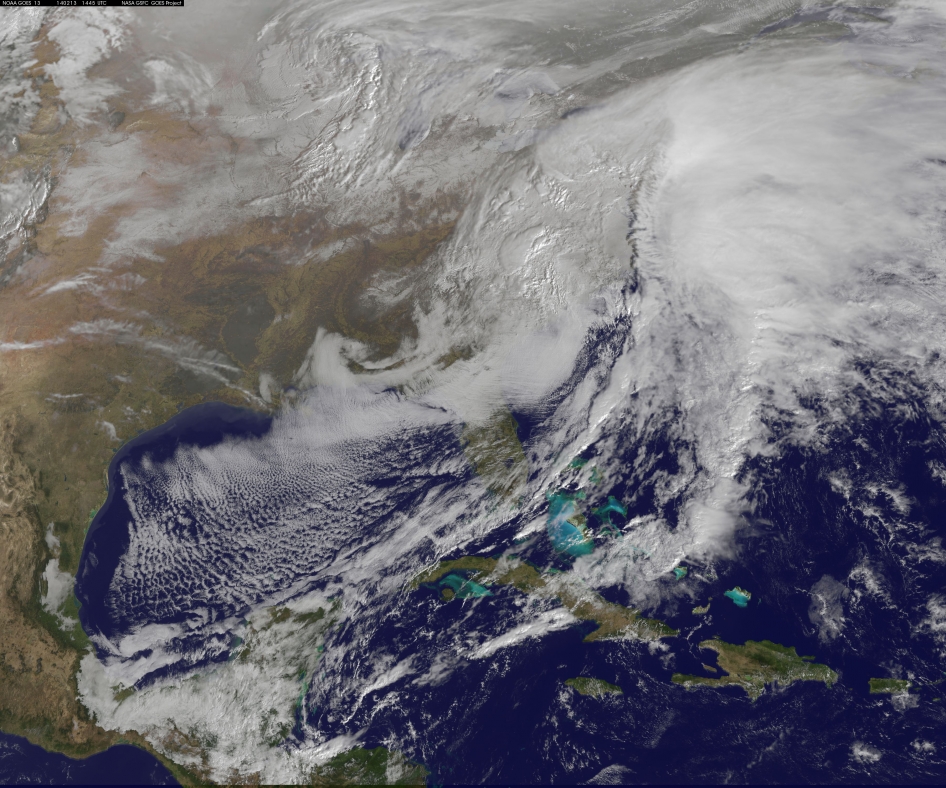
This visible image of the winter storm over the U.S. south and East Coast was taken by NOAA's GOES-13 satellite on Feb. 13 at 1455 UTC/9:45 a.m. EST. Snow covered ground can be seen over the Great Lakes region and Ohio Valley. Image Credit:  NASA/NOAA GOES Project
This visible image of the winter storm over the U.S. south and East Coast was taken by NOAA’s GOES-13 satellite on Feb. 13 at 1455 UTC/9:45 a.m. EST. Snow covered ground can be seen over the Great Lakes region and Ohio Valley. Image Credit: NASA/NOAA GOES Project

NASA — The monster winter storm that brought icing to the U.S. southeast moved northward along the Eastern Seaboard and brought snow, sleet and rain from the Mid-Atlantic to New England on February 13. A new image from NOAA’s GOES satellite showed clouds associated with the massive winter storm stretch from the U.S. southeast to the northeast.

Data from NOAA’s GOES-East satellite taken on Feb. 13 at 1455 UTC/9:45 a.m. EST were made into an image by NASA/NOAA’s GOES Project at NASA’s Goddard Space Flight Center in Greenbelt, Md. The clouds and fallen snow data from NOAA’s GOES-East satellite were overlaid on a true-color image of land and ocean created by data from the Moderate Resolution Imaging Spectroradiometer or MODIS instrument that flies aboard NASA’s Aqua and Terra satellites.The image showed that the clouds associated with the storm were blanketing much of the U.S. East Coast.

At 3:11 a.m. EST, a surface map issued by the National Weather Service or NWS showed the storm’s low pressure area was centered over eastern North Carolina. Since then, the low has continued to track north along the eastern seaboard. By 11 a.m. EST, precipitation from the storm was falling from South Carolina to Maine, according to National Weather Service radar.

By 11 a.m. EST, the Washington, D.C. region snow and sleet totals ranged from 3″ in far eastern Maryland to over 18″ in the northern and western suburbs in Maryland and Virginia. NWS reported that snow, sleet and rain were still falling and more snow is expected as the back side of the low moves into the region.

The New York City region remained under an NWS Winter Storm Warning until 6 a.m. on Friday, February 14 and the National Weather Service expects minor coastal impacts Thursday into Friday afternoon.

New England was also being battered by the storm. At 10:56 a.m. EST, Barnstable, Mass. on Cape Cod was experiencing rain and winds gusting to 28 mph. An NWS wind advisory is in effect for Cape Cod until 7 p.m. EST.

Further north, Portland, Maine was experiencing heavy snow with winds from the northeast at 6 mph. The National Weather Service in Gray, Maine noted “Significant snowfall is likely for much of western Maine and New Hampshire as this storm passes by. There will be a mix or changeover to sleet and freezing rain over southern and coastal sections tonight…before all areas end as a period of snow Friday (Feb. 14) morning.”

On February 13 at 10 a.m. EST, NOAA’s National Weather Service noted “An abundance of Atlantic moisture getting wrapped into the storm will continue to fuel widespread precipitation…which should lift through the Mid-Atlantic States and Northeast Thursday into Friday. A wide swath of heavy snow accumulations are expected with this storm…but air [moving] off the warmer ocean water should change snow over to rain along the coastal areas. Also…a narrow axis of sleet and freezing rain will be possible within the transition zone…which is expected to set up near the I-95 corridor.” For updates on local forecasts, watches and warnings, visit NOAA’s www.weather.gov webpage.

GOES satellites provide the kind of continuous monitoring necessary for intensive data analysis. Geostationary describes an orbit in which a satellite is always in the same position with respect to the rotating Earth. This allows GOES to hover continuously over one position on Earth’s surface, appearing stationary. As a result, GOES provide a constant vigil for the atmospheric “triggers” for severe weather conditions such as tornadoes, flash floods, hail storms and hurricanes.

For updated information about the storm system, visit NOAA’s WPC website: http://www.hpc.ncep.noaa.gov/

bookmark_borderCalifornia Zero Water Allocation

Though much of the United States has been experiencing a cold, high precipitation winter, California has had extreme drought and fire conditions. The State Water Project announced the state reservoir will “effectively be closed for business.”

“This is the most serious drought we’ve faced in modern times,” Felicia Marcus, chairwoman of the State Water Resources Control Board said. “We need to conserve what little we have to use later in the year, or even in future years.”

“Today’s action is a stark reminder that California’s drought is real,” said Gov. Jerry Brown. “We’re taking every possible step to prepare the state for the continuing dry conditions we face.”

“The exceptional drought extends from north to south across parts of 11 counties including, southeast Santa Cruz, far southern Santa Clara, San Benito, Merced, western Fresno, eastern Monterey, eastern San Luis Obispo, western Kern, western Madera, Kings and southwest Tulare,” notes weather.com meteorologist Chris Dolce.

“Truly staggering was the fact that some locations picked up less than half the precipitation in 2013 of their previous record dry year, including Santa Cruz, Calif. (4.78″ vs. old record of 11.85″ in 1929) and the north San Francisco Bay suburb of Kentfield (7.80″ vs. old record of 20.30″ in 1939),” writes weather.com meteorologist Jon Erdman.

bookmark_borderAdrift at Sea for 16 Months

EBON ATOLL — A Mexican man was found washed ashore in his small fiberglass boat on a remote Pacific Ocean island. Since he only speaks Spanish, he has been communicating by drawing pictures. It appears he left Mexico in September of 2012 with a companion on a trip to El Salvador. His companion died several months ago.

His name is Jose Ivan. He survived by eating fish, birds and turtles. When there was not enough rain for drinking water, he would drink turtle blood. All Jose was wearing was a tattered pair of underwear. He had long hair and beard. At first, he could not walk on his own, but the locals fed and cared for him. Now, he is drinking coffee, walking around, and even making jokes.

bookmark_borderPost-mortem Brains

National Institute of Mental Health — To expedite research on brain disorders, the National Institutes of Health is shifting from a limited funding role to coordinating a Web-based resource for sharing post-mortem brain tissue. Under a NIH NeuroBioBank initiative, five brain banks will begin collaborating in a tissue sharing network for the neuroscience community.

“Instead of having to seek out brain tissue needed for a study from scattered repositories, researchers will have one-stop access to the specimens they need,” explained Thomas Insel, M.D., director of NIH’s National Institute of Mental Health (NIMH), one of three NIH institutes underwriting the project. “Such efficiency has become even more important with recent breakthrough technologies, such as CLARITY and resources such as BrainSpan that involve the use of human tissue.”

NIMH, the Eunice Kennedy Shriver National Institute of Child Health and Human Development (NICHD), and the National Institute of Neurological Disorders and Stroke (NINDS) announced funding of the federated network of five brain tissue repositories.

Historically, NIH institutes have awarded investigator-initiated grants to support disease-specific brain bank activities. The NIH NeuroBioBank instead employs contracts, which affords the agency a more interactive role.

Contracts totaling about $4.7 million for the 2013 fiscal year were awarded to brain banks at the Mount Sinai School of Medicine, New York City; Harvard University in Cambridge, Mass., the University of Miami; Sepulveda Research Corporation, Los Angeles; and the University of Pittsburgh.

These brain and tissue repositories seek out and accept brain donations, store the tissue, and distribute it to qualified researchers seeking to understand the causes of – and identify treatments and cures for – brain disorders, such as schizophrenia, multiple sclerosis , depression, epilepsy , Down syndrome , and autism. In addition to serving the research community, the NeuroBioBank website provides the public with information about the donation process and about how post-mortem tissue research advances knowledge about the disorders.

“While making a gift of a loved one’s brain to science may seem unsettling to many of us, brain tissue is a precious resource that enables progress in understanding and treating neurologic and psychiatric disorders,” said NINDS director Story Landis, Ph.D. “Donors are making an important contribution in advancing knowledge about the structure and function of our most complex organ.”

The project seeks brain tissue from people with brain disorders and from non-affected individuals whose brains serve as controls in studies. Anyone age 18 years or older can register as potential donor, but next-of-kin can also give permission for donation of tissue from children and those who have not registered. The preferences and privacy of donors or their next-of-kin are respected in the process of sample collection.

“”The NIH NeuroBioBank will offer economies of scale, increase availability of biospecimens, establish a standardized system, and raise public awareness of the importance of human brain research,” said NICHD director Alan Guttmacher, M.D.

Other brain banks are encouraged to partner with the NeuroBioBank, by making their inventories available via the centralized website, he added.

bookmark_borderStar Explosion

A supernova was discovered in the night sky of London on January 23, 2014.

NASA says, “A supernova is the explosion of a star. It is the largest explosion that takes place in space.”

The explosion was first discovered by students and their teacher Steve Fossey at the University College London.

“It was a surreal and exciting experience taking images of the unidentified object as Steve ran around the observatory verifying the result,” UCL student Guy Pollack said.

International Astronomical Union General Secretary Thierry Montmerle said, “… it is one of the nearest supernova in modern time.”

Supernova Discovered in the Cigar Galaxy - about 12 million light-years away in the constellation Ursa Major, The Big Dipper
Supernova Discovered in the Cigar Galaxy – about 12 million light-years away in the constellation Ursa Major, The Big Dipper

bookmark_borderWake Up In Space

A spaceship launched 10 years ago is approaching its target — a comet. A landing unit will harpoon itself to the surface.

Comets are among the most beautiful and least understood nomads of the night sky. To date, half a dozen of these most heavenly of heavenly bodies have been visited by spacecraft in an attempt to unlock their secrets. All these missions have had one thing in common: the high-speed flyby. Like two ships passing in the night (or one ship and one icy dirtball), they screamed past each other at hyper velocity — providing valuable insight, but fleeting glimpses, into the life of a comet. That is, until Rosetta.

NASA is participating in the European Space Agency’s Rosetta mission, whose goal is to observe one such space-bound icy dirt ball from up close — for months on end. The spacecraft, festooned with 25 instruments between its lander and orbiter (including three from NASA), is programmed to “wake up” from hibernation on Jan. 20. After a check-out period, it will monitor comet 67P/Churyumov-Gerasimenko as it makes its nosedive into, and then climb out of, the inner solar system. Over 16 months, during which old 67P is expected to transform from a small, frozen world into a roiling mass of ice and dust, complete with surface eruptions, mini-earthquakes, basketball-sized, fluffy ice particles and spewing jets of carbon dioxide and cyanide.

“We are going to be in the cometary catbird seat on this one,” said Claudia Alexander, project scientist for U.S. Rosetta from NASA’s Jet Propulsion Laboratory in Pasadena, Calif. “To have an extended presence in the neighborhood of a comet as it goes through so many changes should change our perspective on what it is to be a comet.”

Since work began on Rosetta back in 1993, scientists and engineers from all over Europe and the United States have been combining their talents to build an orbiter and a lander for this unique expedition. NASA’s contribution includes three of the orbiter’s instruments (an ultraviolet spectrometer called Alice; the Microwave Instrument for Rosetta Orbiter; and the Ion and Electron Sensor. NASA is also providing part of the electronics package for an instrument called the Double Focusing Mass Spectrometer, which is part of the Swiss-built Rosetta Orbiter Spectrometer for Ion and Neutral Analysis instrument. NASA is also providing U.S. science investigators for selected non-U.S. instruments and is involved to a greater or lesser degree in seven of the mission’s 25 instruments. NASA’s Deep Space Network provides support for ESA’s Ground Station Network for spacecraft tracking and navigation.

“All the instruments aboard Rosetta and the Philae lander are designed to work synergistically,” said Sam Gulkis of JPL, the principal investigator for the Microwave Instrument for Rosetta Orbiter. “They will all work together to create the most complete picture of a comet to date, telling us how the comet works, what it is made of, and what it can tell us about the origins of the solar system.”

The three NASA-supplied instruments are part of the orbiter’s scientific payload. Rosetta’s Microwave Instrument for Rosetta Orbiter specializes in the thermal properties. The instrument combines a spectrometer and radiometer, so it can sense temperature and identify chemicals located on or near the comet’s surface, and even in the dust and ices jetting out from it. The instrument will also see the gaseous activity through the dusty cloud of material. Rosetta scientists will use it to determine how different materials in the comet change from ice to gas, and to observe how much it changes in temperature as it approaches the sun.

Like the Microwave for Rosetta Orbiter, the Alice instrument contains a spectrometer. But Alice looks at the ultraviolet portion of the spectrum. Alice will analyze gases in the coma and tail and measure the comet’s production rates of water and carbon monoxide and dioxide. It will provide information on the surface composition of the nucleus, and make a potentially key measurement of argon, which will be a big clue about what the temperature was in the primordial solar system when the comet’s nucleus originally formed (more than 4.6 billion years ago).

The Rosetta orbiter’s Ion and Electron Sensor is part of a suite of five instruments to characterize the plasma environment of the comet — in particular, its coma, which develops when the comet approaches the sun. The sun’s outer atmosphere, the solar wind, interacts with the gas flowing out from the comet, and the instrument will measure the charged particles it comes in contact with as the orbiter approaches the comet’s nucleus.

All three instruments are slated to begin science collection by early summer. Along with the pure science they will provide, their data are expected to help Rosetta project management determine where to attempt to land their Philae lander on the comet in November.

“It feels good to be part of a team that is on the cusp of making some space exploration history,” said Art Chmielewski, NASA’s project manager for US Rosetta, based at JPL. “There are so many exciting elements and big milestones coming up in this mission that it feels like I should buy a ticket and a big box of popcorn. Rosetta is going to be a remarkable ride.”

Rosetta is a mission of the European Space Agency, Paris, with contributions from its member states and NASA. Rosetta’s Philae lander is provided by a consortium led by the German Aerospace Center, the Max Planck Institute for Solar System Research, the French National Space Agency and the Italian Space Agency. JPL manages the U.S. contribution of the Rosetta mission for NASA’s Science Mission Directorate in Washington. The Microwave Instrument for the Rosetta Orbiter was built at JPL and JPL is home to its principal investigator, Samuel Gulkis. The Southwest Research Institute, San Antonio, developed the Rosetta orbiter’s Ion and Electron Sensor (IES) and is home to its principal investigator, James Burch. The Southwest Research Institute, Boulder, Colo., developed the Alice instrument and is home to its principal investigator, Alan Stern.

bookmark_borderCheese: Toe, Armpit, Belly Button and Mouth Bacteria

The “Grow Your Own… Life After Nature exhibition,” is an exhibit where cheeses are created using “microbial sketches” created with bacteria samples from various people’s body parts. Each cheese ends up smelling like the donor’s body odor.

“I’m really excited about things that sometimes are a little bit gross, a little bit disgusting,” microbiologist Christina Agapakis.

Agapakis and partner artist Sissell Tolaas said, “Many of the stinkiest cheeses are hosts to species of bacteria closely related to the bacteria responsible for the characteristic smells of human armpits or feet. Can knowledge and tolerance of bacterial cultures in our food improve tolerance of the bacteria on our bodies? How do humans cultivate and value bacterial cultures on cheeses and fermented foods? How will synthetic biology change with a better understanding of how species of bacteria work together in nature as opposed to the pure cultures of the lab?”

“This isn’t cheese for eating,” Agapakis said. “This is cheese for thinking.”

bookmark_borderRecord Breaking Cold Weather and Global Warming

Since we began studying global warming, there has been one thing all scientists could agree on — man-made warming of the Earth will cause an increase in extreme weather events.

We are not saying that the Earth’s temperature is just going to rise. In general, as energy is added to a system, the fluctuations in the system increase. So, we expect more storms, more droughts, more wildfires, more floods, more fluctuations of all kinds. What we are saying is that weather conditions will become more volatile due to the impact of humans. — Sidd Mukherjee & Daniel Brouse (2004)

When it come to the record breaking low temperatures of 2013 and 2014 in the United States, some people are tying to diminish the importance of curbing global warming.  The extreme events appear to give some humans the excuse to be delusional about human induced climate change. However, at this point in time, it is the ocean temperature we need be most concerned about.  The changes we are seeing  help cause the increase in volatility and extreme weather events.

Sorry to say, the ocean temperature is rising more rapidly than scientist had predicted.  Because of the way the Earth is warming, island nations are feeling the heat.  In fact, 2013 was the warmest year on record in Australia.

bookmark_borderHottest Year On Record

AUSTRALIA — Data collected and analyzed by the Bureau of Meteorology show that 2013 was Australia’s warmest year on record while rainfall was slightly below average nationally.

  • Summer 2012–13 was the warmest on record nationally, spring was also the warmest on record and winter the third warmest
  • Overall, 2013 was Australia’s warmest year on record: annual national mean temperature was +1.20 °C above average
  • All States and the Northern Territory ranked in the four warmest years on record
  • Nationally-averaged rainfall was slightly below average for the year, with 428 mm (1961–1990 average 465 mm)
  • Rainfall was mostly below average for the inland east and center, and above average for the east coast, northern Tasmania and parts of Western Australia

2013 was Australia’s warmest year since records began in 1910. Mean temperatures across Australia have generally been well above average since September 2012. Long periods of warmer-than-average days have been common, with a distinct lack of cold weather. Nights have also been warmer than average, but less so than days.

The Australian area-averaged mean temperature for 2013 was +1.20 °C above the 1961–1990 average. Maximum temperatures were +1.45 °C above average, and minimum temperatures +0.94 °C above average. Temperatures were above average across nearly all of Australia for maximum, mean and minimum temperatures, with large areas of inland and southern Australia experiencing the highest on record for each.

Australia has experienced just one cooler-than-average year (2011) in the last decade. The 10-year mean temperature for 2004–2013 was 0.50 °C above average, the equal-highest on record. Averages for each of the ten-year periods from 1995–2004 to 2004–2013 have been amongst the top ten records.

The Australian mean rainfall total for 2013 was 428 mm (37 mm below the long-term average of 465 mm). In comparison with rainfall in all years since 1900, 2013 sits close to the median or mid-point of historical observations.

Annual rainfall was below average across a large region of the inland east centered on western Queensland and extending into northern South Australia and the Northern Territory. Rainfall was above average over parts of the Pilbara and the south coast of Western Australia, as well as along the east coast and northern Tasmania.

More On Global Warming and Climate Change

bookmark_borderInterstellar Overdrive

NASA’s Voyager 1 spacecraft officially is the first human-made object to venture into interstellar space. The 36-year-old probe is about 12 billion miles (19 billion kilometers) from our sun.

New and unexpected data indicate Voyager 1 has been traveling for about one year through plasma, or ionized gas, present in the space between stars. Voyager is in a transitional region immediately outside the solar bubble, where some effects from our sun are still evident. A report on the analysis of this new data, an effort led by Don Gurnett and the plasma wave science team at the University of Iowa, Iowa City, is published in Thursday’s edition of the journal Science.

“Now that we have new, key data, we believe this is mankind’s historic leap into interstellar space,” said Ed Stone, Voyager project scientist based at the California Institute of Technology, Pasadena. “The Voyager team needed time to analyze those observations and make sense of them. But we can now answer the question we’ve all been asking — ‘Are we there yet?’ Yes, we are.”

Voyager 1 first detected the increased pressure of interstellar space on the heliosphere, the bubble of charged particles surrounding the sun that reaches far beyond the outer planets, in 2004. Scientists then ramped up their search for evidence of the spacecraft’s interstellar arrival, knowing the data analysis and interpretation could take months or years.

Voyager 1 does not have a working plasma sensor, so scientists needed a different way to measure the spacecraft’s plasma environment to make a definitive determination of its location. A coronal mass ejection, or a massive burst of solar wind and magnetic fields, that erupted from the sun in March 2012 provided scientists the data they needed. When this unexpected gift from the sun eventually arrived at Voyager 1’s location 13 months later, in April 2013, the plasma around the spacecraft began to vibrate like a violin string. On April 9, Voyager 1’s plasma wave instrument detected the movement. The pitch of the oscillations helped scientists determine the density of the plasma. The particular oscillations meant the spacecraft was bathed in plasma more than 40 times denser than what they had encountered in the outer layer of the heliosphere. Density of this sort is to be expected in interstellar space.

The plasma wave science team reviewed its data and found an earlier, fainter set of oscillations in October and November 2012. Through extrapolation of measured plasma densities from both events, the team determined Voyager 1 first entered interstellar space in August 2012.

“We literally jumped out of our seats when we saw these oscillations in our data — they showed us the spacecraft was in an entirely new region, comparable to what was expected in interstellar space, and totally different than in the solar bubble,” Gurnett said. “Clearly we had passed through the heliopause, which is the long-hypothesized boundary between the solar plasma and the interstellar plasma.”

The new plasma data suggested a timeframe consistent with abrupt, durable changes in the density of energetic particles that were first detected on Aug. 25, 2012. The Voyager team generally accepts this date as the date of interstellar arrival. The charged particle and plasma changes were what would have been expected during a crossing of the heliopause.

“The team’s hard work to build durable spacecraft and carefully manage the Voyager spacecraft’s limited resources paid off in another first for NASA and humanity,” said Suzanne Dodd, Voyager project manager, based at NASA’s Jet Propulsion Laboratory, Pasadena, Calif. “We expect the fields and particles science instruments on Voyager will continue to send back data through at least 2020. We can’t wait to see what the Voyager instruments show us next about deep space.”

Voyager 1 and its twin, Voyager 2, were launched 16 days apart in 1977. Both spacecraft flew by Jupiter and Saturn. Voyager 2 also flew by Uranus and Neptune. Voyager 2, launched before Voyager 1, is the longest continuously operated spacecraft. It is about 9.5 billion miles (15 billion kilometers) away from our sun.

Voyager mission controllers still talk to or receive data from Voyager 1 and Voyager 2 every day, though the emitted signals are currently very dim, at about 23 watts — the power of a refrigerator light bulb. By the time the signals get to Earth, they are a fraction of a billion-billionth of a watt. Data from Voyager 1’s instruments are transmitted to Earth typically at 160 bits per second, and captured by 34- and 70-meter NASA Deep Space Network stations. Traveling at the speed of light, a signal from Voyager 1 takes about 17 hours to travel to Earth. After the data are transmitted to JPL and processed by the science teams, Voyager data are made publicly available.

“Voyager has boldly gone where no probe has gone before, marking one of the most significant technological achievements in the annals of the history of science, and adding a new chapter in human scientific dreams and endeavors,” said John Grunsfeld, NASA’s associate administrator for science in Washington. “Perhaps some future deep space explorers will catch up with Voyager, our first interstellar envoy, and reflect on how this intrepid spacecraft helped enable their journey.”

Scientists do not know when Voyager 1 will reach the undisturbed part of interstellar space where there is no influence from our sun. They also are not certain when Voyager 2 is expected to cross into interstellar space, but they believe it is not very far behind.

JPL built and operates the twin Voyager spacecraft. The Voyagers Interstellar Mission is a part of NASA’s Heliophysics System Observatory, sponsored by the Heliophysics Division of NASA’s Science Mission Directorate in Washington. NASA’s Deep Space Network, managed by JPL, is an international network of antennas that supports interplanetary spacecraft missions and radio and radar astronomy observations for the exploration of the solar system and the universe. The network also supports selected Earth-orbiting missions.

The cost of the Voyager 1 and Voyager 2 missions — including launch, mission operations and the spacecraft’s nuclear batteries, which were provided by the Department of Energy — is about $988 million through September.