Senegal is an African country on the west coast of the continent. The country is on the forefront of global warming’s impacts.
“Climate change makes life harder for Senegalese farmers in many different ways: shorter rainy seasons, more frequent and longer dry spells and droughts, a lower water table, floods, coastal erosion, destruction of mangroves, and disruption of fish stocks. But most pernicious of all is the salinization of soil across large tracts of coastal and riverine farmland,” reports the IRIN news agency.
Salinization is an example of a problem that is likely to effect many areas in the United States.
“For decades in Sine-Saloum, the soil, which used to be known for its quality and productivity, has been badly damaged by climate change, which has led to the salinization of the waterways of the delta,” explained Seydou Cissé, who works at Senegal’s National Institute of Pedology (the study of soils).
In an attempt to abate the problem, anti-salt dykes were built. They did help for a while; however, man’s plans do not compare to the force of nature. Already several islands along the Saint-Louis river have been washed away. “Three or four days after the rain, everything goes white. There are piles of salt. All the crops we sow die. All this is due to the salinity caused by the rising waters of the sea. And when we store valuables in our rooms, rust eats away little-by-little and eventually destroys them,” said Fatou Faye, a resident of Diamniadio island said in 2015. Since that time, the island has been washed away.
“When the sea enters in the river, because you have increasing of salt, it has killed many mangroves. And you know the mangroves are the nurseries of all the seafood,” said Aissata Dia of Actionaid Senegal.
“When the tide is high, the water goes into the kitchen and then gradually the water enters the rooms. My kitchen was rebuilt last year, but even today it is threatened by the rising waters. The high salinity of the seawater eventually breaks down even the cement. After three years, the building collapses,” said islander Faye.
In 2017, a sea wall built to help protect Senegal failed. The miles long breach is not repairable.
Reuters reported in May of 2017: “As Senegal’s coast crumbles, residents ponder move to safer ground”
“A French man told us once that there will be a time when this land won’t exist,” said Badiane, who lives in the working-class district of Guet Ndar. “Maybe in 30 years, maybe in 50. I don’t know.”
“(The people) are trying to fight, but in reality the phenomenon has become very serious,” said Abdou Sane, a former parliamentarian based in Dakar who has spearheaded efforts to reduce the threat of disasters. “It exceeds the means of the government, the means of communities,” he added.
Experts have urged the government to relocate other communities before they face a similar fate.
A UN-Habitat program in 2011 helped move about 60 families out of Guet Ndar to a settlement a short distance inland.
“That’s a way of being resilient,” said Mateugue Diack, a professor of agronomy and disaster risk reduction at the nearby Gaston Berger University.
But communication was lacking and people were reluctant to move, he said. The relocation effort fizzled out before it was completed.
Guet Ndar is populated primarily by fishermen whose families have lived there for generations. Most of those who have lost their homes have remained in the overcrowded area, squeezing in with relatives and neighbors.
“Unfortunately my country is one of those that has this huge problem. We always record that something may happen, that something has happened… but still do nothing,” said Diack.
Q: How do you make gold and platinum?
A: Collide two neutron stars
“It’s so beautiful. It’s so beautiful it makes me want to cry. It’s the fulfillment of dozens, hundreds, thousands of people’s efforts, but it’s also the fulfillment of an idea suddenly becoming real,” said Peter Saulson of Syracuse University.
Not only does a collision of neutron stars create heavy metals, it also causes a wrinkle in space-time. Gravitational waves had been an Albert Einstein theory until 2015. Since then, there have been three recordings of gravitational waves; however, they were all colliding black holes. This was the first recording of gravitational waves in light.
The observation was made by LIGO:
Laser Interferometer Gravitational-Wave Observatory
Supported by the National Science Foundation
Operated by Caltech and MIT
Gravitational waves are ripples in the curvature of spacetime that are generated in certain gravitational interactions and propagate as waves outward from their source at the speed of light. The possibility of gravitational waves was discussed in 1893 by Oliver Heaviside using the analogy between the inverse-square law in gravitation and electricity. In 1905 Henri Poincaré first proposed gravitational waves (ondes gravifiques) emanating from a body and propagating at the speed of light as being required by the Lorentz transformations. Predicted in 1916 by Albert Einstein on the basis of his theory of general relativity, gravitational waves transport energy as gravitational radiation, a form of radiant energy similar to electromagnetic radiation. Newton’s law of universal gravitation, part of classical mechanics, does not provide for the existence of gravitational waves, since that law is predicated on the assumption that physical interactions propagate at infinite speed—showing one of the ways that the methods of classical physics is unable to explain phenomena associated with relativity.
GW170817 Press Release
LIGO and Virgo make first detection of gravitational waves produced by colliding neutron stars
Discovery marks first cosmic event observed in both gravitational waves and light.
Watch the recording of a press conference announcing the discovery, at the National Press Club in Washington, DC:
Watch the recording of a seminar at Caltech titled “Seeing and Hearing the Cataclysmic Universe” following the announcement:
For the first time, scientists have directly detected gravitational waves — ripples in space-time — in addition to light from the spectacular collision of two neutron stars. This marks the first time that a cosmic event has been viewed in both gravitational waves and light.
The discovery was made using the U.S.-based Laser Interferometer Gravitational-Wave Observatory (LIGO); the Europe-based Virgo detector; and some 70 ground- and space-based observatories.
Neutron stars are the smallest, densest stars known to exist and are formed when massive stars explode in supernovas. As these neutron stars spiraled together, they emitted gravitational waves that were detectable for about 100 seconds; when they collided, a flash of light in the form of gamma rays was emitted and seen on Earth about two seconds after the gravitational waves. In the days and weeks following the smashup, other forms of light, or electromagnetic radiation — including X-ray, ultraviolet, optical, infrared, and radio waves — were detected.
GW170817: A Global Astronomy Event
The observations have given astronomers an unprecedented opportunity to probe a collision of two neutron stars. For example, observations made by the U.S. Gemini Observatory, the European Very Large Telescope, and the Hubble Space Telescope reveal signatures of recently synthesized material, including gold and platinum, solving a decades-long mystery of where about half of all elements heavier than iron are produced.
The LIGO-Virgo results are published today in the journal Physical Review Letters; additional papers from the LIGO and Virgo collaborations and the astronomical community have been either submitted or accepted for publication in various journals.
“It is tremendously exciting to experience a rare event that transforms our understanding of the workings of the universe,” says France A. Córdova, director of the National Science Foundation (NSF), which funds LIGO. “This discovery realizes a long-standing goal many of us have had, that is, to simultaneously observe rare cosmic events using both traditional as well as gravitational-wave observatories. Only through NSF’s four-decade investment in gravitational-wave observatories, coupled with telescopes that observe from radio to gamma-ray wavelengths, are we able to expand our opportunities to detect new cosmic phenomena and piece together a fresh narrative of the physics of stars in their death throes.”
A stellar sign
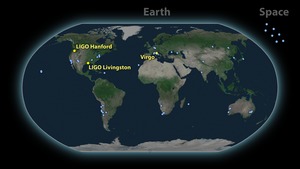
The gravitational signal, named GW170817, was first detected on Aug. 17 at 8:41 a.m. Eastern Daylight Time; the detection was made by the two identical LIGO detectors, located in Hanford, Washington, and Livingston, Louisiana. The information provided by the third detector, Virgo, situated near Pisa, Italy, enabled an improvement in localizing the cosmic event. At the time, LIGO was nearing the end of its second observing run since being upgraded in a program called Advanced LIGO, while Virgo had begun its first run after recently completing an upgrade known as Advanced Virgo.
Current operating facilities in the global network include the twin LIGO detectors—in Hanford, Washington, and Livingston, Louisiana— Virgo in Italy and GEO600 in Germany.
The NSF-funded LIGO observatories were conceived, constructed, and operated by Caltech and MIT. Virgo is funded by the Istituto Nazionale di Fisica Nucleare (INFN) in Italy and the Centre National de la Recherche Scientifique (CNRS) in France, and operated by the European Gravitational Observatory. Some 1,500 scientists in the LIGO Scientific Collaboration and the Virgo Collaboration work together to operate the detectors and to process and understand the gravitational-wave data they capture.
Each observatory consists of two long tunnels arranged in an L shape, at the joint of which a laser beam is split in two. Light is sent down the length of each tunnel, then reflected back in the direction it came from by a suspended mirror. In the absence of gravitational waves, the laser light in each tunnel should return to the location where the beams were split at precisely the same time. If a gravitational wave passes through the observatory, it will alter each laser beam’s arrival time, creating an almost imperceptible change in the observatory’s output signal.
On Aug. 17, LIGO’s real-time data analysis software caught a strong signal of gravitational waves from space in one of the two LIGO detectors. At nearly the same time, the Gamma-ray Burst Monitor on NASA’s Fermi space telescope had detected a burst of gamma rays. LIGO-Virgo analysis software put the two signals together and saw it was highly unlikely to be a chance coincidence, and another automated LIGO analysis indicated that there was a coincident gravitational wave signal in the other LIGO detector. Rapid gravitational-wave detection by the LIGO-Virgo team, coupled with Fermi’s gamma-ray detection, enabled the launch of follow-up by telescopes around the world.
The LIGO data indicated that two astrophysical objects located at the relatively close distance of about 130 million light-years from Earth had been spiraling in toward each other. It appeared that the objects were not as massive as binary black holes — objects that LIGO and Virgo have previously detected. Instead, the inspiraling objects were estimated to be in a range from around 1.1 to 1.6 times the mass of the sun, in the mass range of neutron stars. A neutron star is about 20 kilometers, or 12 miles, in diameter and is so dense that a teaspoon of neutron star material has a mass of about a billion tons.
While binary black holes produce “chirps” lasting a fraction of a second in the LIGO detector’s sensitive band, the Aug. 17 chirp lasted approximately 100 seconds and was seen through the entire frequency range of LIGO — about the same range as common musical instruments. Scientists could identify the chirp source as objects that were much less massive than the black holes seen to date.
LIGO’s data shows the “chirp” sound produced as the two neutron stars inspiral.
“It immediately appeared to us the source was likely to be neutron stars, the other coveted source we were hoping to see — and promising the world we would see,” says David Shoemaker, spokesperson for the LIGO Scientific Collaboration and senior research scientist in MIT’s Kavli Institute for Astrophysics and Space Research. “From informing detailed models of the inner workings of neutron stars and the emissions they produce, to more fundamental physics such as general relativity, this event is just so rich. It is a gift that will keep on giving.”
“Our background analysis showed an event of this strength happens less than once in 80,000 years by random coincidence, so we recognized this right away as a very confident detection and a remarkably nearby source,” adds Laura Cadonati, professor of physics at Georgia Tech and deputy spokesperson for the LIGO Scientific Collaboration. “This detection has genuinely opened the doors to a new way of doing astrophysics. I expect it will be remembered as one of the most studied astrophysical events in history.”
Theorists have predicted that when neutron stars collide, they should give off gravitational waves and gamma rays, along with powerful jets that emit light across the electromagnetic spectrum. The gamma-ray burst detected by Fermi, and soon thereafter confirmed by the European Space Agency’s gamma-ray observatory INTEGRAL, is what’s called a short gamma-ray burst; the new observations confirm that at least some short gamma-ray bursts are generated by the merging of neutron stars — something that was only theorized before.
“For decades we’ve suspected short gamma-ray bursts were powered by neutron star mergers,” says Fermi Project Scientist Julie McEnery of NASA’s Goddard Space Flight Center. “Now, with the incredible data from LIGO and Virgo for this event, we have the answer. The gravitational waves tell us that the merging objects had masses consistent with neutron stars, and the flash of gamma rays tells us that the objects are unlikely to be black holes, since a collision of black holes is not expected to give off light.”
But while one mystery appears to be solved, new mysteries have emerged. The observed short gamma-ray burst was one of the closest to Earth seen so far, yet it was surprisingly weak for its distance. Scientists are beginning to propose models for why this might be, McEnery says, adding that new insights are likely to arise for years to come.
A patch in the sky
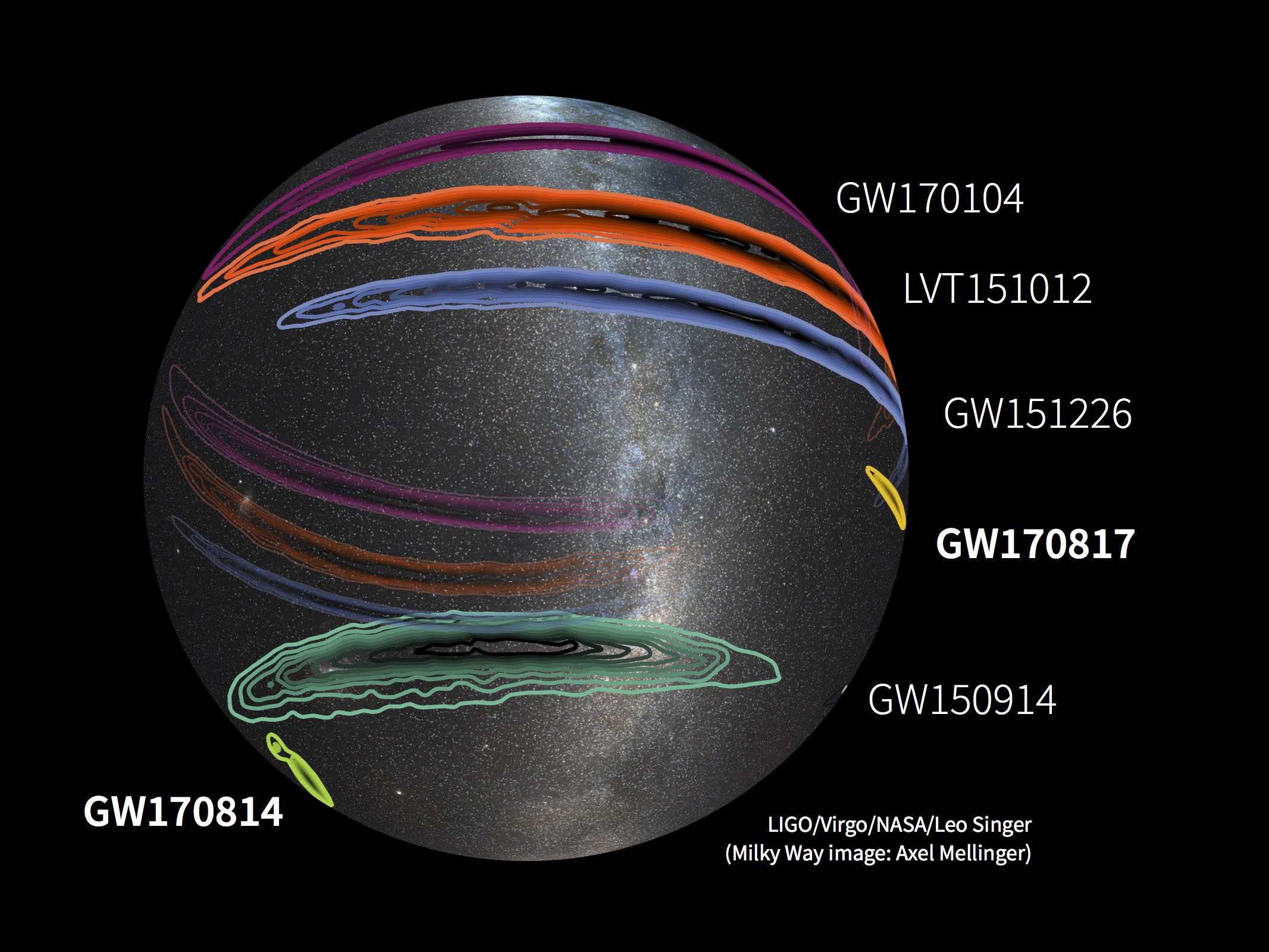
Though the LIGO detectors first picked up the gravitational wave in the United States, Virgo, in Italy, played a key role in the story. Due to its orientation with respect to the source at the time of detection, Virgo recovered a small signal; combined with the signal sizes and timing in the LIGO detectors, this allowed scientists to precisely triangulate the position in the sky. After performing a thorough vetting to make sure the signals were not an artifact of instrumentation, scientists concluded that a gravitational wave came from a relatively small patch in the southern sky.
Virgo Helps Localize Gravitational-Wave Signals
“This event has the most precise sky localization of all detected gravitational waves so far,” says Jo van den Brand of Nikhef (the Dutch National Institute for Subatomic Physics) and VU University Amsterdam, who is the spokesperson for the Virgo collaboration. “This record precision enabled astronomers to perform follow-up observations that led to a plethora of breathtaking results.”
“This result is a great example of the effectiveness of teamwork, of the importance of coordinating, and of the value of scientific collaboration,” adds EGO Director Federico Ferrini. “We are delighted to have played our relevant part in this extraordinary scientific challenge: Without Virgo, it would have been very difficult to locate the source of the gravitational wave.
Fermi was able to provide a localization that was later confirmed and greatly refined with the coordinates provided by the combined LIGO-Virgo detection. With these coordinates, a handful of observatories around the world were able, hours later, to start searching the region of the sky where the signal was thought to originate. A new point of light, resembling a new star, was first found by optical telescopes. Ultimately, about 70 observatories on the ground and in space observed the event at their representative wavelengths.
“This detection opens the window of a long-awaited ‘multi-messenger’ astronomy,” says Caltech’s David H. Reitze, executive director of the LIGO Laboratory. “It’s the first time that we’ve observed a cataclysmic astrophysical event in both gravitational waves and electromagnetic waves — our cosmic messengers. Gravitational-wave astronomy offers new opportunities to understand the properties of neutron stars in ways that just can’t be achieved with electromagnetic astronomy alone.”
A fireball and an afterglow
Each electromagnetic observatory will be releasing its own detailed observations of the astrophysical event. In the meantime, a general picture is emerging among all observatories involved that further confirms that the initial gravitational-wave signal indeed came from a pair of inspiraling neutron stars.
Approximately 130 million years ago, the two neutron stars were in their final moments of orbiting each other, separated only by about 300 kilometers, or 200 miles, and gathering speed while closing the distance between them. As the stars spiraled faster and closer together, they stretched and distorted the surrounding space-time, giving off energy in the form of powerful gravitational waves, before smashing into each other.
Neutron Star Merger Seen in Gravity and Matter
At the moment of collision, the bulk of the two neutron stars merged into one ultradense object, emitting a “fireball” of gamma rays. The initial gamma-ray measurements, combined with the gravitational-wave detection, also provide confirmation for Einstein’s general theory of relativity, which predicts that gravitational waves should travel at the speed of light.
Theorists have predicted that what follows the initial fireball is a “kilonova” — a phenomenon by which the material that is left over from the neutron star collision, which glows with light, is blown out of the immediate region and far out into space. The new light-based observations show that heavy elements, such as lead and gold, are created in these collisions and subsequently distributed throughout the universe.
In the weeks and months ahead, telescopes around the world will continue to observe the afterglow of the neutron star merger and gather further evidence about various stages of the merger, its interaction with its surroundings, and the processes that produce the heaviest elements in the universe.
“When we were first planning LIGO back in the late 1980s, we knew that we would ultimately need an international network of gravitational-wave observatories, including Europe, to help localize the gravitational-wave sources so that light-based telescopes can follow up and study the glow of events like this neutron star merger,” says Caltech’s Fred Raab, LIGO associate director for observatory operations. “Today we can say that our gravitational-wave network is working together brilliantly with the light-based observatories to usher in a new era in astronomy, and will improve with the planned addition of observatories in Japan and India.”
More than 1,200 scientists and some 100 institutions from around the world participate in the effort through the LIGO Scientific Collaboration, which includes the GEO Collaboration and the Australian collaboration OzGrav. Additional partners are listed at http://ligo.org/partners.php
The Virgo collaboration consists of more than 280 physicists and engineers belonging to 20 different European research groups: six from Centre National de la Recherche Scientifique (CNRS) in France; eight from the Istituto Nazionale di Fisica Nucleare (INFN) in Italy; two in the Netherlands with Nikhef; the MTA Wigner RCP in Hungary; the POLGRAW group in Poland; Spain with the University of Valencia; and the European Gravitational Observatory, EGO, the laboratory hosting the Virgo detector near Pisa in Italy, funded by CNRS, INFN, and Nikhef.
High Res. versions of these graphics can be found in our gallery.
GW170817’s numbers
Masses of Neutron Stars and Black Holes
Current operating facilities in the global network include the twin LIGO detectors—in Hanford, Washington, and Livingston, Louisiana – Virgo in Italy, and GEO600 in Germany.
Neutron Star Merger Seen in Gravity and Matter
Virgo Helps Localize Gravitational-Wave Signals
GW170817: A Global Astronomy Event
Artist’s illustration of two merging neutron stars.
LIGO’s data shows the “chirp” sound produced as the two neutron stars inspiral.
Videos
Neutron star merger (Credit: Christopher W. Evans/Georgia Tech)
Jets and Debris from Neutron Star Collision (Credit: NASA/Goddard Space Flight Center/CI Lab)
Last Dance of Neutron Star Pair (Credit: W. Kastaun/T. Kawamura/B. Giacomazzo/R. Ciolfi/A. Endrizzi)
Ripples of Gravity, Flashes of Light (Credit: LIGO/Virgo)
Zooming in on the Source of Gravitational Waves (Credit: LIGO-Virgo)
Final Flight of Neutron Star Pair (Credit: LIGO-Virgo/Aaron Geller/Northwestern University)
Hearing the Wave (Credit: Alex Nitz/Max Planck Institute for Gravitational Physics/LIGO)
The Membrane Domain started conducting global warming experiments in the 1990’s. It was about 1997 when we suggested the climate in Pennsylvania would turn more like Florida and the climate in California would turn more like Hades. The change wasn’t predicted to take place for hundreds of years. Now, only twenty years later, Pennsylvania has hot humid weather in October and California is on fire.
The Los Angeles Times entitled their article “The climate-change fire alarm from Northern California”. “These kinds of catastrophes have happened and they’ll continue to happen.” Gov. Jerry Brown observed at a news briefing Wednesday. “That’s the way it is with a warming climate, dry weather and reducing moisture.”
The article goes on to say, “California is fortunate to have a governor who understands the perils of ignoring climate change and is aggressively pushing policies to mitigate its future harm. Unfortunately, that puts him at odds with a head-in-the-sand president who blithely disregards the obvious connection between the warming climate and the multiple federal disaster areas he’s been forced to declare in Texas, Florida, Puerto Rico and, now, California.”
An article in Scientific American is entitled “Scientists See Climate Change in California’s Wildfires”. The subtitle is “Strong winds and months of record-high temperatures have fueled the destructive fires.”
As humans add fuel to storm systems, weather will become more extreme.
Current models indicate an increase in air quality alerts. The increase risk is not necessarily from an increase in pollution. An on-going research study conducted by InternetU.org suggests a warming climate is likely contributing to reduction in air quality.
The frequency of air quality alerts is on the rise in the United States and many other parts of the world. The Philadelphia Area is a prime example. Philly and suburbs have had multiple days in a row when it was unhealthy to breath. The Action Alert days are also starting earlier in the season and lasting longer into the summer. In fact, a recent string of days with temperatures above 90 have resulted in an Action Alert on September 25, 2017.
Ozone Action Alert for September 25, 2017
When the Earth’s surface temperature is hot enough and sunlight provides enough ultraviolet light, Nitrogen Oxides (NOx) and Volatile Organic Compounds (VOCs) in the air create a chemical reaction. The result is ozone. Tropospheric ozone is very destructive to plants and animals. Tropospheric ozone is killing an unprecedented number of trees. Unfortunately, it is also causing a massive amount of respiratory and immune system problems in humans, such as, asthma.
Equifax is one of the largest credit reporting agencies in the world. Ironically, Equifax provides “identity protection tools with daily monitoring and alerts today!”
From May to July, 2017, Equifax allowed a cybersecurity breach to steal 143 million people’s identity. The stolen information includes social security numbers, birthdays, addresses and driver’s license numbers.
On September 7, Equifax released a statement via Twitter: “We recently discovered a cybersecurity incident involving consumer information. Once discovered, we acted immediately to stop the intrusion. We apologize to our consumers and business customers for the concern and frustration this causes. Learn more: http://www.equifaxsecurity2017.com.”
The data breach compromised about half the population of the United States.
Cyber security specialist Sidd Mukherjee said, “The main issue not addressed is the collection of the data in the first place. There would be no target if there were no centralized database. If the data were maintained in a distributed mechanism, with strict privacy guarantees and guaranteed update (such as blockchain/bittorent/tor allows) we would not be in this situation.
‘But that’s so hard and we need to make money this quarter’
OK, that is actually quite a cruel summary, so let me expand. Back in the day, centralized was the only way to go. The Internet made a lot of things possible and mathematics did as much. Companies like Equifax began in response to a need. They
glommed on to a need twenty years before the Internet and made big databases because they watched ATT and SABRE and railroads, and such. The Internet came along and they lumbered over. And now, they find they are in a strange and terrible land beset with pitfall and with snare.
Equifax makes money through collection and controlled distribution of data. Both those avenues and control are threatened in this brave new world, as Mr. Assange pointed out some time ago.
Don’t get me wrong. I actually think assaults on privacy have done the evolution thing, selected for those schemes which resist assault. And as such, the centralized databases will get selected out of the game. It will take a while, though.”
In other news, until you had many to many communication with latency lower than human attention span, which seems to be about 20 seconds, you can’t really do hive intelligence like the kids are doing with the cell phones. Watch the kids. Demographic is destiny, as someone said.”
An iceberg weighing over one trillion tons (about the size of Delaware) broke off Antarctica. “Antarctica contains 90% of the world’s fresh water as ice. If all the ice melts, sea levels will rise by 60 meters (200 feet). The sea ice melting doesn’t raise the sea level as the ice is already floating.” (Brouse / Mukerhjee 2017)
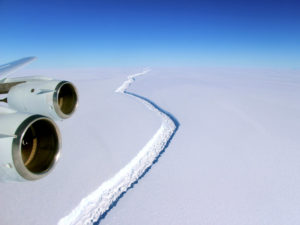
Antarctica Larsen C Ice Crack
The new iceberg was already floating, so it won’t have much effect on the sea level; however, it may a destabilizing effect on the rest of Antarctica. “One warning sign that a dangerous warming is beginning in Antarctica, will be a breakup of ice shelves in the Antarctic Peninsula just south of the recent January 0C isotherm; the ice shelf in the Prince Gustav Channel on the east side of the peninsula, and the Wordie Ice Shelf; the ice shelf in George VI Sound, and the ice shelf in Wilkins Sound on the west side.” (John Mercer 1978)
In January of 2017, a UK research team discovered a huge increase in a massive 90-mile crack running through the Larsen C shelf (pictured to the right). In June of 2017, the crack broke and a huge iceberg was created.
The Ellen MacArthur Foundation and the World Economic Forum, in a report called The New Plastics Economy (which looks at the amount of plastic that ends up in the sea) claims there will be more plastic than fish in the sea by 2050. “If we continue dumping plastic in the sea at the present rate, measured by weight, there will be more plastic than fish by 2050.”
The study examines just one area – San Francisco Bay. “If that’s not representative of the rest of the globe then you can see the potential for large deviations in this calculation,” says Prof Callum Roberts from the University of York.
Q: Do you know what are two of the most dangerous exposures for children and the elderly?
A: Fresh air and sunshine. Either may be hazardous; however, when fresh air and sunshine are combined, the result can be extreme.
The sun can damage your skin and cause cancer. Air pollution causes many health risks, too.
Fresh Air + Sunshine = Dangerous
Sunshine is also part of a deadly reaction. When combined with heat and volatile gases in the air, ultraviolet light causes a deadly reaction. The result is tropospheric ozone.
The dangerous ozone (O3) is created when vehicle (and other) exhaust is not completely combusted. Nitrogen Oxides (NOx) and Volatile Organic Compounds (VOCs) in the exhaust react to temperature and sunlight creating tropospheric ozone (O3).
The ozone in the air can cause permanent damage to your respiratory and immune systems. Millions of micro-explosions enter through your mouth and nose (and to some extent eyes, ears and skin)… then, if lucky, complete their short lives in your lungs. (NOTE: Lucky, for the length of their life. Unlucky, for the length of yours.)
Many days in the Philadelphia region are not healthy for breathing. On “Ozone Action Alert Days” you are advised to avoid outside activities. Children should not play outdoors. Avoid running and other fitness activities. Do not breathe in unconditioned air. Low level ozone is volatile and causes micro-explosions in your lungs that result in chronic respiratory and immune system damage. The more and harder you breathe, the more damage you cause to your body. Avoid exercise.
Russian attacks on the 2016 election were detected by many sources in early 2016. The Department of Homeland Security published the proof on December 29, 2016.
On October 7, 2016, the Department Of Homeland Security (DHS) and the Office of the Director of National Intelligence (DNI) issued a joint statement on election security compromises. DHS has released a Joint Analysis Report (JAR) attributing those compromises to Russian malicious cyber activity, designated as GRIZZLY STEPPE.
The JAR package offers technical details regarding the tools and infrastructure used by Russian civilian and military intelligence services (RIS). Accompanying CSV and STIX format files of the indicators, and an enhanced analysis of GRIZZLY STEPPE activity is available:
Joint Statement from the Department Of Homeland Security and Office of the Director of National Intelligence on Election Security
Release Date:
October 7, 2016
For Immediate Release
DHS Press Office
Contact: 202-282-8010
The U.S. Intelligence Community (USIC) is confident that the Russian Government directed the recent compromises of e-mails from US persons and institutions, including from US political organizations. The recent disclosures of alleged hacked e-mails on sites like DCLeaks.com and WikiLeaks and by the Guccifer 2.0 online persona are consistent with the methods and motivations of Russian-directed efforts. These thefts and disclosures are intended to interfere with the US election process. Such activity is not new to Moscow—the Russians have used similar tactics and techniques across Europe and Eurasia, for example, to influence public opinion there. We believe, based on the scope and sensitivity of these efforts, that only Russia’s senior-most officials could have authorized these activities.
Some states have also recently seen scanning and probing of their election-related systems, which in most cases originated from servers operated by a Russian company. However, we are not now in a position to attribute this activity to the Russian Government. The USIC and the Department of Homeland Security (DHS) assess that it would be extremely difficult for someone, including a nation-state actor, to alter actual ballot counts or election results by cyber attack or intrusion. This assessment is based on the decentralized nature of our election system in this country and the number of protections state and local election officials have in place. States ensure that voting machines are not connected to the Internet, and there are numerous checks and balances as well as extensive oversight at multiple levels built into our election process.
Nevertheless, DHS continues to urge state and local election officials to be vigilant and seek cybersecurity assistance from DHS. A number of states have already done so. DHS is providing several services to state and local election officials to assist in their cybersecurity. These services include cyber “hygiene” scans of Internet-facing systems, risk and vulnerability assessments, information sharing about cyber incidents, and best practices for securing voter registration databases and addressing potential cyber threats. DHS has convened an Election Infrastructure Cybersecurity Working Group with experts across all levels of government to raise awareness of cybersecurity risks potentially affecting election infrastructure and the elections process. Secretary Johnson and DHS officials are working directly with the National Association of Secretaries of State to offer assistance, share information, and provide additional resources to state and local officials.