bookmark_borderClimate Change and Civilization Collapse

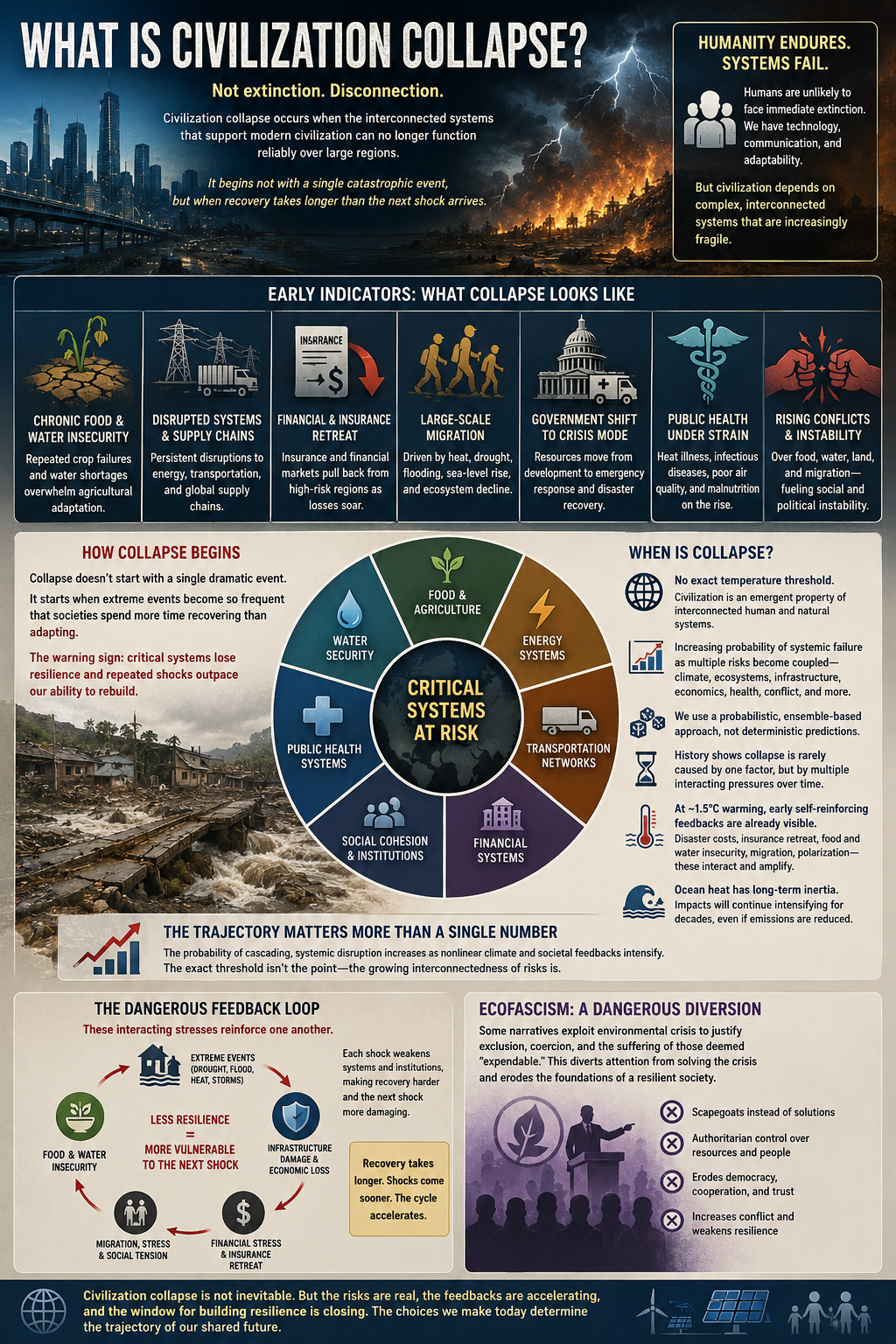
What Is Civilization Collapse?

Humans are unlikely to face immediate extinction under foreseeable climate scenarios. Our species possesses technological capabilities, global communication networks, and a remarkable ability to adapt to changing conditions.

Let’s lower the bar then to civilization collapse and define the term. Not talking about timeframes, could you explain what that term means to you? What are some of the things that would happen? How could we recognize the start? What things would fail?

Good question. Civilization collapse does not mean humanity suddenly disappears. It means that the interconnected systems that support modern civilization can no longer function reliably over large regions. Early signs of collapse are already occurring.

Some of these indicators include:

  • Chronic food insecurity as repeated crop failures and water shortages overwhelm agricultural adaptation.
  • Persistent disruptions to energy, transportation, and global supply chains.
  • Insurance and financial markets retreating from high-risk regions because losses become unmanageable.
  • Large-scale migration driven by heat, drought, flooding, sea-level rise, and ecosystem decline.
  • Governments increasingly shifting resources from development to emergency response and disaster recovery.
  • Public health systems struggling with heat illness, infectious diseases, poor air quality, and malnutrition.
  • Escalating conflicts over food, water, land, and migration.

I don’t think collapse begins with a single dramatic event. It starts when extreme events become so frequent that societies spend more time recovering than adapting. The warning sign is when critical systems lose resilience and repeated shocks outpace our ability to rebuild.

Some of those early indicators are already observable today. The question isn’t whether civilization stops overnight, but whether enough interconnected systems begin failing simultaneously that they reinforce one another. That’s why many researchers focus on cascading risks and coupled feedbacks rather than isolated events.

When Is Collapse?

Signs of disruption and collapse are already becoming visible in many parts of the world.

There isn’t a universally accepted temperature threshold at which civilization “collapses.” Civilization is an emergent property of interconnected human and natural systems, not a single physical variable.

The argument isn’t based on a hard cutoff like “X°C = collapse.” It’s based on the increasing probability of systemic failure as multiple risks become coupled. Climate science provides the physical forcing, while ecology, economics, engineering, public health, and history help us understand how societies respond to repeated, compounding shocks.

That’s why we use a probabilistic, ensemble-based approach rather than deterministic predictions. We aren’t claiming to know the exact year or exact temperature at which civilization fails. We’re evaluating the likelihood that interacting stresses—food and water insecurity, ecosystem degradation, infrastructure failures, migration, financial instability, conflict, and public health crises—begin reinforcing one another faster than societies can adapt.

History shows that civilizations rarely collapse for a single reason. They typically experience multiple interacting pressures that erode resilience over time. Our work extends that systems perspective to a globalized civilization operating within a rapidly changing climate.

In fact, I would argue that we’re already seeing early signs of self-reinforcing societal feedbacks at approximately 1.5°C of warming. Rising disaster costs strain insurance markets, infrastructure, and government budgets. Food and water insecurity contribute to migration and political instability. Repeated extreme events reduce resilience, making recovery from the next disaster more difficult. These interacting pressures don’t constitute “collapse” by themselves, but they are consistent with the early stages of a cascading systemic process.

We also know that the climate system has substantial thermal inertia. The heat already stored in the oceans will continue influencing the climate for decades, even as emissions are reduced. That means many climate impacts will continue to intensify before stabilizing, extending both the duration of environmental stress and the societal challenges associated with adaptation.

So I would frame it less as “civilization collapses at 4°C or 6°C” and more as “the probability of cascading, systemic disruption increases as nonlinear climate and societal feedbacks intensify.” The exact threshold isn’t the point; the trajectory and the growing interconnectedness of the risks are.

Ecofascism

I think we’re already seeing early-stage societal feedbacks emerge. I’m not saying civilization has “collapsed,” but that some of the reinforcing dynamics associated with systemic decline are becoming visible. Financial stress from repeated disasters, insurance retreat, food and water insecurity, migration, political polarization, and declining institutional resilience don’t occur in isolation—they increasingly interact and amplify one another.

One example that concerns me is the emergence of ecofascist narratives. Ecofascism reframes environmental crisis through an authoritarian lens, portraying environmental degradation as justification for exclusion, coercion, or the suffering of groups considered expendable. Rather than focusing on reducing emissions and building resilience, it redirects the conversation toward hierarchy and scapegoating.

Whether we ultimately call this the beginning of “collapse” is partly a matter of definition. What matters to me is recognizing that climate, ecological, economic, and social systems are increasingly coupled. As those feedbacks strengthen, the probability of cascading disruptions rises, even though the exact trajectory remains uncertain.

bookmark_border“Jellyfish” Drone Swarm Report Sparks Intelligence Debate Over Iranian Autonomous Warfare Claims

A newly surfaced U.S. military intelligence debriefing from a downed F-15 pilot has ignited debate within defense and intelligence circles after describing what appears to be a highly synchronized Iranian drone formation operating as a single coordinated system during combat operations over Iran in April.

According to a report published June 23, 2026, the pilot — who later ejected and was recovered after being shot down for the second time in the conflict — observed what he described as an anomalous aerial structure before going down, raising questions about whether Iran has demonstrated a new level of autonomous drone coordination.

The “Jellyfish” Formation

Intelligence sources familiar with the debriefing say the pilot described the drone configuration as resembling a “jellyfish” in structure: a larger grouping of drones positioned above with smaller units suspended beneath, forming what appeared to be a layered, interconnected system.

Rather than behaving as independent aircraft, the drones reportedly moved in tight synchronization, acting “completely as one cohesive unit.” The pilot described flying into what felt like a densely packed “minefield of drones,” characterizing the encounter in stark and highly unusual terms.

The pilot allegedly referred to the formation as “real alien sh*t,” reflecting both the visual complexity and the unexpected coordination observed in the engagement.

If accurate, the sighting could represent a significant leap in Iranian drone warfare capability, potentially indicating advanced swarm networking that allows multiple UAVs to maintain rigid spatial geometry while executing coordinated maneuvers. Such behavior would imply a high level of autonomy, distributed control systems, and real-time coordination far beyond Iran’s publicly understood drone doctrine.

Strategic Implications

Iran’s established drone doctrine has historically emphasized low-cost mass deployment, particularly through delta-wing Shahed-style systems designed to saturate air defenses through volume rather than coordination.

If the “jellyfish” formation reflects a real capability rather than a perceptual artifact, it would suggest a marked shift toward networked autonomous swarm warfare, where drones operate as a dynamically coordinated system rather than dispersed expendable assets.

Such a capability would represent a potentially significant evolution in regional airpower dynamics — moving from mass attrition tactics toward structured, adaptive, and possibly semi-autonomous airspace denial systems.

bookmark_borderA Coupled Framework for Compression of Climate Impact Doubling Times

Climate Jerk in Socio-Ecological Systems

By Daniel Brouse and Sidd Mukherjee

Abstract

Conventional climate-risk analysis often treats impacts as the downstream consequence of physical hazard
intensification alone. In this framing, rising losses, displacement, mortality, infrastructure disruption,
and systemic instability are interpreted primarily as a function of increasing temperature, precipitation
extremes, sea-level rise, or other physical forcing variables. While useful, that approach increasingly fails
to explain the observed acceleration of climate damages in the real world, where losses are shaped not only
by changing hazards, but by the interaction of hazards with exposure, governance capacity, adaptation limits,
and broader socio-economic fragility.

This paper proposes a revised socio-ecological framework for climate impact dynamics:

D(t) = H(t)E(t) − P(t) + S(t)

where:

  • D(t) represents realized climate damages or disruption
  • H(t) is hazard forcing
  • E(t) is exposure
  • P(t) is protection, governance, and adaptation capacity
  • S(t) is socio-economic stress amplification

We argue that climate impacts should be understood not as the output of a stationary hazard-loss relationship,
but as the emergent behavior of a non-stationary coupled system whose internal interactions increasingly amplify
the effects of physical climate forcing.

Within this framework, the relevant measure is not merely the rate of warming or the trend in a single physical
variable, but the compression of effective doubling times for climate impact indicators. We show
that a wide range of impact metrics—including insured losses, flood damages, infrastructure failures,
agricultural disruptions, heat mortality, displacement, and adaptation costs—can be interpreted as manifestations
of an accelerating effective growth constant generated by the coupling of H, E, P, and
S. Under this interpretation, the characteristic doubling time of major climate impacts appears to have
contracted from roughly century-scale behavior in the late nineteenth and early twentieth centuries to
decadal-scale behavior in the contemporary era.

We define this compression in effective timescales as a form of climate jerk: the acceleration
of the acceleration of realized climate damages within a socio-ecological system. Climate jerk is not a purely
meteorological quantity. It is the emergent signature of a civilization encountering intensifying hazards with
increasing exposure, uneven protection, and mounting systemic stress. This framework helps explain why climate
impacts now appear to accelerate faster than hazard-only models would predict, and why adaptation strategies that
focus narrowly on physical climate variables may systematically underestimate future risk.

1. Introduction

Climate change is often described through the language of physical forcing: rising temperatures, increasing
atmospheric moisture, shifting precipitation patterns, stronger heat extremes, sea-level rise, and intensifying
hydrologic and ecological disruption. These changes are real and well-established. Yet the most socially relevant
outcomes of climate change—flood losses, infrastructure failures, heat mortality, wildfire destruction, crop
losses, migration, insurance withdrawal, public-health crises, and governance strain—do not arise from hazard
forcing alone. They emerge from the interaction of physical hazards with where people live, how wealth and
infrastructure are distributed, how resilient institutions are, and how much stress a society can absorb before
nonlinear breakdown begins.

The prevailing hazard-centric framing tends to assume that damages are some relatively stable function of physical
forcing. In its simplest form, this can be represented as a loss function tied directly to hazard magnitude or to
a small set of physical indicators. That approach is increasingly inadequate. The observed growth of climate
damages over the past several decades cannot be fully understood without accounting for the rapid expansion of
exposed assets, the concentration of populations in high-risk geographies, the uneven performance of adaptation
and governance systems, and the feedback loops through which repeated shocks degrade social and economic
resilience.

A coastal flood in 1920 and a coastal flood of comparable meteorological character in 2025 do not produce
equivalent outcomes. The latter strikes a vastly larger and more interconnected system of homes, roads,
hospitals, ports, grids, insurance structures, supply chains, and politically stressed communities. Similarly,
a heat wave or wildfire event today unfolds in a world of denser urbanization, tighter agricultural margins,
aging infrastructure, more expensive real estate, higher debt burdens, and increasingly polarized governance
environments. The same physical perturbation therefore generates a larger and often more persistent social impact.

This paper proposes that climate damages should be modeled as the output of a coupled socio-ecological
system
rather than as a simple hazard response function. We define realized climate damages or disruption
D(t) as:

D(t) = H(t)E(t) − P(t) + S(t)

where:

  • H(t) = hazard forcing, including the frequency, intensity, persistence, and spatial extent of physical climate extremes
  • E(t) = exposure, including the distribution of people, infrastructure, agriculture, insured value, and economic assets in hazard-prone environments
  • P(t) = protection, governance, and adaptation capacity, including physical defenses, institutional competence, emergency response, social safety nets, and long-term planning
  • S(t) = socio-economic stress amplification, including fragility induced by inequality, debt, migration pressures, insurance retreat, infrastructure interdependence, public-health strain, political dysfunction, and cascading failures

The purpose of this formulation is not to claim that these terms are fully separable or universally measurable in
a single closed form. Rather, it is to establish a more realistic conceptual and analytical framework for
understanding why climate impacts are accelerating faster than hazard-only approaches imply.

The central claim of this paper is that the most important observable signature of this coupled system is the
compression of effective doubling times in climate impact indicators. A system whose losses double
every century behaves very differently from one whose losses double every decade. Even if the physical climate
signal evolves more gradually, the socio-ecological damage signal can accelerate much faster because the system
itself is changing: exposure grows, adaptation saturates, and stress amplification compounds each shock. The
result is a shortening of the effective timescale of damage growth.

We refer to this shortening—and the underlying increase in the rate of increase—as climate jerk.
In mechanics, jerk is the derivative of acceleration with respect to time. In climate socio-ecological systems,
climate jerk refers to the increasing acceleration of realized impacts as hazards, exposure, governance limits,
and systemic fragility interact. It is a way of naming the phenomenon in which the climate damage function itself
becomes more nonlinear over time.

The framework developed here does not replace physical climate science. Rather, it extends it into the domain
where climate change is actually experienced: not only in degrees Celsius, but in destroyed infrastructure,
uninsurable neighborhoods, repeated crop failures, overwhelmed emergency systems, migration pressure, and
cascading economic instability. If the aim of climate analysis is to understand the future trajectory of
real-world damages, then the hazard must be studied together with the system it strikes.

2. From Hazard-Centric Models to Coupled Damage Dynamics

2.1 The limitation of hazard-only framing

Traditional climate-impact discussions often begin from a hazard function of the form:

D(t) ≈ f(H(t))

D(t) ∝ H(t)

Such formulations are not inherently wrong. In many narrow contexts, hazard magnitude is indeed the dominant
explanatory variable. But as a general framework for long-horizon climate damages, it is incomplete because it
assumes that the relationship between hazard and impact is sufficiently stable to be described primarily through
physical forcing.

In reality, the same hazard can produce radically different outcomes depending on exposure and social conditions.
A floodplain with sparse settlement and minimal capital stock is not equivalent to a floodplain dense with
suburban development, industrial infrastructure, electrical substations, data centers, hospitals, and
transportation corridors. Nor is a society with strong public-health systems, ample fiscal reserves, and robust
evacuation capacity equivalent to one with weakened institutions, unaffordable insurance, and high preexisting
stress.

Thus, hazard-only models tend to understate the degree to which impacts can accelerate even if the underlying
climate forcing evolves more smoothly. The hazard may be the trigger, but the realized damage is produced by the
coupled system the hazard encounters.

2.2 The coupled socio-ecological formulation

We therefore define realized climate damages as:

D(t) = H(t)E(t) − P(t) + S(t)

This equation is best interpreted as a framework equation rather than a final calibrated model. It formalizes four intuitions:

  1. Hazard alone does not create damage; hazard must strike something.
    The term H(t)E(t) captures the multiplicative effect of physical extremes acting upon exposed
    populations, infrastructure, and assets.
  2. Protection and adaptation can suppress realized damage.
    The term P(t) represents all forms of buffering capacity: seawalls, drainage, building codes,
    early warning systems, evacuation logistics, crop switching, grid hardening, public-health systems, insurance
    mechanisms, and competent governance.
  3. Socio-economic stress can amplify damage independently of hazard magnitude.
    The term S(t) represents the extent to which existing fragility turns a severe event into a
    systemic crisis. A flood striking a financially stressed municipality, an uninsured household sector, or an
    already overloaded emergency system can generate much larger downstream disruption than the hazard alone would imply.
  4. The system is non-stationary.
    None of these terms is constant. Hazards intensify, exposure grows and relocates, protection improves unevenly
    and may saturate, and social stress can accumulate through repeated shocks. The relationship between forcing and
    damages is therefore not fixed.

3. The Four Components of the Framework

3.1 Hazard forcing: H(t)

H(t) represents the physical climate hazard environment. This includes, but is not limited to:

  • extreme precipitation intensity and persistence
  • flood frequency and compound flood risk
  • heat extremes and humidity stress
  • wildfire-conducive heat, drought, and wind regimes
  • drought persistence and agricultural water stress
  • tropical cyclone rainfall, storm surge, and wind damage potential
  • sea-level rise and tidal inundation
  • ecological destabilization affecting disease vectors, food systems, and fire regimes

In a warming world, H(t) is not simply a linear trend in average temperature. It is a changing
hazard field characterized by intensifying tails, altered persistence, compounding events, and growing background
conditions that make extremes more destructive.

3.2 Exposure: E(t)

E(t) represents the amount and distribution of people, infrastructure, assets, and economic activity located in harm’s way. Exposure includes:

  • population growth in coastal, fluvial, and wildland-urban interface zones
  • concentration of high-value property and infrastructure in risk-prone areas
  • growth of insured value and replacement costs
  • supply-chain dependence on vulnerable transport and logistics nodes
  • agricultural exposure to heat, drought, or flood-sensitive regions
  • urban heat exposure due to dense built environments

Exposure matters because climate losses are not driven solely by stronger hazards; they are also driven by the
increasing value and complexity of what those hazards strike.

3.3 Protection and governance: P(t)

P(t) represents the ability of societies to reduce or absorb impacts. It includes:

  • engineered defenses and resilient infrastructure
  • land-use planning and retreat from high-risk areas
  • emergency response and disaster preparedness
  • public-health capacity
  • insurance and financial backstops
  • social safety nets
  • institutional competence and long-term governance

P(t) can delay or reduce damages, but it does not necessarily scale in proportion to
H(t) and E(t). In many jurisdictions, adaptation is underfunded, politically
delayed, or structurally incapable of matching the speed of risk accumulation.

3.4 Socio-economic stress amplification: S(t)

S(t) is the term most often omitted from conventional climate-impact analysis. It captures the degree to which underlying social and economic fragility magnifies the consequences of hazard events. Examples include:

  • insurance withdrawal and rising underinsurance
  • household debt and inability to recover after repeated shocks
  • strained municipal finances
  • political dysfunction and delayed response
  • health-system overload during heat or smoke events
  • labor disruptions, supply-chain breakdowns, and cascading infrastructure failure
  • displacement, migration pressure, and social conflict
  • compounding disasters that strike before recovery from prior events is complete

S(t) is not merely a residual. It is a dynamic amplifier. A society repeatedly struck by
expensive disasters may become more fragile over time, which means later events produce disproportionately larger
damage even if hazard growth is modest.

4. Climate Jerk: The Compression of Impact Timescales

4.1 Why doubling time matters

If climate damages were growing at a constant proportional rate, we could write:

D(t) = D0ekt

Td = ln(2) / k

But the socio-ecological system described above implies that the effective growth rate k is
itself changing through time. Hazard forcing intensifies, exposure accumulates, protection struggles to keep pace,
and stress amplification rises. The relevant quantity is therefore the effective growth constant:

keff(t) = d/dt ln D(t)

Td(t) = ln(2) / keff(t)

The central empirical question is not simply whether climate damages are increasing. It is whether the
characteristic timescale of their increase is shrinking.

4.2 Defining climate jerk

In classical mechanics, jerk is the time derivative of acceleration. Translating that intuition into climate
socio-ecological dynamics, we define climate jerk as the tendency for the acceleration of
realized climate damages to increase over time because the system generating those damages is becoming more
strongly coupled and more fragile.

In practical terms, climate jerk is visible when:

  • major impact indicators begin doubling faster than they did in prior eras
  • damages rise faster than physical hazard trends alone would suggest
  • repeated shocks produce larger secondary and tertiary losses
  • the lag between hazard intensification and social disruption shortens
  • adaptation capacity falls progressively behind the combined growth of hazard, exposure, and stress

Climate jerk is therefore not a claim that every climate variable follows a smooth higher-order derivative. It is
a systems-level descriptor of accelerating impact dynamics.

5. Compression of Climate Impact Doubling Times Since 1890

5.1 A historical interpretation

Under the coupled framework, the long-run history of climate damages can be understood as a sequence of regimes:

Regime I: Low-coupling industrial climate risk (late 19th century to mid-20th century)

Hazards were increasing more slowly, exposed capital stocks were smaller, urban systems were less dense, and
although governance was often weak, the absolute scale of climate-linked losses relative to total societal
complexity was lower. Effective doubling times for aggregate climate damages were likely on the order of a century.

Regime II: Great acceleration and expanding exposure (mid-20th century to late 20th century)

Rapid urbanization, suburbanization, industrial growth, coastal development, and asset concentration increased
exposure dramatically. Hazards intensified in a warming world, but damages rose faster than hazards because the
target system grew denser and more expensive. Effective doubling times shortened substantially.

Regime III: Nonlinear coupled disruption (late 20th century to present)

In the contemporary era, exposure is deeply concentrated, infrastructure is highly interdependent, insured and
uninsured losses are enormous, adaptation is uneven, and repeated shocks feed social and economic fragility. The
result is a further compression in effective doubling times, with many impact indicators now behaving on decadal
rather than multi-decadal or century-scale horizons.

5.2 Approximate compression estimates

A conceptual reconstruction consistent with the coupled-system interpretation is:

Period Character of system Approximate effective doubling time of major climate-impact indicators
1890–1950 weakly coupled hazard-exposure system 100–120 years
1950–1990 accelerating exposure and hazard interaction 40–60 years
1990–2010 strongly coupled damage growth 20–30 years
2010–present nonlinear socio-ecological amplification regime 8–15 years

This implies that the effective doubling time of climate impact indicators has compressed by roughly
an order of magnitude since the late nineteenth century.

If the characteristic impact doubling time was approximately 110 years in the early industrial period and is now
on the order of 10–12 years, then the compression factor is approximately:

110 / 11 ≈ 10

This is the core result of the framework:

The characteristic doubling time of climate impact indicators has compressed by roughly 10× since 1890.

6. Why the Compression Occurs

6.1 Hazard forcing is striking a larger target

The term H(t)E(t) makes clear that damage growth is not proportional to hazard growth alone.
Even if hazard forcing were rising “only” steadily, the multiplication by rapidly expanding exposure would
accelerate realized losses.

6.2 Protection does not scale linearly with risk

Protection and adaptation do matter, but they often scale too slowly. Infrastructure upgrades, governance reform,
managed retreat, insurance restructuring, and social resilience investments are expensive, politically difficult,
and slow to implement. As a result, P(t) often grows more slowly than the combined growth of
H(t), E(t), and S(t).

6.3 Stress amplification turns disasters into systemic crises

The rise of S(t) explains why losses can accelerate faster than the hazard itself. When repeated
events weaken fiscal capacity, drive insurance retreat, deepen inequality, or overload emergency systems, the
system becomes more damage-sensitive. This means that each new event lands on a more fragile base.

6.4 Repeated shocks reduce recovery time

One of the defining features of the present regime is that new shocks increasingly arrive before recovery from
previous shocks is complete. This creates overlap between disasters, transforming what once would have been
isolated losses into rolling crises. In such a system, adaptation capacity is not merely insufficient; it is
continuously eroded by the cadence of events.

7. Implications for Climate Risk Assessment

7.1 Hazard-only projections may systematically understate future damages

If impact projections are anchored primarily to hazard trends, they may fail to capture the additional
acceleration generated by rising exposure and socio-economic fragility. This can lead to persistent
underestimation of flood losses, wildfire costs, heat mortality, migration pressures, and infrastructure
disruption.

7.2 Adaptation must be evaluated as a dynamic race, not a static buffer

In a coupled system, adaptation is not a one-time adjustment. It is an ongoing contest between the growth of
H(t)E(t) + S(t) and the ability of P(t) to keep pace. If protection lags, the
system can transition into a regime where damages accelerate despite nominal adaptation spending.

7.3 Insurance and finance become climate sensors

Insurance withdrawal, premium escalation, municipal credit stress, and repeated reconstruction costs are not
peripheral phenomena. They are indicators that S(t) is rising and that the socio-economic system
is amplifying climate damages faster than conventional models anticipate.

7.4 Climate policy must target the whole damage function

Mitigation remains essential because it constrains H(t) at the source. But adaptation policy must
also reduce exposure and fragility directly: retreat from high-risk zones, resilient infrastructure, public-health
strengthening, emergency governance, and economic systems capable of absorbing repeated shocks.

8. Methodological Implications

The framework presented here is intentionally synthetic. It is designed to reorganize how climate impacts are
interpreted rather than to claim a single universal calibrated model. Its value lies in the fact that it aligns
the analytical unit with the observed phenomenon. The object of concern is not hazard in isolation, but
realized socio-ecological damage.

Future work should therefore focus on:

  1. constructing empirical proxies for H(t), E(t), P(t), and S(t) across regions and sectors
  2. testing whether climate-loss indicators exhibit systematic shortening of effective doubling times
  3. identifying thresholds where protection saturation causes abrupt upward shifts in damage trajectories
  4. integrating climate-jerk metrics into adaptation planning, insurance modeling, and fiscal risk analysis
  5. evaluating whether certain regions are entering high-S(t) regimes where socio-economic fragility dominates hazard growth as the driver of realized losses

This framework is compatible with formal econometric, catastrophe-modeling, and systems-dynamics approaches. It
is not intended to replace them, but to provide a more realistic conceptual architecture for their integration.

9. Discussion

The language of climate change has long been dominated by warming trajectories, emissions scenarios, and physical
thresholds. Those remain indispensable. Yet the lived reality of climate change is increasingly a reality of
damage acceleration: faster-rising losses, faster-rising recovery costs, faster-rising insurance
stress, faster-rising displacement, and faster-rising governance overload.

A hazard-centric perspective struggles to explain why the social damage function can steepen so dramatically in
advance of any single “catastrophic” physical threshold. The coupled framework developed here explains that
steepening as the emergent product of hazard intensification, expanding exposure, lagging protection, and rising
socio-economic stress. The result is not simply more damage, but a compression in the timescale of damage
growth
.

This is why climate change can feel discontinuous even when some physical trends remain gradual. The discontinuity
lies not only in the hazard, but in the system it encounters. As the socio-ecological architecture of modern
civilization becomes more concentrated, more interconnected, more indebted, and more politically strained, the
same increment of physical warming can produce disproportionately larger social consequences.

The concept of climate jerk offers a language for that transition. It identifies the shift from a world in which
climate damages rise slowly enough to be treated as background risk, to a world in which damages accelerate
quickly enough to destabilize the institutions, markets, and governance systems meant to manage them.

10. Conclusion

Climate damages should no longer be modeled primarily as a direct and stable function of physical hazard forcing.
They are better understood as the emergent output of a non-stationary socio-ecological system:

D(t) = H(t)E(t) − P(t) + S(t)

In this framework, hazards matter enormously, but they do not act alone. They act upon a civilization
characterized by rapidly changing exposure, uneven adaptation, and mounting socio-economic fragility. The
resulting damage dynamics are nonlinear and increasingly compressed in time.

The key observable consequence is a shortening of the effective doubling times of climate impact indicators—from
roughly century-scale behavior in the late nineteenth and early twentieth centuries to decadal-scale behavior in
the present era. This order-of-magnitude contraction in impact timescales is the signature of what we call
climate jerk: the acceleration of the acceleration of realized climate damages in a coupled
socio-ecological system.

Recognizing climate jerk matters because it changes the policy problem. The challenge is not merely to reduce
emissions or to defend against isolated hazards. It is to manage a rapidly accelerating damage system in which
physical climate forcing, exposure, adaptation limits, and social fragility interact. In that system, delay is
not neutral. Delay allows the timescale of impacts to compress further, making future adaptation more expensive,
more difficult, and in some cases structurally impossible.

Suggested Figures

Figure 1.

Conceptual diagram of the coupled framework

D(t) = H(t)E(t) − P(t) + S(t)

with arrows showing hazard forcing and exposure multiplying damages, protection damping them, and socio-economic
stress amplifying them.

Figure 2.

Compression of effective doubling times for climate impact indicators, 1890–present

A curve or stepped bar chart showing the shift from ~100–120 years to ~8–15 years.

Figure 3.

Hazard-only model vs. coupled socio-ecological model

  • Panel A: D(t) ≈ f(H)
  • Panel B: D(t) = H(t)E(t) − P(t) + S(t) with nonlinear acceleration

Figure 4.

Climate jerk schematic

A graph showing hazard growth, impact growth, and the rising effective growth constant
keff(t), highlighting the shrinking doubling time
Td(t).

Short Author Summary

We argue that climate damages are not determined by hazards alone. They arise from the interaction of physical
extremes with exposure, adaptation capacity, and social fragility. Using the framework
D(t) = H(t)E(t) − P(t) + S(t), we show how the effective doubling time of climate impacts can
compress from century-scale behavior to decadal-scale behavior. We describe this shortening of impact timescales
as climate jerk: the increasing acceleration of realized climate damages in a coupled
socio-ecological system.

bookmark_borderTrump Announces Prospective Iran Deal, But Questions Remain

President Donald Trump announced that the United States and Iran have reached what he described as a “great settlement” that could bring an end to the current conflict and lead to a formal agreement as early as this weekend.

According to Trump, the breakthrough came after intense negotiations and recent military pressure. He characterized the development as a major diplomatic victory and suggested that Iran had ultimately agreed to terms favored by the United States.

Iranian officials, however, have offered a different account. According to their statements, the framework under discussion is largely the same memorandum of understanding that Tehran reportedly proposed weeks earlier. Iranian sources describe the arrangement as a temporary 60-day agreement that includes a ceasefire in Lebanon and the release of billions of dollars in previously frozen Iranian assets.

The differing narratives have fueled skepticism among analysts, policymakers, and observers across the political spectrum. While supporters of the administration view the announcement as a potentially significant step toward de-escalation, critics argue that the details remain unclear and that multiple previous declarations of imminent diplomatic breakthroughs have failed to produce lasting agreements. In fact, with each previous announcement, Iran appeared to strengthen its negotiating position and gain additional leverage.

bookmark_borderThe Future Is Not Yet Written: Why Human Actions Still Matter in a World of Climate Tipping Points

How hard will our generation make the struggle to thrive become a struggle merely to survive?

by Daniel Brouse and Sidd Mukherjee
June 10, 2026

Introduction

Unfortunately, we have already lost things that cannot be replaced or restored.

One of my favorite questions for people who dismiss the significance of climate change is simple:

How long do you think it takes to make six-million-year-old ice?

The answer, of course, is millions of years.

When ancient glaciers, ice sheets, ecosystems, coral reefs, forests, and species disappear, they do not return on timescales relevant to human civilization. Some losses are effectively permanent from the perspective of any society that will exist over the coming centuries or even millennia.

The reality is that many of the changes now unfolding across the Earth system cannot be reversed within a human lifetime. Yet this does not mean that the future is predetermined or that human actions no longer matter.

In fact, they matter enormously.

The Continued Role of Human Activities

A growing body of evidence suggests that Earth’s major climate systems are increasingly interconnected through a network of reinforcing feedback loops. Sea-level rise, polar amplification, ocean heat content, marine heatwaves, atmospheric rivers, Rossby-wave persistence, AMOC weakening, wildfire feedbacks, permafrost thaw, methane release, ecosystem shifts, and climatic whiplash all appear to be interacting in ways that increase complexity and reduce predictability.

Through our analysis of highly coupled nonlinear systems, we remain convinced that human forcing is still the primary driver and determinant of the ultimate outcome.

Many subsystems appear to be approaching—or perhaps have already crossed—important thresholds. The interactions among these systems make prediction increasingly difficult, and cascading responses are a legitimate concern. In a highly interconnected system, a seemingly modest perturbation can propagate through multiple pathways and produce consequences far larger than the original disturbance.

This possibility is precisely what makes climate change so dangerous.

Has the Climate System Become Autonomous?

An important question is whether humanity has already pushed the climate system beyond a point where it will continue to deteriorate regardless of future actions.

We are not yet convinced that this is the case.

The atmosphere, oceans, cryosphere, and biosphere are all responding to an energy imbalance that human activities continue to create. Greenhouse gas concentrations continue to rise. Fossil fuel combustion, land-use change, industrial processes, and ecosystem degradation continue to alter the balance of incoming and outgoing energy.

In this context, the strength, duration, and trajectory of human forcing still matter enormously.

While some tipping elements may already be in motion, there is little evidence that all future outcomes are now entirely independent of human influence. Rather, current observations suggest that human activities remain one of the most important variables governing how rapidly the climate system changes and how severe the consequences ultimately become.

Will the World Ever Be as It Was?

That does not appear possible.

The climate of the twentieth century is gone.

Many glaciers are retreating beyond recovery. Ancient ice is melting. Species are disappearing. Ecosystems are shifting. Ocean chemistry is changing. Sea levels will continue rising for centuries, and some changes already underway will persist for generations.

The question is no longer whether we can preserve the world exactly as it was.

We cannot.

The more important question is whether we can influence the world that follows.

Can We Influence How Bad It Gets?

The answer remains yes.

This is why continued focus on the acceleration of climate change is so important.

If human activities remain the dominant forcing mechanism, then reducing that forcing can still alter the trajectory of the system, even if we can no longer prevent many of the changes already set in motion.

The difference between a world that warms another degree and one that warms several more degrees is not an academic distinction.

It is the difference between:

  • More manageable versus catastrophic sea-level rise.
  • Regional crop disruptions versus widespread food insecurity.
  • Occasional extreme heat versus chronic heat stress.
  • Increased adaptation costs versus systemic economic disruption.
  • Partial ecosystem loss versus widespread ecological collapse.

Small differences in average temperature translate into enormous differences in impacts because climate risks do not increase linearly. They compound through feedbacks, thresholds, and cascading interactions.

The Moral Question

Ultimately, climate change is not simply an environmental issue. It is a question of human welfare, opportunity, and survival.

The decisions made today will determine the quality of life experienced by many generations to come. They will influence access to food, water, shelter, health, security, and economic stability. They will shape the future of coastal communities, agricultural regions, and ecosystems around the world.

Perhaps the most important question is not whether climate change can be stopped entirely.

It is this:

How hard will our generation make the struggle to thrive become a struggle merely to survive?

The future may no longer be capable of becoming what it once could have been. But it is still capable of becoming far better—or far worse—depending on the choices humanity makes today.

The world as it was may be gone.

The world that will be is still being written.

Feedback Loops → Tipping Points → Domino Effect
Feedback loops amplify climate change and can push interconnected Earth systems past critical tipping points. As tipping points are crossed, they can trigger additional feedback loops and destabilize other climate systems. This cascading “Domino Effect” compresses timescales, accelerates change, and increases the risk of rapid, nonlinear climate transformations.

bookmark_borderDon’t Be Fooled by Oil Futures: The Hidden Supply Crunch

Don’t Be Fooled by Oil Futures: The Hidden Supply Crunch in U.S. Commercial Inventories and the Strategic Petroleum Reserve at Multi-Decade Lows

Introduction: Paper Markets vs. Physical Reality

Oil futures markets are currently sending a deceptively calm signal. Prices appear to reflect a system that is balanced, or at least manageable. But beneath that surface, physical supply conditions tell a very different story.

U.S. strategic and commercial petroleum inventories are being drawn down at a pace that has few modern precedents. These withdrawals are occurring while global supply chains remain under severe stress, driven by geopolitical disruptions and constrained spare capacity.

Reports indicate that disruptions in Middle East production and shipping routes—including instability affecting the Strait of Hormuz—have removed a significant share of global export capacity. Even partial disruptions in this corridor can reverberate through global energy markets because it is one of the world’s most critical chokepoints for crude oil and LNG flows.

In response, the United States has increasingly functioned as a marginal global supplier—exporting crude and refined products while simultaneously drawing down domestic emergency reserves. This dual role is tightening internal buffers even as external risks remain elevated.


The Strategic Petroleum Reserve (SPR): Near Multi-Decade Lows

The U.S. Strategic Petroleum Reserve (U.S. Department of Energy) has declined to levels not seen in roughly four decades.

Current Status

  • Approximately 357.1 million barrels, according to recent estimates
  • Down from about 413 million barrels earlier in the year
  • Approaching levels last seen in the early 1980s

Magnitude of Drawdowns

Recent and cumulative withdrawals have been historically large:

  • ~172 million barrels released under emergency policy actions in the current cycle
  • ~180 million barrels released during the 2022 energy shock associated with the Russia–Ukraine conflict

While each drawdown has been framed as a stabilization tool for global markets, the cumulative effect has been a significant erosion of strategic buffer capacity.

Operational Constraints: The “Minimum Fill” Problem

The SPR is not simply a tank that can be emptied to zero. It is a geologically engineered salt-cavern system that requires a minimum working volume to maintain pressure balance and structural integrity.

Industry analysts, including references from the American Petroleum Institute, have warned that:

  • The system may require ~20% minimum fill to remain operationally stable
  • This implies a functional floor on usable inventory somewhere in the 70–150 million barrel range, depending on configuration assumptions

In other words, not all remaining barrels are economically or technically deployable in a crisis.


Commercial Crude Inventories: Tightening Beneath the Surface

While strategic reserves attract attention, commercial inventories often provide a more immediate signal of market stress.

Weekly Inventory Drawdowns

Data from the U.S. Energy Information Administration indicates:

  • A recent ~8 million barrel weekly drawdown in commercial crude inventories
  • Total commercial crude stocks near 433.7 million barrels
  • Approximately 3% below the five-year seasonal average

On the surface, this deviation may appear modest. However, oil markets are highly sensitive to small changes in inventory when spare capacity is limited.


Refined Products: The Hidden Constraint in Gasoline Supply

Crude oil availability is only part of the equation. Refined product inventories—especially gasoline and distillates—are often the true bottleneck for consumer price spikes.

  • Gasoline inventories have fallen by approximately 38 million barrels
  • This reduction is large enough to materially erode the typical seasonal buffer heading into peak summer demand

When refined product inventories decline faster than crude stocks, it signals stress not just in production, but in downstream refining capacity and logistics.


Cushing and the “Tank Bottom” Effect

One of the most important physical hubs in the U.S. oil system is Cushing, Oklahoma, the delivery point for West Texas Intermediate (WTI) futures contracts.

At low inventory levels, storage hubs face what industry operators call “tank bottoms”—the minimum operational level required to:

  • Keep pipeline flows stable
  • Maintain pump functionality
  • Avoid contamination and pressure issues
  • Preserve deliverability for futures contracts

When inventories approach these thresholds:

  • Market liquidity becomes constrained
  • Price volatility increases
  • Futures pricing can diverge sharply from physical spot realities

Even if headline inventories appear adequate, low usable storage capacity can create localized shortages and logistical bottlenecks.


Why Oil Futures May Be Misleading the Market

Oil futures prices are influenced by expectations, financial positioning, and macroeconomic sentiment—not just physical inventory conditions.

This creates a structural risk:
Markets can appear balanced while physical systems are tightening.

Key disconnects include:

  • Futures reflect expected future supply, not immediate deliverable barrels
  • Financial hedging can suppress or amplify price signals
  • Strategic releases can temporarily mask underlying shortages
  • Export flows can tighten domestic availability even when national production is high

As a result, futures markets may understate near-term physical constraints, especially when inventories are simultaneously declining across both strategic and commercial categories.


Outlook: A System Operating with Reduced Buffers

Taken together, three conditions define the current landscape:

  1. Strategic reserves near multi-decade lows
  2. Commercial crude inventories below seasonal norms
  3. Refined product and storage constraints tightening simultaneously

Even if geopolitical disruptions ease, inventory rebuilding takes time. Most supply forecasts suggest that normalization would require sustained production surpluses over multiple quarters—not weeks.

Industry projections increasingly suggest that price instability could persist into 2026–2027, particularly if global chokepoints remain vulnerable or if demand surprises to the upside.


Conclusion

The key risk in today’s oil market is not necessarily immediate scarcity—it is reduced resilience.

When both strategic buffers and commercial inventories are drawn down simultaneously, the system becomes highly sensitive to shocks that would previously have been absorbed without major price disruption.

In this environment, oil futures may not fully reflect the physical tightness of the system, particularly when storage constraints, refinery bottlenecks, and geopolitical risks converge.

The result is a market that appears stable in financial terms, but increasingly fragile in physical terms.

bookmark_borderJerk-Behavior in Earth’s Rotation: Climate Change, the Third Derivative, and Emerging Risks to Precision Navigation

“Climate-driven changes in Earth’s rotation may be contributing to navigational uncertainties that negatively affect battlefield outcomes and increase the risk of civilian casualties in contemporary conflicts.”

by Daniel Brouse and Sidd Mukherjee

Abstract

Climate change is increasingly altering the physical dynamics of Earth itself. Accelerating ice-sheet loss, sea-level rise, and large-scale redistribution of mass are changing the planet’s rotation rate, shifting its axis of rotation, and introducing increasingly nonlinear behavior into Earth system processes. Recent studies indicate that climate-driven ice melt is lengthening Earth’s day by approximately 1.33 milliseconds per century, making climate change a dominant driver of long-term rotational change. Beyond the slowing of rotation, the acceleration and third derivative (“jerk”) of these changes may represent a more significant concern because they reduce predictability within systems that depend on precise measurements of time, position, and motion. The consequences extend beyond geophysics into GPS accuracy, satellite operations, spacecraft navigation, autonomous systems, and potentially military guidance technologies. This paper examines the emerging science of climate-driven rotational change and places it within the broader context of accelerating Earth-system feedback loops and nonlinear climate dynamics.

Introduction

Earth’s rotation has never been perfectly constant. Variations occur naturally through interactions among the atmosphere, oceans, mantle, core, tides, and cryosphere. Historically, these fluctuations have remained within ranges that can be modeled and predicted through established geophysical processes.

Anthropogenic climate change is introducing a new forcing mechanism into this system. Accelerated melting of glaciers and polar ice sheets is redistributing trillions of tons of mass from high latitudes toward the oceans. This redistribution alters Earth’s moment of inertia and changes the speed and orientation of the planet’s rotation.

While changes in rotational velocity have attracted growing scientific attention, the acceleration and higher-order derivatives of those changes may prove even more significant. The third derivative, commonly referred to as “jerk,” measures how rapidly acceleration itself is changing. Increasing jerk-behavior is often a hallmark of nonlinear systems approaching new states of instability or unpredictability.

The significance of these changes extends far beyond the length of the day. Modern civilization depends upon precise timing, positioning, navigation, and reference-frame stability. Small changes in Earth’s rotational behavior can cascade through technologies that form the foundation of the modern world.

Climate Change and Earth’s Rotational Slowdown

In 2024, researchers from ETH Zurich, NASA’s Jet Propulsion Laboratory, and collaborating institutions demonstrated that climate change has become an increasingly dominant influence on Earth’s rotation. Their work showed that melting ice sheets redistribute mass from the poles toward lower latitudes, increasing Earth’s moment of inertia and slowing the planet’s rotation in a manner analogous to a spinning figure skater extending their arms.

A March 2026 analysis published in the Journal of Geophysical Research: Solid Earth quantified the effect, estimating that climate-driven ice melt is lengthening Earth’s day by approximately 1.33 milliseconds per century. While seemingly small, this represents a measurable and accelerating alteration of one of the planet’s most fundamental physical properties.

Researchers further concluded that the climate-driven component of Earth’s rotational slowdown now exceeds many natural long-term influences and may represent the most rapid climate-related rotational change observed in millions of years.

Polar Motion and the Changing Shape of Earth

The effects of ice-sheet loss are not limited to rotational speed.

As glaciers and ice sheets melt, the redistribution of water mass changes Earth’s shape and alters the position of its rotational axis. Research published in Geophysical Research Letters found that global warming has accelerated the movement of Earth’s rotational pole since the 1990s.

Several mechanisms contribute to this phenomenon:

  • Redistribution of meltwater toward lower latitudes.
  • Gravitational migration of ocean mass.
  • Centrifugal redistribution of water toward the equatorial bulge.
  • Glacial Isostatic Adjustment (GIA), in which land previously compressed by massive ice sheets slowly rebounds upward as ice disappears.

Together, these processes alter both Earth’s moment of inertia and the orientation of its spin axis. The result is a planet whose rotational geometry is changing more rapidly than at any point during the modern observational era.

The Third Derivative: Jerk-Behavior in the Earth System

Velocity measures change.

Acceleration measures changing velocity.

Jerk measures changing acceleration.

In engineering, aerospace systems, and control theory, jerk is often more important than velocity because it determines how predictable a system remains under changing conditions.

Earth’s rotational system now appears to be exhibiting measurable jerk-behavior driven by climate-induced mass redistribution. This means that not only is Earth slowing, but the rate at which it is slowing is itself changing.

Such behavior introduces challenges for predictive models because assumptions based upon previous rates of change become increasingly unreliable. Systems must be updated more frequently, and uncertainty grows as the underlying dynamics become increasingly nonlinear.

The emergence of measurable jerk-behavior may represent one of the clearest physical indicators that climate change is influencing fundamental planetary-scale processes.

Earth Orientation Parameters and Navigation Systems

Modern navigation depends on the precise relationship between celestial and terrestrial coordinate systems.

The International Celestial Reference Frame (ICRF) provides a stable astronomical reference framework based on distant quasars. The International Terrestrial Reference Frame (ITRF) defines geographic coordinates fixed to Earth’s surface.

Earth Orientation Parameters (EOPs) connect these systems.

Organizations such as the International Earth Rotation and Reference Systems Service (IERS) continuously monitor changes in:

  • Length of day
  • Polar motion
  • Axial orientation
  • Precession
  • Nutation

As climate-driven changes accelerate, EOP calculations become increasingly important. Even centimeter-scale errors in Earth’s reference frame can propagate into navigation errors measured in hundreds of meters across interplanetary distances.

The growing variability in Earth’s rotation increases the complexity of maintaining accurate coordinate transformations between space-based and Earth-based systems.

GPS, Spacecraft, and Inertial Navigation

Global Positioning System (GPS) satellites rely upon extremely precise timing and rotational models.

Unexpected changes in Earth’s orientation can create discrepancies between modeled and actual positions. These discrepancies must be corrected through continual updates to Earth orientation parameters.

The same challenge affects:

  • Satellite tracking
  • Spacecraft navigation
  • Astronomical observations
  • Geodesy
  • Autonomous transportation systems
  • Long-range communication networks

Inertial Navigation Systems (INS) face an additional challenge because they operate by integrating acceleration and rotational measurements relative to Earth itself.

As Earth’s rotational characteristics evolve, assumptions embedded within inertial guidance algorithms require more frequent recalibration. Small errors can accumulate over long distances and extended operational periods.

Sea-Level Rise Commitments and Long-Term Rotational Change

The rotational changes observed today are unlikely to stabilize quickly.

Research on the Greenland Ice Sheet has demonstrated that substantial future melting is already committed due to past greenhouse gas emissions. A study led by Jason Box and colleagues concluded that even if emissions ceased immediately, Greenland alone is committed to producing at least 27 centimeters of global sea-level rise.

Subsequent analyses suggest that realistic outcomes may substantially exceed this minimum estimate.

This committed melting implies continued redistribution of mass for decades and potentially centuries. As a result, climate-driven changes in Earth’s rotation, polar motion, and reference-frame stability are likely to continue long after greenhouse gas emissions peak.

The rotational consequences therefore represent not merely a current phenomenon but a long-term geophysical response that may unfold over generations.

Climate Feedback Loops and Nonlinear Dynamics

Understanding Earth’s changing rotation requires understanding the broader climate system in which it occurs.

Climate change is not a simple linear process. It is a dynamic system characterized by numerous interacting feedback loops, including:

  • Albedo Feedback Loop
  • Brown Carbon Feedback Loop
  • Permafrost-Methane Feedback Loop
  • Freshwater-AMOC Disruption Loop
  • Arctic Sea Ice Feedback Loop
  • Amazon Rainforest Dieback Feedback Loop
  • Hydroclimate Whiplash
  • Sudden Sea-Level Rise Pulses (“Cork Release” Events)

Each feedback influences the others through interconnected physical, biological, and social systems.

These interactions create nonlinear responses in which relatively small disturbances can trigger disproportionately large outcomes. The accelerating changes observed in Earth’s rotation may therefore be viewed as one manifestation of a broader planetary trend toward increasing systemic instability and complexity.

Defense and Strategic Implications

Modern military and aerospace systems depend heavily on precision navigation.

Long-range missiles, autonomous drones, hypersonic vehicles, spacecraft, and surveillance platforms all rely upon accurate reference frames and rotational models.

As Earth orientation becomes more variable, maintaining precision requires increasingly sophisticated updates and corrections.

Climate-driven changes in Earth’s rotation may be contributing to navigational uncertainties that negatively affect battlefield outcomes and increase the risk of civilian casualties in contemporary conflicts. As rotational variability increases, the growing complexity of Earth orientation modeling presents an emerging strategic challenge for navigation-dependent systems, including long-range guided munitions, autonomous drones, satellite operations, and other precision-targeting technologies.

Further research is needed to quantify these effects under operational conditions.

Conclusion

Climate change is altering not only Earth’s atmosphere, oceans, and ecosystems but also the planet’s physical rotation.

Accelerated melting of glaciers and ice sheets is slowing Earth’s rotation, shifting its axis, changing its shape, and introducing increasing levels of acceleration and jerk-behavior into planetary dynamics.

Recent research suggests that climate-driven rotational changes are now occurring at rates unprecedented in millions of years. These changes are becoming increasingly relevant to GPS systems, spacecraft navigation, Earth orientation modeling, geodesy, and other technologies dependent upon extreme precision.

Viewed within the larger framework of interacting climate feedback loops and nonlinear Earth-system dynamics, the changing rotation of Earth may represent one of the most fundamental indicators that anthropogenic climate change is affecting the physical mechanics of the planet itself.

Also see:

How Fast Is Climate Change Changing? Earth’s Rotation Is Changing More Than at Any Time in 3.6 Million Years 

References

Box, J. E., Colgan, W., et al. (2022). Greenland Ice Sheet Climate Disequilibrium and Committed Sea-Level Rise. Nature Climate Change.

Dill, R., Soja, B., Chen, J., et al. (2024). The Increasingly Dominant Role of Climate Change on Length of Day. Proceedings of the National Academy of Sciences, 121(28).

ETH Zurich Geodesy and Geodynamics Group. Research on Earth Rotation, Climate Change, and Earth Orientation Parameters.

International Earth Rotation and Reference Systems Service (IERS). Earth Orientation Parameters Technical Bulletins.

NASA Jet Propulsion Laboratory (JPL). Climate-Driven Changes in Earth Rotation and Polar Motion.

Wang, J., et al. (2021). Climate-Driven Polar Motion Since the 1990s. Geophysical Research Letters.

Membrane.com. Sea Level Rise: Then and Now. http://membrane.com/global_warming/Sea-Level-Rise-Historic.html

Membrane.com. Ignite a Domino Effect: Climate Feedback Loops and Cascading Tipping Points. http://membrane.com/global_warming/Ignite-a-Domino-Effect.html

Membrane.com. Greenland Melting Inevitable. http://membrane.com/global_warming/notes/Greenland-Melting-Inevitable.html

Journal of Geophysical Research: Solid Earth. (2026). Climate-Driven Lengthening of Day Associated with Ice Melt and Sea-Level Rise.

Lambeck, K. (2005). The Earth’s Variable Rotation: Geophysical Causes and Consequences. Cambridge University Press.

Munk, W. H., & MacDonald, G. J. F. (1960). The Rotation of the Earth: A Geophysical Discussion. Cambridge University Press.
bookmark_borderThe Dangerous Push Toward Autonomous Warfare

This is exactly what many of us feared when defense officials and political leaders turned against Palantir Technologies over concerns surrounding autonomous weapons systems and mass surveillance capabilities.

According to critics, Palantir resisted efforts to fully embrace autonomous lethal decision-making systems and broad domestic surveillance applications targeting U.S. citizens. Now, instead of slowing the development of AI-driven warfare, lawmakers appear to be accelerating it.

Pennsylvania Senators Dave McCormick and John Fetterman have introduced legislation aimed at rapidly expanding U.S. military drone and autonomous systems capabilities.

As Senator McCormick stated:

“Autonomous drone systems are reshaping modern warfare — China is moving fast, and America can’t afford to play catch-up.”

The proposed legislation calls for a comprehensive strategy to accelerate deployment of autonomous military technologies in order to “protect our troops” and preserve U.S. military dominance.

Supporters argue these systems are necessary to compete with rapidly advancing drone and AI warfare programs in countries like China and Russia. Critics, however, warn that the world is moving dangerously close to normalizing autonomous killing systems where machines — not humans — increasingly make battlefield targeting decisions.

The concern is not simply military competition. It is the long-term ethical and societal implications of handing life-and-death decisions to algorithmic systems while simultaneously expanding surveillance infrastructure, predictive targeting, and AI-driven warfare capabilities.

History shows that once such technologies are normalized in foreign conflicts, pressure often grows to expand their use domestically in the name of “security,” “stability,” or “public safety.”

The world is rapidly entering an era where the line between defense technology, autonomous warfare, and mass surveillance is becoming increasingly blurred — and far too few leaders are seriously debating the consequences.

bookmark_borderOil Forecast: Record Highs Before Structural Collapse?

What is likely to happen to the price of oil?

While the future is uncertain, the highest-probability outcome may be a period of the highest oil prices in history followed by some of the lowest sustained prices in modern history.

In the short term, geopolitical instability, supply disruptions, war risk, and constrained global production capacity are likely to continue pushing prices upward. As the new “forever war” expands and global shipping, refining, and energy infrastructure remain under pressure, oil markets will likely stay extremely volatile and inflationary.

Energy remains the master input cost to the global economy. Rising oil prices feed directly into transportation, food, manufacturing, shipping, aviation, plastics, fertilizers, and virtually every major industrial sector. That creates a cascading inflationary effect across the entire world economy.

But there is a breaking point.

Historically, oil shocks eventually trigger demand destruction. At some point, sustained high energy prices begin crushing consumer spending, slowing industrial activity, weakening trade, and pushing economies into recession. Once that process accelerates globally, oil demand can collapse very quickly.

At the same time, high fossil fuel prices are massively accelerating the transition to renewables, electrification, battery storage, and energy efficiency technologies. Record investment in solar, wind, grid infrastructure, and electric transportation is already reshaping long-term energy demand curves worldwide.

That combination — recession-driven demand destruction plus rapid renewable adoption — creates the possibility that future oil demand may never fully recover to prior growth expectations.

In other words, the world may first experience a final inflationary fossil fuel spike before entering a structurally declining demand era for oil.

For consumers and workers tied to the global economy, that transition could be painful and highly disruptive. But from an environmental and climate perspective, the long-term reduction in fossil fuel dependence could ultimately become one of the few positive outcomes to emerge from the current crisis.

bookmark_borderAsh Devils and Black Rain: Two Extreme Fire–Carbon Phenomena Emerging From Intensifying Disasters

In early May 2026, two striking and very different atmospheric events emerged from fire- and carbon-intensive systems: ash devils in Southern California wildfires and reports of “black rain” in the Black Sea region following industrial strikes. While geographically and causally distinct, both reflect a broader pattern in which human-driven combustion, infrastructure stress, and atmospheric feedbacks are increasingly interacting in extreme ways.


Ash Devils: Fire-Driven Atmospheric Vortices

During active wildfire operations in Southern California, firefighters observed ash devils near the Trinity Fire in the Phelan area.

These are fire-generated vortices formed when:

  • Extreme wildfire heat rapidly warms surface air
  • Hot air rises and induces localized rotation
  • The vortex lifts ash, embers, and debris into the atmosphere

They are a visible expression of how intense combustion events can reorganize local atmospheric dynamics, spreading particulate matter unpredictably.


Black Rain: Industrial Combustion Meets Weather Systems

At the same time, reports from the Black Sea region described “black rain” following drone strikes on oil infrastructure near Tuapse.

The sequence involved:

  • Explosions and fires at petroleum facilities
  • Large-scale release of soot, hydrocarbons, and aerosols
  • Interaction of these emissions with rainfall systems

The result was precipitation contaminated with dark particulates and oily residues, with reported impacts on coastal ecosystems, wildlife, and human health.


A Shared System: Fire, Carbon, and Feedback Acceleration

Although one event is wildfire-driven and the other conflict-driven industrial combustion, both reflect the same underlying system pressure:

Human exploitation of carbon-based energy systems is increasingly feeding back into the climate and atmospheric system itself.

Key interacting processes include:

  • Combustion emissions (wildfire, fossil fuels, industrial fires)
  • Aerosol loading of the atmosphere (soot, ash, particulate matter)
  • Extreme heat and drying conditions that amplify fire behavior
  • Infrastructure vulnerability under stress and conflict conditions

These processes are not isolated—they reinforce each other through feedback loops:

  • More heat → more fire intensity
  • More fire → more aerosols and radiative effects
  • More aerosols and greenhouse gases → further warming and instability

Broader Implication: A Coupled Human–Climate System

What links these events is not just coincidence, but a growing coupling between human systems and climate systems:

  • Energy extraction and combustion
  • Industrial and military infrastructure damage
  • Land-use stress and wildfire expansion
  • Atmospheric redistribution of pollutants

Together, these contribute to a system in which human activity is no longer external to climate change, but embedded within its accelerating feedback structure.

While individual events are local, the underlying trend is increasingly systemic: amplified extremes emerging from interacting climate, energy, and conflict dynamics.


Conclusion

Ash devils and black rain are different manifestations of the same broader reality:
a world where combustion, resource extraction, and environmental stress are increasingly reinforcing atmospheric instability rather than operating independently of it.

The result is not a single cause-and-effect pathway, but a network of accelerating feedbacks linking human activity and climate behavior.